One that got caught

Jack wrote this in September, 2005:

For some while I’ve been haranguing you bloggers to take a look at what this War on Drugs is doing to destroy our institutions, mainly in the criminal justice arena. Here’s an example of a tip-of-the-iceberg for-instance:

The Lincoln Courier, Lincoln, Ill, reports police Cpl. Diana R. Short, 46, and her husband, paramedic John T. Short, 41, were charged with several drug felonies, including growing marijuana in their home for distribution, plus charges of illegal weapons possession. Short’s husband has already accepted a plea bargain and was sentenced to six years. Meanwhile, Diana Short has pleaded not guilty; she faces 18-90 years in prison.

Okay. There’s going to be a bad apple in any barrel. Right? A cop sees a river of money running under her feet, same as all cops do. She’s holding a cup and she’s thirsty. Her pay, according to her thinking, isn’t at all what it should be, and she drives past crack houses and drug deals enough times a night to know the battle to get it off the streets is futile. Begins to wonder, “Why not give myself a raise?”

Several months later Diana’s daughter, Brianna D. Strohl, 24, was charged with conspiracy to do a meth cook raise money for her mother’s bail. Short evidently instructed her daughter by phone from a jail phone and the calls were recorded. The daughter faces 6-30 years.

You have to read a lot between the lines here to see the implications.

First, this lady cop certainly knew phone calls from the jail were recorded, but for some reason we can only guess, she wasn’t deterred from talking about committing a felony on a jail phone.

Hmmmm.

Secondly, this officer was raising weed in her home. Is it possible the officers charged with enforcing drug laws aren’t being tested regularly? Even if the cop wasn’t smoking there’s pollen. Pee in a bottle. Hair, clothing, that sort of thing.

The fact is, in the State of New Mexico police officers are almost never given drug tests. During the several years I worked for an agency within the New Mexico Department of Public Safety not one employee of that department was asked to take a drug test.

Now why, one wonders, would that be?

Probably a visit to your own police department, bloggers, will reveal the same is true in your own State Police and local police administrations.

“I can’t answer for you,” Bob Dylan once whined, “You’ll have to decide,

Whether Judas Iscariot had God on his side.”

Jack

A couple of things

Jack wrote this in October, 2006:

The people on my friends list have been awfully courteous about not sending me spam they’re sending out to mailing lists, and forwards.  I appreciate the fact you don’t do it.

A while back I was getting daily email notices that I had messages on the blog site.  I’d check and find a lot of jokes I heard in 1954, warnings about spyware, cutesy platitudes, and just people wishing me and a hundred people a nice day with a smiley face.

I asked those folks to cease doing it, and when they continued I removed them from my list.

Those of you left, thank you.

I did get a forwarded PM today, but it’s the first in a while.  A cautionary thing about the dangers of identity theft, etc.  Somewhere backward among the forwards was a long note from someone who called herself, Chosen Lady.

Lots of praising of the Lord and self-backpatting for being so good.  But, she said, “Even Jesus knew when to get mad, and so do I.”  I paused long enough before deleting the message to wonder where a person might find Jesus quoted in Matthew, Mark, Luke, as being angry at anyone.

Brought to mind a funeral I attended once.  The preacher took the opportunity to throw a little fire and brimstone into the mix….. lots of people out there to say goodbye to a friend so I suppose the minister had a bigger audience to yell at than the usual Sunday fare.

After the preacher finished another man got behind the podium.

“Bill was a good man and my good friend for forty years.  We’re here to feel our last goodbyes to him.

“All the time I knew Bill you’d have never known he was a Christian until he died.  He acted the way a Christian ought to act, but he didn’t feel the need to brag about it.

“I could say a lot of kind things about Bill, but at the moment that’s the highest praise that comes to mind.”

I agreed then, and I agree now.

Jack

Three dollar bills and gallons of gasoline

Jack wrote this in September, 2005:

Tonight when I went down to Bernalillo to buy my lottery tickets the price on gas, I saw again, is again the highest I’ve ever witnessed in the US.  I’m told the price jumped immediately when the hurricane came in.  I got to talking to a guy outside the store who was obviously taking a break from driving.  Noted his Maryland tags and asked how the gas prices had been along his route.

“Higher than here.  $4 a gallon in Needles, California.  But it’s going to go higher.”

Interesting news.  A person has to wonder how high gasoline can go before it puts a boa-constrictor squeeze on all other consumer spending.  I’d guess, not a lot higher than it’s gone already.

Meanwhile, Public Service Co of NM, has notified customers that charges for gas and electricity will be maybe doubled this winter.  If that’s true here, I’d guess it’s also true elsewhere.

So, I asks myself, what’s happening here?

I’m seeing no assertions that these higher fuel prices have anything to do with the war we’re in, but  they’re coincident with it.

I’m hearing no explanations for fuel prices going up the exact moment when a hurricane comes inland leaving a path of devastation, but from here it appears to opportunistic price-gouging.  The fuel in those tanks couldn’t possibly have cost more as a result of the storm.  It was bought before the storm.  But, the price increase happened to be coincident with the storm in much the way the earlier price increases were coincident with the war.

In ’74, when the Arab oil embargo drove gasoline prices sky-high for those times, Americans got awfully angry about it in fairly short order.  Admittedly, that was before the wussification of the citizenry was complete.

But I’m inclined to believe that if this fuel price situation becomes an enduring feature of American life, there’s no way it can fail to result in inflation, a wintertime disaster to almost match the Hurricane, but concurrent with it, and a lot of Americans who’ve never experienced hunger suddenly knowing there are more important things in life than who won the Super-Bowl.

My pre-wussification mind tells me those Americans will be looking for scapegoats, which might well not be true.  But if Americans discover suddenly that they’ve squandered the legacy of abundance left them by their ancestors, that they’ve sent their industry overseas by sleight of hand, that they’ve elected politicians based on the deadly desire to abdicate responsibility for their own lives, there’s probably going to be a comeuppance.

Today there’s a tender compassion for victims of a disaster.  But the day mightn’t be far distant when Americans turn their backs on those in need because their own needs seem hardly less demanding.

I recall pictures when I was a kid, of Benito Mussolini hanging upside down from a lamp post while his former admirer/worshipers strolled by to spit on the corpse.  That’s because Il Duce quit making the trains run on time.

But that’s all pre-wussification.  No bearing on what happens in America when gasoline prices go to five bucks a gallon and home heating oil doubles in post wussificated America.

Jack

The Great Escape

Mvc-002f

The Great Escape

Call yourself a cop

I’ll call myself a robber

Corner me in an outhouse

Call in your backups

Talk to me through bullhorns

“Come out with your hands up

We know you’re in there

Watching flies strafe dust particles

In sunlight shafts

Savoring the odor and the old news

“Come out or we’ll come in after you. “

Tension builds. No answer.

Anti-climax hero cop makes a perfect photograph

An eyeball peeking through a knot hole.

I’ve escaped

Down through the hole

Into the real world

From Poems of the New Old West

Copyright©2002, Jack Purcell

Tangled webs and Gypsy goodtimes

Jack posted this in August, 2005:

Late 1964, Rex Labor and I were part of a group of Peace Corps trainees on the island of Hilo, Hawaii, whom the Peace Corps decided it could survive without.  They gave us airline tickets back to the mainland, but Rex and I left the plane at Honolulu, planning to go to India on our own, deck hand on a sailboat bound for Australia, something.

Here’s what happened next:

Next day we went looking for work.  Rex took a newspaper and headed down to check out the openings on Waikiki…..I headed for the bars on Hotel Street looking for a job or a hooker to prime me for my job search.  Tomorrow I’d go down to Waikiki to find my busboy job at the Hilton Hawaiian Village.  Today I had more pressing matters.

In a while, I came to a booth with a pretty Gypsy lady; flirted a bit, talked around the issue.  Was certain she was a hooker.  Finally, she demanded, “You want a gypsy good-time?”

“Yeah!  A Gypsy good-time!”

She took me into an attached room with nothing but a cot, sat me down.  “$10″….she took my money and assured she’d be back in a moment.  I sat there and knew when she brought in a snaggle-toothed crone that I’d just lost a sawbuck for another of my lessons in life. 

“Here it is!  A Gypsy goodtime!”  She and the crone danced back and forth in front of me, all of us laughing. 

My life has been rich in gypsy good-times. I’ve been a man wealthy in Gypsy good-times, but that one was best.

A Gypsy-good time when the coconuts fell beside us and mangos piled high under the trees blocking the sidewalks where Rex and I grumbled in our cots picking off sunburned skin to throw to the giant roaches. 

We were young in that country.

From: Day of the Lost Souls
Copyright©2003 Jack Purcell

Rex Labor became a lifelong friend.  Today he’s in China teaching English to adult Chinese.

But the point of this yarn is to convey that I, and maybe a lot of other lottery players obviously don’t mind a Gypsy Goodtime if it’s well conceived and executed.  Probably most of us could even appreciate it.

Probably that crone is dead sometime these last forty years.  Even the younger Gypsy woman’s probably lost to history, not available as a consultant to major lottery operations.

I’m suggesting the lottery management needs to go to the pros, if they want to make a good job of this sort of thing.

There are still plenty around.

Jack

47 Different ways to say, “I’m friendly!”

Jack wrote this in August, 2005:

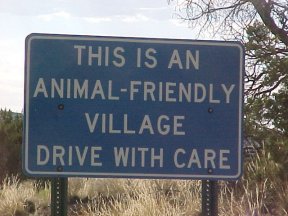
animalfriendly2

It’s true, we’re an animal friendly village.

We tend to get along reasonably well with the neighbor dogs running loose, with the coyotes that encourage the neighbors to bring their dogs in nights, with the snakes, spiders, roadrunners, lamas, even the occasional bobcat or bear.

True also, we occasionally kill one of the above when it makes enough of a nuisance of itself.  But there’s not spite, no satisfaction in doing it.

But all that’s not to say we’re a ‘friendly’ community in other ways.  We’re not.  The old land-grant families hate the developers, the real estate interests, the residue from the times when this area was peppered with hippie communes, and newcomers.  Our Catholics don’t care for the Presbyterians, the only other church in town.  And the Presbyterians driving around in their Volvos and BMWs with NO WAR IN IRAQ, or SAVE THE WHALES bumper stickers would like the place a lot better if opinions were less robust concerning the gentle matters dear to them.

They tend to suffer such indignities as having their front doors egged when they post anything suggesting the current war’s not what they had in mind for the nation.  My next door neighbor had a definite look of hurt when she removed hers.  But she has a name for those who do such things.  “Anglo-hating a**h*les!” is a moniker I’ve heard her use on occasion.

In earlier times they weren’t so friendly to animals, but they got along better with one another because they were all alike.  Same ethnic background, same religion, same generation after generation of first cousins married one another.

Unfortunately, the Apaches kept killing down their numbers and forcing them to abandon the place for a few decades.

Up the hill from here about 3-4 miles is where the earliest residents lived.  A place called Sandia Man cave.  Those folks lived here about 10-12K years ago, and were a lot less animal friendly.  There’s cause to believe they might have killed off the last mastodon in New Mexico, even.  They lived there at a time called the Folsum/Midland era… A time when the mega fauna were coming into short supply because of the Clovis era ancestors of these guys, who had a fierce appetite for saber-tooth tiger and elephant meat.

The only mastodon bones ever found in a Folsum/Midland site were in the Sandia Man cave.  They got the last ‘un, and they did it in a fairly patriotic manner.  The orchards and vineyards here do a lot better without a lot of mega fauna wandering around forever knocking down adobe houses and fences.

Sometime I’ll show you some pictures of the Sandia Man cave, some of his tools I’ve found around, and maybe tell you some more about him.

Jack

Ask Old Jules: Life 20 years from now, The Source of freedom, Not feeling intelligent, Changes in 2012, Discussing existence

Harper, TX 2010 152

Old Jules, what do you think the world will be like in 20 years time?

Bic lighters and pocket-knives will be coveted, high-tech barter items.

Old Jules, what is the source of freedom?

Solitude

Old Jules, I don’t feel intelligent. How can I fix this?

You might begin by differentiating the way you allow words to guide your intellect. Intelligence is not feeling. Feeling intelligent isn’t possible. Feelings are emotions and thoughts are thoughts. Getting a feeling your classmates take pride in their comprehension is not the same phenomenon as thinking your classmates take pride etc. I’d offer the suggestion you’d think yourself more intelligent if you distinguish clearly in your own mind the difference between feelings and thoughts.

Old Jules, what’s your opinion on the changes 2012 will bring?

I think we have some tough times coming down the pike worldwide. I don’t think it has anything to do with 2012 unless the Coincidence Coordinators just happen to be working overtime on an irony project. Things have been weird for a longish while and the Economics 101 course I took 50 years ago has already proved itself badly flawed squared and cubed, so I’m probably wrong anyway.

Old Jules, who’s up for a rousing discussion about existence?

The problem with discussions about existence is finding a common platform of rhetoric where there’s unanimity of acceptance of some basic premises to serve as a lowest common denominator. Okay, so we all accept thus-and-so and we can go from there to explore all the nuances and possibly arrive at some higher level of premises also involving consensus. No such platform of consensus exists. The reason is that while we’re all confined to the incoming data of our five senses, we each assign different levels of reliability and importance to the types of arriving data and we’ve each a unique set of methods of processing the data once it’s filed and prioritized. A huge chunk of everything each of us believes we know isn’t from direct sensory input observation, but rather from reports of others regarding their observations and the conclusions they reached, then handed down through chains of other reporters who interpreted, prioritized and massaged it all based on their own internal systems. It seems to me the only way to come to any personal conclusion about existence, the meaning and possible purpose of it is to directly observe, look for hints, corner-of-the-eye pieces of evidence we’ve overlooked because they’ve always been there, the hide-behinds of reality. One of those, rarely mentioned, is that everything in this reality we occupy has to sit on the carcass of something else to survive. A harsh, savage reality. An amazingly co-dependent maze. Another is the fact that human life involves a series of interchangeable quests, or our perception of it becomes meaningless and despair reigns. But no sooner does one quest end than another stumbling block appears before us. I surmise that challenge has something to do with the meaning of life. Then there’s the matter of time, lightspeed, brain function, and the limits of sensory input forcing everything into the past. But this has grown lengthy and nobody’s likely to read it anyway. Makes no difference even if they do. Good luck in your quest.

Make my day, stranger!

Jack wrote this in October, 2005:

I don’t know when we began giving power to strangers. I think it’s a relatively recent phenomenon. Maybe we watched too many Westerns during our formative years, learned from those steely eyed men in saloons that what strangers think about us is worth a gunfight.

Nowadays the extreme version happens in city traffic. Someone shoots someone else a bird. Next step is an exchange of gunfire.

Here’s how the scenario runs:

Some complete stranger pronounces a bias we don’t share.

Our thought response:

“This offends me.”

That thought process is driven by a deeper one:

“I want to be offended. I give this stranger the power to offend me. I assign enough value to what this stranger says, or believes, to allow it to trigger a negative emotional path within me. What this stranger says or believes matters.”

We know better.

Strangers cut too wide a swath in their traits to have any real value. They span the breadth of potential human biases. But even knowing this we give them the power to ruin a moment.

I say this is a recent phenomenon because humans of the past behaved differently. Our forefathers didn’t care what Brits thought about us because they recognized that Brits live within an entirely different set of interests.

Even today a Zuni doesn’t care what a Navajo thinks about anything because from the perspective of a Zuni, Navajos don’t have anything valid to contribute to any meaningful discussion. Navajos live in a different reality from Zunis.

Both Navajos and Zunis choose to allow themselves to be offended by the opinions of Anglos and Hispanics, but there’s a reason. They’ve found taking offense is a means of gaining power over those groups.

But neither a Zuni, nor a Navajo would bother being offended by the thoughts and words of the other because to each there’s nothing the other might think that carries the weight of validity.

Not long ago the same was true of people almost everywhere. The people in the town where I was reared cared about the opinions of people within that town, but they couldn’t have cared less what the people in Clovis, twenty miles away thought. It was generally understood that Clovis people were stupid and might think and say anything.

Today we care what everyone thinks about almost everything. We pretend to believe what they think carries value, but we know better. We just like the feel of being offended..

Make my day, Stranger! I’m handing you the power to offend me.

This leaves me cold.

Human opinion hasn’t held up well under scrutiny. It’s worth about what it costs. Mine aren’t that reliable and I haven’t found those of others to be any better.

Jack

That hurricane in the Gulf of Mexico

Jack wrote this in August, 2005:

I see on one of the threads that another major hurricane’s stalking around in the Gulf of Mexico …. threatening New Orleans at the moment.  Brings to mind a lot of strange memories.

One of my careers of this lifetime was spent as State Floodplain Manager for New Mexico… wore another hat with it toward the end, Emergency Management Coordinator with a bit of disaster preparedness thrown in.  I was paid on annual grants to the State by the Federal Emergency Management Agency.  Spent a lot of time off in Emmitsburg, MD, New Orleans, Galveston, Oklahoma City, etc.

I suppose the thing that impressed me most during those years was how thoroughly we’ve boxed ourselves in with regards to natural disasters.  The Gulf Coast filled with people, then pumped out all the petroleum from underneath, so’s to cause the entire region to subside beneath the waves, if not kept out by the intervention of man.  The last time I looked the San Jacinto Monument was threatened.  From the top of that spire you could look around and see nothing but submerged streets that used to be high and dry.

In riverine areas the erosion of banks is undercutting whole neighborhoods inland along rivers almost everywhere if they have any flow.  In California, they’ve built so heavily in wildfire, mudslide and earthquake areas that every tremor assures an enormous amount of damage.

And on and on.

During those sessions at the National Emergency Management Training Center, Emmitsburg, MD, guys in the same job I was in from all the States gathered a week or two at a time.  Evenings we used to sing an old Kingston Trio song:

THE KINGSTON TRIO  – “The Merry Minuet”


(Sheldon Harnick)

They’re rioting in Africa.
They’re starving in Spain.
There’s hurricanes in Florida
And Texas needs rain.
The whole world is festering with unhappy souls.
The French hate the Germans.
The Germans hate the Poles.
Italians hate Yugoslavs.
South Africans hate the Dutch
And I don’t like anybody very much!
But we can be tranquil and thankful and proud
For man’s been endowed with a mushroom shaped cloud.
And we know for certain that some lovely day
Someone will set the spark off
And we will all be blown away.

They’re rioting in Africa.
There’s strife in Iran.
What nature doesn’t do to us
Will be done by our fellow man.

I suppose that just about says it all, except nature doesn’t do it, precisely.  We do it to ourselves.  We build in subsidence areas, riverine flooding areas, earthquake areas, coastal hurricane areas, mudslide and wildfire areas, and we feel fairly put out when it floods, shakes, slides, burns.

But there’s always the president to declare it a disaster, throw in a river of taxpayer money so we can build again in the same location.

Until next time.

Jack

The tribal struggle for the moral high-ground

Jack wrote this in February, 2005:

Morning blogsters:

I was reading a feed on one of the Native American blogs this morning.  The story was about Hopi runners joining the run to Mexico City to draw attention to environmental matters, particularly water.  Other tribal runners from the SW US will also be joining.

After reading the feed I walked out to my front porch to savor the new dawn across the Rio Grande Valley.   Cold, beautiful morning.  A blessing.

I can see across the tribal lands of the Zia, the Santa Ana, the Santo Domingo, and a bit of Sandia Rez, along with that owned by whites and the US government.  Probably some of the promontories jutting up are on Jemez tribal lands.

All that land is in the grip of a sustained drought lasting several years.  The lowest common denominator in moisture for the ability of soil to support life in a normally desert clime has been reached.  Over the past five years we’ve averaged five inches of moisture per year, as opposed to the normal nine inches.

Plant life is dying back, soil eroding by wind.  When the rains do come the water will channelize quickly and the arroyos will widen and deepen even more…. the land will be carried away to accumulate in the basins and raise the surface flooding in the rivers.

But on the Santa Ana tribal lands there’s a spot of green.  The huge Santa Ana resort complex, Casino, golf-course is ten miles from here, but the green is visible by the naked eye.  Every day a cloud forms over the complex that can be seen from here, sprayers pumping precious water from the ground, spraying it into the sky to water the golf-course and the lawns.

I’m glad the Hopi, the Din’e, the Mescalero will participate in the run to Mexico to help whites become more aware of water.  The environmental destruction caused by over-grazing on Navajo lands over 150 years of their stewardship is so severe it might never recover.  Erosion from the Navajo Rez carries siltation into the Zuni lands, filling the channel and causing flooding.  Today.

There’s no moral high-ground here.  Whites and Native Americans are acting in concert to destroy this land we love.  We’re doing it out of greed and short-sightedness.

Maybe during that long run to Mexico the realization will dawn among some of them.  No one but the tribes can do anything to change things on the Rez where the environment’s concerned.  If the tribes want to act as a conscience for America on environmental issues (and we desparately need one) it can’t be accomplished from a promontory of hypocrisy.

In the end, we all have to look inside what we are, what we have, and what we CAN change for any change to occur.

Jack