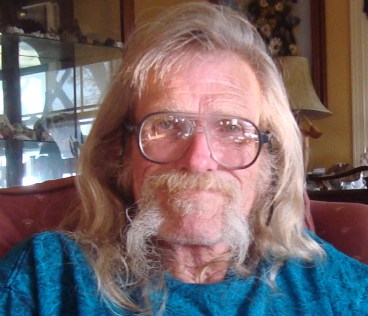
End of Summer- 1965 (unpublished poem)

End of Summer

Autumn, harlot of the year
wanders past September shadows;
a coarse crisp whisper;
her breath, a steel blue wind kiss
on eyelid and cheek;
her touch a harvest moon lips
on forehead
her bare chill feet rustling
leaf carpet
as she creeps in to be my bedpartner.

Jack Purcell

Quid pro quo maybe

Jack wrote this in July, 2006:

I was in here working on the numbers when I heard Tabby talking through her nose thumping the screen door.  Went for a look and she had a mouth full of young finch.

I took it away from her.  Didn’t appear to be too badly injured, but was in that catatonic-I-ain’t-waking-up-to-die thing birds do, so I cupped it in my hands and shot some healing and calm into it.

About five minutes of that and the heartbeat was strong, it began to stir and do a bit of minor struggling.

So I took it over and put it on top of the trash barrel to see if it could fly.  It did.  Flew to the porch where Tabby was sitting, watching.

In less time than it takes to tell it she had it again.  This time there’s no question of me taking away from her again.  Meal time.

So, Mr. Bald Eagle.  Come in and get me, coppers.

J

The Rez – “Where commodity cheese rules!”

Jack wrote this in October, 2006:

I was browsing Native American forums, blogs and websites, reading about white racism.  One NA has a signature mentioning the Navajo Rez, “where commodity cheese rules!”

Don’t get me wrong.  The NAs on those sites weren’t complaining about all the privileges they get that non-Native Americans don’t.

But the accusations and complaints about racism in this government and among non-Natives got me thinking on the subject.

Racism manifests itself in a lot of ways.  Including patronizing, providing special privilege and freebies for no explainable reason.

I had to conclude, after thinking on it a while, they are absolutely right.  I can’t fathom any other explanation than racism for the commodity cheese, health care, tax-free land, and all the rest:

  • Do you (and your government) believe Native Americans are stupid?
  • Do you believe after more than a century of generations being schooled the same as your own children, that Native Americans are more ignorant than non-Native children when they come to the legal age of maturity.
  • Do you believe they are lazy and irresponsible?

I’ll bet you answered no on all counts.

Okay.

So think about it.

Why are you providing Native Americans free commodities you have to pay for?

Why, exactly, do you believe Native Americans can’t get jobs, same as you do, to pay for their own food?

Why do you provide them roads and schools on the reservations with your tax money, when you have to also pay for the roads and schools in your own communities?

Why, exactly, do you believe Native Americans can’t pay taxes to build schools for their children and roads in their communities with their taxes the same as you do? 

Why do you believe they shouldn’t pay property taxes on their lands, same as you do?

You have to worry, try to find health insurance, pay for dentists, plan and save, give up other things so you can assure when you or your kids get sick there’s a doctor, a hospital.  Braces for their teeth, dentists to drill the cavities.

Why do you believe Native Americans can’t provide for their own health and dental care, same as you do?  Save, sacrifice, plan.  Same as you have to do in your own life?

The reason is obvious enough.

You are a racist.

Somewhere inside yourself you believe Native Americans are more ignorant than you, less intelligent, less responsible, shiftless. 

You believe they are a bunch of lazy drunks and can’t work, can’t plan, can’t take responsibility for their own lives.

No matter how much you pad it with sensitivity and phony warmth, with sentimentality and fantasies about how sweetly they love the land, with excuses about how badly men who have been dead centuries treated other long-dead men, the bottom line is you believe they can’t make it the same way you do. 

If you didn’t believe they were all those things, you’d scream to high heavenInstead, you hug yourselves with good feelings about all that’s being done for the NAs.  Give yourselves warm huggies.

And they hate you for it.

Nobody loves a racist.

Jack

Some thoughts about that 700 mile fence

Jack wrote this in October, 2006:

I keep hearing about the multi-billion dollar 700 mile fence debate, despite myself.  At first I thought it was a silly idea, doomed to just be a way of pouring a lot of money into the pockets of contractors using cheap Mexican labor.

But on second thought, if approached properly, I think it might be a boon, an improvement in the lives of a lot of people.

Consider this.  Suppose, instead of hiring contractors to build that fence and spending all that money, we use labor from our fullsome prisons.

Each day we send, say, a couple of thousand prisoners down to the International Border with a suitcase full of clothes, a pair of running shoes, hammers, shovels, and a hundred or so bucks to buy refreshments while they work.

For each group of a hundred or so, a guard.  A guard hired from one of the sheriff departments.  You know the sort.  The kind who would consider it a cramping imposition to squeeze another person into the front seat of a full-sized automobile with him.

The fence might take a while being built, but it would pay for itself many times over.

For every illegal alien crossing northward for honest work, hundreds of prostitutes, gang-raped-to-death 20 year-olds who got caught with an ounce of weed, wife beaters, child molesters, gangsters, robbers, and politicians-caught-with-a-hand-in-the-till would probably escape to the south.

They’d have all their fences behind them.  Those prisons in the US would empty, the cost of maintaining them would vanish.

All those folk who used to be prison guards would have to go back to selling dope to school kids, doing stickups at convenience stores, and eventually they, too, would have their day in the sun.

I like it.

A win-win-win is rarely seen in this life.

Jack

Avatar Meyer Baba

3.22.03 and back ups 095JackCDbackupJune03 173

Avatar Meyer Baba

Desert sun
Creosote
Yucca
And oven wind

Who were you
And what happened?

In 1969 someone built
A shrine in the desert
A shrine for you

Maintained it for many years
Fresh palm leaves inside
In the alter area
I believed so long
Was an urn
For your ashes
I thought

Fresh paint on the shrine
The sign kept your picture
There, safe

Desert sun
Creosote
Yucca
And oven wind

Chain link fence
Around an acre or three
Set up with water
Electricity
Sewer
Connections
So the world could
Come to you here

A world that never came

Desert sun
Creosote
Yucca
And oven wind

I watched the keepers
Grow old
And never saw them

Watched the paint crack
The palm leaves
Gradually became
Less frequent
Until they ceased

Replaced
In favor of
Easier plant life

Desert sun
Creosote
Yucca
And oven wind

And knew

Those who remembered
Were stooping
Under the weight
Of years

Desert sun
Creosote
Yucca
And oven wind

Revisited after a pause
Three years ago
And found the names
Scratched away
Bernal Rubias
Reyda Fresna
Maybe

Your picture
Torn from the sign
Deleted
By vandals
Or

Desert sun
Creosote
Yucca
And oven wind

“I am the ancient
And I come
To Redeem
The modern
World”

A world that never came
But
Desert sun
Creosote
Yucca
And oven wind


From Poems of the New Old West by Jack Purcell, copyright 2003
(This shrine can be seen in Columbus, New Mexico)

Ask Old Jules: Space travel, Wounded Knee, Memory of Universe, Development of America

Harper, TX 2010 123

Old Jules, suppose you had your own private spacecraft capable of interstellar flight.  So you travel to a distant world that you suspect is populated.
You see cities and towns, and  there groups at war.  In other areas there is nothing but plant life. You want to explore, so where would you land?

I’d try to find a safe place to land on each of the warring sides, try to establish communications, and explain to them they need to quit fighting because there’s a race of human beings back where I came from. Explain that once I get back and report they’re here, likely or not there’ll be human beings who aren’t much good at anything but killing, who’ll be coming along ecstatic to know there’s something new they can kill.

I’d pass on all the human weapons, defense,  and strategy I was privy to so’s to give them half a chance. Let them know they need to batten down the hatches, quit fighting, get together and figure out what kind of weaponry they’re going to need to fight off a species of lunatic savages.

 Old Jules, why did historians refer to Wounded Knee as a “battle” and what does this say about the ways in which we should evaluate historical accounts?

Calling it a battle was a means of legitimatizing what happened, a way to imply it wasn’t what it was. It says we should take a careful critical, unbiased and analytical look at all historical events. Particularly watching for nuance, implications, propagandizing and what goes unsaid.

Old Jules, has the universe any kind of memory?

Yes. The universe has both a long-term memory and a short-term memory.

The long-term memory is used to keep track of how the expansion is coming along, doing the occasional reality check, etc.

The short-term memory is used to track specific projects, such as Sol (our star) reversing magnetic poles every eleven years, that sort of thing.

Old Jules, how long did it take America to develop after its independence?

Development in the US lasted until after WWII, when the Marshall Plan began the gradual decline by rebuilding industry in Japan and Germany, creating the beginnings of US industry being unable to compete.

The slide downhill gained speed when US industrialists began selling technology and outsourcing for products produced in the Third World as a means of lowering prices through cheap labor.

Today development inside the US has pretty well halted except within a few narrow areas. Almost everything a US citizen uses in daily life is manufactured or produced outside US boundaries except for some food.

Old Jules, what is worth knowing and what would you rather not know?

It’s worth knowing that we don’t actually know anything. Then it’s worth knowing that again every time we think we know something.

The International 700-Yard Fence Olympics


We’re missing a good bet here.

How about this?

Instead of a worthless, meaningless, ineffective and costly 700 mile fence, suppose we build the same fence 700 yards long, with bleachers, ticket booths for spectators.

Anyone who wishes to compete can do so, but only after having signed away all television and media rights.

Anyone who can cross the fence, or go around the end of it carrying whatever he wants to take with him is assured a hassle-free life in the country of his choice, only having to earn an honest living there.

The starter gun fires.  All down the line Chinamen who want to go to Hong Kong or Australia, Russian and Filipino women who want to find husbands in the US, gunrunners from the US with backpacks full of machine guns who want to go to more exciting places, starving Africans, pot-bellied from malnutrition, flies swarming over them, ribs showing, who want to go somewhere, anywhere out of the sun where there’s food…. Bang! goes the starter pistol.

The competitors run, walk, crawl to the fence, examine it, and decide whether to cut through, go over, go around.  Same as they’d have done if it were 700 miles long.

The way things are going in this land, I think there might come a day when a lot of American citizens are down there, televisions packed up on their backs, pizzas and hamburgers in their lunchkits, crouched on the starting line waiting for the pistol.

I might be there myself.  A cage full of angry cats on my back, trying for some deserted island somewhere.

Jack

Relax, breathe deeply, pause

Jack wrote this in August, 2005, after Hurricane Katrina. The main post is followed by two additional entries or comments that he made afterwards.

I’ve posted this on one of the threads, but it needs to be said more than once, a lot more often than once:

Disasters bring out the best and the worst in people, in Americans.  It’s going to do that during this one.

For a while yet everything that can be done is being done in the disaster area by the people who are trained to do it, hired to do it, have volunteered to do it.  We all want to help somehow.  There’s nothing at the moment we can do except give our hopes and best wishes to the people who are there, either as victims or trying to do their jobs.

For the moment providing shelter, food, water, medication and waste disposal facilities for both victims and disaster workers is going to be the primary goal.  An infrastructure exists and is moving into place as inexorably as the hurricane moved in from the gulf.  It will take time, but it’s happening and will continue to happen.

Giving money ‘for hurricane victims’ for the moment is a bit like giving money to the schools by buying lottery tickets.  Some tiny percentage of it will reach victims, while most will be sucked up into the administrative structures of the organizations making their bread and butter off human misery.

There’s not a shortage of money for dealing with the initial phases of this disaster.  The US taxpayer has payed dearly for a long time and will pay a lot more now to handle this disaster and the aftermath.  The funds are there, and they’ll be replenished by taxpayers, supplemented by taxpayers.

We all want to help, but at the moment there’s nothing we can do with the exception of offering shelter, those of us near enough, to refugees in our own homes.  That would be a boon and a blessing.  But we’ll find not many Americans once they consider it, want to help THAT badly.  Sometimes they’ll make new friends, and sometimes they’ll lose the guns and the silverware.

Once things settle a bit and the needs are actually established in a week or three there’ll be plenty of places Americans who still remember there was a disaster can provide some assistance.  If they listen carefully they’ll learn of thousands of smaller, sometimes more difficult matters spinning off this event, sometimes involving more personal sacrifice than a dollar or two thrown into the storm.  Americans who still want to help after the emotional storm of the television blitz dies and football’s got their attention will have plenty of opportunities to do so.

But this isn’t the time.

If you want to give money, it stands the best chance of getting to the actual victims if you do it through your churches, as opposed to the relief organizations.  The pipeline’s not so long and there aren’t so many salaries and offices in between your hand and the broken domiciles you thought you were aiming your money toward.

Storms begin ‘way back, the poet said.  This one did, they all do.  Those levies have been a long time  on the road to failing, the flooding didn’t happen today…. it happened during all the years we’ve all known it was going to happen and didn’t do what was needed to prevent it.

Today is the storm and the debris.  Let the debris settle a bit before you respond to the internal scream that says you need to do something for these victims.  Human charity is too rare and valuable to be squandered by drowning it in a pool of flood water.

The television crews are doing their jobs, exciting your best emotions, your sympathy, twanging your heartstrings.  Let them do it.  Savor it.  Sympathize with those victims.  Pray for them.  But don’t do anything fast, rash, to satisfy your need for instant gratification.  Hold on to that desire to help and consider long about how you can make it count.

Jack

An afterthought, also posted on a thread:

Tough gig being a human being.

In 1993, I was in New Orleans as part of a FEMA conference with all the regional State Flood Plain Administrators and Emergency Management Coordinators involving this potential storm and others like it.

We toured the levies, discussed the problems with subsidence, kicked around ideas with the LA State Coordinator about possibilities for his disaster response plan. His problems were much as I described in a blog entry a day or so before the storm came in.

A few months from now, a year or two from now and he’ll have those same problems again after the dust settles on this one. Louisiana and New Orleans will figure it will be at least a decade before this happens again, so it will be business as usual. “We’ll take care of mitigation when the possibilities get higher for the next storm. Right now we have too many other priorities for our tax dollars.”

The victims of this disaster, it’s important to remember, a couple of weeks ago would have agreed completely with that logic.

Tough gig being a human being.

More from that thread:

Four4me commented: “And the worst part is hurricanes season isn’t over and hurricanes have a habit of following the same paths sometimes.”

Says I: That ought to be cause for a lot of concern.

It would be awfully bad if another comes in behind this one to the same area. But it might actually better to have the damage concentrated, rather than have the next one (if one comes in) hit Galveston, the FL Keys, the outer banks in the Carolinas…. further scattering resources.

It would be a tough call if someone had the choice to make it, how to direct the next storm.

I expect you’re right that rebuilding will be unimaginably expensive and take a long time, if ever. But this isn’t the first storm that’s ever hit, and our history of response has always been the same. Rebuild. Do it where it was before. As much like before as possible. And repeat the errors of the past.

We’ll pour a lot of new deficit Federal dollars into getting those folks back into homes that can be flooded again. The legions of disaster assistance program workers are already packing their bags to get down there, assess the damage, hand out deficit dollars for what’s been lost, damaged, what can be rebuilt.

I’m not complaining, if this sounds as though I am. I’m not. I’m making an observation based on a number of years of experience and a lot of years of reflection.

Mitigation is the key to all this, and mitigation requires commitment by people, planners, elected officials, taxpayers, to mitigate. To think ahead of catastrophes.

It requires people to sacrifice the joy of living in floodprone, or other disaster prone areas and live in places less prone.

It requires that somewhere somehow sometime Americans take responsibility for making decisions about their own safety and well-being a long time in advance…. when they’re building their homes, starting their businesses, discussing whether they ought to have a crash kit in the closet to throw in the car when a storm’s coming in, and to head for high ground.

But we’re a long way from all that, and we won’t be any closer when the dust settles on this storm.

Jack

The challenge of quietude

Jack wrote this in October, 2006:

Things could seem fairly grim to almost anyone trying to stumble through this new century.  Somebody always walking into a schoolhouse with a gun, someone always bombing someone else, shooting someone else.

  • A cop probably feels things are middling dangerous for cops, feels things have gotten out of hand, feels threatened.
  • Store employees fearing their bosses, merchants fearing their employees, all of them fearing the dangerous potential of every customer.
  • Politicians fearing the opposing party, fearing the voters, fearing the prez.
  • Gangbangers fearing opposing gangbangers, fearing the cops, fearing their brother-gang-members knowing they’ll sell them out for a plea-bargain in a minute if faced with a long-term sentence.
  • Druggies fearing the dealers, fearing the cops, fearing the high-cost of a habit, fearing other druggies, fearing their families, fearing do-gooder mammas and sisters, angry wives who might give them to the cops ‘for their own good’ after a long series of attempts to kick that didn’t work.
  • Christians fearing Muslims, Muslims fearing Christians, everyone fearing what the price-sign above the gas-pump’s going to show the day after the November election.
  • Single women fearing they’ll grow old without a man, married people fearing they’ll lose their partners to disease, to war, to accidents, to infidelity, to abuse.
  • Everyone fearing for the kids, for their safety, their increasingly brainless approaches to reality, for their futures.
  • Everyone watching the television screen, everyone shaking his head with the latest thing happened somewhere.

We’re in one of those niches in human history during which mass-hysteria prevails.  An erosion of faith, a lapse of memory as a result of the bombardment of news submerging the mass-consciousness into the goldfish bowl of NOW.

The reality is that things aren’t worse now than they’ve ever been. 

Death still comes one-to-the-customer.

Kids, cops, gangbangers, birds, whales, baby seals, druggies, Christians, Muslims, every living creature is going to cross the finish line, same as they always have.

People aren’t killing one another more frequently than they’ve ever done.  They’re doing it about the same amount as they always have.  Killing and stomping one another, enslaving one another, robbing one another, invading one another.

Life’s a tough gig if we forget we’re going to die.  It always has been.

The challenge to man has always been putting himself above all that.  The courage to accept he/she will die, the kids will die, their kids will die.

The challenge is in the courage of acceptance, of distancing the self from the daily events creating the illusion death is somehow foreign, unnatural.  Tragic.

The challenge lies in living in the knowledge we’re going to die while behaving as though we aren’t.  In the courage to transcend the inevitability and allow ourselves to understand those other folks, the kid-killers, the gangbangers, the druggies, the cops, the government goons, the Christians and Muslims, the sheeple, all of them are just the same as us.  All stumbling around trying to get through this life.

The challenge lies in forgiving them for forgetting, forgiving ourselves for forgetting we’re going to die and submerging ourselves in fear and brother hate.

The challenge lies in transcending the forgiveness enough to be grateful for the moments, every one of them, between the crying and the dying.  Grateful for the pain, the hardship, the loss, and the spiritual growth potential.

The challenge of acceptance that it ain’t all flowers and honey, never  has been, never was supposed to be.  That this life isn’t about what happens across the ocean, in Washington, in the crack-house down the block, or in the next bedroom where the kids are sleeping.

This life is about this side of the ocean, this city, this block, this house, this bedroom, right there where you are sleeping.

The impression you are making in that mattress, that pillow is where the minutes are ticking away, that’s where opportunities to become something better are located somewhere in a flash of life and time that’s ticking, ticking ticking trickling sand into the bottom of the glass.

The courage to repudiate the mind-games of others.

Others shouting to you that where someone else dies matters.  Others demanding you pretend you won’t have to die, if you hire more cops, hand more of your personal decision-making over to the government, watch more television, put more people in prison, send the army off to stomp bad guys somewhere.

Ignoring the cowards whispering if you avoid different ingredients in your food, buy the latest health miracle and don’t breath second-hand smoke you won’t have to die.

That’s the challenge.  Same as it’s always been.

Jack

Eternal Wisdom Of Young Writers

From Poems of the New Old West, by Jack Purcell, copyright 2003:

Eternal Wisdom of Young Writers

Some things can be depended on
Some things never change
Flies still swarm around
The ripe carcass of a horse

English departments
Still deride
Robert Frost
Entirely ignoring now
Sandburg;
Edgar A Guest
(Carl and Eddie
Didn’t make the cut)
Not even
Remembered well enough
To enjoy the scorn
Of these
(How demeaning!)
Those two
Dead ‘poets
Of the people’

Pointee headed
Working-on-my-novelists
And unpublished poets.
Repudiate the works
Of their unpublished peers
By calling it ‘Frostian’
Do they?
They do.

How it tingles
How it rings
Familiar
After all these years

Old Robert
Old king Robert
Old published poet
Laureate Robert
The Frostiest
Of the
Frostians
Would have smiled

And written a poem