Category Archives: Adventure

Doctor Jonas

Jack wrote this in December, 2005. I’m adding the next post he made to the end of this one, and there is another one about this encounter tomorrow.

Hi blogsters:

The town of Truth or Consequences installed a Vietnam Memorial Wall in 1982.  A replica of the Wall in Washington, D.C., in a city part a mile off IH25.  It’s a good stopping place for stretching your legs, munching a sandwich and pondering as a break on the long drive between El Paso and Albuquerque.

Today I pulled in there figuring to do a hamburger and the stretch routine.  Down at the other end was a beat up brown Econoline van with POW MIA stickers on it and a painted sign along the top:  RAINBOW CHRISTIAN MINISTRIES.

Beside the van cooking something on a Coleman stove on legs was a guy I haven’t seen in a long while.  Doctor Jonas.  He looked up when I got out of the truck and we waved at one another from a hundred yards, then he went on cooking while I strolled leisurely along the wall, as I’m prone to do.

“Life good, brother Jack?”  As I neared him, from about 30 yards.  Jonas, I observed, was still wearing old BDUs and more hair than any man needs.  He had the look of a man with an odor, though I can’t say I noticed one about him.

“Still good, Jonas.”  He turned down the stove and took a few steps in my direction, arms extended.  “We don’t hug, Jonas.”  I held out a hand for shaking, instead (in lieu of the hug).  “How’s the preaching business?”

“Get’s tougher all the time.”

We wandered back toward the van and he turned the stove back up.

Jonas is usually known as Doctor Jonas.  He carries the Christian gospel to the street people, speed freaks, street prostitutes in Albuquerque.  His foot in the door with them is that he uses skills acquired during two tours as a combat medic in Vietnam to provide them with unofficial medical care.

Jonas is something of an institution.  He funds his ministry by bringing prescription anti-biotics, anti-inflamatories and whatnot up from Mexico and selling them to illegal aliens in Albuquerque.  That, and selling a bit of jade on the side keeps him preaching and ministering to people who need it as badly as anyone in the US can need it.

As we talked I heard a moan from inside the van.  I shot a questioning glance at Jonas and he just shrugged.  “Junkie having a try at withdrawal.  I brought him down to Caballo where I thought I could keep a better eye on him, but the Park Pigs were getting too nosy.”

Another of Jonas’s services.  He serves as a nursemaid and guardian angel for people going through withdrawal from hard drugs.  I never saw the guy in the truck, but he moaned on and off all the time we were near enough to the van to hear him.

We talked a bit longer and I had an, “I wish I’d said that” experience before I left, which I’ll relate to you maybe in the next entry.

Jack

A bit more Jonas

I’m going to save the “I wish I’d said that” portion of today’s Jonas encounter for tomorrow, but I’ve re-read the anecdote below and I feel I need to broaden the brush stroke on him a bit.

Jonas isn’t an easy man to be around.  It’s impossible not to have an almost breathless respect for him, but difficult to like him as a personality.  He must be near my age, and the years are telling on him, but he has an almost obnoxious youthful enthusiasm, a robustness and exuberance that’s not easy to take.

As I mentioned, the appendage above his torso is hair in every direction with a grinning set of somewhat snaggled, yellowing teeth and a pair of eyes peering out.

His clothing, BDU fatigues with cargo pockets, are worn and give the impression of not being clean, though I suspect they actually are.  His appearance causes the viewer to expect him to stink, which he doesn’t.

Jonas is definitely a gentle soul, maybe a wise one, but his demeanor speaks of a puppy foolishness.

However, having said all that, I’ll say again, you can’t know him, or know of him, without feeling a humility and respect entirely out of proportion to the human being in front of you.

I’d say the non-Christian religions are lucky there aren’t more Christians of the Jonas variety.  He’s one of the handful of Christians I’ve met in my entire lifetime who behaves as though he actually believes in Jesus Christ.

Jack.

An added comment:

Someone PMed me expressing the concern that some cop-type of the ‘other’ Christian variety would pick up on the description I’ve given of Jonas and his activities that fall outside the US definitions of legality.

I probably should have prefaced one of these two entries with the caveat: Jonas ain’t his real name, Rainbow isn’t the name of the ministry that’s on his van, and brown isn’t the color.

Having said that, I should also say that the law enforcement community is well aware of Jonas and his activities. They’ve done everything they could think of to make his life difficult for the last quarter-century, or more. He’s been busted more times than I’ve eaten at McDonalds. Which is to say, it doesn’t happen any more often than either of us can help it, but it occasionally does.

But you can’t stop a man who knows he’s right and keeps coming. Even in America.

Jack

Ask Old Jules: Bad genes, Tolerance of the religious, Looking in the mirror, Nature of happiness

Harper, TX 2010 123

Old Jules, what are your favorite words?

Spontaneity has a nice ring to it

Old Jules, are all the mistakes, vices, injustices and sufferings of the world due to bad genes?

Human beings are just human beings. Same as they’ve always been. They don’t know how to be anything different. Don’t expect anything more from them and you won’t be in for a letdown.

Old Jules, how can I be more tolerant of religious people?

What they believe [or anyone else believes] isn’t your affair. Unless they ask what you think or get in your face leave them the hell alone. It isn’t your business. Learning what isn’t your business is how you learn to be tolerant.

Old Jules, how often do you look into the mirror?

Once every week or two. When I’m going to town I try to remember to look in the mirror to see how badly my whiskers have built up so’s to decide whether to shave before meeting my admiring public.

Old Jules, is happiness a blessing or a conquest?

Both. If a person can say to himself/herself in all candor and honesty, “If I were someone else I’d envy me my life and what I am,” the person is probably both happy and has conquered a piece of what needs conquering in life. And frankly, if I had to be someone else I’d be gawdawful jealous of me.

McCarthy RIP

Jack wrote this December 13, 2005:

Old Eugene’s passed over to the other side.  Could have put a stop to the Vietnam War back in ’68 if the country’d had the ability to see into a few years of future.  He was the reason Johnson resigned from the ’68 presidential campaign.

Nope, we ain’t talking Charlie McCarthy, the guy modern politicans and most politically sophisticated and involved Americans do their best to imitate.  The prototype for radio talk show hosts.  He died some while back when his buddy Edgar Bergan died.

Nope, we ain’t talking Joseph “Tailgunner Joe” McCarthy, who headed the House UnAmerican activities committee and started the Commie Behind Every Tree fad that led us into Vietnam, Bay of Pigs, you name it.  Not him.

No, we ain’t talking Douglas MacArthur here.  He’s been out of the biz for a while.  Never was heard much of after Harry Truman fired him over his determination to lay a radioactive cobalt belt a thousand miles wide across Manchuria to keep invaders from getting into North Korea unless they came from the south, as Japan did in the past.

Just old Eugene McCarthy.  A politico who never got to be a hero prez.  Wrong attitude.  He didn’t want to get us into any wars, or keep us in them.  He wanted to get us out of one before we lost a lot more men.

RIP

Jack

Update on Jack’s books, new link

Hi everyone,
I got the second volume of Jack’s blog posts finished, and it’s available on Lulu.com now. There are four books listed there, his poetry book, the book about the Lost Adams Diggings, and these two from the blog posts. Take a look!

This second volume also includes Desert Emergency Survival Basics (also linked in the “Survival Book” header on this blog) which has never been in print before.
I might be out of town for a bit (and offline) the first part of May but later I’ll be continuing with more volumes.

Thanks for being loyal readers!
Jeanne

Justice by body count

Jack wrote this in December, 2005:

I don’t care to argue with konane on her own blog, but I feel compelled to make a few observations about the assertions contained in her entries.

First, any war worth being fought is worth whatever sacrifices Americans have to make to fight it.  Every one of us ought to measure the worth of any war by whether we’re willing to die in it.  Willing to lose an arm or a leg in it.  Willing to lose a son or a daughter in it.

The fact we aren’t, mostly, being asked to make those sacrifices because they’re being made by others doesn’t change the basic premise.  If we aren’t willing to lose a son over a particular cause or piece of geography, we ought not be asking others to do so.

Konane is fond of calling the other half of the US, the ones she opposes because they don’t support this war, cowards.  Democrats.  The loyal opposition.  Cowards.  Traitors.  Because they disagree with her.

I’m not a Democrat, nor a Republican.  Not even a self-proclaimed Libertarian.  But I’ve served in the forces supposedly defending this country, been downrange from machine-gun and rifle fire directed at me in the cause of defending this country (even though the shots were fired by US troops, whom those around me and I were firing at).  I have a problem with being called a coward or a traitor by people who have never served this country in any armed forces capacity because I oppose this war.  It’s not a thing I’d allow any person to do to my face, and I have a profound disrespect for anyone who’d do it behind the safety of distance and anonymity.

Here’s a proposal to end this idiot conflict in a way that should satisfy those who support it:

Suppose an American life is worth, say, two of human beings anywhere else.  Okay.

How about when twice as many civilians in non-Christian nations have died under US firepower  as died in 9/11, how about then we call it an even trade and bring the troops home?

Fair?

Then you can bring them home today.

Okay, how about three for one?

You can still bring them home today.

The arrogance of Americans who aren’t risking their lives, limbs or offspring calling other Americans traitors and cowards because they oppose a war that has not been declared by the US Congress is absurd.

Human life is sacred.  It’s sacred enough to justify civil debate.  Sacred enough to worry about civilians being killed in other geography.  Sacred enough to tolerate opposition to any undeclared war in a supposedly free land of civilized people.

Severed limbs and human carcasses cause grief to those who bear them, to those who are dear to them.  It’s not an exclusively American phenomenon.  Neither is a callous willingness to create more of them just because it makes the ones back home feel good.  But the folks who measure the sanctity of human life over politics aren’t necessarily traitors and cowards.  They might be something else entirely.

Jack

Day of the Lost Souls


Copyright©2003 Jack Purcell

Sky mariners in some other reality probably navigate as old mariners here sounded the nighttime and foggy channel bottoms sampling with buckets to fix their positions by mud color, or sand, or shells. They’d examine the debris in buckets and ponder; arid southwest: almost turquoise. Inland California: grey-blue. Coastal: yellow hazy blue. But that was forty years ago. Maybe the atmosphere has grayed during these decades, the way my own mustache, eyebrows and hair has shifted to bare metal silver.

1964, blue on blue, I tunneled through tints and shades of airy void from the New Mexico desert to arrive in San Francisco several hours ahead of my outbound rendezvous. The old DC3 clubbed the air dizzy and crawled over the unconscious body getting me to the coast. Those blunt wings hammered the molecules of blue air into solid ice to hold man and machine aloft and skim across the bumpy surface.

But we were young in that country. The November 9, 1964, San Francisco Airport Terminal teemed with Peace Corps Volunteers. We milled around the gate awaiting our flight to Hawaii.

Ten more days and I’d be a full 21, a legal man. Full of mature, critical appraisal I skulked the waiting area; studied the rosy cheeks and sunny attitudes; the strapping young adults I knew I’d spend the next piece of my life among. Though some were older than me they were mostly kids.

I watched those youngsters straight-on for a while until they noticed. Then I shifted and gazed covertly at the reflections from the plate glass window/wall of our capsule. Those windows were all that separated us from the din of steel-gray planes and scorching ash-gray runways. Silent planes vanished into the heat waves and hazy yellow blue skies.

I pretended to read my book and scrutinized my soon-to-be-companions out of the corners of my eyes; strained to hear the dribble of their conversations which each seemed to say, “I’m a neat person. I’m worthy of this.” Some, I could surmise, tacitly agreed to allow certain others to be as neat as them.

We were elite, the acceptance letter assured us. Only one of every forty applicants, the letter whispered, were accepted for the intensive preparation to save the poor in hungry backward lands. We were all riding on the bobsled thrill of those flattering words. The resulting fast pulse beat of waiting in the terminal became a political caucus. Probably most of us figured those others were likely to be special, but secretly believed the Peace Corps made a mistake in letting our particular selves in.

The candidates talked films; of Viradiana, of Antonioni, of Fellini and of a Swede who made foreign films in those days. Of Existentialism. Talked about the beatnik poets. All so serious. What’s your major? Where did you get your degree? I pondered the words, scowling to myself.

I could see these mostly weren’t my kind of folks. I’d scraped and cheated to get a high school diploma several years earlier, did three years in the US Army. Hitch-hiked across the country several times, been in jail more than once. Sweated under a blazing sky in dozens of hellish jobs that didn’t carry any prestige in these circles of toy-people. Now we were going off to India to teach the natives how to raise chickens. Bouncing off through rainbow skies bearing the weight of the white man’s burden to teach a culture older than our God how to raise poultry. But we were young in that country,

I felt uncomfortable in my snazzy dark suit with narrow lapels. My only suit. It was the leading edge of fashion when I bought it for $20 a couple of years earlier in Boston. The pencil thin blue tie with gold flecks felt awful on my neck, and worse as I became conscious of the width of ties the others were wearing.

As the morning wore into early afternoon more of the India X Peace Corps trainees filtered into the waiting area from incoming flights, draining the rest of the country of heroes. I hung around alone and tried to guess which of the waiting passengers were trainees, and which were just transients.

I gazed at the women who were obvious volunteers, wondering whether any Peace Corps taboos would stand between me and female companionship during the next few months. I idly checked out the prospects. Most didn’t bear up under a lot of scrutiny. Rules of training could make for a long dry spell, and the fraternity boys were already busy staking out their campsites among the curly haired Goldiloxes of the crew.

Eventually, I noticed a lean, freckle-faced red-headed Irish looking chap hanging around watching, same as I was. He wasn’t mingling with the other selectees much, and he appeared gangling and awkward. I smiled to myself, musing, probably feeling superior. Just as I felt somehow superior to all these fresh-scrubbed college folks off to slum among the huddled masses. Labor, I learned, was his name. Rex Labor. At that moment I watched, listened to, and studied a future friend for life for the first time.

A lady schoolmarm, strangely vacant blue-eyed, lanky, ruddy faced and scarlet haired, from Virginia caught my focus. I heard her tell someone she was an English teacher. Lillie Rogers. Lillie Belle Rogers, I learned later. No raving beauty, but a touch of class, presence, bearing. Straight and tall. I sensed an underlying tinge of bitterness in her manner.

Sometime later it came to mind, a female counterpart to Labor. I didn’t sense that Lillie Belle would be the lady of this group I’d come to know best. I’d have rejected that notion, then. Lillie Belle Rogers. A long, sensuous neck ahead of Nancy Philson and Priscilla Thomas in a dead heat. Women I wouldn’t have picked for myself that day in the San Francisco airport. But in a few weeks, the training gave everyone a chance to show their mettle. Or their fluff. For those three and a few others, it was bare stainless-steel.

The flight to Oahu was long…..I was seated next to a tough blonde named Georgia Grover…..nice humor, vaguely pretty, and I began laying what I hoped was groundwork for later. Foundations for things to come but never came.

When we arrived on the islands I was already feeling a rising alienation from the group. I didn’t like a lot of folks in those days, and I could tell I wasn’t going to like most of these. The chaos leaving the main terminal created visible stress among the Chosen. We had half a mile or so to walk to the Hawaiian Airlines Terminal and the next jump to the big island. No transportation from one terminal to the other for the bags. An early test.

Husky young college gents struggled with their own bags and staggered in macho competition to help the attractive ladies. Mr. and Mrs. Eebie, the elderly retired couple of the group shuffled along behind with the jaded males and less attractive females. The girly girls and ex-twirlers chattered across the tarmac admiring the white man and his burden. Georgia Grover shrugged away the offers of help and shouldered her own bags. Most likely, Lillie Rogers, Priscilla Thomas, and Nancy Philson never had the offer.

Time passed quickly during the next weeks. Four hours a day devoted to language lessons. We built chicken house made from lava rock passed down hand to hand; chopped sugarcane in the fields for the thatched roof. Downed palm trees and built a walking bridge. The remainder of our days were spent in formal exercise, poultry disease classes, and getting inoculations against the diseases of the distant east. I came to know the other trainees, and them, me. I found a few worthy of respect.

Somehow we found time to frolic in blue green waters under the blue white waterfall of Rainbow Falls. We climbed the nearby cliffs and gazed into the discharge spray below the falls. And late one afternoon I found myself with Lillie whispering from a cradle of limbs in a huge banyan tree near the falls; lips brushing ear and neck to be heard above the cascading clamor of falling water. Forms and futures swirled in clouds studied through a break in the green umbrella.

Competition was a strong component of the training. A thin-line between competition and popularity. We were advised on arrival that most of us wouldn’t make the final grade. We’d be expected to excel but we’d be subject to constant scrutiny and weeding by the staff and in the end we’d also be rated by our peers. They wanted ‘team-players’. Roughly half of us wouldn’t make it.

One afternoon in a distance run I found myself beside the redhead, Rex. We outdistanced the whole crowd on a ten mile run, came in long before the others. Found we weren’t appreciated for our efforts. Evidently the run was intended to be something of a fellowship, team thing. Labor and I didn’t hear the message. The whole affair on the big island was a distance run, and Rex and I were neck and neck for last place.

That night, Rex and I went into Hilo and had a few beers, exchanged a few dreams, disappointments, and observations about the place and the people. We were young in that country.

Mid-selection was coming in that beautiful land, and before it arrived, I was fairly certain I would be one of the deselectees. I was also fairly certain Labor would be. Neither of us fit in. We were different, even from the others I thought would be deselected. By that time we’d been through the Minnesota Multi-phased Personality Test. The rumor was you couldn’t even lie consistently on that one, except they could sniff you out, flush you like quail in the cool dawn. I knew I was doomed.

The morning before selection time the staff added the final horror. Humiliation and forced betrayal. The peer ratings. We’d been warned and knew they were coming but they still came hard.

Question: Here is a list of your fellow trainees. Top to bottom, list the people you consider most equipped for the task of Peace Corpsman, down to least favorable. Top to bottom, which do you like the most. Down to whom you like the least. And so on. Sell your young souls, trainees; young Americans. We won’t accept the papers back until you’ve listed them all, every white space above a black line filled with a name of someone you’ve spent the last two months learning to admire or scorn.

I was angry as I watched 80 eyes probe the room checking names against faces. I worked out my own strategy, locked eyes, whenever I could. I reversed the list they wanted. Picked the weakest and least liked for my Ajax and Penelope. Threw the leaders to the dogs. With my own name at the pinnacle, of course. But I knew the exercise was futile.

Even so, I was crushed when my name came out on the list of get-outs. I didn’t notice how the others reacted, and I don’t remember much about the time between the boot and the airplane. I do know that somewhere in there, I decided I wasn’t going back to the mainland. Somewhere during that time Rex made a similar decision.

The rain was falling sideways when we got off the plane in Honolulu. Big Joe Weiss, Korean War marine was with us on the plane to Oahu. He listened to our dreams and talked quietly of staying in the islands with us. He was as crushed as I was about being given the shove. But in the terminal building, he couldn’t look at either of us as he told us he was going on to the mainland. I could see that big Joe was limping inside, hurting. Maybe worse than I was, with all my bravado.

Rex and I had a notion about catching a sailing boat, heading for Australia or New Zealand. We had a couple of hundred bucks each, guts, energy, and no promises to keep. We’d signed on for a two year stint in Injia, and Injia belched us back. We were a bolus flying out the mouth of someone who’s just had the Heimlich performed unexpectedly during an aborted dying incident.

We spent a few precious bucks on a taxicab…..told the driver we wanted the cheapest hotel he knew of. It was the Huna Hotel, he took us to. Twelve bucks a night. But we were young in that country.

The rain continued through the night, and we emerged from the room still full of energy and bravado….we were taking big steps, making deep tracks in our future lives…..we thought we were about to make big tracks on the land, as well.

We picked up a newspaper looking for boarding houses……Rex found one belonging to a Japanese lady named Matsushige….he wrote down the address as I looked over his shoulder….wrote on the classified page of the newspaper…..2323 East Manoa Road.

We took a city bus, carrying our bags, our belongings from the dead Peace Corps experience, and got off at the confluence of East Manoa and Manoa Road. The driver pointed a direction for us. But at 2323, our knock was answered by a man who appeared to be dressed in a pair of WWII Japanese uniform trousers. He curtly explained that he didn’t know what the hell we wanted, didn’t want to know. Didn’t appreciate our disturbing his home, his morning.

We walked to Manoa and looked….nothing made any sense.

So, we found a pay phone and Rex called the number from earlier…..wrote 2319 on the newspaper. Hung up the phone, turned puzzled from the booth. “Twenty-twee twenty twee?” I still burst out in laughter every time I think of that incident four decades later. I can still see him turning puzzled from the booth muttering, “Twenty-twee twenty-twee?”

We settled in at Matsushige’s that day, a second floor room with two bunks, 4 feet or so apart, parallel, a desk between the two at the head. Shared the john with some other roomers….settled in young, full of bravado, full of dreams.

Next day we went looking for work. Rex took a newspaper and headed down to check out the openings on Waikiki…..I headed for the bars on Hotel Street looking for a job or a hooker to prime me for my job search. Tomorrow I’d go down to Waikiki to find my busboy job at the Hilton Hawaiian Village. Today I had more pressing matters.

In a while, I came to a booth with a pretty gypsy lady; flirted a bit, talked around the issue. Was certain she was a hooker. Finally, she demanded, “You want a gypsy good-time?”

“Yeah! A gypsy good-time!”

She took me into an attached room with nothing but a cot, sat me down. “$10″….she took my money and assured she’d be back in a moment. I sat there and knew when she brought in a snaggle-toothed crone that I’d just lost a sawbuck for another of my lessons in life.

“Here it is! A gypsy goodtime!” She and the crone danced back and forth in front of me, all of us laughing. My life has been rich in gypsy good-times. I’ve been a man wealthy in gypsy good-times, but that one was best. A gypsy-good time when the coconuts fell beside us and mangos piled high under the trees blocking the sidewalks where Rex and I grumbled in our cots picking off sunburned skin to throw to the giant roaches. We were young in that country.

We stayed in touch with a few of the trainees still on the big island. Lillie and I wrote and sometimes talked by phone. We made plans to meet in Oahu after final selection whether she went on to India or not. Nancy Philson and Priscilla Thomas came through a few days ahead, voluntarily dropped from the group. An evening of drunken revelry on hotel street and they were off to the future.

I met Lillie at the airport with the other triumphant survivors. Chianti, baby gouda cheese, and a rented jeep, and we made long and easy love on the beaches in sight of Chinamans Hat, Hanuama Bay, the Blowhole, toward the end, pounding surf spraying the moonlight. Her red hair tickled my face as we idled the jeep down the inland spine of Oahu, back to Honolulu.

Next night, the gin mills of Honolulu and Hotel Street. Lillie’d never seen a stripper….I took her to a place I’d been a few nights previously with Nancy and Priscilla. The best I’d ever seen, her veils of blue velvet, blue chiffon.

They boarded the plane, and India X was off to save the world from hunger, from savage restraints, from a historic dearth of fowl in their diets. Off to Gujarat.

In a while, I flew back to the big island and went into the jungle off the Kohala range, thinking to become a hermit, thinking to die there. While I was gone Rex met a Japanese Hawaiian girl named Janice and flew back to the mainland with her.

In six weeks I came out of the jungle, in a maelstrom of roiling grey blue clouds. I’d met myself for the first time. I finally had seen myself; also seen God in that quiet forest. I knew I had more to do.

Years later while he was in the Marine Corps Rex’s kids came to be among my favorite children….Janice, an object of my deep respect. From a distance I watched those kids and admired Rex and Janice as parents and friends. Their marriage gasped to an end before the 20th century finished wiggling.

Today Rex’s in Seattle, trying to find what he should do with his life. Searching for the greatest gypsy good-time of them all. And I wait for the moment I’ll return to the woods as I did so many years ago beneath a savage sky in some country of youth and springtime. Give me, Powers of the Universe, the springtime but spare me the youth.

Copyright©2003 Jack Purcell

It’s here! Volume One, that is…

First volume of several

I finally got volume one, posts from 2005, ready for purchase (print-on-demand) on Lulu.com, so wanted to show you a few pictures and say a few things about the book.
First of all, if you’ve been reading along here, you’ve noticed that I add “Jack wrote this in 2005” (or whenever) at the top of each post. I decided to publish these volumes in a sort of chronological order (by month) so the posts in this particular volume will be familiar to you since they were posted here most recently. Same with the next volume, which is 2006… those posts came from previous blogs, but you’ve seen them over the last two years. You’ll even see some that aren’t yet posted, as I scheduled those in advance through the end of this year.

Title Page
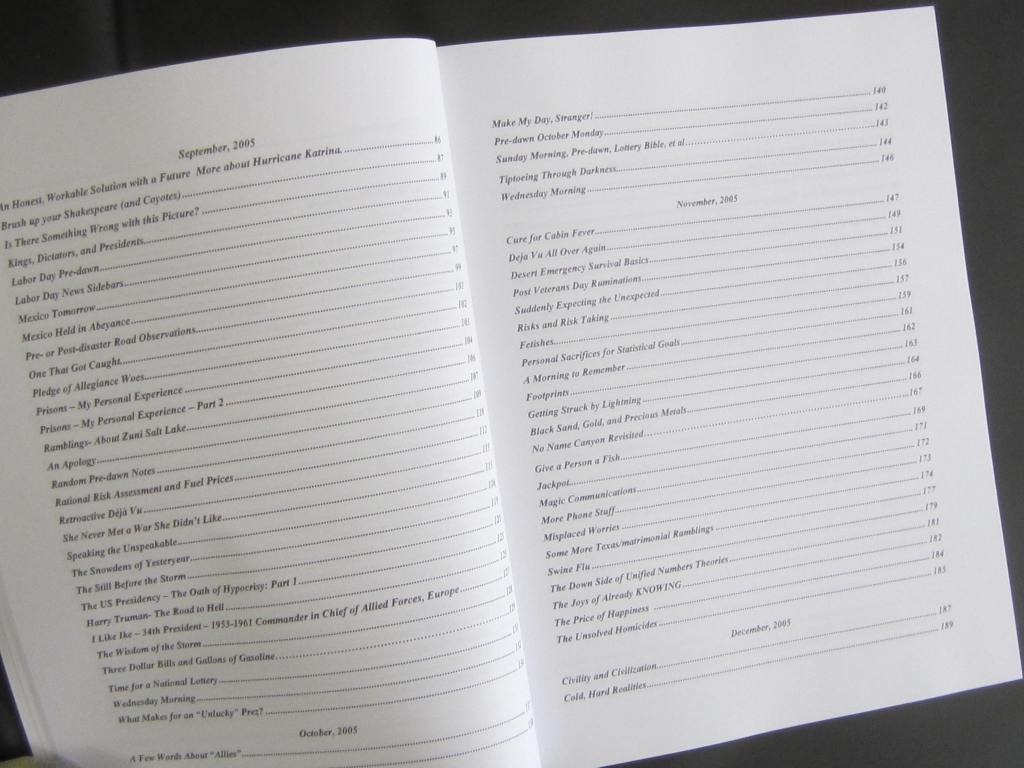
Table of Contents
Table of Contents Page 2
Table of Contents Page 3
Back Cover

The completed book is 216 pages. There are a few photos, but I tried to keep the costs down by removing those that weren’t relevant to the text. I also tried to keep costs down by choosing the paperback format.

2006 is almost ready as well! I’ll give you an official announcement when I’ve made a few corrections.

I’ve gone over all the material I have from the blogs, and I estimate four more volumes if I keep them around the same length. Keeping track of formatting gets very complicated with a longer book so this is for my own convenience. But I might also do a book of “Ask Old Jules” posts, which are not included here. Jack answered thousands of questions when he was on that Q&A site, so there’s a lot to sort on those.

Marketing is not my forte, so except for posting updates here and on Jack’s Facebook page as the books become available, I won’t be trying to make my fortune over these. Feel free to share the link if you’d like. I appreciate all of you. https://www.lulu.com/en/us/shop/jack-purcell-and-jeanne-kasten/so-far-from-heaven/paperback/product-m96j8d.html?page=1&pageSize=4
Jeanne

Civility and civilization

Jack wrote this in December, 2005:

Hi blogsters:

Taking a breather here and got to thinking about something that happened a few years ago that’s worth relating.

During the post-Y2K financial challenges I substitute taught in the public schools for a while.

Those situations often leave the sub in front of a bunch of kids without any obvious means of spending the time.  The regular teach didn’t know he was going to get into a car wreck or have a terrible hangover, so there’s no agenda.

One week I found myself in front of several days of classes of high school seniors.  Rather than let them use it for a study hall, I decided to get them talking about what they believe in.  Try to get them into a mode of defining it and possibly thinking in ways they hadn’t done so before.

One of the days was spent talking about civilization.  What it is.  What are the characteristics of a civilization, as opposed to merely a complex society.

From the beginning, every classroom full of kids believed a society couldn’t call itself a civilization if it condoned slavery within it.  They continued believing that (after some discussion) even after I pointed out the fact the US allowed slavery until a century and a half ago.

It was a strange sensation, watching those kids absorb, then adopt the realization that by their own definitions the US couldn’t possibly have been a civilization until the end of the Civil War.  But they were universally adamant in that regard after thinking about it.  Even after I pointed out further that slavery existed almost all over the world in one form or another until fairly recently in history….REALLY recently.

But once they’d decided there couldn’t be civilization without civility defined as a respect for the freedom of the individual, they hung tight on it.  Those kids decided human beings weren’t civilized anywhere until ‘way after a lot of civilizations (by other definitions) had risen and fallen.

Smarter kids, those, than I figured on them being.  And perfectly willing to stick by their guns on something they believed in.

Another thing they were adamant about as a prerequisite for civilization was a respect by the government and the citizenry, for human life.  A wisdom and determination that whims wouldn’t rule when it came to robbing individuals of their freedom.  That criminal statutes wouldn’t be jailing people, or killing people this week for behavior that would be legal a year from now.  (We talked about prohibition and the aftermath.  There were booze runners who were jailed during prohibition who weren’t released from prison until 20 years after the repeal of the Amendment).

That town we were in had three prisons.  Two for men and one for women.  Prisons were the main source of employment.  Those kids knew a lot about prisons.  They probably knew more than most adults in the US about what happens in penal institutions because they heard about it from family members who were employed in them.

Because of that, probably, they believed unanimously that prison is a serious matter that we aren’t handling in a way that reflects a respect for human life, for law, for individual freedom, for humanity.  They believed without much argument that we shouldn’t be imprisoning people for victimless crimes.

The bulk of the prisoners in the women prison are there for drug possession and prostitution.  Those youngsters believed in their hearts there ought to be a better means of dealing with such matters in a civilized society.

It took them longer, but these kids absolutely believed, following a lot of debate, that due process is the foundation of civilization.  They believed wars without due process were criminal, that they were the antithesis of civilization because they failed to respect human life enough to follow their own prescriptions and procedures.  They believed killing, mayhem are serious matters worthy of reflection, debate, and a profound respect for doing things thoughtfully and exactly according to law.  They believed failure to do so is a symptom of a society withdrawing from the condition we call ‘civilization’.

Thanks to that experience, I believe there’s a lot of hope for this country, once those kids get control of the political processes.  They had a lot more potential wisdom than most adults I’ve encountered in past years.

Jack

Ask Old Jules: Failures of society, Does luck exist, Places to talk about important things, Cloning of extinct animals, Getting rid of emotions

3.22.03 and back ups 1098

Old Jules, in which ways do many in society “grow up the wrong way” or are badly influenced? And why is this?

Rites of Passage got lost in the dust of history. In the past when a young man or woman reached the local age of adulthood a group of older folk took them apart and filled them in of a series of community standards summed up: 1] Here’s what is expected of you, 2] Here are some things you’ll encounter and you won’t necessarily understand, but here’s a set of guidelines we’ve found to work well enough to establish as rules. Behave within these guidelines and you’ll be okay. 3] Time you got out of your parents keeping and started carrying your own weight.

Old Jules, is there such thing as luck?

There’s something that walks, talks and acts a lot like the lady who mustn’t be named. It’s the reason gamblers of the gambling persuasion are among the most superstitious [which is to say, they acknowledge a piece of the human experience, the universe, and unseen strings being pulled as a matter of faith] people on the planet. The range of taboos in the air over a racetrack or a casino block of table games isn’t the product of casual gamblers. It’s the result of the observations of people who’ve spent enough of their lives watching cards fall and horses stumble to swallow their pride and treat the subject with conspicuous respect.

Old Jules, are there any places in real life where people talk about things that have substance to them?

Interesting question. Back in the day there were places where young people gathered and talked about things we believed had substance. Coffee klatches at university union buildings, Greenwich Village Coffee Houses [mid-1960s]. I’m guessing today if I had to be a fly on the wall I’d consider it fairly lightweight stuff, but back then it seemed weighty. We all took ourselves fairly seriously. A singing duet of the time actually did a song about the phenomenon I found a bit amusing years later. Loved it when it came out and thought it was hefty stuff. Perspectives change. (Simon & Garfunkel – The Dangling Conversation)

Old Jules, scientists are using cloning to bring back extinct animals. What’s your opinion?

When scientists apply science to create technologies they aren’t functioning as scientists. They’re functioning as engineers. Engineers will attempt to apply any capability science uncovers, whatever it might be. Engineering is single-minded, focused on intent. Weighing anything other than cost/benefit doesn’t come into consideration. If it can be done and if there’s money to be made from it, it will be done. I’m personally a lot more concerned about genetic engineering of feed and food grain crops than I am about animal cloning. Monsanto’s already got pollen from GE grain products drifting all over the planet on the winds. The engineered pollens don’t recognize boundaries, fences, human intentions or the desirability of maintaining the original species unchanged.

Old Jules, is it possible to rid myself of emotions?

The loyal opposition rears its ugly head. I disagree with the previous answerers insofar as the individual desirability of allowing emotion to play a large part in our lives unless we individually assess the issue and make conscious choices concerning it for our own lives. We can’t completely divest ourselves from emotion, but we can recognize it and insist on it staying in whatever corral we build for it. We can decide for ourselves the degree to which we allow ourselves to be herded around by anger, sadness, and boredom. We can relegate them to the passenger seat and not allow them access to the gas pedal, wheel, clutch or brakes.

A Strange Experience

Jack wrote this in March, 2005:

I consider everything that happens to be metaphysical, but if I didn’t I’m not certain I’d think this was.

I don’t often get into Albuquerque, but one weekday a friend had to pick up a rental car.  She asked me to take her into town to pick it up.  I dropped her off at the rental car place, hung around to make certain the car was ready, and crossed under the freeway, intending to get on the northbound ramp.  But I missed the turn.

It was summertime, hot in the truck, and I was feeling a bit weird.  I’m 62 years old and have had the occasional dizzy spell, so I drove along thinking I’d find a place to go inside for a cold drink and a breather.  I was feeling really strange and disoriented.  Even though I knew the area, I was uncertain exactly where I was.

I came to a major intersection with a fast food joint on it…. Der Weinerschnitzel… hadn’t noticed it before in the area, but any port in a storm, thinks I.  I parked and joined the line inside waiting to order.

The guy behind me, a gunzel looking fellow maybe 50, unexceptional in his looks, started talking to me while we waited.  He said some things, I don’t recall what about, that piqued my interest.  He was just passing through town, I know he said, had to pass some time.

I ordered a drink and sat down.  When he got his order he came and sat down near me and we continued talking across a couple of tables until he got up and brought his food over to my table.  Started talking about the lottery.  I didn’t have much interest in the lottery.  Bought a QP now and then, but otherwise it seemed a stupid waste of money.

The guy said he was a numerologist.  I pretended dumb on the subject, though I’d read a good bit about it.  Asked him a lot of questions, and his answers convinced me he was not only NOT a numerologist, but he didn’t know what a numerologist was.  I had him pegged for a BS artist.  But the conversation wasn’t costing anything and it was cool inside.  I sipped and listened.

He said he travels all the time, playing lotteries state to state, makes a circuit.  Said he makes his living that way.  “Yeah, right!” I thinks silently.  Said he studied the numbers constantly.

I plied him with a few questions for the sake of courtesy.  It didn’t take a lot to keep him talking.  The man was enthusiastic on the subject.  Got out a pen and started writing things down on a napkin, making charts, showing me a few of the ways the numbers behave.  Told me he’d been doing this for 12 years, never won a jackpot, but made a living off it anyway.  Said he’d figured it out all by himself, when I asked if there were any books on the subject.  I didn’t believe much about what he was saying, but I do believe in what Vonnegutt called, ‘dancing lessons from God’, …. letting unexpected experiences happen and riding along with them a while.

Anyway, the guy finished eating, left me with a handfull of napkins with drawings on them and a fairly vivid recollection of the conversation.  I left, too, and when I drove away I discovered I didn’t know precisely where I was, still.  I drove around a while until I saw a familiar cross street and headed home.

It was several months, those napkins sitting there wadded in view, before I got around to pulling up the lotteries and looking a bit to see whether there was anything to what I’d been told.  There was.  Just enough to get me looking at what the splinters he gave me implied.

Since then I’ve been spending 20 bucks a draw on the lotteries, usually PB.  10 tickets per draw, plus the multiplier.  I’m still exploring the possibilities implied by what he told me, working every draw to learn more.  But after about a year I’m not more than $50 down, probably closer to $30.  And learning more every draw, thinking of more new ways to look at those numbers and understand the patterns, what it all means.

Someone here says on every post that if you don’t win a jackpot you’re just paying to play.  For me, that’s been true so far, though at times I’ve been $100 or so up, other times almost that much down.  But it seems to me he’s coming awfully close to being wrong.

I’d surely like to know who that guy was I met at Der Weinerschnitzel.

Jack