Category Archives: Adventure

Hurling Off Splinters and Chunks of our Lives Into the Parker Spiral

Good morning readers.  Thanks for coming by for a read this morning.  Old Sol jumped when I said “Frog!” a little while ago, so you can rest easy knowing I’ve got him headed for the horizon, rate of climb indicator showing him right on schedule.  I’m figuring his ETA’s going to be about what you’re expecting.

Back when I was a wealthy man [measured in how much time I figured was left between me and exiting the vehicle] I used to spend a lot more time and energy begging and cajoling Old Sol to behave himself.  I put up with all his yawning and complaining, because I had a lot of life I was needing to get rid of and that seemed as good a way to slough it off as anything else.

Not just that way, either.  I was fat with life, spent it like a drunken sailor hurling chunks and splinters of it off every which way, losing weight gradually until I was more comfortable carrying what was left of it around in earth gravity.  I’ve got a lot more of my life spinning around in the Parker Spiral not knowing whether it’s Abel or Mable or which way’s up than I have left around here to tip my hat to.

What’s left is comparable to trying to squeeze groceries, gasoline, cat food and necessaries into a monthly Social Security pension check, so I tend to be more conscious about what I spend it on than I used to do.  It ain’t as though there’s any of it I can afford to run off downstream without me having had a look at it.

So, once I’ve reminded Old Sol he’s got important people waiting on him, I try to get on with my other business and let him tend his own affairs.  Lately he’s been grumpy about that, running the thermometer up over a hundred degrees F, but he’s going to have to get used to it. 

I ain’t got time for Old Sol’s games, not like I thought I did back when I was fat and wealthy.

Old Jules

The Electric Kool Aid Acid Test

Hi readers.  Thanks for coming by.

Maybe the reason I lured myself into allowing my hopes to include that 1977 C60 school bus was just a time warp slipped in briefly.  Fond memories have a way of coming back to haunt folks as they approach the jumping off place, I reckons.

A million years ago, Back Just Before Hippies Were Invented, summer, 1964, when KoolAid was just KoolAid and acid was still just something to excite a strip of litmus paper, I had my first experience driving a school bus.

As described in the post linked above, I’d gotten out of jail in Rochester, NY, walked halfway down Ohio, been picked up by a taxicab going deadhead back to Terre Haute, Indiana, after taking a drunken businessman to Columbus, OH, to see his estranged wife and kids.  He left me on a street corner in Terre Haute, where I dodged beer bottles thrown by kids the rest of the night.

Mid-morning a yellow school bus pulled across the intersection where I was standing, a car pulling a trailer pulling in behind it.  Loma Linda Academy painted on the side.  The door popped open and the driver yelled, “Do you know how to drive this thing?”

I had a middling amount of experience driving dump trucks and such when I was younger, and I was hungry enough for a ride to lie through my teeth.  “Sure thing.  Nothing to it!”  He vacated the driver seat, I took it, and we said goodbye to Terre Haute.

Turned out he was a Baptist minister moving his family to Las Vegas, New Mexico.  He’d contracted with the manufacturer to take the bus to Loma Linda, California, figuring he’d stack the seats in back, load up his belongings in the empty space, and get the hauling expenses paid for by delivering the bus.

Rick Riehardt was his name.  Young, 30ish man with a nice family.  One of several Baptist ministers I’ve met in my life I came to respect and was able to enjoy their company.  But a menace behind the steering wheel of a school bus.

The rear of the bus was loaded with his belongings, forward of that, loose seats stacked, with about half the seats still bolted to the floor, up front.  Rick had a five-gallon jug of KoolAid and a cooler loaded with Bologna sandwiches behind the driver seat.  He was “a loaf of bread and a pound of red” sort of man when it came to eating on the road.

We struck up a salubrious acquaintance as we motored along in that bus, picking up other hitch-hikers as we came to them.  Enough, at times, to fill the intact seats in the bus.  College kids, soldiers on leave or in transit, bums, beatniks, people who didn’t care to admit where they’d been, where they were going. 

One kid who’d just been down south working with SNCC and marching with emerging civil rights movement, marching, getting beat-hell-out-of by redneck sheriffs, getting treated like a stinking step-child by a lot of the blacks he was supporting.

The hitchers rotated on and off the bus as we drove southwest, Rick and my ownself being the only constants, me being the only driver.  We hadn’t gone far before Rick began cajoling me to drive the bus on to California after he’d unloaded it in Las Vegas, re-installed the seats, and he’d leave the family behind.  But I was headed for Portales, New Mexico.  Figured on getting off and heading south at Santa Rosa, well east of Las Vegas.

Eventually I agreed to it because I didn’t think there was a chance in hell he’d get the bus to California in one piece driving it himself.  That, and I was probably hallucinating on KoolAid and bologna sandwiches by that time.

We parted as friends, him offering to buy me a bus ticket back to Portales, me insisting I’d ride my thumb.  Caught a ride in Needles, CA, with four drunken US Marines in a new Mercury Station Wagon on 72 hour pass.  Headed for Colorado Springs.  All they wanted from me was for me to stay sober and awake watching for Arizona Highway Patrol airplanes.  Every time I dozed they’d catch me at it and threaten to put me back afoot.

We made it from Needles, CA, to Albuquerque alive, about 1100 miles in 12 hours.  I was ready for a rest.  Crawled into a culvert and slept until I had my head back on straight enough to stick out my thumb again.

Rick and I used to exchange post cards for a decade or so, but I lost track of him somewhere back there.  Never lost track of the KoolAid and bologna, though.  I still keep it around in my head in case I ever need it.

Old Jules

A worthy read. J

The Kitchen's Garden

Yesterday as I walked about in the heat with my hose making sure animals had water to stand in and cold water in their troughs I began to wonder about how much water I was  using. How much water is needed to run a sustainable, organic farmy.

So I did a little research.

Daisy (milking dairy cow) will consume between 30 and 40 gallons of water a day.  It takes 4 gallons of water to make 1 gallon of milk. She produces over 7 gallons a day.

Queenie  (beef heifer) will drink 15 – 20 gallons a day.  The steer will drink the same. It takes 3 gallons of water to produce one hamburger pattie. Though pound by pound chicken takes massively less water than beef. Hmm.  The chickens will drink about a pint each a day.

Mama (a lactating ewe) will drink 2-3 gallons a day and the other…

View original post 696 more words

Massacre Canyon – Long After the Dust Settled

Hi readers.  I might have once thought I knew what a massacre was, but time’s eroded my perspective.  During the mid-1990s I made the toughest backpacking trip of my life to spend 8-9 days in there to try for a better understanding of the subject.

Here’s the basic story of the events leading to it being named, “Massacre Canyon”:

http://www.livestockweekly.com/papers/97/07/03/3bowser.html

RETIRED GENERAL Michael Cody served in a somewhat more modern army than the men he and others honored recently at Massacre Canyon in New Mexico, but Cody’s army still traces its history to the men who helped open the West. A student of the era and the area, Cody has an affinity for and an understanding of the men who fought on both sides of the conflict more than a century ago.

Massacre In Las Animas Canyon
Led To End Of Apache Victorio

By David Bowser

HILLSBORO, N.M. — Indian legend maintains that rain at a funeral means the gods are weeping over the death of a great man.

Black clouds boil up over the Black Range Mountains as Michael Cody, a retired U.S. Army general, addresses a gathering along Animas Creek. Soldiers and spectators traveled to this clearing to dedicate a headstone honoring those who fought in Massacre Canyon more than a century ago. Three Congressional Medals of Honor were awarded in that clash Sept. 18, 1879, between the buffalo soldiers of the Ninth U.S. Cavalry and the Apache warriors of Victorio.

“The Battle of Las Animas Canyon did not begin on the 18th of September, 1879,” says Cody, who is working on several books concerning the era. “It had its beginning long before then.”

Until 1872, the Tchine, the Red Paint People of the Apache, made their home around Ojo Caliente in New Mexico.

Prior to 1872, there was a reservation at Ojo Caliente for the Tchine. By 1872, miners and ranchers had come, and the Apache were moved.

They were shifted from reservation to reservation until 1876, when Victorio and the rest of the Tchine left the reservation and went to Ojo Caliente. That winter, they surrendered and were taken to the Mescalero reservation near present-day Ruidoso. They stayed until August, 1878.

“Unable to stand it any longer, Victorio and his segundo, Nana, a 73 year-old man, took the entire Tchine nation, almost 600 people, and left the Mescalero reservation to go home to Ojo Caliente,” Cody says.

The Ninth United States Cavalry, the most decorated unit in the history of the United States Army, was responsible for the area. They were headquartered at Fort Bayard under Col. Edward Hatch.

“When Victorio left the reservation, he headed for Ojo Caliente,” Cody says. “When he got there, he found E Company of the Ninth United States Cavalry. It took Victorio about 10 minutes to turn E Company from cavalry to infantry. He killed about 11 people, eight troopers and three civilians, took 68 horses and mules, and headed out.”

Victorio moved south toward Silver City, New Mexico.

“He hit a couple of small ranchitos to get food, to get some ammunition,” Cody says. “Somewhere between Silver City and Kingston, he ran into a militia group made up of miners.”

Victorio’s band killed about 10 men, took another 50 horses and went down the Animas. Victorio had not lost a man.

Two of the 15 graves in this clearing are those of Navajo scouts who rode with the Ninth Cavalry.

“They were from the Sixth Cavalry, but detached to the Ninth,” Cody explains. “They picked up Victorio’s trail and the entire Ninth United States Cavalry went to the field.”

Second Lt. Robert Temple Emmet was on court martial duty in Santa Fe, N.M., when word came of the attack at Ojo Caliente. Emmet traveled 48 hours by stagecoach to Fort Bayard to rejoin his troops following Victorio down the Animas.

“There are several versions of what happened next,” Cody says. “The stories according to the Apache and in army records does not differ much.”

The First Battalion, commanded by Capt. Byron Dawson with Lt. Mathias Day and a Lt. H. Wright, came upon either an Indian woman down by the creek or a couple of Apache warriors who fired shots at the approaching soldiers.

Ignoring the Navajo scouts’ warnings not to follow, the cavalry chased the Indian woman — or the two warriors — across this clearing about a quarter mile and into what has become known as Massacre Canyon.

The canyon entrance is about 30 yards wide with spires of rock on either side. The trail makes an S-curve through the canyon with a rock outcropping that is about 16 yards wide and three yards deep.

“It’s flat as an arrow,” Cody says. “It’s a perfect place to put about 20 guys with rifles.”

The First Battalion, 25 men from Companies A and B of the Ninth Cavalry and perhaps 50 from Company E, remounted and came through the entrance in single file. With the 75 men well inside the canyon, Victorio opened fire.

Sixty-one Tchine lay along the ridgeline. There were 60 warriors and one woman, Nahdoste, the sister of Geronimo and Nana’s wife.

In the first volley of fire, 32 horses fell. The First Battalion was trapped.

The Second Battalion under the command of Capt. Charles Beyer with First Lt. William H. Hugo and Second Lt. Emmet heard the gunfire and came down the Animas.

As they approached Massacre Canyon, Victorio lifted his fire, let them get close, then opened up again. Victorio now had four companies of cavalry pinned down.

“All this started at 9 a.m. on 18 September 1879,” Cody says. “Victorio followed a classic method of warfare: kill the horses first, then kill the troopers at your leisure — a perfectly executed ambush.”

Late in the afternoon, Lt. Day with a small detachment attempted to break to the head of the canyon to climb up the steep slope and come back along the ridgeline to roll Victorio’s flank.

“As he got on the ridgeline,” Cody says, “the Apache held their fire until he was totally exposed, then opened fire on his flank. Day and his detachment were pinned down.”

Hugo and Emmet with a detachment outside the canyon attempted the same maneuver on Victorio’s other flank. They tried to come up a little canyon on the other side of the ridgeline, climb the massive slope and roll the Apache flank.

“The Apache let him in, then opened fire on his flank,” Cody says.

Now Hugo and Emmet were pinned down.

“By late in the afternoon, it was time to get out of there,” Cody says. “Troops on the valley floor were down to two or three rounds of ammunition per man. The order was given to withdraw. Lt. Day at the head of the canyon refused to obey. He had a man, one of his troopers, wounded on the ridgeline above him, and rather than obey the order, he climbed onto that ridgeline under fire to rescue his trooper. For this the commander of troops threatened him with court martial for refusal to obey his order to withdraw.”

Hugo and Emmet were also given the order to withdraw. They fired three volleys in an attempt to get the Apaches’ attention so the people on the valley floor could get out. It worked, but Emmet also refused to obey the order to withdraw.

“Five of his troopers, buffalo soldiers, were exposed on the ridgeline above him,” Cody says. “Rather than obey the order to withdraw, he climbed the ridgeline to get above those five, drawing fire, then laying down a base of fire so his men could escape. For this Lt. Robert Emmet was threatened with a court martial for refusal to obey an order.”

On the valley floor, Pvt. Freeland was wounded in the first volley. By late afternoon, he was in bad shape. He had taken a bullet through his thigh, breaking the bone.

First Sgt. John Denny, lying on the ridgeline about a quarter mile away, ran through the exposed rock-strewn area to pick up Pvt. Freeland, got him on his shoulders and ran back 400 yards, all under direct fire.

Day, Emmet and Denny were each awarded the Congressional Medal of Honor for their actions.

The field commander, Lt. Col. Nathan A.M. Dudley, who threatened both lieutenants with court martial for not withdrawing, was relieved by Major Albert P. Morrow.

Morrow and the Ninth Cavalry, working with the Tenth Cavalry, continued to chase Victorio.

“The 10th Cavalry blocked the water holes,” Cody says. “The Ninth followed the Apache. The Ninth kept the pressure on the Apache until October 1880 at Tres Cabrillos, when Col. Juaquin Terrazas of the Mexican cavalry got into the act.”

The Mexican government granted permission for the U.S. Army to follow Victorio into Mexico. Morrow’s scouts pinned Victorio down at Tres Cabrillos. Victorio had women, elders and children, and many wounded. They were out of food and ammunition. Morrow informed Col. Terrazas of his intention to surround Victorio and ask for his surrender.

At that, Terrazas withdrew the Mexican government’s permission for the U.S. Army to operate south of the border, insisting that Morrow return to the United States. The Ninth Cavalry wheeled and went back to U.S. soil.

Terrazas surrounded Victorio’s band and slaughtered them.

“It was an abject massacre,” Cody says. “He slaughtered them. He took about 100 women and younger children — not the real little ones — those they eviserated and smashed their skulls. The ones that were old enough, they kept for slaves.”

But Nana, now 75 years old, was out with Nahdoste and 14 warriors gathering provisions. Author Max Evans, whose book on Nana is to be published next year, claims that an Apache medicine woman, Lozen, was also with Nana. According to Evans, Lozen could sense approaching danger. If she had been with Victorio, Evans reasons, the band would have escaped.

“When they got back, they found this slaughter,” Cody says. “That was the beginning of the Nana vengence campaign.”

Every raid that Nana led from then on, he took no prisoners. Nana and his warriors burned and destroyed. Finally, they caught Col. Terrazas.

Nana and his band finally came in.

“When Nana did surrender, he was 76 years old,” Cody says. “They took him to the reservation in Oklahoma and he died there, but he died as an unrepentent hater of the Mexican people. It’s understandable. Honorable men fight for dishonorable causes, but that doesn’t take away from the fact that they are honorable. Nana was an extraordinary, historic figure.”

The services here were the result of seven years of work by Gene Ballinger, a historian and author; Cody and a number of others representing such groups as the Medal of Honor Society, The Buffalo Soldiers Society and other parties interested in preserving New Mexico history.

Twice during the services here on the F Cross Ranch of Jimmy Bason, rain splattered the soldiers and civilians gathered along the Animas.

That evening as most of the participants and spectators sat in their motel rooms in Truth or Consequences or at the S Bar X bar in Hillsboro, the clouds opened up in this rugged, arid land, washing the long-ago battlefield with a heavy mourning rain.

As you can see, it’s not easy to escape a lot of theatrical hand wringing and rhetorical horse manure carried along as baggage when it comes from some retired Army scud with the name Cody worn as a pair of crutches.  A dozen-or-two decades establishes fairly well what those soldiers died for in that canyon.

Even though there’s a USFS road [maintained by US taxpayer funding] leading in from the East, access to the site is denied by the owners of the giant ranch.  For you, me, and any Mescalero Apaches who’d like to see where their ancestors taught the US Army a few basics about ambush.

The only way in involves backpacking down from the Mimbres Divide.  Tough tough tough tough.

But worth every minute of it.  Every drop of sweat it takes to get there.

A person can still examine the pockmarks on the watermelon-sized rocks those soldiers were trying to squinch themselves down behind.  Can still pan spent, deformed rounds out of the canyon bottom.  See the inside of the mind of Victorio, where he placed his men, the landmark selected to commence firing when the troops passed it.

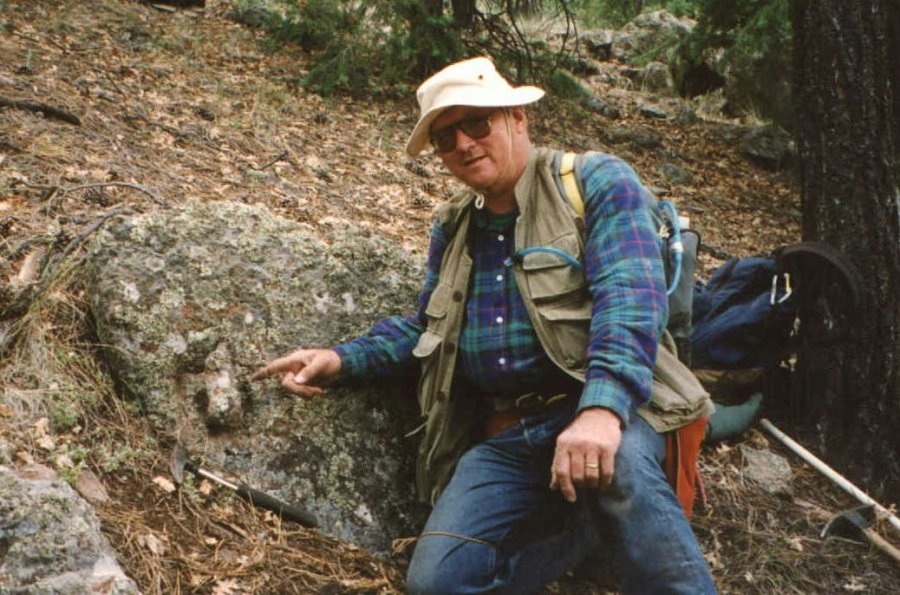
In those days guys like Cody and Gene Ballinger were already doing a lot of posturing and flag waving about the 12 unmarked graves on the plateau you can see in the picture toward the center.  Cody, Ballinger et al didn’t have to pack in.  The rancher to the East allowed them access by the Forest Road.

So during my eight days in there part of the way I passed the time was digging down a couple of feet below the surface various places in the canyon, plateau, and further up Animas Canyon, carefully gathering and placing rocks.  Creating enough other unmarked graves to make it difficult for them to go in and rob artifacts out of the actual graves.  Which I believed then and now, they were in the process of doing.

Old Jules

Divine Intervention – A Blossom Fell

Good morning readers.  Thanks for coming by for a read this morning.

I was relaxing in a camp chair just before dusk yesterday when the Coincidence C0ordinators gave me a nudge to remind me my priorities are too much anchored in the chicken, cabin, drainage issues recent past.  The bachelor roosters were loose for their afternoon free range and my attention was directed to making certain neither of them sneaked off to bloody TGSB.

KERWHUMP!

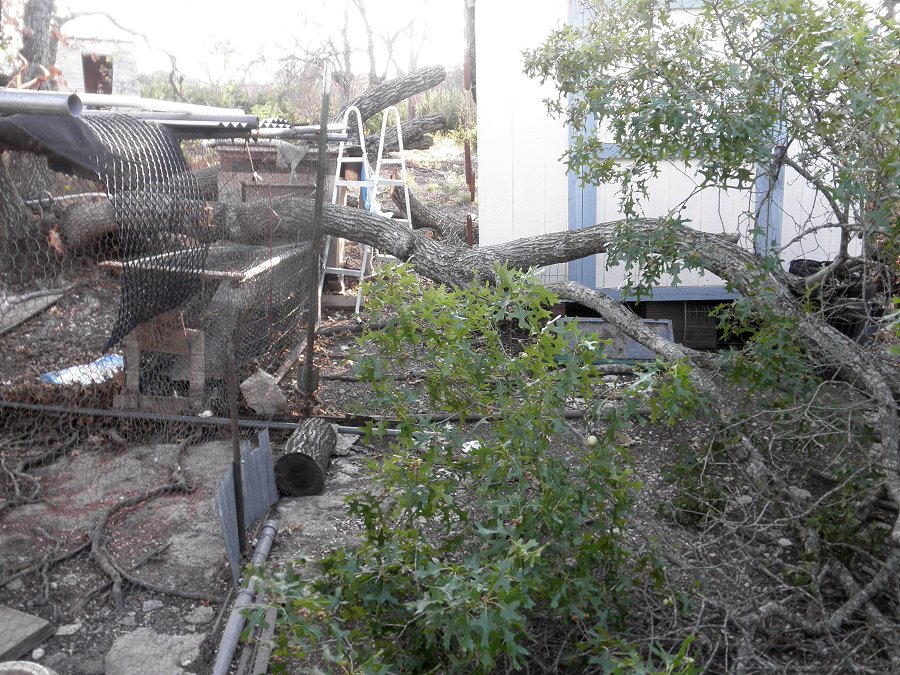
Suddenly a few feet away I had an oak tree poking into my affairs.  The chickens were going crazy running every direction, guinea-mania drowning out the chicken-panic, me just trying to fathom what I was seeing.

Turned out one of the remaining trunks of the oak that fell on the roof of the storage building a while back decided to put the squeeze on the Bachelor Rooster Containment Center.

Spang blocked off the chute between the pen and the night fortress, raising all manner of questions about protected places to house the roosters for the night.

But more importantly, forced the awareness that this cabin, all the storage buildings, even the main chicken pen, surrounded by dying oaks waiting to fall on something important.

Nobody got crushed in this one.  The cats were well away, even I was far enough out of reach so only a few leaves and a bit of dust got to me.  But I’ve got lots of trees and not-all-that-many cats.

I pondered it all last night for a considerable while.  If that tree had come down on me there’d have been a lot of hungry, thirsty chickens and felines lying around with Xs over their eyes before anyone got around to wondering how long it had been since they’d seen me and why.

And the fact is, even though I’m a fair-hand at the one-man-band act, I can’t figure any way in hell to bring a lot of these potential crushers down in a way that doesn’t include them falling on the cabin roof.

So I did a lot of weighing and juggling what I ought to be thinking and doing.  Concluded I first need to scout around for a home for the chickens.  The lady who runs the Habitat For Humanity Thrift Store has a lot of free rangers, along with some goats and two dogs to protect them all.

I reckons I’ll be talking to her next time I’m in town to find out whether she might give them a home.

Meanwhile, maybe put up a tent out in the meadow for summer sleeping until I can feel some confidence the tin roof won’t be sleeping beside me if I snooze indoors.

When I left New Mexico a lot of the reason I felt pressured to do it was the fact of a roof arguing in favor of collapse and an 18 inch adobe wall looking for an excuse to fall.  If Gale hadn’t offered the use of this cabin I’d have had to find a lot less wholesome place than this before the snow flew.

Back to square one, thinks I.

Old Jules

The Illusion of Survival

Several years ago during that pesky time when the publishing house had accepted Desert Emergency Survival Basics for publication, but I hadn’t yet seen the contract they were proposing, the editor was asking for re-writes and a number of changes in the final draft. We discussed it on the phone a number of times and I was pecking away at it, but holding back until I’d seen what they were bringing to the table. 

But before I got too far along I got a call from him because of a news event.  A family in Oregon, or Washington had taken a back road in the National Forest, gotten snowed in, and died because they didn’t apply some of the basics suggested in the Survival Book.

Him:  The scope of the book is broader than the name suggests.  It shouldn’t require a lot of work to make it a general survival manual.

Me: A lot of work’s already gone into it.  And I’ve already re-written it the way you suggest earlier.  You’ve got it in front of you.  Before I do any more work on it you and I need to talk about money.  Every time I’ve asked about what you’re offering as an advance you’ve hedged.  Said you needed to discuss it with the boss.

Him:  We don’t usually offer much in the way of advances.  We’re not that big, even though we offer a lot of titles.

Me:  Then you and I probably don’t have much to talk about.  You know and I know I’m never going to see a penny beyond the advance.  I have a fair idea what’s contained in your standard contract.  I’m not going to lift another finger on this book until I see an advance, and if it’s not enough to pay for my time already, hearing you’re going to be flexible about changing the contract details.

Him:  I’ll talk to the boss.  But that book needs to be published.  That family might have survived if they’d read it.

Me:  I’ve got some survival issues of my own here.  Hypothetical people who might die won’t pay my rent.  I’ve already done the work.  But if you’re proposing to print that book and give it away so neither of us makes anything on it what you’re saying might make sense.  Appeal to my better nature.

Him:  I can’t do that.  We’re in business.

Ultimately they sent me the standard contract and offered a token advance.  The willingness to alter the details of the contract didn’t include changes that would have allowed me to eventually get paid for my labor by eliminating provisions for them to squirm out of paying.

I’ve thought about that a lot over the years and eventually concluded the entire concept of survival and survival books qualifies as a cruel hoax.  An ironic illusion.  Because human beings are going to experience death inevitably as a means of exiting the vehicle.  Some are going to die getting lost in the woods.  If they survive getting lost it’s almost certainly going to be luck, instinct, or common sense.

As an example, somewhere earlier on this blog I described a snowstorm Keith and I got caught in on Santa Rita mesa, and how the GPS seemed to be lying about where the truck was.  How we believed the GPS instead of what we knew to be true, and more-or-less quickly found the truck.

That same snowstorm, not too far away, a kid was lost.  The news was full of it, Search and Rescue eventually was ready to give him up for dead.  But the kid, clothed in a light jacket, used his brain, sheltered under a rock ledge, and made it out after five unlikely days.

Which isn’t at all the same as saying the kid survived.  He won’t.  Neither will anyone else.

Old Jules

A Matter of Curiosity, Mostly

Good morning readers:

I doubt anyone among the current readers is going to put my speculative assertions about the abundance of platinum of a few days ago to the test.  But someone who finds the blog on a search engine someday might.  It would be a lot simpler and easier today than it was a decade-or-so ago.  Not to mention cheaper.

So, for that potential reader, here’s what I’d suggest as a minor project:

Get one of these – They’re getting cheaper every day.  $100 will probably get you one.

QX5 Microscope – Digital Blue QX5 Digital Microscope

The QX5 Microscope is the upgraded version of the award-winning Intel QX3 computer USB microscope.

Explore the microscopic world with the only USB microscope that connects to a computer. The QX5 USB Microscope includes software that allows you to view, edit, animate and even measure samples, then create slideshows and videos. The QX5 USB Microscope has the mobility to come out of its base for the viewing of larger or possibly live samples in their natural habitats.

Then build one of these:

Build a high resolution spectrograph in 15 minutes

http://sci-toys.com/scitoys/scitoys/light/spectrograph/spectrograph.html

Find a weathered Quaternary caldera and dig into the inside of the rim, near the top, saving the sample below about an inch deep to a foot deep in a five gallon bucket.  Carefully, carefully, carefully pan down the sample until whatever’s heaviest is all that’s left on the bottom of the pan. 

Then do direct microscopy on the sample, after familiarizing yourself with the appearance of micron platinum.  If you see some prime suspects work the sample down a lot further, but saving the spoils because you’re going to be interested in whatever else is left in the sample, and micron minerals are prone to float on the static surface of the water.

Once you’ve got it separated, use the spectrograph you built to determine whether what you’re seeing is actually platinum, and what else is in there with it.

If you don’t have a Quaternary caldera, but would still like to give it a try, go somewhere with a history of active vulcanism during the Quaternary, find a corrugated culvert 4-5 feet diameter going under a road  downstream, but as far upgrade as possible.  Crawl into the culvert with a whisk-broom and large spoon and take concentrate samples from the bottoms of the corrugations.

Then do your direct microscopy and spectograpy on the concentrates, same as above.

You could do something similar from streambeds in mineral bearing areas, but you’d need to learn to ‘read’ a channel so’s to know where to take your samples.

Old Jules

The Smoke We Called Living

A few days ago Wayne, the guy everyone’s looking at in this pic sent it to me.  Brought back memories of a time when I had a dozen suits in the closet and more ties than would fit on a rack across the closet door.  That photo must be from 1975, 1976.  Leading edge watch I was wearing must have cost a bundle.

I’m the one with the chin.  The meataxe is the one without one.  Ken was his name.  If my memory serves me rightly he died sometime in the late 1980s, early ’90s and left a lot more people glad he did than wished he didn’t.  By that time he’d been far enough out of my life long enough so’s I didn’t give much of a damn one way or another.  Ken never amounted to much this lifetime, but he narrowly missed a few good bets, geography and time being a key factor.  He’d have fit right in a number of places when goose-stepping was more popular as a pastime.

Old Wayne’s stuck with that career all these decades, fought his way up the ladder to success, winding down now.  When we re-established contact a few months ago I’d thought for a long time he was probably dead, too.  But he’s a couple of months away from hanging up his gun, instead.  Retiring.  Cleaning out his desk, I reckons.

I’m hoping before I head off into the sunset, but after he finishes getting all that behind him, we’ll get out on a river bank somewhere and watch the bobbers on a trotline, scramble up some catfish and eggs for breakfast.   Him winding down, me just listening and watching.

For a human being, getting success behind ain’t always easy.  Tough drug  to kick most times, but a man has to do it.

Old Jules

Mandala Dreams update from Jeanne

Hi everyone, I thought I’d sneak a  post in here when Old Jules isn’t looking.

Since I got back from New Mexico last weekend, I’ve been clearing space to draw again so I thought I’d tell you a little more about what I do with these gel pens.

When a drawing is finished, it’s never really finished because I can take original drawings and make hundreds of variations on the computer using Paint Shop Pro 7. The first picture is a really old drawing I did when I was just starting to get serious about it. Soon after it was finished, I was unhappy with it for several reasons. I  hadn’t developed the ability to plan for margins and also lacked the skill for keeping it symmetrical.  (Although it did sell, I never got a good scan of it because of the size. I’ve since learned that Kinko’s has a huge scanner so now I use their services for large drawings. This one is about 12×12 inches.)

But the second version is a favorite that I always enjoy looking at, and I frequently use it for greeting cards. It’s also in the running as a possible variation for fabric.  Same drawing, just tweaked with PS Pro 7.

The originals are always the best for viewing in person because I use a lot of metallic and fluorescent inks which don’t show in a reproduction, but playing with changing colors and shapes  gives me more variety for printed copies and fabric.  I’ve even used the manipulations as starting places for entirely new drawings.

Here’s a mandala that really is special just because of the capability of the particular gel pen I was using. There is a line of Sakura gel pens that actually makes an outline on the edge of the color as it’s drawn across the surface. If you enlarge this piece, you’ll see how much more intricate this becomes.  Although I’m pretty good at fine line drawings, these pens add even more detail. The finished size of this drawing (not the paper)  is about 4 1/2 x 4 1/2 inches.
This is  also an old one, but it shows off this added line feature really well.

Since I’m only working one part-time job right now, I have time to draw again, and I’m working on several half-finished pieces. I also have an order for some greeting cards that just need to be assembled since I already have the photo reproductions.  I also intend to get back to those soldered glass pendants since I have a stack of those that I set aside when the soldering started to drive me nuts. I listed three on Etsy last night and will probably put up several more soon: http://www.etsy.co/shop/Mandaladreamer).

Here’s what I was working on this evening:
This one will be fun when it’s finished because all those fluorescent inks glow under a black light.

I also sorted through my entire collection of pens and threw out at least a couple of dozen that didn’t survive not being used frequently last winter, as gel pens  to dry out easily. Here’s what’s left:

Old Jules suggested that I write a post about my recent trip to New Mexico, but since the main thing I came back with was a determination to keep  drawing and work harder at sharing it, I figured I’d post this instead.

~Jeanne (Mandala56)

Recapping the Lost Gold Mine Search

I think I’ve posted most of this before in earlier posts, but for those who weren’t here to read it at the time, I’ll do it again. 

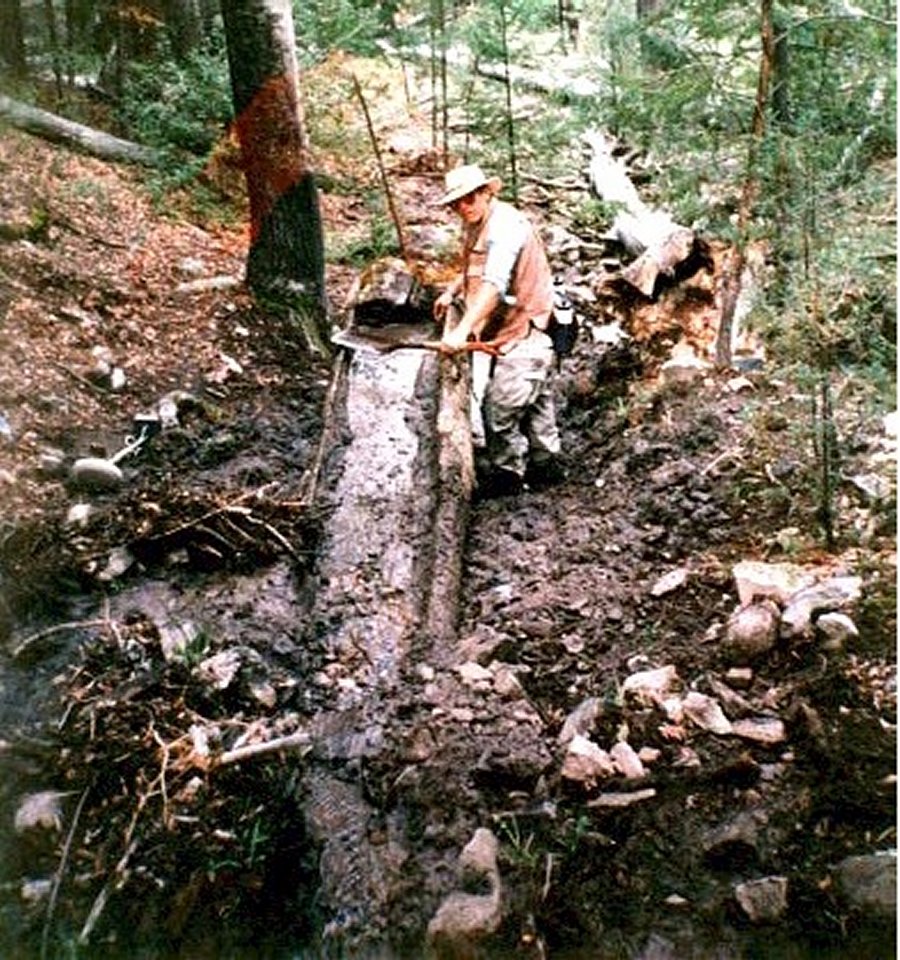
A longtom sluicebox axed out of a 3 foot diameter log, a spring 75 feet above the sluice, an arrastra below.  I’d been walking past the arrastra a few years before I recognized it for what it was.  One day I was leaning against a deadfall aspen getting my breath, gazing at it, when it dawned on me that 500 pound rock had a reason for being shaped the way it was.

A burned out cabin ruin with an aspen tree growing out of the inside, bear claw marks 12 feet up, 3 hand forged nails. 

A mysterious map chiseled on the face of a 300 pound rock surface depicting the exact layout of the canyon, the cabin, the waterfall, all so accurately depicted the person had to have scrutinized the layout from the mountaintop, then scratched it on this stone 600 vertical feet below and half a mile away. 

The rock was carefully placed on the canyon wall above eye-level so it was easily seen, but only by someone looking up.

Dozens of places upgrade where the man worked the quartz outcroppings.

Symbols carved into rock faces long ago on the upper-west face of the mountain below the most heavily worked quartz outcroppings near the crest.  None of it made a hell of a lot of sense.

One day I was climbing around up there with my lady friend of the time, Jan.  Following the guy around, trying to figure out what the hell he was doing and why.  We came to a rock face with a quartz outcropping he’d been working, but stopped, obviously half-done.  Not like him at all.

I stepped back a few paces studying it, mildly confused.  Glanced at the ground at my feet and there lay an arrowhead, quarter-inch of the point broken off.  I believed I was looking at the reason he quit before the job was done.

But that long tom and that sluice were testimony the man [or men] working there were in a production mode.  They weren’t prospecting, they were processing ore.  Scrapings from the bottom surface of the sluice, burned and panned didn’t turn any signs of anything heavy.  Downstream just below the V-bottom of the canyon went 100 yards or so to a stricture might have once had a beaver dam, landslide, something clogging it so’s there was a flat bottom with maybe 7-8 feet of sediment.  Along one side a channel had been cut going through the sediment, but not all the way to the bottom of the V.  It would have been a major job getting to the bottom for sampling, never got around to it.

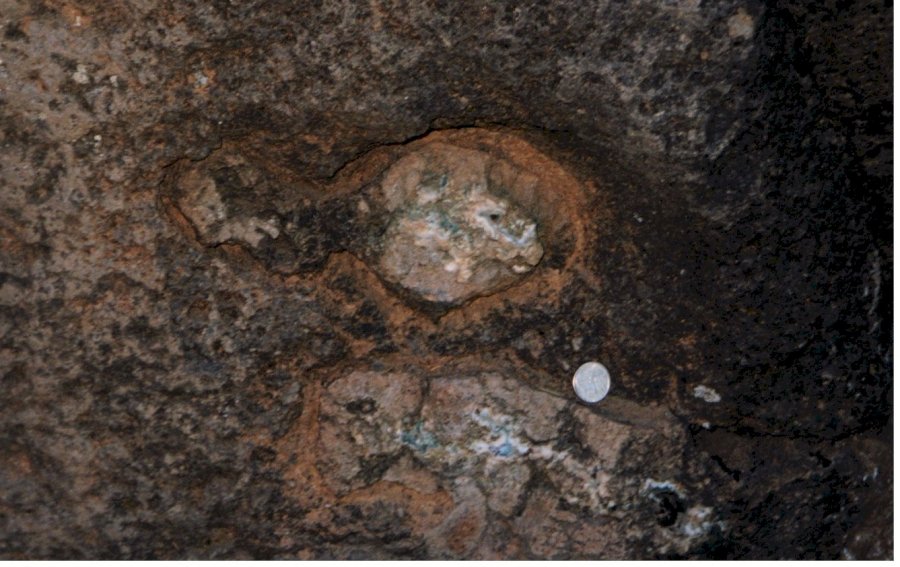
But from the bottom of the existing channel the pans showed a huge amount of heavy, heavy, heavy bead-like material, rusty brown.  Eventually spectroscopic assays showed what was mentioned a couple of posts ago.

And there was considerable more of it in other nearby canyons.

But we never found the source of whatever the guy was running through that longtom, what he was crushing with the arrastra.

Old Jules