Tag Archives: Nature

Running Around Bare-Assed Naked – Visitors, Telescopes and Determination

Good morning readers.  Thanks for coming by for a read this morning.

Yesterday afternoon I was sitting outdoors reading Mitcheners, The Bridges at Toko-Ri [a truly bizarre piece of twisted logic intended to explain why the US was fighting a war in Korea nobody understood] wearing nothing but a pair of shoes.  Nobody much comes here, but I heard a vehicle on the hill, glanced up and saw a truck making its way down.  Ran indoors and slipped on a pair of trousers, still zipping up and pulling my galluses over my shoulders when the newish neighbor pulled up in front of the cabin.

Which has happened occasionally since he moved up there.  Something just to get used to, me being a guy who ain’t interested in what neighbors think of me if they have to use binoculars or come unexpected to get around to thinking it.

We talked a while, had a pleasant visit, and he left without commenting on the fact he’d probably gotten a forbidden view of my almost 70 year old traffic stopping bod.

But this morning when I logged on and glanced through the daily digests of Yahoo Group posts I came across this posted yesterday on the “Not Your Usual Goat” list:

Re: OT: Zillow
 
Fri Jun 29, 2012 9:33 am (PDT) . Posted by: “Cheridehart” thumber_smiget
I am to open to even consider going out nude more or less even in my nighty
. We are to open for that . Even with the neighbors on the next 20 acre lot
We are in farm land area my place was a wheat field at one time what trees
I have around the house I planted . I was adjusting the telescope one day for the hubby for sky watching and
focused in on a house going up on the hill side say about 25 miles away . I
did not think anything of it it was being built did not know someone was
staying there had not seen any one . Had hubby check it out if I had it set
for him okay it was a little blurred for me he wears glasses . Well when he
looked the guy was taking a shower in the garage part of the place right
where I had it pointing Hubby ask me if I was spying on the neighbors and
how many times have I watched him shower . I told him for now on he can
adjust it for him self from now on I am sticking to my own scope which is
pointed a Venus at the moment be going back to the moon soon . We have very
few out side lights so makes for a very good night sky watching around here
Can not believe how may satellites are up their blinking there way across
the skies. The last three good sky events we have had we where so clouded
could not see anything. Cheri
Led me to consider the big house someone built on the ridge about 10 miles away from here, which I watched them build through a telescope.  As it happens, I shower outdoors every day pouring gallon orange juice jugs of water warmed by sunlight over my head.  Direct line of sight from the big house on the ridge.
 
Got me wondering whether Cheri might be up there looking at my private stuff through a spyglass pretending I’m Venus.
 
Which I ain’t.
 
Maybe I need to start keeping one hand over my crotch.
 
Old Jules
 
Afterthought:  About The Bridges at Toko-Ri
Paraphrased
 
Navy Task Force Admiral character:  “No, this war isn’t necessary.  We could let them have it [read, let the North Koreans have Korea].  But what would we give them next?  Japan?  Hawaii?  California?  Besides, it’s honorable.”
 
Soon-to-be-dead fighter pilot:  “I’ve got to do this because the bastards shot down a guy I admired while he was directing fire on their advancing troops.  I can’t let my buddies down.  Wouldn’t be honorable.”
 
Soon-to-be-dead helicopter rescue pilot:  “I do it because I hate communists.  I’m a gutsy guy.  Not some coward.”
 
Weepy wifee of soon to be dead fighter pilot:  “I was against the war, didn’t want my hubby killed.  But I changed my mind after the Admiral explained why it’s necessary.  Now I’m okay with it, though I still whine and weep.  Now I whine and weep in a noble, more courageous way.”


Flux Transfer Event Topology

http://science.nasa.gov/science-news/science-at-nasa/2008/30oct_ftes/

Good morning readers.  I’m going to have to kick this around with Old Sol while I’m coaxing him up this morning.  Meanwhile, I’ll tell you it’s nice seeing something coming out of NASA occasionally a person could consider useful and exciting.

The whole 2008 business about the 8 minute cycling had completely escaped my notice until I came across this at http://spaceweather.com/this morning.

HIDDEN PORTALS IN EARTH’S MAGNETIC FIELD: A NASA-sponsored researcher at the University of Iowa has developed a way for spacecraft to hunt down hidden magnetic portals in the vicinity of Earth. These gateways link the magnetic field of our planet to that of the sun, setting the tage for stormy space weather. [video]

Then, a bit of searching turned up this:

Magnetic Portals Connect Earth to the Sun

 http://science.nasa.gov/science-news/science-at-nasa/2008/30oct_ftes/

“We used to think the connection was permanent and that solar wind could trickle into the near-Earth environment anytime the wind was active,” says Sibeck. “We were wrong. The connections are not steady at all. They are often brief, bursty and very dynamic.”

Several speakers at the Workshop have outlined how FTEs form: On the dayside of Earth (the side closest to the sun), Earth’s magnetic field presses against the sun’s magnetic field. Approximately every eight minutes, the two fields briefly merge or “reconnect,” forming a portal through which particles can flow. The portal takes the form of a magnetic cylinder about as wide as Earth. The European Space Agency’s fleet of four Cluster spacecraft and NASA’s five THEMIS probes have flown through and surrounded these cylinders, measuring their dimensions and sensing the particles that shoot through. “They’re real,” says Sibeck.

Now that Cluster and THEMIS have directly sampled FTEs, theorists can use those measurements to simulate FTEs in their computers and predict how they might behave. Space physicist Jimmy Raeder of the University of New Hampshire presented one such simulation at the Workshop. He told his colleagues that the cylindrical portals tend to form above Earth’s equator and then roll over Earth’s winter pole. In December, FTEs roll over the north pole; in July they roll over the south pole.

Sibeck believes this is happening twice as often as previously thought. “I think there are two varieties of FTEs: active and passive.” Active FTEs are magnetic cylinders that allow particles to flow through rather easily; they are important conduits of energy for Earth’s magnetosphere. Passive FTEs are magnetic cylinders that offer more resistance; their internal structure does not admit such an easy flow of particles and fields. (For experts: Active FTEs form at equatorial latitudes when the IMF tips south; passive FTEs form at higher latitudes when the IMF tips north.) Sibeck has calculated the properties of passive FTEs and he is encouraging his colleagues to hunt for signs of them in data from THEMIS and Cluster. “Passive FTEs may not be very important, but until we know more about them we can’t be sure.”

There are many unanswered questions: Why do the portals form every 8 minutes? How do magnetic fields inside the cylinder twist and coil? “We’re doing some heavy thinking about this at the Workshop,” says Sibeck.

If NASA’s going to be throwing money around like a drunken sailor it’s good to know sometimes it hits something worth knowing.  Even a blind hog finds an acorn now and then, I reckons.

Old Jules

Suppression of Public Discussion of How Damned Hot It Is

Good morning readers.  Thanks for coming by for a read this morning.

I went to town a few days ago to get the stolen car covered by liability insurance, and when I returned the Great Speckled Bird was defunct.  Evidently decided it was better to take his chances on ending up in a factory farm for chickens next lifetime than put up with more of Old Sol’s blessings during this one.

Naturally his passing stirred things up considerably here.  The bachelor roosters were promoted to full-fledged hen-chasers and released to free range daily, sleep with the flock, nights.  But it’s also caused an undercurrent of rumors.  Whisperings and quiet cluckings nights when the doers can’t be identified and prosecuted.  Claims that it wasn’t just the heat offed TGSB, but radioactive fallout. 

It’s partly my own fault.  One of the felines was probably sneaking a look when I was reading trivia such as the article below:

http://www.prweb.com/releases/2012/5/prweb9498292.htm

Gen. Stubblebine’s prognosis is dire: “When the highly radioactive Spent Fuel Rods are exposed to air, there will be massive explosions releasing many times the amount or radiation released thus far. Bizarrely, they are stored three stories above ground in open concrete storage pools. Whether through evaporation of the water in the pools, or due to the inevitable further collapse of the structure, there is a severe risk. United States public health authorities agree that tens of thousands of North Americans have already died from the Fukushima calamity. When the final cataclysm occurs, sooner rather than later, the whole Northern Hemisphere is at risk of becoming largely uninhabitable.

“. . . The US Government’s statistics document an excess death rate of 20,000 US residents, mostly healthy infants, in the first 9 months following the multiple nuclear events at Fukushima. . As a humanitarian, strategist, intelligence analyst, father and grandfather, General Bert understands that doing nothing is, quite simply, not an option.

“. . . The lack of information is, however, a matter of State policy in Japan where it is now a felony offense to discuss negative aspects of either nuclear power or the Fukushima situation in particular.”

Old General Bert’s correct, the cats, chickens and I all agree.  Doing nothing is not an option.  But as Commander in Chief around here, I’m not aware of a damned thing I can do, nor of anything the cats and chickens can do to influence whether the Northern Hemisphere becomes largely uninhabitable.

Any more than we can do anything about this heat wave, except hunker down and try to think of ways to not follow TGSB into the next incarnation.  And maybe try to find something useful to occupy ourselves despite the standing 8-count we’re all trying to function in.

For starters, I’m declaring martial law within the hearing-radius of the cabin and henhouse.  Japan, at least, can be accused of doing something, even though not a damned thing can be done.  I’m taking a page from Japan’s book and making it a criminal offence for any item of poultry, feline, or human being here to say, “Damn it’s hot.”  Or, “Reckon how radioactive it is today?”

Old Jules

Divine Intervention – A Blossom Fell

Good morning readers.  Thanks for coming by for a read this morning.

I was relaxing in a camp chair just before dusk yesterday when the Coincidence C0ordinators gave me a nudge to remind me my priorities are too much anchored in the chicken, cabin, drainage issues recent past.  The bachelor roosters were loose for their afternoon free range and my attention was directed to making certain neither of them sneaked off to bloody TGSB.

KERWHUMP!

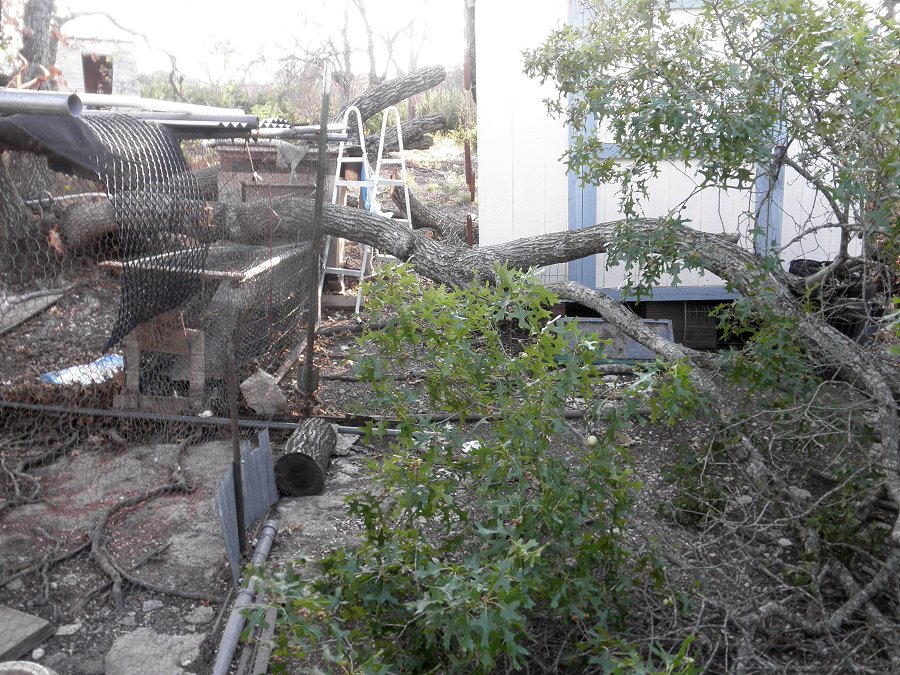
Suddenly a few feet away I had an oak tree poking into my affairs.  The chickens were going crazy running every direction, guinea-mania drowning out the chicken-panic, me just trying to fathom what I was seeing.

Turned out one of the remaining trunks of the oak that fell on the roof of the storage building a while back decided to put the squeeze on the Bachelor Rooster Containment Center.

Spang blocked off the chute between the pen and the night fortress, raising all manner of questions about protected places to house the roosters for the night.

But more importantly, forced the awareness that this cabin, all the storage buildings, even the main chicken pen, surrounded by dying oaks waiting to fall on something important.

Nobody got crushed in this one.  The cats were well away, even I was far enough out of reach so only a few leaves and a bit of dust got to me.  But I’ve got lots of trees and not-all-that-many cats.

I pondered it all last night for a considerable while.  If that tree had come down on me there’d have been a lot of hungry, thirsty chickens and felines lying around with Xs over their eyes before anyone got around to wondering how long it had been since they’d seen me and why.

And the fact is, even though I’m a fair-hand at the one-man-band act, I can’t figure any way in hell to bring a lot of these potential crushers down in a way that doesn’t include them falling on the cabin roof.

So I did a lot of weighing and juggling what I ought to be thinking and doing.  Concluded I first need to scout around for a home for the chickens.  The lady who runs the Habitat For Humanity Thrift Store has a lot of free rangers, along with some goats and two dogs to protect them all.

I reckons I’ll be talking to her next time I’m in town to find out whether she might give them a home.

Meanwhile, maybe put up a tent out in the meadow for summer sleeping until I can feel some confidence the tin roof won’t be sleeping beside me if I snooze indoors.

When I left New Mexico a lot of the reason I felt pressured to do it was the fact of a roof arguing in favor of collapse and an 18 inch adobe wall looking for an excuse to fall.  If Gale hadn’t offered the use of this cabin I’d have had to find a lot less wholesome place than this before the snow flew.

Back to square one, thinks I.

Old Jules

A Matter of Curiosity, Mostly

Good morning readers:

I doubt anyone among the current readers is going to put my speculative assertions about the abundance of platinum of a few days ago to the test.  But someone who finds the blog on a search engine someday might.  It would be a lot simpler and easier today than it was a decade-or-so ago.  Not to mention cheaper.

So, for that potential reader, here’s what I’d suggest as a minor project:

Get one of these – They’re getting cheaper every day.  $100 will probably get you one.

QX5 Microscope – Digital Blue QX5 Digital Microscope

The QX5 Microscope is the upgraded version of the award-winning Intel QX3 computer USB microscope.

Explore the microscopic world with the only USB microscope that connects to a computer. The QX5 USB Microscope includes software that allows you to view, edit, animate and even measure samples, then create slideshows and videos. The QX5 USB Microscope has the mobility to come out of its base for the viewing of larger or possibly live samples in their natural habitats.

Then build one of these:

Build a high resolution spectrograph in 15 minutes

http://sci-toys.com/scitoys/scitoys/light/spectrograph/spectrograph.html

Find a weathered Quaternary caldera and dig into the inside of the rim, near the top, saving the sample below about an inch deep to a foot deep in a five gallon bucket.  Carefully, carefully, carefully pan down the sample until whatever’s heaviest is all that’s left on the bottom of the pan. 

Then do direct microscopy on the sample, after familiarizing yourself with the appearance of micron platinum.  If you see some prime suspects work the sample down a lot further, but saving the spoils because you’re going to be interested in whatever else is left in the sample, and micron minerals are prone to float on the static surface of the water.

Once you’ve got it separated, use the spectrograph you built to determine whether what you’re seeing is actually platinum, and what else is in there with it.

If you don’t have a Quaternary caldera, but would still like to give it a try, go somewhere with a history of active vulcanism during the Quaternary, find a corrugated culvert 4-5 feet diameter going under a road  downstream, but as far upgrade as possible.  Crawl into the culvert with a whisk-broom and large spoon and take concentrate samples from the bottoms of the corrugations.

Then do your direct microscopy and spectograpy on the concentrates, same as above.

You could do something similar from streambeds in mineral bearing areas, but you’d need to learn to ‘read’ a channel so’s to know where to take your samples.

Old Jules

Honoring the Oceans in the Hen House

Me:  Why so quiet there Ms. Australorp?  Thinking of giving up on those chalk eggs?

Her:  No.  I’m just feeling a little reflective and sad.  I spent yesterday honoring the oceans.

Me:  You WHAT?  You spent yesterday wearing down those chalk eggs, same as every other day for the past couple of weeks. Honoring the oceans?  I need to pull those eggs out from under you.  A few days out chasing grasshoppers will help you regain perspective.

Her:  No.  Really.  I was thinking about all that radioactivity in the North Pacific.  Thinking about the Great Pacific Garbage Patch.  All those poor turtles and plankton.

Me:  Thinking of signing some petitions?  Thinking of voting for someone who knows what to do about that garbage in the ocean vortices?  Those two roosters caged over there know as much about what to do about it all as any human being.

Her:  I know.  Still, I feel sad about it.  I think an empty, meaningless gesture or two might help me feel better.  Maybe a rally and a few petitions after these eggs hatch.

Me:  Rest your mind on that one, babe.  I’m pulling those eggs.  The golf ball, too.

Old Jules

Er. . . Um – Physicists Explain Baby Black Holes to One Another

Pre-Large Hadron Collider, CERN

http://www.physicsforums.com/showthread.php?t=56569

Chroot:   The type of matter is not relevent at all. All you need to do is to put enough matter into a small enough space that its escape velocity exceeds the speed of light. Viola, you have a black hole.  – Warren

Aki:  Aren’t they presently creating baby black holes in labs right now?
 
J20QU3: I wouldnt of thought so, they may be trying but even for a baby black hole u need a huge mass first.
 
Da Willem:  You only need a huge mass density. But the problem (or I guess we should count ourselves lucky) with baby black holes, is that they evaporate very fast.
 
NANOTEC:   they are creating very very small blackholes, the size of a few protons. the part that is tough, is the sustainability. the minuature black holes created evaporate very very quickly as well. from what i guess, CERN(when finished) will help out with this part of the process.
 
Chronos:  There is reason to believe you need at least a planck mass to form a black hole [whose schwarzchild radius would be a planck length]. The limit may, however, be lower if certain higher dimensional theories are correct. In that case the Large Hadron Collider at CERN may be able to produce them. At present, none have yet been created of any size in colliders, so far as anyone knows. If the planck mass limit [~10E19 Gev] holds, we will never create one.
 
NANOTECH:  How could we benefit from creating these black holes at CERN?
 
Nereid:  I too am curious to know why NanoTech thinks mini-black holes have been created in colliders – AFAIK, there’s nothing in the data from any collisions that even hints at such production. Further, if they could be made in colliders, there’d be plenty of them formed from UHE cosmic ray collisions with N or O nuclei (in the air) – again, no hints of such in all the CR data.Mini-BHs would evaporate through Hawking radiation – at least that’s the theory. As no one has observed a mini-BH, this theory has not yet been directly tested (although it is consistent with a large body of indirect experimental and observational data).
 
Grogs:  You’re probably right about today’s nukes not having the ‘oomph’ to create a black hole. I hadn’t really thrown any numbers into the calculation. Focusing them precisely enough (smaller than the radius of an atom ) would probably be a huge problem too. It would probably still be easier than dragging 3 SM’s of material together, but it’s many, many years down the road, if it’s possible at all.For the sake of comparison (to the 1019 GeV number Chronos mentioned), what energies are the latest and greatest supercolliders producing?
 
————-
 
It’s the thought that counts, I reckons.
Old Jules

So How About Them Radioactive Tuna?

Me:  Soooo.  How you cat-folks feeling about some canned cat food this morning?  Can I hear some ‘Amens’ on that?

Invader cat:  Amen!  Amen!  Amen!

Naiad:  Hold that thought a minute.  Any idea what they put in those big bags of Purina food?  Where they get it?  That sort of thing?

Me:  No idea at all.  I just thought you guys would want a dose of something out of a can.

Invader cat:  Amen!  Amen!  Amen!

Naiad:    I’m not so sure.  Got any liver and bacon flavor?

Me:  Probably some of that in here somewhere.  But the cans on top are salmon, tuna and chicken and tuna.  Below, is seafood supper.  I’d rather not dig down in the package if it’s okay.

Naiad:  I’m not all that hungry  Might go out and catch a mouse and just settle for that.  I heard you grumbling and muttering about that radioactive bunch of tuna they caught out of San Diego the other day. 

Me:  Yeah, they did.  But it was just ceisum 134 and 137.  Not dangerous levels yet.

Naiad:  So you figure they just threw them away?  Or ground them up into fish meal to feed to pigs?  Maybe put them into cans of food of one sort or another?

Me:  I don’t know.  I don’t think there’s any routine testing anyway.  The article said, “The real test of how radioactivity affects tuna populations comes this summer when researchers planned to repeat the study with a larger number of samples. Bluefin tuna that journeyed last year were exposed to radiation for about a month. The upcoming travelers have been swimming in radioactive waters for a longer period. How this will affect concentrations of contamination remains to be seen.

“Now that scientists know that bluefin tuna can transport radiation, they also want to track the movements of other migratory species including sea turtles, sharks and seabirds.”

I reckons they’ll be checking it out, directly.

Naiad:  You go ahead and feed the rest of these guys whatever you want to.  I’m going hunting.

Invader cat:  Amen!  Amen!  Amen!

Old Jules

Earlier Versions of MICA Software if you can use them

Over the years this compulsive project of mine chasing what isn’t happening and when it isn’t has led me into ownership of several versions I ceased using after upgrades were released.   Salt Cedar Latillas for Erosion Control

 Even the earliest versions are better than the next-best off-the-shelf software intended to do what it does.

So I’ve got three versions of the CDs and 120 page hardback handbooks lying around drawing dust.  They’d serve for most folks who aren’t being fanatic about the kinds of issues I’m fanatic about.

If any of you readers are into what’s going on in the sky in a way that might allow you to benefit from owning a not-quite-up-to-date version, these are available for the cost of postage getting them to you.

Feel free to email me at josephusminimus@hotmail.com if you’d savor a copy.

Old Jules

An easy-to-use astronomical almanac from the U.S. Naval Observatory

About MICA

MICA, the Multiyear Interactive Computer Almanac, is a software system that provides high-precision astronomical data in tabular form for a wide variety of celestial objects. The program computes many of the astronomical quantities tabulated in the The Astronomical Almanac. However, MICA can compute this information for specific locations and flexible times, thus eliminating the need for table look-ups and additional hand calculations.

Designed primarily for professional applications, MICA is intended for intermediate-to-advanced users. Basic knowledge of astronomical terminology and positional astronomy is assumed.

MICA provides essential data for use in

Astronomy and astrophysics Space science Geodesy and surveying
Geophysics Meteorology Environmental science
Operations planning Accident reconstruction and litigation Illumination engineering
Architecture Photography  

MICA was first released in 1993 for MS-DOS and Apple Macintosh systems. MICA 2.0 was updated for Windows and modern Apple Macintosh systems and released in August 2005. MICA 2.0 provided all the data available in earlier versions of the software and included several new features. The current version of MICA is 2.2.2, which was released in January 2012.

Features

MICA can perform the following types of computations:

  • Precise positions for the Sun, Moon, major planets, Pluto, selected asteroids, selected bright stars, and cataloged objects (e.g. stars, quasars, galaxies, etc.) using external catalogs provided with the program. Up to ten different position types are available (depending on which object was chosen).
  • Various astronomical time and reference system quantities (e.g. sidereal time, nutation and obliquity, equation of the equinoxes, Earth Rotation Angle, calendar/Julian date conversions, and delta T).
  • Twilight, rise, set, and transit times for major solar system bodies, selected bright stars, selected asteroids, and cataloged objects.
  • Physical ephemerides useful for making observations of the Sun, Moon, major planets, and Pluto. Both illumination and rotation parameters are available for all listed bodies, except for the Sun.
  • Low-precision topocentric data describing the configuration of the Sun, Moon, major planets, Pluto, and selected asteroids at specified times and locations. MICA also includes a sky map option as an aid in locating the objects.
  • Visibility information for solar and lunar eclipses, as well as transits of Mercury and Venus.
  • Four different types of positions of Jupiter and the Galilean Satellites and offsets of the satellites from Jupiter.
  • Dates and circumstances of various astronomical phenomena (solstices and equinoxes, apsides of Earth and the Moon, moon phases, conjunctions, oppositions, and greatest elongations of Mercury and Venus). A phenomena search feature is also available, which generates a table similar to the ‘Diary of Phenomena’ contained in section A of The Astronomical Almanac.

New features and changes in MICA 2.2/2.2.1/2.2.2 include

  • Earth Rotation Angle (ERA) and the equation of the origins.
  • Apside times (perigee/apogee of the Moon, perihelion/aphelion of Earth) as a stand alone computation or within the Phenomena Search function.
  • The DeltaT.val file has been updated with new data. The date with the first predicted value for this file is 2455745.0 (2011 July 2 12:00).
  • Computations of future eclipses and transits now allow the user to set their own value of delta T.
  • Configurations of major solar system bodies and asteroids, lunar eclipses, and all phenomena calculations now include “Zone” as a time system option.
  • Magnitudes have been added to the positional information provided for solar system bodies and catalog stars.
  • The International Astronomical Union (IAU) 2000B nutation model was replaced with the 2000K nutation model described in USNO Circular 181, Nutation Series Evaluation in NOVAS 3.0 (Kaplan 2009).
  • Lunar distance has been added to the “Phases of the Moon” output table.
  • Physical ephemeris algorithms have been updated to account for the aberration of the Sun due to the planet’s motion.
  • Physical ephemeris calculations have been updated with data from the “Report of the IAU/IAG Working Group on cartographic coordinates and rotational elements: 2006.”
  • The ‘Planet’ column header in the solar conjunctions output has been renamed to ‘Object’ to cover both planets and asteroids.

Talking the Walk – Part 2 – Leading a Cow to Water

http://www.rt.com/news/monsanto-brazil-seed-soy-908/

Monsanto is also the world’s largest manufacturer of synthetic bovine growth hormone, injected into cows in order to stimulate greater milk production. The widespread pressure by the company to use the chemical and the subsequent measures taken by Monsanto to suppress information regarding the potential health risks sparked uproar among American farmers.

When dairy producers that did not use Monsanto’s products began labeling their products as “Hormone Free” or “Organic”, Monsanto slapped them with a lawsuit as recently as 2008, claiming the labels amounted to negative advertising against hormone-produced milk.

Director of corporate communications for Monsanto, Phil Angell, summed up Monsanto’s take on the issue in a report by food author Michael Pollan for New York Times Magazine in 1998: “Monsanto should not have to vouch for the safety of biotech food. Our interest is in selling as much of it as possible. Assuring its safety is FDA’s job.”

http://rt.com/usa/news/white-house-monsanto-peer-991/

Michael Taylor, a former attorney for the US Department of Agriculture and lobbyist for Monsanto, was recently appointed to a federal role as the deputy commissioner for foods at the United States Food and Drug Administration (FDA). Since then, the FDA shot down requests from consumer protection groups to label genetically modified products as such. With a White House-Monsanto connection already established with the appointment of Taylor, PEER and others are interested in what other ties could exist between the two.

Heck, readers.  There ought to be something a verbose man such as myself could think of to say about all this.  I’d do it, too, if I could think of something.

Maybe I could point out those pointee-heads working three shifts in the Monsanto laboratories would call themselves ‘scientists’ if someone asked what they are.  Same as the folks over at CERN.

Or maybe I could just ask the reasonable question:  “Do you honestly believe one of the two breeds of foxes guarding the hen house is going to leave more feathers lying around when the dust settles?”

Old Jules