Tag Archives: economy

Where’s the goat with the gold plated horns?

Hi readers.  Thanks for coming by for a read.

The hmmm government is shut down.  Federal holiday of sorts, I reckons.

NSA’s almost certainly still bugging your phone today. Homeland Security people are sitting around backyard barbeques bouncing around ideas for the next terrorist scare.  The war profiteers are still working three shifts trying to find computers fast enough to tally up the money they’re making, but months behind in doing it.  International Bankers are sitting around boardrooms thinking up reasons they need bailing out with a government injection.

But, the hmm government’s shut down.  Scary stuff. 

Imagine all the stuff government does that won’t get done today.  Without anyone noticing it, all kinds of stuff I can’t think of right now isn’t getting done, and if I had any inkling what it was it would probably rattle me down to my bootheels.

Heck, what if that stuff doesn’t get done tomorrow?  Or ten years from now?  Hells bells, eventually someone would notice.  Scaryscaryscary.

But what’s going on is intended to fill the heads of people who pay attention to what the government is doing.  Assume, for the sake of the argument, this whole thing is theater.  An illusion of drama to keep everyone focused.

Where is the goat with the golden horns?  What is ACTUALLY going on someone doesn’t want you seeing because you’re too busy worrying the FDA and US Department of Agriculture are home not protecting you from genetic modified food grains and Monsanto?

Where’s the goat with the gold plated horns?

I don’t know the answer and I’m not searching for one.  But if I were I’d stand as much chance for success as I’d have going to Israel collecting money for the Palestinian Relief Fund.

Likely as not it’s something fairly large though.  The dust will settle, the government will go back to work, and you can bet there’ll be something brand, spanking new crept onto the scene when you weren’t looking.

Old Jules
Comprehending Corner-of-the-eye creeping craziness

Hi readers.  There’s something weird going on in the US you probably aren’t aware of unless you happen to be someone who plinks with a .22 rifle or pistol.  Or maybe a firearm of some other caliber.

But it’s been going on two years now, still going on today.  Ammunition manufacturers in China, Mexico, Russia, Czechoslovakia the US and elsewhere are working three shifts turning it out and shipping it t0 retail outlets and online suppliers.  They’re nowhere near satisfying the demand.

WalMart stores, for instance, get a shipment in during the night and before the store’s been open an hour there’s no more .22 ammo and damned little of anything else.

For reasons nobody anywhere can explain US citizens are filling the closets and garages with ammunition, mostly .22 caliber.

This silent, subtle fact is lurking in the periphery of something a lot larger, and I’ve spent a lot of time discussing it with anyone who might have ideas as to why it’s happening.  Everyone has ideas, and everyone admits they’re as mystified as I am what it means.

Old Jules

Denouements

Good morning readers.  Thanks for coming by for a read.

Certain types of problems seem to follow us through life, probably so’s the Universe can teach us whatever lessons it is we’re supposed to be learning during this one.  Frequently we’re slow coming to an understanding as to what ours are.  Mine, I suspect, probably are a consequence of karma acquired during a previous lifetime involving motor vehicles.

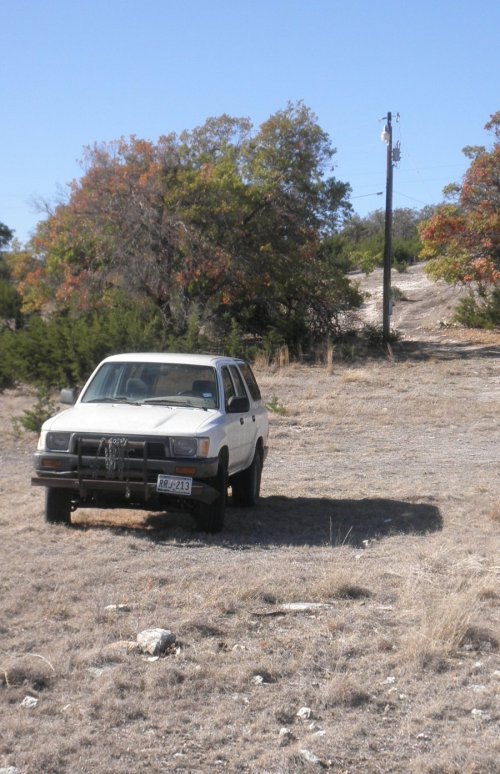
Which I hadn’t realized until I began looking at all the posts here involving transportation during my stay here.  One piece of that saga was the Toyota 4 Runner that carried me to this piece of real estate in 2008.  And became a subplot microsaga:

 Got me a new truck!

 Confession Time

The New Truck Resurrection

The Communist Toyota 4-Runner

A long one.  And one I’m finally going to apply a razor to.  I’ve found a guy who’ll follow me back out here next time I go to Kerrville, and put that 4 Runner onto a car dolly, pull it out of my life.

I went out and put the wheel back on it, took it off blocks and pushed it up the hill with the Toyota RV far enough so’s we’ll be able to get it onto the dolly.  Gale and the guy up the hill came out and improved the road enough yesterday with some machinery so’s a regular person will be able to get in and out of the valley without blowing a tire.

It’s not easy for me to part with that 4 Runner.  Lots of life history events trapped in it, but it’s clear enough the time’s come for a denouement.  Turns out I’ll be doing something similar with the Toyota RV, because Jeanne’s son, Michael’s decided it’s not the best option for him.

I’m willing to believe, for the moment, that when the 4 Runner goes out of this valley I’ll have poured enough of the life-ingredients into it to have filled whatever hole it was the vehicle challenges demanded of me this lifetime and I can have some other kind for a while.

Gracias, Jack

A place to live if the RV breaks down

Hi readers. I swapped Gale for this trailer, finalized it yesterday.

In addition to giving me the means to get my stuff out of this valley and into storage in Harper, I can live in this thing if the RV breaks down somewhere up the road. It’s light enough so a half-ton junker pickup truck can pull it.

It takes a considerable load off my mind. Both Gale and Raymond, the guy up the hill have pointed out if that RV quits I’ll be dead in the water. I tried not to let it bother me, but couldn’t help it nagging me some.

But with a Coleman stove and oven, my diesel burning heater, a bunk, I can live in this thing. Better than almost all my ancestors almost certainly lived before they left Europe. And certainly better than any Native American ancestors did.

The DuoTherm heater began life in the late 1940s or early ’50s as a kerosene trailer heater. The man up the hill had it, but we couldn’t get the carb to work. Eventually replaced the carb with a needle valve and converted it to diesel fuel, which is cheaper and more easily available.

Besides, if a person doesn’t have much he doesn’t have much to lose.

Old Jules

Wossname Bush dynasty looking out for US interests

Hi readers. Thanks for coming by for a read.

Two members of the Extended Family of US Presidents are scared the US will get into trouble if big oil companies and producers can’t export crude instead of refining it inside the US.

There’s no telling what sorts of awful things might happen if those big companies aren’t allowed to send natural resources to places where the profits are higher and where the labor and other costs of refining can be done in backward places where workers get paid a dollar a day.

Isn’t that nice?

George W. Bush Institute – U.S. Export Restraints on Crude Oil Violate International Agreements
Posted by Alan M. Dunnon September 11, 2013

http://www.bushcenter.org/blog/2013/09/11/us-export-restraints-crude-oil-violate-international-agreements

The U.S. current policy of restricting crude oil exports is fundamentally at odds with binding U.S. commitments under a number of international agreements. The General Agreement on Tariffs and Trade, or GATT, is the foundation agreement for the World Trade Organization, WTO. Among the principle GATT commitments adopted by all WTO member countries is a prohibition on the imposition of quantitative restraints on exports. There are exceptions to this prohibitionbut they are narrowly construed and apply only to certain, and very limited, circumstances.
Crude oil and natural gas, like almost all other products, are subject to GATT disciplines on trade. These same disciplines apply to crude oil and natural gas under U.S. free trade agreements, FTAs, such as the NAFTA, as well as numerous bilateral investment treaties, BITs, most of which also incorporate the GATT prohibitions on restricting exports.
The Prohibition on Export Restrictions Is Enforceable
GATT obligations prohibiting export restrictions are enforceable in binding proceedings under the WTO Dispute Settlement Understanding, DSU. These are the very same procedures recently used by the U.S. to successfully challenge China’s restrictions on exports of raw materials and coerce Chinese compliance through the DSU mechanism. Currently, the U.S. again is using these procedures to pursue a second challenge to China’s export restraints on rare earths, tungsten, and molybdenum.
Importantly, some of the Chinese export restraints that were found to violate the GATT are comparable to the U.S. export restrictions on crude oil and natural gas, including:
• Quantitative restrictions;
• Additional requirements and procedures vis-à-vis the quantitative restrictions; and
• Delayed licensing requirements on exports.
Other U.S. international agreements incorporate the GATT obligations and prohibitions either by reference or direct recitation, and most of those agreements also provide a right of action by which parties may challenge violations to the agreements, typically in international arbitration and sometimes in the courts. For example, bilateral investment treaties and trade and investment facilitation agreements, TIFAs, often incorporate the GATT obligations and provide rights of action under arbitration.
U.S. Statutes Regarding Oil Export Licensing Should Be Interpreted By the Agency and the Courts to Avoid Conflict With GATT Rules
The current U.S. export control regime on exports of crude oil are rooted in a complicated web of U.S. statutes and implementing regulations that give the U.S. president and/or various executive branch agencies sufficient discretion to grant exports of crude oil or gas if the export would be consistent with the U.S. “national interest” or “public interest.” Basic rules ofstatutory interpretation dictate that the executive branch and the courts must resolve any ambiguity in interpreting these statutes in a manner that is consistent with the GATT and other U.S. international agreements. For example, the Court of Appeals for the Federal Circuit ruled that:
[A]n interpretation and application of [a] statute which would conflict with the GATT Codes would clearly violate the intent of Congress.
Conclusion

The General Agreement on Tariffs and Trade, Article XI, prohibits U.S. export restrictions on crude oil and natural gas to other GATT/WTO member countries, except under very limited exigent circumstances. The limited exceptions to the basic prohibition on export restrictions are narrowly construedand reliance on these exceptions to the GATT prohibition would require the U.S. to impose onerous restrictions on domestic U.S. production and consumption of crude oil and/or natural gas. In addition, even delaying exports under protracted export licensing schemes have been found to be violations of the GATT.
These well-established rules of international trade are incorporated in numerous binding international agreements to which United States is a party. The WTO and other agreements have enforcement mechanisms that enable the parties to these agreements to compel U.S. compliance.
For all of these reasons, the current U.S. policies and procedures restricting exports of U.S. crude oil and natural gas are highly vulnerable to legal challenges in WTO as well as other international forums and the U.S. courts.

Alan Dunn served as Assistant Secretary of the U.S. Department of Commerce during the Administration of George H. W. Bush and as one of the lead U.S. negotiators in the multilateral GATT Uruguay Round negotiations, which established the World Trade Organization (WTO). He also served as a lead negotiator in the North American Free Trade Agreement (NAFTA) negotiations with Mexico and Canada. He is a partner at Stewart and Stewart and has been practicing international trade law for 30 years. This guest post is in conjunction with the Bush Institute’s September 12 conference, Energy Regulation: Lessons about Growth from the States, the Nation and Abroad.

If a person can’t tell where the interests of a family hide when they’re inoffice, it’s nice to be able to see it by hindsight.

Old Jules

Making money the old fashioned way

Hi readers. Thanks for coming by for a read this morning.

I saw a bumper sticker in town yesterday in the parking lot of the last Gibson’s store in existence. 20 year old beat-to-hell pickup with the sticker, “I make money the old fashioned way – I work for it“.

Judging by the truck, I’m guessing he’s probably telling the truth.

Inside the store when I went to pay for my purchase the cashier held the bill up to the light, then used a black felt tip pen on it and squinted at it again. When she decided it was okay I asked whether they get any phonies.

Lots of them.” She shrugged and counted out my change, which I didn’t examine closely. That’s trust.

The fact is there are lots of old fashioned ways to make money. Working has always been the least efficient method, but it’s widely praised by people who have a lot of it by inheritance, politics, graft, bailouts, handouts, subsidies, and prostitution. Someone has to do the grunt work or the whole system of economics falls apart.

Fact is, someone has to ring the cash registers, clean out the sewer lines, change the oil on cars, sit behind desks doing meaningless, boring, dead-end chores all day or it would become downright inconvenient for people who made their money the various other old fashioned ways.

And those hamburger flippers and sewer plant operaters need to be able to find something about it they can construe as a virtue, rather than just being fools and useful zombies drawing lousy pay for essential work to keep things running.

Wouldn’t go to San Antonio, TX for a $100 bill plus gas

Hi readers.  When I got back from town yesterday and was putting the groceries into hideyholes and places they wouldn’t scatter hell-to-breakfast in the RV when it went up the hill again I came across a slip of paper the cashier put in one of the bags.  Had a ‘code’ number on it and said if I went to HEB.com/viva and put in that number I could win valuable prizes.

Well, heck.  I was thinking I wouldn’t mind winning a free bag of potatoes, a bag of onions, who knows?  Maybe some cat food or a pound of cheese.  A nice brisket would be nice.

So naturally I plugged in the website, went through my name, email address, zipcode and age to get all whetted down so’s I could find out if my number was a big winner.

Whoopteedooo!  I won a free pass to some museum 100, 150 miles away from here I wouldn’t go to without a gun to my head.  Those folks surely do take care of their customers and know how to build enthusiasm for promotions.


Hi D M,
Thanks for celebrating 70 years with H-E-B in San Antonio and entering the ¡Viva! SA Giveaway today! You’re now in the running for the chance to win free passes to exciting San Antonio landmarks, gift cards to great SA shops and restaurants and MUCH MORE.There are plenty of other spots on the iViva! SA Game Board to visit. Don’t miss a single chance to win – come back with a new code soon to unlock a space on the board!

Visit all 8 hot spots by October 1, 2013!

Good luck,

Your friends at H-E-B

I should have known a grocery store chain had better sense than to give away something valuable such as a bag of potatoes or onions.

Old Jules

Lucky to have good allies

Thanks for coming by for a read, readers.

I was talking to an old guy in town the other day about how lucky the US is to have good, strong allies in this dangerous world.

Him:  Not many countries have been that lucky.  A lot of them hardly have any allies at all.

Me:  Good point.  Korea’s a good example.  If we didn’t have Korea for an ally there’s no telling what would have happened to Japan.  North Korea always threatening to nuke Japan, and all.

Him:  That’s right.  We have to keep a lot of troops over there to keep the North Koreans from invading our ally, South Korea, and nuking Japan.  Old Dugout Doug MacArthur had it right when he said, “Korea’s a dagger pointed at the heart of Japan.

Me:  Yeah.  Costs a lot, but it’s worth it to protect a good ally.  Too bad Japan and Korea don’t have more friends and allies, though.  They’re rich as hell and if some other country could help protect them we could bring some of our troops home.

Him:  No way we can do that though.  We’d no sooner pull our troops out than someone would be going after Japan.

Me:  Well, I suppose it might not be so tempting before too long.  A nuke from North Korea won’t add much to what’s already there the way things are going.  And invading a country wouldn’t be much fun if the invading troops have to wear radiation suits to keep from being poisoned by radiation.

Him:  They are good allies though.  Korea and Japan, both.  I’d hate to see us have to get by without having them for allies.  They’ve done a lot for us.  Korea and Japan both.

Me:  I’m glad too.  It’s a scary world out there.  Without good allies like Korea and Japan things would be a lot scarier.  But we’re lucky we don’t have more.  I don’t think we could afford it.

Old Jules

Being a marketable commodity: A ticket to the Promised Land

21 grams aftermath 3

Hi readers.  Thanks for coming by for a read.

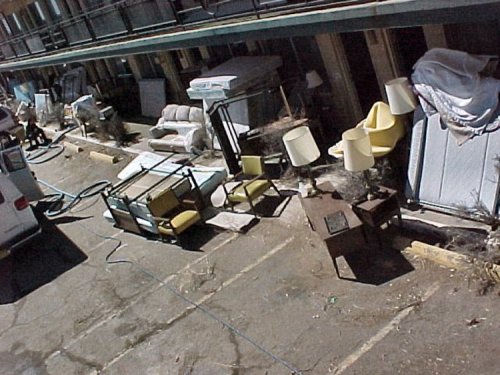
During the hardest, leanest times of my life, shortly after Y2K, I used to visit with the Korean guy who owned the trashed out motel across the parking lot from the Chinese joint my one-room apartment was situated behind.  [I mentioned that motel before because one of the scenes from the movie 21 Grams was filmed there.]

Kim, the old Korean guy used to come over and we’d drink coffee and talk about Korean places we both knew.  He’d stare around him and say, “Man, you are POOR!”

Me:  I ain’t poor.

Kim:  This is America!  You don’t have to live this way.

I did odd jobs of handyman work for Kim to make a little cash sometimes, so I didn’t boot him out on his ass, calling me poor.  And one day Kim offered me a proposition.

Kim told me there were wealthy families in Korea who had daughters they’d love to see become US citizens.  Said they’d pay a man thousands of dollars for marrying one of them, staying married long enough to get her papers completed, then divorce.

He made it clear this would be strictly a business proposition.  No kissee kissee fickycick in the deal.  Cash and carry all the way.

Kim offered to put me in touch with some Korean families who were in the market for that kind of work.  I thought about it long and hard, but one thing led to another and I never did it.

But I was telling Jeanne about it on the phone, just remembering, a while back and it came to me.  I’m betting there’s a lot more of that nowadays than there was then, and that the price is sky high.  I’d bet there are Japanese who’d pay out the wazoo to get a piece of their gene pool somewhere east of the Mississippi river these days.  Not to mention rich Chinamen, Koreans, Malasians, hell, who knows.  Maybe even Arabs.

Hell, I’m thinking if times ever get really hard I’ll trim my mustache, polish my boots and go after some of that easy money if the price is right.  The world’s full of pest holes I’ll bet rich wealthy people with Swiss bank accounts would love to get their daughters out of.

Wonder if old Kim’s still owner of that motel.

Old Jules

The Irish and the Jews – Ireland and Israel

Hi readers.  Thanks for coming by for a read.

I was trying for the past few days to think of a modern ethnic analogy to Jews, searching my mind for something to compare Israel to in modern and less-modern times.

Finally it dawned on me.  The Irish and the Jews have a surprising similarity in history.  Pre-diaspora Jews revolted, revolted, revolted against the Roman Empire occupation.  And for 500 years the Irish revolted, revolted, revolted against the British depredations of Ireland.

Both groups have profound ethnic identification, geographic identification with ‘homeland’, and conspicuous religious doctrinal loyalty.  Both groups have been reduced by starvation, by ethnic bigotry from ruling governments, by slaughter.  Both have been endlessly persecuted by those with the power to persecute them.

For 500 years the British did everything a civilized power could do to empty Ireland of Irish and for 2000 years the European states and Russia did everything they could do to rid themselves of Jews.

All that ended with the Irish independence resulting from the last revolt in 1922, and the creation of the State of Israel following WWII.

During the decades following independence Ireland flourished for the first time in its history.  Became, over the decades, the seventh most developed country in the world and among the wealthiest in GDP.  Probably the most peace-loving country in the modern world in the 5/6th of the island where British no longer rule.

Israel flourished, too, though it couldn’t be accused of being peace-loving.  Almost every moment of Israeli history includes brink-of-war scenarios.  The early 20th Century British clich’e, “The Irish brought most of their troubles on themselves,” found its way into Israeli explanations of their difficulties with their own Irish/British analogy.

In view of the similarities that contrast between warlike and peace-loving is surprising.  Rhymes more with relations in Northern Ireland and with the British.  Religious partisans might suggest it’s the difference between the Old Jehovah and the New Jehovah.  But history argues otherwise. 

Seems a lot more likely that, while Ireland is strictly neutral, Northern Ireland is still aligned with the British and by extension, the US.  So is Israel.  And while Ireland is finally completely free of British oppression, Northern Ireland isn’t, and by contrast adopted something akin to Zionism in an attempt to rid itself of Britain and the British.

Terrorism, intimidation and threats.  All the usual suspects from the bad old days.  Jews and Irish.  Israel and Northern Ireland. 

Something to ponder.

Old Jules