Tag Archives: Japan

Tokyo uppercrust fashion challenges of the future

Blue, or yellow? Which goes best with white? Which does the discriminating Tokyo party-goer find contributes to the alpha image?

Keeping up with the latest footware fads is becoming a challenge in Japan.  As the Nipponese citizenry leans increasingly to the clothing styles depicted in the photograph weighty fashion decisions will be required.

Old Jules

Lucky to have good allies

Thanks for coming by for a read, readers.

I was talking to an old guy in town the other day about how lucky the US is to have good, strong allies in this dangerous world.

Him:  Not many countries have been that lucky.  A lot of them hardly have any allies at all.

Me:  Good point.  Korea’s a good example.  If we didn’t have Korea for an ally there’s no telling what would have happened to Japan.  North Korea always threatening to nuke Japan, and all.

Him:  That’s right.  We have to keep a lot of troops over there to keep the North Koreans from invading our ally, South Korea, and nuking Japan.  Old Dugout Doug MacArthur had it right when he said, “Korea’s a dagger pointed at the heart of Japan.

Me:  Yeah.  Costs a lot, but it’s worth it to protect a good ally.  Too bad Japan and Korea don’t have more friends and allies, though.  They’re rich as hell and if some other country could help protect them we could bring some of our troops home.

Him:  No way we can do that though.  We’d no sooner pull our troops out than someone would be going after Japan.

Me:  Well, I suppose it might not be so tempting before too long.  A nuke from North Korea won’t add much to what’s already there the way things are going.  And invading a country wouldn’t be much fun if the invading troops have to wear radiation suits to keep from being poisoned by radiation.

Him:  They are good allies though.  Korea and Japan, both.  I’d hate to see us have to get by without having them for allies.  They’ve done a lot for us.  Korea and Japan both.

Me:  I’m glad too.  It’s a scary world out there.  Without good allies like Korea and Japan things would be a lot scarier.  But we’re lucky we don’t have more.  I don’t think we could afford it.

Old Jules

Japanese whale hunting, seaweed, salmon and next year’s Toyotas

Hi readers.  Thanks for coming by for a read.  Toward the bottom of this post you’ll find my favorite quote for 2013:  Salmon News:  “We think something happened in the ocean.”

The good news is the Japanese are still eating whales, even though you could light up Tokyo with the radiation in a whale liver.  Seaweed, too, they’re still eating. 

[This sushi thing’s something I’m going to miss.  Used to always look forward to going to Tao Lyn Oriental Market in Albuquerque and buying packets of seaweed and sushi ingredients.  That’s probably something I won’t be doing again.]

The bad news is that the Japanese will likely pass up the rest of the human species in the race to the next evolutionary step.  Possible good news is they’ll devote that extra intelligence in the second head to actually improving Toyotas into the next evolutionary level.

http://factsanddetails.com/japan.php?itemid=879

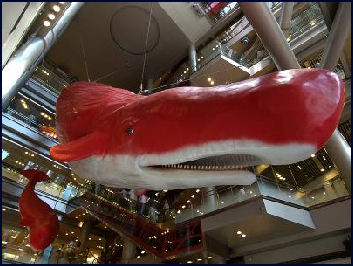
[Nice pic of a half-butchered red whale]

http://factsanddetails.com/media/2/20090819-Ray%20Kinnane%2030257371_redwhale.jpg


Love of Whale Meat in Japan

Home > Japan > 05Animals…

WHALES, WHALE MEAT, SCIENTIFIC WHALING, WHALE HUNTS AND JAPAN

Many Japanese, especially older and middle-ages ones enjoy eating whale meat. It is sauteed, roasted and eaten raw. Japanese say it tastes more like beef than fish. Whale bacon sells for as much as $180 a pound at gourmet food shops and dishes made with whale go for as much as $100 a plate at restaurants.

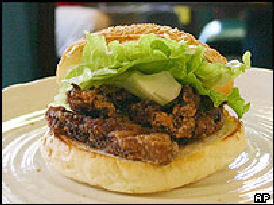
[Nice pic of a Japanese Whale Hamburger – tastes just like pork or chicken]

http://factsanddetails.com/media/2/20090819-minke%20whale%20bruger%20at%20hakodate%20restuarants%20BBC%20_40657000_ap_burger203.jpg
 Whale meat is dark red and doesn’t look at like fish meat. Japanese consider blue, fin and sei whales to be the most delicious. Sperm whales aren’t regarded as very tasty. Humpback meat isn’t considered that good but the organs are palatable. Japanese generally like minke whales less than other species because they are small and don’t contain much fat, which is what the Japanese love. Meat from minke whales is the easiest to get today. Before the 1987 ban on whaling the Japanese didn’t even hunt them.
 Whale meat in Japan has traditionally made into stews with soy sauce and spinach. These stews are now made with beef or pork. In the whaling town of Wadamachi in Chiba you can get whale steaks, whale jerky, carved whale-tooth jewelry and even a one-meter-long decorated whale penis. Some towns sell whale nose cartilage pickled in sake in cans with a spouting whale. Those who have tried it said the cartilage has a crispy texture and a pungent taste.
 Taruichi, a Tokyo restaurant that specializes in whale meat, offers 36 choices: fried whale, whale bacon, whale heart, whale testicles, whale kidney and even ice cream made with whale fat. Boiled tongue is said to be particularly delicious. At whale restaurants in Shimonoseki you can get fried whale tail, grilled whale tongue wafers, boiled blubber and whale sashimi. In some places you can get sliced whale skin and whale burgers made with fried minke whale.
 Whale meat distributors claim that whale meat is high in protein and low in calories and have alleviated the problem of toughness associated with whale meat through improved freezing techniques. The tail meat sells for as much $70 a pound and is prized for whale sashimi. which is eaten with grated garlic or ginger to mask the odor. The health benefits of whale meat is a matter of some debate. On study found that Japanese in Wakayama Prefecture that eat pilot whale have high levels of mercury in their hair.

Meanwhile, this for you sushi lovers:

Southern California seaweed tests over 500 percent higher for radioactive iodine-131 than anywhere else in US
Thursday, July 12, 2012 by: Jonathan Benson, staff writer
Tags: seaweed, California, radiation

http://www.naturalnews.com/036449_seaweed_California_radiation.html
 

And this for you salmon lovers:

Salmon News:  “We think something happened in the ocean.”
http://portland.indymedia.org/en/2013/08/424670.shtml

Sockeye salmon at dire historic low on Canada’s Pacific coast — “We think something happened in the ocean” — “The elders have never seen anything like this at all” — Alaska and Russia also affected

Aboriginal people in British Columbia who rely on Skeena River sockeye are facing some extremely difficult decisions as sockeye salmon returns plunge to historic lows. Lake Babine Chief Wilf Adam was on his way to Smithers, B.C., on Monday for a discussion about whether to entirely shut down the food fishery on Lake Babine, something he said would be drastic and unprecedented.

Mel Kotyk, North Coast area director for the Department of Fisheries and Oceans said department scientists don’t know why the return numbers are so low. “[…] we think something happened in the ocean.”

“We’ve never seen anything like this in all these years I’ve done this. I’ve asked the elders and they have never seen anything like this at all.” said Chief Wilf Adam
These stories were posted up on enenews. This suggests a possible explanation is radiation from Fukushima. That is speculation at this point. It could also be climate change related.

In 2011, Arnie Gundersen, nuclear expert from Fairewinds said this: “So eventually though we are going to see top of the food chain animals like tuna and salmon and things like that that have this process bio accumulates. The bigger fish gradually get higher and higher concentrations. And I am concerned that the FDA is not monitoring fish entering the United States because sooner or later a tuna is going to set off a radiation alarm at some part and people are going to think it’s a dirty bomb or something like that. So that’s not here yet because the tuna haven’t migrated across the Pacific. But I am thinking by 2013 we might see contamination of the water and of the top of the food chain fishes on the West Coast.”

!n July 2012 Gundersen said this: “The federal and even state agencies are not measuring this… I’ve been working on the West Coast and I’ve been trying to get the people of Oregon to demand of their state, the people of Alaska to demand of their state: Check the salmon, it is not difficult, it’s on the order of $500 a fish. Of course you don’t have to test every fish, but let’s test a couple and see. Either alleviate the fear or announce that yes indeed they are radioactive.”

For now I’m thinking the seafood flavored cat food’s still safe provided it comes in half-inch thick lead cans.

Old Jules

If you can’t trust the Japanese, then who?

Hi readers. Thanks for coming by for a read this morning.

Most of you will probably agree the Japanese are the most intelligent, advanced, scientifically advanced, politically and economically savvy people on the planet. It’s the reason most of you are driving Japanese automobiles.

Think about it: Japan invaded and raped East Asia for a decade, was bludgeoned to death by a costly sea war followed by two atomic bombs before they’d surrender. And within half-decade the US was at war defending Japan. “Korea,” Doug MacArthur declared, “is a dagger pointed at the heart of Japan!”

Obviously the Japanese were one hell of a lot smarter than those governing the US. The bombed-out Japanese industries were rebuilt by US taxpayers, providing them with decades newer steel mills and manufacturing capabilities than those on US soil. Ultimately the result was decline in US production and the slippery slope decline of US economic stability.

Think about it: Today the Japanese have a better space program than NASA:

http://www.dogpile.com/info.dogpl.t10.6/search/web?fcoid=417&fcop=topnav&fpid=27&q=japanese+space+program&ql=

Japanese Space Program
JAXA, the Japan Aerospace Exploration Agency (former Nasda) is Japan’s version of Nasa.

  • Hayabusa was launched 9 May 2003. The probe sent to gather samples from asteroid 25143 Itokawa. After numerous glitches, the probe returned to Earth. Scientists have not yet opened the sample container.
  • In 2006, JAXA launched Akari, an infrared astronomy satellite. Its mission is to survey the entire sky in infrared. On 6 August 2007 it has surveyed 94 percent.
  • Selene was launched September 14, 2007. Selene was the largest lunar mission since NASA’s Apollo, Selene orbited the moon for 20 months. It provided data used to improve topological and gravity maps.
  • Oicets – This experimental satellite was designed to demonstrate optical communications between distant satellites. Launched in 2005, it was retired in 2009.
  • H-II Transfer Vehicle (HTV) first flew to the International Space Station on 10 September 2009.
  • In 2010 IKAROS probe was the world’s first spacecraft to use solar sailing as the main propulsion

The best engineers in the world are Japanese. Agreed? The most competent scientists in the world are Japanese. Agreed? The most savvy politicians and economists in the world are Japanese. Agreed?

If any scientists and engineers anywhere can be trusted to be right about important matters involving human science, engineering and environmental issues, the place to look for affirmation should be Japan. Agreed?

Japanese science and engineers designed and produced the three nuclear meltdowns at Fukushima power plants.

Are the most competent, advanced scientists and engineers in the world concerned about manmade climate change? Are they concerned about contaminating the North Pacific with radioactive cooling water? Obviously they are not.

After the disaster, then until now, have the most advanced, competent scientists in the world bothered to do anything to contain the cascade of environmental problems supposedly associated with nuclear fuel rods exposed to the atmosphere and sea water? They have not.

Japanese scientists and engineers knew everything they could know about the tectonic environment of Japan. They designed those plants and built them with all that in mind, took the worst possible scenarios into account. Obviously.

So how is it the populations of nations with less competent scientists and engineers, the people who drive Japanese automobiles, come to believe anything their own scientists postulate concerning other matters involving advanced science?

The most advanced, most intelligent, the most savvy scientists and engineers on the planet proved themselves capable of ignoring the obvious, of assuring Japan their nuclear power plants were safely constructed.

How can anyone bring himself to believe what any scientist, any engineer, any politician says about manmade climate changes? Particularly any scientist or engineer who isn’t Japanese.

Old Jules

When the world ended

Hi readers.  Thanks for coming by for a read.

Driving to Kerrville yesterday my mind wandered to the uncle of my ex-wife.  Uncle Ed.  Interesting man.

He was on the staff of Douglas MacArthur during WWII and was one of the first group of people into Japan after they agreed to stop fighting.  Stood on the USS Missouri while the documents were being signed by all the parties and served on MacArthur’s staff for a while when MacArthur was Supreme Commander of Allied Pacific Forces.

Uncle Ed had a lot to say about all that when he could find someone to listen.  I listened a good bit.

Ed thought there were a lot of serious flaws in the Japanese surrender speeches and documents by the Emperor and the other high-ranking Japanese officials.  Fact is, neither the Emperor, nor the high-underlings ever mentioned the word, surrender.  Nothing in any of it contained anything suggestingJapanese Imperial behavior toward the conquered lands was reprehensible, no mention was made of the treatment of prisoners, the tortures, the slaughters.

In fact, the ‘surrender amounted to a Japanese admission they’d tried to do what they thought was best for Asia and Japan, and lacked the moxey to pull it off.  The Emperor confirmed this as his view in a presentation to the Diet four days after the arrival of MacArthur onto Japanese soil.  Immediately following the speech by the Emperor his uncle, Prince somebody-or-other went further and proclaimed Japanese behavior was no different from the behavior of other strong, modern nations.  He pointed out they didn’t take Indochina from the Indochinese, but from the French, didn’t take Malaya from the Malayans, but from the British.  And so on.

Maybe it’s actually no surprise the Mayor of Osaka made his statements recently that the ‘comfort girls’ they forced to serve their troops were just a necessary evil to keep up the morale.

Carolyn’s uncle Ed recalled the Japanese aristocracy was egalitarian in this regard.  He smiled that within five days of the arrival of US troops in Yokohama they’d brought in hundreds of peasant girls to serve in brothels to keep up the morale of occupying US troops.  The money from those whore houses, the supposed, was the first significant US currency to circulate in Japan after the war.  A few hundred thousand GIs need a lot of comforting.

I don’t suppose there’s actually any reason the Japanese today should feel any shame and remorse for the actions of their grandfathers.  Any acknowledgement.  The fact is, Asia remembers for them, even though the US has forgotten.  Of all the countries in the world in danger of flexing their military muscles, probably there’s not one with as many willing hands on whatever it would take to stop them among their potential adversaries.

Digression:  Aside from the deck of the USS Missouri and the whore houses, one of Ed’s most vivid recollections of immediate post-War Japan was that every civilian vehicle he saw ran on charcoal.  Charcoal!  Imagine that!

Old Jules