First off, The Invader Cat’s not becoming a fixture around here. It’s just hanging around getting meals and paying the fare by being bullied by chickens and the other cats. It has a home somewhere. I’m certain of it because sometimes it vanishes for a couple of days.
But it’s not a fixture and it’s not becoming a fixture. Even though when I was putting the piece of the can of feed I’d saved for it down last night, it came within a couple of feet of me scratching it behind the ears.
Secondly, if you’re among those trying to figure out what’s not happening by tracking Ganymede, you’re a day late and a dollar short. Ganymede looks great at first, but the further you hone things down the more you’ll conclude something’s missing. I’d suggest doing some dizzying calculations correlating Ganymede positions with with the position of Mercury. Which, if you run through enough ways of measuring where they are, will give you a lot clearer view of what’s not happening.
Thirdly, I worked a lot on the brush dams in the ruts on the road coming down here yesterday in hopes of further rainfall runoff forcing the hill to give up more of the dirt it’s been bringing down from above. Over the years it’s gradually been filling the worst blow-out-a-tire, high-centering ruts. Now if we can keep getting a few of these male rains I think this will finish it off.
Which is to say, spectacular erosion won’t be happening and past erosion will have reversed itself somewhat.
Lastly, despite your hardheadedness on the issue if you’ve got any, cold weather isn’t happening.
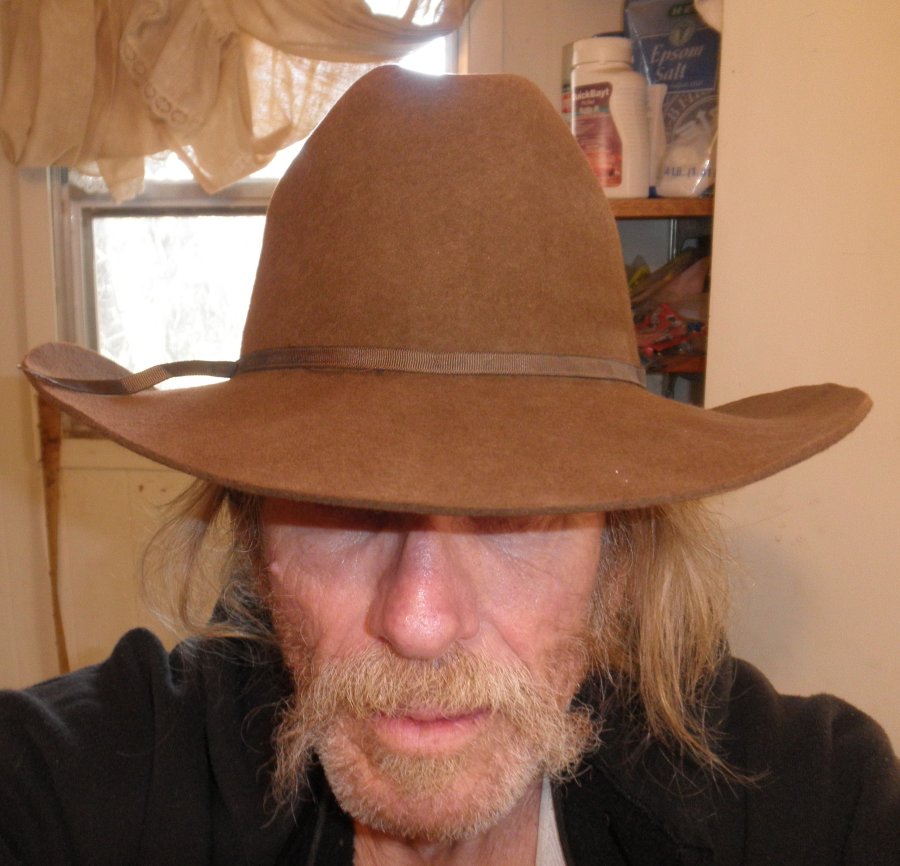
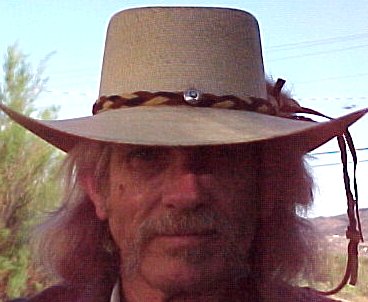
If you’re going to be a part of what’s happening you’re going to have to switch from felt to straw. If you try to hang on to your outdated good-times idea about felt you’re going to have sweat running down around your eyelids and getting into your ears next time you go to town. And you won’t be happening.
Just saying.
Old Jules
Edit 8:37 am: I neglected to mention earlier while talking about Mercury and Ganymede that Saturn seems to be happening a little bit. Even though it’s way to hell and gone off the other side of things where you’d expect it to have to be.
Good morning readers. Thanks for coming by for a read.
That adobe was built sometime in the 1930s as a turkey barn, then later converted to a dairy barn until the 1950s. The walls were 18 inches thick, the floor a couple of inches of poured concrete, flat roof that held several thousand gallons of water when snow accumulated on the roof and the canales intended to drain the melt became solid ice.
No heat, rotten iron pipes for plumbing, and a back wall ready to collapse next snowfall. The vigas holding up the roof, cracked timbers sagging with the weight of 75 winters. Roof leaking into the adobe walls, eroding them beneath the vigas enough to cause me to arrange the couch I slept on in such a way there’d be something between me and it if the whole thing collapsed.
The rent was so high I couldn’t afford to pay it, eat, feed the cats and pay the utilities, even with the intermittent jobs I could pick up. So they’d cut off the utilities every few months until I could raise the money to have them turned back on.
Maybe the best place I’ve ever lived. Certainly the hardest.
That last winter living there I was shovelling snow off the roof, slipped and fell into the snow on the ground below and lay there unconscious some undetermined time before I awakened and struggled indoors. Stove up something awful the rest of the winter.
But the cats loved the place and so did I, even as I watched the walls dissolve and the crack between the back room wall and ceiling widen. The near-certainty the house wouldn’t last another winter gradually had me wondering whether I could find a bridge to live under without giving up the felines.
Gale had been suggesting for several years that I move here and live in this cabin on his place. Another winter in Placitas, the cat necessities, and the vice grips of no-obvious-alternatives gradually persuaded me.
Gale and his brother drove up from Texas with a trailer, packed me up and hauled me, the cats, and all my worldly goods down here in one fell swoop. A person can count himself lucky if he can have one friend in a lifetime like Gale’s been to me.
For several years here it’s been easy to not think about what comes next, to just savor being here and the absolute luxury of not being in the joy of Placitas, the adobe, the proximity of some bridge to live underneath. We seemed a lot younger, that short time ago, Gale and me. The cats, too, for that matter.
But aging comes more quickly these days and it’s creeped into the picture until it fills it. The Coincidence Coordinators are nagging at me with increasing urgency and insistence to look for the next bridge not to live under.
So far I believe I’ve been the luckiest man ever to walk the face of this planet, possibly among the happiest. I’ve discovered I’m nowhere near as tough as I once thought myself to be and Placitas taught me I’m also not the pioneer my ancestors were. I wouldn’t change a minute of those years after I gave myself a Y2K, but I sincerely won’t regret not doing it again if I don’t have to.
But maybe now I’ve toughened up enough to make the next step as much a blessing as this one’s been.
I probably should post this on Ask Old Jules, but nobody much reads that blog. Not that it matters whether anyone reads it, I suppose. But if I’m going to compose words something in me likes it better thinking it will be read by someone else, than to just fade into oblivion.
I’ve been thinking a lot about this solitude addiction of mine lately, attempting to be candid with myself about it and what it means. The tripwire involved several emails I’ve received asking what makes me do it, want it, whatever. It’s plain enough the emails were sincere and genuinely interested, at least on some level. But it’s also patently obvious the concept is foreign enough to those asking to leave them without a foundation for thinking about it.
One of the emailers was a cautious man carefully lo0king for someone to keep an eye on a property he owns in a remote area. He’s somewhat caught between conflicting realities, I suppose. There’s a need for someone ‘responsible, someone he can trust. But anyone who’d stay there and do what needs doing is going to be a person he can’t understand, can’t identify with.
His concern’s legitimate. If he allows someone to occupy the place and they happen to be the sort to cook meth on the side, or grow illegal herb, he’s in danger of having the property confiscated. But he also runs that risk even if the grower or cook enter the unattended property without his knowing it. Absentee ownership isn’t as seductive a proposition as it once was.
But the email exchange did get me asking myself to form some candid understanding of exactly what motivates me and why I’m a lot happier not being around people much. And the eventual answer startled me a bit, seemed internally inconsistent.
I generally like people okay as individuals, I concluded, but dislike them in the composite. I don’t have much in common with groups, but I can almost always find something in common with individuals. So when I meet strangers in town I find I’m able to have friendly, enjoyable exchanges, though brief.
But I’m always acutely aware that each of those strangers is a part of some larger we, identifying with it, considering himself and it inseparable at some fundamental level. And almost every ‘we’ I’ve ever examined closely has led me to want nothing to do with it.
However, another piece of being around ‘we’ identifications scattered around all over urban landscapes is the forced realization of isolation and exclusion of a different sort than that of a hermit, deliberately self-imposing solitude.
The simple fact is, I get lonely and hell when I’m around people. And I’m not lonely at all when I’m not.
At least I think I might if I tried it. I actually don’t recall ever feeling lonely under those circumstances, though I do recall not caring for it.
Even the dispicable can’t always dodge the steamroller. Kaufman was rewarded, Greenglass spent a few years in prison, punctuated by testimonies before Congressional Committees to help forge a US package of ideas about a war on International Communism. Appropriate enough, liar lying to other liars to create a consistent set of lies. Not to suggest C0mmunists weren’t also lying. They mostly just weren’t elected and appointed officials sworn to uphold the Constitution of the United States.
Federal Judge Irving Kaufman, who subverted the legal processes in his own courtroom to predjudice the jury in favor of conviction of both Rosenbergs, then sentence them to death in the electric chair:
In 1953, Julius and Ethel Rosenberg were sent to the electric chair for stealing the secret of the atom bomb for the Soviet Union.
They were called the “Atom Spies,” and 50 years ago this summer, they were executed for giving the secret of the atomic bomb to the Soviet Union. They are the only Americans ever executed for espionage in peacetime. Greenglass was the star witness for the prosecution against the Rosenbergs – and he also happened to be Ethel Rosenberg’s brother. He served 10 years in prison for his actions as a traitor, and then changed his name and dropped out of sight. As he neared 80, Greenglass decided to break his silence. He talked only after 60 Minutes II agreed to disguise his face and voice.
His story begins in the summer of 1950 when the FBI took Greenglass in for questioning. He confessed almost immediately for spying, and quickly implicated Julius, Ethel and his own wife, Ruth. David and the Rosenbergs were arrested. Ruth Greenglass never was charged.
“That’s what I told the FBI,” says Greenglass. “I said, ‘If you indict my wife, you can forget it. I’ll never say a word about anybody.'”
It was quite simply his choice, he says today. So Greenglass says he turned on his sister to save his wife. “I would not sacrifice my wife and my children for my sister. How do you like that?”
Greenglass made his choice when America was at war with communists in Korea, and in fear of the Soviet Union, which had recently tested its own atomic bomb.
The four spies were unlikely actors in a Cold War drama: Julius was an unsuccessful engineer; Ethel spent most of her time raising their two young sons; Greenglass was a draftsman and a tinkerer; and his wife Ruth was a wife and mother. All had been ardent communists.
During World War II, Greenglass, then a sergeant, was posted to Los Alamos, the secret army base in New Mexico, where thousands of scientists and soldiers were building the atom bomb. Although he had a low-level job, Greenglass says he knew what was going on.
He says Julius Rosenberg recruited him to spy with a simple sales pitch: “He said, ‘We have to help our ally.'” By ally, he meant Russia. “Russia was an ally at the time, and that we have to help them with all the information we get.”
Greenglass told the FBI that he gave the Russians sketches and details on the device used to trigger a nuclear blast. But he says he didn’t enjoy being a spy.
“I was continually conscious of what’s behind me. I didn’t enjoy it. I just did it because I said I would,” says Greenglass.
Did he realize how dangerous it was? “I didn’t really think it was, because I didn’t think the Russians were an enemy,” he says.
His career in espionage came to an end soon after the war ended. Back in civilian life, Greenglass and Julius opened a machine shop together. They argued over the business, and over Greenglass’ growing disenchantment with Communism.
Four years later, Julius warned Greenglass that the FBI was on to them, and urged him to flee the country. Greenglass had a family passport picture taken, but he had no intention of using it.
“I didn’t want to leave the United States to go to some hellhole like Russia or China, or wherever the hell he wanted to send me,” says Greenglass. Instead, he took a bus to the Catskill Mountains. “I figured I’d find an obscure place. And I see that the FBI is following me. And they lose me.”
But he never made it to the Catskills. He went into custody instead. And within hours, he began cooperating with the FBI, sealing the Rosenberg’s fate.
He was the star witness for the prosecution at their trial, and he told the jury about his espionage, and described the activities of Julius, Ethel and his wife, Ruth.
He testified that one evening, he and Ruth brought sketches and handwritten notes about the atom bomb to the Rosenberg’s New York apartment. After dinner, Greenglass said they set up a typewriter on a folding bridge table in the living room, and turned his hand-written notes into a neatly-typed document for the Soviets.
Prosecutors asked Greenglass who did the typing. He said under oath that Ethel did the typing. His wife, who also took the stand, told virtually the same story.
That story was virtually the only evidence the government had against Ethel Rosenberg. But prosecutors argued that Ethel’s typing proved she was an active participant in the spy ring. After the trial, they admitted that without the typing testimony, they could never have convinced the jury that Ethel was anything more than the wife of a spy – and that’s not a crime.
Why did Greenglass lie on the stand? He now says Roy Cohn, an assistant prosecutor in the Rosenberg case, made him do it. Cohn went on to become Joseph McCarthy’s right-hand man.
Greenglass says that Cohn encouraged him to testify that he saw Ethel type up the notes. And he says he didn’t realize at the time the importance of that testimony.
But the jury knew how important it was, and found both Julius and Ethel Rosenberg guilty of conspiring to commit espionage. Judge Irving Kaufman imposed the death penalty.
Fifty years later, we know a lot more than anyone could have known in 1951. For example, we know that much of what David Greenglass said about Julius Rosenberg is true. It has been verified by other, independent, sources, all of which confirm that Julius Rosenberg was a Soviet spy. We also know that there is very little, if any, evidence that implicates his wife, Ethel, in any illegal activity.
But in the days before the execution, there were protests and vigils in New York, Washington and Europe. The Rosenbergs both claimed they were innocent, and many believed in them. There were a flurry of last-minute attempts to get a stay of execution. And there was no shortage of Americans who felt that justice was being done.
Up until the last minute, the authorities were willing to commute the death sentences if the Rosenbergs cooperated and named names. But they refused and were executed on June 19, 1953 – without ever breaking their silence.
Why did Greenglass think Julius and Ethel maintained their silence to the end? “One word: stupidity,” says Greenglass, who holds his own sister responsible for her own death.
—————————————-
But I promised a Denouement:
Of course, it makes no difference now. Any more than it matters who killed JFK, Robert Kennedy, MLK, and President Diem of Vietnam.
Doesn’t matter, really, any more than it matters that the Gulf of Tonkin Incident, the incident used to justify the US involvement Vietnam War, was a manufactured incident. A cynical lie to dupe the US public and arouse patriotic fervor. Same as the Rosenberg trial.
A pyramid of lies, once the foundation’s in place, builds on itself. Only the names of the liars and the names of the victims change. It’s only incidental that sometimes the victims are also liars.
If any lessons can be learned from it all it’s probably only that the romantic patriots can always be trusted. Trusted to believe the lies. The liars can’t trust one another, but they know they can always trust the romantic patriots.
The liars couldn’t succeed without them.
Old Jules
Today on Ask Old Jules on Facebook:
Old Jules, what’s your definition of an idealist?
An idealist is a person who locks his teeth into the ankle of an abstraction and doesn’t let go, doesn’t look for another ankle, doesn’t look closely at whatever’s above and below the ankle.
When Louis Nizer penned The Implosion Conspiracyit might be said enough time had passed to provide perspective. Two decades had passed since the trial and execution of the Rosenbergs rocked the nation. Nizer disliked Communists, asserted he’d refuse to defend one in his profession as a defense attorney. However, he wrote a lengthy analysis of the trial, the transcripts, testimonies, the individuals involved in an even-handed manner that wouldn’t have been possible during the Commie craze days of the events.
Basic events leading to the trial: The US was developing the atomic bomb at Los Alamos, New Mexico during the late stages of WWII. The information was being shared with the US Ally, Britain, but kept secret from the US Ally, the USSR. Elaborate security measures were in place to assure the developments remained the exclusive property of the US and British governments. Elaborate almost beyond description, devised by the US military and the FBI.
But the British liaison to the project was physicist Klaus Fuchs, a spy for the Soviet Union. The Germans knew Fuchs to be a Soviet spy, but the British and Americans didn’t, until they gained access to records captured as they advanced into Germany.
Aside from Fuchs, the other USSR source for information about developments at Los Alamos was David Greenglass, a US Army machinist and brother to Ethyl Rosenberg. Greenglass had been a Communist his entire adult life and had been separated from an earlier military job because of questions about his loyalty and honesty.
David Greenglass stole the crucial secrets of the lens molds used to detonate the bomb, the implosion device. By hindsight, it’s clear he did it for money, for the same reasons he stole automobile parts, uranium, anything he could lay hands on to sell on the black market.
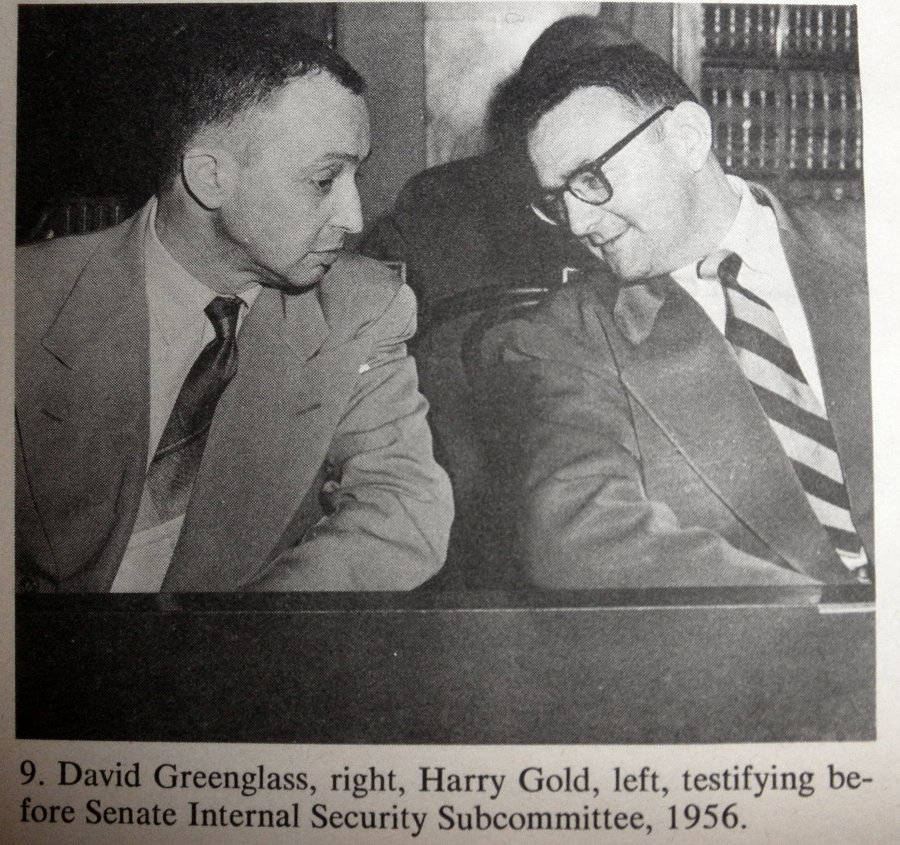
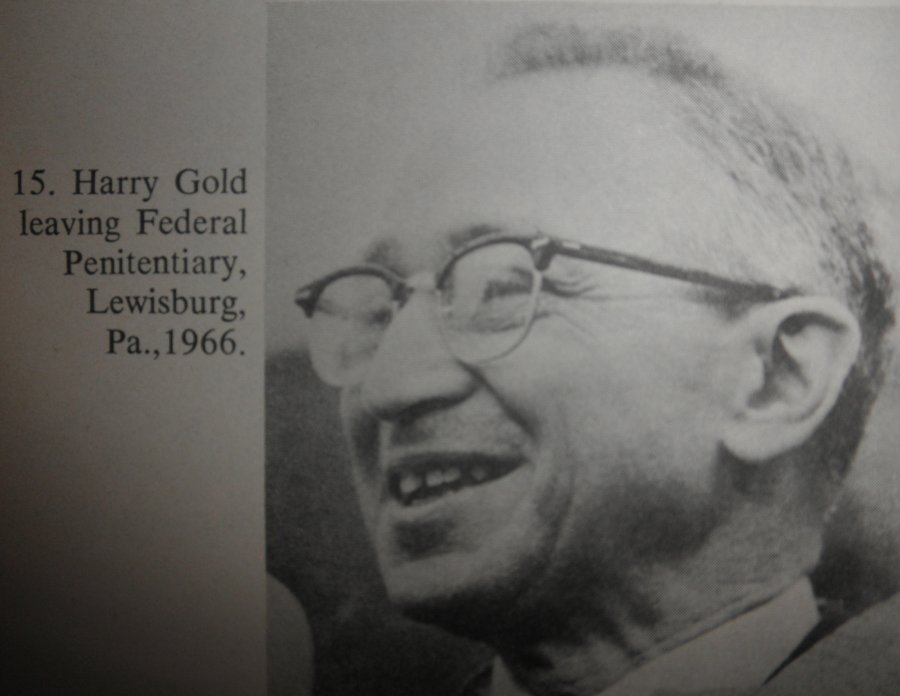
Greenglass passed the secrets to his wife, Ruth, who passed them to Harry Gold. Gold was the direct connection to the Soviet spymaster, Yakovlev, in the Soviet Embassy. It’s clear enough from everything provided in evidence and testimony that Gold was a man without loyalty to any nation, ideal, idea, or human being other than himself. He did it for the money and for no other reason.
The testimony of Greenglass, awaiting trial for treason, and his wife, Ruth, who was never charged, provided the testimony connecting Julius and Ethyl Rosenberg to the plot. The witness stand accusations by Greenglass against his sister and brother-in-law, and the corroborating testimony from his wife, who didn’t yet know whether she’d be charged, constituted almost the only evidence of the prosecution. The other witnesses directly involved in the plot mostly did not know the Rosenbergs, or barely knew them and knew little of their activities.
Because of the weakness of the government case insofar as testimony and physical evidence of the Rosenberg involvement in actual spy activities, the focus of the prosecution became a trial of Communist ideology. Witnesses who knew nothing about the plot, the bomb secrets, the Rosenbergs were called to testify about how they’d switched their own loyalties from Fascism to Communism, then become loyal US citizen-experts making a living selling books and giving lectures on the insidiousness of Communism.
The trial transcripts excerpts Nizer provides make it clear the Defense had two opponents: the US Attorney prosecutor, and the judge, who constantly intervened, interrupted, interjected in ways clearly intended to prejudice the jury against the defendants.
The key players who gave, or sold the atomic bomb to the USSR in 1945 went free, or were given relatively light sentences.
The Rosenbergs, clearly Communist idealists, possibly part of the plot, died in the electric chair.
When Allied forces found documents in Germany revealing Fuchs as a Soviet spy the chain of resulting indictments followed a path to almost all the conspirators except the Rosenbergs. Before spymaster Yakovlev fled the US, during his last meeting with Gold, he made the following observations:
Yakovlev: Don’t you remember anything I tell you? You’ve been a sitting duck all this time. We probably are being watched right now. How we pick such morons I’ll never understand! We’ve been living in a goldfish bowl because of you. Idiot! Idiot!
I am leaving the country immediately. I’ll never see you again. Just go away. Don’t follow me.
He went.
But the answer to Yakoviev’s question is worth an answer. They recruited from the US Government, the US military, from US universities, from US businessmen.
From the same pool of applicants who later sold their industries, their industrial tools, secrets, capabilities, economies, and debts to the Peoples Republic of China and other foreign nations.
They weren’t Communists, like the Rosenbergs. They were opportunists, entrepreneurs, devil-take-the-hindmost politicians, like their descendants a few generations later.
Old Jules, does an animal’s life mean as much or nearly as much to you as a human’s, or do you feel animals are insignificant/worthless in comparison? Also, do you believe it is ever morally right to harm/kill animals? What about humans?
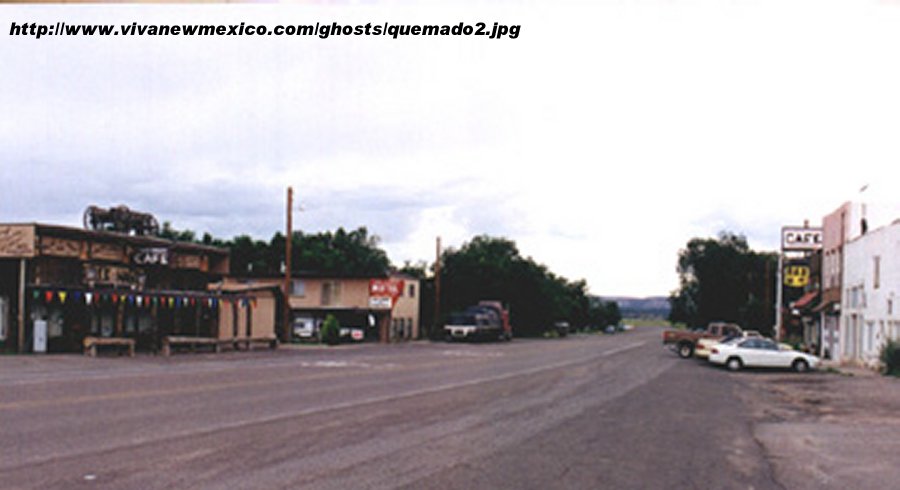
It must have been an Eve, Christmas or New Year, 1996 or 1997. Keith and I, or Mel and I were partnered that trip and the cold, or the mud drove us into town. We got a room in the motel you see just beyond the cafe with the chuckwagon on the roof. Quemado was dead, every business in town shut down except the bar underneath the yellow sign on the right side of the picture.
Sometime after dark we wandered across the highway to the bar. A couple of pickups were parked in front and we hoped there’d be a hamburger and beer to be had. At least we figured it would be warmer than the motel room.
We stepped up to the bar and examined the half-dozen other customers through the smoke as we pulled off our coats. Behind the bar a guy probably named Bad Teeth was grinning, looking us over. Same as everyone else in there, all of whom appeared to be ten-generations of first cousins inter-married to Bad Teeth’s ancestors.
“Any chance of getting something to eat?” The faint odor of hamburgers lingered in the background.
Bad Teeth just grinned and looked past me at the badasses huddled over one of the tables. “You won’t be here that long.”
“Long enough for a beer, anyway.” My partner was showing signs of irritation.
“Only certain kinds of people come in here.” My eyes followed where Bad Teeth was pointing at the cluster of bullet holes in the ceiling. “Nobody else stays long.”
But my partner, Mister Wiseass, wasn’t looking at the ceiling. He was letting his gaze size up all the drinkers, them doing the same to us. “Gay bar in Quemado?” He poked me in the ribs with his elbow, laughing. “He’s right. If anyplace else was open we ought to go there.”
The door was only a few steps away. I grabbed his arm and headed for it. “Let’s go there anyway. The smoke’s stuffing up my sinuses.” I suppose we’d have just been too much trouble. Nobody followed us out to the street.
Or maybe it really was a gay bar. I’m happy enough not knowing.
Bad judgement was driving to Quemado instead of another 80 miles to Springerville, AZ, if we wanted something as complicated as a hamburger. Just saying.
When Ned Sublette used to sing the song linked below at a honkytonk out on the West Mesa in Albuquerque he always got out alive. Maybe all those cowboys were just glad someone finally said it.
Old Jules
Ned Sublette: Cowboys are Frequently, Secretly Fond of Each Other:
Good morning readers. Thanks for stopping by for a read this morning.
Those of you who haven’t been getting enough magnetism in your areas will be glad to know we’ll be having a nice little geomagnetic storm today.
CME TARGETS EARTH, MARS: A coronal mass ejection (CME) launched from the sun on Feb. 24th appears set to hit both Earth and Mars. According to analysts at the Goddard Space Weather Lab, the cloud should reach Earth today, Feb. 26th around 1330 UT, followed by Mars two days later.
The CME was hurled into space by a filament of magnetism, which rose up from the sun’s northestern limb and erupted on Feb. 24th: SDO movie. Although much of the cloud headed north, out of the plane of the planets, the cloud’s lower edge will dip down low enough to intersect Earth, Curiosity, and Mars.
It couldn’t have come at a better time here. The ranchers have been complaining something awful about the magnetic drought.
Meanwhile, it’s mostly business as usual here. When I went out onto the porch to say my hellos to the felines it was all present and accounted for except the invader cat. It was out there last night, but I figure it’s commuting to whatever place it has real people somewhere, keeping them on edge, then hurrying back here where things are really happening. But that leaves it open to the possibility of missing something both places.
I’m thinking it will carry on this game as long as it thinks it can get by with it at both ends.
Those of you who believe radio waves are messing with your heads will be gratified to know there’s a place in the US where you can get away from it.
There’s a 13,000-square-mile section of West Virginia known as the Quiet Zone where there’s no WiFi, no cell service, and strict regulations placed on any device that could pollute the airwaves. Those unique conditions are enforced (and aided by the surrounding mountains) to protect the radio telescopes in the area from interference, and it’s hardly anything new — as The Huffington Post notes, Wired did an extensive profile of the zone back in 2004 (the area itself was established in 1958). But as the BBC recently reported, the Quiet Zone is also now serving as something of a refuge for people who believe that wireless technology makes them sick — a condition sometimes called Electromagnetic Hypersensitivity (or EHS). Those claims are, of course, in dispute by most medical professionals, but that apparently hasn’t stopped folks from calling the local real estate agent “every other week or so” to inquire about a place in the zone.
For those who don’t want to migrate to West Virginia, however, experts suggest a person might just hit the switch at the power pole and see whether it results in any improvement.
One body of opinion leans to the thought that radio waves have a lot more influence on the human mind when they’re allowed to enter an antenna, swoop down through some receiver to an amplifier, then out to a speaker. Then back through the air where they encounter a human ear.
Making sure those radio waves don’t get passage through and convert themselves to something the human mind can interpret into pictures and words, those experts say, interrupts the damage they can do, or at least reduces it.
Almost no one here is qualified to tell you how not to blow yourself up, but one of our favorite members and one of the Group’s founders, Art Corbitt, would rail about ammonia in lraches being explosive. Keyword fulminate.
Cyanide tailings are the wirst offenders, so one really has to process that out before extraction.
Geology degrees I am told could have morr chemistry and mechanical engineering, so this may be normal for the industry.
Good morning readers. Thanks for coming by for a read.
After I finished my morning download ritual this morning and prepared to go outdoors to bring up Old Sol and turn out the chickens I checked Ask Old Jules Biggest Regret?to see which of my brainstorms of the past she’s picked for the day. I take a lot of things about myself for granted and occasionally one of my answers rattles me a bit, gets me asking questions about me and what makes me tick. This morning is one of those.
Sitting out there under the tree I found myself asking, “What in the dickens is wrong with me that I feel so content and can’t come up with anything to regret? It ain’t as though I haven’t gone the last mile to assure myself of plenty any sane person would prefer to be otherwise.”
I can’t guess how many people live the way I do, close to the cuff, physically having to force myself to maintain a comfort range that includes whatever the Universe tossed my way. Probably a lot do in the poorer countries, but likely not too many within the boundaries of the US. But when I see some evidence of them, I generally find myself on the edge of feeling sorry for them.
But meanwhile, I’m about as content, almost euphoric about my own life most of the time as a person could be. Yeah, there are nagging things need doing, need changing, forever being pushed forward in time for one reason or another because of limited options. But they whisper from the wings and mostly I don’t pay them any mind.
“Would I like, or trust someone like me if I came across him?” That’s what I finally found myself asking. And the answer’s a bit confusing to me. “No,” I’m forced to admit, “I probably wouldn’t. How the hell could you trust someone like that? “
“So, do you want to change it?”
“I’d hate to. I’m more-or-less fond of being happy. But it might be better to cultivate some regrets, some yank-your-heart-out-things I wish I’d done differently. This satisfaction thing can be taken too far.”
Cultivating regrets, yearnings, deep feelings of loss might just be what it takes to live a life of fulfillment. It would open the door to finding things to be scared of, frightened they’d happen. Angry because they did, or didn’t.
If it hadn’t been for an old friend who was a pilot telling me I could fly an airplane as cheaply as I could spend an hour on the range practicing with a large-bore pistol every week, I’d probably never have thought of doing it. But something about the idea grabbed me.
I went out to the Killeen, Texas airport and took a few lessons to find out whether flying was one of the adventures I wanted to give myself this lifetime. Turned out there was no question in the question.
But being a man of ideas, not much time passed before I decided I could buy an old aircraft and save a lot of the cost of renting one while I learned. A 1947 Cessna was sitting on the strip with a for sale sign on it, that one at the top of the post, so I bought it.
But finding an instructor to teach me to fly a taildragger cut down a lot of my options. I ended up with a guy named John Rynertson, who introduced himself by saying he was one of the best pilots around. He owned a Cessna 120, and John taught me enough to get me started.
But we had a falling out, him not soloing me in a timely manner, me thinking he wasn’t doing so because he wanted to maximize the trainer fees. One day we landed, me thinking this was the day of the solo, and he sneered I wasn’t ready yet. We were standing by the airplane, so I climbed inside, started the engine and taxied down to the end of the runway, gave myself my first solo flight, illegal.
John and I didn’t have much truck with one another after that. I flew that old Cessna without having a ticket allowing me to do it, while he flew his C120 up one day and pulled the wings off it in a snap-roll, killing himself exactly the way a man ought to do if he’s going to pull the wings off a Cessna.
I didn’t realize it at the time, but I’d taken off downwind for the first time. I couldn’t find another instructor, and I was relocating to another town at the time, where nobody knew me. So for several years I flew that Cessna, 500+ hours flying time, as though I was entirely legal. Flew out to New Mexico, over to Savanna, Georgia, sleeping under the wing along the way, with no license to pilot an aircraft.
But eventually word got around the Georgetown Municipal Airport and someone cautioned me the FBO was going to rat me out to the FAA. I decided it was time to complete my training. Found an old outlaw pilot to sign me off and made an appointment with the FAA examiner in Austin.
When he looked at my log and saw I had 500 hours he shook his head a longish time. “I’ve been checking out pilots for thirty years. Before you the one with the most flying hours I’d ever seen was a guy with 100 hours, and he almost killed me during the check ride. Couldn’t fly an airplane.”
I grinned at him. “You care to watch me take it around the patch a few times before we do the check ride? I’ll get the numbers every time around and turn off by the first taxi way.”
We did the check ride and I flew back to Georgetown legal, for the first time.
74 years old, a resident of Leavenworth, KS, in an apartment located on the VA campus. Partnered with a black shorthaired cat named Mister Midnight. (1943-2020)
Since April, 2020, this blog is maintained by Jeanne Kasten (See "About" page for further information).
https://sofarfromheaven.com/2020/04/21/au-revoir-old-jules-jack-purcell/
I’m sharing it with you because there’s almost no likelihood you’ll believe it. This lunatic asylum I call my life has so many unexpected twists and turns I won’t even try to guess where it’s going. I’d suggest you try to find some laughs here. You won’t find wisdom. Good luck.






 So Far From Heaven
