
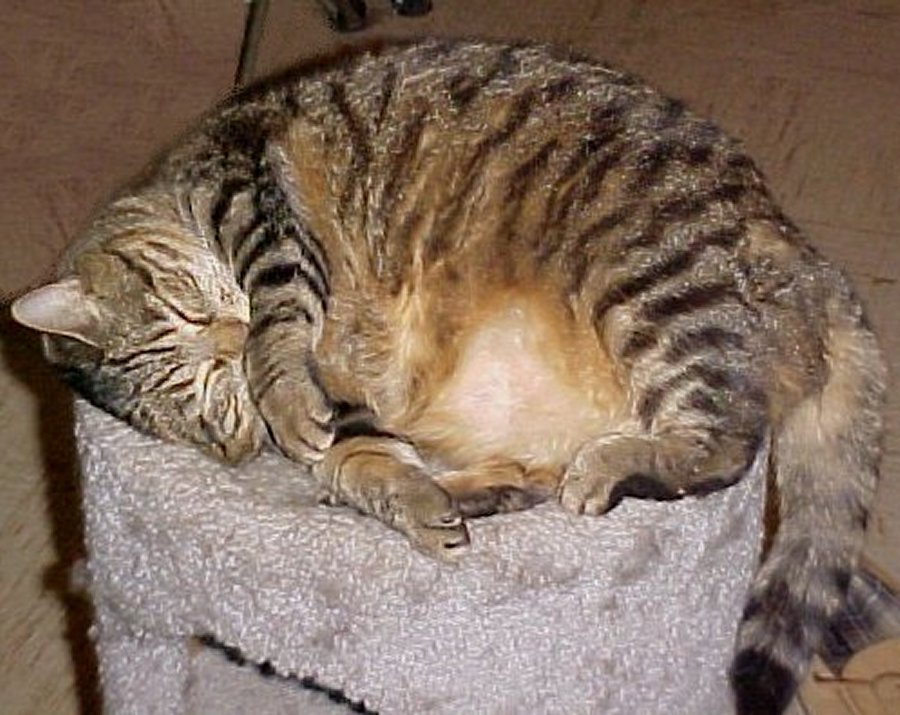
Hydrox jumped off my lap and stalked over to the bed.
“Sometimes you human beings disgust me with your pretense.”
Him being second-in-command around here, I try to keep him up-to-date on my thinkings and directions. Seems prudent to me because he’ll have to take over if I kick. I’d just been asking him if he thought we could get along okay living in a travel trailer.
“Just what ‘we’ are we talking about here? You and me? You and all the cats?” He glared at me. “You, the cats and the chickens?”
I shrugged, wondering where he was going with this. I felt a tirade in the making. “Just you cats and me. The chickens can’t be part of it.”
“Well, that’s a relief, anyway. But I think you need to think through this second-in-command crap and all the what-if-you-ain’t-around side of it.” He gestured with his nose toward the porch. “The only ‘we’ worth talking about involves mutual resolve. Creatures willing to allow the well-being of others within the ‘we’ to influence what they do. No creature unconcerned for the well-being of the others, no creature the others don’t have a commitment to, can be part of a meaningful ‘we’.”
I thought about it a moment. “That makes sense. It’s why I was trying to keep you up-to-snuff on things.”
His frustration was obvious. “Yeah, and that’s where you’re proving how stupid you are. For me,” He tweaked a claw under his chin, “the only ‘we’ around here is you and me. And maybe Niaid, just a whisker.”
This rattled me, but he went on before I could say anything. “When that coon on the porch ran at you and I jumped in, that’s ‘we’. When you go to town and buy food for us, that’s ‘we’. But do you see Tabby or Shiva the Cow Cat lifting a paw for me if I was starving? Do you see either of them jumping in if a coon attacked me?”
He waited while I considered it. “I suppose I don’t.”
“Then they’re not a part of any ‘we’ I belong to.”
The more I pondered it the more it seemed to me he’d come upon an important thread in the fabric of reality I’d been overlooking. Not just with cats and chickens, but with every piece of human intercourse around me most of my life.
When a person goes down to City Hall, or the County Courthouse to perform some necessary business, for instance, and the clerk begins the ritual of obstruction, a ‘we’ is in the process of being defined. The clerk is the spear-point for a huge ‘we’ of contradictory demands on the ‘we’ you occupy.
“Do you have proof of residence?”
“There’s my driver’s license.”
“That’s not enough. I need a utility bill or tax return.”
“I didn’t bring that.”
“Then I can’t help you.”
The ‘we’ that clerk represents just defined a boundary excluding you from that ‘we’ and placing you inside another ‘we’ it considers an enemy. And in a real world, that definition would be mutually recognized, rather than singularly by the human spear-point drawing the boundary.
Which is probably why representative democracy was doomed to eventual failure. In a fantasy of wishful thinking a population created ‘we’ with a set of unrealistic boundaries. When new ‘we’ entities developed around government centers those included in the ‘we’ tribes were those they associated with, lived near, shared a commonality with. In Washington, D.C. In Austin, Texas.
And inevitably those outside that ‘we’ became an obstruction, a product, an enemy to their ‘we’.
“The only ‘we’ worth talking about involves mutual resolve. Creatures willing to allow the well-being of others within the ‘we’ to influence what they do. No creature unconcerned for the well-being of the others within the ‘we’, no creature the others don’t have a commitment to, can be part of a meaningful ‘we’.”
Sometimes it takes an outsider to the human ‘we’ constructions, a feline with a firm hold on reality, to recognize the obvious.
Old Jules
“Electing pet skunks to guard the henhouse might work for a while. But the skunk-instincts and chickens behind the walls they’re guarding metamorphoses the ‘we’ they live in. The skunks become a we with a priority of digging under chicken-house walls and the we of being pet skunks fades until it no longer can call itself a we.” Josephus Minimus











 So Far From Heaven