Category Archives: 1990’s

Protecting the Aristocracy From Mutants, Muslims, Mormons and Malcontents

Good morning readers. Thanks for coming by for a read this morning.

During almost a decade when most of my salary was paid by FEMA I used to have to go to FEMA Regional Headquarters every quarter for meetings with people doing the same job I was doing in New Mexico, but from Oklahoma, Arkansas, Louisiana, Texas, and hmm if there’s another state in this FEMA Region I can’t recall it at the moment.  But you get the idea. 

Fairly dreadful meetings and nowhere near as interesting as the weeks spent in the training center at Emmitsburg, MD, or the various other meetings in places where there were Civil War battlegrounds to drift off and walk around on studying how those poor bastards delt with their differences of opinion.

But that’s another story for another time.

The Regional meetings for Emergency Management people and Flood Plain Management people were held on the top floor of an amazing bunker complex at FEMA Region 6 Headquarters outside Denton, Texas.  A venal, truly hidebound lot of bureaucrats we were, too.  Although the worst of us was nowhere near as anal, ugly, downright arrogant as the FEMA people.

And that was before 9/11 and FEMA becoming a part of Homeland Security.  I hate to think how it must be today.

But what I wanted to tell you about is that bunker complex.  Damnedest thing I’ve ever beheld this side of Carlsbad Caverns if it was set up for the US Congress, the 82nd Airborne Division and MD Anderson Hospital were all planned to be housed inside it.  For a long, long while.

Just the parts I was allowed to visit and mull over were several stories underground and probably several acres diameter.  Above ground under all the festooning of antenna, cable and concrete was a pillbox so the people underground could go up and peek out to shoot the occasional mutant, malcontent, or just enjoy the sight of all the devastation.

The first level entryway was a hallway with sprinklers to wash off the radioactivity lingering on anyone going inside, along with slots to allow shooting anyone who didn’t use soap or wash long enough.  And just beyond that was a huge freezer for dragging the carcasses into of people who either got shot or didn’t get clear of the radiation quickly enough to avoid the blind staggers.

Nearby was a huge, amazing, pristine, empty hospital complex with supplies, stacked along the walls, equipment, tables, clean shining stainless steel waiting for some doctors to show up to treat any patients that might show up.

Next floor down was the ‘Continuity of Government’ facility.  A place designated for the Governors of all the Region 6 States, their staffs, their families to wait out whatever difficulties led to them being there.  Hallways with State Flags for each of the member States hung in front of entranceways to avoid Louisiana confusing itself with New Mexico.

An entire floor was devoted to warehousing food, water, all manner of supplies the people living down there would be consuming.  Another floor devoted to Security and Military personnel, along with their equipment and ammunition.  That floor also contained the communications equipment so’s they could talk to anyone who still was alive outside and able to speak English.  Or to whomever else was left out there with radio equipment still working.

And those were just the floors I was allowed to visit.  The FEMA folk hinted there was a lot more, winked knowingly, but wouldn’t discuss what was there.

Soothing thought, I found it, knowing the government had arranged for a place for all those folks I considered more important than regular people to get in out of the rain and keep doing whatever needed doing for the people outside with their eyeballs running down their faces and their flesh sloughing off.

I surely hope they’re still maintaining those bunkers.  I’d hate to think the politicos aren’t being looked after if something happens.

Old Jules

Portales, New Mexico’s Multi-Phased Personality Test

I found out the other day there’s another occasional reader here shared classrooms and the seven-year drought with me in the 1950s.  Surprising, the people of that town and that vintage clicking to remember.

Every kid in Portales, New Mexico, believed Gene Brown and Bobby Thomas were lower trash than they, themselves were.  Including me.  I can’t recall now why they believed it, though both started smoking before they learned to masturbate, most likely.

But maybe the fact both kids were considered such lowlifes explained the reason I ran around with them a while, caught those freight trains to Clovis with them.  [Riding the Rap]. 

Bobby Thomas quit school, lied about his age and joined the army when we were 9th graders.  The next time I saw him he was a different person from the buzzard-necked, shunned youngster he’d been.  I’ve often thought quitting school, for him, must have been a cheap price to pay for an opportunity to be out from under the pall of scorn the town piled on him for being whatever they thought he was.

Gene Brown, on the other hand, was still vilified as one of the historical lowlifes 30 years later when I went back for a visit.  Never saw him, but I was surely impressed with how the sign the town stamped on his back stayed through the decades.  Likely he came by it honestly.  Certainly early.

On the other hand, a lot of the higher society folk who shunned those two managed to make lousy enough choices in life to earn their later reputations as lowlifes.   And some of the kicked around, not-quite lowlifes did impressive, though maybe meaningless things with their lives.

My old friend, Fred Stevens, who spent early years as a hotshot savings and loan president, went down with the ship in the mid-80s crash, was as solid a citizen as I’ve ever known.  But he assured me I’d have thought differently if I’d known him as an S&L president.

I’m sorry I didn’t get up to Seattle for a chance to reacquaint myself with the other banker from our kidship, but after he’d chosen to live under a bridge instead of running a financial institution.  [Could you choose to live on the street?]

But I think the one I’d like most to know before I die is the one walked around the corner from a class reunion at the Cal Boykin Hotel in the early 1990s.  Reunion for the grad classes 1960-1970.  Fred Stevens told me about it.  One of the attendees walked into a bank branch a block from the Cal Boykin Hotel and stuck it up.  Walked clean away with $1500 and a well-deserved place in local legend.

I hope he’s remembered.  Wish I’d thought of it and had the brass to do it.

Old Jules

Massacre Canyon – Long After the Dust Settled

Hi readers.  I might have once thought I knew what a massacre was, but time’s eroded my perspective.  During the mid-1990s I made the toughest backpacking trip of my life to spend 8-9 days in there to try for a better understanding of the subject.

Here’s the basic story of the events leading to it being named, “Massacre Canyon”:

http://www.livestockweekly.com/papers/97/07/03/3bowser.html

RETIRED GENERAL Michael Cody served in a somewhat more modern army than the men he and others honored recently at Massacre Canyon in New Mexico, but Cody’s army still traces its history to the men who helped open the West. A student of the era and the area, Cody has an affinity for and an understanding of the men who fought on both sides of the conflict more than a century ago.

Massacre In Las Animas Canyon
Led To End Of Apache Victorio

By David Bowser

HILLSBORO, N.M. — Indian legend maintains that rain at a funeral means the gods are weeping over the death of a great man.

Black clouds boil up over the Black Range Mountains as Michael Cody, a retired U.S. Army general, addresses a gathering along Animas Creek. Soldiers and spectators traveled to this clearing to dedicate a headstone honoring those who fought in Massacre Canyon more than a century ago. Three Congressional Medals of Honor were awarded in that clash Sept. 18, 1879, between the buffalo soldiers of the Ninth U.S. Cavalry and the Apache warriors of Victorio.

“The Battle of Las Animas Canyon did not begin on the 18th of September, 1879,” says Cody, who is working on several books concerning the era. “It had its beginning long before then.”

Until 1872, the Tchine, the Red Paint People of the Apache, made their home around Ojo Caliente in New Mexico.

Prior to 1872, there was a reservation at Ojo Caliente for the Tchine. By 1872, miners and ranchers had come, and the Apache were moved.

They were shifted from reservation to reservation until 1876, when Victorio and the rest of the Tchine left the reservation and went to Ojo Caliente. That winter, they surrendered and were taken to the Mescalero reservation near present-day Ruidoso. They stayed until August, 1878.

“Unable to stand it any longer, Victorio and his segundo, Nana, a 73 year-old man, took the entire Tchine nation, almost 600 people, and left the Mescalero reservation to go home to Ojo Caliente,” Cody says.

The Ninth United States Cavalry, the most decorated unit in the history of the United States Army, was responsible for the area. They were headquartered at Fort Bayard under Col. Edward Hatch.

“When Victorio left the reservation, he headed for Ojo Caliente,” Cody says. “When he got there, he found E Company of the Ninth United States Cavalry. It took Victorio about 10 minutes to turn E Company from cavalry to infantry. He killed about 11 people, eight troopers and three civilians, took 68 horses and mules, and headed out.”

Victorio moved south toward Silver City, New Mexico.

“He hit a couple of small ranchitos to get food, to get some ammunition,” Cody says. “Somewhere between Silver City and Kingston, he ran into a militia group made up of miners.”

Victorio’s band killed about 10 men, took another 50 horses and went down the Animas. Victorio had not lost a man.

Two of the 15 graves in this clearing are those of Navajo scouts who rode with the Ninth Cavalry.

“They were from the Sixth Cavalry, but detached to the Ninth,” Cody explains. “They picked up Victorio’s trail and the entire Ninth United States Cavalry went to the field.”

Second Lt. Robert Temple Emmet was on court martial duty in Santa Fe, N.M., when word came of the attack at Ojo Caliente. Emmet traveled 48 hours by stagecoach to Fort Bayard to rejoin his troops following Victorio down the Animas.

“There are several versions of what happened next,” Cody says. “The stories according to the Apache and in army records does not differ much.”

The First Battalion, commanded by Capt. Byron Dawson with Lt. Mathias Day and a Lt. H. Wright, came upon either an Indian woman down by the creek or a couple of Apache warriors who fired shots at the approaching soldiers.

Ignoring the Navajo scouts’ warnings not to follow, the cavalry chased the Indian woman — or the two warriors — across this clearing about a quarter mile and into what has become known as Massacre Canyon.

The canyon entrance is about 30 yards wide with spires of rock on either side. The trail makes an S-curve through the canyon with a rock outcropping that is about 16 yards wide and three yards deep.

“It’s flat as an arrow,” Cody says. “It’s a perfect place to put about 20 guys with rifles.”

The First Battalion, 25 men from Companies A and B of the Ninth Cavalry and perhaps 50 from Company E, remounted and came through the entrance in single file. With the 75 men well inside the canyon, Victorio opened fire.

Sixty-one Tchine lay along the ridgeline. There were 60 warriors and one woman, Nahdoste, the sister of Geronimo and Nana’s wife.

In the first volley of fire, 32 horses fell. The First Battalion was trapped.

The Second Battalion under the command of Capt. Charles Beyer with First Lt. William H. Hugo and Second Lt. Emmet heard the gunfire and came down the Animas.

As they approached Massacre Canyon, Victorio lifted his fire, let them get close, then opened up again. Victorio now had four companies of cavalry pinned down.

“All this started at 9 a.m. on 18 September 1879,” Cody says. “Victorio followed a classic method of warfare: kill the horses first, then kill the troopers at your leisure — a perfectly executed ambush.”

Late in the afternoon, Lt. Day with a small detachment attempted to break to the head of the canyon to climb up the steep slope and come back along the ridgeline to roll Victorio’s flank.

“As he got on the ridgeline,” Cody says, “the Apache held their fire until he was totally exposed, then opened fire on his flank. Day and his detachment were pinned down.”

Hugo and Emmet with a detachment outside the canyon attempted the same maneuver on Victorio’s other flank. They tried to come up a little canyon on the other side of the ridgeline, climb the massive slope and roll the Apache flank.

“The Apache let him in, then opened fire on his flank,” Cody says.

Now Hugo and Emmet were pinned down.

“By late in the afternoon, it was time to get out of there,” Cody says. “Troops on the valley floor were down to two or three rounds of ammunition per man. The order was given to withdraw. Lt. Day at the head of the canyon refused to obey. He had a man, one of his troopers, wounded on the ridgeline above him, and rather than obey the order, he climbed onto that ridgeline under fire to rescue his trooper. For this the commander of troops threatened him with court martial for refusal to obey his order to withdraw.”

Hugo and Emmet were also given the order to withdraw. They fired three volleys in an attempt to get the Apaches’ attention so the people on the valley floor could get out. It worked, but Emmet also refused to obey the order to withdraw.

“Five of his troopers, buffalo soldiers, were exposed on the ridgeline above him,” Cody says. “Rather than obey the order to withdraw, he climbed the ridgeline to get above those five, drawing fire, then laying down a base of fire so his men could escape. For this Lt. Robert Emmet was threatened with a court martial for refusal to obey an order.”

On the valley floor, Pvt. Freeland was wounded in the first volley. By late afternoon, he was in bad shape. He had taken a bullet through his thigh, breaking the bone.

First Sgt. John Denny, lying on the ridgeline about a quarter mile away, ran through the exposed rock-strewn area to pick up Pvt. Freeland, got him on his shoulders and ran back 400 yards, all under direct fire.

Day, Emmet and Denny were each awarded the Congressional Medal of Honor for their actions.

The field commander, Lt. Col. Nathan A.M. Dudley, who threatened both lieutenants with court martial for not withdrawing, was relieved by Major Albert P. Morrow.

Morrow and the Ninth Cavalry, working with the Tenth Cavalry, continued to chase Victorio.

“The 10th Cavalry blocked the water holes,” Cody says. “The Ninth followed the Apache. The Ninth kept the pressure on the Apache until October 1880 at Tres Cabrillos, when Col. Juaquin Terrazas of the Mexican cavalry got into the act.”

The Mexican government granted permission for the U.S. Army to follow Victorio into Mexico. Morrow’s scouts pinned Victorio down at Tres Cabrillos. Victorio had women, elders and children, and many wounded. They were out of food and ammunition. Morrow informed Col. Terrazas of his intention to surround Victorio and ask for his surrender.

At that, Terrazas withdrew the Mexican government’s permission for the U.S. Army to operate south of the border, insisting that Morrow return to the United States. The Ninth Cavalry wheeled and went back to U.S. soil.

Terrazas surrounded Victorio’s band and slaughtered them.

“It was an abject massacre,” Cody says. “He slaughtered them. He took about 100 women and younger children — not the real little ones — those they eviserated and smashed their skulls. The ones that were old enough, they kept for slaves.”

But Nana, now 75 years old, was out with Nahdoste and 14 warriors gathering provisions. Author Max Evans, whose book on Nana is to be published next year, claims that an Apache medicine woman, Lozen, was also with Nana. According to Evans, Lozen could sense approaching danger. If she had been with Victorio, Evans reasons, the band would have escaped.

“When they got back, they found this slaughter,” Cody says. “That was the beginning of the Nana vengence campaign.”

Every raid that Nana led from then on, he took no prisoners. Nana and his warriors burned and destroyed. Finally, they caught Col. Terrazas.

Nana and his band finally came in.

“When Nana did surrender, he was 76 years old,” Cody says. “They took him to the reservation in Oklahoma and he died there, but he died as an unrepentent hater of the Mexican people. It’s understandable. Honorable men fight for dishonorable causes, but that doesn’t take away from the fact that they are honorable. Nana was an extraordinary, historic figure.”

The services here were the result of seven years of work by Gene Ballinger, a historian and author; Cody and a number of others representing such groups as the Medal of Honor Society, The Buffalo Soldiers Society and other parties interested in preserving New Mexico history.

Twice during the services here on the F Cross Ranch of Jimmy Bason, rain splattered the soldiers and civilians gathered along the Animas.

That evening as most of the participants and spectators sat in their motel rooms in Truth or Consequences or at the S Bar X bar in Hillsboro, the clouds opened up in this rugged, arid land, washing the long-ago battlefield with a heavy mourning rain.

As you can see, it’s not easy to escape a lot of theatrical hand wringing and rhetorical horse manure carried along as baggage when it comes from some retired Army scud with the name Cody worn as a pair of crutches.  A dozen-or-two decades establishes fairly well what those soldiers died for in that canyon.

Even though there’s a USFS road [maintained by US taxpayer funding] leading in from the East, access to the site is denied by the owners of the giant ranch.  For you, me, and any Mescalero Apaches who’d like to see where their ancestors taught the US Army a few basics about ambush.

The only way in involves backpacking down from the Mimbres Divide.  Tough tough tough tough.

But worth every minute of it.  Every drop of sweat it takes to get there.

A person can still examine the pockmarks on the watermelon-sized rocks those soldiers were trying to squinch themselves down behind.  Can still pan spent, deformed rounds out of the canyon bottom.  See the inside of the mind of Victorio, where he placed his men, the landmark selected to commence firing when the troops passed it.

In those days guys like Cody and Gene Ballinger were already doing a lot of posturing and flag waving about the 12 unmarked graves on the plateau you can see in the picture toward the center.  Cody, Ballinger et al didn’t have to pack in.  The rancher to the East allowed them access by the Forest Road.

So during my eight days in there part of the way I passed the time was digging down a couple of feet below the surface various places in the canyon, plateau, and further up Animas Canyon, carefully gathering and placing rocks.  Creating enough other unmarked graves to make it difficult for them to go in and rob artifacts out of the actual graves.  Which I believed then and now, they were in the process of doing.

Old Jules

Giving the Devil His Due

Good morning readers.  Thanks for coming by for a read.

Before I leave Dennis Tolliver in the dust of history I’m going to share a couple of other anecdotes with you to round out your understanding of the sort of man was, might still be if he’s alive.

During the years I lived in Socorro I’d frequently stop in at Mel’s furniture store for coffee.  Often we’d stroll around the corner to Tolliver’s used car lot for the novelty.  Mel King

Mel and Dennis were close friends and both were trapped in self-images including a strong measure of outlaw-billybadass.  Nothing much was said about it, but it hovered in the background as scenery too solid not to be real.

One day we were huddled in the car lot office when a Navajo from the Alamo Rez came in with a small caliber pistol he offered as a down payment on a truck.  Dennis noted it was loaded with a round in the chamber, examined it and scowled.

Dennis:  This pissant thing?  What the hell do you think I’d want with it? 

He handed it back to the guy.

Navajo:  It’s a good pistol.

Dennis:  Good pistol my ASS.  Shoot me with this damned thing! 

He stood up and threw his arms out to make a better target.

Dennis:  Shoot me anywhere you want to with it!  If I have to go to the hospital I’ll give you the damned truck free!

The guy looked at the pistol, looked at Dennis, seemed to be considering it.  Then he just shook his head, stuffed the pistol under his belt and left.

Dennis:  Bastard was trying to set me up.  If I’d taken that pistol from him I’d have had cops all over this place.  A convicted felon in possession of a firearm!  If that bastard was real he’d have shot me and tried for the free truck.

I was more closely acquainted with a guy who’d grown up with Dennis, who enlisted in the army with him, served with him in Vietnam.  A man who had no use at all for Dennis Tolliver.  One day he explained his reason.

Several years before Dennis did his armed robbery trick in Grants the two of them found themselves in possession of some dynamite and blasting caps.  They were drunk, and went out on the Interstate blowing up traffic barrels, abandoned automobiles, whatever presented itself.

Eventually a police car came over the horizon behind them, lights and siren providing the drama.  Dennis floorboarded the truck, but the cop was on the tailgate in no time.

Dennis:  Light that stick of dynamite and throw it out on him.

The cap was taped around the dynamite stick with electrical tape.  The guy telling me the story said he lit it and tried to throw it out, but it slipped and rolled under the seat of the truck, him fumbling around under there for it.

Dennis, calmly:  You really need to get that out of here or that cop’s going to have us.

Finally the guy found it, tossed it out the window soon enough so’s it exploded outside the truck, blew out all the windows and the truck rolled into the ditch.  Dennis came out unscathed, but my bud got all his hair burned off, ended up in the hospital, then jail. 

Pissed him off royally, because he was charged and convicted for the whole mess, while Dennis walked.  Dennis even testified against him.

Worthless bastard!” was all he had to say about Dennis.

Old Jules

The Undone, the Undead and the Unexpected

I should have named those claims the Onyx.  Everything about them, start-to-finish was Onyxpected.

Keep in mind, I was looking for evidence of a fairly specific group of legendary dead men who met their demise in the early 1860s.  Not just any old group of dead guys.  Special dead guys, though mostly nameless.

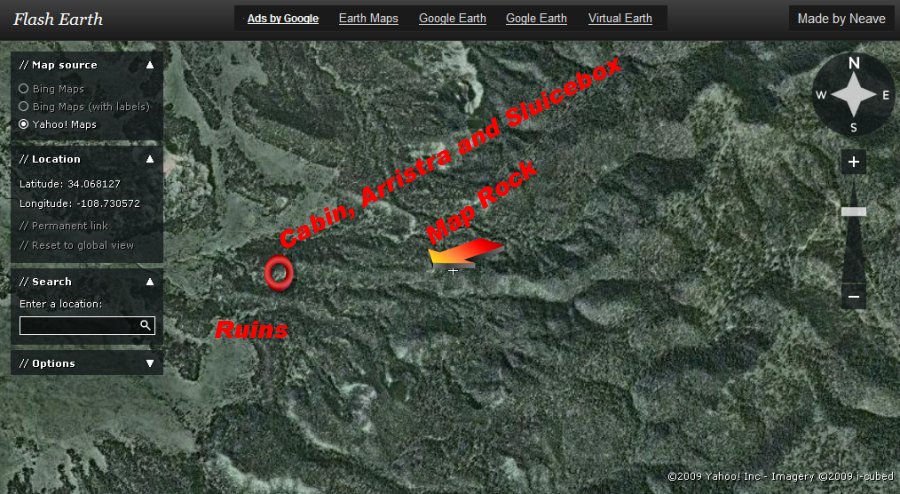
I’d been compiling, studying the versions of the legend, of accounts handed down by searchers, survivors and a lot of lies I couldn’t afford to judge without checking them out.  The evidence I was looking for was a burned out cabin ruin, maybe a sluicebox, something akin to a waterfall.  A pair of bare peaks roughly 20 miles to the north the legend called, ‘Piloncillos’.  Baldies.  Possibly a formation resembling the head of a bear.

Keith and I had been bouncing around that country for a couple of years, chasing dead men.  The Zuni Mountains, Santa Rita Mesa, Largo Canyon, Red Hill caldera, Pelona Mesa, the Sawtooths.  We saw a lot of fine real estate,  had plenty of adventure, but we hadn’t found anything to nail theory to anything on the ground.

Eventually I began assembling fragments of various versions of the legend, each at least mildly supported by some other version.  Began drawing circles at ten mile intervals outward from somewhat verifiable points, overlapping circles.  I ended up with a slice of orange peel on a map where the circles converged.   On a 7.5 minute USGS topo I counted 32 canyons within the orange peel that seemed to have possibilities.  Numbered them 1-32 with little stickers on the face of the map.

Keith was tied up in Santa Fe a day-or-so longer than I was, so I headed out, intending to cross some canyons off the map before he arrived, meet him at a camp on Elk Plateau when he got there. 

But canyon #3, I learned from a Hispanic rancher I met when I went to cross off Cabin Springs [canyon #2], had a burned out cabin ruin and something he described as a water-trough cut with an axe out of a 3′ diameter tree.  Late evening I arrived and set up camp on Elk Plateau to wait for Keith, me in a state of high anxiety.

But I’ve digressed. 

I was going to tell this story in full, but leading into the subject of platinum, palladium, rhodium, iridium and osmium.  How, in those days a person would have a hell of a time even assaying for them, how if located, they had to be sold through the Platinum Consortium, which wasn’t interested in buying.  How the melting temperature of the stuff makes a serious challenge of smelting it, in any case.  How it takes a special kiln, a special crucible to do anything at all with platinum.

How the New Mexico Bureau of Mines assured me our expensive spectroscopic assay was meaningless, a scam.  “There’s no platinum in New Mexico,” they assured me.  How at the precise time they told me that piece of fiction, the Platinum Consortium was mining the tailings of 19th Century gold mines near White City, New Mexico, for platinum they didn’t want when those mines were active, maybe didn’t even recognize.

How Sunburst Mining Company opened an operation mining platinum, gold and silver in microscopic quantities on the edge of a caldera within view of the peak above my claims a couple of years later.

I’d figured on telling you how they employed over a hundred people over there for a few years, got crosswise with New Mexico Department of Environment, ran into financial problems in other mining locations, went kaput.

And I was going to tell you how Keith and I found a canyon of maybe the weirdest geology I’ve ever come across.  Named it No Name Canyon.

But hells bells, I reckons I’m going to have to save that for another day.

Meanwhile, if you’ve missed the other background on all this you can find it by exploring the tags and whatnot or searching the site for ‘lost gold mine’.

Old Jules

Gamblers, Gambling and Risk-taking

Previously blogged May 17, 2005

Saturday a recently acquired friend and I revisited one of the sites I spent a lot of time puzzling over during the search for the lost gold  mine.  The place was the focus of the ’98 search  and a good many years prior to that.  Sometimes it amazes me how many times I climbed and unclimbed the west face of that mountain, always finding something new and puzzling.  I spent most of a month camped at the top, friends coming in for a week or so, then heading back to their lives elsewhere without finding what we were looking for, but finding enough adventure, fellowship and mountain air for a while and remember as one of the good times.This was Jim’s first time up there.  We went in mainly to look at a rock pillar that’s peeling away from a cliff face.

It’s a formation that fascinated a man I’ve come to know awfully well by his work; a man I never met, but whom I followed around that mountain puzzling over what he did, how he did it and why he did it.  A man who lived and died 150 years ago, roughly.  A man who knew a gamble when he saw one, went into a canyon spang in the middle of Apache country at a time when the best he could hope for if he was a quick death, or if his luck was bad, hanging upside down over a slow fire.

I’ve been wearing the arrowhead that almost certainly killed him hanging from a leather thong around my neck for a decade or more.  The ruin a few charred logs high, a long-tom sluice he carved with an axe out of a three-foot diameter log, a 400 pound rock he chiseled down to use as an arrastra and a hundred or so signs and symbols he made on rocks, along with his various diggings are all that’s left to tell what kind of man he was.

A gambler, he was, gambling on being caught by Apaches, gambling a broken leg in a place where such a thing was sure death.  A man who believed in himself so thoroughly that in that setting that he pecked away at the base of a 50 ton pillar of rock trying to get at what was underneath until it gives a man the fantods even today to walk beneath it.

One of the things I’ve spent a lot of time contemplating as I watched Orion chasing the Pleiades across the night sky to the background music of wind in the treetops is the thought of how a man of that sort would feel about a world where low-level risk-taking is a criminal offense.

A time when edging the nose of  a vehicle onto the pavement without fastening the seat belt probably won’t get you hurt, but it will almost certainly get you a conversation with an armed pair of mirror sunglasses.  A time when risk is defined in how many years it might take you to get cancer from whatever you’re eating or smoking.  When excessive gambling is betting the grocery money at the blackjack table.

I wonder if he’d have played a wheel, or just picked a few numbers that suited him and bought a hundred tickets with the same six numbers on them, going for broke on something he believed in, the way he did in life.

One of the ways we define who and what we are includes what we’re willing to give up to travel around the sun a few more times.  That guy on the mountain wasn’t inclined to give up much.

Old Jules

The Legal Money Raffle Consortia

Previously posted in 2005:

I used to know a guy named Mike, down in Socorro.  A man with a lot of ideas.

During the mid-‘90s, about the time the Internet was cranking up big-time, Mike had the idea it would be cool to start an online raffle.

Mike had some money lying around.  Just about enough to buy a full-sized Harley, and a large RV.  But he thought he could increase the amount of money he had by taking a risk.  He’d sell raffle tickets online for a Harley and a large RV without buying them until someone won the raffle.  If he didn’t sell enough tickets, he’d make up the difference with his savings.  But if he did sell enough tickets, he’d give away the Harley and RV, and pocket whatever extra came in.

It turns out raffles are illegal at almost any level, though the cops and prosecutors look the other way if they feel the cause is a good one, or if it’s just small potatoes.  But item one for Mike turned out to be that if he went online he’d be almost certain to be prosecuted.

Item 2, was the fact he was, in effect, proposing to raffle a motorcycle and an RV that didn’t exist.  The fact he didn’t own them yet compounded the felony he would be committing.

Now what Mike was proposing to do was precisely what lotteries do.  Raffling off something that doesn’t exist…. Money that they plan on earning as interest.

But, of course, when a government-sanctioned, or government-owned administrative entity commits an act that rhymes with something that would be a felony if an individual behaved identically, all’s well with the world.

Unless they happen to have a lot of attention focused on their behavior, which sometimes happens.

Similarly, I used to know a guy named Dan, who had a lot of cash lying around doing nothing.  He dreamed up an online something he called a ‘money club’, or ‘money pool’.  Members, Dan dreamed, would pay $5 per month into the pool.  Every month the total proceeds, minus 10 percent (to Dan as operational and administrative fees) would be handed out to some lucky member by a process known as Random Number Generator…. Something nearly identical to what’s being done by lotteries.  Except it would be private enterprise….. private sector.

Dan figured the payout percentages would be so much better, the odds so much better than any lottery that it would cause players to flock to him.  He might have been right.

But there was naturally a catch.  What he was proposing was and is a herd of felonies at almost every level of jurisdiction.  Even though what he proposed was a lot better for the players involved, than the competition (the government and the various legally recognized mob) could (read ‘would’) offer.

So neither of these ideas ever came to fruition, though each represented the cleaned up versions of corrupted first-cousins we all accept as normal in the lottery systems.

It’s surprising sometimes to see people who claim to believe in free enterprise so blindly support any government monopoly.

Old Jules

Erosion by Time

Good morning readers.  Thanks for coming by for a read this morning.  It’s raining again this morning and all that erosion mitigation I’ve been doing is in the slow process of sealing itself with floating cedar leaves, beginning to back up water and drop the silt burden.

There’s a timely, subtle irony in this.  While that miniscule effort directed at reversing erosion by time begins doing its job, my old friend Gale, [who owns this place] pictured above climbing a mountain in 1998 is in the intensive care unit of the Kerrville hospital.  He’s been there almost a week now, them searching for a different sort of erosion.

He was carrying a high temperature for an old man when he finally went to a medico, who sent him to Emergency.  In ICU they found he had pneumonia, a blood infection, and didn’t know what-all else.  Yesterday they finally discovered a massive kidney stone.  Today they’ll be doing surgery to remove it and hopefully he’ll begin the long climb to recovery.

I’ve been spoiled by good health and mostly robust physical condition.  I suppose, even though I’ve known he had a lot of aches, pains and vehicular problems, I still think of him as that young man of almost 60, climbing that mountain, or maybe younger.  I’ve probably been harder on him, less understanding of his limitations than I should have been as I watched him not doing a lot of things he knew he should, or I thought he should.

But it’s time I recognized he’s not as young as me anymore, that he’s grown to be an old man while I watched, not noticing.  Happened too slowly, I suppose, maybe like watching a kid grow up.

I’ve got to learn to show more respect and patience for old people.

Old Jules

Naming Your Own Poison: Dependency Relationships

This is taken from a letter written in the year 2000:

Seems the modern world’s addicted to more afflictions than drugs.  Maybe it’s tied up in the unprecedented social experiment of the 20th Century attempting to yank the values and roles of 10,000 years of human history up, shake the dirt off, and clone them into something never before tried.  But without entirely losing what went before.

Personal boundaries became ambiguous, and while there was always the dependency inherent in shared family and social role assignments, removing it without replacement parts might have set things adrift further than anyone anticipated.

For instance, in my personal life with my ex-wife, there was a dependency thing, but it was a fairly mature relationship except in certain aspects of the dependencies.  Those grew and gradually became boa constrictors over the decades, became such a part of the rock and roll of marriage, I found I couldn’t breathe.  And I suspect the same almost had to be true for her, as well.

But after that marriage broke up, it really used to trouble me that my relationship with the next woman couldn’t have been an adult, happy, non-dependency, shared-joy kind of relationship. We were both people who had been through long marriages and half a century of life. It only missed it in enough crucial places to kill it.   In fact, there were places where it was there.  But it was woven into a fabric of unstated, unagreed-to expectations, manipulations and untuned boundaries directly tied to ownership.  Or a hunger for ownership and the powers and controls inherent with it.

It’s not easy to imagine how younger people find their way around inside that matrix of nebulous expectations.

You’ve got to learn from your mistakes, . . . I’m not saying that I’ve got the way, the truth, and the light here, but I will say, subtract raging hormones from your system. Raging hormones screw everything up. And if what you want is self-respect and growth, dependency relationships are the antithesis of it. I mean, there is a stage of your development where you can grow from that, but if you need that, it’s a statement of your level of growth. And once you get past that, the whole concept is repugnant.

And if you have learned everything you’re supposed to learn, you’re probably not going to have another relationship.  I’ve told you that after I knew I was breaking up with her I spent six weeks or so just listening and considering her catalog of complaints about me. Some were valid, some weren’t. But I listened and considered them all because that kind of input from someone who knows you well doesn’t come often and in a context where the ego allows you to distance yourself from it in a way where you might be able to actually learn something about yourself. Once I knew I was going to break with her, I no longer had any investment in defending my behavior. I learned a lot.

During the same time frame, and during all the preceding months she never listened to a damn thing–never learned anything about herself–remained stolid in her absolute innocence, victimization, purity of thought, and responsibility for any aspect of the failure of our relationship, which she desperately didn’t want to fail.

The part of this that’s most difficult to grasp is that she wanted and needed sex as much as I did. We were a matched set in that way, a couple of really uninhibited, highly-sexed people. But there was an assumption of quid pro quo in her whole approach to the problems–all her life men had been lusting after her because of her physical beauty.

She never came to the realization that all she had to do was relax a little in her “rightness”, compromise, understand, give a little, take a little, and she could save the relationship and grow some at the same time. Growth wasn’t her strong suit. She hadn’t changed much since we were kids.

Truthfully, in hindsight, I’m grateful for my own sake that she couldn’t bend,  couldn’t hear the things I’d said, and responded with shocking venom to every attempt I made for honest dialogue about our mutual problems. If she had, I’d have had to remain with her–it wouldn’t have taken much–I’d have been owned by her, and at her insistance, owned her.

Old Jules

Mel King

The hoopla about the dead cop in Tijeras got me thinking about my old friend, Mel King, and another dead cop just down the road from this one in Mountainair, New Mexico, in 1987. 

That one changed Mel’s life in a multitude of ways, for all the remainder of it.  I posted this on another blog December 21, 2005, the anniversary of his death:

If I ever write another book, Mel King will have to occupy a few chapters of it.  I’ve mentioned him a few times on this blog, but mostly, I’ve not been able to write much about him at all.  I’m still digesting what happened to him.

On one of the threads recently the discussion drifted to the War on Drugs.  I suppose if I’d never met Mel I probably wouldn’t have thought much about that issue, would never have bothered to form an opinion about it.

But in many ways, Mel was a product of that war, from the time it began during the Reagan Administration, he was one of the adversaries.  It changed him from a small-time marijuana growing woods-vet to a wealthy man.  When the ‘war’ drove the price of jade sky-high he was approached by a number of ranchers in the area, asked to teach them how to grow weed in quantity.  He became their broker, as well as a grower.

The War on Drugs involved Mel in a major felony arrest, confiscation of much of his property, caused the mysterious death of a police officer, got Mel targeted repeatedly on America’s Most Wanted television series, and constant harassment by the FBI, State Police and local police for the remainder of his life.

They wanted to believe he killed a Mountainair, NM, police officer because it was the only construction of the facts that didn’t expose the rotten core of the War on Drugs.  If Mel didn’t kill that cop, another cop, or cops, almost certainly did.

Unacceptable.

Shortly before he was murdered in December, 2004, he showed me an anonymous, hand-written letter accusing him of killing the policeman and threatening to come balance it all.  The undertone and nuances of the letter suggested it was written by another member of the ‘policeman brotherhood’ who wanted to even things out, not because he knew the dead cop, but because a person doesn’t get suspected of killing a cop and get by with it.

It’s time I began writing down a few things about Mel King anyway.

Mel King was a major, financially successful marijuana grower and large-scale broker in New Mexico for many years.  During that time he was also a long-term heroin addict.  (He first became addicted to morphine while in the hospital recovering from wounds he got in the Marine Corps in Vietnam).

The only way Mel got away with what he was doing for so many years was by being considered a complete maniac, and by making certain the authorities got their fair share of the proceeds.  He drove around in a VW van with bullet-holes in the windshield from the inside.

When he got busted in 1987, with 150 pounds in his house it was because he made himself too big a nuisance to be allowed to go on.  He was attracting too much attention.

But even so, he never came to trial.  That 150 pounds of high-grade vanished from the evidence lockers.  The empty bags with his evidence numbers on them were found in the home of the policeman who made the initial stop during his arrest.  But someone murdered that policeman, probably for the marijuana, which is how they happened to find the empty evidence bags.

While he was in jail awaiting bail, Mel resolved to turn his life around.  He freed himself from heroin and when he was released he started a successful furniture business, did his best to stay clean for the remainder of his life.  Succeeded in being a trustworthy, successful man and one of the best friends I’ve ever had.

During the years I knew him, Mel was a deeply spiritual man.  He was honest, guileless, hard-working, sincere, courageous, and in many ways, wise.  We prospected a lot of canyons together, talked of many things over campfires listening to the wind in the pines.  He was also my partner during Y2K.

Mel and I disagreed on many things, but he believed, as I do, that he knew what happens to a man when he dies.  He never feared death and he never believed he’d done anything in this life to give him any reason to fear it.

I believe he was right.

Old Jules