Category Archives: 1990’s

About Discussion Boards and Chat Rooms

From a previous post April 3, 2005

Okay.  What’s been on your mind this morning, the readership asks, me adroitly putting the words into the communal mouth.

In between working on other internet projects, I’ve been thinking about Discussion Boards and Chat Rooms.  What is it about those things?  What’s the appeal to us?  Why do they so frequently erode into acid exchanges between the users?  How do complete strangers come to have such a rancor for one another?  And how to otherwise, probably nice enough people (they have to be… someone would have taught them manners if they behaved that way offline) come to have such nasty streaks when they wear a mask of anonymity?

I’ve seen discussion boards and participated in a few previously.  In those days, a few people were still doing non-spectator things outdoors.  Enough were, at least, to keep sites of that sort in business selling metal detectors, gold pans, books, sluiceboxes, dry-washers and whatnot.  That’s when I first noticed this discussion board spinoff phenomenon I eventually came to think of as the snake pit.

People would come to the boards to learn about prospecting, about a particular lost mine, about some piece of equipment or other. But on any site there’d come a time when a specific group of individuals would just sort of hang out there.  They weren’t there to learn, and they obviously weren’t there to share information.  Mostly, they were just wasting time, disparaging people who asked questions, disparaging the attempts others made to answer.  The snake pit.

These weren’t just trolls.  They were men who knew the subjects the board was created to discuss.  But treasure hunters and prospectors have never been long on the information-sharing business.  So instead, these guys hung around blustering at one another, arguing which had the most skill with a metal detector, which detector brand was best.  Online acquaintances who frequently hated one another and everyone else, but still hung around.

Mid-1998, I became convinced Y2K was an actual threat.  That belief led me to another type of chat room.  A place where people who believed similarly hung around to talk about  TEOTWAWKI (the end of the world as we know it) and exchange information about Y2K preparedness.  At least, that’s how it began.

Before too long we all discovered that, while we each believed Y2K was going to happen, to one degree or another, we had some serious rifts in the other aspects of our lives.  Some were born again Christians who wanted to ask one another and answer one another whether this was going to be the Rapture, and if so, when it would begin, and what it would be like, both for themselves, and for the non-believers who’d be left behind to suffer it out on the ground.

That sort of thing.  That, and just how bad would things get, post-Y2K.  And how much a person should bet that it would happen at all. Attempts at risk analysis, though most of us didn’t know a lot about computers.

From mid-’98 until I departed for my woods-retreat mid-’99, I watched the Y2K chat room with a measure of awe, disgust, concern and wonderment.  I watched those people who came to the chat room to learn become experts after a few visits (the fundamentals of preparedness were, after all, relatively simple).  I watched the competition among the new survival experts when `newbies’ came to the chat room. People who’d just heard about Y2K and wanted to know more.  The poor old newbies found themselves swarmed by all the old-timers who were, themselves, newbies a couple of weeks earlier.  Everyone wanted to demonstrate his knowledge by telling some newbie about it all.

Meanwhile, the rancor, the snapping and snarling, the pro-gun/anti-gun, born-again/non-religious wars raged among those folks who came there first to just learn, who all had the same reason for their original visits.  And, of course, the romances.

The snake pit.

So.  How do strangers who have no reason to give a hoot in hell what one another think come to such a pass?  What is it about discussion boards and chat rooms that draws people so closely into one another that they wish to apply pain, sarcasm, poison?  That they actually allow the poison being spewed by the malignant random stranger to pierce their feelings?

It’s a study.  I’ll swear it is.

Old Jules
Dear Hearts and Gentle People – [Bullet Holes in the Ceiling]

Hi readers.  Thanks for coming by for a read.

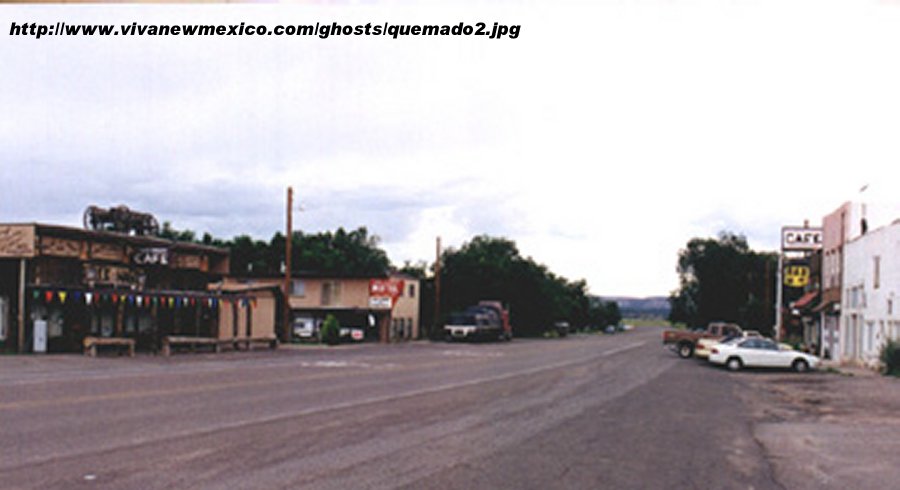
It must have been an Eve, Christmas or New Year, 1996 or 1997.  Keith and I, or Mel and I were partnered that trip and the cold, or the mud drove us into town.  We got a room in the motel you see just beyond the cafe with the chuckwagon on the roof.  Quemado was dead, every business in town shut down except the bar underneath the yellow sign on the right side of the picture.

Sometime after dark we wandered across the highway to the bar.  A couple of pickups were parked in front and we hoped there’d be a hamburger and beer to be had.  At least we figured it would be warmer than the motel room.

We stepped up to the bar and examined the half-dozen other customers through the smoke as we pulled off our coats.  Behind the bar a guy probably named Bad Teeth was grinning, looking us over.  Same as everyone else in there, all of whom appeared to be ten-generations of first cousins inter-married to Bad Teeth’s ancestors. 

“Any chance of getting something to eat?”  The faint odor of hamburgers lingered in the background.

Bad Teeth just grinned and looked past me at the badasses huddled over one of the tables.  “You won’t be here that long.”

“Long enough for a beer, anyway.”  My partner was showing signs of irritation.

“Only certain kinds of people come in here.”  My eyes followed where Bad Teeth was pointing at the cluster of bullet holes in the ceiling.  “Nobody else stays long.”

But my partner, Mister Wiseass, wasn’t looking at the ceiling.  He was letting his gaze size up all the drinkers, them doing the same to us.   “Gay bar in Quemado?”  He poked me in the ribs with his elbow, laughing.  “He’s right.  If anyplace else was open we ought to go there.”

The door was only a few steps away.  I grabbed his arm and headed for it.  “Let’s go there anyway.  The smoke’s stuffing up my sinuses.”  I suppose we’d have just been too much trouble.  Nobody followed us out to the street. 

Or maybe it really was a gay bar.  I’m happy enough not knowing. 

Bad judgement was driving to Quemado instead of another  80 miles to Springerville, AZ, if we wanted something as complicated as a hamburger.  Just saying.

When Ned Sublette used to sing the song linked below at a honkytonk out on the West Mesa in Albuquerque he always got out alive.  Maybe all those cowboys were just glad someone finally said it.

Old Jules

Ned Sublette:  Cowboys are Frequently, Secretly Fond of Each Other:


Dinah Shore 1949 – Dear Hearts and Gentle People


‘Squirrelly’ Armijo Survives his own Funeral

A legendary man in the Quemado/Reserve area nicknamed ‘Squirrelly’ Armijo had a good working claim down near Queen’s Head in the Gallos near Apache Creek in the 1940s  through the 1960s. Maybe that’s where he came across a skeleton, and probably just figured he might as well take it home, so he put it in his truck.
Driving up those winding mountain roads he lost control of the truck and rolled it. Squirrelly was thrown clear and the truck caught fire. He must have been out of his head, maybe with a concussion, because he evidently wandered into the mountains in a daze.

The police arrived and found the burned out truck with a skeleton inside and assumed because the truck belonged to him the remains were Squirrelly’s. He was pronounced dead, an expensive funeral held, and he was buried.

Twelve days later Squirrelly wandered out of the woods several miles away, which was a source of, first joy and awe, then suspicion. Initially it was thought he’d killed the person the skeleton belonged to. Then the lawsuits began, the Armijo family and the Funeral home arguing heatedly about who owed money to whom for burying some anonymous skeleton.

The story is so well-known it was used in a book about forensic pathology in New Mexico during the 1990s, the forensic pathologist explaining such a thing could never happen these more enlightened times.  Journey in Forensic Anthropology, Stanley Rhine, University of New Mexico Press, Albuquerque, 1998.  Author Rhine elected to change Squirrelly’s surname to Aramando to avoid any sort of civil action.   The Armijo family’s been herding sheep in that country since the time there was nobody out there but them and Mimbres Apaches.  A lot of them are still there.

“A Premature Funeral

“Bones and Fire
“On June 4, 1959, Forest Service lookouts reported smoke rising from what was assumed to be a small forest fire just east of the Arizona state line, among the 8,000-feet peaks of the San Francisco Mountains of southwestern New Mexico. A firefighting crew dispatched to the scene discovered no forest fire, but an automobile burning furiously on the side of a gravel forest road. Dousing the flames, they found a mass of burned flesh, a skull, some other bones, and some teeth resting inside the burned-out hulk.

“The car was found to belong to a Mr. Armando, well known in the
lightly populated region. His fiery demise prompted the organization of a six-person coroner’s inquest in Catron County. According to former Catron County Sheriff and now Washoe County ( Nevada) Coroner Vernon McCarty, the “six responsible citizens” required by 1950s New Mexico law were most easily found by the justices of the peace at a local bar.

“McCarty observed that an insufficiency of able-bodied citizens could be remedied either by visiting several such spots or by prolonging the official quest at one of them for as long as it took to empanel the necessary six people.

“The resulting coroner’s jury in this case was made up of ranchers, Forest Service firefighters, two bartenders, and a service station attendant. It concluded that the remains were “badly burned and charred beyond positive identification,” according to the Albuquerque Journal for June 17, 1960. Nonetheless, an identification was made by Armando’s two brothers-in-law and the district attorney, apparently functioning in his multiple roles of death investigator and skeletal “expert.” That it was Armando was attested to the by the fact that the human skull was accompanied by some impressively large upper incisors. These prominent choppers had . . .”

Probably Squirrelly never paused to wonder about any moral or ethical issues when he put that skeleton into his truck. He just did it absent-mindedly the way any of us might.  Probably somewhat as Mel did on Gobblers Knob:

Exploring Alley Oop’s Home Circa 1947.

I suppose the Squirrelly story came to mind because it’s a synopsis of the possibilities carried to the ultimate extreme, accompanied by the fact I recently had an email from his great-nephew wanting to ask some questions about my mention of his Queenshead claim in my lost gold mine book.

Old Jules

Previous posts:  Skulls, skeletons and homicides:

The Ruin Skull – A Long Day Ago

Cold Mystery, Fevered Romance and Lost Gold

The Strangeness – Background Context of Unsolved Homicides

Meanwhile, today on Ask Old Jules:  Mirror Holds Information From the Past? –

Old Jules, if someone had a mirror from 40+ years ago, could something be gathered from its backing?

Old Jules replies:  The pastametric pressure of all that stored history would almost certainly explode backward opening a hole into a parallel universe carrying with it the identities and souls of everyone who ever looked into the mirror.  Read more …..


Vacating the Premises – A Vanishing Act

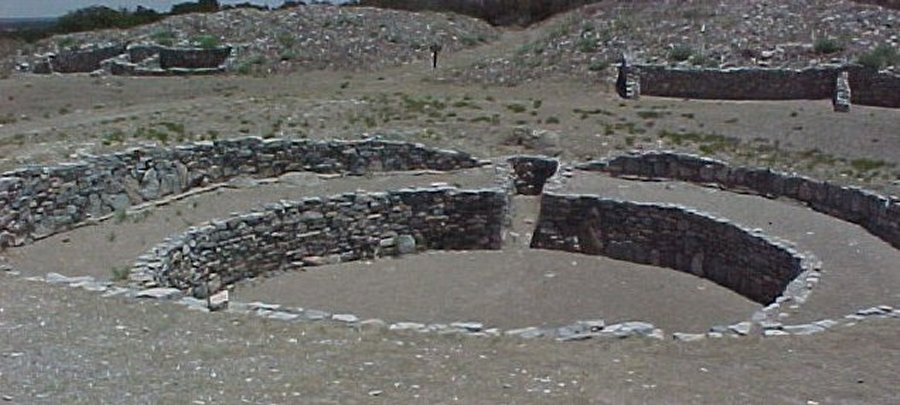
The mountain I used to prospect for several years is covered with ruins wherever there is water.  Big ruins.   I used to sit on one near my camp and try to imagine what it must have been like.

One summer solstice afternoon I was sitting on the cliff boundary of the ruin watching the sunset.  In the basin below there’s a volcanic knob out toward the center of the plains.   I’d discovered a single kiva on top of it years before and puzzled over it vaguely.  What was that kiva doing there, miles away from the big houses?

But because that day happened to be solstice, I suddenly noticed when the sun went down, it vanished directly behind the point of that Kiva knob!  Yon damned Mogollons used it to mark summer solstice!

A place like that fires the imagination, and I spent a lot of time thinking of those people who lived in that ruin. Some of these groups had evidently been in the same locations for 300-400 years, and suddenly their government leaders decided they had to leave.  Politicians, or priests, or both, deciding what was best for them.

One day they  just left.  I’ve always thought it was because of that grim civil war nobody knows anything about that happened among them around the time these ruins were abandoned.  Bashing in the heads of anyone who didn’t agree to migrating.

They probably watched and even hosted strings of these travellers along the trail until their own turn came.

What a thing it must have been to be one of them on that last day, saying good bye to the place your great-grand-dad, your granddad, your dad, and everyone else as far back as anyone could remember, including you were all born, lived, and mostly died.

Everyone voluntarily packed a few belongings, a medicine bag and blanket or two, a stone hatchet and a few scrapers, and left, leaving corn in the bin for those coming behind.  Abandoned pots lying around all over the place measured the things they couldn’t carry.

Sometimes sitting on that mountain early in the morning it sort of overwhelmed me, the pain and sorrow in those villagers.  Probably they all left in the morning one day, after a while of maybe being notified it was their turn.  A few weeks of  planning.  What to take?  What to leave behind.

Finally they probably finished the last minute packing the night before.  At dawn they made a line down the basin heading south, looking back over their shoulders as long as they could, feeling so sad.  Knowing they’d never go home again, wondering about the place they were going.

Remembering how it was playing on the mountain with their grandads when they were  kids, remembering the special, secret places kids always have.  Just looking and yearning to stay, and already missing that long home where their ancestors had roamed for 2000 years.

They’d have tried to keep it in sight as long as they could, each one stopping to wipe the trail dust off his face, pretending to catch his breaths.  But yearning back at the old home place, piercing the heat waves with their eyes, straining to see it one last time, maybe crying, certainly crying inside.  The kids probably screeching enough to cover everyone elses grief.

As they trekked south they were joined by other groups from the neighboring villages.  The dust rose on the trail making a plume, a cloud around them.  They examined these strangers who were now trail mates and wondered who they were.

Some, they probably soon discovered had a mother-in-law, or uncle who came from their village.  They got to know one another better there on that hot, sad, lonesome trail away from all they they’d ever known, and they shared the hardships of the journey together for a long time.

Today, it’s just piles of rock, potsherds, holes left by scholars and other diggers for spoils.  The land still falls off across Johnson Basin, sun going down over that volcanic nub that once measured the time to plant.  Cow men ride their motorized hosses across the old trails, cows stomp around looking for grass, making the pottery fragments even smaller.

But sometimes late at night when the wind howls down the mountain a man might hear, or think he hears an echo of the chants, the drums, the night mumbles and whispers of lovers, the ghosts of lovers.  Pulls the bag tighter around his ears and wonders.

Old Jules


Today on Ask Old Jules:  What is Forgiveness?

One of the Fascinations of Christian TV

Maybe I should have explained this on my earlier post.  If my dad’s still alive he’s too old to care, and anyone else who might have once felt anything about it will also be old enough to handle it.

For me, discovering I had a biological half-brother didn’t come as a particular shock.  I’d always figured I probably had a few, maybe a lot.  My dad never made any bones about having been a rounder all his life.  His extra-marital affairs cost him a couple of marriages.

One night during the early 1980s, Dad and I were sitting in the parking lot of the Georgetown, Texas, hospital at 2:00 am, because his wife of the time was inside being treated in the Emergency Room.  They were visiting my wife and me over some holiday.

It was a long wait, and the conversation drifted to women, observations about them, stories about them, puzzlements about women we’d found during our individual experiences with them.  Somewhere during all that the subject of the products of our meanderings came into the discussion.

He said he didn’t actually know how many kids he’d left along his back trail, but one was a sure thing.  He’d first seen the guy on television because someone told him there was a televangelist who bore an amazing likeness, both in physical features and in mannerisms of speech and gesture.

Dad was mildly interested, enough to eventually watch the guy on television.  Which bowled him over.  He said it was like watching a movie of himself speaking at a Toastmaster meeting at an earlier age.  A suspicion dawned for him sufficiently to cause him to find out more about the man.  Where he was from, how old he was, and eventually to find out who the mother of the televangelist was.  He had, it turned out, vivid recollections of her when they both were a lot younger.

He didn’t name the man, and I didn’t give it a lot of thought for a number of years.  But early during my Christian television watching it came back full force.  For a moment I was disoriented, almost as though I watching my dad on television.  I truly was amazed and there was no doubt in my mind I was seeing my biological half-brother.  Just about my own age. 

My lady friend of the time, whom I made a point of having watch him without explaining, commented, “He looks and talks like you.  Weird.”

The man was a moving speaker and a faith healer of some fame.  So one of the attractions motivating me to rise at 3:00 am and watch Christian television was the strangeness of watching him, particularly. 

I always tried to catch his show and his appearances when I could.  If a person’s going to put himself through an experience of that sort, 3:00 am’s not an altogether bad time to do it.

Old Jules

A Search for the Meaning of Life

In 1992, when my 25 year marriage dissolved and I moved to Santa Fe, New Mexico, one of the projects I was determined to pursue was an attempt to understand the meaning of life, or something in the neighborhood.  I did a lot of thinking and planning about how to approach the matter in a way I considered the most likely possibility for success.

Part of the project involved learning everything I could about religions and metaphysics, and I began with an intense study of Christianity, early Christian history, pre-Nicean Christian documents, practices and beliefs at a time before anything qualified as Canon.  For a couple of years I submerged myself in the subject.

During the same time period I got up 3:30 am and spent a couple of hours watching Christian television to get a better understanding of what was going on with Christianity today.  I found I got a lot of enjoyment doing it, and I discovered one I liked particularly well and thought of almost as an old friend.

Garner Ted Armstrong.  I spent a year or so in my early 20s working for Rainbow Baking Company in Houston loading bread trucks off a conveyor belt 12 hours a day, and I filled some of the solitude listening to Garner Ted over a portable radio and earpiece.  I considered him one of the best rhetoricians of the 20th Century already when I found him preaching on television.

But what I hadn’t realized was his level of scholarship and open mindedness about Christian history.  The fact I was submerged in it at the time led me to write a letter to him asking his take on some issues I’d found ambiguous.

From that time until his death several years later, Garner Ted Armstrong and I indulged in exchanges of 20 page letters discussing the nuances of Christian history, Christian texts, the implications of the Nag Hammadi codices, news coming out of the Dead Sea Scrolls, where Christianity had been and possibly where it was going.

A truly strange time of my life, though just one of those side-trails that had little to do with my coincident search and research involving a lost gold mine, nor with understanding the meaning of life.  The former, I never found, and the latter, when I found it, didn’t need elaboration.

I still miss old Garner Ted Armstrong and those long letters.

Old Jules

Exploring Alley Oop’s Home Circa 1947

When my mom left her second husband near Apache Junction, Arizona  to move near my granddad’s place at Causey, New Mexico, I was considerable upset about it all.  I’d become overfond of the Arizona guy, liked him a lot despite his human flaws that bothered my mom.

Time proved my level of upset couldn’t be handled by beating it out of me, nor by any of the other usual ways people tried back then to nudge a kid back into being seen and not heard.  The Runaways, 1947

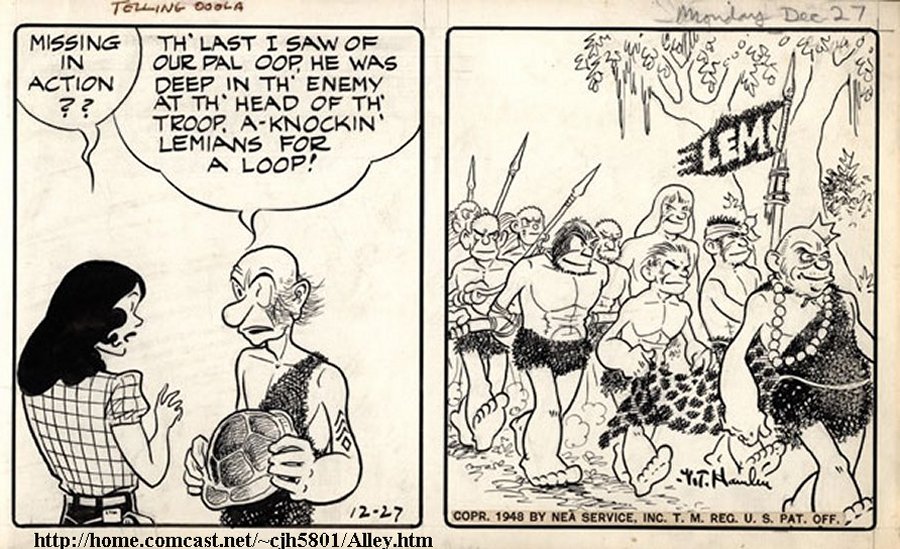
My first step-dad [Arizona] was fond of reading the Alley Oop comic strip to me and I was a huge fan.  Alley was a cave man skipping forward and backward in time thanks to a 20th Century scientist.  Alley even had a 20th Century lady friend named Oola. 

About the only thing I’d brought with me from Arizona was my stack of Alley Oop comic strips.  We’d travelled light across the desert.  And when we arrived in Causey one of the jobs my sisters had was reading those Alley Oops to me, trying to bring up my spirits.  Which I suppose it did until they’d finished reading them to me.

Something more permanent had to be done, and my granddad decided to have a shot at it.  He promised to take me to visit Alley’s home.  Mesa Verde, Colorado.

What a trip that must have been, me pestering him whether we were there yet, how much further before we’d see Alley’s home.  I don’t know how long we stayed, but I never forgot old Alley and his home.  I still had one picture of the cave dwelling he took back then until Y2K.

And of the hundreds of ancient ruins, documented and undocumented, I’ve poked around in during my life, I’ve never visited one, found one, without thinking to myself with a smile that Alley Oop might have lived there, visited there ahead of me.

When Mel King and I were exploring the ruin on Gobbler’s Knob and were driving back to Socorro when he reached into his daypack for something, came out with a human skull it was the first thing I said to him.  “What the hell is that?  You packed off Oola’s skull.  Get it the hell out of this truck!” 

I screeched onto the shoulder and he hid it behind a cedar until  we’d be headed back to Gobber’s Knob so he could put it back where it belongs.

Nowadays I think I have more in common with Alley Oop than with any modern human being.  If there was ever a right time for me to pop out of the gene pool it would probably have been more appropriate temporally in some other Universe where Alley Oop lived and breathed.  It made more sense than this one.

Old Jules


The Price of Not Expecting the Unexpected

If I were prone to regrets of things done and undone I’d regret not being more observant when something was going on around me worth observing.

I was on a business trip in a New Mexico State vehicle meeting city officials in Portales, the town where I grew up.  I visited with my old friend and classmate Fred Stevens and, we ate out together the previous night at a local restaurant.  

Next morning hanging around City Hall I chatted with my 6th grade teacher, Bill Walman, then Parks and Recreation Director, and Mack Tucker, director of something else, with whom Kurtiss Jackson and I had worked for Skeeter Jenkens on the ranch ‘way back when [ A Sobering View of Y2K].

If I’d been paying attention I might have noticed something at the meeting.  Or maybe during one of the chats with friends I mentioned the route I’d be taking home.  Maybe I’d have examined the car for something attached to it.  Years of hindsight would have been helpful.  Some of the details of the following sequence of events might be out of order, might be inaccurate by having dimmed with the years.  But it’s a fairly close portrayal of something that I still don’t understand with whatever’s been gained by the passage of time.

After the meeting I left late-morning and headed west to go home to Socorro.  Probably there was a lot I could have noticed if I’d had my senses tuned.  But I was on autopilot.

The road between Portales and Roswell seems a long one to motorists and I probably was exceeding the speed limit.  There was almost no traffic, and I didn’t notice whom I passed and what they might have been driving.

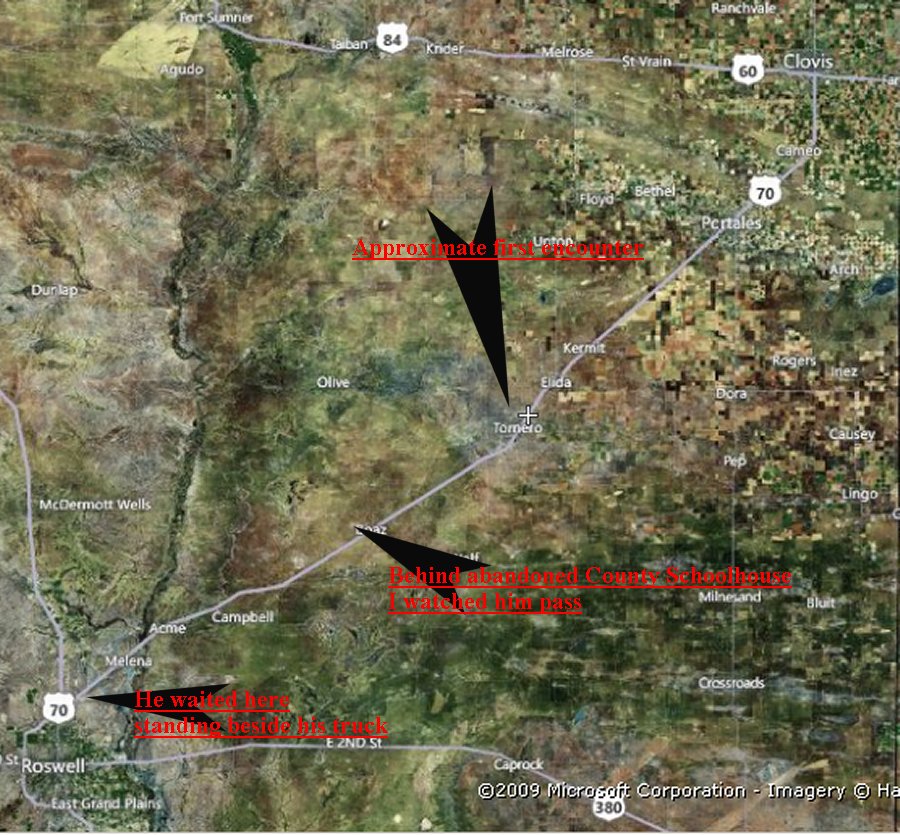
I’d consumed a lot of coffee that morning and somewhere out beyond Elida I stopped and walked to a tree along the fenceline to relieve myself.  A battered old truck pulled up behind the state car and stopped with the engine idling.  When I finished I went to his window. 

 
“Anything I can do to help you?”

The guy was dressed in a shabby bodyshop shirt, bad teeth, nasal twang accent of a local.  “Ah was just wondering why someone in a government car passed me going 80 miles an hour.”

“What makes you think I was going 80 miles an hour?   The speed limit’s 55.  If I passed you going 55 I might have been speeding to go past just to get around you.”

“What gumment agency you working for going that fast?  I jest want to know why you’re driving so fast in a state car!”

I told him to take the tag number and call it in if he had a complaint, but he went on and on with a nasal, makes-no-sense questioning. 

I got back into the car and drove on, but stopped again at Kenna.  The village had become a ghost town, but it had a lot of memories for me because Skeeter’s ranch was outside Kenna, and when Portales was ‘dry’ most Portales teenagers used to drive here to buy beer because the Portales bootleggers wouldn’t sell to them.

I’d begun to awaken a bit, though, and was wondering about the guy in the truck.  I watched as he drove past on the highway and probably considered the fact he was now ahead of me again.  A few miles out of town I passed him again, this time carefully not exceeding the speed limit by much.

Once he was out of sight far behind me the coffee was working on me again, and I pulled down a side road and behind an abandoned schoolhouse for another bladder call. 

I paused and poked around the old school yard waiting for him to go past, figuring I’d wait until he went by, let him get out of sight in front of me, then drive on to Roswell with him well ahead of me.  I don’t recall why I did this precisely.  I wasn’t alarmed yet at this point.  Maybe I was just enjoying the bits and pieces of school yard litter from so long ago.  Even the old outhouse was still standing.
 
I drove on, taking my time now.  But when I arrived at the intersection north of Roswell where traffic goes north toward Santa Fe, south into Roswell, or west into the mountains, there he was, pulled off and waiting.  He somehow knew, I suddenly realized, I’d gotten behind him.  So instead of going on I drove into Roswell and got some lunch, figuring he’d be out of my life by the time I headed west.
 

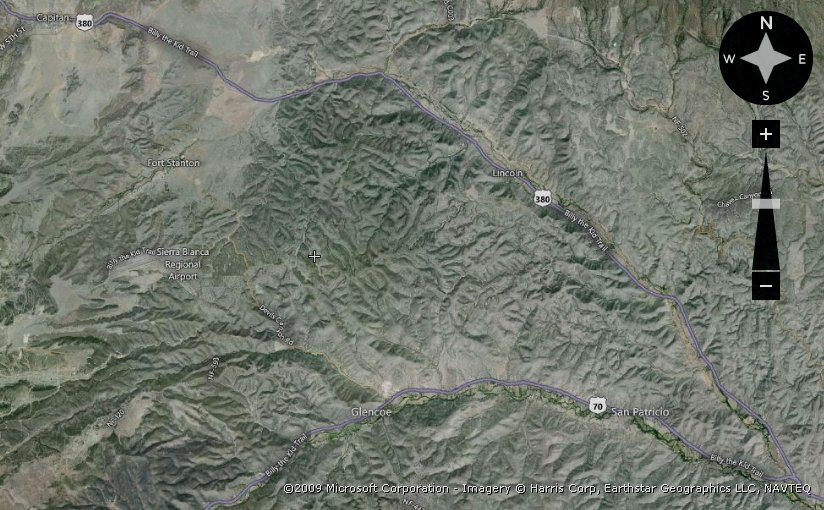
But a few miles west of Roswell, there he was again.  He let me go past, so up the road a way I pulled off and parked behind a convenience store, went inside to let him go by while I had an ice cream bar.  He did go by, and I finished my ice cream and headed west again.  But at the intersection going to Ruidoso into the mountains, or Lincoln and westward to Carrizoso there he was again. 

I drove on by, pretending to be going to Ruidoso.  I pulled over again a couple of miles up the road, out of sight of the highway and waited for him to go past for half-hour, but he didn’t.  So I figured I’d lost him, headed back through Lincoln, and there he sat in front of a museum, engine running.  I pulled in behind him, determined to confront him.

I drove out of town behind him and a few miles up the road he turned into a picnic/camping area and turned around, stopped at the entrance facing the highway.   By now I was pissed, but also damned confused and slightly alarmed.  I couldn’t understand how he could be doing this. 

I was armed and I walked up behind his car so he could see me in the rearview, but with the firearm behind me out of sight. 

“Why are you following me?”

“Ahhhm not following yew.  I just stopped here to take me a rest.”

“You waited back there at the intersection.  You waited again in Lincoln.  Why are you following me?”

“I’m not follering yew.  But I still want to know why a person in a gumment car passed me going 80 miles an hour.”  And so on.

I’m warning you.  Don’t follow me anymore.”  I shrugged it off, curious how far he’d go with this.


We played cat-and-mouse, me in a busy parking lot in Capitan during a thunderstorm as he went by, him waiting for me in Carrizoso.  He wanted me to know he had a fix on me. 


 I was convinced by the time I passed him on the hood of his truck west of Valley of the Fires that he was a cop… couldn’t see any way a private citizen could have the equipment it would take to do what he was doing. 

It’s a long drive through that desert between Carrizozo and Socorro and my mind was working 90 miles an hour.  As I approached Socorro I became convinced I was about to be arrested for  something. 

I called a friend with the City of Socorro and asked him to go look at my house to see if there were a bunch of cops waiting there.  There weren’t, and I didn’t see the follower until several years later in Albuquerque during a much later phase of what came to be a decade of that sort of crap.

A week later I described it to my Bureau Chief in Santa Fe.  When I’d finished telling it I asked, “Do you know of anything I ought to know?  Could this be Internal Affairs following me around for some reason?”

He thought about it frowning.  “No, I don’t think it could possibly be that.  I’d know it if any questions were being asked about you.  They’d have asked me.”  Then he looked me in the eye.  “You need to be careful about that speeding, though.  If you get stopped for speeding in a State car working for DPS it’s no questions asked.  They’ll fire you.”

What began that day lasted almost a decade.  Long after I’d left DPS and through several post-Y2K years. 

But back in the beginning, all manner of other mysterious happenings intruded into the lives of those who climbed that mountain with me, and to me.  I don’t know to this day whether the two parallel sets of happenings were connected.

Maybe if I’d been paying more attention from the beginning.

Old Jules


The Strangeness – Background Context of Unsolved Homicides

By the time this was published in 1999, I was no longer going up that particular mountain.  I was busy on my Y2K land and dwelling preparations about 50 miles northeast of Quemado.

But this will give you an idea of the general local psychological environment in the area, both while I was working the mountain and [it turned out] later, while I was doing Y2K.

http://articles.latimes.com/1999/nov/20/news/mn-36275

Unsolved Slayings Have Small N.M. Town Living in Fear

Crime: With seven people killed since 1996, residents are openly packing heat. Authorities see no connections among the deaths.

November 20, 1999|PAUL DUGGAN | THE WASHINGTON POST QUEMADO, N.M.

— There’s not much to the town. You come upon it in the vast, yellow-brown emptiness of southern New Mexico’s high desert grassland. It’s mainly just a strip of old storefronts on Highway 60, with some dusty side streets.

In a 40-mile radius of Quemado you might find 500 people, about half of them ranchers living like pioneers on the plains and in the foothills, miles from any neighbor. The rest live in town, in trailer homes and faded stucco bungalows amid the tumbleweeds and pinon trees.

The sheriff, Cliff Snyder, said it used to be a peaceful place in its lonesome way, before all the killings. Now there’s fear in the air, like a foul wind.

Who murdered Gary and Judy Wilson? It’s a mystery. They disappeared in November 1995 and turned up eight months later, so many bones in the woods. Who shoved Gilbert Stark into a 20-foot well and closed the cover in ’96? Who shot the elderly Clark couple and their daughter in ’97? Who put a bullet in the heart of James Carroll, 59, as he stood in his corral just north of town one autumn day last year? The sheriff doesn’t know.

He and the state police said they are convinced the cases aren’t related. They were random eruptions of murder where murder used to be rare, Snyder said. He has no clear explanation for it. All of the victims lived in the countryside around Quemado, about 125 miles southwest of Albuquerque. Before the Wilsons were slain, no one had died by another’s hand in this part of sprawling Catron County in nearly a decade.

And no one wants to be next. In a swath of America where gun control means hitting what you’re aiming at, a lot of folks are packing iron. They’re propping shotguns and rifles beside their beds; they’re driving with pistols on the front seats of their pickups. The sheriff said he doesn’t mind. This is the rural West, he pointed out, and guns are a heritage.

“We’re raised with them,” said Snyder, 42. He shrugged. “If I pull over a vehicle, I figure they’re armed, if they live in this county.”

At El Sarape Cafe on Quemado’s main street, Irene Jaramillo, 43, keeps a .22-caliber semiautomatic on a shelf near the griddle. One morning last week, Paul Strand, 67, who owns a horse ranch south of town, was sipping coffee in the cafe with his wife and holding forth on the subject of their firearms.

“I sleep with a Colt .45 under my pillow,” he said. “I have a loaded assault rifle beside the bed, a Russian-type, ready to roll. And a sawed-off shotgun next to that, loaded, legal, but just barely, in terms of the barrel length.”

Across the street, Carl Geng, who is in his 60s, runs the Allison Motel with his wife. They also own a ranch outside of town. Geng said he thinks he knows the culprit in one of the homicide cases. “I’ve got a .38,” he said, gesturing to his truck in the parking lot. “He sets one foot on my ranch, I’ll blow his head off.”

The sheriff said he and the state police think most or all of the victims were murdered by acquaintances with whom they had personal disputes. As for suspects, investigators have only “theories,” he said.

It’s a crime in New Mexico to carry a concealed loaded weapon in a public place but legal for anyone 21 or older to carry one openly, no permit necessary. James Clark, a Vietnam veteran, started packing two handguns after his parents, William Clark, 84, and Pearl Clark, 74, were slain in 1997 along with his sister, Sharron Hutson, 44. Folks in Quemado are used to seeing him in town with a .45-caliber Colt Peacemaker on his right hip and a .40-caliber semiautomatic in a shoulder holster.

“Which is fine,” said Irene Jaramillo’s husband, Jimmy, who is one of Snyder’s deputies. “I told him, ‘As long as I can see them.’ “

James Clark and his wife, Elaine, 42, now live in the remote trailer home where the elderly couple was murdered. Elaine Clark, who prefers a lighter-weight .35-caliber, sat in the kitchen one day last week with her husband’s heavy semiautomatic on the table in front of her. There was a loaded hunting rifle propped against the freezer by her left hand.

“We always used to brag that it was like the Old West, in the way that your house was never locked,” she said. “Someone passing by, if you were gone, they could come in and get something to eat. But now it’s more like the Old West the way you’re always on guard. You don’t walk up to my house unless I know you’re coming . . . or you could darn well get shot.”

Catron County, with just 3,000 residents, covers almost 7,000 square miles. It’s bigger than Connecticut. Snyder, who was a deputy when the seven homicides occurred, was elected sheriff last year. He has an undersheriff and four deputies, including Jaramillo, who patrols the northern half of the county around Quemado. Half a dozen state troopers also work in the county. But with such a vast area to cover, it sometimes takes an hour or more to reach the scene of an emergency.

Cold Mystery, Fevered Romance and Lost Gold

A burned out cabin ruin with an aspen tree growing out of the inside, bear claw marks 12 feet up, 3 hand forged nails, a longtom sluicebox axed out of a 3 foot diameter log, a spring 75 feet above the sluice, an arrastra below. 

A mysterious map chiseled on the face of a 300 pound rock surface depicting the exact layout of the canyon, the cabin, the waterfall, all so accurately depicted the person had to have scrutinized the layout from the mountaintop, then scratched it on this stone 600 vertical feet below and half a mile away.  The rock was carefully placed on the canyon wall above eye-level so it was easily seen, but only by someone looking up.

I’m guessing the date must have been spring, 1995.  I’d moved my search to the mountain I described above and was performing a systematic search of  the canyon from the discharge to the mountain crest.  I’d filed two mining claims at the location of the cabin and sluicebox pictured in the earlier post, and downstream.  I hadn’t yet found the map rock, and I was spending every moment I could squeeze between job duties, romantic obligations and financial constraints camped on that mountain.

I headed down there planning on spending a week, but on the road the Mitzubishi Montero sprung a water hose a few miles outside of Grants.  It was raining while I mucked under the hood, taping the hose and getting enough coolant in it to drive it to a parts house in Grants, where I installed it in the rain.  I was chilled and soaked as I drove south from Grants, but in too much of a hurry now to change clothes.

By the time I arrived at my usual camp site I was running a high fever and feeling my breathing becoming hard labor.  I hastily dragged a tarp out of the truck,  put my sleeping bag under it and got inside, hoping I’d shake off what I was afraid was coming.  I’d had pneumonia enough times this lifetime to recognize the onset.

The next morning found me weak, fever skylining, knowing I’d better try to get out of there while I still could.  I threw some brush over my gear because I was too weak to reload it onto the truck, and started down the mountain.  My vision was blurred and I was hallucinating, barely able to stay on the two-track.  When I reached the US Forest Service road a line of fenceposts ahead briefly became a line of riflemen aiming at me.

I remember nothing of the trip after that until I found myself at the home of my lady friend in Albuquerque, wrapped in a blanket on the floor of her downstairs because I wasn’t strong enough to climb them, burning with fever, shaking with chills.  She, nursing me with herbs and leftover antibiotics from her medicine cabinet.

“There are some people missing out there where your claims are.”  She was sipping coffee at the table, looking over the paper at me.  “A man and his wife.  The State has people out searching for them.”  She shook her head.  “They must have been right near where you were.”

The couple lived across a basin at the base of the mountain.  I could probably see their dwelling through binoculars from the mountaintop.  They were woodcutters, but I’d never encountered them, to my knowledge. 

As I recovered in Albuquerque the search died away.  The local sheriff announced the couple had probably just abandoned their house and gone somewhere else.  They were nobody, outsiders.  He refused to treat their vanishing act as a possible crime, didn’t allow the State Police to investigate their home.  But the time on the floor in Albuquerque weak as a kitten, tended hand and foot is one of those tender, grateful memories of my years with the lady.

Over the next several months I continued, sometimes in company with Keith, sometimes with other friends, sometimes alone, exploring, sampling, puzzling over what I was finding there.  Then, the first day of elk season that fall I encountered two elk hunters with their truck stuck in a stream bed.  When I finished towing them out, we introduced ourselves.

“Did you hear about those bodies they found in the canyon over there?”  He gestured to the mountain indicating a canyone one over from mine, plus one.   Renfro Canyon on the rock map sketch.  Less than a mile from my claims.  “A bear dug them up.  They were buried in an Indian ruin and a hunter found them this morning.”

The bodies turned out to be the people who’d turned up missing while I was giving myself pneumonia.  I felt reasonably confident the police would be contacting me with questions about whether I’d seen anything, because I was probably the only person on the mountain besides the victims and the murderers at the time it happened.

The Bureau I worked for, Emergency Management Planning and Coordination [EMPAC] was part of the New Mexico Department of Public Safety, though a step-child and somewhat separate.  I went to my Bureau Chief and explained what had happened, asked whether he thought I should go over to the State copshop and volunteer to talk to them about it.

“Man, I wouldn’t touch that.  Let them come to you.  You might be the best suspect they’ve got.”  A lawyer friend gave me the same advice, informally.

So I kept quiet and waited, and they never came.  I kept working that mountain, homicides and multiple-homicides continued to happen over the next couple of years remaining unsolved and generally thought to be uninvestigated, and the entire county became a quagmire of paranoia.  Everyone carrying firearms, nobody trusting anyone.

Meanwhile, the mountain echoed the weirdness and pressure the county was experiencing.  Somewhere during that time began the strangest chain of events and experiences of my entire life.

Which I might describe in a later blog or series of blog posts.

Old Jules