Category Archives: History

A Side to ‘Freedom’ Worth Considering

Those of us spoiled to a particular concept of freedom and the fear it’s coming unravelled might be well served to read Papillon once in a while.  I didn’t mention it in my review of it here, but I should have:  Papillon.

From one perspective the entire book is about freedom of a sort we, confined to our mental boxes containing what freedom is, refuse to acknowledge exists, can exist, for ourselves and those around us.  It’s the story by Henri Charriere of his own life, searching and occasionally finding that kind of freedom while trapped in an environment few slaves in history could match for savagery endured.  A deliberate, carefully devised savagery imposed by a modern, civilized nation.

A nation, I’ll add, not too unlike our own.

But what I intended to say about Papillon this post is one of the corner-of-the-eye aspects of freedom and Charriere’s finding of it during the most trying of times.  Once when he was in solitary confinement so severe as to be intended to drive him insane, to break him, destroy him.  Another when he was confined to a boat with other escapees mid-ocean.

These shreds of rhetorical freedom we savor can be unravelled like a wool sweater with a touch of pen to paper.  The freedom Charriere describes are immune to confiscation.   But they’re the responsibility of each of us to find within ourselves.  Nobody’s capable of giving them to us by signing a paper.  We can’t win them by force of arms by storming a Bastille, or Winter Palace.

The winds of history are eroding away those easy freedoms written on parchment and signed into some illusion of reality for most of the citizenry.  That’s happening and there aren’t any heroes likely to ride in on white horses, nor White Houses to save them. 

But we don’t have to allow ourselves the anguish of loss.  A piece of each of us lives outside the rules and the rule-makers, the savages, the rapacious Viking kings of government and finance.

Maybe the starting place for finding real freedom requires losing the illusion that Viking kings can give it to us and take it away.

Choose Something Like a Star


 Choose Something Like a Star

by Robert Frost – 1947

O Star (the fairest one in sight),
We grant your loftiness the right
To some obscurity of cloud –
It will not do to say of night,
Since dark is what brings out your light.
Some mystery becomes the proud.
But to be wholly taciturn
In your reserve is not allowed.

Say something to us we can learn
By heart and when alone repeat.
Say something! And it says “I burn.”
But say with what degree of heat.
Talk Fahrenheit, talk Centigrade.
Use language we can comprehend.
Tell us what elements you blend.

It gives us strangely little aid,
But does tell something in the end.
And steadfast as Keats’ Eremite,
Not even stooping from its sphere,
It asks a little of us here.
It asks of us a certain height,
So when at times the mob is swayed
To carry praise or blame too far,
We may choose something like a star
To stay our minds on and be staid.

It isn’t as though you have a more favorable alternative.

Old Jules

The Challenge of 2012: Not Knowing Who Wants to be King

One of my personal goals during the past several decades has been to live through an entire presidential term without knowing which politician occupies the White House.  A second goal is to not know which segment the single party occupying the Congressional seats disguised as two parties pretends to  be the one in power.

I almost made it through a presidential term without knowing who was up there once, but I fell off the wagon inadvertently because of 9/11.  I don’t recall who the guy was who was president then, but I do remember having to know who he was then for a while.

This time around I hornswoggled myself into knowing.  Him being a black guy, I was curious to see whether he’d be any different than the string of white ones preceding him.  But now I’ve satisfied myself he isn’t and my curiosity’s receded sufficiently to allow me to pound it down into the seldom-referred-to compartment of my brain where I try to keep things that are none of my affair. 

Old Sol and I have that in common, not wanting to know who is president of the US.  He doesn’t want to know, either.  Notice how he’s got his face squinched up in preparation for what he knows is coming.

But the challenge doesn’t begin with a new president.  It begins early during each election year as a Chinese fire drill of power-hungry liars telling the truth about one-another, but lies about themselves.  Along with the attitudinal lackeys of each among the citizenry saying things back and forth, repeating the lies in favor of their own preference and in opposition to those they vilify for one reason or another.

I’m going to be modifying the reading material online and offline I expose myself to so’s to help me in my goal of not knowing the names of all those lowlifes and read whatever lies they’re telling about others, and what truths are being told about them by their enemies.

From my point of view the greatest presidents of the US are those nobody ever heard of.  They did their jobs so well they barely get honorable mention in history because nothing noteworthy happened while they were president.  Which ought to be the goal of every president.

Here are some presidents I consider the great ones:

Martin Van Buren


Millard Fillmore


Franklin Pierce

Rutherford B Hayes

James Garfield

Chester A Arthur

Warren G. Harding

I’m including Jefferson Davis because nobody even acknowledges he was once president of half the country:


Here are two candidates for future greatness:

Gerald Ford


Jimmy Carter

Once the willow switch and razor strop went out of style as a method for dealing with loud, greedy, demanding children, the only methods left were ‘reasoning’ with them, which didn’t work, then ignoring them.

I’m going to skip the reasoning and just ignore them.

Old Jules

Jeanne’s Christmas Gift to Visitors and a Few Non-Gifted Words


Jeanne does Christmas but she has a gift worth giving.  I mostly don’t do Christmas so I tips my hat in gratitude she’s here to give it.

Note from Jeanne: This is one of the largest gel pen drawings I’ve ever made. It’s 24 x 24 inches square. I did that size as an experiment for a contest entry for a casino, but when I didn’t win, I re-worked it quite a lot and decided to show it in other exhibits.  I hope you enjoy looking at it!

Morning Readers,

Hope all of you are getting the cobwebs out of your punkin heads sufficiently to maximize whatever joy a person gets out of sitting around a Christmas tree unwrapping packages.

I overslept here, didn’t wake until dawn.  Maybe some of this Christmas spirit thing rubbed off on me and disrupted my routines.  Nice morning.  Quiet outside, cool, but not a shock to hit you when you climb out from under the covers or hit you in the face when you venture outside.

A red dawn.  Sailorman would be concerned about that, I expect.

Last night the cats refused to keep me entertained, so I began reading H. D. F. Kitto’s, The Greeks.  It’s a book I’ve read before, but I occasionally read it again as a refresher course.  Kitto’s work is a fairly expansive treatise on life in Greece during the Classical Period, but he constantly jumps backward so’s to demonstrate how they got where they were and why.

Those Classical Greeks are worth the effort of remembering about.  They’re as much how we got where we are as Homer, the Dorians, the Minoans are how they came to be what they were.  We owe our ability to think in particularly organized ways to them, mathmatics, philosophy, their practical use of democracy, even our concept of drama to some extent.

But we in the West also owe the curse of the Utopian Ideal to their pointy little heads.

That Utopian Ideal has haunted us every since, even though the Greeks, themselves never actually believed in it.  They knew perfectly well that human beings are fundamentally flawed in ways that assure they’ll poison their own watering holes, then run them dry.  They knew that wherever human weakness fails to do the trick, fate, or the gods will step in to lend a hand.

Those Greeks studied Homer much the way really devout Christians study the Old Testament.  And Homer, whatever else it might be, is a refined catalog of human strengths and weaknesses.  Of the drumbeat repetition of human experience.

In their own way, the Greeks were experts on a few thousand years of history in ways we aren’t.  They learned from it, not as we believe we’ve learned from it, but haven’t, but rather as an assurance that human beings make the same mistakes over and over.  That they’ll go on making them as long as there’s a human being left to do the job.

The Greeks derived a wisdom from their knowledge of history, but the wisdom was an oblique one that provided a separate wisdom….. one that included the certainty there’ll never be any Utopia.  Never be any meek inheriting much of anything and holding onto it.

But that’s my premise, not Kitto’s.

I hope you’ll spend a bit of time remembering what Christmas was supposed to be the anniversary of the beginning of.  Not baby-Jesuses or Santa Clauses, readers, but a beginning of a spiritual commitment to peace, love, understanding.

An ideal for breaking the endless cycle of power struggles, killing, worship of gluttony and greed.  A beginning for human beings to take responsibility for their own behavior, attitudes and lives.

Christmas.  Jesus.  A beginning of not being so frightened of everything.  So angry.  So aggressive and downright rattlesnake ugly mean you want to kill strangers a long way from here who are no threat to you if you’ll leave them alone, and take joy from doing it.

A beginning of having the faith that death is part of human experience, and that isn’t something you have to be so damned cowardly scared of it keeps you furious and wanting to look away at anything at all to take your thoughts away from having to do it.

I hope you’ll remember that for a few moments, readers, but I know you won’t.

I ain’t a Utopian.

Old Jules

Wobblehead Extensions, Crowfoots and Mayan Ruins in Georgia

Good morning readers. I’m grateful you’re here reading this cold morning.

Every time we think we’ve got things figured out and can make pronouncements to one another without fear of someone making a counter-pronouncement back at us with any danger of validity this seems to happen.  Some smarty-pants academian digs around where he’s got no business being and spang finds something to cut us off at the knees.

In this instance it’s fairly solid physical evidence a Mayan city once thrived in the otherwise non-Mayan and feet-implanted-in-the-ground US state of Georgia.  The offending pointee-headed guy with the cheek to find it doesn’t even have the courtesy to be a US academian who can be bludgeoned by grant money and sneers from his peers to shut the hell up about it and not go around shaking and rattling previous pronouncements.

1,100-year-old Mayan ruins found in North Georgia http://tinyurl.com/d5gwjpq

When evidence began to turn up of Mayan connections to the Georgia site, South African archeologist Johannes Loubser brought teams to the site who took soil samples and analyzed pottery shards which dated the site and indicated that it had been inhabited for many decades approximately 1000 years ago. The people who settled there were known as Itza Maya, a word that carried over into the Cherokee language of the region.

The city that is being uncovered there is believed to have been called Yupaha, which Spanish explorer Hernando de Soto searched for unsuccessfully in 1540. So far, archeologists have unearthed “at least 154 stone masonry walls for agricultural terraces, plus evidence of a sophisticated irrigation system and ruins of several other stone structures.” Much more may still be hidden underground.

A good level-headed other good US scholar took a more level-headed approach to the finds:

UPDATE: Raw Story contacted another UGA Scientist, Dr. B. T. Thomas of the Department of Environmental Science, who indicated that, while it is unlikely that the Mayan people migrated en masse from Central America to settle in what is now the United States, he refused to characterize Thornton’s conclusions as “wrong,” stating that it is entirely possible that some Mayans and their descendants migrated north, bringing Mayan building and agricultural techniques to the Southeastern U.S. as they integrated with the existing indigenous people there.

He didn’t go on to say what needs saying.  Namely that the South African guy needs to go home and  tend his own affairs.  There’s plenty of digging to be done in Africa and plenty of good US academians capable of handling any digging needs doing here.  And most especially the South African guy needs to be kept away from the copper artifacts found in Florida and Georgia in other mounds that bear a strong similarity to Aztec artifacts in Mexico.

We don’t need any guys running around in pickup trucks drinking beer and talking about Mayan calendars.  Things are already complicated enough.

Which brings me to crowfoots and wobblehead extensions.  I borrowed Little Red yesterday and went into Kerrville.  I spent a goodly while hanging around in the AutoZone store picking the brains of guys in bib overalls with grease under their fingernails.

Those wobblehead extensions offer a new lease on life for the hope of getting the starter off the Communist Toyota.  The crowfoots might be helpful getting the new one back on.  Not pictured here, but also new to  the anti-Japanese engineering arsenal is a mirror that swivels at the end of a telescoping handle for looking into places nobody ever intended them to be looked into.

Old Jules

Tribes, Reservations, Tribal Sovereignty and the BIA

A lot of changes and challenges are lurking in the wings whispering to the 21st Century.  Some of those will happen where nobody much will see them except the people on the receiving end.  One of those probably includes the Indian Reservation system inside the US.

By hindsight the entire construction appears to have been a cynical wink-and-nod method of getting the tribes out of the way long enough and quietly enough to rape from them with a corncob and lie whatever they’d been promised.  This worked fairly well as demonstrated in Arkansas, the ‘Cherokee Strip’ in Oklahoma, the Black Hills of South Dakota when gold was discovered, and countless other places.

There must have been some vague notion that eventually the tribal members would be absorbed into the general population to live and work alongside whites and other ethnic groups.   But any attempt to visualize a long-term role for the tribes living on the Rez resulted in thinking about something else, instead.

Chief Supreme Court Justice John Marshall took a lot of the fun out of the now-you-see-it-now-you-don’t reservation philosophy and launched federal trusteeship of tribal lands into a new phase.

The Federal Trust Responsibility In A Self-Determination Era
By Lynn H. Slade

http://library.findlaw.com/1999/May/20/132928.html

“Chief Justice John Marshall’s early opinion in Cherokee Nation v. Georgia is bedrock: describing tribes as “domestic dependent nations,” Justice Marshall characterized tribes as weak and unsophisticated, reliant upon the protection of the United States:

“They occupy a territory to which we assert a title independent of their will, . . . meanwhile they are in a state of pupilage. Their relation to the United States resembles that of a ward to his guardian.(7)

“Marshall’s premise, that tribes need federal protection of their lands and resources, continues to animate contemporary trust doctrine opinions.”

But today, in a time of profound national debt and joblessness the financial picture of the tribes is certain to raise legislative eyebrows.  $6.5 billion dollars in visible expenditures to maintain the current system with no end in sight seems unlikely to survive in an economic climate where the only certainties are military, law enforcement, bailouts of banks and muli-nationals, and benefits for politicians.

Cost of running the Bureau of Indian Affairs:

http://www.doi.gov/budget/2012/data/pdf/testimony_INTH_LH20110330.pdf

STATEMENT OF LARRY ECHO HAWK ASSISTANT SECRETARY – INDIAN AFFAIRS BEFORE THE SUBCOMMITTEE ON INTERIOR, ENVIRONMENT, AND RELATED AGENCIES COMMITTEE ON APPROPRIATIONS U.S. HOUSE OF REPRESENTATIVES ON THE PRESIDENT’S FISCAL YEAR 2012 BUDGET REQUEST FOR INDIAN PROGRAMS IN THE DEPARTMENT OF THE INTERIOR MARCH 30, 2011

“The FY 2012 budget request for Indian Affairs programs within the Department totals $2.5 billion in current appropriations.

“This reflects $118.9 million, a 4.5 percent decrease, from the FY 2010 enacted level. The budget includes a reduction of $50.0 million to eliminate the one-time forward funding provided in 2010 to Tribal Colleges and Universities; a reduction of $41.5 million for detention center new facility construction due to a similar program within the Department of Justice; and a reduction of $22.1 for administrative cost savings and management efficiencies.”

Cost of providing health care for tribal members:

http://en.wikipedia.org/wiki/Indian_Health_Service#Budget

The 2010 United States federal budget includes over $4 billion for the IHS to support and expand the provision of health care services and public health programs for American Indians and Alaska Natives (AI/ANs). Investments in the Indian health system will focus on improving the health outcomes of AI/ANs and promoting healthy Indian communities. The Budget builds upon resources provided in the recovery Act for IHS.[15] This covers 2.5 million Native Americans and Alaskan Natives for an average cost per person of $1,600, far less than the average cost of health care for other United States Citizens.[16]

The Indian Health Service (IHS) is an operating division (OPDIV) within the U.S. Department of Health and Human Services (HHS). IHS is responsible for providing medical and public health services to members of federally recognized Tribes and Alaska Natives. IHS is the principal federal health care provider and health advocate for Indian people, and its goal is to raise their health status to the highest possible level. IHS provides health care to American Indians and Alaska Natives at 33 hospitals, 59 health centers, and 50 health stations. Thirty-four urban Indian health projects supplement these facilities with a variety of health and referral services.

A 2010 report by Senate Committee on Indian Affairs Chairman Byron Dorgan, D-N.D., found that the Aberdeen Area of the Indian Health Service(IHS) is in a “chronic state of crisis.”[1] “Serious management problems and a lack of oversight of this region have adversely affected the access and quality of health care provided to Native Americans in the Aberdeen Area, which serves 18 tribes in the states of North Dakota, South Dakota, Nebraska and Iowa,” according to the report.

IHS was established in 1955 to take over health care of American Indian and Alaska Natives from the Bureau of Indian Affairs. The provision of health services to members of federally recognized tribes grew out of the special government-to-government relationship between the federal government and Indian tribes. This relationship, established in 1787, is based on Article I, Section 8 of the Constitution, and has been given form and substance by numerous treaties, laws, Supreme Court decisions, and Executive Orders. The IHS currently provides health services to approximately 1.8 million of the 3.3 million American Indians and Alaska Natives who belong to more than 557 federally recognized tribes in 35 states. The agency’s annual budget is about $4.3 billion (as of December 2011).

EmploymentThe IHS employs approximately 2,700 nurses, 900 physicians, 400 engineers, 500 pharmacists, and 300 dentists, as well as other health professionals totaling more than 15,000 in all. The Indian Health Service is one of two federal agencies mandated to use Indian Preference in hiring. This law requires the agency to give preference hiring to qualified Indian applicants before considering non-Indian candidates for positions. IHS draws a large number of its professional employees from the U.S. Public Health Service Commissioned Corps. This is a non-armed service branch of the uniformed services of the United States. Professional categories of IHS Commissioned corps officers include physicians, physician assistant’s, nurses, dentists, pharmacists, engineers, environmental health officers, and dietitians. Many IHS jobs are in remote areas as well as Rockville, MD Headquarters, and at Phoenix Indian Medical Center. In 2007, most IHS job openings were on the Navajo reservation. 71% of IHS employees are American Indian/Alaska Native.[2]

Efficiency and Public Law 93-638 (Tribal Self Determination – 1975)

More.gov lists four rated areas of IHS: federally-administered activities (moderately effective), healthcare-facilities construction (effective), resource- and patient-management systems (effective), and sanitation-facilities construction (moderately effective). All federally-recognized Native American and Alaska Natives are entitled to health care. This health care is provided by the Indian Health Service, either through IHS-run hospitals and clinics or tribal contracts to provide healthcare services. IHS-run hospitals and clinics serve any registered Indian/Alaska Native, regardless of tribe or income. Tribal-contract health care facilities serve only their tribal members, with other qualified Indians/Alaska Natives being offered care on a space-available basis. This policy makes it difficult for an Indian who leaves their tribal home for education or employment to receive health care services to which they are legally entitled. An IHS fact sheet clarifies that Indians are also eligible to apply for low-income health care coverage provided by state and local governments, such as Medicaid. IHS 2007 third-party collections were $767 million, and estimated to be $780 million in 2008.[3] Most tribally-operated health services clinics require Native Americans who qualify for Medicaid to use their benefits at their clinics, supplementing the block-grant funds they receive from IHS to serve their tribe’s medical needs. This has the potential to create profits in federally-funded. tribally-operated health clinics[citation needed].

The Indian Health Service suffers from inadequate funding, and is unable to adequately serve the population it is trying to serve.[4] Some of those who are served by the system are not satisfied with the efficiency of IHS. A contributor to Indianz.com, a website for Native American news, feels that Native Americans are “suffering” at the hands of IHS.[5] She feels IHS is underfunded, and necessary services are unavailable. Others have concerns that the restrictions of the Indian-preference policy do not allow for the hiring of the most highly-qualified health professionals and administration staff, so quality of care and efficiency of administration suffer.[citation needed]

IHS also hires Native/non-Native American interns, who are referred to as “externs”; one position available every summer at area offices is the Engineering Externship. Participants are paid according to the GS pay-grade system, which is beneficial for college students. Their GS level is determined according to credit-hours acquired from an accredited college. Engineering Extern participants generally practice field work as needed and office work.
The Federal Trust Responsibility In A Self-Determination Era, by Lynn H. Slade continues:

These trust concepts and changing visions of the tribe require re-examination of trust doctrine. It is, at the very least, incongruous for a tribe to seek or obtain regulatory primacy, yet still claim the need for a guardian’s protection from improvident transactions. It seems indisputable that the skill and knowledge sets and administrative machinery required to manage leasing and mineral contracting are of no higher an order than those required to administer the provisions of the Clean Air Act and Clean Water Act. Congress’ provision for such delegations impliedly rejects the central premise underlying the trust doctrine, that tribes cannot be trusted to manage their affairs.(198) Moreover, some tribes are insisting that resource developers recognize the tribal government and tribal courts as having general jurisdiction over them and the same powers as state governments.(199) If these trends continue, the premise of a need for federal guardianship inherent in Chief Justice Marshall’s description of tribes as “domestic dependent nations” increasingly will be false.

Any way you cut it things aren’t going to be easy for the tribes during the 21st Century.  As demonstrated by Social Security, having anything in the federal trust is a lousy idea, even if it seems untouchable.  And a middle-class citizenry that can’t afford health care for itself, pay for its own schools and libraries, and chaffs under its own costs for housing, roads, sewers isn’t likely to be sympathetic to a genre of people who have that provided by the government.

A few days of focus by daytime talk radio hosts would change the whole tone of discussions about reservations and lands held in trust by the US government.  If I had any land in Federal Trust I think I’d be trying to figure out how to get it out before someone deeds it to the Chinese or Citibank.

Old Jules

A Few Things Zuni – Part 1

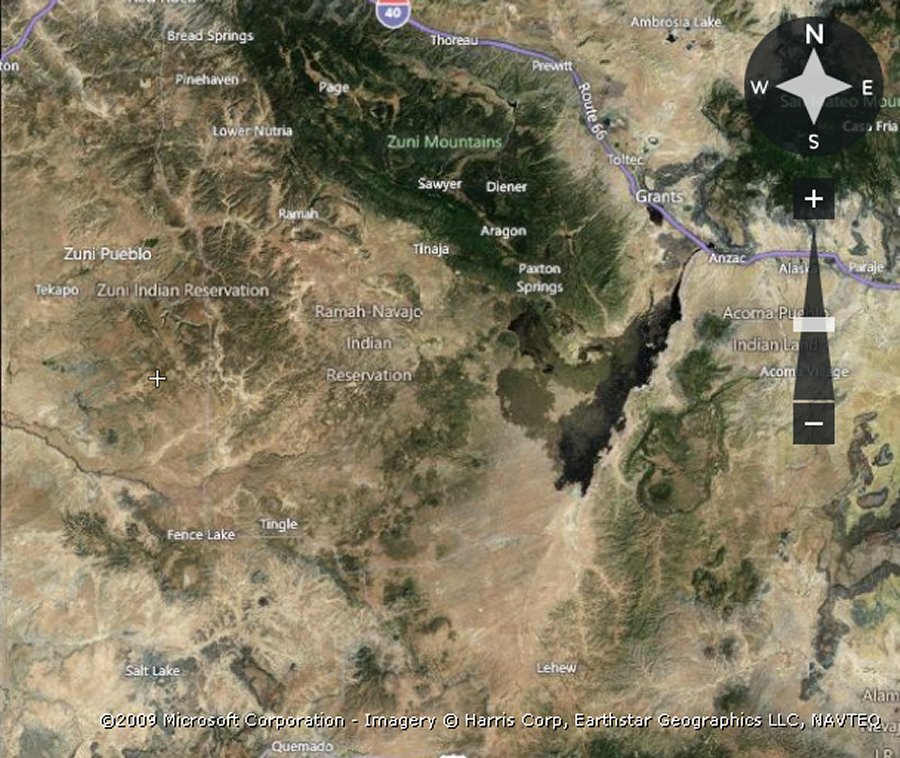
During the early 1990s the Coincidence Coordinators conspired to make Zuni Pueblo and the geography surrounding it a major focus in my life.  I mentioned a bit about Zuni here:  This is Zuni Salt Lake, but over the next couple of whiles I’d like to tell you a bit more about them. 

At the time the overwhelming part of my salary was paid by FEMA and a part of my job involved mitigation of recurring natural disaster damage behind federal disaster expenditures.  In New Mexico a huge percentage of the recurring expense was located on Navajo lands, but flooding on the Zuni River reared its head as a concern during the same time period.

Meanwhile, the Coincidence Coordinators got into the act.  The search for the lost gold mine was being driven by documents from the US Archives, New Mexico State Archives, fragments of mention from 19th Century newspapers, later-in-life memories of men connected to the events and documented in books, topo maps and other researched sources.

Keith and I, examining and submerging ourselves together during that phase of my search, concluded the areas to the east of Zuni, and to the south were prime candidates for the location.  Candidates based on what we knew at the time.  Wilderness Threats.

By my own recollection that phase of the search lasted only three, maybe four years, maybe less.  But it led by numerous routes, into more than a decade of closer association with Zuni, both as a tribe, and as a geography.  I’ll be posting more about that, about Keith’s and my explorations, about the Zuni pueblo and the people living there, and about some aspects of the history and culture.

But I’ll begin by posting this piece of doggerel I wrote a long time ago about my first visit to the Zuni Rez and my first encounter with the Zuni and Ramah Navajo.  That meeting with the Zuni Tribal Council burned itself into my memory as few things I’ve experienced this lifetime have.

Flooding on the Zuni land
Tribal chairman calls
Upstream Ramah Din’e band
Over grazing galls.

Ancient ruins I travel past
Forgotten tribes of old
And finally arrive at last
On Zuni land as told:
Tribal council meets, he chants
A time warp history.

I Listen long the raves and rants
And river mystery:
Navajo must have his sheep
To have his wealth, it’s plain.
Too many kids, too many sheep
Too little grass and rain.
Forgotten white man wrongs and deeds
The raids of Navajo
Corn that didn’t sprout the seeds
And stumbled Shalako
More sheep grazed than in the past
Arroyos grew wide and deep
Siltation settled hard and fast
In riverbed to sleep.

Navajo siltation choked
An ancient channel bed
Water rose above the banks
200 cattle dead
Houses flooded, ruined cars
Fields of grain were lost
A playground field a channel mars
And who should bear the cost?

The tribal chairman Ramah band
Listened to my tale
Stony silence, steady hand
Informed me I would fail.

“If those Zunis don’t like floods
Tell them to reduce the chances;
We’ll hold back our streams of muds
If they’ll call off their damned rain
dances.”

(Doggerel to smile by)

Old Jules

Guide: Adopt Selective ‘Remember’ BS Rhetoric With Surgical Precision

Alive and safe, the brutal Japanese soldiers who butchered 20,000 Allied seamen in cold blood

Just keep it safe and simple pretending to remember something about the ‘fighting’ by Allied troops across the planet.  Hug yourself with some feelgood to help you feel sensitive and patriotic.

http://www.dailymail.co.uk/news/article-491548/Alive-safe-brutal-Japanese-soldiers-butchered-20-000-Allied-seamen-cold-blood.html

Carefully remember today ONLY the Japanese attack on Pearl Harbor carrying some vague message we should remain prepared against similar future events. 

Carefully do NOT remember the Rape of Nanking, the Bataan Death March, the savage treatment of Allied POWs and civilians in occupied territories of The Greater-East-Asian-Co-Prosperity Sphere.

Carefully do NOT remember the beheading of hundreds, maybe thousands of prisoners, the starvation and death by disease of a huge percentage of other prisoners compared to elsewhere, almost anywhere among the armies of either side.

Carefully do NOT remember  the overwhelming percentage of that conduct was perpetrated by enlisted men and officers below the rank of captain.  Men who returned to their homes to be accepted within a couple of years as allies and fast friends of the US and other nations they fought, invaded, raped, pillaged and slaughtered only months earlier.

Carefully do NOT remember the Marshall Plan and the rebuilding of Japanese industry and infrastructure destroyed by the war, rendering much of US industry obsolete or absolescent.  DON’T remember the 20,000 suicide-before-surrender Japanese cliff-jumps at Okinawa.

And while you’re at it see if you can find a feelgood argument with someone  about the ethical and moral side of the atomic bomb, Hiroshima and Nagasaki.

Better to forget all of it than pretend to remember some of it.  Crank up your Mazda, turn on the FM and listen to some oldies while you remember what it was like to have a job.  What happened 1941 – 1945 had nothing at all to do with anything happening today.

You don’t remember a damned thing about anything that happened to other people.  Just remember Santy’s coming to town.

Old Jules


I can’t forget but I can’t remember what – December 7, 2011

Middling cold here and I’m trying to thaw some water for the cats and chickens, along with thawing my fingers enough to type.

There was something I was supposed to remember this morning but I can’t recall what it was even though I started the post and put that pic on it to remind me.  That, and a pic of the Toyota sitting out across the meadow.

Tora tora tora!


Maybe it will come to me later in the day.

Old Jules

The Devil Take the Hindmost Religion of Human Progress


The Lone Psychiatrist Rides Again


So,” says I to Mr. Hydrox, my second-in-command.  “Just what-the-hell do we think we’re doing?”

“Who?” Hydrox explains.

“Us.  You.  Me.  Niaid, Shiva, Tabby.  The Great Speckled Bird and the hens.  It’s coming on Christmas.  Why aren’t we gearing up?  Going on buying sprees?  Getting into the spirit of things?”

Christmas where the desert went and why


Hmmm,” Hydrox frowns, scratching behind his ear.  “You’re thinking of what?  Maybe buying a few miles of lights and stringing them up?   Finding some ways of burning up some more kilowatt hours without warming the cabin, pumping water, creating anything, putting food on the table or adding anything necessary to things around here at all?”

I pulls at the suspenders to my insulated coveralls, stalling for time.  “Well, yeah.  Everyone else does it.  Remember when we lived in Placitas and the whole town got drunk and walked around the village singing?  Don’t you miss that?”

I hated it,” Scrooge McHydrox mutters.  “So did the other cats.  Christmas.  Halloween.  Easter.  But especially Christmas.  Kids buzzing around the roads on new motorcycles trying to run one another over.  Garbage piled up around the pickup containers.  You humans are a mystery to me.  Can’t think of enough things to buy and throw away. 

“But all the while yapyap yapping about how hard times are.  Yap yapping about the cost of just staying alive.  You humans don’t even know how to eat a pound of meat that didn’t come in half-pound of plastic.”

This raised my hackles a bit.  “We’re smart.  We’re on top of things.  Every one of those empty cat food cans in that barrel over there are a sign of human progress and intelligence.  Someone somewhere dug that ore out of the ground.  Someone else smelted it and rolled it down into sheets to make into cans to hold meat someone else grew and killed and butchered so you can have a full belly.

“You eat better than the people who did all that work.  You cats eat better than the progeny of the people of the people I buy it from are likely to.”

Hydrox glared at me in a way I like to think of as put-in-his-place.  “Yeah.  And who’s responsible for all that?”

“Human progress,” I replied proudly.  “The religion of I-Got-Mine.”

Old Jules


Anachronistic Perceptions and Temporal Priorities

Morning readers.  I appreciate you coming by this morning.

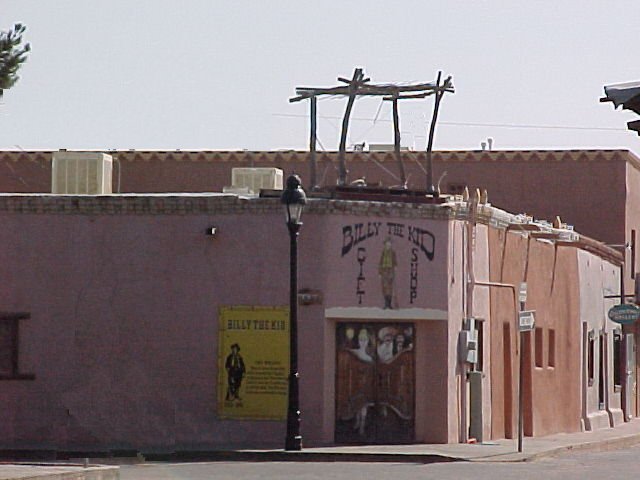
The building pictured is on the corner of the plaza in Mesilla, New Mexico.  I don’t recall at the moment what connection it has to Billy the Kid, other than the fact he hung around Mesilla.  I do know the building was the center-piece for a lot more resounding events than some half-baked kid with a pistol could ever have added to, or taken away from.

That building, in 1860, was the County building where Jacob Snively, former Secretary of War for the Texas Republic, and his partners filed the mining claim for their gold strike at Pinos Altos, New Mexico.  They attempted secrecy, but the word leaked out quickly.  They headed back to the Gila, camped after dark, and woke in the morning surrounded by a booming mining camp sprung up during the night, home of a major gold rush.

Not much later the same building became the headquarters for Colonel Baylor and the first wave of Texan Confederate invaders of the western territories.  The primary Government building for the Confederate Territory of Arizona. 

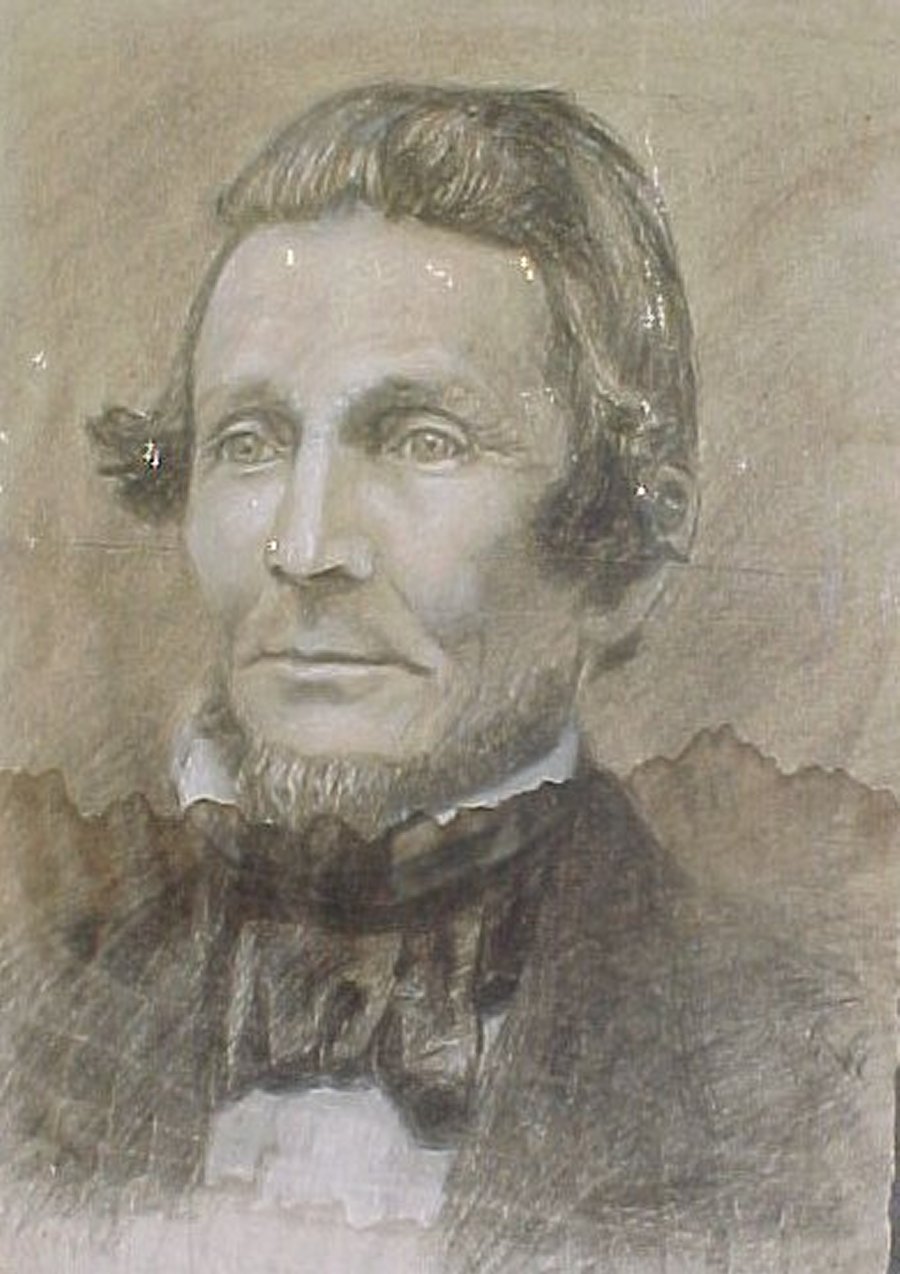
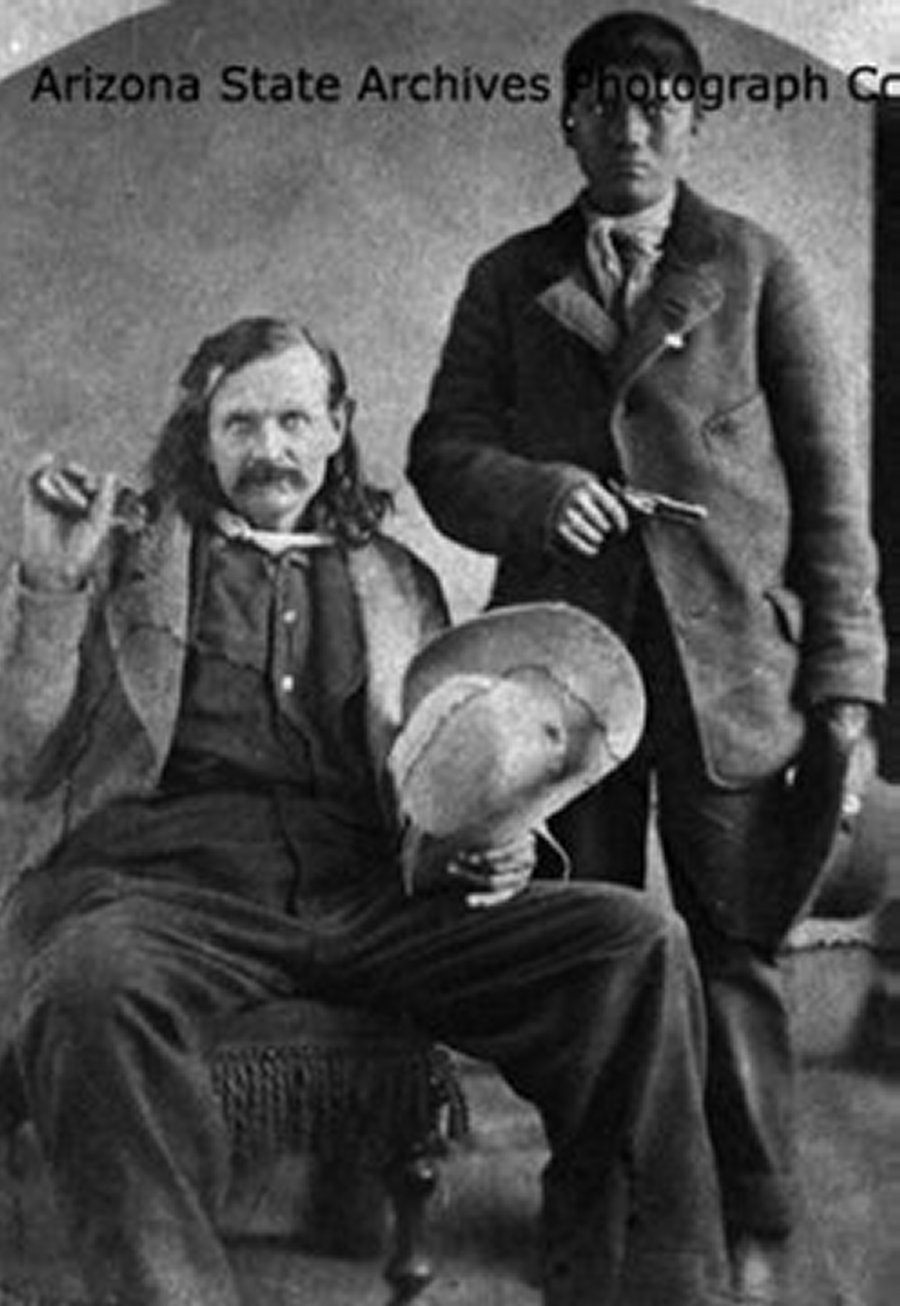
Baylor recruited from there and volunteer recruits from Mesilla and Pinos Altos comprised the overwhelming part of the force of Sherrod Hunter for his invasion and occupation of Tucson.   One of Snively’s partners, Jack Swilling, commanded the Confederate troops at Picacho Pass, westernmost battle of the Civil War.  Swilling eventually became the founder of Phoenix, Arizona.

Jack Swilling

There it sits today, that building, proclaiming itself to be something involved with a tiny man with a big pistol, but it has a lot more to say if anyone was listening.

Old Jules