Category Archives: Survival

Vacating the Premises – A Vanishing Act

The mountain I used to prospect for several years is covered with ruins wherever there is water.  Big ruins.   I used to sit on one near my camp and try to imagine what it must have been like.

One summer solstice afternoon I was sitting on the cliff boundary of the ruin watching the sunset.  In the basin below there’s a volcanic knob out toward the center of the plains.   I’d discovered a single kiva on top of it years before and puzzled over it vaguely.  What was that kiva doing there, miles away from the big houses?

But because that day happened to be solstice, I suddenly noticed when the sun went down, it vanished directly behind the point of that Kiva knob!  Yon damned Mogollons used it to mark summer solstice!
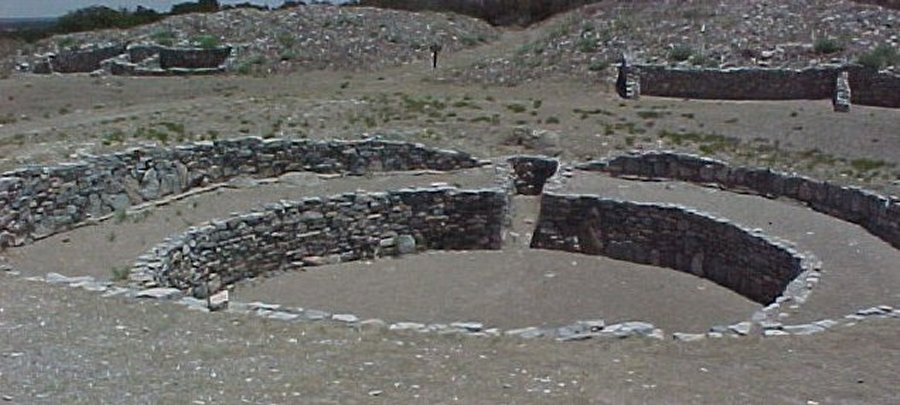
A place like that fires the imagination, and I spent a lot of time thinking of those people who lived in that ruin. Some of these groups had evidently been in the same locations for 300-400 years, and suddenly their government leaders decided they had to leave.  Politicians, or priests, or both, deciding what was best for them.

One day they  just left.  I’ve always thought it was because of that grim civil war nobody knows anything about that happened among them around the time these ruins were abandoned.  Bashing in the heads of anyone who didn’t agree to migrating.

They probably watched and even hosted strings of these travellers along the trail until their own turn came.

What a thing it must have been to be one of them on that last day, saying good bye to the place your great-grand-dad, your granddad, your dad, and everyone else as far back as anyone could remember, including you were all born, lived, and mostly died.

Everyone voluntarily packed a few belongings, a medicine bag and blanket or two, a stone hatchet and a few scrapers, and left, leaving corn in the bin for those coming behind.  Abandoned pots lying around all over the place measured the things they couldn’t carry.

Sometimes sitting on that mountain early in the morning it sort of overwhelmed me, the pain and sorrow in those villagers.  Probably they all left in the morning one day, after a while of maybe being notified it was their turn.  A few weeks of  planning.  What to take?  What to leave behind.

Finally they probably finished the last minute packing the night before.  At dawn they made a line down the basin heading south, looking back over their shoulders as long as they could, feeling so sad.  Knowing they’d never go home again, wondering about the place they were going.

Remembering how it was playing on the mountain with their grandads when they were  kids, remembering the special, secret places kids always have.  Just looking and yearning to stay, and already missing that long home where their ancestors had roamed for 2000 years.

They’d have tried to keep it in sight as long as they could, each one stopping to wipe the trail dust off his face, pretending to catch his breaths.  But yearning back at the old home place, piercing the heat waves with their eyes, straining to see it one last time, maybe crying, certainly crying inside.  The kids probably screeching enough to cover everyone elses grief.

As they trekked south they were joined by other groups from the neighboring villages.  The dust rose on the trail making a plume, a cloud around them.  They examined these strangers who were now trail mates and wondered who they were.

Some, they probably soon discovered had a mother-in-law, or uncle who came from their village.  They got to know one another better there on that hot, sad, lonesome trail away from all they they’d ever known, and they shared the hardships of the journey together for a long time.

Today, it’s just piles of rock, potsherds, holes left by scholars and other diggers for spoils.  The land still falls off across Johnson Basin, sun going down over that volcanic nub that once measured the time to plant.  Cow men ride their motorized hosses across the old trails, cows stomp around looking for grass, making the pottery fragments even smaller.

But sometimes late at night when the wind howls down the mountain a man might hear, or think he hears an echo of the chants, the drums, the night mumbles and whispers of lovers, the ghosts of lovers.  Pulls the bag tighter around his ears and wonders.

Old Jules


Today on Ask Old Jules:  What is Forgiveness?
Seems the advantages of being out of sight and out of mind for most of the population aren’t necessarily advantages when the out-of-sight geography includes something a multi-national corporation wants. All those city folks needing to keep the air conditioners turned down to 70 and to be able to light up the hair dryers every morning probably never ask themselves where the electricity popped out of the ground and hopped into the wires they plug things into.

One more bug on the windshield of civilization.  Old Jules


BEYOND THE MESAS, LLC

[The following letter was written by former Hopi Tribe chairman Benjamin H. Nuvamsa from Shungopavi.  He presented the letter to the Hopi Tribal Council on Friday January 13, 2012]

January 13, 2012
Hopi Tribal Council
Hopi – Tewa Senom

It is time we have a serious discussion about coal mining on our reservation, our water rights and our environment.  For far too long, we have pushed these issues aside, not willing to talk about how these issues impact our lives.  We must talk about how the Peabody Western Coal Company and Navajo Generating Station are affecting our lives.  Since the mid 1960’s, Peabody Coal has been mining our coal, pumping our precious Navajo Aquifer water and paying us pennies on the dollar in return.  Navajo Generating Station is emitting dangerous and harmful particulates into the air we breathe.  Our coal resources are being depleted.  Our Navajo Aquifer has been damaged…

View original post 979 more words

Finding Non-Virtuous Pursuits: The Challenge

I’ve spent most of a lifetime avoiding virtue successfully without having to devote a lot of energy to doing it.  But it’s gotten a lot more difficult.

For instance, I predominantly eat veggies along with some rice.  If I feel the need for protein I throw in some eggs.  Sounds harmless enough.  I’ve got a rice steamer with a platform compartment in the top allows me to steam a mess of veggies and rice faster than I can tell it.  I love it, and it’s easy to clean afterward without using any water.  I run a 1.1 penny US baby-wipe wipe over it after I pour out the vittles and it’s ready to run another race.

But suddenly I’ve discovered not eating meat is at least a virtue, in some cases, a religion.  Wedges me firmly between a rock and a hard place.  I’ll eat a bit of meat sometimes when I can afford it, but honestly I feel better saving the money against the possibility of something coming up so’s I need money.

I’ve got a little sausage in the freezer I had Gale pick up for me last time he was in San Angelo, but in some sense it’s like the quarter-bottle of Y2K Jack Daniels Black Label sitting on the microwave drawing dust.   It’s just too good to use, except on special occasions.

So, for the purposes of not being virtuous, the sausage doesn’t help much more than the Jack Daniels.   I need to come up with some cheap, non-virtuous things I can do that don’t require burning any gas, borrowing a vehicle, or glutting myself more than I do when I cook up a nice Idaho potato, chop up some jalapeno, onion, half-stick of butter and smother it in yogurt or cottage cheese.

Lessee. 

pride…. heck, I’m already up to my Adam’s apple with pride.  Any more pride might be a hazard to my health.

covetousness  Maybe that’s a possibility.  Maybe I can think of something to want really badly.  Nothing much comes to mind, but this is too important to reject out of hand.

envy  … That would be pretty cool, finding someone to envy.  But I can’t recall running across anyone I thought was enviable in so long I’m not sure I ever did.

lust … Nope.  Donealready beentheredonethat with lust.  I ain’t going there again.

anger  …Took me 50-odd years to figure out I was an angry person, same as everyone claimed I was.  Big job of work getting rid of it once I figured out I was.  Anger needs to make a home in people who don’t know the tricks.  I don’t think I could hold onto anger in a way it would find palatable.

gluttony . . .   Gluttony might work. I’ve got 100 pounds of milo maize out there.  Maybe boil some up, put some butter on it, maybe some pepper and onions.  Curry.  But I’d have to drop in some sausage to keep it from metamorphosing into something virtuous.  Something to think about, anyway.

sloth …  Sheeze!  Sloth is absurd.  It’s a red herring they hang out there pretending to offer up hope in case a person can’t avoid virtue some other way.  But hells bells!  When’s a person supposed to find any time for sloth when there’s only 24 hours in a day?  Sloth is BS.  Forget it.

That milo’s looking better and better.  At least until I can think of some more respectable way to clear my conscience without bankrupting myself.

Old Jules


Sculpting Realistic ‘We’ From the Ideal Universe

Hydrox jumped off my lap and stalked over to the bed.

“Sometimes you human beings disgust me with your pretense.”

Him being second-in-command around here, I try to keep him up-to-date on my thinkings and directions.  Seems prudent to me because he’ll have to take over if I kick.  I’d just been asking him if he thought we could get along okay living in a travel trailer.

“Just what ‘we’ are we talking about here?  You and me?  You and all the cats?”  He glared at me.  “You, the cats and the chickens?”

I shrugged, wondering where he was going with this.  I felt a tirade in the making.  “Just you cats and me.  The chickens can’t be part of it.”

“Well, that’s a relief, anyway.  But I think you need to think through this second-in-command crap and all the what-if-you-ain’t-around side of it.”  He gestured with his nose toward the porch.  “The only ‘we’ worth talking about involves mutual resolve.  Creatures willing to allow the well-being of others within the ‘we’ to influence what they do.  No creature unconcerned for the well-being of the others, no creature the others don’t have a commitment to, can be part of a meaningful ‘we’.”

I thought about it a moment.  “That makes sense.  It’s why I was trying to keep you up-to-snuff on things.”

  His frustration was obvious.  “Yeah, and that’s where you’re proving how stupid you are.  For me,” He tweaked a claw under his chin, “the only ‘we’ around here is you and me.  And maybe Niaid, just a whisker.”

This rattled me, but he went on before I could say anything.  “When that coon on the porch ran at you and I jumped in, that’s ‘we’.  When you go to town and buy food for us, that’s ‘we’.  But do you see Tabby or Shiva the Cow Cat lifting a paw for me if I was starving?  Do you see either of them jumping in if a coon attacked me?”

He waited while I considered it.   “I suppose I don’t.”

Then they’re not a part of any ‘we’ I belong to.”

The more I pondered it the more it seemed to me he’d come upon an important thread in the fabric of reality I’d been overlooking.  Not just with cats and chickens, but with every piece of human intercourse around me most of my life. 

When a person goes down to City Hall, or the County Courthouse to perform some necessary business, for instance, and the clerk begins the ritual of obstruction, a ‘we’ is in the process of being defined.  The clerk is the spear-point for a huge ‘we’ of contradictory demands on the ‘we’ you occupy. 

“Do you have proof of residence?”

“There’s my driver’s license.”

That’s not enough.  I need a utility bill or tax return.”

“I didn’t bring that.”

“Then I can’t help you.”

The ‘we’ that clerk represents just defined a boundary excluding you from that ‘we’ and placing you inside another ‘we’ it considers an enemy.  And in a real world, that definition would be mutually recognized, rather than singularly by the human spear-point drawing the boundary.

Which is probably why representative democracy was doomed to eventual failure.  In a fantasy of wishful thinking a population created ‘we’ with a set of unrealistic boundaries.  When new ‘we’ entities developed around government centers those included in the ‘we’ tribes were those they associated with, lived near, shared a commonality with.  In Washington, D.C.  In Austin, Texas. 

And inevitably those outside that ‘we’ became an obstruction, a product, an enemy to their ‘we’.

“The only ‘we’ worth talking about involves mutual resolve.  Creatures willing to allow the well-being of others within the ‘we’ to influence what they do.  No creature unconcerned for the well-being of the others within the ‘we’, no creature the others don’t have a commitment to, can be part of a meaningful ‘we’.”

Sometimes it takes an outsider to the human ‘we’ constructions, a feline with a firm hold on reality, to recognize the obvious.

Old Jules

“Electing pet skunks to guard the henhouse might work for a while.  But the skunk-instincts and  chickens behind the walls they’re guarding metamorphoses the ‘we’ they live in.  The skunks become a we with a priority of digging under chicken-house walls and the we of being pet skunks fades until it no longer can call itself a we.”  Josephus Minimus


The Consequence of Premature Whatchallit

Good morning readers. Thanks for coming by for a visit.

The Toothless Soothsayer was going to be my post for today, but as I was working on it yesterday I accidently hit the ‘PUBLISH’ button and it became history.

It’s going to be a busy day here.  It’s been almost a month since I’ve been to town for provisions and I’ve got a list two-pages long of things I’ve runned out of already, or that I’m down to bare bones on.  The cats have been threatening to go on strike if I don’t get some other flavors of canned food, the chickens are fighting the cats for dry cat food, and the deer are complaining about what’s available to steal from the felines and chickens.

I thought I’d stocked up enough on the old kind of cheap lightbulbs, but the cheapo ones burn out a lot faster than a person might expect.  I’m hoping I can find a few more on the shelves to snag before lightbulb-Y2K happens. 

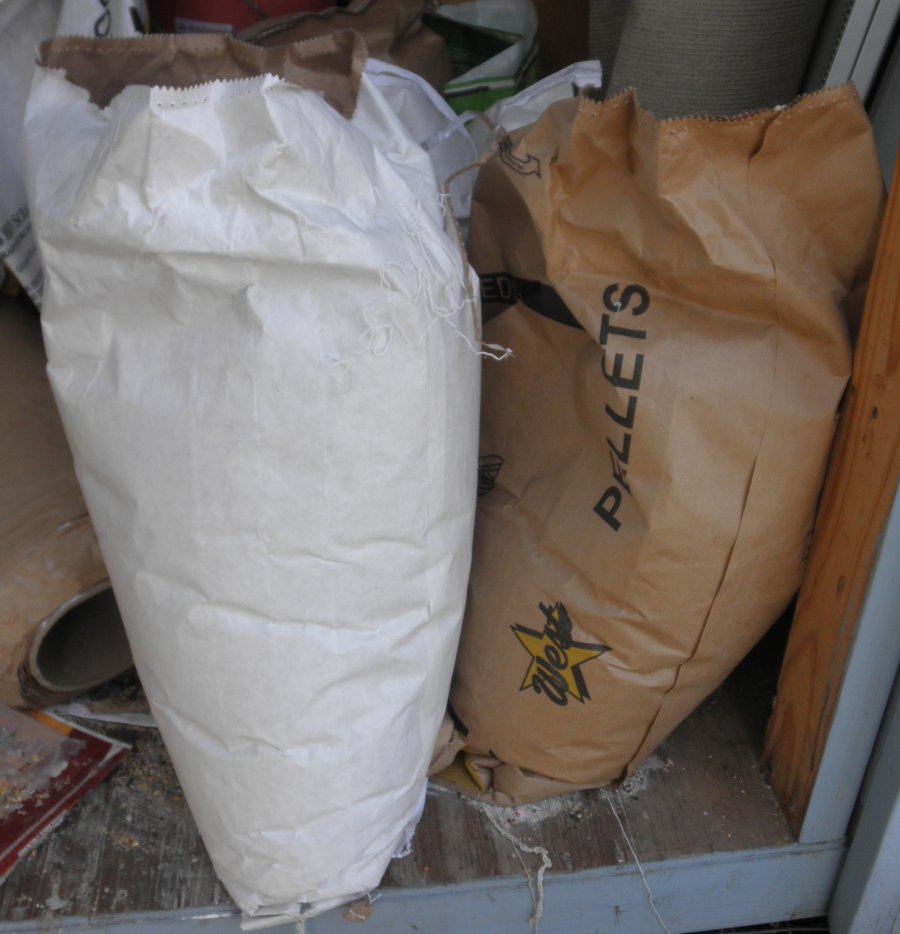
Most of you probably haven’t noticed what’s happened to the price of feed grains, but I expect you’ll be seeing it on the grocery shelves in the form of pricetags before long.  The price of chicken scratch is up about 25 percent from sometime a while back, and layer pellets up almost that. 

The flock is free ranging a lot further than they used to because I’ve cut down of how much I put out for them.  It’s a tightrope, making sure they have enough to supplement their forage, but keeping it down to a level so’s they don’t waste it, which they’ll do.  They’ve always been spoiled, profligate, ungrateful birds.  But now they’re being driven by necessity to range out a quarter-mile, which is the idea behind free-rangers but too good for them to allow them to appreciate it.

A while back my laser mouse with a cord went out, and digging around I found a cordless one I’d never been satisfied with from several years ago.  Out of hunger I put a couple of triple-A batteries in it and found it worked okay.  Couldn’t recall why I’d abandoned it.

Then I discovered it goes through batteries something ugly.  It’s a gas hog and I don’t think my need to have a cordless mouse is worth the price of keeping it on the road.  Probably it’s going to be me tied to the comp at the end of a fiber-optic cord again.

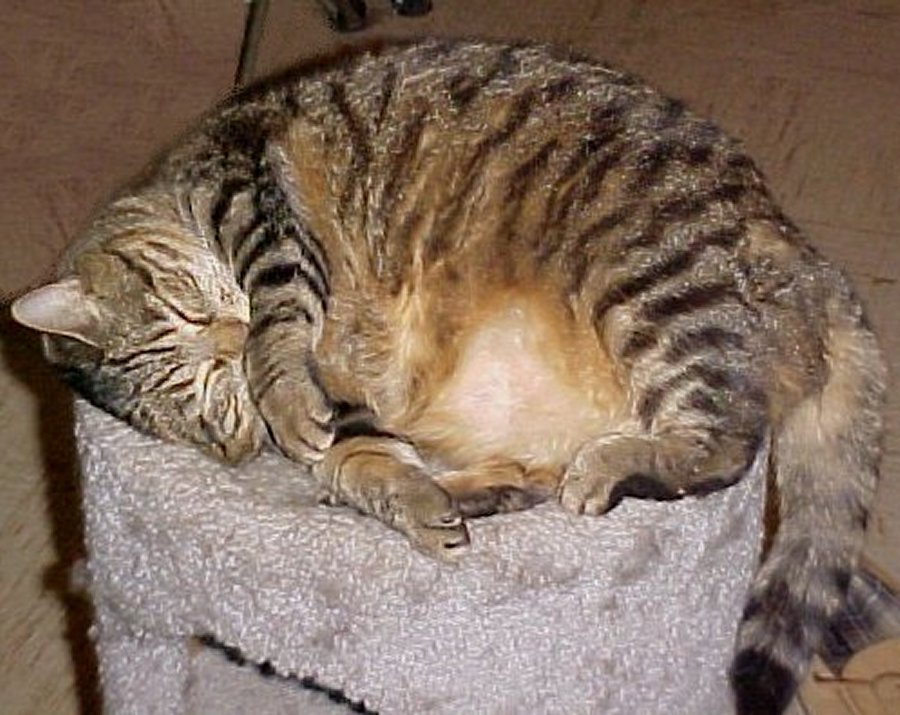
If you’re travelling out in the vicinity of Grants, New Mexico, and you see the cat at the top of the page, tell her Hydrox, Niaid and I said hello.  I doubt you’ll see her because she vanished in 2003 and we figured she’d joined Mehitabels #1 and #2 on permanent mouse patrol.

But you never know.

Old Jules

White Doves, Rainbow Family and Esoterica

Good morning readers.  Thanks for coming by for a read.

WordPress is being a communist this morning. Or maybe the world came to an end last night sometime but it hasn’t gotten to me yet because I’m so far out in the country.

I was going to regale you this morning with some things I dug up online about building and retrofitting hydrogen generators to internal combustion engines yesterday but on the off chance the world ended last night, I won’t.  The whole thing might be a moot issue.   Talking Our Way Into Oblivion – Hydrogen and Hot Air

I’d also thought I’d share with you a couple of interesting things that appear to occur when the center of mass of a system of orbiting bodies changes, but if the world ended there’s no point getting into that, either.  I suppose I’ll be obliged to break my iron discipline and focus to tell you about a couple of things happened here a while back.

A while back this dove flew in here and spent a few weeks sharing the chicken feed on the ground.

I’d never seen a white dove before.  It’s forty miles to the nearest town of any size, fifteen miles to a village big enough to have a gas station/convenience store.  So I didn’t figure it was a pet.

But when I approached it on the ground it didn’t fly.  At first I thought it was injured or sick.

It had no fear at all.  Nothing seemed to be wrong with it.

A week or two after these pictures were taken it began spending more time higher in the trees and less on the ground.  Then it evidently just decided to move on to whatever was waiting for it somewhere else.

A free spirit.  Sort of reminded me of the Rainbow folk I’ve shared campsites with in remote places and occasionally picked up as hitch hikers.  Didn’t have much in common with the wild doves around here and nothing at all with birds somewhere else in houses with cages.  Marching to her own drum, not letting anything get into the way of doing it.   But not living in fear.

Which behooves me to tell you a bit about the Rainbow Family.

I first attended a Rainbow Gathering as part of a team of New Mexico Emergency Management Planning and Coordination  [EMPAC] personnel assigned to be there with the National Guard during the Taos gathering of the early 1990s.  I’d never heard of the Rainbow group prior to that, had no idea what to expect because neither did anyone else in New Mexico government.

What I observed was Woodstock without the music, a lot of folks who reminded me of my own younger times of long hair, protest, sex, drugs and rock and roll on the family side of things.

On the other side I saw National Guard troops loaded with live ammuntion and no clear instructions and rules of engagement being frequently hassled, treated with condescension alternately with re-enactments of some flower-chile ‘Come Join Us’ pleas from earlier times.  ‘Family’ members running alongside government vehicles engaging in every form of engagement except disengagement.

And  to complicate matters further,  a civilian group of Taos Hispanics who wanted nothing so much as the gathering broken up and out of those mountains they considered their own.

I spent a harrowing week or two up there trying to keep my mind from falling into a state of spacial-time disorientation.  When it was all over we drove back to Santa Fe wiping our brows in relief that nobody’d been shot, beaten to death by locals, no major incidents.   My thoughts at the time were as far from ever wanting to see another Rainbow Family member as they could get and stay on the planet Earth.

I count myself lucky to have encountered many of Family members in other settings during the two decades afterward, picking them up hitch hiking, sharing remote campsites, discovering there’s a side to some part of the Rainbow Family membership I hadn’t noticed in the Taos experience.

Gypsy-like free-spirited, thoughtful and considerate people just doing their own thing, trying their best not to leave any bigger mark where they’ve been than they absolutely must.  Good pleasant folks to spend some time with.

So long, I’d have to add, as a person stays clear of the party-animals and really cool people drawn to the mass gathering.

Old Jules


Spark and Tinder for the Next Country Music Wave

Morning readers.  I’m obliged you came by for a read this morning.

A while back while I was in Kerrville I was in one of the huge office supply stores that have driven all the locally owned ones out of business.  I was nosing around looking at things when I glanced at a guy, a woman and a clerk studying copiers or fax machines. 

“Small world!”  I mutters to myself.  The male customer part of the trio was a face a decade older than one I’d known too well almost a decade ago.  A guy named Tony Wossname.  Once a motel manager in Grants, New Mexico.  A man I’d been blessed to observe through the lens of the darkest side of his character. 

I changed positions in the store, moving place to place studying this later model of a man who could spot desperate need for a job when he saw it and derived a lot of pleasure out of making it as painful and difficult for the desparee as his power allowed.

After I discovered I couldn’t get any other job in Grants, New Mexico following Y2K I went to work in a motel off the Interstate, graveyard shift, as a night clerk for a while.  Besides giving me almost enough money to pay rent, utilities, and buy a little carefully selected grub, the job showed me a side of humanity I wasn’t familiar with.  And it gave me a lot of time to think about what I observed.

One of the things Tony liked about being a motel manager was his radio in the locked office the 11-7 shift clerk couldn’t access.  The radio had no speakers in the office, nor in his apartment beside it, but it did have speakers in the lobby where he couldn’t hear it.

What kind of music do you like?” Tony’d asked me conversationally during the job interview.

I like any good music.”  I shrugged, recognizing a management school tactic for getting the applicant to relax.

So do I.  But there’s some on the air these days I can’t stand.”  He scowled and shook his head.  “I hate that RAP stuff.”

I just don’t listen to the radio much.  I like older music, mostly.  The modern CW swill could probably drive me nuts.”

He had what he wanted and changed the subject, now that I was all relaxed.

I got the job, which included two lobby speakers tuned to a modern CW station, 11 pm to 7 am with the volume control and station selector behind a locked door.

I did a lot of writing on those shifts while trying to stay sane.  Here’s one night of inspiration about modern country music:

3:30 AM

Hearing this country music station wailing all night so many nights has caused me to realize what’s changed in country music. It used to encompass a fairly wide range of fairly lowbrow experiences and sentiments. Love, cheating, drinking, bull riding, hound dogs, mama, trains, trucks, car wrecks, dead friends, being broke, dreams of something or another, hopes, losses, resentment, pride of accomplishment, prison, cows, land, and clothing. Now it’s nothing but drooling whining love songs. Wonder what the hell that means?

Probably  means females are picking all the hits, buying all the records, and the men who dance lockstep with them are also females.   Something’s definitely changed, in any case.  There are still Guy Clarks out there, still Prines, still Tom Russells, still Willies and Merles. That just ain’t getting hit records.

Maybe the baby boomers lost something after their quadruple bypasses. Ever heard of a woman getting bypass surgery? I haven’t.

Maybe ten years from now we’ll be hearing country songs about bypasses and prostate cancer- about Winnebagos, casinos, golf, medicare—about grandkids wanting to  put him/her in a nursing home- about hearing aids and false teeth, thick toenails and sagging skin.

If so, it will be an improvement, and I, for one, look forward to it.   Maybe tonight I’ll write the off-the-charts hit CW song for 2012. 

Cheatin’ a Broken Heart

Westbound on the Interstate
Out on the Great Divide
Our Winnie overheated
So we pulled off on the side

The sagebrush and the red rock buttes
Invoked our reverie
While the engine cooled I thought about
My bypass surgery.

Refrain:
You can have your diabetes
Talk about your brand of “C”
But when heat waves blur the red rock
I’ll take bypass surgery

We’ll be turning south at Flagstaff
For the fairways to the south
Where my third ex-wife will meet us
With the grandkids and her mouth

Those two eggs up on whiskey toast
Home fries on the side
She always made for breakfast
Were my downfall and her pride

We’ll take the brats along with us
And camp somewhere below
The international boundary
Buying meds in Mexico

‘Cause it’s not the margaritas
Nor the senoritas sweet
It’s the discount pharmaceuticals
That tug these flattened feet

Now the engine’s finished cooling
And the wheels begin to roll
And there ain’t no bloody stool
In the RV commode bowl

Refrain:
You can have your diabetes
Talk about your brand of “C”
But when heat waves blur the red rock
I’ll take bypass surgery

So here I am, 2012 coming on strong and fast.  The lyrics for the big hit for the year already written, the New CW Wave craze all mapped and ready to take off.

Gotta find a musician.

Remember where you heard it first.

Old Jules

The Price of Not Expecting the Unexpected

If I were prone to regrets of things done and undone I’d regret not being more observant when something was going on around me worth observing.

I was on a business trip in a New Mexico State vehicle meeting city officials in Portales, the town where I grew up.  I visited with my old friend and classmate Fred Stevens and, we ate out together the previous night at a local restaurant.  

Next morning hanging around City Hall I chatted with my 6th grade teacher, Bill Walman, then Parks and Recreation Director, and Mack Tucker, director of something else, with whom Kurtiss Jackson and I had worked for Skeeter Jenkens on the ranch ‘way back when [ A Sobering View of Y2K].

If I’d been paying attention I might have noticed something at the meeting.  Or maybe during one of the chats with friends I mentioned the route I’d be taking home.  Maybe I’d have examined the car for something attached to it.  Years of hindsight would have been helpful.  Some of the details of the following sequence of events might be out of order, might be inaccurate by having dimmed with the years.  But it’s a fairly close portrayal of something that I still don’t understand with whatever’s been gained by the passage of time.

After the meeting I left late-morning and headed west to go home to Socorro.  Probably there was a lot I could have noticed if I’d had my senses tuned.  But I was on autopilot.

The road between Portales and Roswell seems a long one to motorists and I probably was exceeding the speed limit.  There was almost no traffic, and I didn’t notice whom I passed and what they might have been driving.

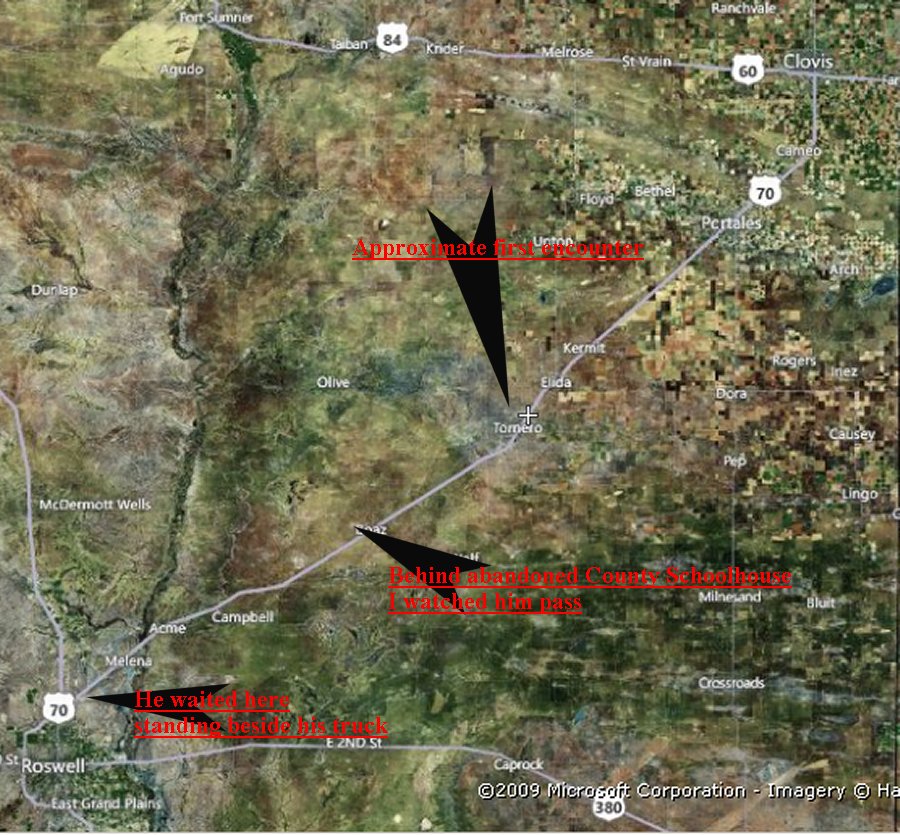
I’d consumed a lot of coffee that morning and somewhere out beyond Elida I stopped and walked to a tree along the fenceline to relieve myself.  A battered old truck pulled up behind the state car and stopped with the engine idling.  When I finished I went to his window. 

 
“Anything I can do to help you?”

The guy was dressed in a shabby bodyshop shirt, bad teeth, nasal twang accent of a local.  “Ah was just wondering why someone in a government car passed me going 80 miles an hour.”

“What makes you think I was going 80 miles an hour?   The speed limit’s 55.  If I passed you going 55 I might have been speeding to go past just to get around you.”

“What gumment agency you working for going that fast?  I jest want to know why you’re driving so fast in a state car!”

I told him to take the tag number and call it in if he had a complaint, but he went on and on with a nasal, makes-no-sense questioning. 

I got back into the car and drove on, but stopped again at Kenna.  The village had become a ghost town, but it had a lot of memories for me because Skeeter’s ranch was outside Kenna, and when Portales was ‘dry’ most Portales teenagers used to drive here to buy beer because the Portales bootleggers wouldn’t sell to them.

I’d begun to awaken a bit, though, and was wondering about the guy in the truck.  I watched as he drove past on the highway and probably considered the fact he was now ahead of me again.  A few miles out of town I passed him again, this time carefully not exceeding the speed limit by much.

Once he was out of sight far behind me the coffee was working on me again, and I pulled down a side road and behind an abandoned schoolhouse for another bladder call. 

I paused and poked around the old school yard waiting for him to go past, figuring I’d wait until he went by, let him get out of sight in front of me, then drive on to Roswell with him well ahead of me.  I don’t recall why I did this precisely.  I wasn’t alarmed yet at this point.  Maybe I was just enjoying the bits and pieces of school yard litter from so long ago.  Even the old outhouse was still standing.
 
I drove on, taking my time now.  But when I arrived at the intersection north of Roswell where traffic goes north toward Santa Fe, south into Roswell, or west into the mountains, there he was, pulled off and waiting.  He somehow knew, I suddenly realized, I’d gotten behind him.  So instead of going on I drove into Roswell and got some lunch, figuring he’d be out of my life by the time I headed west.
 

But a few miles west of Roswell, there he was again.  He let me go past, so up the road a way I pulled off and parked behind a convenience store, went inside to let him go by while I had an ice cream bar.  He did go by, and I finished my ice cream and headed west again.  But at the intersection going to Ruidoso into the mountains, or Lincoln and westward to Carrizoso there he was again. 

I drove on by, pretending to be going to Ruidoso.  I pulled over again a couple of miles up the road, out of sight of the highway and waited for him to go past for half-hour, but he didn’t.  So I figured I’d lost him, headed back through Lincoln, and there he sat in front of a museum, engine running.  I pulled in behind him, determined to confront him.

I drove out of town behind him and a few miles up the road he turned into a picnic/camping area and turned around, stopped at the entrance facing the highway.   By now I was pissed, but also damned confused and slightly alarmed.  I couldn’t understand how he could be doing this. 

I was armed and I walked up behind his car so he could see me in the rearview, but with the firearm behind me out of sight. 

“Why are you following me?”

“Ahhhm not following yew.  I just stopped here to take me a rest.”

“You waited back there at the intersection.  You waited again in Lincoln.  Why are you following me?”

“I’m not follering yew.  But I still want to know why a person in a gumment car passed me going 80 miles an hour.”  And so on.

I’m warning you.  Don’t follow me anymore.”  I shrugged it off, curious how far he’d go with this.


We played cat-and-mouse, me in a busy parking lot in Capitan during a thunderstorm as he went by, him waiting for me in Carrizoso.  He wanted me to know he had a fix on me. 


 I was convinced by the time I passed him on the hood of his truck west of Valley of the Fires that he was a cop… couldn’t see any way a private citizen could have the equipment it would take to do what he was doing. 

It’s a long drive through that desert between Carrizozo and Socorro and my mind was working 90 miles an hour.  As I approached Socorro I became convinced I was about to be arrested for  something. 

I called a friend with the City of Socorro and asked him to go look at my house to see if there were a bunch of cops waiting there.  There weren’t, and I didn’t see the follower until several years later in Albuquerque during a much later phase of what came to be a decade of that sort of crap.

A week later I described it to my Bureau Chief in Santa Fe.  When I’d finished telling it I asked, “Do you know of anything I ought to know?  Could this be Internal Affairs following me around for some reason?”

He thought about it frowning.  “No, I don’t think it could possibly be that.  I’d know it if any questions were being asked about you.  They’d have asked me.”  Then he looked me in the eye.  “You need to be careful about that speeding, though.  If you get stopped for speeding in a State car working for DPS it’s no questions asked.  They’ll fire you.”

What began that day lasted almost a decade.  Long after I’d left DPS and through several post-Y2K years. 

But back in the beginning, all manner of other mysterious happenings intruded into the lives of those who climbed that mountain with me, and to me.  I don’t know to this day whether the two parallel sets of happenings were connected.

Maybe if I’d been paying more attention from the beginning.

Old Jules


The Strangeness – Background Context of Unsolved Homicides

By the time this was published in 1999, I was no longer going up that particular mountain.  I was busy on my Y2K land and dwelling preparations about 50 miles northeast of Quemado.

But this will give you an idea of the general local psychological environment in the area, both while I was working the mountain and [it turned out] later, while I was doing Y2K.

http://articles.latimes.com/1999/nov/20/news/mn-36275

Unsolved Slayings Have Small N.M. Town Living in Fear

Crime: With seven people killed since 1996, residents are openly packing heat. Authorities see no connections among the deaths.

November 20, 1999|PAUL DUGGAN | THE WASHINGTON POST QUEMADO, N.M.

— There’s not much to the town. You come upon it in the vast, yellow-brown emptiness of southern New Mexico’s high desert grassland. It’s mainly just a strip of old storefronts on Highway 60, with some dusty side streets.

In a 40-mile radius of Quemado you might find 500 people, about half of them ranchers living like pioneers on the plains and in the foothills, miles from any neighbor. The rest live in town, in trailer homes and faded stucco bungalows amid the tumbleweeds and pinon trees.

The sheriff, Cliff Snyder, said it used to be a peaceful place in its lonesome way, before all the killings. Now there’s fear in the air, like a foul wind.

Who murdered Gary and Judy Wilson? It’s a mystery. They disappeared in November 1995 and turned up eight months later, so many bones in the woods. Who shoved Gilbert Stark into a 20-foot well and closed the cover in ’96? Who shot the elderly Clark couple and their daughter in ’97? Who put a bullet in the heart of James Carroll, 59, as he stood in his corral just north of town one autumn day last year? The sheriff doesn’t know.

He and the state police said they are convinced the cases aren’t related. They were random eruptions of murder where murder used to be rare, Snyder said. He has no clear explanation for it. All of the victims lived in the countryside around Quemado, about 125 miles southwest of Albuquerque. Before the Wilsons were slain, no one had died by another’s hand in this part of sprawling Catron County in nearly a decade.

And no one wants to be next. In a swath of America where gun control means hitting what you’re aiming at, a lot of folks are packing iron. They’re propping shotguns and rifles beside their beds; they’re driving with pistols on the front seats of their pickups. The sheriff said he doesn’t mind. This is the rural West, he pointed out, and guns are a heritage.

“We’re raised with them,” said Snyder, 42. He shrugged. “If I pull over a vehicle, I figure they’re armed, if they live in this county.”

At El Sarape Cafe on Quemado’s main street, Irene Jaramillo, 43, keeps a .22-caliber semiautomatic on a shelf near the griddle. One morning last week, Paul Strand, 67, who owns a horse ranch south of town, was sipping coffee in the cafe with his wife and holding forth on the subject of their firearms.

“I sleep with a Colt .45 under my pillow,” he said. “I have a loaded assault rifle beside the bed, a Russian-type, ready to roll. And a sawed-off shotgun next to that, loaded, legal, but just barely, in terms of the barrel length.”

Across the street, Carl Geng, who is in his 60s, runs the Allison Motel with his wife. They also own a ranch outside of town. Geng said he thinks he knows the culprit in one of the homicide cases. “I’ve got a .38,” he said, gesturing to his truck in the parking lot. “He sets one foot on my ranch, I’ll blow his head off.”

The sheriff said he and the state police think most or all of the victims were murdered by acquaintances with whom they had personal disputes. As for suspects, investigators have only “theories,” he said.

It’s a crime in New Mexico to carry a concealed loaded weapon in a public place but legal for anyone 21 or older to carry one openly, no permit necessary. James Clark, a Vietnam veteran, started packing two handguns after his parents, William Clark, 84, and Pearl Clark, 74, were slain in 1997 along with his sister, Sharron Hutson, 44. Folks in Quemado are used to seeing him in town with a .45-caliber Colt Peacemaker on his right hip and a .40-caliber semiautomatic in a shoulder holster.

“Which is fine,” said Irene Jaramillo’s husband, Jimmy, who is one of Snyder’s deputies. “I told him, ‘As long as I can see them.’ “

James Clark and his wife, Elaine, 42, now live in the remote trailer home where the elderly couple was murdered. Elaine Clark, who prefers a lighter-weight .35-caliber, sat in the kitchen one day last week with her husband’s heavy semiautomatic on the table in front of her. There was a loaded hunting rifle propped against the freezer by her left hand.

“We always used to brag that it was like the Old West, in the way that your house was never locked,” she said. “Someone passing by, if you were gone, they could come in and get something to eat. But now it’s more like the Old West the way you’re always on guard. You don’t walk up to my house unless I know you’re coming . . . or you could darn well get shot.”

Catron County, with just 3,000 residents, covers almost 7,000 square miles. It’s bigger than Connecticut. Snyder, who was a deputy when the seven homicides occurred, was elected sheriff last year. He has an undersheriff and four deputies, including Jaramillo, who patrols the northern half of the county around Quemado. Half a dozen state troopers also work in the county. But with such a vast area to cover, it sometimes takes an hour or more to reach the scene of an emergency.

Cold Mystery, Fevered Romance and Lost Gold

A burned out cabin ruin with an aspen tree growing out of the inside, bear claw marks 12 feet up, 3 hand forged nails, a longtom sluicebox axed out of a 3 foot diameter log, a spring 75 feet above the sluice, an arrastra below. 

A mysterious map chiseled on the face of a 300 pound rock surface depicting the exact layout of the canyon, the cabin, the waterfall, all so accurately depicted the person had to have scrutinized the layout from the mountaintop, then scratched it on this stone 600 vertical feet below and half a mile away.  The rock was carefully placed on the canyon wall above eye-level so it was easily seen, but only by someone looking up.

I’m guessing the date must have been spring, 1995.  I’d moved my search to the mountain I described above and was performing a systematic search of  the canyon from the discharge to the mountain crest.  I’d filed two mining claims at the location of the cabin and sluicebox pictured in the earlier post, and downstream.  I hadn’t yet found the map rock, and I was spending every moment I could squeeze between job duties, romantic obligations and financial constraints camped on that mountain.

I headed down there planning on spending a week, but on the road the Mitzubishi Montero sprung a water hose a few miles outside of Grants.  It was raining while I mucked under the hood, taping the hose and getting enough coolant in it to drive it to a parts house in Grants, where I installed it in the rain.  I was chilled and soaked as I drove south from Grants, but in too much of a hurry now to change clothes.

By the time I arrived at my usual camp site I was running a high fever and feeling my breathing becoming hard labor.  I hastily dragged a tarp out of the truck,  put my sleeping bag under it and got inside, hoping I’d shake off what I was afraid was coming.  I’d had pneumonia enough times this lifetime to recognize the onset.

The next morning found me weak, fever skylining, knowing I’d better try to get out of there while I still could.  I threw some brush over my gear because I was too weak to reload it onto the truck, and started down the mountain.  My vision was blurred and I was hallucinating, barely able to stay on the two-track.  When I reached the US Forest Service road a line of fenceposts ahead briefly became a line of riflemen aiming at me.

I remember nothing of the trip after that until I found myself at the home of my lady friend in Albuquerque, wrapped in a blanket on the floor of her downstairs because I wasn’t strong enough to climb them, burning with fever, shaking with chills.  She, nursing me with herbs and leftover antibiotics from her medicine cabinet.

“There are some people missing out there where your claims are.”  She was sipping coffee at the table, looking over the paper at me.  “A man and his wife.  The State has people out searching for them.”  She shook her head.  “They must have been right near where you were.”

The couple lived across a basin at the base of the mountain.  I could probably see their dwelling through binoculars from the mountaintop.  They were woodcutters, but I’d never encountered them, to my knowledge. 

As I recovered in Albuquerque the search died away.  The local sheriff announced the couple had probably just abandoned their house and gone somewhere else.  They were nobody, outsiders.  He refused to treat their vanishing act as a possible crime, didn’t allow the State Police to investigate their home.  But the time on the floor in Albuquerque weak as a kitten, tended hand and foot is one of those tender, grateful memories of my years with the lady.

Over the next several months I continued, sometimes in company with Keith, sometimes with other friends, sometimes alone, exploring, sampling, puzzling over what I was finding there.  Then, the first day of elk season that fall I encountered two elk hunters with their truck stuck in a stream bed.  When I finished towing them out, we introduced ourselves.

“Did you hear about those bodies they found in the canyon over there?”  He gestured to the mountain indicating a canyone one over from mine, plus one.   Renfro Canyon on the rock map sketch.  Less than a mile from my claims.  “A bear dug them up.  They were buried in an Indian ruin and a hunter found them this morning.”

The bodies turned out to be the people who’d turned up missing while I was giving myself pneumonia.  I felt reasonably confident the police would be contacting me with questions about whether I’d seen anything, because I was probably the only person on the mountain besides the victims and the murderers at the time it happened.

The Bureau I worked for, Emergency Management Planning and Coordination [EMPAC] was part of the New Mexico Department of Public Safety, though a step-child and somewhat separate.  I went to my Bureau Chief and explained what had happened, asked whether he thought I should go over to the State copshop and volunteer to talk to them about it.

“Man, I wouldn’t touch that.  Let them come to you.  You might be the best suspect they’ve got.”  A lawyer friend gave me the same advice, informally.

So I kept quiet and waited, and they never came.  I kept working that mountain, homicides and multiple-homicides continued to happen over the next couple of years remaining unsolved and generally thought to be uninvestigated, and the entire county became a quagmire of paranoia.  Everyone carrying firearms, nobody trusting anyone.

Meanwhile, the mountain echoed the weirdness and pressure the county was experiencing.  Somewhere during that time began the strangest chain of events and experiences of my entire life.

Which I might describe in a later blog or series of blog posts.

Old Jules