Tag Archives: Books

Book Review – Into the Rising Sun – Patrick K. O’Donnell


Good morning readers.  Thanks for coming by for a read this morning.

This book ought to be required reading for all these namby-pamby ‘thank you for your service’ self-hugging smugness goodygoody submerged hypocrites, thinks I. 

These are the WWII experiences told by men who came back from WWII and didn’t talk about it.  Didn’t join the VFW, didn’t wave any flags, and grew old holding it inside their heads because what they saw and experienced as young men didn’t fit inside the picture the US Empire was drawing of itself and its conduct of WWII.

Eventually some decided it was time to tell it and O’Donnell was there to record what they said.  Into The Rising Sun was the result.  They told of being sent into places nobody needed to go, under-equipped with incompetent leadership, under-supplied, half-starved into malaria swamps against an enemy no better off than they were.

They told of the most significant experience of their lives.  A dismal experience perpetrated by negligence, mediocrity, politics, publicity and lies for the folks back home waving flags and beating drums.  Sending their own sons off to join them in jungles where getting captured meant becoming a meal for the enemy.  Where shooting all prisoners was the norm. 

Burma, the Solomons, the South Pacific they lived didn’t make its way into any Broadway musicals and the ‘thank you for your service’ expressions represented an irony too confusing to face.  Legions of men betrayed by their government for convenience, whims and indifference.  Betrayed by a failure of the military leadership to commit itself to the reality they were living and fulfill their own responsibilities, the only excuse for their existence.

The 20th Century is loaded with places a person wouldn’t care to have been.  What these men lived wasn’t unique.  Happened so many places to so many men of the 20th Century from all countries a book couldn’t list them all.

But this book probably represents as good a synopsis as anyone’s likely to produce.  It’s good the old men finally told it.

Old Jules

Book Review – Seven Pillars of Wisdom, T.E. Lawrence

Hi readers.  Thanks for coming by.

If any of you are bored, or maybe a bit ashamed hearing yourselves parrot to one another how much you hate Muslims, or Arabs, or one of the numerous other epithets you apply to people of Semitic ancestry without knowing a damned thing about them, you might find this a cleansing read.  [Long sentence, eh?]

I found it in a ‘free’ box in a thrift store held together by rubber bands, but there’s probably another read left in this copy.  If any of you can’t find a copy and want this one I’ll send it to you, rubber bands and all.

Lawrence was a young Englishman assigned early in WWI to go into the desert and try raising a rebellion among the Beduins against the Turkish Empire.  The allies were having an awful time with those Turks, getting themselves made monkeys of, their cannon-fodder reduced to cannon-fodder without seeing any positive results.  Someone got the idea a revolt in the background might help.

So young Lawrence found himself a camel and headed out to make friends of the tribes, to try arranging dissatisfaction among them.  To offer money, weapons, military advisors, explosives to weaken the back door to pesky Turkey.

Lawrence lived among them several years.  Became trusted by them, successfully stirred them into revolt, led them, came to respect and understand them.  Earned their trust, I should have said, to the extent any representative of a European power could be trusted.  And trusted them in a more-or-less realistic way.

These are his memoirs, his exploits, his observations about the people.  The events that came to be important as an influence on the future running right to the present.  And changed his entire perspective about loyalties, betrayals, patriotism and individual responsibility.

In some ways what happened to Lawrence is reminescent of what the Templars were accused of and slaughtered for by the European powers.  Becoming too familiar, dangerously understanding of the fabled, demonized enemy.

Lawrence could probably offer an Eighth Pillar of Wisdom if he’d survived until today and had a chance to offer his thoughts about what he’d see around him.

A worthy read, worth the rubber bands holding it together.  655 pages with introduction and remarks by his friend, George Bernard Shaw.

Old Jules

The Boy Captives – J. Marvin Hunter – Book Review

Hi readers.  Thanks for coming for a read.  I bought this tome in a thrift store in Kerrville before I knew it’s the hottest piece of literature to be had in TimeWarpVille [Junction], Texas. 

I suppose that qualifies me to brag I have a nose for cool, an instinct for hot, to boast that I was also country when country wasn’t cool, same as the song said. 

Over in TimeWarpVille every business in town has a stack of these with a $10+ pricetag.  And customers standing in line to buy soft drinks, potato chips, deer corn, and steel fenceposts will each answer verbal quiz questions about it, when asked. 

They likes it.  They likes it real good.  They know the family heirs to the publishing history.  This I know to be true because I asked and was answered.

I’m reasonably comfortable some of the other parts of this non-fiction book are also true.  There’s a fair amount of documentation and affidavits from people alive at the time of the incidents certifying various parts of the story they had personal knowledge about.

I’d guess the older brother, Clinton’s part of the tale he’d possibly be able to pass a polygraph on 75-80%.  Maybe higher.  Most of the details he gives don’t conflict with anything clearly different and known under more verifiable circumstances elsewhere.

Brother Jeff’s part of the tale, however, has a somewhat different air about it, to my suspicious mind.  I ain’t going to say he wasn’t traded to the Apache, not going to say he wasn’t adopted by Geronimo.  But if I had to stake any money on the truth or fiction of it I’d put my large bills on most of his story being lost in the dust of history because it ain’t on these pages.

Not that it matters.  Fact is, the book is a hoot, an interesting read, a flashback to a time when Brother Comanche still rode southeast under a Comanche moon, killing, taking captives, stealing horses.   Good descriptions from a couple of kids of settlers before their capture about their lives, the family.

And both brothers succeed in spinning yarns Marvin Hunter could put on a printed page well enough to keep the reader turning them, not putting the book aside for something with more potential for holding the mind in place.

You Texas readers would almost certainly enjoy this tome, thinks I.

Old Jules

From The Mixed-Up Files of Mrs Basil E Frankweiler – Book Review

Hi readers.  I don’t know whether I’ve ever mentioned on this blog that I’m a big admirer of a lot of young adult fiction writers.  Mainly Newbery Award folk because I wouldn’t take a chance on anything else that didn’t come highly recommended.  So, when I found From The Mixed-Up Files of Mrs Basil E Frankweiler, by EL Konigsberg in a 10 cent basket at the dogpound thrift store in Kerrville, I snagged it.  Same as I’d have done with any Newbery.

I’m glad I did.  Fact is, while I haven’t encountered many books with that award I considered unworthy of the time spent reading them, occasionally I have.  But this one’s from back when writers were writers and readers were glad they were.

The basic plot’s just a brother and sister who decide to run away from home.  But beyond that summary it becomes a reading experience, as opposed to the alternatives too frequently provided in best selling books.

The kids each have talents, each balancing the weaknesses of the other, each recognizing that fact, and the entire plot and characterization orbits it, relies on it.  The brother’s the financial side of things.  The sister’s a planner.

So she plans where two youngers could probably really have gotten by with hiding in 1967 for a couple of weeks without being discovered, without getting bored.  And the brother provides the funds needed to get there with his winnings from cheating at cards on the school bus.

What’s not to like?  Hell, nothing’s not to like.  It’s a fast read, so it leaves the reader with plenty of time to read it twice, which he’ll want to do if he’s an admirer of good, serious wordsmithing manifested in plots, characters and fast moving events.

They hide in the Metropolitan Museum, evade guards, study a sculpting by a master, discovering secrets about it,  and bathe in the fountain at night fishing for coins.

Great read if you aren’t a snob who only reads really good Stevie Ray King, Norbert Robbers and Louis L’Amour.

Old Jules

Waldo – Robert A. Heinlein – Book Review

My first introduction to science fiction came in the Portales Junior High School Library around 1958.  One of the first of the hundreds of Sci-Fi books read over the course of a lifetime was Red Planet, by Robert A. Heinlein.  Probably Keith, one of the readers of this blog, stood beside me in PJHS Library and argued over who’d get to check it out first. 

The library didn’t include a lot to select from and we pored over them all.  Thunder and Roses, by Theodore Sturgeon.  City, by Clifford D. Simak.  The Martian Chronicles, by Ray Bradbury.  The Stars are Ours, and Star Born, by Andre Norton. And anything by Robert Heinlein.

Written in 1940, Waldo must have been one of Heinlein’s earliest novels.  By the late 1950s it was still too early to be profound.  Most of the setting, plot, concepts Heinlein visualized in 1940 hadn’t yet come to pass.  Hadn’t made their way into human reality in a form more concrete than a pleasurable indulgence in imagination set to words.  My memories of reading it were vague compared to hundreds of other works by Heinlein and other visionaries who hammered and blasted the new genre into mainstream readership. 

So when Waldo showed up in a box of books in the Saint Vincent de Paul Thrift Store in Kerrville for a dime each and I bought them all, noticing Waldo among them, I was only mildly interested.  Another couple of hours of something to read before dropping off to sleep, I figured.

I was wrong and discovered how wrong I was roughly 20 pages into the book.  Squinted, read and re-read it far past my normal sleep time.  Read it again the next day.  Twice.

Aside from a goodly other phenomena Heinlein described in 1940 that eventually came to pass decades later, he discusses others that haven’t yet made it into mainstream thinking.  One of which includes something I’ve been examining with insane intensity during the past several years, began experimenting with during the late 1990s.  Dropped, partly because of Y2K, partly because the Internet and home computer RAM didn’t yet allow the accumulation and examination of sufficient evidence to arrive anywhere beyond conjecture and assertion.

Thankee, Saint Vincent de Paul Thrift Store.  And thankee Robert Heinlein, particularly for this one.

I keep Waldo close at hand, thumb through it when I’m pondering where things are going as I go through my daily downloading rituals, working my way through the maze to the center. 

You mightn’t, probably won’t be as impressed with this tome as I am.  But I’m betting if you can find it you’ll be more than mildly surprised.  Find yourself asking, “How the hell did Heinlein figure all that out in 1940?

If not, you’ll at least enjoy a fun plot, good characters, a couple of hours of science fiction back when that’s what it was.

Old Jules

Art Work Update from Jeanne

Last week when I finally cleared the decks and got out all the pens again, I realized how critical it seemed for me to start drawing every day. In the meantime I came across this little book while I was shelving at the library:

It describes Resistance and how to combat it. Those of you who are doing creative work already know what I’m talking about. But knowing the characteristics of Resistance and having a plan to fight it helps. I’m going to have to own this book just in case I ever see myself getting away from drawing again.

So here are a few photos for you showing what I’ve been working on.These aren’t scans, so the photo angles will be a bit off.

Although I find the asymmetrical ones very fun to work on, I also demand that I retain my ability to do the symmetrical ones free-hand. All those curlicues in the middle area compensate somewhat for where it got off track. I hope.

I rarely get out a ruler, but on this one I did for the next stage. I just used it to mark dots where I wanted to start those outside edge designs. Once I had one that I thought was round, and when I got a circular mat cut for it, it turned out it wasn’t round at all. So now I’m more careful about that, either making sure it’s round or not getting round mats!

Here’s one more from the end of last night:
I don’t think it’s finished, but at this point it’s definitely time to walk away and not look at it for a few days.

However, I couldn’t help bringing it over to Paint Shop Pro to see what I could come up with:
Love it!

Here’s a close-up of an old one that I had already matted about 6 years ago. I had pens that weren’t as good as the ones I use now, so I’m brightening it up with better colors:
I guess that center motif has always been a favorite of mine. I need to break away from that.

Just for fun, here’s a photo of the above taken under a black light:

A photo of the work table. My son took a card table and cut off the legs so it’s only about a foot high.  I sit on a cushion on the floor. I have a clamp-on light and a clamp-on magnifier. It works great since I can move it around easily and can use it for anything up to a couple of feet square.
Oh, I also worked on that long strip one lying across the pens. But I’ll show you that one again when it’s finished.
I hope everyone has a good creative day!
Jeanne


They Ought to Add ‘Barbara Allen’ to the Controlled Substance List

Good morning readers. Thanks for coming by for a read this morning.

I’m really glad I don’t have free will.  If I’d had free will I’d almost certainly have screwed things up something awful.  I can’t see any way a person making a lifetime of deliberate, conscious choices could have made the necessary ones to allow me to eventually become me.  If I’d had to find my way through that maze all by myself there’s no guessing what I’d have become, what would have become of me.

I’m a firm believer the Universe gave us scorpions, black widow spiders, brown recluse spiders and similar poisonous orthropods to train a man to shake out his trousers and boots before he puts them on.  But he no sooner learns it than he begins to forget slowly, and eventually he’s pulling on his britches or boots same as if the Universe hadn’t blessed us with Brother Scorpion.

But if the timing is good, if the Universe is feeling generous, and if the asteroid Pallas is 85 days since a conjunction with Old Sol and 293 days since an opposition, sometimes the Universe will cut us a break.  A man can slip on his britches, pull up his galluses, feel something crawling up his leg under the cloth, dance around slapping his pants, and shake out a regular big bug carcass instead of the various alternatives.

But I’ve digressed. 

Yesterday I borrowed Little Red and headed to town feeling good, but worn down to a small frazzle from cutting big cedars with my expensively repaired chainsaw, dragging them over piece-by-piece to construct a tasteful aspiring beaver dam.  Made all the feedstore, thrift store, grocery store and dollar store stops grinning like a possum, joking with the store clerks.  Bought a can of Chinese boot wax and asked the clerk whether he could tell it from Shinola, which brought a blank look.

Even bought two packages of this for a buck each at Dollar Tree.  I’ve never seen the stuff before, but my thigh was itching something fierce from that non-black widow earlier.  I was feeling a strong urge to find a restroom and drop my pants for a looksee.

As a backup, in case whatever was going on down there was as full of drama as it felt, I picked up a tube of this, too, at a buck.

But I’ve digressed again.

On the way out of Dodge I swung by the Boys Ranch Thrift Store, second to the last stop.  Not much of interest there except a shopping cart full of hardback books with a sign, “Free Books”.  I nosed around, popped open an anthology, A Treasure of the Familiar.  It opened to “Barbara Allen“, which I haven’t thought of in half-a-century.  Walked out singing to myself, trying to remember the words to “Barbara Allen“, putting the first few stanza together.  Sang it a mile down the road to the dog-catcher thrift store, debating with myself whether to go inside, or just head home.

In the parking lot a joyful sight grabbed me.

The finest off-road vehicle I’ve ever owned was a 1986 Montero.  Thousands of giddy miles up and down mountains, desert and canyons in my old Montero.  That truck would squeeze between any two trees the Universe could invent, climb anything, go through hip-deep water.  But when you got it stuck, it was for-sure, lead-pipe cinch, STUCK.

So I left that place singing “Barbara Allen” at the top of my lungs, pretending Little Red was my old Montero, remembering and flying low to the ground.

Stopped in to drop off a few bags of feed at Gale’s, needing to lift something to bring myself down, but even after unloading a few hundred pounds of sacks, still singing, still flying.

Middling good day, it was.

Old Jules

Unanticipated Consequences – An Accidental Great Read

English Seamen In The 16th Century, Lectures Delivered at Oxford, Easter Term, 1893-94, James Anthony Froude.

Saturday evenings after they finish an auction a couple of blocks from her home in Olathe, Kansas, Jeanne often goes to the parking lot to nose through what didn’t sell and is being readied to haul to the dump.  When she comes across books she thinks might be to my tastes, she calls me and asks if I’d like her to snag them and send them to me.  This tattered old tome was one such.

I’d never heard of Froude and she said the book was beat up badly, but I made a snap decision and had her take it.  Thanks, Coincidence Coordinators, and twice-thanks, Jeanne.

The Project Gutenberg EBook of English Seamen in the Sixteenth Century, by James Anthony Froude, http://www.gutenberg.org/files/18209/18209-h/18209-h.htm.

I considered myself modestly well-versed on the times from Henry VIII through Elizabeth, the English Reformation, the Huguenots in Holland, the Inquisition, the Spanish super-power status, and the troubles with Mary, Queen of Scots.  But somehow I’d never put it all together.  I’d never paused to ask myself how England, a country virtually without military power, no navy to speak of, came to become an empire, a sea power without equal during a relatively short time-span.

I’d also never asked myself the careful questions about the defeat of the Spanish Armada by what amounted to a scattering of privately owned ships, almost without any help from the crown.  In fact, a tiny, fragmented private navy having to find ways around the obstructions, mind-changings, mood shifts and flighty fancies and wishful thinkings of Elizabeth.

Froude makes a strong case for the premise that the two greatest western powers of the time, the Catholic Church and the king of Spain, forced them into the future kicking and screaming in protest.  By arrogance, pride, cruelty, certainty in the belief they could do anything and get by with it, they blind-sided themselves.  They forced a population of merchants and fisherman-sailors to learn to build ships and fight at sea as an alternative to being tortured by the Inquisition, forced into slavery in Spanish galleys, or burned at the stake.

Even after Citizens Hawkins and Drake began ravaging the Spanish shipping, intercepting Spanish treasure, burning Spanish towns in revenge for Spanish and Inquisition atrocities, the Inquisition and Philip refused to see what loomed on the horizon.  They continued plotting to assassinate Elizabeth in hopes of bringing Mary to the throne and Catholicism back to the realm.  They continued capturing English crewmen and punishing them for doctrinal heresy.

And eventually, assembled the greatest war fleet in the history of mankind to invade the island and restore doctrinal purity.  The outcome seemed obvious to them and there appeared to be no other, gazing into their own futures.

But Froude, gazing into the past, has an advantage, looking through the centuries since, past the Napoleonic times, the generations of British imperialism and conquest, to the day the power of the Catholic Church began the first lesson in humility.  And to the day the power of Spain imploded.

A recommended read.

Old Jules

Today on Ask Old Jules:  Your Life’s Work?

Old Jules, what do you regard as your life’s work?
What will be your major contribution to the world?

The Implosion Conspiracy – Louis Nizer – How the USSR got the Atomic Bomb

When Louis Nizer penned The Implosion Conspiracy it might be said enough time had passed to provide perspective.  Two decades had passed since the trial and execution of the Rosenbergs rocked the nation.  Nizer disliked Communists, asserted he’d refuse to defend one in his profession as a defense attorney.  However, he wrote a lengthy analysis of the trial, the transcripts, testimonies, the individuals involved in an even-handed manner that wouldn’t have been possible during the Commie craze days of the events.

Basic events leading to the trial:  The US was developing the atomic bomb at Los Alamos, New Mexico during the late stages of WWII.  The information was being shared with the US Ally, Britain, but kept secret from the US Ally, the USSR.  Elaborate security measures were in place to assure the developments remained the exclusive property of the US and British governments.  Elaborate almost beyond description, devised by the US military and the FBI.
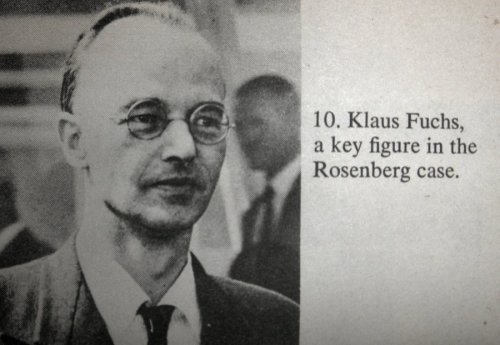
But the British liaison to the project was physicist Klaus Fuchs, a spy for the Soviet Union.  The Germans knew Fuchs to be a Soviet spy, but the British and Americans didn’t, until they gained access to records captured as they advanced into Germany.

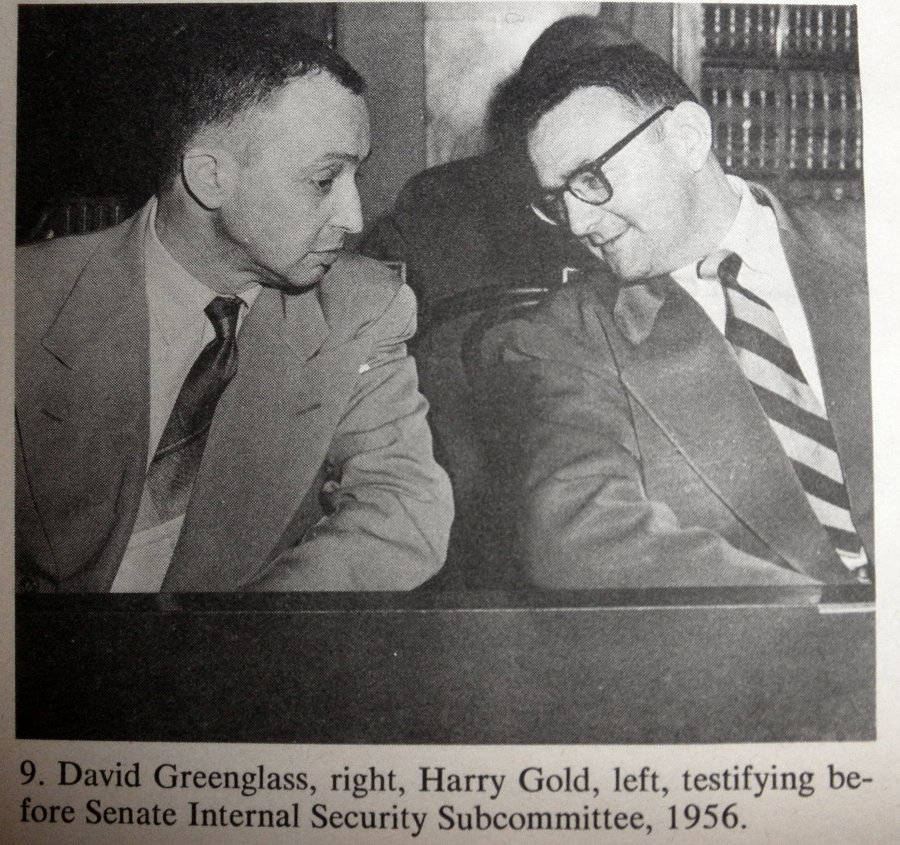
Aside from Fuchs, the other USSR source for information about developments at Los Alamos was David Greenglass, a US Army machinist and brother to Ethyl Rosenberg.  Greenglass had been a Communist his entire adult life and had been separated from an earlier military job because of questions about his loyalty and honesty.

David Greenglass stole the crucial secrets of the lens molds used to detonate the bomb, the implosion device.  By hindsight, it’s clear he did it for money, for the same reasons he stole automobile parts, uranium, anything he could lay hands on to sell on the black market.

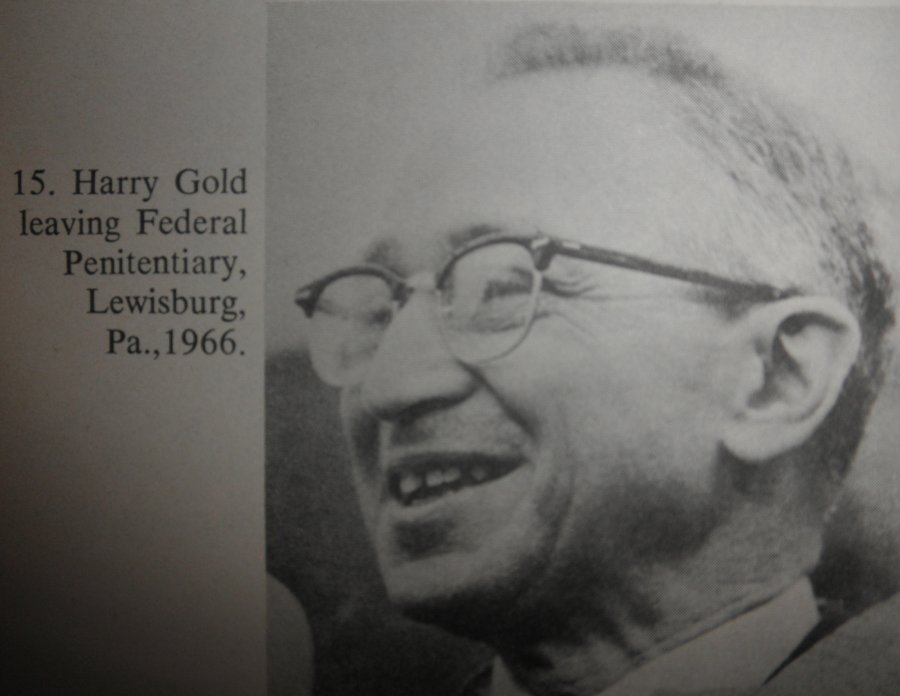
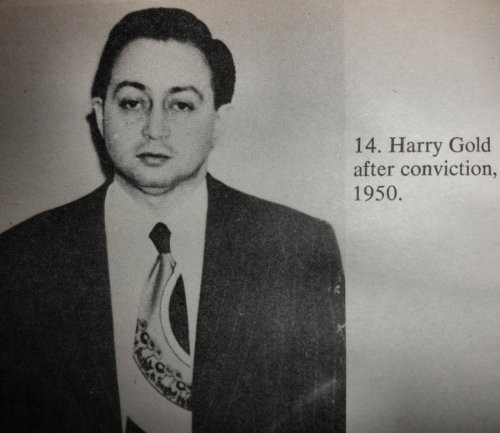
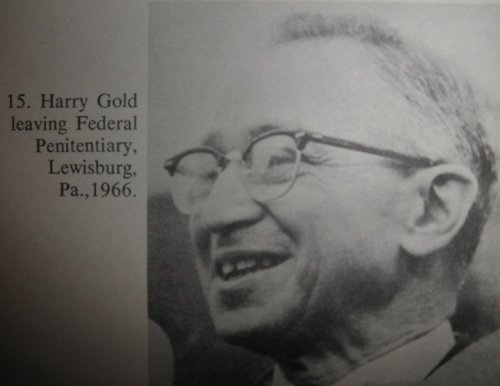
Greenglass passed the secrets to his wife, Ruth, who passed them to Harry Gold.  Gold was the direct connection to the Soviet spymaster, Yakovlev, in the Soviet Embassy.  It’s clear enough from everything provided in evidence and testimony that Gold was a man without loyalty to any nation, ideal, idea, or human being other than himself.  He did it for the money and for no other reason. 
The testimony of Greenglass, awaiting trial for treason, and his wife, Ruth, who  was never charged, provided the testimony connecting Julius and Ethyl Rosenberg to the plot.  The witness stand accusations by Greenglass against his sister and brother-in-law, and the corroborating testimony from his wife, who didn’t yet know whether she’d be charged, constituted almost the only evidence of the prosecution.  The other witnesses directly involved in the plot mostly did not know the Rosenbergs, or barely knew them and knew little of their activities.

Because of the weakness of the government case insofar as testimony and physical evidence of the Rosenberg involvement in actual spy activities, the focus of the prosecution became a trial of Communist ideology.  Witnesses who knew nothing about the plot, the bomb secrets, the Rosenbergs  were called to testify about how they’d switched their own loyalties from Fascism to Communism, then become loyal US citizen-experts making a living selling books and giving lectures on the insidiousness of Communism.
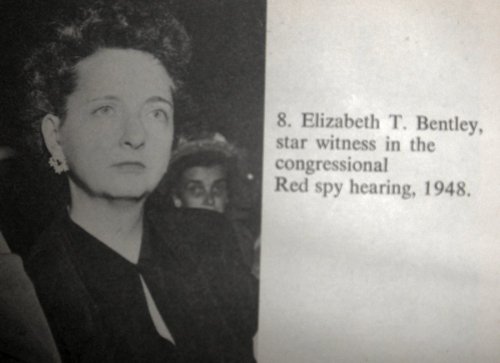
The trial transcripts excerpts Nizer provides make it clear the Defense had two opponents:  the US Attorney prosecutor, and the judge, who constantly intervened, interrupted, interjected in ways clearly intended to prejudice the jury against the defendants.

The key players who gave, or sold the atomic bomb to the USSR in 1945 went free, or were given relatively light sentences.
The Rosenbergs, clearly Communist idealists, possibly part of the plot, died in the electric chair.

When Allied forces found documents in Germany revealing Fuchs as a Soviet spy the chain of resulting indictments followed a path to almost all the conspirators except the Rosenbergs.  Before spymaster Yakovlev fled the US, during his last meeting with Gold, he made the following observations:

Yakovlev:  Don’t you remember anything I tell you?  You’ve been a sitting duck all this time.  We probably are being watched right now.  How we pick such morons I’ll never understand!  We’ve been living in a goldfish bowl because of you.  Idiot!  Idiot! 

I am leaving the country immediately.  I’ll never see you again.  Just go away.  Don’t follow me.

He went.

But the answer to Yakoviev’s question is worth an answer.  They recruited from the US Government, the US military, from US universities, from US businessmen.

From the same pool of applicants who later sold their industries, their industrial tools, secrets, capabilities, economies, and debts to the Peoples Republic of China and other foreign nations.

They weren’t Communists, like the Rosenbergs.  They were opportunists, entrepreneurs, devil-take-the-hindmost politicians, like their descendants a few generations later.

Old Jules

Today on Ask Old Jules:  Value of Animal vs. Human Lives?

Old Jules, does an animal’s life mean as much or nearly as much to you as a human’s, or do you feel animals are insignificant/worthless in comparison? Also, do you believe it is ever morally right to harm/kill animals? What about humans?

Redcoat, by Richard Holmes – Book Review

When an author succeeds in creating a page turner from a segment of history beaten thoroughly to death by a thousand other historians and writers of historical fiction there should be some background music and applause.


Richard Holmes has succeeded. 

Redcoat follows the British soldier through the Seven Year War, the Peninsula War, the wars in the Americas, the wars in India through the Sepoy Mutiny and Afghanistan to the Crimea.    And every page contains some new surprise, some fragment of detail the reader won’t have encountered previously. 

Ever wondered where the idea for Hornblower’s fascination with the Lady Barbara Wellesley most likely originated?  Illustrations:  “Below:  The Marquess of Anglesey was a talented cavalry commander who, when Lord Paget, beat the French at Benavente and Sahagun.  Unfortunately he ran off with Wellington’s sister-in-law and could not be re-employed in the Peninsula.  As Lord Uxbridge he lost a leg at Waterloo.”

Or, page 154, Lt. Arthur Moffat Lang, “Many are given to drink and drunkenness like the Germans.  Foreign wines on account of their being accustomed to beer, does not agree with them, and in hot countries over-seas brings on burning fevers . . .”

Holmes has sifted through the chaff of history to cover the subject thoroughly on the outside in a 427 page epidermis, along with constant peeks at the liver, the bladder, the spleen and the dirt under the fingernails of the British soldier:  A man as limited and flawed as the Brown Bess musket he carried into battle, but one who experienced a surprisingly long series of successes where failure would have been far more appropriate.

‘Christopher Duffy suggests of the eighteenth century that:  “The most pronounced moral traits of the English were violence and patriotism.”‘

If that sounds familiar today it might be worth pondering whether it’s part of the package the 20th Century delivered to your own doorstep. 

Excellent work and a worthy read, Redcoat.

Old Jules