Tag Archives: home

News from the Middle of Nowhere

Old Sol’s going through some unusual upheavals today.  I don’t recall ever seeing such an array of sunspots reported:

“GIANT SINE WAVE: Imagine a sine wave 400,000 km long. Today, NASA’s Solar Dynamics Observatory is monitoring just such a structure. It’s an enormous filament of magnetism slithering over the sun’s northeastern limb:”

http://spaceweather.com/

Meanwhile it’s a red morning out there, so all you salesmen probably need to take warning.

Last night I was planning to haul water but I was interrupted by a wild hog meandering out from behind the truck as I came around the corner of Gale’s house.  We stood and looked at one another from about 20 feet, him undecided about whether he wanted some of me, while though I’d decided I couldn’t think of anything to do about it if he did.  When he wandered off behind a hedge I ducked inside to seal an agreement with him that we’d postpone any drama until we could each feel better about invading the personal spaces of the other.

Gale had told me he was having a lot of hogs troubling him but he didn’t mention I needed to pack a .45 walking around the place.

Maybe more later.  I’ve got to go let his chickens out.

07:45 AM – Snagged enough water to hold things together a couple of days down here without seeing any porkers.  Kay’s duck, which was missing last night when I locked down the chickens and caused me concern, flew in while I was filling the water jugs.  Eased my conscience considerable.  I hate having one of their critters come up KIA or MIA while I’m the one taking care of things.

While I was driving back down here I got to thinking about that tusker last night and the fact something’s been tearing up the pen where I keep the roosters every night.  Went out looking for hints of what might be doing it and found pig scat all around out there.  If it was there before I hadn’t noticed it and it appeared fresh.

I’m guessing whatever water source the wild hogs were using somewhere else must have dried up and motivated them with ambition to do some exploring.  It’s been a year since pigs were a problem here except for brief spatterings, a herd passing through.   I’m hoping these will follow the pattern, what’s left of them.

Tidbits you’ll be glad to know:

On this day in 1948 the Chinese formed the Peoples Republic of China, intended to create a nation of manufacturers to create all the stuff Western Europeans and US workers were having to make for themselves previously, getting their hands dirty.

On this day in 1926 Turkey began allowing civil marriage, the results of which subsequently became obvious.

On this day in 1918 the first US troops landed in Vladivostok, Russia, to help settle things down and restore the aristocrats overthrown by wossname, revolutionaries.  For those guys WWI didn’t end until 1920.

On this day in 1866, Navajo Chief Manuelito turned himself in at Fort Wingate, New Mexico, thus putting the final touches on getting all those Navajo over into the temporary [15 years] rez at Bosque Redondo, Fort Sumner bunched up with the Mescalero so’s to get the numbers down to something more tidy and manageable, which they did. [The Long Walk of the Navajo http://www.logoi.com/notes/long_walk.html ]

Old Jules

“The Java Jive” (Ink Spots, 1940)
http://www.youtube.com/watch?v=iP6IUqrFHjw&feature=related

Drought, Starving Wildlife Stewardship and Paradox

Looking for solutions

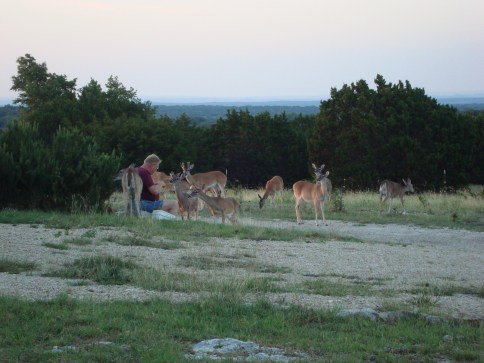
There’s an irony in this picture.  Gale, the man feeding the deer, owns this 300 acres I live on.  One of the reasons he originally bought it had to do with the passion for hunting he spent most of his life following, which, 40 years ago was a passion we shared and was one of the ties leading to our becoming friends.  Between us we’ve killed more large mammals than either of us can remember, though I don’t recall we ever hunted together.

Each of us following the routes our lives took us gradually and independently lost any interest in killing any more if it could be avoided.

Which is still a long way from sitting on a rock feeding tame deer every evening.  I’ve never arrived there.  I’d far prefer the deer staying out in the woods tending their own affairs and leaving me to tend mine, which they refuse to do.

Now, along comes the extended drought.  Today he’s feeding a herd of 30-40 starving deer up there, spending $100 + per month on corn, range cubes and hay.  If he tried to feed them enough to get them beyond near-starvation he’d bankrupt himself doing it.  He’s picking cactus tines out of the lips and noses of his tame deer because they’re so hungry they’re trying to eat prickly pear cactus.

I’ve got another 20-30 down here I’m not feeding intentionally.  ‘Mine’ are so desperate for food they constantly hang around waiting for me to feed the chickens, refuse to be run away further than I can throw a rock, and even come onto the porch for the cat food when any is left outdoors.

But watching a herd of deer starve to death, whether you’re feeding them and given them names, or are just some guy trying to mind his own affairs and have them forced on him as unwelcome guests, is a troubling position to be in.  A few days ago he and I were discussing it trying to come up with some means of providing them more to eat without him having to spend a lot more money doing it.

Eventually it came to me people in Kerrville are probably still mowing their lawns, bagging the grass clippings and putting them out on the curbs to be picked up by the city.  We talked about this a while and considered the fact the bags of grass ferment when sealed, creating a feed we’ve both been around called silage, which livestock love.

Next time either of us goes to town we’ll be looking at lawns to see if we’re right in believing they’re still watering grass and mowing it.  If they are, I’ll soon be putting up a post on Kerrville FreeCycle Yahoo Group asking if any of them would,

  1.  be willing to allow a trailer to be positioned on their lots where others could bring bagged grass clippings so we could haul them off weekly or a couple of times per month to feed the deer, and
  2. if such a lot and such a trailer were in place in Kerrville, would they be willing to carry their clippings there instead of just to the curb in front of their homes.

But this mightn’t work, and even if it works it’s only a partial solution to the problem.

I’m looking for ideas and information.  You others living in drought-stricken areas, do you have any idea what, if anything, locals with starving deer populations are doing to supplement their feeding?

Any ideas or experiences that might lead to even interim or partial solutions will be appreciated.

Thanks,  Old Jules

Money isn’t the solution to this problem, but the performance in Cabaret does seem apropos somehow:

Cabaret- Money

http://youtu.be/I8P80A8vy9I

White Trash Repairs and Fixes – Owls and Rock ‘n Roll

[Plus Gregorian Chants, Chuck Wagon Gang Gospel, Navajo flute, Beethoven’s 9th, Mozart Horn Concertos, old-timey country, cowboy and hillbilly, bluegrass,  big band, folk, blues and songs of the Civil War, WWI and WWII thrown in for the discerning night predator]

Bear with me here.  This is a bit complex for a dumb old redneck to explain.

The problem:  If you’re a person trying to keep free ranging chickens some of them will insist on sleeping in the trees.  If you also keep guineas, all of those will nest in the trees.  The guineas tend to bunch up in several clumps in the treetops, and they whisper and burble to themselves or to one another in their dreaming.

Enter, the owl:

“An Owl’s range of audible sounds is not unlike that of humans, but an Owl’s hearing is much more acute at certain frequencies enabling it to hear even the slightest movement of their prey in leaves or undergrowth.

“Some Owl species have asymmetrically set ear openings (i.e. one ear is higher than the other) – in particular the strictly nocturnal species, such as the Barn Owl or the Tengmalm’s (Boreal) Owl. These species have a very pronounced facial disc, which acts like a “radar dish”, guiding sounds into the ear openings. The shape of the disc can be altered at will, using special facial muscles. Also, an Owl’s bill is pointed downward, increasing the surface area over which the soundwaves are collected by the facial disc. In 4 species (Ural, Great Gray, Boreal/Tengmalm’s & Saw-whet), the ear asymmetry is actually in the temporal parts of the skull, giving it a “lop-sided” appearance.

“An Owl uses these unique, sensitive ears to locate prey by listening for prey movements through ground cover such as leaves, foliage, or even snow. When a noise is heard, the Owl is able to tell its direction because of the minute time difference in which the sound is perceived in the left and right ear – for example, if the sound was to the left of the Owl, the left ear would hear it before the right ear. The Owl then turns it’s head so the sound arrives at both ears simultaneously – then it knows the prey is right in front of it. Owls can detect a left/right time difference of about 0.00003 seconds (30 millionths of a second!)

“An Owl can also tell if the sound is higher or lower by using the asymmetrical or uneven Ear openings. In a Barn Owl, the left ear left opening is higher than the right – so a sound coming from below the Owl’s line of sight will be louder in the right ear.

“The translation of left, right, up and down signals are combined instantly in the Owl’s brain, and create a mental image of the space where the sound source is located. Studies of Owl brains have revealed that the medulla (the area in the brain associated with hearing) is much more complex than in other birds. A Barn Owl’s medulla is estimated to have at least 95,000 neurons – three times as many as a Crow.

“Once the Owl has determined the direction of its next victim, it will fly toward it, keeping its head in line with the direction of the last sound the prey made. If the prey moves, the Owl is able to make corrections mid flight. When about 60 cm (24″) from the prey, the Owl will bring its feet forward and spread its talons in an oval pattern, and, just before striking, will thrust it’s legs out in front of it’s face and often close it’s eyes before the kill. Click here to see a Great Gray Owl using it’s hearing to catch a small rodent concealed under snow.”

http://www.owlpages.com/articles.php?section=Owl+Physiology&title=Hearing

Got all that?  The feathered cones or funnels around the eyes of the owl act as parabolic sound receivers.  They work in concert using parallax to locate the positions of prey.

In a sense it works similarly to an array of electron telescopes  positioned some distance apart to provide parallax to measure the distance from earth to celestial objects.

Or the way this vintage pocket range finder used parallax to accurately provide distance for photographers:

Okay.  So how’s a poor old redneck who has guineas sleeping in the trees being picked off by owls carrying secret weapons, a guy who has four cats he needs to consult regularly on important matters, a man with a herd of free ranging chickens supposed to curtail such nonsense?

Answer:  Echoes.  Noise reflected from all directions 24/7.

I began by looking for castoff disk harrow blades, woks, pot lids and parabolic tv dishes and placed them in strategic locations around the place.


At the time my CD player would only take five CDs, so until the player wore out it was Gregorian Chants, Mozart Horn Concertos and Carlos Nakai Canyon Suite [Navajo flute] here day and night, outdoors maximum volume.  But by the time that player went Communist,  months had passed and I hadn’t lost any more guineas at night.

So there I was knowing how to keep the owls somewhere else, owning a couple of hundred CDs, but cats, chickens, guineas all mutually agreed on one point:  it was time to broaden my horizons music-wise.  Even the coyotes were sick of Mozart and the cats were beginning to open confessional booths for the chickens.

Enter the Coincidence Coordinators:

A lady on the Kerrville FreeCycle Yahoo group advertised she’d like to give away a Sony 200 CD disk player because she was using an MP3 or some such thing for her music.  I called her and made a special trip to town to pick it up, swing by the Habitat for Humanity Recycling Store to buy an old receiver and a pair of speakers large enough to wiggle the ears of the deer population.

Eventually that player wore out.  But as luck would have it, I found a 300 CD player at the Salvation Army Thrift Store and a willingness on the part of the guy at the counter to do some horse trading, which I’ll describe another time, that horse trading in thrift stores. http://tinyurl.com/3t4ums9

Yeah, it ain’t the way the smart alecs save their chickens from predation by owls – I don’t know how they do it.  But this old white trash redneck fixed them owls but good and the chickens and cats are in Rock and Roll Heaven.

Old Jules

 Rock and Roll Heaven by the Righteous Brothers
http://youtu.be/k2cijNKu9qc

Swatting Flies in the Last Century


A letter to 6 year old Julia in Kansas before Y2K:

Sunday, Nov. 7, 1999
The Great Divide

Good morning, Julia.

I’m sitting here in the cool dawn, sipping a cup of coffee, listening to the chickens crow and being heckled unmercifully by the blacks for favors. The two polish roosters, Rosencrantz and Guildenstern, are beginning to try their hands at crowing without notable success. They tend to be off on their time and they cut the crowing short of the ur-ur-urrrrr of the more mature birds.

But enough of this chicken news.  I began writing this to discuss the subject of fly swatting with you, certainly a more worthy focus of discourse when watching the birds in their activities, which reminded me how gratified I was by your interest in the various flock members during your visit. So I’ll finish the chicken component of this letter by saying you are right to be interested in them.

The importance of chickens in human life, now and in the past, cannot be over-stated. Even the great human philosopher, Plato, in the Socrates dialogues, put mention of a chicken in the final words of Socrates, prior to his death. Socrates, pacing, reflecting, and finally on the verge of succumbing to the hemlock he’d taken, spoke abruptly; almost as an afterthought, to Crito, (one of his yes-men): “Crito, we owe a cock to Asclepius. Please pay without fail.”

So there you are. In fact, one of the deeper philosophical questions of this and earlier times contemplated by wise men everywhere is, “Why did the chicken cross the road?”

Why, indeed. However, as I’ve said, the subject of this letter was intended to be fly swatting, not chickens, and I’ll not have it compromised by endless meanderings on lesser matters. The prowess with the flyswatter you demonstrated during your visit demands nothing less.

I’ll begin by saying that when I was a youngster (back when the 20th century had only begun its interminable mid-life crisis), it was widely, almost universally,  recognized that children are far more adept at killing flies than are adults. Probably because of their lightning reflexes and sharper eye. This wisdom has suffered neglect partly because of screen doors, refrigeration, air conditioning, indoor plumbing, and other curses of modern life.

In my day, anytime there was a gathering of adults for dominoes or canasta, picnics or outdoor parties, even if there was only one child present, he would quickly be given a fly swatter and put to the task. When more than one child was present, usually it was thought that the rowdiest, most rambunctious child, the one most likely to lead the others to acts of courage, bravado, or cunning, would be the best suited to ridding the affair of the fly nuisance.

I can promise you that in those days my fly swatting skills were second to none. However, over the years I’ve lost my razor edge. My reflexes are no longer as sharp, and the keenness of eye is largely gone, as the case with most adults.

Of course, the proper tools are also the victims of disuse. There were giants in the earth for fly swatting tools back then. For a dime you could purchase a fly swatter with a limber wooden handle and a flap of heavy rubber or leather that was equal to the most severe fly nuisance. My granddad had one he’d made himself of tooled leather that could sometimes send three or four flies at once off to the hereafter.

In those times the fly problem was probably worse than it is today. I’ve never seen it happen, but I was told many times by adults who had themselves seen it, of incidents where a child lapsed in the task he’d been assigned, fell behind, and was actually carried away by swarms of the angry insects.

Anyway, I’m sitting here, a burned-out has-been in the fly swatting arena, hoping to give you a few tips – the old worn out champ passing on a few tricks to a future talent who is yet a novice. Even with the fly swatting tools available in stores today, I firmly believe you can hone the skills with diligence and patience to become, as Marlon Brando coined the phrase in, “On the Waterfront”, a contender.

First off, it’s important to recognize that flies frequently jump backward or drop downward in their efforts to elude the slap. If you anticipate this and lead them a little, you’ll find what would otherwise have been a useless swing that did little more than knock over a lamp or a porcelain knick-knack, will result in the satisfying trophy of a fly in the dishwater or in a large bowl of coleslaw underneath the target area.

Secondly, you need to always keep in mind that while fly killing is a high priority to adults when they put you to the task, the priority invariably changes when they see a dead fly dropping into their drink. So, unless you do it unobserved, I’d suggest you’ll be more widely acclaimed for your skills if you steer well clear of anything but the most subtle or inadvertent trajectory of a defunct fly into any food or drink which is in view of an adult or older child who can’t be trusted to remain silent in the shared joy of secret knowledge. Most can’t, I myself learned in the hard school of experience.

Thirdly, the swing, or swings. Usually the fly swatter, (the tool, not the child wielding it) works best with short abrupt flicks of the wrist from an area only a foot or so above the insect. With the lighter tools of today’s world, the swing probably needs to be handled with vigor and with a little attention to the follow-through. On a window or other surface where the flies are thickly gathered, sometimes a series of rat-tat-tat slaps can net a goodly pile of carcasses and numbers for your growing record book.

Keep in mind that even on days when you are approaching previous records, adults are unlikely to be impressed when a previous record broken is accompanied by fly remains smeared across the front of the refrigerator or permanently embedded in a window screen. Fly killing is a matter involving politics, philosophy, and judgment, as well as the keenness of eye and lightening reflexes mentioned earlier.

I suppose the thing that got me started thinking of writing you about flies is the abundance of them in this house the last couple of days. I don’t know why. Usually they are attracted to areas where there’s livestock. But here there is no livestock. Just the three cats, the chickens, and myself.

You might tell your mom and dad I’ve been using my wood stove the last couple of days. It’s enough to roast a human out of the house with a single large log burning on a cold night. But getting it hot enough to cook food requires a lot of smaller wood. With large logs inside it won’t boil water between now and the day you, Julia, become the bride of some fortunate suitor.

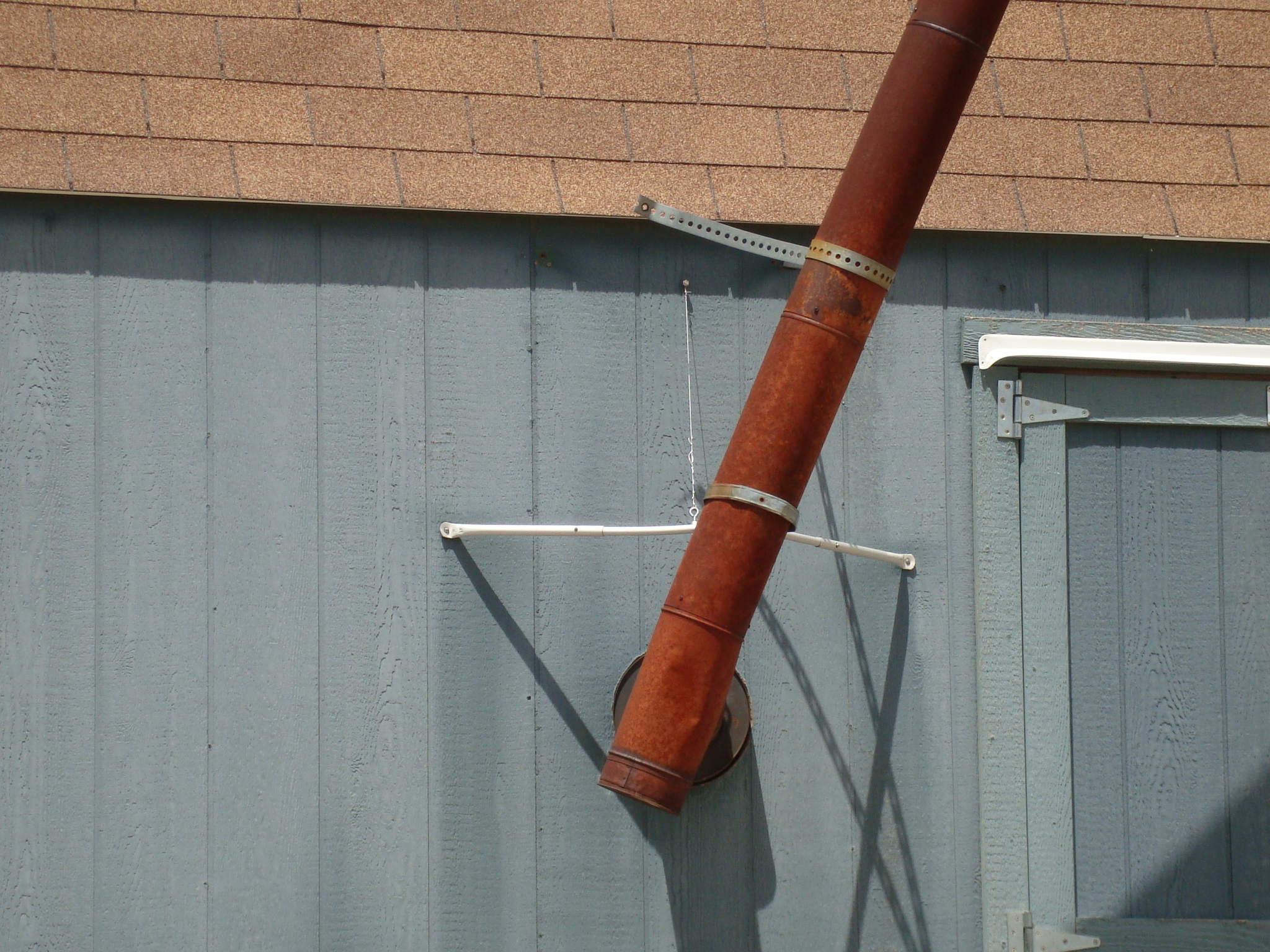
Your dad will want to know the thing I went through the wall with did fine with normal fires, but when I determined to stoke it full of small wood for a breakfast fire and coffee this morning it charred the paper front on the insulation around the outer pipe. Of course, the stovepipe was glowing red through that episode, which is to be avoided.

You might also mention that trying to erect a stovepipe along a wall by one’s self is a thing you haven’t really lived until you’ve done. Cartoons used to show shanty houses with zigzagging stovepipe. I never knew why until now.

Hanging the kitchen cabinets alone was also one of those experiences which, like the man who decided to carry a cat home by the tail, will most likely remain burned in memory for a while.

I’m not inclined to regret anything in my recent past and hope I never will. The person I now am differs from the person I was at your age as a result of cumulative lessons I’ve learned from choices I’ve made between that time and this. However, there’s nevertheless a temptation to gnash my teeth a little for not having taken advantage of your dad’s kind offer to help with the electrical wiring from the windmill, solar panels, inverter, and batteries, into the house. I’m reminded of that offer each time I fiddle with the connections and the hidden short somewhere shuts down the inverter.

Hmmm… this letter has gone on and on. There’s nothing particularly personal or confidential about it, except the tips on fly killing, so feel free to share it with your family. Or keep it until you are able to read better and read it yourself.

Best wishes to your brothers and your mom and dad.

Affectionately,
Old Jules

Note from Julia in 2008:
I honestly don’t remember this at all. This is by far the best letter ever written to me, I’m just glad I can read it and appreciate it now!
~ Julia

Burl Ives– Blue Tail Fly
http://youtu.be/1ardNXjE-_I

Important Events from the Middle of Nowhere

Mouser wins prize for lousy judgement

The cat you see above came to me as a loaner 13-or-so years ago.  A litter mate to Hydrox, the jellical cat I’d established an actual contract with for the remainder of one of our lifetimes.  Mehitabel, an adult in the household, hated Hydrox and I thought he needed some company, so I borrowed Naiad on an indefinite loan, no contract involved.

 Turned out she’s probably the best mouser I’ve ever enjoyed spending a piece of my life with, a survivor.  She went through Y2K with me, has braved every available kind of predator stalking cats from dogs to coyotes, an eagle, hawks, bobcats and probably others she’s never had the courage to divulge, even to me, a liberal and open-minded sort of guy.
She generally trusts me but there’s always been that no-contract thing hanging over her head, and the guy loaned her to me got murdered a few years ago.  She’s acutely aware if I hold strictly to our original agreement I have no option other than to return her to Socorro, New Mexico sometime.  So she’s careful not to cross me.
But I’ve digressed.
When Gale, Kay and I encounter one another we almost always exchange news about which predators are currently threatening our chicken-herds, particularly predators that might commute from mine to theirs, or vicee versee.  Yesterday Gale sprung one me:
“There’s a cat working up here you might want to keep an eye open for.  Kay took a shot at it, but she missed.  Black cat hanging around down by the hen house.”
“Black cat?  Stalking your chickens?”
“Stalking something down by the hen house.  Lots of rats down there because of the chicken feed.”
“Black cat?  You sure it wasn’t Naiad?  She’s been around chickens on and off forever.  Never bothered a chicken.”
“You have a black cat down there?”
“Yeah.  I’ll email you a picture.  I’d be obliged if you don’t shoot her.  She won’t bother your chickens.”

Toyota Goes Communist

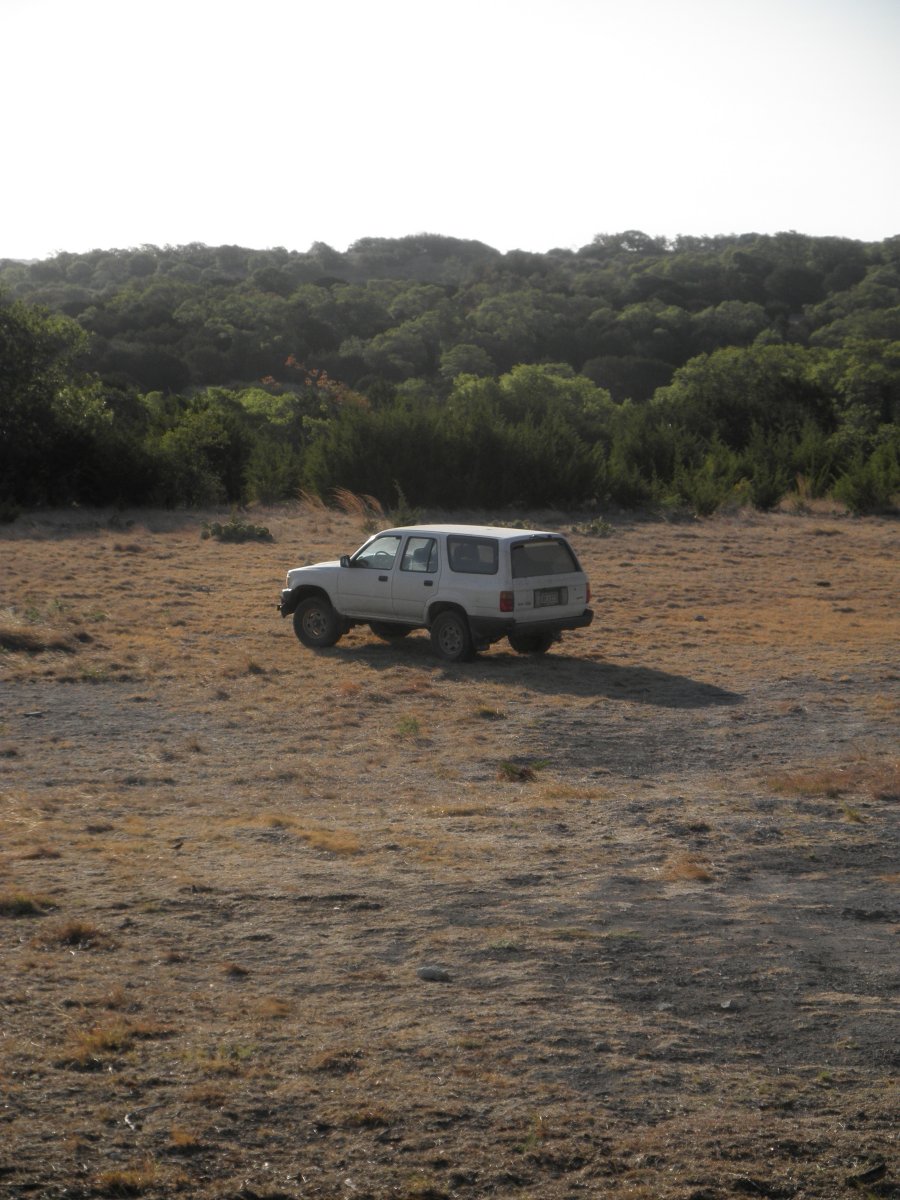
Thursday I needed to go to town, so I packed the ice-chest with ersatz ice, a shopping list, and went to roll the 4Runner downhill to start it so’s to get up to Gales and borrow a truck to go to town.  The 4Runner did okay rolling down but I suppose just half-mile trips back and 4th to Gale’s place hasn’t kept the battery charged.  I’m thinking it spang went completely dead.
So, 100 degrees out there and me all dressed up for town I pulled up my galluses and hiked my young-ass over the hills and through the woods, picked up Little Red, the loaner truck, bumped my young-ass back down here, picked up the list and ice-chest, then off to town, where I happened to notice L’il Red’s license tag and Safety Inspection Sticker had both expired back in June.
Sweated blood and bullets all the way to town, various thrift stores, feed store, grocery store, all without getting into a gunfight with the law over the expired civilization indicated on the windshield.  And not entirely the result of me being unarmed.  Every time I saw a police vehicle I kicked into my ‘invisible’ mindset mode, which works a lot more frequently than a person might be led to expect if the person isn’t into such esoterics.
 NEWS ITEM #3
The Terlingua blogsman
Posted a piece this morning I love and I think you might love too.  Popular Science Magazine archives going back to before the invention of life as we know it.  Going back so far there weren’t even any human beings running around to publish and read it, at least no human beings as we’re currently prone to indulge in believing humans are.
Stay tuned.  Likely something else will happen here sometime.
Old Jules

Johnny Horton – Old Slewfoot

Artful Communications – White Trash Repairs 3

That’s my telephone line running horizontally across the pre-dawn.  It used to didn’t look precisely as it does now.  For a while, maybe a couple of years that piece of plastic electrical tape wasn’t hanging down from it, giving it a tidier, more professional appearance.

Before that, even, it had the standard non-innovative, regular stretched-across-to-the-house look you find in other, less interesting, living places.

When I moved into this cabin several years ago that phone line was one boring piece of wire with plastic insulation.  All over this planet unimaginative people are gazing at telephone lines going to their houses, probably wondering what they could do to add some savoir faire, something with flair, to the scene.

Luckily, mine was the result of careful planning and artful inspiration.

The first few years I lived here this land was plagued with cows the owner of the place didn’t own, but didn’t want to put the money into fencing out.  Fencing this place well enough to keep cows out would run in the neighborhood of $10,000, maybe higher.

But Texas, being the forward-thinking place it is, doesn’t require a person who wants to run cows to provide fences to keep them inside grazing on his own land.  Texas figures if someone doesn’t want livestock belonging to someone else running all over him eating his grass, tearing things up, knocking things over, Texas, I was going to say, figures a narrow-minded person of that sort needs to put his money where his mouth is and build a fence.

The default position is that a cow’s gotta do what a cow’s gotta do and the onliest way a cow can be kept from doing it is for someone who doesn’t like it to belly up to the bar and pay to keep her from doing it.  Beef prices being what they are you sure as hell can’t expect the man running the herd to pay for fencing them in.  He’d be robbing himself of graze surrounding his own holdings.  He’d be cutting into his own profit, lifestyle, devil-take-the-hindmost image, and he’d be eroding the tradition ranchers all over the west have worked hard for generations to maintain of being lowlife, cheap, greedy, penny-pinching scum who would do anything for a buck.

But I’ve digressed.  I wanted to tell you about my phone line, how it came to pass that it needed to change from a regular piece of unbroken wire into the work of art you see before you in that pic.

There were cows running all over this place when I got here.  They weren’t scared of anyone, nor anything, because they’d had it demonstrated nobody was going to shoot them and go to jail for it.  The man who owned them lived a long way off somewhere, never checked on them, never fed them, and the drought going on here had left them some of the poorest, scrawniest, lousiest cows a person could want.  There wasn’t a blade of grass on this, on any of the several other unfenced properties where they ran, more than an inch high.

But cows get lonely, even when they aren’t wanted.  Out in the woods spending the night they can’t find water hoses to chew to pieces, things to knock over, break, buildings to rub up against to get rid to the fleas and ticks plaguing them.  So, when those cows were here they loved to gather up around Gale’s house up on the hill, and around this cabin.  We tried everything short of building an expensive bunch of fences to keep them out.

But I need to get to the telephone and quit this rambling.

One night when I’d had a bellyful of cows already I heard them outside the window.  Things were falling and the sounds of them rubbing against other things told me to get the spotlight and have a look-see.  Might have been 20-30 cows out there, a few feet from the window.

I grabbed the 12 gauge from behind the door, ran outside in my birthday suit, lifted that shotgun to my shoulder and carefully shot my telephone line in two.  It was dark, but I heard it fall, knew something was amiss, but I could hear the fridge running, so I knew I still had electricity.
Next morning I looked around for something I could use to splice it back together, then twist around to get it back up sky-level instead of hanging around low for someone to forever be tripping on or cows chewing to pieces.

Art is function.  Art is simplicity.  Art conveys emotion, the human condition, the need of humans to communicate with other humans.

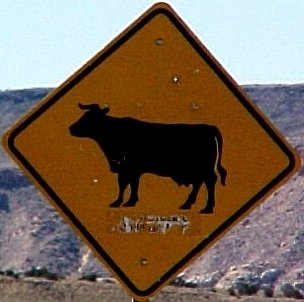
When you’re driving along and you see this sign it means you are in a free-ranging area and that the man running cows without having to fence them off the public right-of-way will get a prize-breeding-stock price for his beef from your insurance company if he can arrange a way for you to run one over.

That’s the reason you see straw scattered on the blacktop and in the grader ditch.

Old Jules

Afterthought:  One positive thing about having those cows around was that Shiva the Cowcat and I used to spend a lot of quality time together running around the hills chasing those cows off with a slingshot.  It kept me in shape and provided Shiva the Cowcat with cheap thrills of having something big run from her. Shiva misses those cows something awful.

Eddy Arnold – The Lonesome Cattle Call
http://youtu.be/MHE496Z-Sf0

Could you choose to live on the street?

That little farm you see down there is the place where I spent a good many of my formative years after my mother remarried and we moved to Portales, New Mexico. As you can see, we’d had a pretty good year for hay, which dates the picture to 1949, or 1950, before the big drought hit.

When we sat outdoors in the evening the red neon lights blinked “Schumpert Farm Supply” across the top of the long building running diagonally to the railroad tracks until I went to bed. From my limited perspective the Schumperts were ‘rich’. In that small town that railroad running through didn’t identify who was rich but it did identify who wasn’t. That little farm I lived on and no other property that side of the tracks had any rich people.

In the rigidly established social structure in Portales business men generally came down on the side of being ‘rich’, along with professors at Eastern New Mexico University, bankers, physicians, preachers, school teachers and a few elderly ladies who lived in houses big enough to be thought of as mansions. Farmers, ranchers, Mexicans and people who worked in the businesses weren’t ‘rich’.

I doubt the adults paid a lot of attention to the social strata, but school teachers did, and the kids adopted it more firmly than a religion. Rich kids were easy to recognize because they made good grades, weren’t hassled by teachers, got elected to everything, brought cookies to school Christmas, Easter and Halloween, and had the best bicycles early, cars later. For the most part they were insufferable snobs.

But not the Schumpert boys. I was in school with Stephen and Billy, and there was a precocious younger one I don’t recall the name of. Stephen was a year older than me, Billy a year younger, and there wasn’t a breath of snobbery in the entire family. Stephen, particularly, had a knack for getting in just the right amount of just the right kinds of trouble to keep from qualifying as a goody-goody. Good solid boys from a good solid family. I had a lot of respect for all of them.

I left that town early and stayed mostly away for several decades. I lost track of almost everyone I ever knew there.

But after Y2K when I moved into town to Grants, New Mexico, I came across Billy Schumpert being president of a bank there. Naturally we got together and talked about whatever we each knew that might interest the other. Billy’s the one told me what happened to Stephen.

Stephen worked as a bank examiner several years, then became president of a bank in Colorado, maybe Denver. Had a regular family, seemed to be destined to follow a career path and eventually retire. But one morning he didn’t show for work late in the 1980s. Nobody had any idea what became of him. He wasn’t a drinker, didn’t use drugs, didn’t have a ‘secret life’. He just vanished for no apparent reason.

Over time the police and other agencies gave up, assumed he was the victim of some crime, dead. But the family put up a reward for information about Stephen, sent private investigators and others searching for him. Eventually, six, seven years later they located him living under a bridge in Seattle.

Over time everyone who loved Stephen went up there trying to talk him into returning to real life, return home.

“No! I had enough!” That’s all he’d say and he never came back.

I’ve pondered Stephen a lot during the years since I learned what he’d done with his life. In some ways I think I understand, though I’m not sure. My own life has been a long series of reversals in direction. It’s meandered, cutting as wide a swath of human experience as I was able to pack into it. So, from that perspective, I can gnaw at the edges of understanding Stephen’s behavior. But I was a wild kid and I’ve always pushed the envelope, all my life.

Stephen was ‘tame’.

I’d like to see old Stephen again if he’s alive. He’d be 70, 71 years old now and maybe wiser than he was in the 1980s when something told him he’d had enough. I’d like to sit on the porch and talk with him a long time to come to know how he came to make his choice to isolate himself, to impoverish himself.

Simon & Garfunkel – Richard Cory 1966 live
http://youtu.be/euuCiSY0qYs

Got me a new truck!

My old Toyota 4Runner went Communist on me in December, had to be parked facing downhill to allow it to be started next time.  A Catch 22 involving if-replacing-the-starter-doesn’t-fix-it has left me having to borrow a vehicle anytime I need to go into town, or have someone pick up what I need has existed from then until now.

Meanwhile this old ranch truck has been sitting up there for the last five years unused after he twisted off a fuel line.  Gale, my old bud who owns this place and the F350, has had a long run of guilt-not-bad-enough-to-cause-him-to-fix-it, but too bad to just free him up, solved both our problems in one fell swoop:

“You can have that old F350 if you’ll fix it.”

“Whoooooopeeee!”

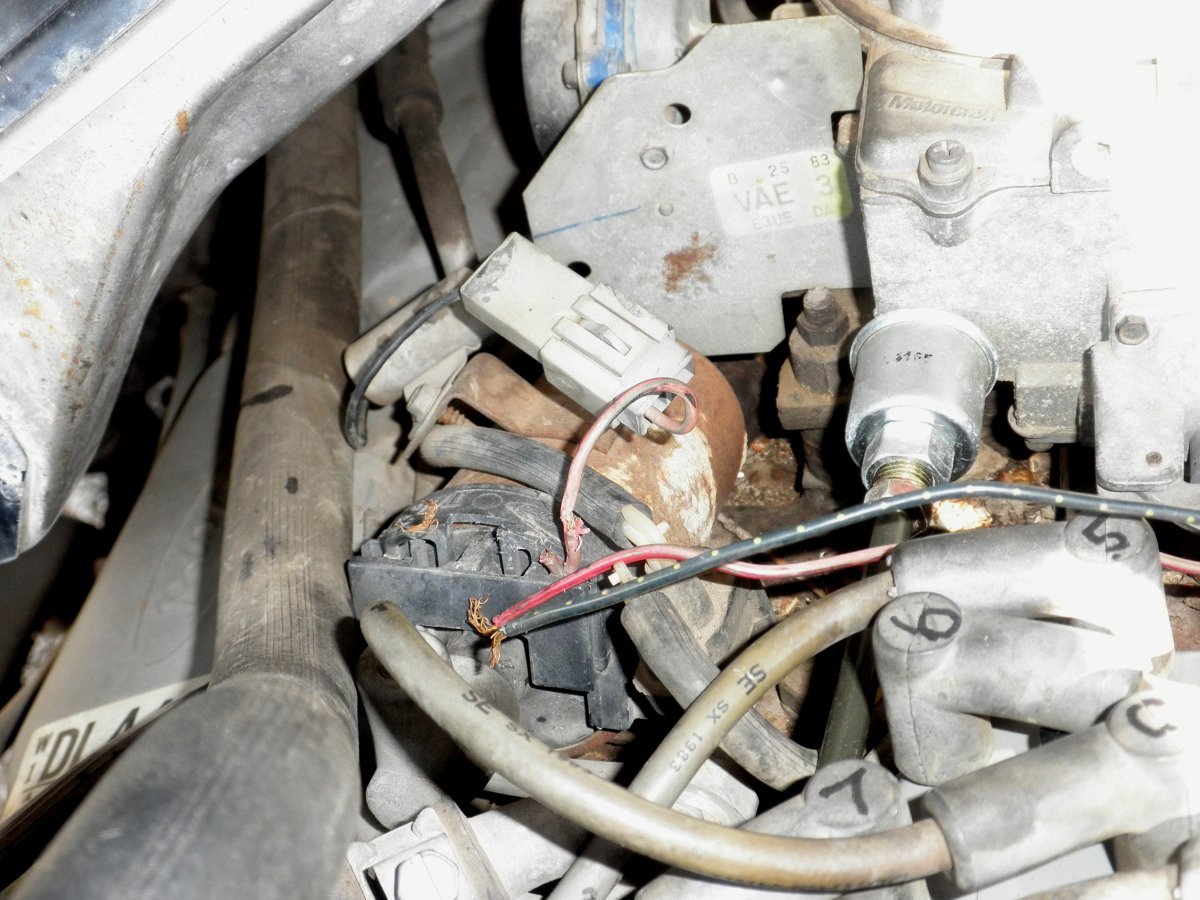
It’s an ’83 and hasn’t been registered for public roads since the early ‘90s, but he says it ran fine until he broke the gas line.  Unfortunately, over the years other people tried to fix it, coons lived under the hood, the wiring is chicken noodle soup.

I bought a vintage Chilton Manual from Amazon dirt cheap, but it didn’t have anything much about the wiring.

The coil appears to be made of scrap iron, the electronic ignition might be a retrofit.  Not even going to tell you what the inside of the distributor looked like when I popped it.

It’s not getting fire and I’m about out of fancy ideas.  If I don’t figure something out soon I’m going to have him tow me into town and let a real mechanic work on it, put an inspection sticker on it, and register it for the highway.

I think it’s going to make a pretty good old truck.

Robert Earl Keen – The Road Goes On Forever
http://youtu.be/_tMDXgf2cH4

About 11:30 AM Saturday

Reading the Terlingua or Bust blog  http://terlinguabound.blogspot.com/ I see he’s blowing out tires something awful out there even when they aren’t on the ground.  Some of the comments suggested it’s the heat, which makes sense. 

I don’t think the roads here are much better than his are likely to be, so maybe I ought to be glad I haven’t gotten that truck on the road yet.  Getting up to Gale’s is the worst of it… about half-mile of badly eroded 2-track rotten limestone trying to tear up tires at the best of times.  But his house to the pavement is another half-mile, better maintained but still rough.  Then the three miles of pavement to the mailbox has several lousily maintained cattleguards a person can never predict whether they’ll have a loose somethingorother pop up and take a whack at something.

From the mailbox to the main highway is a lot better, state road with no more than the usual fry-an-egg-on-it hotter-than-a-$2 pistol   asphalt.

Once again I owe the Coincidence Coordinators a debt of gratitude for sparing me stuff I didn’t even think about might happen.

Thankee Coincidence Coordinators.  I tips my hat to you.

Old Jules

The Runaways, 1947

Causey, New Mexico, was a dot in the road.  Pavement from nowhere to nowhere running between a scattering of frame houses, a small roadside store and gas station.  A rock schoolhouse, a church, and a few rusting hulks of worn out farm machinery in the weeds. http://www.ghosttowns.com/states/nm/causey.html

Our cottage was on the same side of the road as the schoolhouse.  Most of the village was on the other side, including the windmill across the road from our house where my sister and I went for water and carrying the bucket between us to tote it home.

To my tiny, four-year-old mind, the center of town was the store, diagonally across the road, to the left of the windmill.  Everything of importance happened there.  Cars from other places stopped for gas.  The store had Milk Nickles.  Ice cream on a stick, covered with chocolate.  Pure heaven that didn’t come often.

If the store was heaven, behind our house was hell.  The toilet.  A ramshackle tower with dust flecks floating in the shafts of light that came through the cracks between the boards, light coming through underneath where the ground had caved away from the wall.  Home of black widow spiders and the occasional rattlesnake.  The place was a chamber of terrors for me.  I was always certain I’d fall through the hole to the horrors beneath when I used it.

Our little cottage had two rooms.  A sort of kitchen, living area in front also had a little counter where my mom tried to operate a little variety store.  Keychains, trinkets, a handkerchief or two.  Things that wouldn’t be found across the street at the store.

She was also a seamstress.  Most of my memories of that time include her huddled over a treadle sewing machine working on the felt curtains she was making for the stage of the school auditorium.  Mom was a woman twice divorced.  In 1947, that was no small thing.  In that time and place broken marriage was considered to be the fault of an untrained, unskilled, unwise, probably immoral woman.  Two divorces, three children, and no resources made my mother the subject of mistrust by the woman of the community, and disdain by the men.

Memories have probably faded and altered with the half century since all this happened.  The perspectives of a child plagued with fears and insecurities seem real in my recollections, but they, too, have probably been twisted with the turns and circles the planet has made around the sun; with the endless webs of human interactions, relationships formed and ended.

My sisters went to school in that village.  Frances, my sister who died a few years ago, must have been in the second grade.  Becky, maybe in the 5th.  I hung around doing whatever preschoolers do in that environment when everyone else is busy.  I have flashing memories of standing by the road throwing rocks at cars; trying to get the little girl down the road to show me her ‘wet-thing’.

I remember being lonely; of wishing aloud my mom would give me a little brother to play with.  “I wish I could,” she’d reply, “but you tore me up so much when you were born, I can’t have any more kids.”

That trauma of my birth was a favorite theme of my mom.  She was fond of telling me how the doctors were long arriving when I was ready to be born;  how a nurse and my dad held her legs down so I couldn’t emerge until the proper people were there.  How it damaged her insides and caused her to have to undergo all kinds of surgery later.

I recall I felt pretty badly about that.

During harvest season it seemed to me the entire community turned out to work in the fields.  We’d all gather in the pre-dawn at the store, then ride together to the cotton fields in the back of an open truck.  Mom and the girls were all there, along with the neighbors and some of their kids.  Two of the kids were about my age:  Wayne and Sharon Landrum.

In retrospect I doubt we preschoolers helped much.  My mom had put a strap on a pillowcase and promised a Milk-Nickle every time it was filled.  This was probably more to keep me busy and out of trouble than it was to pay for the ice cream bar.  I can’t imagine that a pillowcase would have held the ten pounds of cotton it would have taken to pay a nickle.

The lure of sweets weren’t sufficient to occupy smaller kids, I suppose.  There came a time when Wayne, Sharon, and I wandered off from the field.  At first it was just to take a walk, but the road was long and we must have made some turns.  Before too long we’d gotten so far from the farm we didn’t know the way back.  We were frightened and kept moving.

In the end we found the lights of a farmhouse sometime after dark.  The family brought us inside and fed us something.  We sat around a stove trying to keep warm until some of the searchers came and picked us up.

In the morning at the store all those field workers who’d had to lose part of a day of wages wanted vivid descriptions of the spankings we got.  They wanted to make sure.

That was my first experience with running away, at least on my own part.  My mom had done some of it, running away from my dad and her second husband.  My dad had done some of it, letting his kids go off, first to Arizona into the shelter of a brutal, drunken step-dad, then into the shack in Causey.

Old Jules

Johnny Cash– In Them Old Cotton Fields Back Home
http://www.youtube.com/watch?v=1vCK8mSyhb0

Off the Shelf: What I’ve Been Reading


The nearest town, 15 miles away, has started a library, so I paused in my various re-readings off my own bookshelves to check out library books.   I was familiar with some of the authors I began with, but it had been a long time since reading them.

Elmore Leonard–  I ran through a plethora of his books in a short time.. everything the library had.  I’ve never read a book by the man I didn’t like, whether it’s the westerns he began with, or the detective stories that later became his tour de force.  I recommend him to anyone in danger of doing some light reading.  However, I came across one that’s unlike any Elmore Leonard I’ve ever read.  The Touch.  Those of you into metaphysics and healing would probably find it of interest.  It’s the best handling of the stigmata phenomenon, guru-ism, and commercial evangelism that I’ve ever read.

Rudolpho Anaya– This guy came highly recommended by the librarian.  Sorry, folks.  I came away thinking some editor somewhere dropped the ball on the three books I checked out.  Loose sloppy writing, wordy, rambling.  I suspect editors are a lot more forgiving of ethnic writers  and mooshy metaphysical gawdawful rambling flashbacks these days than when I dealt with them as a writer.  150 pages of Rudolpho Anaya would have benefited by a lot of cutting and brutal rewriting, and still ended up with maybe 75 pages worth the time.  Maybe.

Nevada Barr– Never heard of her, but I thought I’d give it a try.  Checked out three books, made it twenty-five pages into one and declared, “No more!”

Elizabeth M. Cosin– I check a couple of these out because the first one was named Zen and the City of Angels.  I’m willing to try what I don’t know, and the name of the yarn brought back pleasant memories of Zen and the Art of Motorcycle Maintenance.  Checked out two.  Score, zero-two.  They’ll go back in hopes someone else can struggle through them.

Poul Anderson– checked out The Stars are Also Fire because I recall liking Anderson’s work several decades ago.  The Boat of a Million Years comes to mind.  It was a fine work.  However, this Stars are Fire piece seems to me to be the work of a person who needed to smoke some weed to get his mind back, or a manuscript written early in his career, a dead turkey no publisher would touch by an unknown writer, dragged up out of the files and published as a pot-boiler hack to raise grocery and whiskey money, riding the name of the later, more competent Poul Anderson.  I’m 67 pages into it, debating with myself whether to drop the effort and read some William Soroyan off my own shelf until I get back to the library tomorrow.

I’d like to point out to you that the sentence-before-the-last in the previous paragraph is five lines long.  Count’em.  Five.

No good writer would put a sentence that long on a page where some poor human might read it.

Old Jules
Reading Increases the Imagination:
http://www.youtube.com/watch?v=NeUid2rv848