My old Toyota 4Runner went Communist on me in December, had to be parked facing downhill to allow it to be started next time. A Catch 22 involving if-replacing-the-starter-doesn’t-fix-it has left me having to borrow a vehicle anytime I need to go into town, or have someone pick up what I need has existed from then until now.
Meanwhile this old ranch truck has been sitting up there for the last five years unused after he twisted off a fuel line. Gale, my old bud who owns this place and the F350, has had a long run of guilt-not-bad-enough-to-cause-him-to-fix-it, but too bad to just free him up, solved both our problems in one fell swoop:
“You can have that old F350 if you’ll fix it.”
“Whoooooopeeee!”
It’s an ’83 and hasn’t been registered for public roads since the early ‘90s, but he says it ran fine until he broke the gas line. Unfortunately, over the years other people tried to fix it, coons lived under the hood, the wiring is chicken noodle soup.
I bought a vintage Chilton Manual from Amazon dirt cheap, but it didn’t have anything much about the wiring.
The coil appears to be made of scrap iron, the electronic ignition might be a retrofit. Not even going to tell you what the inside of the distributor looked like when I popped it.
It’s not getting fire and I’m about out of fancy ideas. If I don’t figure something out soon I’m going to have him tow me into town and let a real mechanic work on it, put an inspection sticker on it, and register it for the highway.
I think it’s going to make a pretty good old truck.
Reading the Terlingua or Bust blog http://terlinguabound.blogspot.com/ I see he’s blowing out tires something awful out there even when they aren’t on the ground. Some of the comments suggested it’s the heat, which makes sense.
I don’t think the roads here are much better than his are likely to be, so maybe I ought to be glad I haven’t gotten that truck on the road yet. Getting up to Gale’s is the worst of it… about half-mile of badly eroded 2-track rotten limestone trying to tear up tires at the best of times. But his house to the pavement is another half-mile, better maintained but still rough. Then the three miles of pavement to the mailbox has several lousily maintained cattleguards a person can never predict whether they’ll have a loose somethingorother pop up and take a whack at something.
From the mailbox to the main highway is a lot better, state road with no more than the usual fry-an-egg-on-it hotter-than-a-$2 pistol asphalt.
Once again I owe the Coincidence Coordinators a debt of gratitude for sparing me stuff I didn’t even think about might happen.
Thankee Coincidence Coordinators. I tips my hat to you.
Causey, New Mexico, was a dot in the road. Pavement from nowhere to nowhere running between a scattering of frame houses, a small roadside store and gas station. A rock schoolhouse, a church, and a few rusting hulks of worn out farm machinery in the weeds. http://www.ghosttowns.com/states/nm/causey.html
Our cottage was on the same side of the road as the schoolhouse. Most of the village was on the other side, including the windmill across the road from our house where my sister and I went for water and carrying the bucket between us to tote it home.
To my tiny, four-year-old mind, the center of town was the store, diagonally across the road, to the left of the windmill. Everything of importance happened there. Cars from other places stopped for gas. The store had Milk Nickles. Ice cream on a stick, covered with chocolate. Pure heaven that didn’t come often.
If the store was heaven, behind our house was hell. The toilet. A ramshackle tower with dust flecks floating in the shafts of light that came through the cracks between the boards, light coming through underneath where the ground had caved away from the wall. Home of black widow spiders and the occasional rattlesnake. The place was a chamber of terrors for me. I was always certain I’d fall through the hole to the horrors beneath when I used it.
Our little cottage had two rooms. A sort of kitchen, living area in front also had a little counter where my mom tried to operate a little variety store. Keychains, trinkets, a handkerchief or two. Things that wouldn’t be found across the street at the store.
She was also a seamstress. Most of my memories of that time include her huddled over a treadle sewing machine working on the felt curtains she was making for the stage of the school auditorium. Mom was a woman twice divorced. In 1947, that was no small thing. In that time and place broken marriage was considered to be the fault of an untrained, unskilled, unwise, probably immoral woman. Two divorces, three children, and no resources made my mother the subject of mistrust by the woman of the community, and disdain by the men.
Memories have probably faded and altered with the half century since all this happened. The perspectives of a child plagued with fears and insecurities seem real in my recollections, but they, too, have probably been twisted with the turns and circles the planet has made around the sun; with the endless webs of human interactions, relationships formed and ended.
My sisters went to school in that village. Frances, my sister who died a few years ago, must have been in the second grade. Becky, maybe in the 5th. I hung around doing whatever preschoolers do in that environment when everyone else is busy. I have flashing memories of standing by the road throwing rocks at cars; trying to get the little girl down the road to show me her ‘wet-thing’.
I remember being lonely; of wishing aloud my mom would give me a little brother to play with. “I wish I could,” she’d reply, “but you tore me up so much when you were born, I can’t have any more kids.”
That trauma of my birth was a favorite theme of my mom. She was fond of telling me how the doctors were long arriving when I was ready to be born; how a nurse and my dad held her legs down so I couldn’t emerge until the proper people were there. How it damaged her insides and caused her to have to undergo all kinds of surgery later.
I recall I felt pretty badly about that.
During harvest season it seemed to me the entire community turned out to work in the fields. We’d all gather in the pre-dawn at the store, then ride together to the cotton fields in the back of an open truck. Mom and the girls were all there, along with the neighbors and some of their kids. Two of the kids were about my age: Wayne and Sharon Landrum.
In retrospect I doubt we preschoolers helped much. My mom had put a strap on a pillowcase and promised a Milk-Nickle every time it was filled. This was probably more to keep me busy and out of trouble than it was to pay for the ice cream bar. I can’t imagine that a pillowcase would have held the ten pounds of cotton it would have taken to pay a nickle.
The lure of sweets weren’t sufficient to occupy smaller kids, I suppose. There came a time when Wayne, Sharon, and I wandered off from the field. At first it was just to take a walk, but the road was long and we must have made some turns. Before too long we’d gotten so far from the farm we didn’t know the way back. We were frightened and kept moving.
In the end we found the lights of a farmhouse sometime after dark. The family brought us inside and fed us something. We sat around a stove trying to keep warm until some of the searchers came and picked us up.
In the morning at the store all those field workers who’d had to lose part of a day of wages wanted vivid descriptions of the spankings we got. They wanted to make sure.
That was my first experience with running away, at least on my own part. My mom had done some of it, running away from my dad and her second husband. My dad had done some of it, letting his kids go off, first to Arizona into the shelter of a brutal, drunken step-dad, then into the shack in Causey.
News flash: The sunspots are back. “The sunset conditions of August 2nd were just right to show the massive sunspots AR1260, AR1261 and AR1263 to the casual observer who happened to glance at the sun for a brief few moments,” reports Stephen W. Ramsden of Atlanta, Georgia. “You could even see the penumbra with the naked eye!” He had a camera handy and snapped this picture:
“The size and broiling movement of these sunspots just boggles the mind,” he says. “You could fit every planet in the solar system with all of the known asteroids neatly inside the largest group…wow!”
Every day that sphere of interlocking bands of horizontal magnetic fields comes across our skies and we comment among ourselves, “It’s hot!”
We’re mostly right on that score.
But it’s also constantly changing and there’s so much about it nobody understands, nobody even guesses that even what we humans believe we do know about it is largely mysterious, unexplained outside a body of equally fluid theory.
The face of old Sol moves across in front of us every 13.5 days telling us about its moods. Nowadays they’re even able to monitor what’s going on across the side we can’t see. Quite a breakthrough because what’s going on there will have bearing on our lives when it becomes the face to us again in the 27 day spin cycle.
But all over the planet, humanity having to gone to the trouble to find out what the sun’s been keeping hidden from us until recently, when that side twists around where we can see it for ourselves we’ll say again, “It’s hot.”
We’ll be right again, as we almost always are.
A solar wind stream flowing from the indicated coronal hole should reach Earth on Aug. 7th or 8th. Credit: SDO/AIA.
Friday Morning 5:30 AM
On August 4th, active sunspot 1261 unleashed a strong solar flare, the third in as many days. The blast, which registered M9.3 on the Richter Scale of Flares, hurled a bright coronal mass ejection (CME) almost directly toward Earth. Moving at an estimated speed of 1950 km/s, this CME is expected to sweep up an earlier CME already en route. Analysts at the GSFC Space Weather Lab say the combined-CME should reach Earth on August 5th at 10:00 UT plus or minus 7 hours: “The impact on Earth is likely to be major. The estimated maximum geomagnetic activity index level Kp is 7 (Kp ranges from 0 – 9). The flanks of the CME may also impact STEREO A, Mars and Mercury/MESSENGER.” High-latitude sky watchers should be alert for auroras.
I spent a while this morning visiting various blogs, groups and reading blasts. Stayed mostly away from the news feeds, however.
But I came away renewed, refreshed and relaxed from all the exercise dodging ricochets of wisdom, originality and profundity.
Found out Love’s a big deal however it happens to be packaged, especially if it’s universal and unconditional (not making any demands), and I was appropriately edified with the knowing of it.
Found out pets are cute and smart, which I hadn’t noticed before,
Found out wild animals wouldn’t hurt a flea, mostly, unless it’s the fault of some human,
Found out humans mostly wouldn’t hurt a flea if they’re properly loved,
Found out millions of chickens spending their lives in lines of 3′ wire cubes a mile long and three deep from egg to hatchet were capable of being subjected to some irony called legal cruelty if they died prematurely by some other than the normal method,
Discovered there’s an amazing breadth of conflicting, mutually exclusive truths floating around,
Discovered the wisest folk on the planet and those most prone to pass one-sentence fragments of that wisdom along to others are those who wish they’d been born with a Tribal Census Number of one sort or another, but who almost certainly weren’t (though they, followed by I, would be the last to say so). The good news is there are plenty more of the same tribe willing to shoot it back at them.
I suppose I’ve almost exhausted that source of wisdom for the moment. Thinking next I’m going to study the labels on food cans.
I probably should have mentioned something else I’m noticing and find a lot more humorous than any of the above:
The emergence of the “I fought in [name a war the US indulged in during the past half century] syndrome. Most don’t come right out and say so, but the great majority attempt to convey a distinct impression they were infantry point men, or at least out where the bullets were flying. And it was tough. The PX, pizzas and whores were all off somewhere different than where they were. Tough and scary with all those meanies trying to get through the wire every night and them laying ambushes on the jungle trails, crawling in tunnels full of snakes and little brown brothers with hand grenades. Unspoken implications they weren’t among the 150/1 REMF [rear-echelon MFs] in Vietnam, not among the 500/1 in everything since.
Naturally all this gets followed by a lot of fawning modern day patriots thanking them for protecting all this freedom we now enjoy, frowning about how little thanks and respect vets get for being vets.
If you hold your mouth right you can get a smile out of this phenomenon. Twist it around a little further and you can even squeeze out a laugh.
REMFs circa 1963
[Edit: Sheeze. Just got an email from someone thought I was saying I was a Vietnam Vet. I’m not. This pic is Korea, 1963. Nobody ever heard of Vietnam yet. That 1st Cav patch – in those days was “The horse we never rode, the line we never crossed and the yellow is the reason why”]
I took the picture but I’ve since then metamorphosed into a point-man with a nasty scowl figuring on getting a Veteran bumper sticker and some thanks for all I must have sacrificed so you modern patriots could stay free, etc etc etc etc etc.
Sometimes I think we old people really are as pathetic as young people believe we are.
10:00 AM afterthought
If lip-service croc-tears patriots actually wanted to say thanks to someone who made a sacrifice they’d pay a visit now and then to a long-term care VA hospital instead of displaying “Support Our Troops” stickers and sloganizing a lot of easy, empty rhetorical cliché. The wheel chair population wasting away forgotten in those hospitals sacrificed something they wanted to keep, even though they probably never believed they did it to protect the freedom of anyone else.
Likely it gets lonesome in there being a has-been swept off into a corner so’s they don’t distract from the enthusiasm for the ones haven’t done their unintentional sacrificing yet. Paying them an occasional visit, taking them a pecan pie, sitting around exchanging lies about wars we fought would get a lot nearer to sincerity than a thousand flags and bumper stickers.
And those guys would welcome it, though they’d have every right to be suspicious and wonder whether the world’s coming to an end.
Taking a breather here and got to thinking about something that happened a few years ago that might be worth relating.
During the post-Y2K financial challenges I substitute taught in the public schools for a while.
Those situations often leave the sub in front of a bunch of kids without any obvious means of spending the time. The regular teach, say, didn’t know he was going to get into a car wreck or have a terrible hangover, so there was sometimes no agenda.
One week I found myself in front of several days of classes of high school seniors. Rather than let them use it for a study hall, I decided to get them talking about what they believe in. Try to get them into a mode of defining it and possibly thinking in ways they hadn’t done so before.
One of the days was spent talking about civilization. What it is. What are the characteristics of a civilization, as opposed to merely a complex society or culture with traditional, defined behavioral norms?
From the beginning, every classroom full of kids believed a society couldn’t call itself a civilization if it condoned slavery within it. They continued believing that (after some discussion) even after I pointed out the fact the US allowed slavery until a century and a half ago. Almost every group of humans we dub ‘civilized’ in history had slaves.
Watching those kids absorb, then adopt the realization that by their own definitions the US couldn’t possibly have been a civilization until the end of the Civil War was fascinating. But they were universally adamant about it, even after thinking about it. When I pointed out further that slavery existed almost all over the world in one form or another until fairly recently in history….REALLY recently they gradually decided most of their recent ancestors weren’t civilized..
Once they’d decided there couldn’t be civilization without civility defined as a respect for some degree of freedom of the individual, they hung tight on it. Those kids decided human beings weren’t civilized anywhere until ‘way after a lot of civilizations (by other definitions) had risen and fallen.
Those were smarter kids than I figured on them being. And perfectly willing to stick by their guns on something they believed in.
Over the course of a few days these kids decided they absolutely believed, following a lot of debate, that due process is the foundation of civilization. They believed wars without due process were criminal, that they were the antithesis of civilization because they failed to respect human life enough to follow their own prescriptions and procedures. They believed killing, mayhem are serious matters worthy of reflection, debate, and a profound respect for doing things thoughtfully and exactly according to law. They believed failure to do so is a symptom of a society withdrawing from the condition we call ‘civilization’.
Toward the end some of them must have ratted me out to their parents. I didn’t get many sub-teaching jobs after that.
Seems there’s a moon of Saturn spewing water out into space faster than Saturn Moonians can catch it to make proper use of it. That whole Saturn ring fiasco is mainly chunks of ice out cluttering up what would otherwise be a nice, clean see-through piece of real estate with nothing in it to offend drought-stricken city people who have grass needs watering, golf courses needing to be kept green, swimming pools and hot-tubs to frolic in, and other important uses.
But that’s not the worst of it. A growing body of evidence argues Mars used to have plenty of water for golf courses and whatnot, but it got ripped off and wasted by parties unknown.
Investigators among the astronomical community recently discovered a black hole off a few hundred million light years away is doing something similar there.
They’ve been bragging for some while about creating ‘baby black holes’ in the super-colliders and at Sandia National Laboratory.
It’s a slow day here, is the reason I’m posting this. It’s not because I was over reading White Trash Repairs/There, I Fixed It – Repairs blog http://thereifixedit.failblog.org/ and got riled with their uppidy attitudes.
No, I just feel a need to be forthright about the kind of person I choose to be. Maybe that can best be expressed with a sneak preview of some projects I’ll be discussing here later.
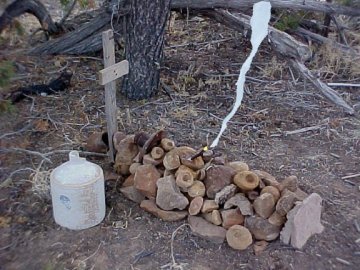
After I haul some more rocks the above is going to be a woodshed with a watertight roof. The hot tub was on the porch when I moved here, cracked, home to wildlife. Now it’s metamorphosing into an eventual place to keep my firewood dry.
There’s a lot of work yet to be done raising that roof a few more feet.
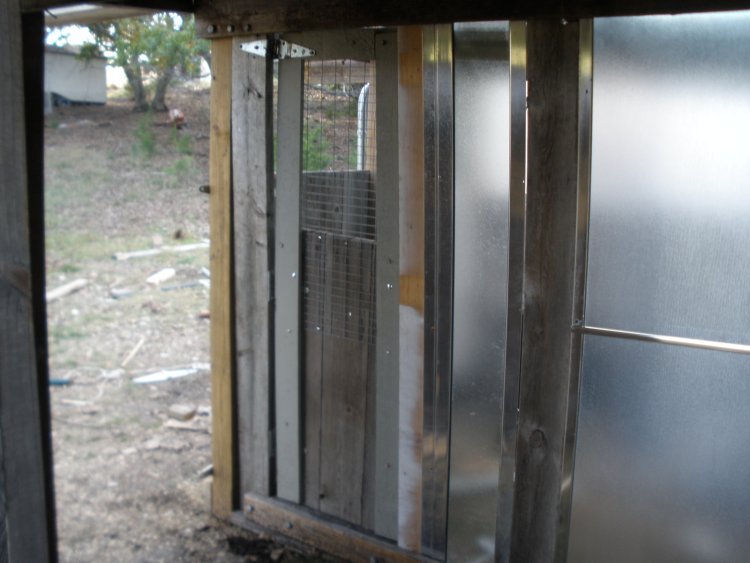
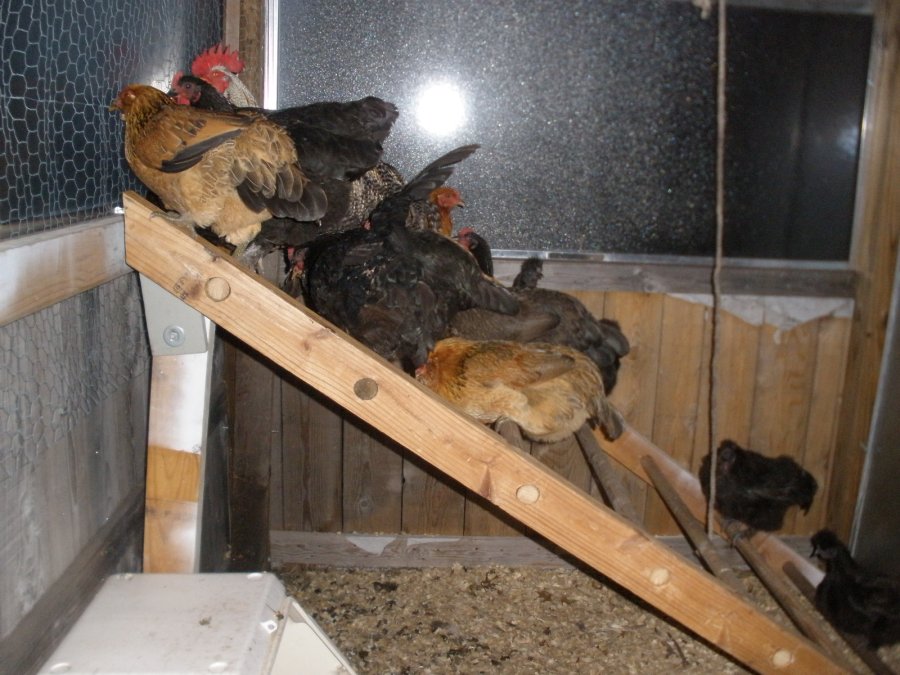
Then there’s this. A nesting box for brooding hens to keep them separate until the chicks are old enough to mix with the flock, but still protected from predators. Refrigerator shelves cut down to fit the cable spool, mounted on a sawed-in-half lawn mower platform for mobility: Or this: A chicken-house fabricated entirely from salvage, discarded shower doors, camper shell roof, refrigerator shelves, whatever came to hand free:
I don’t know when we began giving power to strangers. I think it’s a relatively recent phenomenon. Maybe we watched too many Westerns during our formative years, learned from those steely eyed men in saloons that what strangers think about us is worth a gunfight.
Nowadays the extreme version happens in city traffic. Someone shoots someone else a bird. Next step is an exchange of gunfire.
Here’s how the scenario runs:
Some complete stranger pronounces a bias we don’t share.
Our thought response:
“This offends me.”
That thought process is driven by a deeper one:
“I want to be offended. I give this stranger the power to offend me. I assign enough value to what this stranger says, or believes, to allow it to trigger a negative emotional path within me. What this stranger says or believes matters.”
We know better.
Strangers cut too wide a swath in their traits to have any real value. They span the breadth of potential human biases. But even knowing this we give them the power to ruin a moment.
I say this is a recent phenomenon because humans of the past behaved differently. Our forefathers didn’t care what Brits thought about us because they recognized that Brits live within an entirely different set of interests.
Even today a Zuni doesn’t care what a Navajo thinks about anything because from the perspective of a Zuni, Navajos don’t have anything valid to contribute to any meaningful discussion. Navajos live in a different reality from Zunis.
Both Navajos and Zunis choose to allow themselves to be offended by the opinions of Anglos and Hispanics, but there’s a reason. They’ve found taking offense is a means of gaining power over those groups.
But neither a Zuni, nor a Navajo would bother being offended by the thoughts and words of the other because to each there’s nothing the other might think that carries the weight of validity.
Not long ago the same was true of people almost everywhere. The people in the town where I was reared cared about the opinions of people within that town, but they couldn’t have cared less what the people in Clovis, twenty miles away thought. It was generally understood that Clovis people were stupid and might think and say anything.
Today we care what everyone thinks about almost everything. We pretend to believe what they think carries value, but we know better. We just like the feel of being offended..
Make my day, Stranger! I’m handing you the power to offend me.
This leaves me cold.
Human opinion hasn’t held up well under scrutiny. It’s worth about what it costs. Mine aren’t that reliable and I haven’t found those of others to be any better.
I don’t know much about human beings these days, though I used to think I knew everything worth knowing about them. Putting a little distance between myself and the daily onslaught of news, spending my time in my own company instead of in the company of other people, and watch/listening instead of speaking when I’m around others has forced a realization that I don’t know spit about these creatures.
But it’s also clear to me that I didn’t know spit about them back when I knew a lot about them. Including me. I was in too close and personal, too much a part of the herd, to see what was happening around me. A person inside a jetliner going several hundred miles an hour can throw a rock from the tail section all the way to the pilot and when it plunks against his scalp that rock will have traveled further than Babe Ruth ever hit a baseball. A fly inside the cabin of a jet fighter is supersonic when it goes from the back of the cabin to the front.
In a sense, the same phenomenon is at work when humans are in the company of other humans. Bunched up together in a stadium, concert hall, skyscraper, there’s an invisible wall around them disguising the fact the rocks they throw are going further and the flies are flying faster than anyone had any right to expect. The person in the next seat, the stewardess serving meals and drinks, the movie playing seems real to them, while the 20,000 feet to the ground doesn’t, while the outside rushing by doesn’t seem real at all, and all that microscopic activity on the ground below them doesn’t count for anything.
Back when I rode airliners, worked in buildings full of people, drove around inside a vehicle in heavy traffic and kept track of events I knew a lot about human beings. Same as you do now.
But now that I’ve backed away, put some distance between myself and humanity, to me they look more like chickens than they ever looked like human beings. I understand chickens fairly well, but I don’t know squat about human beings.
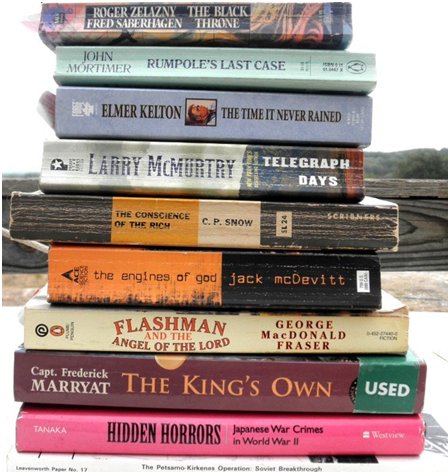
Leavenworth Papers #17 – The Petsamo-Kirkenes Operation: Soviet Breakthrough and Pursuit in the Arctic, October 1944, Major James F Gebhardt,Combat Studies Institute, US Army Command and General Staff College, 1948
Detailed examination of the Soviet success in the offensive attempting to identify what the US military should learn from it. Concluded light infantry to be the weapon of choice in arctic warfare. Examines the lessons learned by the Germans fighting under those conditions.
Good read for those interested in such matters.
Hidden Horrors – Japanese War Crimes in World War II, Yuki Tanaka, Transitions: Asians and Asian Americans Series, 1996
The Contents describes it better than I can:
1. The Sandakan POW Camp and the Geneva Convention
2. The Sandakan Death Marches and the Elimination of POWs
3. Rape and War: The Japanese Experience
4. Judge Webb and Japanese Cannibalism
5. Japanese Biological Warfare Plans and Experiments on POWs
6. Massacre of Civilians at Kavieng
Conclusion: Understanding Japanese Brutality in the Asia-Pacific War
Tanaka elaborates on the collaboration between the US and Japan to cover-up and downplay many of these events because of the post-WWII need for Japan as a strong Pacific partner against Communist aggression. Many were not investigated, prosecuted, even mentioned again in public media.
Fifty years after the Japanese surrender Tanaka writes: “Consequently, we Japanese have failed to recognize ourselves as aggressors, still less as perpetrators of war crimes. Moreover, because of the widespread perception of ourselves as victims of war, the notion of “victim” gradually expanded even to the point that the Japanese state was also seen as a victim of war.”
Reveals various deals made between the US Command under Dugout Doug and the Japanese commanders who conducted human lab experiments on POWs. Immunity from prosecution in return for everything learned in the experiments.
The King’s Own – Captain Frederick Marryat
Marryat’s a worthy read. He was a British Navy Captain when he retired in the 1820s and began publishing fiction works based on his experiences. His writings almost certainly were foundations for Horatio Hornblower and a lot of other sea yarn characters in fiction series during the 20th Century.
Marryat’s the daddy and granddaddy of them all.
Flashman and the Angel of the Lord, George MacDonald Frazer
The Flashman series is possibly the most laughing [and among the most educational] historical fiction series ever written.
I thoroughly resent Frazer dying before he wrote several more of them, though I re-read the ones he did write at least one time every decade. He’s welcome to resent me dying off without reading them again if it works out that way.
The Flashman Papers in Chronological order
Flashman [Britain, India and Afghanistan, 1839-42]
Royal Flash [England, 1842-43, Germany 1847-48]
Flashman’s Lady [England, Borneo, Madagascar 1842-45]
Flashman and the Mountain of Light [Indian Punjab 1845-46]
Flash for Freedom [England, West Africa, USA, 1848-49]
Flash and the Redskins [USA 1849-50 and 1875-76]
Flashman at the Charge [England, Crimea and Central Asia 1854-55]
Flashman in the Great Game [Scotland, England1856-58]
Flashman and the Angel of the Lord [India, South Africa, USA, 1858-59]
Flashman and the Dragon [China, 1860]
The Engines of God, Jack McDevitt
Respectable and readable sci-fi.
The Conscience of the Rich, CP Snow
Strange and unsettling book. Published during the 1950s the title’s an anachronism to such an extent the reader feels a bit lost at the beginning, figuring on some class warfare thing that would have found that name a decade later.
In fact, it’s probably the book Maugham would have written in Of Human Bondage if he’d been writing about a family of Jewish aristocrats in Britain during the 1920s and 1830s. The intractable controls imposed by the Jewish family on personal choices of family members in almost every facet of their lives.
Unsettling, but a worthy read.
Telegraph Days – Larry McMurtry
That original McMurtry book where he decided to become Louis L’Amour wasn’t bad, certainly a lot better than some that came later. I’d put Telegraph Days somewhere up near the top of his work since he became the great American novelist trying to push L’Amour out of the way.
The Time it Never Rained – Elmer Kelton
Good read about that pivotal time in the relationship between independent ranchers in the west and the US government, coincident with the drought of the 1950s.
Rumpole’s Last Case – John Mortimer
Another good Rumpole. What more needs saying?
The Black Throne – Roger Zelazny and Fred Saberhagen
Saberhagen books were always considered safe to buy at a quarter in the thrift stores until this one. I imagine it wasn’t him dropped the ball, but maybe it was just a pot-boiler for both of them. The writing craft is what’s at fault. Everything’s there, crisp dialogue, plot, characters with some depth. Good command of the language.
But something’s missing. I wouldn’t spend a quarter on it next time if I can remember when I see it again in a thrift store.
Retired university librarian. Oblique political humor of a liberal slant, frequently a smiler, sometimes a chuckler or horselaugher.
If you know more about politics than I do you might enjoy it even more. To me they’re just faces sometimes attached to names, but fun and interesting.
“Airplanes, cats, guns, war, the more than occasional rant about the party of the Confederacy, the spinelessness of the Democrats and crap about anything else that flits through the somewhat offbeat mind of an armed lesbian pinko as she slides down the Razor Blade of Life.”
I’m not crazy about a lot of the content, but the airplane pics she posts are worth the price of admission and reading the posts offers a different slant on things worth chewing on.
74 years old, a resident of Leavenworth, KS, in an apartment located on the VA campus. Partnered with a black shorthaired cat named Mister Midnight. (1943-2020)
Since April, 2020, this blog is maintained by Jeanne Kasten (See "About" page for further information).
https://sofarfromheaven.com/2020/04/21/au-revoir-old-jules-jack-purcell/
I’m sharing it with you because there’s almost no likelihood you’ll believe it. This lunatic asylum I call my life has so many unexpected twists and turns I won’t even try to guess where it’s going. I’d suggest you try to find some laughs here. You won’t find wisdom. Good luck.

 My old Toyota 4Runner went Communist on me in December, had to be parked facing downhill to allow it to be started next time. A Catch 22 involving if-replacing-the-starter-doesn’t-fix-it has left me having to borrow a vehicle anytime I need to go into town, or have someone pick up what I need has existed from then until now.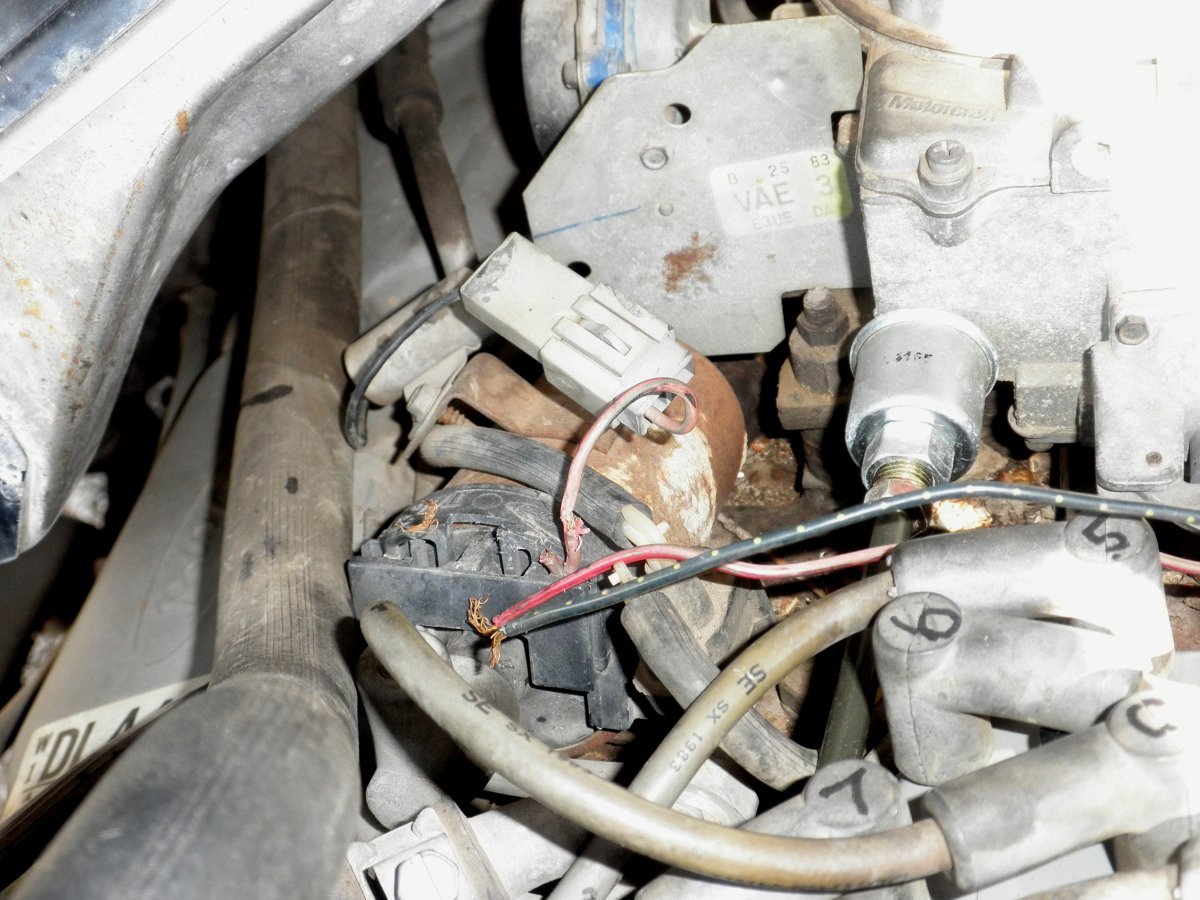












 So Far From Heaven

