C.S. Lewis, author of the Narnia series of kid books and the Screwtape Letters died. He was also a middling good science fiction writer. I always enjoyed his work and consider him an important writer within his area of interest.
At the time of his death I didn’t hear about it because Aldous Huxley died the same day and got most of the fanfare.
Huxley’s Brave New World was all the rage at the time, one of those books young intellectuals all asked one another whether they’d read, and of course they all answered, “Yeah, wasn’t it great?” whether they’d read it or not.
Overall I believe Lewis has stood the test of time better than Huxley, but we can’t go back and give Lewis a better funereal showing at this late date, so I just figured I’d mention it here.
I’m going to get away from the brave new world of the 21st Century and the animal kingdom for this segment and go back a few million years to my childhood. I explained a little about that farm on the other side of the railroad tracks here: Could you choose to live on the street?, but to pursue the bullying issue I’ll elaborate a bit.
The kids who lived on the other side of those tracks were overwhelmingly tough, poor, and ‘bad’. The families were farm laborers or otherwise unskilled, lots of kids, and Hispanic or considered ‘white trash’. The kids living there went to Lindsey Grammar School, and the RR tracks defined the boundary between Lindsey and the other two grammar schools.
In 1949, when I was starting school my mother went to war with the superintendent of schools and the school board to make certain I went to East Ward, not Lindsey. She succeeded.
Meanwhile, on this side of the tracks and the highway there were a few neighborhoods of kids who belonged in Lindsey, but were doomed by geography to go to school with the regular population at East Ward. One of those was a boy named Floren Villianueva and his siblings. A tough, bad, mean as hell youngster with older brothers meaner than him. He and I entered the first grade in the same class.
Floren and I somehow got crosswise with one another almost the first day of classes during recess. He gave me a blow to the stomach that knocked the wind out of me, doubled me over and might well have been responsible for the hernia of the goozle that’s caused me trouble to this day.
After school each afternoon Floren and his brothers walked home the same route I did, and for a few days they went the extra distance to chase me home, throwing rocks at me when they couldn’t catch me, beating hell out of me when they could. Me finding safety only when I went through the door to the house.
That naturally came to the attention of my mom after a few days. One afternoon she was standing on the porch shaking a rug and saw me running across the tracks chased by Floren and his brothers. They came right into the yard, and she grabbed a broom and chased them off, yelling insults.
When they were gone she turned on me in a fit of rage, grabbed me by the ear and dragged me into the house where she kept her switch. While she was beating hell out of me she was yelling, “If I ever see or hear of you running from a fight again this is nothing compared to what you’ll get.”
When my step-dad got home she told him about it and he just shook his head. “Running from a bunch of God-damned Mexicans!”
I went about in disgrace a few days, the story circulating among the adults with me in hearing distance, all of them dumbfounded by my cowardice.
But I never ran from a fight again. I started carrying a heavy stick with me walking home and only had to whack one of those other kids upside the head with it one time. Afterward Floren and I fought a lot of times during recess and I never whipped him, but I took the beatings rather than the alternatives.
This is too lengthy for me to continue where I’m going with it, but it’s necessary background to get in place before going forward in this segment.
I'd guess Phil probably resembled this young marine when he arrived
I hadn’t thought about my old running buddy, Phil, for a while. That last blog entry got me chewing on thoughts of him. I’ll tell you a bit more about him.
Phil went to the Marine Corps as the result of being a 17 year old driving from Temple, Texas, to Austin with a case of beer in the car. A Williamson County Sheriff Deputy stopped him on a tail light violation, asked for his drivers license and saw the case of beer. Old Phil, being a clever youth, gave the officer a Texas Drivers License with an altered date of birth, so’s to keep from being arrested as a minor in possession of alcoholic beverages.
The deputy wasn’t fooled. He hauled Phil off to the slammer to reflect on his sins. He was offered the alternatives of going to prison for presenting a phony ID, or going into the US Marine Corps.
In Vietnam, at least, Phil was old enough to drink. He became Marine Recon and a sniper. Phil was in the jungle with a squad of other snipers surrounded by a NVA rocket launching unit when the first rockets were fired into Da Nang AFB. The squad wisely stayed hidden and didn’t take any shots, they radioed in the location of the rocket unit and brought an airstrike down on top of themselves.
They’d be dropped into an area where the NVA was expected to set up a battalion or division headquarters, sit there a couple of weeks waiting quietly, and try for a head shot at a senior officer. Once the shots were fired they’d try to sink back into the bushes until things went quiet, then slink out to some place where they could be lifted out.
Phil did two tours over there. When he came back he had such a chest full of medals they snatched him up for Nixon’s Honor Guard. Which Phil believed would be easy duty.
Instead, it was riot control. Wherever Nixon went there were anti-war riots, and Phil and his unit busting heads, which he thoroughly hated, since he agreed with the demonstrators.
Phil hated politicians, hated war, hated the men responsible for sending him over there and making him the troubled, rage filled human being he was during the decade and a half I knew him.
But the Vietnamese body counts were a lot higher because of Phil.
When I last saw him half his face was eaten away by Lupus, contracted as a result of Agent Orange in those jungles. The Veterans Administration was fighting and squirming denying all those guys were ill from Agent Orange, that the problems were Service Connected, so they’d have to offer disability and whatnot.
Phil used to observe that he might have been a lot better off if he’d just let them send him to prison for the beer and phony ID. Then they couldn’t have even drafted him for that place.
I wonder if that old Agent Orange has killed him yet. Another victim of friendly fire with a delayed action fuse.
Korean War vintage – The From Here to Eternity Version’s missing the first and last stanza, but worth the watch:
The complete version
Around 1956-’57 when Elvis was drafted
Sailor around 1957
A million men or more left their hearts in San Francisco to be reminded by this song. When we returned and the troop ships passed under the Golden Gate a million uniform hats went into the air:
The Berlin Crisis of 1961 brought this one to the top. I listened to it in basic training along with everyone else they could drag out of the sticks to wear a uniform:
The constant ‘brink of war’ cold war military also serving as armies of occupation:
Then along came Vietnam
And those who decided Canada made more sense
than the Okie from Muskogie
and politicians singing For God Country and My Baby to the tune of 1000 bottles of beer on the wall in 10 part harmony for another half-century.
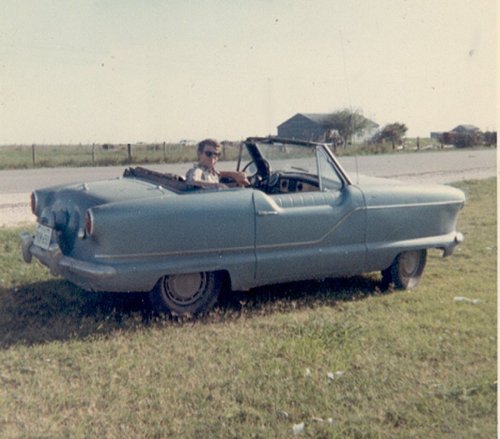
In 1967 I was working 5.5 days a week doing hard physical labor, taking night courses at the University of Houston and having an urgent, compelling romance with my wife-to-be living in Port Lavaca, 150 miles away. Every minute I could spare I cranked up that Metropolitan and headed west to spend a few hours with her. Even for a young man exhaustion built and I had a lot of difficulty staying awake while driving.
Picking up hitch-hikers was one of the ways I stayed awake. Just having someone to talk to on that endless road was a major asset.
1967 was a year of serious racial tensions and polarization. During the years immediately previous a gradual mind-opening of tolerance was manifested in a brief cliche, “I’ve got nothing against blacks, but I wouldn’t want my sister to marry one.” For a while a person heard that at least once a week.
One day as I was leaving Houston I stopped for two black guys hitching at an empty stretch of highway. As they ran up to the car they saw the University of Houston sticker on back and without moving to get in they took on a grinning, belligerant-but-joshing attitude. “You go to U of H?”
“Yeah. Where you guys headed?”
Still no move to get in. “We go to Texas Southern [a black university in Houston]. You a queer? The last guy picked us up went to U of H was a queer. Dumped us out here ’cause we didn’t want none of him.”
“I’m not a queer. I’m going to Port Lavaca to see my girl friend.”
They relaxed and squeezed into the Metropolitan, joshing about the klutzy car, how tight it was, how they didn’t want to be seen riding with a white guy. “Anyone sees us riding with you they’ll think you’re queer. They’ll think we’re letting you queer us.”
As we reached highway speed I grinned and looked over at them. “I’ve got nothing against queers but I wouldn’t want my brother to marry one.”
Both of them gagged on that, double-took me, one another, trying to decide whether to be offended. Finally one of them guffawed. “Hey man, that’s a good one!” Held his hand up to be slapped.
Turned out to be fairly nice guys headed to Corpus Christi for the weekend. The drive to Port Lavaca went by fast, once we decided we were just three young guys not needing to fight, fear, or scrutinize every word for some slur or threat.
Sometimes it’s easy to forget how much times have changed.
The human mind is a strange place to find ourselves living if we ever get enough distance from the background noise to notice. I tend to notice it a lot.
This morning seemed destined to be just another day. Gale and Kay were doing the Austin Gem and Mineral Show, so I’d figured to walk up to his house to get the truck mid-day so’s to take care of putting their chickens to bed tonight. Startled me a bit when I looked up and there he sat in Little Red a few feet away, having brought it down to me. My hearing must be further gone than I’d realized.
Seemed they’d no sooner gone than I got an email from Jeanne saying my old friend from childhood and later lost-gold-mine chasing days was in Fredericksburg trying to get hold of me hoping I could get over there for lunch. Heck, it must be 15 years or more since I’ve seen Keith, though recently he’s been reading this blog. Naturally him being 40 miles away and me with a truck sitting there available, I headed over there.
Really nice visit, but in the course of bringing one another up-to-date he asked me a number of questions about my situation here that forced me to take a hard look and organize my thoughts about it all. That kicked off a series of trails of thinking to organize clearer, more concrete priorities for myself within a realistic examination of my options.
There aren’t a lot of them, but they’re all stacked atop a single one: having the means of leaving this place in a relatively short time if the need arises. It’s time I decided on a single course of action and begin leading events in a direction that allows it to congeal in a way that accomodates the needs of the cats.
But the process of thinking about it in an organized way had a parallel thinking-path over whispering somewhere else in my brain wiggling out a sort of excitement, anticipation about it. Here’s something that will be pure trauma and agony for the cats I do everything possible to spare such things, and my ticker’s beating a little faster in a pleasurable way just considering it.
That, combined with the certainty the process of getting things together to execute the plan I come with is going to involve some unpleasantness, excruciating work and fingernail chewing as it goes along.
Seems I’ve somehow contrived to be two different places at the same time inside my mind. One being pushed by probabilities to do what makes sense rather than what I’d prefer, the cats would prefer. And one reaching somewhere into fond memories of pinon trees, high mountains and an entirely different sort of solitude than I have here.
Keith confided to me today, “Everyone thinks you’re crazy.” I can’t find any good argument that everyone’s wrong. It’s nice being crazy and still being as happy as I manage to be all the time, though.
Anyway, to satisfy that fiddle-footed nagging, here are some songs of the highway and the road.
I find my views about rioting to be possibly artificially drawn away from magnetic north by several personal experiences with them, as well as having been an adult during the giant city burning episodes around the time of the MLK killing.
From personal observation and experience I feel a high level of certainty that every riot since the 1960s was and is heavily infiltrated by police or other government provocateurs, pushing, inflaming and instigating to direct events toward violence. I’m not suggesting the riots wouldn’t have happened without them. The riots would almost certainly have happened anyway. I honestly don’t have a clue why they’re doing it.
But my first experience with it was Halloween, 1960, in Borger, Texas. During the days before Halloween the kids in high school were all gearing up for it, but I was a newbie in town, had no reason to anticipate what they saw as the normal way to celebrate Halloween. Wild and wooly oil-field worker traditions combined with a boys-will-be-boys tolerance on the part of adults left the options wide open.
The newspaper the next day described it as a quieter than usual Halloween with the main damage being someone starting a bulldozer at a construction site and driving it through a house, nobody hurt.
A few hundred teenagers drunk on main street armed with eggs, veggies, rocks, jars of gasoline, cornering police paddy wagon with barrage after barrage, following them back to the station house and setting fire to the lawn was just a beginning. I never saw anything like it, even during the riots at the University of Texas I was a part of a decade later.
My point is, rioting is fun, it’s joyful, it’s seductive if the anonymity of a mob can be maintained and when there are no consequences. It doesn’t take much to get people rioting under those circumstances.
On the other hand, the day after Kent State and afterward throughout the remainder of the Vietnam War the temptation to riot was always there so long as it was someone else stepping off the curb into the street. The police and a lot of the rest of the country made it plain by word and attitude they felt tolerance for what happened at Kent State and wouldn’t mind seeing it again.
I recall what a letdown it was when I realized I wasn’t the gutsy hotshot I had people thinking I was, that I was just a loudmouth coward when it came to offering myself up for what I claimed I believed in by making myself a target for all those cops to practice on.
I don’t think things are much different now. My near-certainty about riots in the US is that the government response will determine whether there are riots, or won’t be. I don’t give advice, but if I did I’d suggest anyone involved in a peaceful demonstration immediately remove himself/herself from the area as rapidly as possible at the first sign of violence.
I’d suggest carefully exploring the route and area of the demonstration on maps and on the ground beforehand. Pre-arranged escape routes memorized to allow getting the hell out of dodge. Cell phones set with standby text messages to friends and cohorts to get the message out immediately that things are going sour. But I won’t suggest it.
But I don’t have a lot of reason to think having a riot going on and being in the center of it is a place I’d want to spend a lot of time.
North by Northwest – Climbing the American ladder of success
The Alamo – “When I was a boy any girl would turn up a bunch of trees like that, cut a bunch down and one for a ridge pole and build herself a cabin alongside the other. Seems like all anyone would ever need.”
The Outlaw Josie Wales parleys with 10 Bears – “Dying ain’t so hard for people like you and me. It’s living that’s hard. Governments don’t live here. It’s people who live here. I’m saying people can live here together without butchering one another.”
I was reading clickclack gorilla’s hitching story and it dawned on me what’s going on in Europe with hitch-hiking is entirely different from it in the US. Evidently thumbing rides there still includes ‘respectable’ people. It wasn’t so long ago the same was true in the US.
As a youngster and young man I hitched across the US up-down and sideways more times than I’ve traveled it any other way. In the military it used to be the most common way soldiers traveled, but it was also a legitimate way of getting to a destination for anyone else, as well. When I got out of jail for riding trains in Rochester, New York, in 1964, the judge at the arraignment told me, “Don’t you know hopping trains in New York is a FELONY?”
“No sir. I didn’t know that.”
“Is there someone you can contact to get money for a bus ticket to get back to New Mexico?”
“No sir, there isn’t.”
“I’m going to say this, then I’m going to let you go. Hitch-hiking is only a misdemeanor in New York.”
After I was released a police officer drove me out to the Interstate and let me off at a freeway entrance. And way led onto way.
All that hitching as a youth was an adventure I suspect a lot of people alive today haven’t experienced. Every trip was a hundred stories, including the one above. And every hitch-hiker I’ve picked up over the decades since [I still do] has been a story in itself. I keep a case of Dinty Moore stew in the truck and usually give them a can or two if they’ve convinced me they’re hungry.
Today people are generally frightened of hitch-hikers, or just don’t believe the potential feel-good rewards of picking them up is worth the risk of getting robbed, assaulted, or just being trapped inside a vehicle with a person who smells as though he’s been on the road a while is worth it. I’d opine they’re thinking smart. I’d be lying if I said I haven’t had some close calls, both hitching, and picking up hitch-hikers.
But I do it anyway, and I’m glad I do, glad I have, wouldn’t trade having done it for the alternative.
I’m thinking I might throw in a few of those hitch-hiking, hitch-hiker tales on this blog occasionally. Some are chilling, some are strange, but every one is unique.
When I got out of the US Army in 1964 I was a confused young man. I had no idea what I wanted to do with the rest of my life, but initially I felt some urgency to get started doing it. My first thought was to buy a farm in the vicinity of Portales, New Mexico, where I’d spent most of my youth and done a lot of farm labor. That area was in the process of the subtle change from hardscrabble family farms to agribusiness farms, though I didn’t recognize it.
Although my granddad had a small farm a few miles from town, and although the main revenue for the population was farm-related, most non-farmers didn’t hold farmers in high regard. Including my granddad, with reasons he considered adequate.
The result was that my granddad, my mom and my step-dad took active measures, once I found a 160 acre irrigated farm I could swing for, to make certain with the local bank that I didn’t get financing to buy it. They each pronounced separately to me that I was destined for ‘better things’ than farming, which I bitterly resented.
Someone mentioned to me the Peace Corps was a place where young people at loose ends were volunteering to go off and set the world right. Relatively new at the time, I’d never heard of it, but I applied.
Then, as I’d done numerous times before, I hitch-hiked out of that town. The World Fair was going on in New York, and I headed that direction, and spent the summer in Greenwich Village simulating being a beatnik.
I might talk more about all this in future posts, but I’ve digressed from my original intentions for this one.
I began my Peace Corps training in Hilo, Hawaii. India X Peace Corps Project, intended to send bright young Americans off to Gujarat, India, to teach the locals how to raise chickens. Sometime I’ll probably wax poetic about all that, but I’m trying to limit my digressions.
Training was intended to be a time of intense learning, but it was also clear, we were cautioned from the beginning, it also served as a filter to remove the great percentage of the trainees through observation, psychological testing, peer ratings, and voluntary withdrawals. A sort of basic training with the emphasis on washing out all trainees with potential shortcomings. About 2/3 of India X washed out of training before the end, including me.
But I’m having a lot of trouble getting to the point of this post because of all the background material. Enough!
One of the methods of screening trainees was the Minnesota Multi-Phase Personality Test. Most of the trainees were well-enough educated to be familiar with it. The MMPP was reputed to be ‘unbeatable’, and we were each acutely aware of our personal shortcomings. Most of us agreed if the Peace Corps had any idea what was going on in our heads they’d faint, revive themselves, and deselect us without further ado.
During the week prior to the test we’d gather at night to discuss the best strategy for foiling the Peace Corps cadre and the MMPP. The two obvious approaches were, a] Tell the truth and suffer the consequences, and hope to be forgiven, or, b] Lie consistently.
By reputation, the MMPP wasn’t capable of being lied to consistently without catching you out.
Most of us viewed ourselves as the cream of US youth. The Peace Corps told us that’s what we were from the first day of acceptance for training. We’d been picked from hundreds, maybe thousands of applicants.
So we’d already fooled them that much.
Our consensus as a group was to lie consistently. Some of us succeeded.
This is getting lengthy, so I’ll use it as a launchpad, most likely, for some future posts.
74 years old, a resident of Leavenworth, KS, in an apartment located on the VA campus. Partnered with a black shorthaired cat named Mister Midnight. (1943-2020)
Since April, 2020, this blog is maintained by Jeanne Kasten (See "About" page for further information).
https://sofarfromheaven.com/2020/04/21/au-revoir-old-jules-jack-purcell/
I’m sharing it with you because there’s almost no likelihood you’ll believe it. This lunatic asylum I call my life has so many unexpected twists and turns I won’t even try to guess where it’s going. I’d suggest you try to find some laughs here. You won’t find wisdom. Good luck.






 So Far From Heaven