Category Archives: Book Reviews

Unanticipated Consequences – An Accidental Great Read

English Seamen In The 16th Century, Lectures Delivered at Oxford, Easter Term, 1893-94, James Anthony Froude.

Saturday evenings after they finish an auction a couple of blocks from her home in Olathe, Kansas, Jeanne often goes to the parking lot to nose through what didn’t sell and is being readied to haul to the dump.  When she comes across books she thinks might be to my tastes, she calls me and asks if I’d like her to snag them and send them to me.  This tattered old tome was one such.

I’d never heard of Froude and she said the book was beat up badly, but I made a snap decision and had her take it.  Thanks, Coincidence Coordinators, and twice-thanks, Jeanne.

The Project Gutenberg EBook of English Seamen in the Sixteenth Century, by James Anthony Froude, http://www.gutenberg.org/files/18209/18209-h/18209-h.htm.

I considered myself modestly well-versed on the times from Henry VIII through Elizabeth, the English Reformation, the Huguenots in Holland, the Inquisition, the Spanish super-power status, and the troubles with Mary, Queen of Scots.  But somehow I’d never put it all together.  I’d never paused to ask myself how England, a country virtually without military power, no navy to speak of, came to become an empire, a sea power without equal during a relatively short time-span.

I’d also never asked myself the careful questions about the defeat of the Spanish Armada by what amounted to a scattering of privately owned ships, almost without any help from the crown.  In fact, a tiny, fragmented private navy having to find ways around the obstructions, mind-changings, mood shifts and flighty fancies and wishful thinkings of Elizabeth.

Froude makes a strong case for the premise that the two greatest western powers of the time, the Catholic Church and the king of Spain, forced them into the future kicking and screaming in protest.  By arrogance, pride, cruelty, certainty in the belief they could do anything and get by with it, they blind-sided themselves.  They forced a population of merchants and fisherman-sailors to learn to build ships and fight at sea as an alternative to being tortured by the Inquisition, forced into slavery in Spanish galleys, or burned at the stake.

Even after Citizens Hawkins and Drake began ravaging the Spanish shipping, intercepting Spanish treasure, burning Spanish towns in revenge for Spanish and Inquisition atrocities, the Inquisition and Philip refused to see what loomed on the horizon.  They continued plotting to assassinate Elizabeth in hopes of bringing Mary to the throne and Catholicism back to the realm.  They continued capturing English crewmen and punishing them for doctrinal heresy.

And eventually, assembled the greatest war fleet in the history of mankind to invade the island and restore doctrinal purity.  The outcome seemed obvious to them and there appeared to be no other, gazing into their own futures.

But Froude, gazing into the past, has an advantage, looking through the centuries since, past the Napoleonic times, the generations of British imperialism and conquest, to the day the power of the Catholic Church began the first lesson in humility.  And to the day the power of Spain imploded.

A recommended read.

Old Jules

Today on Ask Old Jules:  Your Life’s Work?

Old Jules, what do you regard as your life’s work?
What will be your major contribution to the world?

The Implosion Conspiracy – Louis Nizer – How the USSR got the Atomic Bomb

When Louis Nizer penned The Implosion Conspiracy it might be said enough time had passed to provide perspective.  Two decades had passed since the trial and execution of the Rosenbergs rocked the nation.  Nizer disliked Communists, asserted he’d refuse to defend one in his profession as a defense attorney.  However, he wrote a lengthy analysis of the trial, the transcripts, testimonies, the individuals involved in an even-handed manner that wouldn’t have been possible during the Commie craze days of the events.

Basic events leading to the trial:  The US was developing the atomic bomb at Los Alamos, New Mexico during the late stages of WWII.  The information was being shared with the US Ally, Britain, but kept secret from the US Ally, the USSR.  Elaborate security measures were in place to assure the developments remained the exclusive property of the US and British governments.  Elaborate almost beyond description, devised by the US military and the FBI.

But the British liaison to the project was physicist Klaus Fuchs, a spy for the Soviet Union.  The Germans knew Fuchs to be a Soviet spy, but the British and Americans didn’t, until they gained access to records captured as they advanced into Germany.

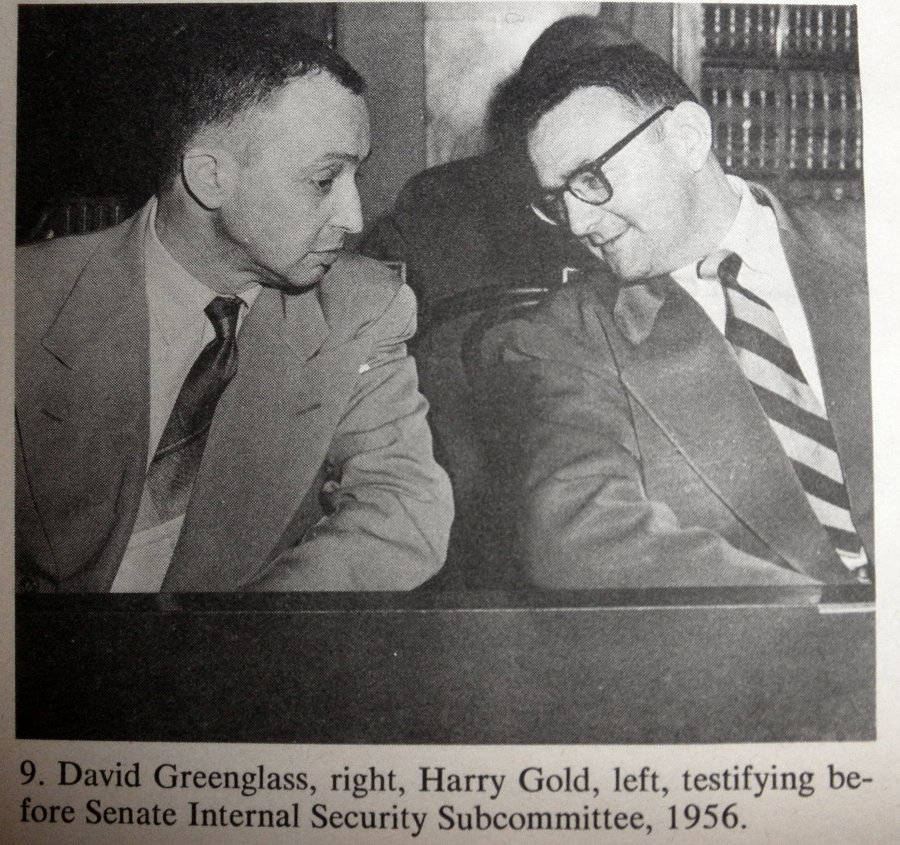
Aside from Fuchs, the other USSR source for information about developments at Los Alamos was David Greenglass, a US Army machinist and brother to Ethyl Rosenberg.  Greenglass had been a Communist his entire adult life and had been separated from an earlier military job because of questions about his loyalty and honesty.

David Greenglass stole the crucial secrets of the lens molds used to detonate the bomb, the implosion device.  By hindsight, it’s clear he did it for money, for the same reasons he stole automobile parts, uranium, anything he could lay hands on to sell on the black market.

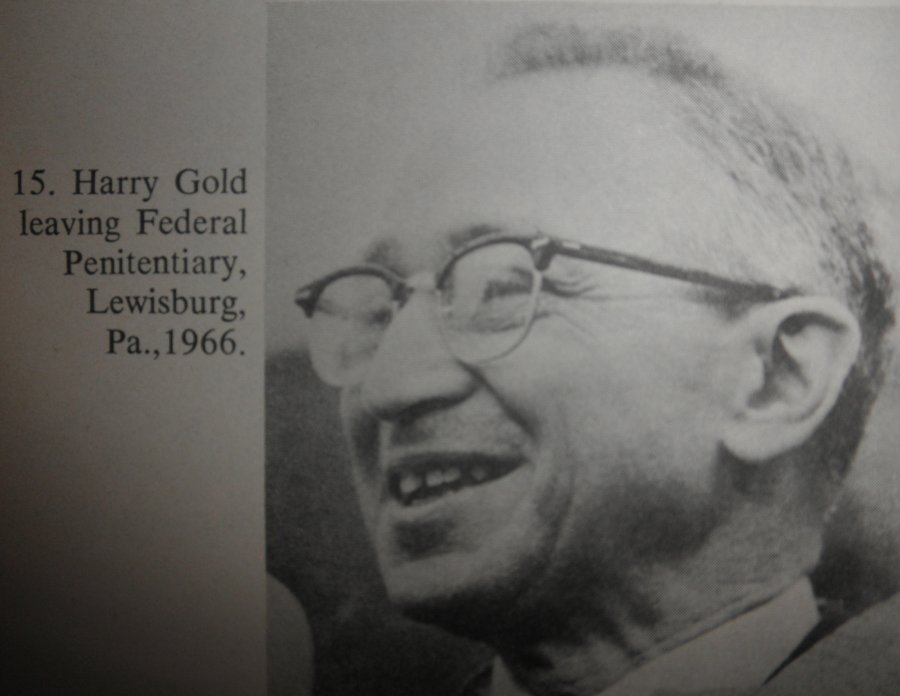
Greenglass passed the secrets to his wife, Ruth, who passed them to Harry Gold.  Gold was the direct connection to the Soviet spymaster, Yakovlev, in the Soviet Embassy.  It’s clear enough from everything provided in evidence and testimony that Gold was a man without loyalty to any nation, ideal, idea, or human being other than himself.  He did it for the money and for no other reason. 

The testimony of Greenglass, awaiting trial for treason, and his wife, Ruth, who  was never charged, provided the testimony connecting Julius and Ethyl Rosenberg to the plot.  The witness stand accusations by Greenglass against his sister and brother-in-law, and the corroborating testimony from his wife, who didn’t yet know whether she’d be charged, constituted almost the only evidence of the prosecution.  The other witnesses directly involved in the plot mostly did not know the Rosenbergs, or barely knew them and knew little of their activities.

Because of the weakness of the government case insofar as testimony and physical evidence of the Rosenberg involvement in actual spy activities, the focus of the prosecution became a trial of Communist ideology.  Witnesses who knew nothing about the plot, the bomb secrets, the Rosenbergs  were called to testify about how they’d switched their own loyalties from Fascism to Communism, then become loyal US citizen-experts making a living selling books and giving lectures on the insidiousness of Communism.

The trial transcripts excerpts Nizer provides make it clear the Defense had two opponents:  the US Attorney prosecutor, and the judge, who constantly intervened, interrupted, interjected in ways clearly intended to prejudice the jury against the defendants.

The key players who gave, or sold the atomic bomb to the USSR in 1945 went free, or were given relatively light sentences.

The Rosenbergs, clearly Communist idealists, possibly part of the plot, died in the electric chair.

When Allied forces found documents in Germany revealing Fuchs as a Soviet spy the chain of resulting indictments followed a path to almost all the conspirators except the Rosenbergs.  Before spymaster Yakovlev fled the US, during his last meeting with Gold, he made the following observations:

Yakovlev:  Don’t you remember anything I tell you?  You’ve been a sitting duck all this time.  We probably are being watched right now.  How we pick such morons I’ll never understand!  We’ve been living in a goldfish bowl because of you.  Idiot!  Idiot! 

I am leaving the country immediately.  I’ll never see you again.  Just go away.  Don’t follow me.

He went.

But the answer to Yakoviev’s question is worth an answer.  They recruited from the US Government, the US military, from US universities, from US businessmen.

From the same pool of applicants who later sold their industries, their industrial tools, secrets, capabilities, economies, and debts to the Peoples Republic of China and other foreign nations.

They weren’t Communists, like the Rosenbergs.  They were opportunists, entrepreneurs, devil-take-the-hindmost politicians, like their descendants a few generations later.

Old Jules

Today on Ask Old Jules:  Value of Animal vs. Human Lives?

Old Jules, does an animal’s life mean as much or nearly as much to you as a human’s, or do you feel animals are insignificant/worthless in comparison? Also, do you believe it is ever morally right to harm/kill animals? What about humans?

Redcoat, by Richard Holmes – Book Review

When an author succeeds in creating a page turner from a segment of history beaten thoroughly to death by a thousand other historians and writers of historical fiction there should be some background music and applause.


Richard Holmes has succeeded. 

Redcoat follows the British soldier through the Seven Year War, the Peninsula War, the wars in the Americas, the wars in India through the Sepoy Mutiny and Afghanistan to the Crimea.    And every page contains some new surprise, some fragment of detail the reader won’t have encountered previously. 

Ever wondered where the idea for Hornblower’s fascination with the Lady Barbara Wellesley most likely originated?  Illustrations:  “Below:  The Marquess of Anglesey was a talented cavalry commander who, when Lord Paget, beat the French at Benavente and Sahagun.  Unfortunately he ran off with Wellington’s sister-in-law and could not be re-employed in the Peninsula.  As Lord Uxbridge he lost a leg at Waterloo.”

Or, page 154, Lt. Arthur Moffat Lang, “Many are given to drink and drunkenness like the Germans.  Foreign wines on account of their being accustomed to beer, does not agree with them, and in hot countries over-seas brings on burning fevers . . .”

Holmes has sifted through the chaff of history to cover the subject thoroughly on the outside in a 427 page epidermis, along with constant peeks at the liver, the bladder, the spleen and the dirt under the fingernails of the British soldier:  A man as limited and flawed as the Brown Bess musket he carried into battle, but one who experienced a surprisingly long series of successes where failure would have been far more appropriate.

‘Christopher Duffy suggests of the eighteenth century that:  “The most pronounced moral traits of the English were violence and patriotism.”‘

If that sounds familiar today it might be worth pondering whether it’s part of the package the 20th Century delivered to your own doorstep. 

Excellent work and a worthy read, Redcoat.

Old Jules

An Addendum About My Personal View of Mormons

I didn’t say this in the post because I didn’t think it needed saying, but I think it might.

I’ve got nothing bad to say about Mormons.  I’ve never been ill-treated by them, cheated by them, lied to by them so far as I know.  The ones I’ve met have generally been solid, hard-working, honest people.  Seemingly more so compared to the impression I’ve been left with in my seven decades of experience with the remainder of the population.  Christians, Gentile, Jew, atheist, Muslim and agnostic.  Even Buddhists, Taoists, Hindu, and the herd of New Age Gurus.  Even Hopi Elders and Ambiguous Native American Shamans.

My interest in Mormons came to being with the gradual realization that the parties involved in the lost gold mine I searched for so many years were predominantly Mormons.  It was a factor left entirely out of the legend as it came out of the 19th Century and it required years of research to uncover that fact.  The cousin of one of the central characters was evidently the second wife of Brigham Young.  Family names of the lost gold mine participants also show up among people involved in Mountain Meadows.

The timing on the lost gold mine incident and that of the Mountain Meadows massacre originally drew my interest.

What Mormons believe about polygamy, same-sex marriages, almost anything at all has no bearing on my impression and generally benevolent attitude toward them as a whole.  In areas where we disagree I’m willing to forgive them for being wrongheaded, same as I try to forgive everyone else who disagrees with me.  Otherwise I’d be forever having to keep score of who was right in this world, and who is wrong.  It just ain’t worth the effort even those relatively few areas where I can’t restrain myself from having an opinion.

Old Jules

The Mountain Meadows Massacre – Juanita Brooks

I’m re-reading The Mountain Meadows Massacre, by Juanita Brooks at the moment.  Twenty or thirty years ago when I submerged myself in everything I could find about the event I concluded the Brooks work was the best out there.  When it came into my hands again recently I held back beginning it again to savor the anticipation.  Now I’m midway through it again and it’s as fine a piece of research as ever.

Brooks was a Mormon lady, which made the Mountain Meadows Massacre a work of courage on her part.  The LDS church had spent a century suppressing the realities about the mass homicide of an estimated 60-120 men, women, and children of the Fancher wagon train journeying through Utah to California in 1857, by Mormons and members of a tribe of Native Americans.

The event happened at a time when there was plenty of massacre going on across North America, but was unusual for a couple of reasons.  First, because the people involved were Mormons killing Christians, as opposed to Christians killing Mormons, and the motivation wasn’t acquisition of territory belonging to someone else.   Second, because the circumstances surrounding the massacre involved ‘normal’, dutiful, pious people behaving in ways anyone outside the context could only consider far from normal.  Believing the killing was defensively justified and necessary.

Brooks establishes clearly and thoroughly that the heads of the LDS ordered the massacre and that John Lee, who’d been hanged for it and handed full responsibility by the LDS Church, was carrying out those orders.

An excellent read for anyone interested in history, human behavior, duty, and the ability of the human mind to justify anything it applies itself to.

Old Jules

A Side to ‘Freedom’ Worth Considering

Those of us spoiled to a particular concept of freedom and the fear it’s coming unravelled might be well served to read Papillon once in a while.  I didn’t mention it in my review of it here, but I should have:  Papillon.

From one perspective the entire book is about freedom of a sort we, confined to our mental boxes containing what freedom is, refuse to acknowledge exists, can exist, for ourselves and those around us.  It’s the story by Henri Charriere of his own life, searching and occasionally finding that kind of freedom while trapped in an environment few slaves in history could match for savagery endured.  A deliberate, carefully devised savagery imposed by a modern, civilized nation.

A nation, I’ll add, not too unlike our own.

But what I intended to say about Papillon this post is one of the corner-of-the-eye aspects of freedom and Charriere’s finding of it during the most trying of times.  Once when he was in solitary confinement so severe as to be intended to drive him insane, to break him, destroy him.  Another when he was confined to a boat with other escapees mid-ocean.

These shreds of rhetorical freedom we savor can be unravelled like a wool sweater with a touch of pen to paper.  The freedom Charriere describes are immune to confiscation.   But they’re the responsibility of each of us to find within ourselves.  Nobody’s capable of giving them to us by signing a paper.  We can’t win them by force of arms by storming a Bastille, or Winter Palace.

The winds of history are eroding away those easy freedoms written on parchment and signed into some illusion of reality for most of the citizenry.  That’s happening and there aren’t any heroes likely to ride in on white horses, nor White Houses to save them. 

But we don’t have to allow ourselves the anguish of loss.  A piece of each of us lives outside the rules and the rule-makers, the savages, the rapacious Viking kings of government and finance.

Maybe the starting place for finding real freedom requires losing the illusion that Viking kings can give it to us and take it away.

Choose Something Like a Star


 Choose Something Like a Star

by Robert Frost – 1947

O Star (the fairest one in sight),
We grant your loftiness the right
To some obscurity of cloud –
It will not do to say of night,
Since dark is what brings out your light.
Some mystery becomes the proud.
But to be wholly taciturn
In your reserve is not allowed.

Say something to us we can learn
By heart and when alone repeat.
Say something! And it says “I burn.”
But say with what degree of heat.
Talk Fahrenheit, talk Centigrade.
Use language we can comprehend.
Tell us what elements you blend.

It gives us strangely little aid,
But does tell something in the end.
And steadfast as Keats’ Eremite,
Not even stooping from its sphere,
It asks a little of us here.
It asks of us a certain height,
So when at times the mob is swayed
To carry praise or blame too far,
We may choose something like a star
To stay our minds on and be staid.

It isn’t as though you have a more favorable alternative.

Old Jules

Jeanne’s Christmas Gift to Visitors and a Few Non-Gifted Words


Jeanne does Christmas but she has a gift worth giving.  I mostly don’t do Christmas so I tips my hat in gratitude she’s here to give it.

Note from Jeanne: This is one of the largest gel pen drawings I’ve ever made. It’s 24 x 24 inches square. I did that size as an experiment for a contest entry for a casino, but when I didn’t win, I re-worked it quite a lot and decided to show it in other exhibits.  I hope you enjoy looking at it!

Morning Readers,

Hope all of you are getting the cobwebs out of your punkin heads sufficiently to maximize whatever joy a person gets out of sitting around a Christmas tree unwrapping packages.

I overslept here, didn’t wake until dawn.  Maybe some of this Christmas spirit thing rubbed off on me and disrupted my routines.  Nice morning.  Quiet outside, cool, but not a shock to hit you when you climb out from under the covers or hit you in the face when you venture outside.

A red dawn.  Sailorman would be concerned about that, I expect.

Last night the cats refused to keep me entertained, so I began reading H. D. F. Kitto’s, The Greeks.  It’s a book I’ve read before, but I occasionally read it again as a refresher course.  Kitto’s work is a fairly expansive treatise on life in Greece during the Classical Period, but he constantly jumps backward so’s to demonstrate how they got where they were and why.

Those Classical Greeks are worth the effort of remembering about.  They’re as much how we got where we are as Homer, the Dorians, the Minoans are how they came to be what they were.  We owe our ability to think in particularly organized ways to them, mathmatics, philosophy, their practical use of democracy, even our concept of drama to some extent.

But we in the West also owe the curse of the Utopian Ideal to their pointy little heads.

That Utopian Ideal has haunted us every since, even though the Greeks, themselves never actually believed in it.  They knew perfectly well that human beings are fundamentally flawed in ways that assure they’ll poison their own watering holes, then run them dry.  They knew that wherever human weakness fails to do the trick, fate, or the gods will step in to lend a hand.

Those Greeks studied Homer much the way really devout Christians study the Old Testament.  And Homer, whatever else it might be, is a refined catalog of human strengths and weaknesses.  Of the drumbeat repetition of human experience.

In their own way, the Greeks were experts on a few thousand years of history in ways we aren’t.  They learned from it, not as we believe we’ve learned from it, but haven’t, but rather as an assurance that human beings make the same mistakes over and over.  That they’ll go on making them as long as there’s a human being left to do the job.

The Greeks derived a wisdom from their knowledge of history, but the wisdom was an oblique one that provided a separate wisdom….. one that included the certainty there’ll never be any Utopia.  Never be any meek inheriting much of anything and holding onto it.

But that’s my premise, not Kitto’s.

I hope you’ll spend a bit of time remembering what Christmas was supposed to be the anniversary of the beginning of.  Not baby-Jesuses or Santa Clauses, readers, but a beginning of a spiritual commitment to peace, love, understanding.

An ideal for breaking the endless cycle of power struggles, killing, worship of gluttony and greed.  A beginning for human beings to take responsibility for their own behavior, attitudes and lives.

Christmas.  Jesus.  A beginning of not being so frightened of everything.  So angry.  So aggressive and downright rattlesnake ugly mean you want to kill strangers a long way from here who are no threat to you if you’ll leave them alone, and take joy from doing it.

A beginning of having the faith that death is part of human experience, and that isn’t something you have to be so damned cowardly scared of it keeps you furious and wanting to look away at anything at all to take your thoughts away from having to do it.

I hope you’ll remember that for a few moments, readers, but I know you won’t.

I ain’t a Utopian.

Old Jules

Graham Greene – The Heart of the Matter – Book Review

[With the exception of Brighton Rock] I’ve never read a book by Graham Greene I didn’t consider worth tucking away for at least one future reading.  I encountered The Heart of the Matter too late in life to feel any confidence I’ll live long enough to enjoy this one again, but that’s the result of the aging process, not the book.  It will be there with the others still waiting if I kick before I get around to it again.

Set in an imaginary West African British colony early during WWII, The Heart of the Matter is vaguely reminiscent of  Maugham’s Ashenden series in some ways, Of Human Bondage, in others, with a touch of Heart of Darkness thrown in for seasoning.  Scobie, the aging, passed-over-for-promotion Deputy Commissioner of Police, is the primary character and the only European character in the book who loves Africa and wants nothing more than to remain there his entire life.

However, his wife, Louise, hates it, bludgeons him with his lack of upward mobility, harnesses his kindness and determination to avoid causing her pain even though there’s no love left between them, and tortures him with guilt.  She frequently declares tearfully he doesn’t love her and draws his assurances, “Of course I love you.”

The native population loves his unique respect and fairness in the execution of his duties whenever the individuals are not involved in crime.  When they are involved they despise him for identical reasons.  The Indian and Syrian merchants and Neutral Nation Shipping and Smuggling concerns mostly just would rather he could be bribed or tricked into seeming to be vulnerable to bribes.

Through this tightening stricture of War, Colonial idiosyncracies, needy personal relationships, and intrigue Greene threads Scobie’s strait-jacketed life along a complex and interesting plot worthy of far more well-known and durable writers.

I’d suggest readers who’ve only been exposed to Brighton Rock might find themselves surprised to discover in The Heart of the Matter that Greene is a writer they want more of.  Same as so many other of Greene’s works.

Old Jules

Book Review – Aztec Autumn, Gary Jennings

When I came across this tome in a thrift store for a quarter it reminded me I’d read and enjoyed Aztec, by Jennings sometime in the 1990s and enjoyed.  So I snagged it for a quarter and got a read I’d be hard pressed to sell for less than a couple of bucks .

Jennings does a workman-like job of creating strong characters and a seductive plot involving a personal grudge leading to the Mixton War between the tribes of Mexico and the Spaniards.  While Coronado was battling his way around New Mexico searching for the Seven Cities of Cibola, an Aztlan nobleman leading a consortium of tribes and slaves with the intention of driving all whites out of Mexico briefly spilled a lot of Spanish blood.

The primary character, Tenamaxtli, encounters Cabeza de Vaca, Estevan, and Frey Marcos de Niza in various wanderings through the plot, and visits villages throughout northern Mexico for a probably realistic-enough look at conditions and cultures.  There’s also an underlying flow of attitudes and behavior portrayed in the interactions of the tribes among themselves, the Spanish treatment of slaves, both native and imported, and the policies of the Church toward the indigents.

All in all a good read.  If I had it to do over, though, I think I’d have searched out Aztec and given it a re-read before pursuing this one.

Old Jules

Greg Bear – The Forge of God – Book Review

Greg Bear gave himself a hefty job of work for this 473 page tome.  The subject is the arrival of aliens on the surface of the earth, the gradual discovery of their motive to ‘eat’ the planet, and the reactions of science and politicos as the realization becomes certainty.

In some ways the internal plotting resembles Heinlein’s, The Puppet Masters, in others, Larry Niven’s, Lucifer’s Hammer.  However, if you’re a reader who finds himself studying the characterization as the author develops it, the tool used in furthering the plot, you might find this one a bit annoying.

Although Greg Bear’s handling of the plot requires the introduction of a lot of characters for the reader to attempt to keep track of, he does a fairly craftsman-like job.  He’s obviously aware of the problem and uses a lot of internal plotting to provide the reader with anchors of segment  for each of them to assist.  If he hadn’t been a workmanlike writer he’d never have succeeded as well as he did, which isn’t to say he succeeded completely.  Greg Bear’s skill at characterization kept the work from becoming a complete disaster.

The plot develops rather slowly, and to keep the interest of the reader the author introduces a number of not-often-used event features as crucial pieces of his plot.  This served in my instance to keep me determined to finish the book. 

The concepts Greg Bear introduces are compelling enough to cause me to pause in the reading about 2/3 of the way through to allow some digestion of it all before continuing.  There was no temptation to leave it alone after a day, but I found when I returned I found I already had to reorient myself, reacquaint myself with the individuals connected to names among his multitude of characters, briefly re-study which sub-plot I’d absented myself from when I stopped to contemplate what he was doing.

I believe authors could gain a lot of benefit by carefully studying Bear’s handling of a complex plot broken constantly by updating internal, brief sub-plots, and constant shuffling a population of characters within.  Before reading the book I might have thought it was an impossible task.  After reading it I’d conclude it was merely improbable in a Tolstoyesque sort of way.

I’ve pondered how he might have done it better, considering the task he set for himself, and haven’t thought of any way it could have been done without removing some of the sub-plots, which he’d made essential to the overall plot development.  A trap he’s too competent an author to have caught himself in unaware.

Too busy might be how I’d describe the book, but still compelling enough to cause the reader to work hard to struggle through.  At least some patient readers.

Old Jules