Category Archives: Books

Desert Emergency Survival Basics

You survival and preparedness-oriented readers might find something you didn’t already know in here to be useful.  The Introduction section to the book Desert Emergency Survival Basics explains my purposes for writing it better than I can today:
The potential range of human experience includes finding ourselves in unanticipated dangerous situations. Most of those situations have been examined minutely and described in print in the form of survival manuals. Desert survival is not an exception. Excellent books are available to explain primitive survival in the desert southwest duplicating lifestyles of Native Americans a thousand years ago. That is not the intent of this book.

A few decades ago I had an acquaintance with a man named Walter Yates. Walter had the distinction of surviving a helicopter crash in the far north woods by jumping into a snowdrift before the impact. He managed to survive winter months with almost nothing except the clothes on his back when he jumped.

Walter’s experience was a worthy test of human potential for emergency survival in extreme conditions. The margin for error was microscopic. The reason he survived rested on his ability to quickly detach his mind from how things had been in the past, how he wished they were, and accept completely the situation he was in. He wouldn’t have made it out of those woods if he couldn’t rapidly assess his new needs and examine every possibility of fulfilling them. “It’s all in the mind,” he once told me.

The margin for error in the desert is also narrow. That margin is dehydration. Extremes of temperature are also a factor, but they are more easily managed than the needs of the human body for water. Anyone who survives an unanticipated week in desert country did so by either having water, by carrying it in, or finding it.

Over the years I’ve followed a number of search and rescue accounts and discussed the issue with searchers. The general thinking among those workers is that a person missing in the desert southwest should be found or walk out within three to five days. After three days the chances for live return spiral downward. Returns after five days are lottery winners. When a missing person isn’t found within a week, it’s usually because he’s been dead for five days.

This book is to assist in avoiding situations that lead to the need to survive those crucial three days, and to provide the basics of how to walk out and how to find water in the desert southwest. If you need the emergency information here it will be because you became lost, stranded by mechanical failure, or physically incapacitated. I won’t address the bugs and plants you might find to eat. If you have water you’ll survive without eating until rescue.

When this book was written I had a close association with New Mexico State Search and Rescue (SAR). I was also writing a book about a lost gold mine at the time. The State Search and Rescue Coordinator (SARC) knew about the book. I had a special arrangement with him because I was spending a lot of time in remote canyons searching. If something delayed me there I didn’t want them to send out the SAR guys to look for me.

One day in the coffee-room SARC asked me about my progress in the search and the gold mine book. I explained the lost gold mine search to him and how the information available in the past was sketchy.

“So you’re writing a book that’s likely to cause flatlanders to go out into the desert searching for this thing?”

I thought about it a moment before I answered. “It might. A lot of people would have tried anyway, but this book might bring in some who wouldn’t have come otherwise.”

SARC glared at me. His whole world revolved around  flat-landers getting lost in the mountains or desert. Several times every month they’d scramble the forces to try to locate someone misplaced. Sometimes it’s a brain surgeon from Houston who got himself mis-located mountain climbing on the east face of Sandia Mountain within sight of Albuquerque . Other times a physicist from California gets off the pavement in the desert and loses his bearings. Sometimes SAR arrived in time to save their lives. New Mexico back country can be unforgiving.

“If you’re going to publish a book that will take a lot of idiots out where they can get into trouble you’d damned well better include some warnings on desert survival and how they can stay out of trouble! I don’t want to spend the next five years dragging the bodies of your readers out of the arroyos in body bags.”

That conversation ultimately resulted in this tome.

Over time it’s been expanded and rewritten numerous times to eventually become what’s posted here. Here’s the link, but there’s a new page for it on the navigation bar at the top of the page.
Desert Emergency Survival Basics

Old Jules


Sons Of The Pioneers – Cool Water

Did You Ever Fake Reading a Book?

The e-newsletter  Shelf Awareness  occasionally includes author interviews where a standard question is “What book have you faked reading?”   This brought to mind something I can tell  now because I don’t think they can take my high school diploma back from me.

When we students who began school in the first half of the 20th Century in Portales, New Mexico entered Junior High in 1957, they explained a lot of what we had to get done during the next few years if we wanted to graduate from high school. If those years passed and we hadn’t done each thing on the list we’d be pumping gas the remainder of our lives.

Among the various academic requirements was Major Book Report every year. I didn’t see this as a problem up front. I was a heavy reader and couldn’t imagine a deadline arriving on that one without me nailing it in plenty of time.

But somehow the 8th or 9th grade came along and spang, there I was, with Mrs. Wilbanks standing before the class announcing day-after-tomorrow our big book reports were due. Suddenly I was in a panic. I’d read plenty of books, but none that came to mind as qualifying for a big book report. Those normally had to be cleared with the teacher ahead of time, which somehow slipped by me for one reason or another.

I don’t know what made me decide to invent a book that didn’t exist.  It seems insane all these decades later.  But I suppose  I concluded I just hadn’t read any Big Books after I went to the library and saw the lists of the ones other kids had been thumbing through and dogearing.

But I got out my Esterbrook fountain pen with the turquoise ink and set to work inventing a Big Book I’d read.  “Chessman”, by Borden Deal .  It was a good book and I regret Borden Deal never wrote it.  I turned in the book report on time and sighed thinking I’d cheated death one more time.

A few days later Mrs. Wilbanks brought the graded book reports in and prepared to pass them back, but she cautioned us to just look at the grades and corrections, then hand them back in.  They’d go into our permanent files with our other Big Book Reports until we graduated High School.

Then she pulled out a book report from the stack I could recognize from my desk near the back of the room.  Sloppy, turquoise handwriting on yellow paper.

I don’t give A+ on Big Book Rep0rts, but I’ve made an exception this time.”  She lighted up the room with her smile and gestured toward me with it while I sank into my seat.  “I believe this might be the best Big Book Report ever written by one of my students.”

Knowing that book report was up there hanging over my head as evidence bothered me a lot.  When I left Portales and headed for another school my 11th year, I hoped they’d let me carry my records so I could snag it, but it wasn’t to be.  Next year I changed schools again and again didn’t get an opportunity to steal it back.

Not until I graduated in 1961 did I again get my hands on my Big Book Report on “Chessman”, by Borden Deal.  I packed it away with all my other important papers and kept it until Y2K, when it went into the fire after one last read.

If you haven’t read the book I recommend you write it.  It’s a winner.

Old Jules


The Coasters – Charlie Brown
http://youtu.be/dS9sOCRH3MU

Papillon


Hi blogsters:

A couple of days ago I came across a tattered copy of Henri Charrierè’s, Papillon on the bookshelf.   I’d read it many times over the decades, but there’s always one more read left in it, it seems.  This might be the last.

Charrierè’s autobiography always has something new to tell me, depending on where my life is when I re-read it.

Papillon (Charrierè) was transported to the French prison islands of Guinea in the Caribbean in 1931, where thousands of prisoners were kept out of sight and mind of the French citizenry.  Devil’s Island was the most well known, but it was only one of the camps where 80 percent of the prisoners died before serving out their sentences.

The book is a story of courage, determination, brutality, as Papillon goes through a series of escape attempts, dungeons, unthinkable tortures, solitary confinements at a time in history when the ‘civilized world’ was no more civilized than it was before, or since.  Eventually, he escaped and became a worthy citizen of Venezuela from 1945 until he wrote the book in 1967.

In some ways the writing and the stories both remind me of the fiction works of Gabriel Garcia Marquez.

Strange how some nationalities get all the credit, while others manage to escape notice.  The Spaniards and Portuguese take their battering from the waning memories of the Inquisition.  The Russians from the Gulag camps.  The Chinese from the Great Cultural Revolution.  The Belgians from the terrors they poured onto the Congo.  The Cambodians, the Ethiopians and the Germans have all been held up to the light and examined with appropriate repudiation.

Somehow the Brits and the French just managed to escape notice when the recognition for some of the vilest institutionally sanctioned acts of human brutality in modern human history.

Papillon.  A book worth reading and thinking about by all you ‘jail’em-til-they-rot’ enthusiasts.

We haven’t caught up to the French, Brits, Spaniards, Cambodians, Chinese, Russians, Belgians, Germans, and other civilized nations yet.  But we have the ingredients.

Plenty of prisoners and prisons.  A freedom-loving population of the same kind of jurors, courts, prosecutors who sent Papillon and thousands of others off to a life and deaths they’d never tolerate for any cute animal that appeared in a Walt Disney film named Bambi.

Old Jules

Papillon Trailer
http://www.youtube.com/watch?v=DARD1l-tr6g

Papillon(1973) – Theme from Papillon
http://www.youtube.com/watch?v=gNp_3dpiTno&feature=related


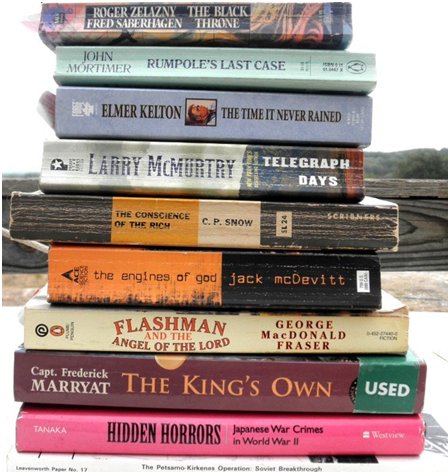
Bookstack – Quick Reviews

Bottom to top

Leavenworth Papers #17 – The Petsamo-Kirkenes Operation: Soviet Breakthrough and Pursuit in the Arctic, October 1944, Major James F Gebhardt,Combat Studies Institute, US Army Command and General Staff College, 1948

Detailed examination of the Soviet success in the offensive attempting to identify what the US military should learn from it. Concluded light infantry to be the weapon of choice in arctic warfare. Examines the lessons learned by the Germans fighting under those conditions.

Good read for those interested in such matters.

Hidden Horrors – Japanese War Crimes in World War II, Yuki Tanaka, Transitions: Asians and Asian Americans Series, 1996

The Contents describes it better than I can:

1. The Sandakan POW Camp and the Geneva Convention

2. The Sandakan Death Marches and the Elimination of POWs

3. Rape and War: The Japanese Experience

4. Judge Webb and Japanese Cannibalism

5. Japanese Biological Warfare Plans and Experiments on POWs

6. Massacre of Civilians at Kavieng

Conclusion: Understanding Japanese Brutality in the Asia-Pacific War

Tanaka elaborates on the collaboration between the US and Japan to cover-up and downplay many of these events because of the post-WWII need for Japan as a strong Pacific partner against Communist aggression. Many were not investigated, prosecuted, even mentioned again in public media.

Fifty years after the Japanese surrender Tanaka writes: “Consequently, we Japanese have failed to recognize ourselves as aggressors, still less as perpetrators of war crimes. Moreover, because of the widespread perception of ourselves as victims of war, the notion of “victim” gradually expanded even to the point that the Japanese state was also seen as a victim of war.”

Reveals various deals made between the US Command under Dugout Doug and the Japanese commanders who conducted human lab experiments on POWs. Immunity from prosecution in return for everything learned in the experiments.

The King’s Own – Captain Frederick Marryat

Marryat’s a worthy read. He was a British Navy Captain when he retired in the 1820s and began publishing fiction works based on his experiences. His writings almost certainly were foundations for Horatio Hornblower and a lot of other sea yarn characters in fiction series during the 20th Century.

Marryat’s the daddy and granddaddy of them all.

Flashman and the Angel of the Lord, George MacDonald Frazer

The Flashman series is possibly the most laughing [and among the most educational] historical fiction series ever written.

I thoroughly resent Frazer dying before he wrote several more of them, though I re-read the ones he did write at least one time every decade. He’s welcome to resent me dying off without reading them again if it works out that way.

The Flashman Papers in Chronological order

Flashman [Britain, India and Afghanistan, 1839-42]

Royal Flash [England, 1842-43, Germany 1847-48]

Flashman’s Lady [England, Borneo, Madagascar 1842-45]

Flashman and the Mountain of Light [Indian Punjab 1845-46]

Flash for Freedom [England, West Africa, USA, 1848-49]

Flash and the Redskins [USA 1849-50 and 1875-76]

Flashman at the Charge [England, Crimea and Central Asia 1854-55]

Flashman in the Great Game [Scotland, England1856-58]

Flashman and the Angel of the Lord [India, South Africa, USA, 1858-59]

Flashman and the Dragon [China, 1860]

The Engines of God, Jack McDevitt

Respectable and readable sci-fi.

The Conscience of the Rich, CP Snow

Strange and unsettling book. Published during the 1950s the title’s an anachronism to such an extent the reader feels a bit lost at the beginning, figuring on some class warfare thing that would have found that name a decade later.

In fact, it’s probably the book Maugham would have written in Of Human Bondage if he’d been writing about a family of Jewish aristocrats in Britain during the 1920s and 1830s. The intractable controls imposed by the Jewish family on personal choices of family members in almost every facet of their lives.

Unsettling, but a worthy read.

Telegraph Days – Larry McMurtry

That original McMurtry book where he decided to become Louis L’Amour wasn’t bad, certainly a lot better than some that came later. I’d put Telegraph Days somewhere up near the top of his work since he became the great American novelist trying to push L’Amour out of the way.

The Time it Never Rained – Elmer Kelton

Good read about that pivotal time in the relationship between independent ranchers in the west and the US government, coincident with the drought of the 1950s.

Rumpole’s Last Case – John Mortimer

Another good Rumpole. What more needs saying?

The Black Throne – Roger Zelazny and Fred Saberhagen

Saberhagen books were always considered safe to buy at a quarter in the thrift stores until this one. I imagine it wasn’t him dropped the ball, but maybe it was just a pot-boiler for both of them. The writing craft is what’s at fault. Everything’s there, crisp dialogue, plot, characters with some depth. Good command of the language.

But something’s missing. I wouldn’t spend a quarter on it next time if I can remember when I see it again in a thrift store.

Other blogs you might enjoy:

Bildunblog
http://bildungblog.blogspot.com/

Retired university librarian. Oblique political humor of a liberal slant, frequently a smiler, sometimes a chuckler or horselaugher.
If you know more about politics than I do you might enjoy it even more. To me they’re just faces sometimes attached to names, but fun and interesting.

Just An Earth-Bound Misfit

http://eb-misfit.blogspot.com/

“Airplanes, cats, guns, war, the more than occasional rant about the party of the Confederacy, the spinelessness of the Democrats and crap about anything else that flits through the somewhat offbeat mind of an armed lesbian pinko as she slides down the Razor Blade of Life.”

I’m not crazy about a lot of the content, but the airplane pics she posts are worth the price of admission and reading the posts offers a different slant on things worth chewing on.

An Old Texan Remembers
http://benntexas.blogspot.com/

Trips, weather, just whatever thoughts move him to post them any given day.

This is dedicated to All you old guys who read here:
Guy Clark – Boats to Build

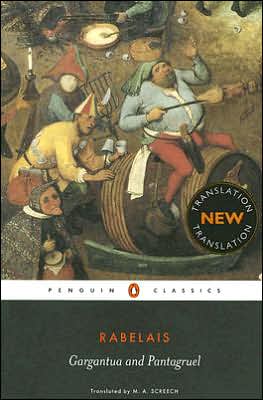
Good Read: Gargantua and Pantagruel – Rabelais

Multi-faceted laugh-a-minute and dead serious

If you’re one of those folks who believe you ‘don’t like’ the works or Renaissance writers you might be the victim of having been forced to read the wrong ones by academians. Fact is the period includes some of the most entertaining writing mankind has ever been guilty of producing. Rabelais is one such example.

Academian praisers of Rabelais and this particular work have already expressed a lot of the truths to be found here, the exquisite style, the masterly satire. All they say is true and would be reason enough to read Gargantua and Pantagruel. I won’t repeat those laurels to affirm them. Instead, I’ll say it’s gutter crude, frequently barnyard humor with more levels than Grand Central Station.

Hilarious work.

But I’ll suggest another reason a segment of readers might find Rabelais interesting. Followers of the Thelemic ‘tradition’ created by Alister Crowley during the early 1900s might be surprised to discover Crowley’s claims to having channeled the doctrine from Horus in Cairo in 1910, were preceded by Rabelais several centuries earlier. Rabelais creates an imaginary monastery and sect of monks he names, “Thelema”, where a sign above the entry reads, “DO AS YOU WILL”. Sound familiar?

Give this book a chance. If you do you won’t regret it unless you offended by violations of polite discourse.

But if you read it as an admirer of Crowley’s channeling be prepared to have some of your balloons deflated, lean back and enjoy butchering of a sacred cow for the barbecue.


Some other blogs you might enjoy:

Old Fool’s Journal
http://www.oldfool.org/

This man has my admiration for a number of reasons, not the least of which is the cleanliness of his kitchen.

Coffee with the Hermit
http://hermitjim.blogspot.com/

If he doesn’t hit your interest button today likely he will tomorrow.

Outta the Cornfield
http://oakcreekforum.blogspot.com/

One of the most considerate people I’ve come across blogging.  Great pics.

Off the Shelf: What I’ve Been Reading


The nearest town, 15 miles away, has started a library, so I paused in my various re-readings off my own bookshelves to check out library books.   I was familiar with some of the authors I began with, but it had been a long time since reading them.

Elmore Leonard–  I ran through a plethora of his books in a short time.. everything the library had.  I’ve never read a book by the man I didn’t like, whether it’s the westerns he began with, or the detective stories that later became his tour de force.  I recommend him to anyone in danger of doing some light reading.  However, I came across one that’s unlike any Elmore Leonard I’ve ever read.  The Touch.  Those of you into metaphysics and healing would probably find it of interest.  It’s the best handling of the stigmata phenomenon, guru-ism, and commercial evangelism that I’ve ever read.

Rudolpho Anaya– This guy came highly recommended by the librarian.  Sorry, folks.  I came away thinking some editor somewhere dropped the ball on the three books I checked out.  Loose sloppy writing, wordy, rambling.  I suspect editors are a lot more forgiving of ethnic writers  and mooshy metaphysical gawdawful rambling flashbacks these days than when I dealt with them as a writer.  150 pages of Rudolpho Anaya would have benefited by a lot of cutting and brutal rewriting, and still ended up with maybe 75 pages worth the time.  Maybe.

Nevada Barr– Never heard of her, but I thought I’d give it a try.  Checked out three books, made it twenty-five pages into one and declared, “No more!”

Elizabeth M. Cosin– I check a couple of these out because the first one was named Zen and the City of Angels.  I’m willing to try what I don’t know, and the name of the yarn brought back pleasant memories of Zen and the Art of Motorcycle Maintenance.  Checked out two.  Score, zero-two.  They’ll go back in hopes someone else can struggle through them.

Poul Anderson– checked out The Stars are Also Fire because I recall liking Anderson’s work several decades ago.  The Boat of a Million Years comes to mind.  It was a fine work.  However, this Stars are Fire piece seems to me to be the work of a person who needed to smoke some weed to get his mind back, or a manuscript written early in his career, a dead turkey no publisher would touch by an unknown writer, dragged up out of the files and published as a pot-boiler hack to raise grocery and whiskey money, riding the name of the later, more competent Poul Anderson.  I’m 67 pages into it, debating with myself whether to drop the effort and read some William Soroyan off my own shelf until I get back to the library tomorrow.

I’d like to point out to you that the sentence-before-the-last in the previous paragraph is five lines long.  Count’em.  Five.

No good writer would put a sentence that long on a page where some poor human might read it.

Old Jules
Reading Increases the Imagination:
http://www.youtube.com/watch?v=NeUid2rv848

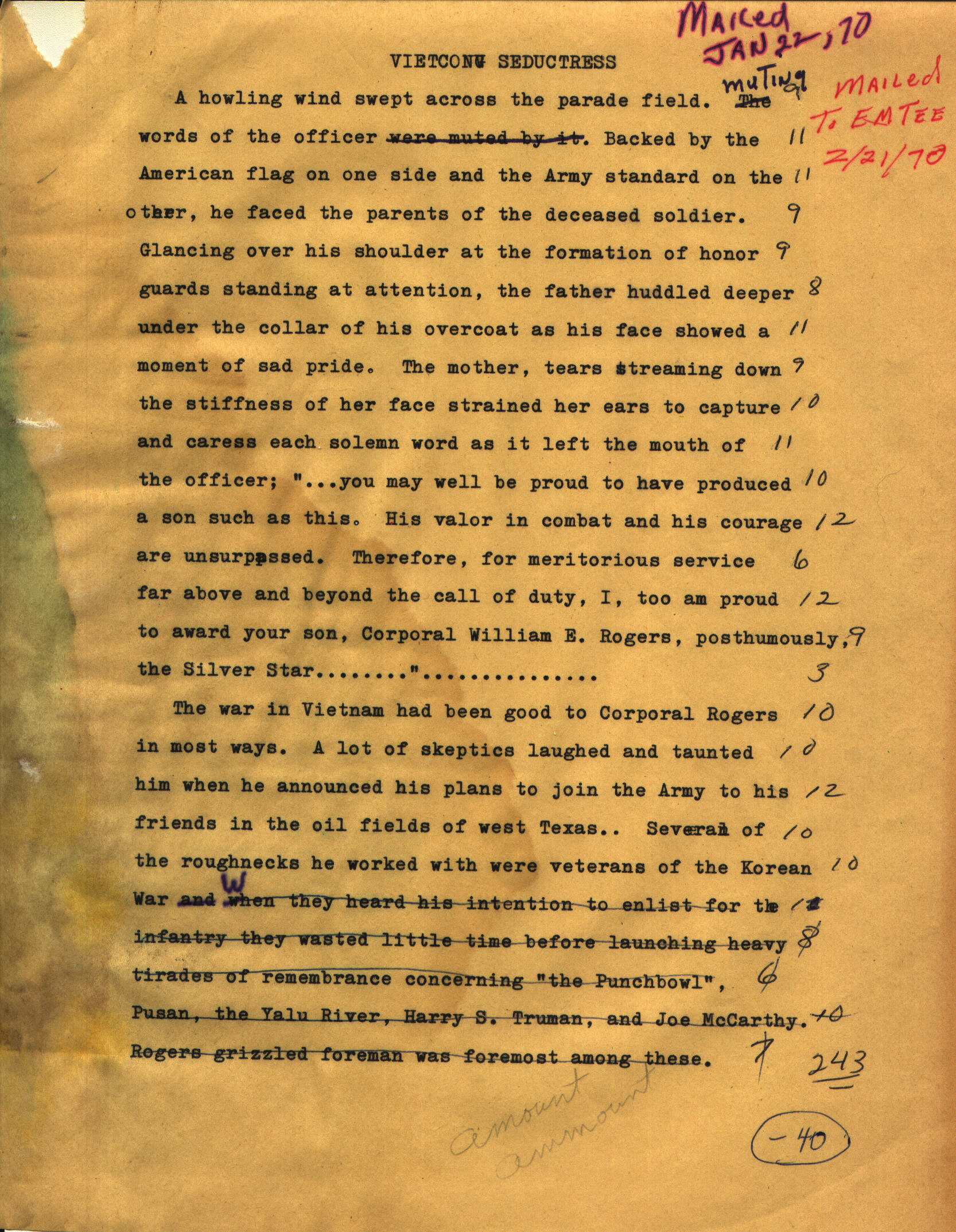
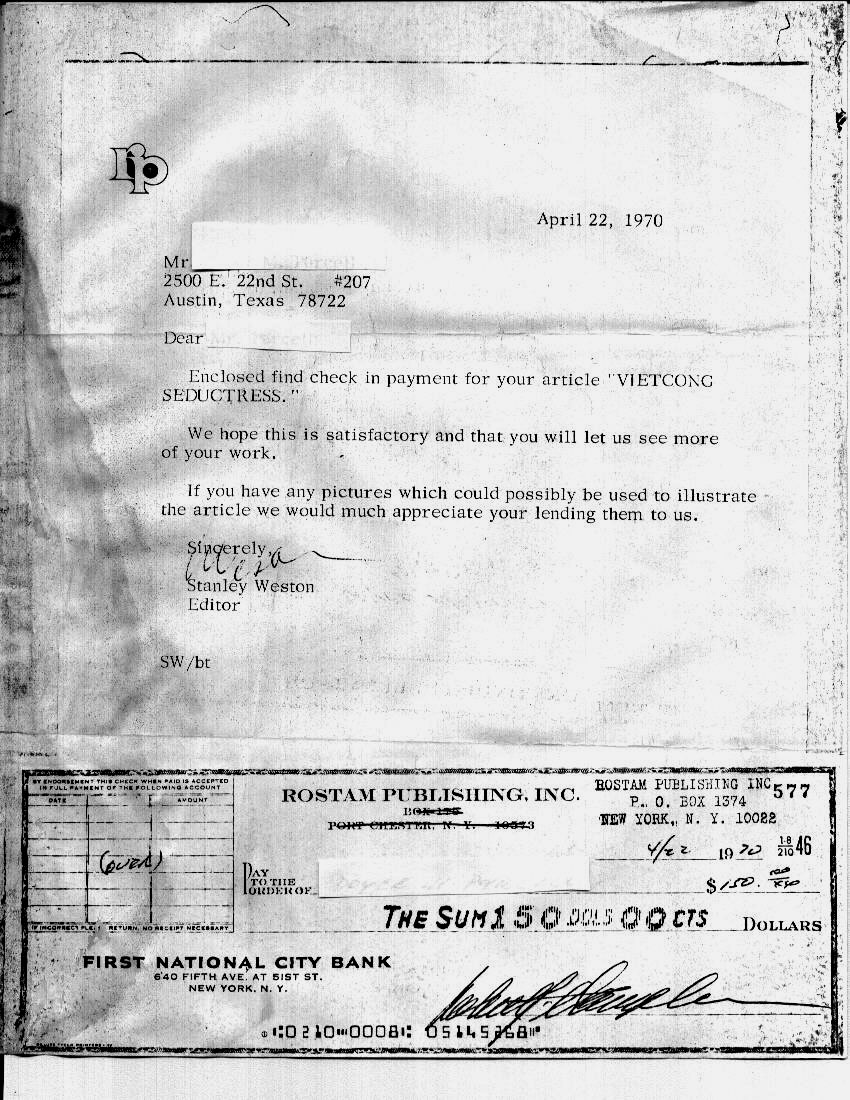
Vietcong Seductress, et al


Hi blogsters:
Sometimes trying to piece together our lives can be quite a chore.  Peaceful Warrior posted something on one of the groups about the way his name has been a problem to him, and it got me thinking about it.
I was given a name at birth that nobody since has been able to pronounce.  They followed that with another one nobody’d ever heard of.  So when I exited that burg at the age of 15 or so, I left those two names behind and became Jack for most purposes.
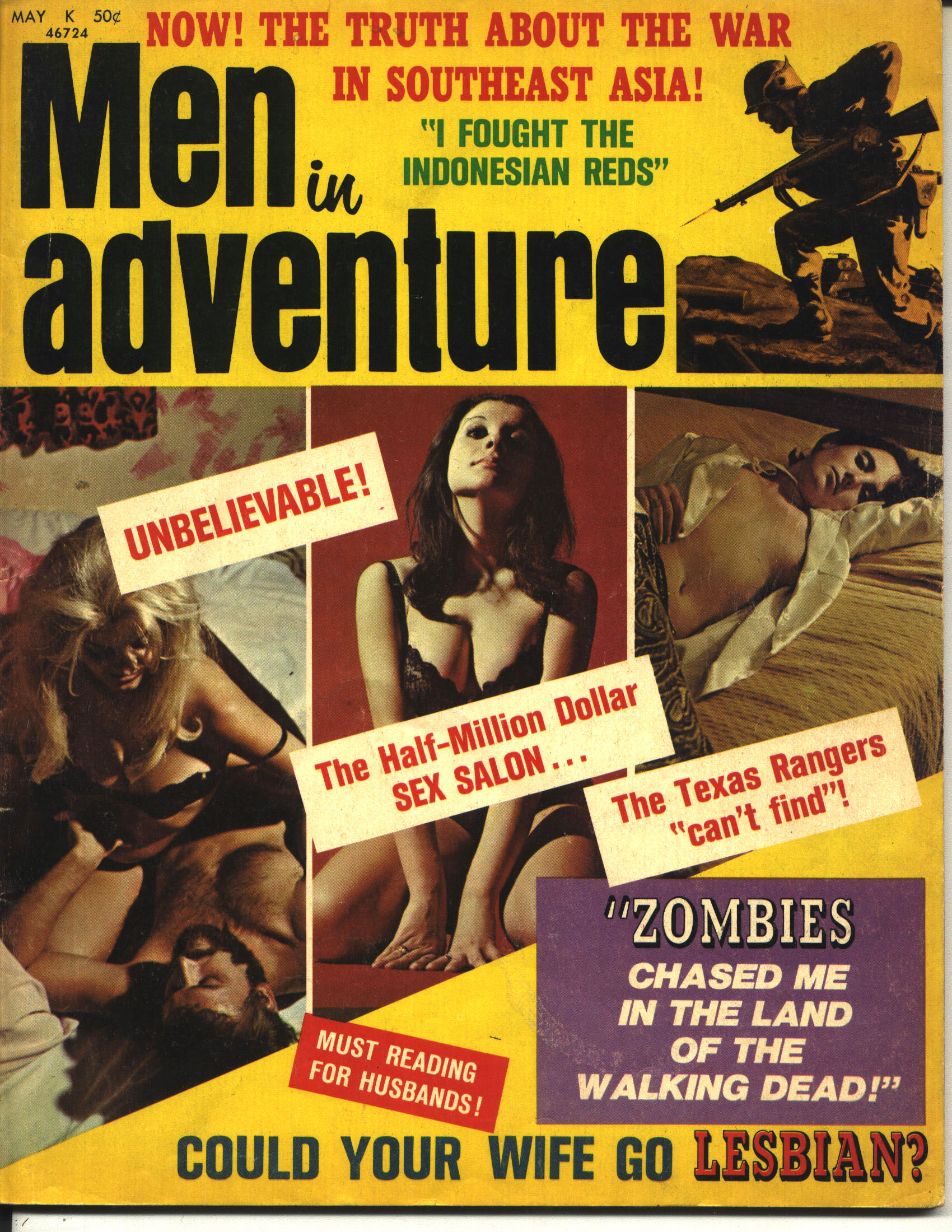
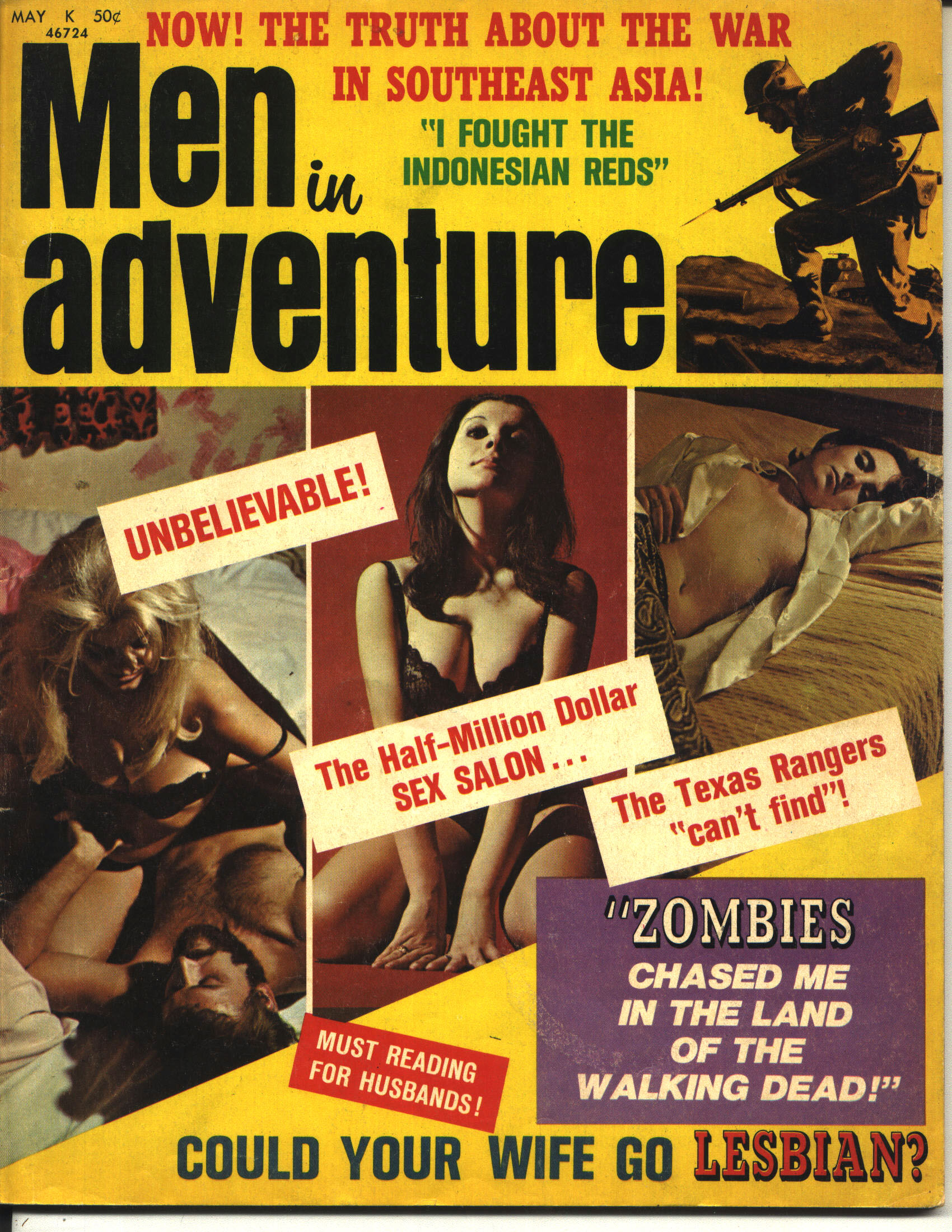
But as a struggling young writer in the late ’60s I found myself needing yet another handle…. I was writing for the hairy-chested men magazines… Men, For Men Only, a genre of magazines that vanished by the mid-1970s.
They usually had a picture on the cover of a Marine with a machete struggling with python wrapped around a half-naked woman in some jungle.  That sort of thing.
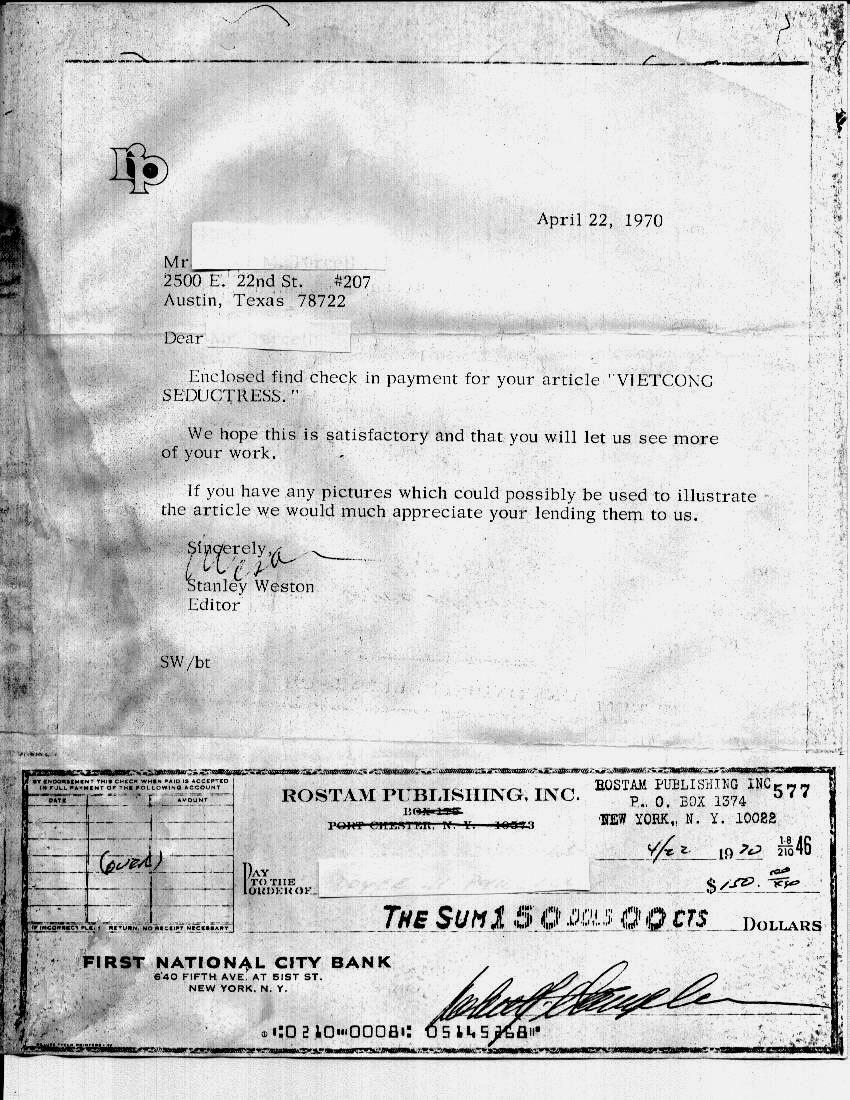
Well, fact was, in those days I thought there was half-a-chance I’d want to be president, or try to get a decent job sometime.  Didn’t want stories like, Viet-Cong Seductress, or The Half-Million Dollar Sex Salon The Texas Rangers Can’t Find following old Jack around the remainder of his life.
Adopted the pseudonym, Frank C. Riley, which worked well enough.
Then the market collapsed for hairy-chested men stories.  Best paying hack-writer market left was something called ‘Confession‘ mags, which must have been read by the mothers of Romance Novel readers of today.  I figured, what the hell.
Popped out  I Was An Outlaw Motorcycle Mama, sent it off, got a nice letter back telling me there was a middling amount of what they read they liked, but that I needed to work on my female perspective a bit.  Eventually they published it, but they never bought another, though I tried.  But unless I’m mistaken, Motorcycle Mama was the only time I ever succeeded in passing myself off as a woman.  Only time I really ever tried, during that confessions market thing.
Amazing the things a man will do for money.

Old Jules

Hack Writing

Editor:
“Give me a 750 word
Masterpiece
Describing
How crushed ice
Machines
Can be used
On construction sites
To slow the cooling

And surface cracking
Of freshly poured
Cement.
Make it lively
Make it dance

I want it yesterday
We’ll argue
Prices
Three months from now
When you see the check.”

“Give me 2000 words
To titillate
Give me that whorehouse
That famous Chicken Ranch
In La Grange, Texas.
I want pockets picked
I want gonorrhea
I want luscious hookers
And hints of corruption
Deep in Texas
Law enforcement

I want it yesterday
We’ll argue
Prices
Three months from now
When you see the check.”

“I want 2000 words
Fiction
Something about
Beautiful Vietcong seductresses
Luring innocent GIs
To bed and death
In some stinking thatched hut
With pigs squealing outside
I want to see her despair
Her soul searching
As she discovers she loves him

I want a hint of non-fiction.

We’ll argue
Prices
Three months from now
When you see the check.”

Workshop:
“I want a poem
About how you feel
When your lover
Jilts you
In favor of someone
Of his own sex
And begins
Taking hormones.

I want the word
Encyclopedia
Used in every
Third line.

No pay
You just have
The pleasure
And satisfaction
Of doing what I
Told you to.
To help you
Get used to the feel
Of being a writer”

From “Poems of the New Old West”, NineLives Press, Copyright 2003

The Beatles– Paperback Writer


A Question for the Brave New World


When I went back to my hometown as a young soldier on leave, Christmas, 1961, it was enough of an event to bring my granddad in from his hardscrabble farm.

We sat around the living room, my mom and step-dad, sisters, and granddad, mulling over the war we were certain to have with the Soviet Union soon.

At that point I was as well-educated (by usual standards) as any of the people in the room and all our ancestors by virtue of having completed high school prior to entering the Army.

In talking about the (then current) brink-of-war crisis my granddad muttered something in Latin.  My mother and step-dad cocked an ear.

“Cicero’s probably not the best place to gain any wisdom about America today,”  My step-dad frowned and adjusted his dentures, followed by another Latin quote.

“Neither is Pliny.”  My mom shook her head at both of them.

Young man who knew everything worth knowing, I was.

I didn’t know any Latin, didn’t know who Pliny was, nor Cicero.  I was as ‘well educated’ as anyone in the room and considered my knowledge sufficient to have a wealth of valuable opinion on the issues of the day.  I felt a vague discomfort with them spouting Latin back and forth at one another and naming people I knew nothing about.

I had reason to recall that conversation in 1976, the US Bicentennial year, when the state of America and the state of education was being examined and bandied about.  Thoughtful minds were concerning themselves that Americans were becoming illiterate and ill-educated.

The thinkers of 1976, asked Americans to ask themselves whether they were better educated than their parents and grandparents, despite many more years spent in formal educational institutions.

The general answer in polls was that Americans considered themselves more canny, better informed than their parents, though weaker in most areas of knowledge once considered essential for a person to be ‘educated’.

The moving finger writes and then moves on.

Are you better educated than your parents and grandparents?

Better educated?
Less well-educated?
Know more about everything but less well-educated?
Less well-educated, less well-informed than parents?
Smarter and with more common-sense without Latin, history, philosophy, and other useless studies?

Sam Cooke- Wonderful World