Category Archives: Education

Learn a New Language with YouTube


Hi blogsters:

I rarely talk to young people, though I’ll confess to craftily observing them when I can, watching their interactions reflected in a plate-glass window, sneakily watching them at another table in a restaurant, trying to hear and understand what they’re saying.

The problem is, mostly I can’t understand what they’re saying.  As the years have progressed I’ve noticed that, even in convenience stores and fast-food joints I often can’t understand the simplest thing that’s being spoken.  I tilt my head, ask them to repeat, explain I’m a bit hard of hearing and ask them to repeat again, and finally usually give up and just smile and nod ‘yes’ if that seems it might be appropriate.

I don’t believe it’s entirely my hearing doing this.  I think there’s something new and different going on with language, but more importantly, inside the heads of people who sound as though words should be spoken through a mouth full of something, and really fast.

Mostly I don’t have a clue.  Frequently my curiosity taunts me.  I don’t know who these people are.  I don’t know what, nor how, they think.  To me it would be easy to merely mutter to myself, these kids are incredibly stupid, illiterate, and so whacked-out on television and public school brainwashing it’s a wonder they can function at all.

But I’m trying to insist to myself that the human race hasn’t truly devolved all that much in only a couple of generations.  These aren’t subhumans, though it would be easy to conclude they are, based on a lot of their mannerisms and behaviors in public.  I think these creatures probably think and feel, but that they don’t express those thoughts and feelings in ways that allow me to fathom them.

Enter, the blessing of YouTube.  When they aren’t too long, it rarely takes more than half-hour download on my dial-up.  But it’s a chance to actually decipher something one of those people thinks, feels and expresses, in a way that bypasses the mouth full of marbles and the speed with which the words come to the fore.  Once it’s downloaded it can be repeated until near-understanding arrives.

Old Jules

Steve Goodman– Talk Backwards [Edit: hope one of these links will work better]

http://www.youtube.com/watch?v=AMSMAjg2zCU

http://youtu.be/AMSMAjg2zCU

(Cee Lo Green) “Fuck You” sign language performance
http://youtu.be/sv3tadz5Q3o

Note: Thanks to Monique Maes for her photo.
http://moniquemaes.tumblr.com/
http://www.reverbnation.com/teapartyseance


Amazing Synopsis

Have you ever considered how much time, energy, money and lousy grades could be avoided if world history could be summarized for the kiddos into videos lasting a few minutes?  For instance, consider the European conquests of Africa, the American continents, and India.  The chillerns spend all kinds of time having to memorize the nigglingest details and names the teachers can’t even pronounce.  Pizzzzarrro.  Montezooooma.  Courtessss.   Geroneeemo.  Krazyhorse.  Not to mention the even worse ones in Africa and India.

But the hilarious fact is that all that isn’t needed.  All those books didn’t need to be printed.  All those names and dates didn’t need to be memorized to understand the basics of the European conquests of more-primitive geography.

Here it is.  The incredible 4 minute 56 second summary of the European conquest of Africa, the Americas and India:

http://youtu.be/1csr0dxalpI

If the video doesn’t play the link below should work:

http://www.youtube.com/watch?v=1csr0dxalpI

Those kids can now go back to playing on the computers with a total understanding of the history of their ancestors.

I’m going to search around to try finding some more good summaries of other hard-to-remember history.

Old Jules


How Do You Say the Pledge Nowadays?

It’s come to my attention that school is starting already. I recall being in a school auditorium as a youngster when they added the words,
‘under God’ to the Pledge of Allegiance. Mr. Doak and Mr. Burke, Civics and
History teachers, were up there trying to get it right while teaching it to a couple of hundred kids.  Kids who were still on shaky ground from learning it the first time. That would have been in the mid-1950s:

Mr. Doak:  “Okay.  This isn’t complicated and shouldn’t take long.  Just say it like you always said it, but after, ‘one nation’, pause, then say, ‘under God’, then pause again before going on.

“Try it.  I pledge allegiance to the flag of the United States of America and to the Republic for which it stands, one nation,

under God,

with liberty and justice for all.”

Cacophony of 300 kids lost mid-way through.  Mr. Doak pauses with a frown waiting for the noise to die down. Mr. Burke’s frowning too.  He nudges Mr. Doak.

Mr. Burke:  “Eh, John, hold on a minute.  I think it’s supposed to be ‘one
nation under God’, not ‘one nation with a pause, under God with a pause.”

Mr.Doak:  “Ralph, look at it.  The comma’s in front of and after ‘under God.'”

Mr.  Burke: “John, that doesn’t mean it’s supposed to sound like some run-on sentence.  This is the Pledge of allegiance!”

Mr. Doak:  “Ralph, I know what it is.”  Doak scowls and turns back to the 300 lost faces.  “Let’s try it again now.”

Burke:  “No, no, no, John.  Let’s try it one time my way.”

Doak grinding his teeth:  “Ralph, we have to get this over with.”

Burke:  “I’m not the one holding it up John.  We’ve got to get this right.  What you’re telling them is wrong.”

Doak:  “Who’s in charge of this, Ralph?  When Livingston said one of us has to do it you didn’t volunteer to get up here and explain it.”

Burke:  “Neither did you.”

Doak:  “No, but I eventually agreed to.  You just agreed to come up and help.”

Burke:  “Never mind.  Tell them to do it any way you want to.  The Pledge is yours!  I have nothing more to say.”

Doak:  “Good.”  Turns back to the 300.  “Okay, let’s try it again.”

The question of whether the framers of the Constitution would have thought a child having to say, ‘under God’ is a fairly weird one, by hindsight.  But not because the placement of the commas is a major issue.

The reason it’s weird lies in the fact that the question of whether this nation
is indivisible was never considered by the Supreme Court, never mentioned in the US Constitution.  The founders put off any debate about the indivisibility issue because every member knew that no state would agree to become a member if the decision was irreversible, whatever the circumstances.  So, while it was discussed, it was also pointedly not discussed in loving detail.

Half century later it was discussed, however.  The discussion began at Fort
Sumter and ended with Lee’s surrender at Appomattox Courthouse. That avoidance by the founding fathers of an inevitably crucial issue was decided by force of arms, one half, (the half possessing an army) of the nation believing it was indivisible, the other half believing it was divisible. The stronger half forced the weaker half to accept indivisibility at gunpoint after a lot of bloodshed.

Thus, the Pledge of Allegiance came into existence after Lee’s surrender at
Appomattox. The winning side forced each surrendering Confederate soldier to say a pledge accepting indivisibility as one of the precepts of citizenship, followed afterward by many generations saying the pledge from early childhood since then.

But the US Supreme Court was never asked whether that Pledge acknowledging indivisibility was Constitutional, which might have saved a hundred thousand lives, legs, arms, and a whole different approach to US governance.

Instead, they’ve been asked repeatedly to decide the easier matter of whether it’s a violation of a child’s civil liberty to utter the words, “Under God”.

Old Jules

Civil War Songs – Oh I’m A Good Old Rebel
http://youtu.be/mO2cL64Fbaw

Battle Cry of Freedom — Civil War song on mountain dulcimer
http://youtu.be/K_jANE2QPFE

Fife and drum – Battle Cry of Freedom – 145th Gettysburg
http://youtu.be/eAsD4Bg0st0

Note:  The flag with a Native American waving a weapon flies summertimes near the booths along IH10 as it passes through the Laguna tribal lands.  Although the Laguna universally despise the Acoma neighbors neither tribe has engaged in warfare against anyone since 1597. 

Civility and Civilization

Hi blogsters:

Taking a breather here and got to thinking about something that happened a few years ago that might be worth relating.

During the post-Y2K financial challenges I substitute taught in the public schools for a while.

Those situations often leave the sub in front of a bunch of kids without any obvious means of spending the time. The regular teach, say, didn’t know he was going to get into a car wreck or have a terrible hangover, so there was sometimes no agenda.

One week I found myself in front of several days of classes of high school seniors. Rather than let them use it for a study hall, I decided to get them talking about what they believe in. Try to get them into a mode of defining it and possibly thinking in ways they hadn’t done so before.

One of the days was spent talking about civilization. What it is. What are the characteristics of a civilization, as opposed to merely a complex society or culture with traditional, defined behavioral norms?

From the beginning, every classroom full of kids believed a society couldn’t call itself a civilization if it condoned slavery within it. They continued believing that (after some discussion) even after I pointed out the fact the US allowed slavery until a century and a half ago. Almost every group of humans we dub ‘civilized’ in history had slaves.

Watching those kids absorb, then adopt the realization that by their own definitions the US couldn’t possibly have been a civilization until the end of the Civil War was fascinating. But they were universally adamant about it, even after thinking about it. When I pointed out further that slavery existed almost all over the world in one form or another until fairly recently in history….REALLY recently they gradually decided most of their recent ancestors weren’t civilized..

Once they’d decided there couldn’t be civilization without civility defined as a respect for some degree of freedom of the individual, they hung tight on it. Those kids decided human beings weren’t civilized anywhere until ‘way after a lot of civilizations (by other definitions) had risen and fallen.

Those were smarter kids than I figured on them being. And perfectly willing to stick by their guns on something they believed in.

Over the course of a few days these kids decided they absolutely believed, following a lot of debate, that due process is the foundation of civilization. They believed wars without due process were criminal, that they were the antithesis of civilization because they failed to respect human life enough to follow their own prescriptions and procedures. They believed killing, mayhem are serious matters worthy of reflection, debate, and a profound respect for doing things thoughtfully and exactly according to law. They believed failure to do so is a symptom of a society withdrawing from the condition we call ‘civilization’.

Toward the end some of them must have ratted me out to their parents. I didn’t get many sub-teaching jobs after that.

Old Jules

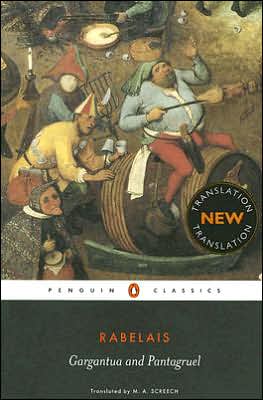
Good Read: Gargantua and Pantagruel – Rabelais

Multi-faceted laugh-a-minute and dead serious

If you’re one of those folks who believe you ‘don’t like’ the works or Renaissance writers you might be the victim of having been forced to read the wrong ones by academians. Fact is the period includes some of the most entertaining writing mankind has ever been guilty of producing. Rabelais is one such example.

Academian praisers of Rabelais and this particular work have already expressed a lot of the truths to be found here, the exquisite style, the masterly satire. All they say is true and would be reason enough to read Gargantua and Pantagruel. I won’t repeat those laurels to affirm them. Instead, I’ll say it’s gutter crude, frequently barnyard humor with more levels than Grand Central Station.

Hilarious work.

But I’ll suggest another reason a segment of readers might find Rabelais interesting. Followers of the Thelemic ‘tradition’ created by Alister Crowley during the early 1900s might be surprised to discover Crowley’s claims to having channeled the doctrine from Horus in Cairo in 1910, were preceded by Rabelais several centuries earlier. Rabelais creates an imaginary monastery and sect of monks he names, “Thelema”, where a sign above the entry reads, “DO AS YOU WILL”. Sound familiar?

Give this book a chance. If you do you won’t regret it unless you offended by violations of polite discourse.

But if you read it as an admirer of Crowley’s channeling be prepared to have some of your balloons deflated, lean back and enjoy butchering of a sacred cow for the barbecue.


Some other blogs you might enjoy:

Old Fool’s Journal
http://www.oldfool.org/

This man has my admiration for a number of reasons, not the least of which is the cleanliness of his kitchen.

Coffee with the Hermit
http://hermitjim.blogspot.com/

If he doesn’t hit your interest button today likely he will tomorrow.

Outta the Cornfield
http://oakcreekforum.blogspot.com/

One of the most considerate people I’ve come across blogging.  Great pics.

Learning to Live with Being Stupid

The discovery, beginning about 15 years ago, that I’m not anywhere near as smart as I think I am, and that I’m a world away from knowing as much as I think I know, has been unsettling and somewhat disruptive.  That realization, along with the concurrent observation that an overwhelming piece of what I do know is wrong, hasn’t been as easy to incorporate into something useful in my life as you might think.

Before my smarts and knowings all started to unravel I was a fairly impressive person.  I could explain, without you even asking me to do it, just about anything you might be wondering about.  I knew what you ought to do with your life, how your life became the lousy, empty mess it appears to me to be, and what the government ought to do about anything it had the power to do.  I knew what men ought to do about women and other men, and I knew what women ought to do about men and other women.

I began to get screwed out of that when  out of the corner of my eye I noticed some aspects of my own life that I wouldn’t recommend to anyone.  It crept into my consciousness that I’d made a lot of choices and given a plethora of advice to others that simply didn’t have a lot of merit.

This didn’t come all at once.  It started as a trickle with a lot of seemingly small matters I couldn’t help noticing, which I tried to compartmentalize and ignore, same as everyone else does.  But eventually I couldn’t keep them inside the fences I’d built for them.  They were forever sneaking over mingling with others I’d locked up in file drawers I’d clearly marked, “TOP SECRET – DO NOT OPEN”.

This forced me to try to herd them back where they belonged, but in doing so the others tagged along, dancing and clowning and shamelessly demanding I recognize they existed, wanting me to scratch them behind the ears and pay some attention to them.

I figured the easiest approach would be to have a look at their blood lines and shoot the mongrels and mutts, but keep the purebreds.  This required an examination of how I came by all that knowing of every description.

It rocked me to my boot heels to find almost every one of those certainties  came from something someone else said, and I believed it, hugged it tight, and called it my own.  That wouldn’t have been so bad if I hadn’t then asked myself where the people I’d heard it from came to own it.   Imagine my surprise when it dawned on me they’d also heard it from someone else, who heard it from someone else.

Gradually, I realized I hadn’t done much thinking for myself.  In fact, I hadn’t based much of anything on the evidence of my own eyes and observations.  Strangers with the voice of authority told me many things other strangers had told them and I frequently accepted it as gospel.  I often abdicated my intelligence in favor of those strangers many times removed.   Without consciously deciding to do so, I treated truth as though it relied on a vote-count of humans to decide its own nature.

I hate it, discovering something like that.  The last 15 years of dismantling a system of giving strangers default authority to control my mind and my life hasn’t even been entirely successful.  I still constantly find the opinions of strangers creeping in, waving their arms around, trying to grab control so I won’t be stupid anymore.

But I’m determined to keep at it.  All those strangers saying things back and forth to one another and believing it over time hasn’t done much good for the people who believe it now.

And it never did me a damned bit of good, even though I was smarter when I believed it, too.
Old Jules

Glen Campbell – Gentle on My Mind
http://www.youtube.com/watch?v=cFIRTtn_ZSE

A Question for the Brave New World


When I went back to my hometown as a young soldier on leave, Christmas, 1961, it was enough of an event to bring my granddad in from his hardscrabble farm.

We sat around the living room, my mom and step-dad, sisters, and granddad, mulling over the war we were certain to have with the Soviet Union soon.

At that point I was as well-educated (by usual standards) as any of the people in the room and all our ancestors by virtue of having completed high school prior to entering the Army.

In talking about the (then current) brink-of-war crisis my granddad muttered something in Latin.  My mother and step-dad cocked an ear.

“Cicero’s probably not the best place to gain any wisdom about America today,”  My step-dad frowned and adjusted his dentures, followed by another Latin quote.

“Neither is Pliny.”  My mom shook her head at both of them.

Young man who knew everything worth knowing, I was.

I didn’t know any Latin, didn’t know who Pliny was, nor Cicero.  I was as ‘well educated’ as anyone in the room and considered my knowledge sufficient to have a wealth of valuable opinion on the issues of the day.  I felt a vague discomfort with them spouting Latin back and forth at one another and naming people I knew nothing about.

I had reason to recall that conversation in 1976, the US Bicentennial year, when the state of America and the state of education was being examined and bandied about.  Thoughtful minds were concerning themselves that Americans were becoming illiterate and ill-educated.

The thinkers of 1976, asked Americans to ask themselves whether they were better educated than their parents and grandparents, despite many more years spent in formal educational institutions.

The general answer in polls was that Americans considered themselves more canny, better informed than their parents, though weaker in most areas of knowledge once considered essential for a person to be ‘educated’.

The moving finger writes and then moves on.

Are you better educated than your parents and grandparents?

Better educated?
Less well-educated?
Know more about everything but less well-educated?
Less well-educated, less well-informed than parents?
Smarter and with more common-sense without Latin, history, philosophy, and other useless studies?

Sam Cooke- Wonderful World