Category Archives: Wildlife

Pack Goats for the Elderly and a Youngish Hermit

I didn’t know I was joking when I composed this post a couple of days ago.  But even though Jeanne’s visited me here and knows me better than anyone else, when she read it she thought it was so outrageous I must be joking.  After I explained I was serious and consider it a viable alternative she thought about it a day and just told me again she likes the blog entry as a joke.  But she’s really uncomfortable about the concept as a serious possibility I might try living this way.

So I suppose I must be joking unless I decide it’s the right way to go.  But I’m concerned about the bearings on bicycle wheels.  I’m thinking maybe light motorcycle wheels might hold up better:

The financial constraints involved in trying to get the old F350 capable of pulling a travel trailer and the unknowns involved in why it was left on this place when Gale and Kay bought the property are seeming a bit overwhelming at the moment.  That, combined with the uncertainties of whether I can find an old travel trailer I can fix adequately got me thinking about this.

A couple of years ago when I thought my life might proceed differently than it has, there was a middling possibility I might have an extended trip into the high mountains left in me.  My thought at the time was to spend a month or two in the Gila Wilderness in the immediate vicinity of the Continental Divide.

But at that altitude and the years creeping up on me, combined with the length of the stay that would be required, caused me to think I didn’t want to do it carrying a backpack the way I’ve always done in the past.  My initial thought was a burro, but the fact is hauling a burro’s a bit of a problem.

A few times in the mountains, decades ago, I encountered packers with llamas and talked with them about it, but those animals are as difficult in the size department as donkeys.

However, I ran into someone once in the Gila with a string of goats doing the packing.  Goats, to my way of thinking, have a lot of advantages over the larger animals insofar as transport.  Considering it led me to join some Yahoo Goat Packing groups:

packgoat · All Things Packgoat
 
I began doing some shopping around looking for a couple of young goats I might train, but intervening events led me to see that another long trip into the mountains isn’t in the cards for me in the immediate future.  And further consideration about that particular use for them in that area also mightn’t be the best.  They’d be a magnet for large predators, risky to leave unattended, and they’d need a lot of attention.
 
But thinking about pack goats during the years since has caused me to think there might be a role for them to play in a more urban setting.  Namely, for older folks who could hike to the store for groceries, but have difficulties carrying them home without a vehicle.  Maybe a goat cart, for that matter.
Feeding them would be no problem because goats will eat just about anything and thrive on it.
 
But a pack goat would provide a lot more mobility than a shopping cart for people living on the streets and under bridges, as well.  A goat can go almost anywhere a person can, climb into places where a person would have a lof of problems climbing into.   The ability to easily move residency out of the clusters of street people living under bridges would keep the owner out of police sweeps, out of reach predatory humans preying on the people living under those conditions.
 
In fact, I’ve been acquainted over the years with several people living in small house-wagons traveling around pulled by burro-power as a lifestyle and talked with them about it at some length.  It strikes me a person with a willingness to walk alongside the contraption instead of riding in it might actually be able to construct a small, light house on an aluminum frame with bicycle wheels sturdy enough to carry everything it took to live, move without buying gasoline, big enough for four cats.
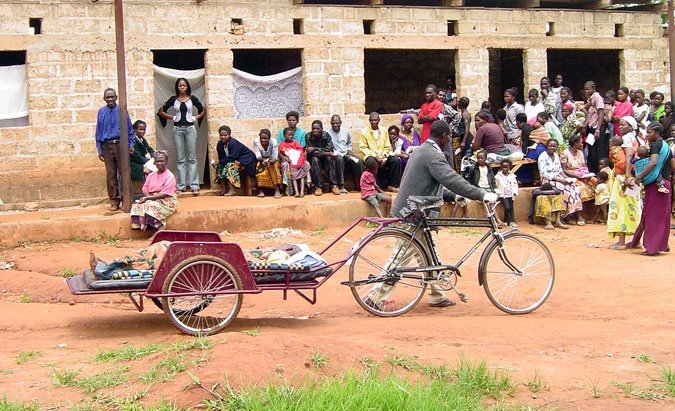
Maybe something along these lines only larger
 Something large enough to haul some luxuries such as a camp stove, some groceries, a place out of the weather, but small enough to get out-of-sight come nightfall.
 Nothing as big, or elaborate at this, but something a lot lighter a couple, or four goats, maximum, could pull.
 Maybe about that size, but constructed with bicycle wheels, ball bearing axles, built on an aluminum frame from salvage aluminum rails and door frames.  Actually aluminum mightn’t be durable enough as the frame.  Maybe steel bed frame angle iron frame as a base for everything above aluminum.
 
Equipped with photovoltaic charged LED lawn lights to allow night reading, cooking, etc, a chuck box and a small gas fridge.  Maybe a guy would have to move up to a pair of donkeys to pull it.  But maybe not.
 
I’m thinking maybe two bicycles welded outside a steel bed frame with a tie-rod between the handle-bars behind a yoke might serve, and a swiveling tail-wheel [bicycle wheel] to stabilize the weight and balance on the overhang behind the two rear bicycle wheels might be a good starting place visualizing the possibility.
 
I’m going to have to puzzle about this more as a potential way to keep living without going under a bridge if circumstances demand I have an escape route.
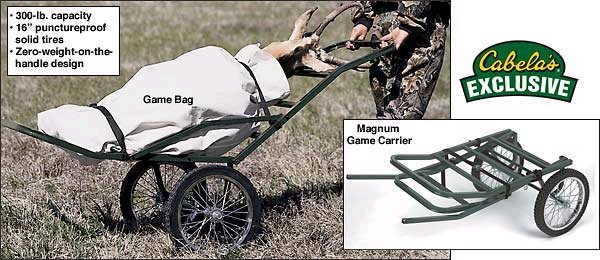
But here are a few other concept pics from the Practical Action website, Cabelas, and elsewhere, just to remind myself of the directions my mind’s going on all this:
 
 
Old Jules
Frankie Laine, Mule Train

Shadowcats and Sugar Pills

I glanced out the window and saw this:

Niaid was curled up on the bed, [I double-checked] so whatever else that critter was, it was an outsider.  The chickens were ranging free and I couldn’t hear any alarm from them, but this guy just looked too big to have roaming around without interruption.

As I came around the cabin where I could see him better:

It was obvious the feline was operating out of a different reality.  Which didn’t necessarily mean he didn’t need to be the focus of protective measures.  But how does a person protect his chickens from a shadow-cat?  I’ve done some websearching on the various news sites and checked out the methods incorporated by the US Government into programs to avoid having shadow-cats disrupting citizen-like critters such as these:

The consensus seems to be you have to get one of these:

No matter what the cost.

I’m not certain I want to have one of those running around here loose, even when I have dangerous shadowcats skulking around peeking at my holdings.

Once something of that sort gets a foothold there’s no predicting where it will end:

Sugar pills in toy jars
Candy counter cures
For the sensory deprived
For the spirit that yearns hardship
Facade struggle for the
Stagely frightened
Sedentary soul

Living a reality
Where gangster boss of fantasy
Celluloid deeds and words
Are worth repeating;
Gladiator wars in plastic armor
Oaken clubs and pigskin missiles
Pudding danger jello struggles
Hard and real inside the mind
Inside the molded plastic
Toy of the mind

Man who cleans the windshield
At the signal is an actor
In the show last night
On MTV or HBO
Sexy girls dancing
In the background
As he postures
Rag and bucket
On the glass

Toy hero pushes button
In the Kevlar coated dragon
Of the field
Sees the enemy extinguished
In a prophylactic
Box of evening news
Before and after
Old war movies
All the same

Any loss is accidental
Cost of war’s
In higher taxes
Salaries for heroes
Fuel bullets
Not in blood
Not in blood
Sterile sealed
In plastic baggies
Plastic baggies
Hold the artificial
Flavor
Of the life
When life was real

Yet the sickness
Needs a remedy and cure

Sugar pills in toy bottles;
New candy counter pudding
For the soul.

Old Jules
Copyright NineLives Press, 2004

October Quietude, Dead Bugs and Old Roosters

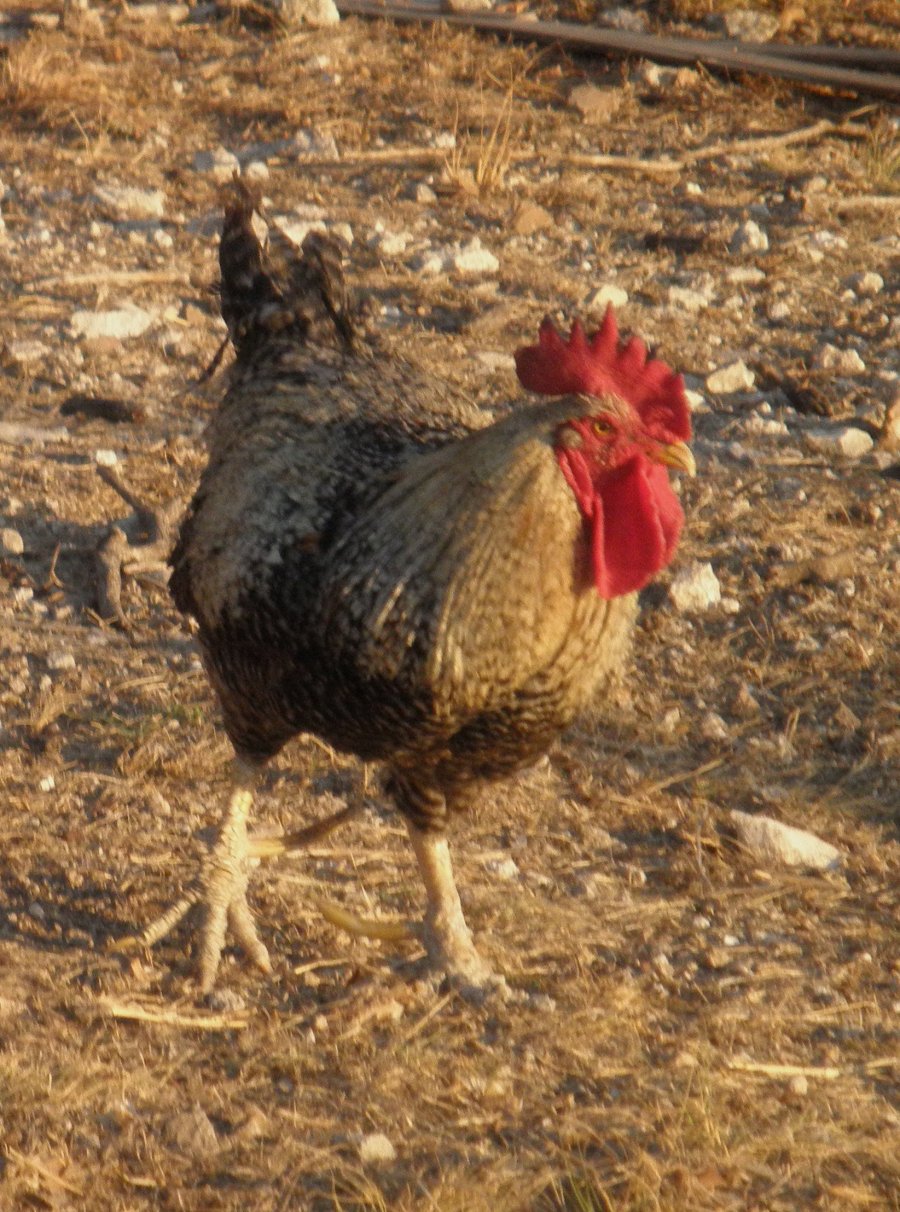
The rains during the past couple of weeks combined with the break in the heat wave hasn’t bumped the Great Speckled Bird back into what must have been a spry, active youth as I’d hoped it might.  [The Great Speckled Bird: Respecting our Betters] [The Liar: The Great Speckled Bird, Part 2

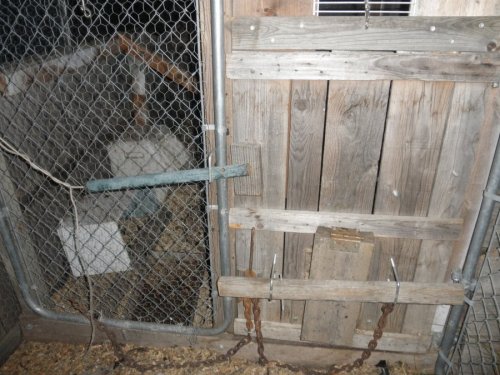
From the inside of Night Fortress 2 there’s a step up through the exit hole and he’s having a lot of difficulty with it because of his crippled leg and wing.

Those chains, incidently, are part of an ongoing war with generations of Brother Coon trying to dig into the fortress at night.  The links where they meet the ground have treble-hooks wired to them to discourage digging there, but it’s a labor intensive game.  They’re the first line of defense.  Under the wood chips they’re on the holes are stuffed with prickly pear cactus, then covered with wood chips.  Brother Coon eventually gets past them all and insists on my going to the next level of debate:  The Lost Coon Diggings

Even the largest hen doesn’t have a problem with it.  But after the hens are all out harvesting the night carcasses under the bug-light he’ll still be in there crowing, evidently dreading the prospect of fighting his way through that opening.

I load the chicken drinking water up with home-made colloidal silver, catch him and soak his legs in orange-peel tincture, and it all seems to help, but gradually GSB’s hard living before I got him’s coming home to roost.

Usually GSB doesn’t indulge in cliche, but maybe his mind’s going, too.  Lately I’ve heard him say more than once, “If I’d known I was going to live this long I’d have taken better care of myself.”

If he keeps doing that I might be tempted to chop off his head.

C. W. McCall “Wolf Creek Pass”

http://youtu.be/xC_onLPc-0E

Wilderness Threats


A man I went to grammar school, junior high and some high school with, then several decades later became reacquainted and huff-puffed a lot of up and down mountain canyons recently began visiting this blog.  If no other reader enjoys the tale, at least he will, because he was there:

The following is copyrighted material from a book I wrote once.  I give myself permission to use it here. [ Crazy Lost Gold Mine-ism]

I’ve never concerned myself much with the dangers of wild animals during my extensive time in the woods.  Mostly they’ll mind their own business if a person takes reasonable precautions and doesn’t go out of his way to provoke them.  In New Mexico backlands of the late 20th century the real threats usually come in the form of humans.  When those happen they usually come as suddenly and unexpectedly as finding one’s self in the middle of a herd of elk.

Grasshopper Canyon and Stinking Springs are on the northern end of the Zunis below Oso Ridge on the west face of the mesa.  Two canyons run north and south, parallel to the face, half a mile apart, separated from one another by steep, narrow walls several hundred feet high.  These two walls consist of coral reef from some ancient time when Oso Ridge was an island.  The canyons aren’t easily accessible, so I prospected there a while.

The land below Oso Ridge around Grasshopper Canyon is checker-boarded in ownership.  Grasshopper is all National Forest, but immediately south is a section of Navajo tribal land.  Adjacent to the Navajo section is a section belonging to the Zuni tribe.  Fences between these sections allow a person to always know whether he’s on public land or tribal land.

I was working Grasshopper Canyon with my friend Keith, a stockbroker from Santa Fe. We separated and worked the arroyos southward parallel to one another, gradually moving toward the fence delineating the Navajo section.  Occasionally we’d call out through the woods to make certain we weren’t out-distancing one another.  The last thing either of us expected was an encounter with another human in those woods.

I was bent over taking samples from the bed of a shallow arroyo, just deep enough so when I straightened I could view the small meadow around me.  I stood getting my breath and stretching the kinks out of my back when I saw a man dressed in cammies backing out of the woods at the edge of the meadow.  He was being stealthy, carrying a .22 rifle in a ready position.  He had twenty to thirty colorful birds hanging on a string around his neck the way a fisherman carries a stringer of fish.  As I watched, almost invisible to him with only the top of my head showing above the arroyo, his eyes searched the woods to his right where Keith was working.  Keith had called out from there a few moments previously.

Still watching Keith’s direction the man backed toward me until he was only a few feet away from me.  “Nice string of birds.”  I scrambled up the bank while he spun and pointed the .22 in my general direction.

My partner’s in the woods back behind you.  You don’t want to be firing in that direction.”  We studied one another.  He eyed the shoulder rig I was wearing and the butt of the 9 mm automatic showing from the bottom.  “’You out here killing songbirds?”

Mister Songbird was a young man and from appearances, a Zuni.  He stared a moment longer before answering.  My impression was that he was considering whether I was a game warden or other law enforcement official.  “I’m getting them for Zuni New Year.  They let us do that.”

We talked for a few minutes, me accepting what he said at face value, and the tension gradually dissolved.  He agreed to get the hell out of the canyon because we were working there and wouldn’t want any shooting.  Besides, we’d probably messed up his hunt with our yelling and bustling around the woods.  I watched him back into the meadow to the south and allowed myself to sigh with relief.

Back in Santa Fe I called the US Fish and Game Department.  I thought there was a remote chance the feds were really allowing Zunis to kill protected species birds on National Forest land.  If so, I was prepared to be indignant.

When I told my story the fed was silent a moment.  “You are a lucky man,” he observed.  “You confronted an armed man committing multiple Federal felonies and he didn’t shoot you.”

*     The following didn’t make it into the final draft of the manuscript: The fed also observed the Zuni lad would have spent a lot more years in prison for killing those songbirds than he would have for killing me.  I drew a good bit of comfort from knowing that.

Eventually logic won out over the other appeals of the Zuni Mountains as a location for the lost gold mine I was searching for.  Although the Zunis were handy for me, being only a few hours drive from Santa Fe, they were too far from Tucson.

Also, too many prominent landmarks in the area would have immediately brought the original survivors back.  The route I imagined them following would have taken them within sight of Los Gigantes and enough other one-of-a-kind eccentricities to make the location unmistakable.

Even the Big Notch and Little Notch in the Continental Divide can be seen from miles to the west.  There’s nothing else similar to it in North America.

Marty Robbins – Little Green Valley

http://youtu.be/WT5qegD28Wo

Crazy Lost Gold Mine-ism

This post requires some background to get to what it’s about.  The first part is background.  The actual subject of the post doesn’t start until ‘way on down toward the bottom.

Back before Y2K happened I spent a lot of years and energy researching and searching the mountains of SW New Mexico for a particular lost gold mine.

Doing a thing of that sort, the smart individual would keep his mouth shut about it.  But I don’t qualify in that regard.  I spent several years poring over records and winter nights poring over maps with a magnifying glass, almost always certain of knowing where it was, chawing at the bit to get out into the barrancas to file a claim on it.  But also putting my research into a form others searching for it might find helpful.  Insane.

Eventually I found a location where evidence on the ground fit the legend locations well enough to keep me working the west face of that mountain, climbing and unclimbing it with friends and associates, building up a lot of muscle, finding a lot of interesting rocks, and getting surprising assays, but no joy to speak of on gold.

“A burned out cabin ruin with an aspen tree growing out of the inside, bear claw marks 12 feet up, 3 hand forged nails, a longtom sluicebox axed out of a 3 foot diameter log, a spring 75 feet above the sluice, an arrastra below.  A mysterious map chiseled on the face of a 300 pound rock surface depicting the exact layout of the canyon, the cabin, the waterfall, all so accurately depicted the person had to have scrutinized the layout from the mountaintop, then scratched it on this stone 600 vertical feet below and half a mile away.  The rock was carefully placed on the canyon wall above eye-level so it was easily seen, but only by someone looking up.”

By 1998 I’d spent a lot more treasure, worn out vehicles, worn out relationships with lady friends and put a lot of friends to sleep going on about it and spending all my waking hours thinking, searching, or talking about it.  I decided it had taken up enough of my life and it was time to move on to other things after one final effort.

I took several weeks of vacation from work and spent it determined to get that gold mine out of my life, or into it in a way that didn’t include continued searching for it.  During part of it Gale and Dana, another old friend, joined me up there.

But that’s all another story.

During the 1990s I used to get several letters and phone calls a week from other people who were searching for the mine, asking questions about specifics of my research findings, asking questions about various terrain features, or just wanting me to go climb a mountain where they knew it was but didn’t feel like climbing themselves, willing to give me 10% of it if they were correct.  Of course they always knew they were correct.

But gradually that all tapered off.  In 2003, in the desperate throes of surviving the desperate financial aftermath of Y2K I published a book about my research, and the calls, emails and letters started coming in again for a while, but again gradually receded after a few years.  Those guys all got old and everything quieted down.

That lost gold mine slid spang out of my life.

But finally, here’s what this post is about.

Suddenly, beginning a couple of months ago, my old email address box began a new trickle, becoming a stream, of questions about all manner of details about those canyons and researches I elaborated on in the book.  Old guys, some older than I, were suddenly making noises about ideas, searches, evidently studying the book and maps, wanting refinements on what I’d described.

2011, every old worn-out has-been treasure hunter in Christendom  is suddenly wanting me to search my memory-banks about canyons I once stomped around in.  I’ve mostly answered the emails, tried to remember and flesh out what most of them were asking about, but a lot of it’s just too mixed in with too many other canyons, rocks and trails to recover with clarity.

But some of them are actually being subtle but provacative, wanting to argue with me about research findings, value judgements I made regarding 160 year old documents I dug up in the US Archives, military records, and a particular Apache I consider a key in the affair.

Heck, it ain’t as though I found the damned mine.  I don’t know where it is, though I spent a lot of years, treasure, sweat, and women thinking I did.  Now, suddenly I have people coming out of the woodwork wanting me to change my mind about where I thought it was because my reasons for thinking it weren’t the same as their reasons for thinking it’s somewhere I didn’t think it was.

Absolooooodle, incomprehensibly, insane.

Yeah.  It’s real important where I think it is.  If I don’t think it’s where it is, that old gold mine’s likely to switch places with where it thought it was.  Next thing you know it will be where I thought it was.  And that ain’t where these other guys now think it is, so I need to change my mind and think it’s where they think it is.  Otherwise it won’t be there.

I have no idea what the hell this is all about.  Maybe the price of gold combined with worrying about Social Security has the geezers going crazy thinking they’re 50 years old again.

Old Jules

Billy Vaughn And His Orchestra – The Shifting Whispering Sands ( 1956 )

Don’t Call an Angry Jersey Bull a Sick Cow

He won’t like it.


  Every spring and fall the lady friend I mentioned in So Long, and Thanks for all The Valentines entry and I used to go adventuring down the Rio Grande to the wildlife refuges.  We’d watch the antics of the full quota of migrating birds at Bosque del Apache  Wildlife Refuge near San Antonio, NM  [ http://friendsofthebosque.org/aboutrefuge.html ] and other sites near the river.  We carried our cameras and binoculars along, same as everyone else, and let where the birds were tell us where it was okay to go.

One year we were scouting the roads and farms on the east side of the river when we spotted a huge flock of cranes grazing among a dairy herd.  No signs forbidding trespassing, so I followed the irrigation ditch bank to get us as near them as possible.  Then we got out of the truck and began threading our way through the cows as we tried to get close enough for good pictures while the birds tried to foil the effort by moving further away.

The cattle were contained by an electric fence positioned about 18 inches off the ground.  The lady and I got separate by about 40 yards, me trying to be sneaky and circle around the cranes, her a few feet away from the cattle but on the side of the fence opposite them.

Jules! There’s something wrong with that cow.”  I was focused on the cranes and didn’t pay her any mind.  I didn’t care if there was something wrong with one of the cows.  “Jules! That cow is SICK.”

This happened several times, me still ignoring it, her becoming increasingly shrill.  Finally, frustrated, I glanced toward her.  SHEEZE!

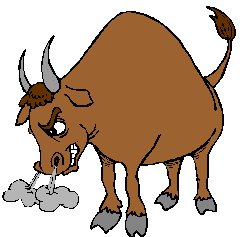
A huge Jersey bull was snorting and pawing up a dust cloud fifteen feet across that single strand of electric wire from her, telling her to “QUIT CALLING ME A COW!”

I yanked off my mackinaw.  “THAT IS NOT A COW.  STAND STILL!  DON’T SAY ANYTHING ELSE!  DON’T MOVE!”  I waved the mackinaw in the air.  “HYAAAAH!  HAYAAAH LOOKEE HERE YOU BASTARD!”

Snort.  Stomp.  Paw.  Dust.  Now he’s turning my way and I ain’t even across the fence from him.  “Hyahhhh!”  Less enthusiasm.

To her:  “Back away slowly.  REALLY slow.  Hyahhhh!”  Me backing away too, still waving the mackinaw, stepping across the fence, him taking a few paces toward me.  “HEAD TO THE TRUCK!  Slowwwww and easy.  Don’t attract his attention again.”  SOB’s thinking he’ll charge me, moving my way stomping and snorting, pawing up dirt.

I got up on the ditch road thinking how I can jump into seven, eight feet of water if I need to without ruining the camera and binocs.  He’s maybe 40 feet away, still coming.  She’s beside the truck.  “OKAY!  START YELLING AND WAVING YOUR ARMS AROUND, THEN IF HE TURNS GET IN THE TRUCK!”

She did, he did, and I did.  He never came past the fence.

When I was a kid a Jersey bull was universally known to be a dangerous beastie.  We had to sit through films at school telling us to watch out for them.  I read somewhere once that more kids on farms were killed by Jersey bulls than died any other way.  She sat through the same films.

I suppose she forgot.

Or maybe I was just more tuned in because of a Jersey milk cow who used to chase me all over the barnyard, me trying to get her into the stall for milking.  My step-dad always sneered at me about that, “All you have to do is grab that ring in her nose!  She won’t do anything after that.”

I don’t recall I ever got close enough to grab that ring and test it out.  I preferred batting her across the nose with a broken hoe handle.

When It’s Mushroom Picking Time in Minnesota http://teresaevangeline.blogspot.com/2011/09/when-its-mushroom-picking-time-in.html reminded me of this.  Rather than bog down her comments with my yarns I figured I’d best post it here if I wanted to tell it.

Old Jules

Johnny Cash -the Bull Rider
http://youtu.be/TViGS1ePGp8

6:15 AM Newsflash:

Last night I heard a ruckus outside the back window along with the sound of destruction.  I shined a flashlight through the screen and found a feral sow and 5-6 piglets about the size of Cocker Spaniels had broken into the rooster pen and were tearing everything up, one trying to get up the chute to the night rooster fortress.

I got the .22 and picked a target, the one tearing up my chute, fired through the screen, resulting in more destruction of the pen, a squealing, flopping-all-over-the-place pig, herd stampede by the others, and one ANGRY feral sow.

She’s been out there all night snorting and grunting.  My guess is that piglet’s still alive out there, injured, and she’s waiting until I come out to express her displeasure.

I’m not going outdoors until it’s light enough to see what I’m doing and she’s doing so’s we can come to some sort of permanent understanding about the issues involved.

Old Jules

7:30 AM aftermath

Judging from appearances she and the pigs ate the one I shot during the night.  Stinks something awful all over back there.  They did a lot of damage to the rooster pen, which I’ll have to shore up today while the two roosters run loose and hopefully leave The Great Speckled Bird: Respecting our Betters alone.

The Liar: The Great Speckled Bird, Part 2 might have to hang off in the background today, leaving the hens alone.

Damage from the hogs wasn’t restricted to the chicken pen.  They tore off some of the siding to the storage building trying to get to the chicken feed, also, broke pieces off.  More repairing and shoring up necessary there.

When I went out the sow was in a cedar thicket near the main henhouse where I could hear, but couldn’t see her.  Couldn’t tell whether the pigs were in there, too, or not.  I agreed not to go in after and she agreed to not come out after me.

Old Jules

News from the Middle of Nowhere

Old Sol’s going through some unusual upheavals today.  I don’t recall ever seeing such an array of sunspots reported:

“GIANT SINE WAVE: Imagine a sine wave 400,000 km long. Today, NASA’s Solar Dynamics Observatory is monitoring just such a structure. It’s an enormous filament of magnetism slithering over the sun’s northeastern limb:”

http://spaceweather.com/

Meanwhile it’s a red morning out there, so all you salesmen probably need to take warning.

Last night I was planning to haul water but I was interrupted by a wild hog meandering out from behind the truck as I came around the corner of Gale’s house.  We stood and looked at one another from about 20 feet, him undecided about whether he wanted some of me, while though I’d decided I couldn’t think of anything to do about it if he did.  When he wandered off behind a hedge I ducked inside to seal an agreement with him that we’d postpone any drama until we could each feel better about invading the personal spaces of the other.

Gale had told me he was having a lot of hogs troubling him but he didn’t mention I needed to pack a .45 walking around the place.

Maybe more later.  I’ve got to go let his chickens out.

07:45 AM – Snagged enough water to hold things together a couple of days down here without seeing any porkers.  Kay’s duck, which was missing last night when I locked down the chickens and caused me concern, flew in while I was filling the water jugs.  Eased my conscience considerable.  I hate having one of their critters come up KIA or MIA while I’m the one taking care of things.

While I was driving back down here I got to thinking about that tusker last night and the fact something’s been tearing up the pen where I keep the roosters every night.  Went out looking for hints of what might be doing it and found pig scat all around out there.  If it was there before I hadn’t noticed it and it appeared fresh.

I’m guessing whatever water source the wild hogs were using somewhere else must have dried up and motivated them with ambition to do some exploring.  It’s been a year since pigs were a problem here except for brief spatterings, a herd passing through.   I’m hoping these will follow the pattern, what’s left of them.

Tidbits you’ll be glad to know:

On this day in 1948 the Chinese formed the Peoples Republic of China, intended to create a nation of manufacturers to create all the stuff Western Europeans and US workers were having to make for themselves previously, getting their hands dirty.

On this day in 1926 Turkey began allowing civil marriage, the results of which subsequently became obvious.

On this day in 1918 the first US troops landed in Vladivostok, Russia, to help settle things down and restore the aristocrats overthrown by wossname, revolutionaries.  For those guys WWI didn’t end until 1920.

On this day in 1866, Navajo Chief Manuelito turned himself in at Fort Wingate, New Mexico, thus putting the final touches on getting all those Navajo over into the temporary [15 years] rez at Bosque Redondo, Fort Sumner bunched up with the Mescalero so’s to get the numbers down to something more tidy and manageable, which they did. [The Long Walk of the Navajo http://www.logoi.com/notes/long_walk.html ]

Old Jules

“The Java Jive” (Ink Spots, 1940)
http://www.youtube.com/watch?v=iP6IUqrFHjw&feature=related

Drought, Starving Wildlife Stewardship and Paradox

Looking for solutions

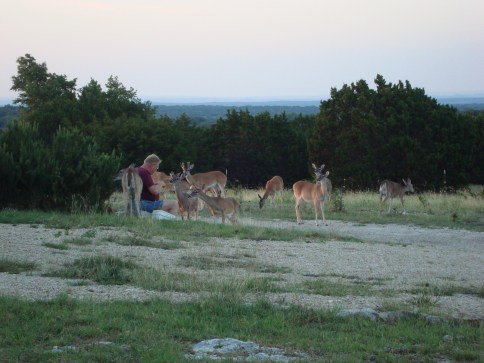
There’s an irony in this picture.  Gale, the man feeding the deer, owns this 300 acres I live on.  One of the reasons he originally bought it had to do with the passion for hunting he spent most of his life following, which, 40 years ago was a passion we shared and was one of the ties leading to our becoming friends.  Between us we’ve killed more large mammals than either of us can remember, though I don’t recall we ever hunted together.

Each of us following the routes our lives took us gradually and independently lost any interest in killing any more if it could be avoided.

Which is still a long way from sitting on a rock feeding tame deer every evening.  I’ve never arrived there.  I’d far prefer the deer staying out in the woods tending their own affairs and leaving me to tend mine, which they refuse to do.

Now, along comes the extended drought.  Today he’s feeding a herd of 30-40 starving deer up there, spending $100 + per month on corn, range cubes and hay.  If he tried to feed them enough to get them beyond near-starvation he’d bankrupt himself doing it.  He’s picking cactus tines out of the lips and noses of his tame deer because they’re so hungry they’re trying to eat prickly pear cactus.

I’ve got another 20-30 down here I’m not feeding intentionally.  ‘Mine’ are so desperate for food they constantly hang around waiting for me to feed the chickens, refuse to be run away further than I can throw a rock, and even come onto the porch for the cat food when any is left outdoors.

But watching a herd of deer starve to death, whether you’re feeding them and given them names, or are just some guy trying to mind his own affairs and have them forced on him as unwelcome guests, is a troubling position to be in.  A few days ago he and I were discussing it trying to come up with some means of providing them more to eat without him having to spend a lot more money doing it.

Eventually it came to me people in Kerrville are probably still mowing their lawns, bagging the grass clippings and putting them out on the curbs to be picked up by the city.  We talked about this a while and considered the fact the bags of grass ferment when sealed, creating a feed we’ve both been around called silage, which livestock love.

Next time either of us goes to town we’ll be looking at lawns to see if we’re right in believing they’re still watering grass and mowing it.  If they are, I’ll soon be putting up a post on Kerrville FreeCycle Yahoo Group asking if any of them would,

  1.  be willing to allow a trailer to be positioned on their lots where others could bring bagged grass clippings so we could haul them off weekly or a couple of times per month to feed the deer, and
  2. if such a lot and such a trailer were in place in Kerrville, would they be willing to carry their clippings there instead of just to the curb in front of their homes.

But this mightn’t work, and even if it works it’s only a partial solution to the problem.

I’m looking for ideas and information.  You others living in drought-stricken areas, do you have any idea what, if anything, locals with starving deer populations are doing to supplement their feeding?

Any ideas or experiences that might lead to even interim or partial solutions will be appreciated.

Thanks,  Old Jules

Money isn’t the solution to this problem, but the performance in Cabaret does seem apropos somehow:

Cabaret- Money

http://youtu.be/I8P80A8vy9I

White Trash Repairs and Fixes – Owls and Rock ‘n Roll

[Plus Gregorian Chants, Chuck Wagon Gang Gospel, Navajo flute, Beethoven’s 9th, Mozart Horn Concertos, old-timey country, cowboy and hillbilly, bluegrass,  big band, folk, blues and songs of the Civil War, WWI and WWII thrown in for the discerning night predator]

Bear with me here.  This is a bit complex for a dumb old redneck to explain.

The problem:  If you’re a person trying to keep free ranging chickens some of them will insist on sleeping in the trees.  If you also keep guineas, all of those will nest in the trees.  The guineas tend to bunch up in several clumps in the treetops, and they whisper and burble to themselves or to one another in their dreaming.

Enter, the owl:

“An Owl’s range of audible sounds is not unlike that of humans, but an Owl’s hearing is much more acute at certain frequencies enabling it to hear even the slightest movement of their prey in leaves or undergrowth.

“Some Owl species have asymmetrically set ear openings (i.e. one ear is higher than the other) – in particular the strictly nocturnal species, such as the Barn Owl or the Tengmalm’s (Boreal) Owl. These species have a very pronounced facial disc, which acts like a “radar dish”, guiding sounds into the ear openings. The shape of the disc can be altered at will, using special facial muscles. Also, an Owl’s bill is pointed downward, increasing the surface area over which the soundwaves are collected by the facial disc. In 4 species (Ural, Great Gray, Boreal/Tengmalm’s & Saw-whet), the ear asymmetry is actually in the temporal parts of the skull, giving it a “lop-sided” appearance.

“An Owl uses these unique, sensitive ears to locate prey by listening for prey movements through ground cover such as leaves, foliage, or even snow. When a noise is heard, the Owl is able to tell its direction because of the minute time difference in which the sound is perceived in the left and right ear – for example, if the sound was to the left of the Owl, the left ear would hear it before the right ear. The Owl then turns it’s head so the sound arrives at both ears simultaneously – then it knows the prey is right in front of it. Owls can detect a left/right time difference of about 0.00003 seconds (30 millionths of a second!)

“An Owl can also tell if the sound is higher or lower by using the asymmetrical or uneven Ear openings. In a Barn Owl, the left ear left opening is higher than the right – so a sound coming from below the Owl’s line of sight will be louder in the right ear.

“The translation of left, right, up and down signals are combined instantly in the Owl’s brain, and create a mental image of the space where the sound source is located. Studies of Owl brains have revealed that the medulla (the area in the brain associated with hearing) is much more complex than in other birds. A Barn Owl’s medulla is estimated to have at least 95,000 neurons – three times as many as a Crow.

“Once the Owl has determined the direction of its next victim, it will fly toward it, keeping its head in line with the direction of the last sound the prey made. If the prey moves, the Owl is able to make corrections mid flight. When about 60 cm (24″) from the prey, the Owl will bring its feet forward and spread its talons in an oval pattern, and, just before striking, will thrust it’s legs out in front of it’s face and often close it’s eyes before the kill. Click here to see a Great Gray Owl using it’s hearing to catch a small rodent concealed under snow.”

http://www.owlpages.com/articles.php?section=Owl+Physiology&title=Hearing

Got all that?  The feathered cones or funnels around the eyes of the owl act as parabolic sound receivers.  They work in concert using parallax to locate the positions of prey.

In a sense it works similarly to an array of electron telescopes  positioned some distance apart to provide parallax to measure the distance from earth to celestial objects.

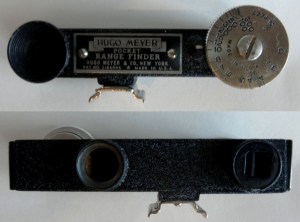
Or the way this vintage pocket range finder used parallax to accurately provide distance for photographers:
Okay.  So how’s a poor old redneck who has guineas sleeping in the trees being picked off by owls carrying secret weapons, a guy who has four cats he needs to consult regularly on important matters, a man with a herd of free ranging chickens supposed to curtail such nonsense?

Answer:  Echoes.  Noise reflected from all directions 24/7.

I began by looking for castoff disk harrow blades, woks, pot lids and parabolic tv dishes and placed them in strategic locations around the place.


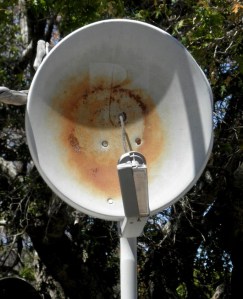
At the time my CD player would only take five CDs, so until the player wore out it was Gregorian Chants, Mozart Horn Concertos and Carlos Nakai Canyon Suite [Navajo flute] here day and night, outdoors maximum volume.  But by the time that player went Communist,  months had passed and I hadn’t lost any more guineas at night.

So there I was knowing how to keep the owls somewhere else, owning a couple of hundred CDs, but cats, chickens, guineas all mutually agreed on one point:  it was time to broaden my horizons music-wise.  Even the coyotes were sick of Mozart and the cats were beginning to open confessional booths for the chickens.

Enter the Coincidence Coordinators:

A lady on the Kerrville FreeCycle Yahoo group advertised she’d like to give away a Sony 200 CD disk player because she was using an MP3 or some such thing for her music.  I called her and made a special trip to town to pick it up, swing by the Habitat for Humanity Recycling Store to buy an old receiver and a pair of speakers large enough to wiggle the ears of the deer population.

Eventually that player wore out.  But as luck would have it, I found a 300 CD player at the Salvation Army Thrift Store and a willingness on the part of the guy at the counter to do some horse trading, which I’ll describe another time, that horse trading in thrift stores. http://tinyurl.com/3t4ums9

Yeah, it ain’t the way the smart alecs save their chickens from predation by owls – I don’t know how they do it.  But this old white trash redneck fixed them owls but good and the chickens and cats are in Rock and Roll Heaven.

Old Jules

 Rock and Roll Heaven by the Righteous Brothers
http://youtu.be/k2cijNKu9qc

Important Events from the Middle of Nowhere

Mouser wins prize for lousy judgement

The cat you see above came to me as a loaner 13-or-so years ago.  A litter mate to Hydrox, the jellical cat I’d established an actual contract with for the remainder of one of our lifetimes.  Mehitabel, an adult in the household, hated Hydrox and I thought he needed some company, so I borrowed Naiad on an indefinite loan, no contract involved.

 Turned out she’s probably the best mouser I’ve ever enjoyed spending a piece of my life with, a survivor.  She went through Y2K with me, has braved every available kind of predator stalking cats from dogs to coyotes, an eagle, hawks, bobcats and probably others she’s never had the courage to divulge, even to me, a liberal and open-minded sort of guy.
She generally trusts me but there’s always been that no-contract thing hanging over her head, and the guy loaned her to me got murdered a few years ago.  She’s acutely aware if I hold strictly to our original agreement I have no option other than to return her to Socorro, New Mexico sometime.  So she’s careful not to cross me.
But I’ve digressed.
When Gale, Kay and I encounter one another we almost always exchange news about which predators are currently threatening our chicken-herds, particularly predators that might commute from mine to theirs, or vicee versee.  Yesterday Gale sprung one me:
“There’s a cat working up here you might want to keep an eye open for.  Kay took a shot at it, but she missed.  Black cat hanging around down by the hen house.”
“Black cat?  Stalking your chickens?”
“Stalking something down by the hen house.  Lots of rats down there because of the chicken feed.”
“Black cat?  You sure it wasn’t Naiad?  She’s been around chickens on and off forever.  Never bothered a chicken.”
“You have a black cat down there?”
“Yeah.  I’ll email you a picture.  I’d be obliged if you don’t shoot her.  She won’t bother your chickens.”

Toyota Goes Communist

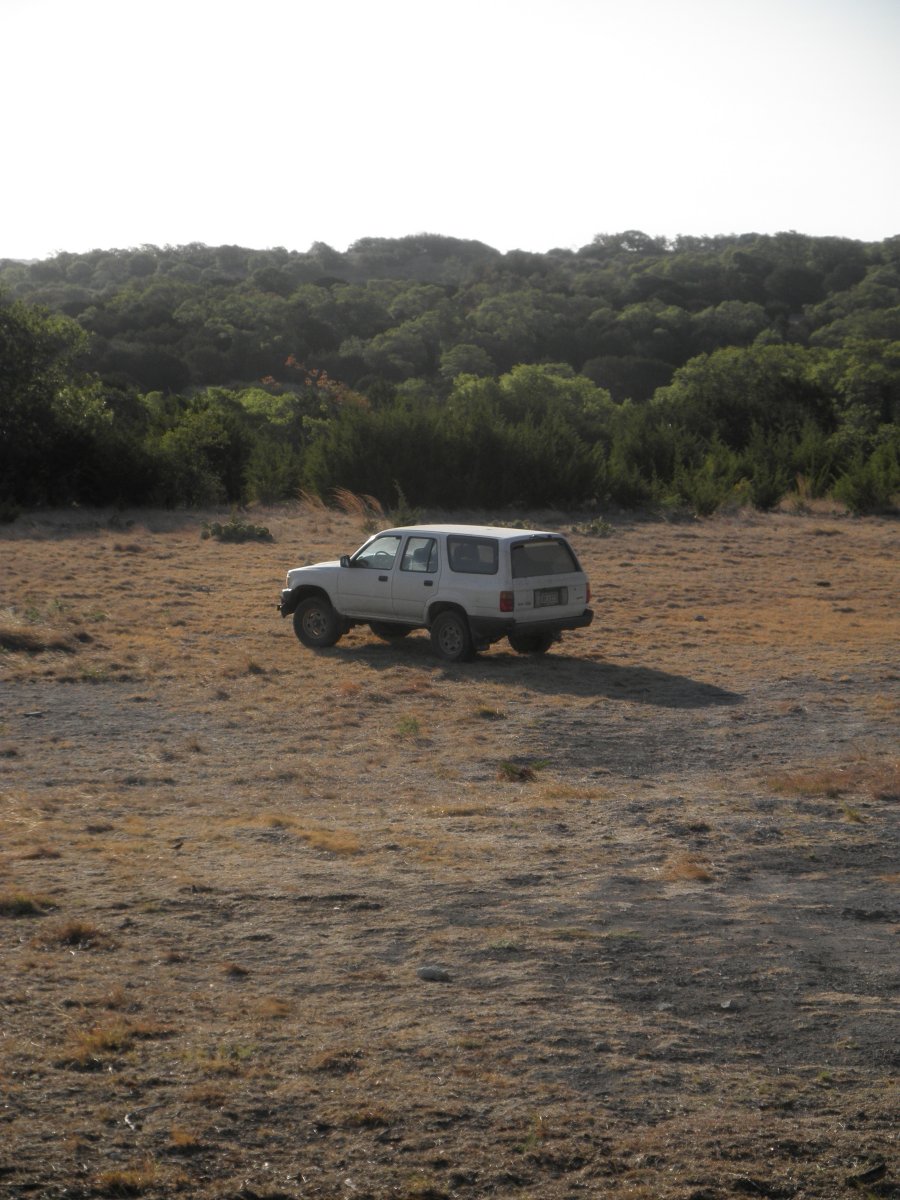
Thursday I needed to go to town, so I packed the ice-chest with ersatz ice, a shopping list, and went to roll the 4Runner downhill to start it so’s to get up to Gales and borrow a truck to go to town.  The 4Runner did okay rolling down but I suppose just half-mile trips back and 4th to Gale’s place hasn’t kept the battery charged.  I’m thinking it spang went completely dead.
So, 100 degrees out there and me all dressed up for town I pulled up my galluses and hiked my young-ass over the hills and through the woods, picked up Little Red, the loaner truck, bumped my young-ass back down here, picked up the list and ice-chest, then off to town, where I happened to notice L’il Red’s license tag and Safety Inspection Sticker had both expired back in June.
Sweated blood and bullets all the way to town, various thrift stores, feed store, grocery store, all without getting into a gunfight with the law over the expired civilization indicated on the windshield.  And not entirely the result of me being unarmed.  Every time I saw a police vehicle I kicked into my ‘invisible’ mindset mode, which works a lot more frequently than a person might be led to expect if the person isn’t into such esoterics.
 NEWS ITEM #3
The Terlingua blogsman
Posted a piece this morning I love and I think you might love too.  Popular Science Magazine archives going back to before the invention of life as we know it.  Going back so far there weren’t even any human beings running around to publish and read it, at least no human beings as we’re currently prone to indulge in believing humans are.
Stay tuned.  Likely something else will happen here sometime.
Old Jules

Johnny Horton – Old Slewfoot