When an author succeeds in creating a page turner from a segment of history beaten thoroughly to death by a thousand other historians and writers of historical fiction there should be some background music and applause.
Richard Holmes has succeeded.
Redcoat follows the British soldier through the Seven Year War, the Peninsula War, the wars in the Americas, the wars in India through the Sepoy Mutiny and Afghanistan to the Crimea. And every page contains some new surprise, some fragment of detail the reader won’t have encountered previously.
Ever wondered where the idea for Hornblower’s fascination with the Lady Barbara Wellesley most likely originated? Illustrations: “Below: The Marquess of Anglesey was a talented cavalry commander who, when Lord Paget, beat the French at Benavente and Sahagun. Unfortunately he ran off with Wellington’s sister-in-law and could not be re-employed in the Peninsula. As Lord Uxbridge he lost a leg at Waterloo.”
Or, page 154, Lt. Arthur Moffat Lang, “Many are given to drink and drunkenness like the Germans. Foreign wines on account of their being accustomed to beer, does not agree with them, and in hot countries over-seas brings on burning fevers . . .”
Holmes has sifted through the chaff of history to cover the subject thoroughly on the outside in a 427 page epidermis, along with constant peeks at the liver, the bladder, the spleen and the dirt under the fingernails of the British soldier: A man as limited and flawed as the Brown Bess musket he carried into battle, but one who experienced a surprisingly long series of successes where failure would have been far more appropriate.
‘Christopher Duffy suggests of the eighteenth century that: “The most pronounced moral traits of the English were violence and patriotism.”‘
If that sounds familiar today it might be worth pondering whether it’s part of the package the 20th Century delivered to your own doorstep.
Good morning readers. Thanks for coming by for a read this morning.
When I post a blog I frequently do so in complete ignorance of current events. I don’t have a television, the radio never gets turned on, and I don’t read newspapers or magazines until they sometimes fall into my hands many years after they were printed.
I don’t know and don’t wish to know who wants to be king. The Challenge of 2012: Not Knowing Who Wants to be King And I’m not likely to get any joy from knowing which readers prefer which liar and scoundrel, and which prefer some other one. I have no intention to participate in the scramble to assassinate characters of the occupants of one side of the pool of corruption to give advantage to the occupants of the other side of the pool.
If a post here manages to convey an impression I’m giving support to one political illusion over another, it’s entirely by accident and not to be taken as a launchpad for more intense and focused discourse on the issue.
I didn’t say this in the post because I didn’t think it needed saying, but I think it might.
I’ve got nothing bad to say about Mormons. I’ve never been ill-treated by them, cheated by them, lied to by them so far as I know. The ones I’ve met have generally been solid, hard-working, honest people. Seemingly more so compared to the impression I’ve been left with in my seven decades of experience with the remainder of the population. Christians, Gentile, Jew, atheist, Muslim and agnostic. Even Buddhists, Taoists, Hindu, and the herd of New Age Gurus. Even Hopi Elders and Ambiguous Native American Shamans.
My interest in Mormons came to being with the gradual realization that the parties involved in the lost gold mine I searched for so many years were predominantly Mormons. It was a factor left entirely out of the legend as it came out of the 19th Century and it required years of research to uncover that fact. The cousin of one of the central characters was evidently the second wife of Brigham Young. Family names of the lost gold mine participants also show up among people involved in Mountain Meadows.
The timing on the lost gold mine incident and that of the Mountain Meadows massacre originally drew my interest.
What Mormons believe about polygamy, same-sex marriages, almost anything at all has no bearing on my impression and generally benevolent attitude toward them as a whole. In areas where we disagree I’m willing to forgive them for being wrongheaded, same as I try to forgive everyone else who disagrees with me. Otherwise I’d be forever having to keep score of who was right in this world, and who is wrong. It just ain’t worth the effort even those relatively few areas where I can’t restrain myself from having an opinion.
I’m re-reading The Mountain Meadows Massacre, by Juanita Brooks at the moment. Twenty or thirty years ago when I submerged myself in everything I could find about the event I concluded the Brooks work was the best out there. When it came into my hands again recently I held back beginning it again to savor the anticipation. Now I’m midway through it again and it’s as fine a piece of research as ever.
Brooks was a Mormon lady, which made the Mountain Meadows Massacre a work of courage on her part. The LDS church had spent a century suppressing the realities about the mass homicide of an estimated 60-120 men, women, and children of the Fancher wagon train journeying through Utah to California in 1857, by Mormons and members of a tribe of Native Americans.
The event happened at a time when there was plenty of massacre going on across North America, but was unusual for a couple of reasons. First, because the people involved were Mormons killing Christians, as opposed to Christians killing Mormons, and the motivation wasn’t acquisition of territory belonging to someone else. Second, because the circumstances surrounding the massacre involved ‘normal’, dutiful, pious people behaving in ways anyone outside the context could only consider far from normal. Believing the killing was defensively justified and necessary.
Brooks establishes clearly and thoroughly that the heads of the LDS ordered the massacre and that John Lee, who’d been hanged for it and handed full responsibility by the LDS Church, was carrying out those orders.
An excellent read for anyone interested in history, human behavior, duty, and the ability of the human mind to justify anything it applies itself to.
All that’s over there until the first post tomorrow is the single-post archive migrated from Facebook. But if you’d care to go for a look at the archive it might give you an insight into the general drift.
I’m posting this today in hopes of discovering whether anything needs changing, whether the navigation works, and to just give anyone interested a gander at it. If you click it and find there’s a problem of any sort I’d be obliged if you’d send her an email, post it here, or let us know by mental telepathy.
Seems the advantages of being out of sight and out of mind for most of the population aren’t necessarily advantages when the out-of-sight geography includes something a multi-national corporation wants. All those city folks needing to keep the air conditioners turned down to 70 and to be able to light up the hair dryers every morning probably never ask themselves where the electricity popped out of the ground and hopped into the wires they plug things into.
One more bug on the windshield of civilization. Old Jules
[The following letter was written by former Hopi Tribe chairman Benjamin H. Nuvamsa from Shungopavi. He presented the letter to the Hopi Tribal Council on Friday January 13, 2012]
January 13, 2012
Hopi Tribal Council
Hopi – Tewa Senom
It is time we have a serious discussion about coal mining on our reservation, our water rights and our environment. For far too long, we have pushed these issues aside, not willing to talk about how these issues impact our lives. We must talk about how the Peabody Western Coal Company and Navajo Generating Station are affecting our lives. Since the mid 1960’s, Peabody Coal has been mining our coal, pumping our precious Navajo Aquifer water and paying us pennies on the dollar in return. Navajo Generating Station is emitting dangerous and harmful particulates into the air we breathe. Our coal resources are being depleted. Our Navajo Aquifer has been damaged…
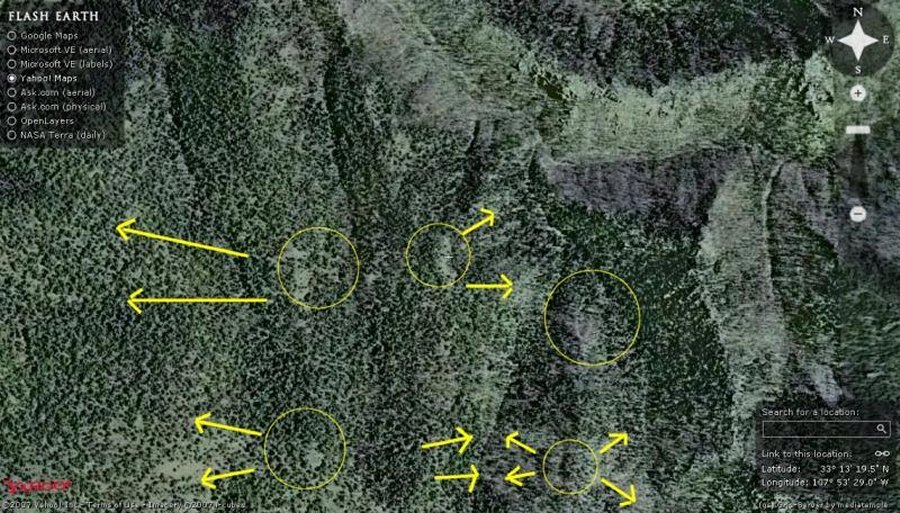
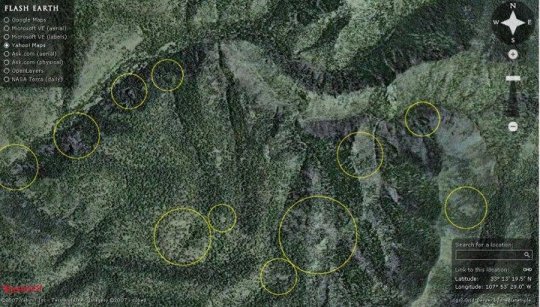
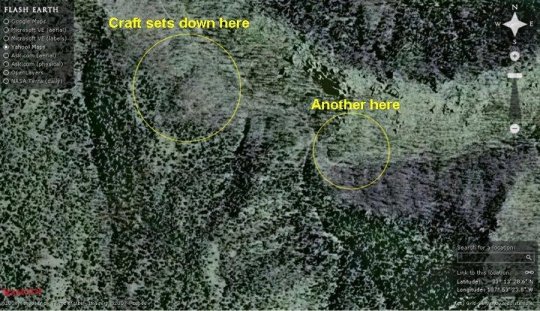
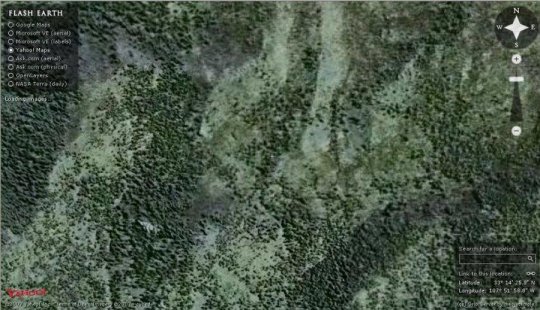
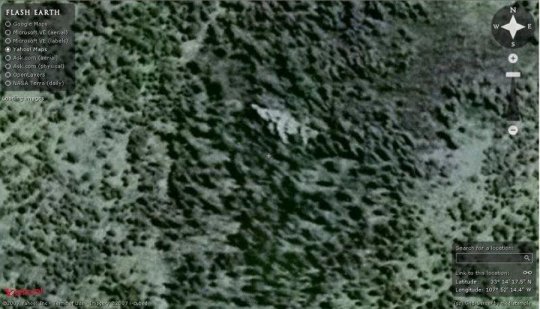
This is located almost atop the Continental Divide in the Gila Wilderness at around 8000′-9000′ above Mean Sea Level elevation. Nobody much goes up there. I was actually looking for something else when two comparatively ‘small’ parallel gouges mid-picture first caught my eye.
Trench deep on our left pushes up rocks ahead
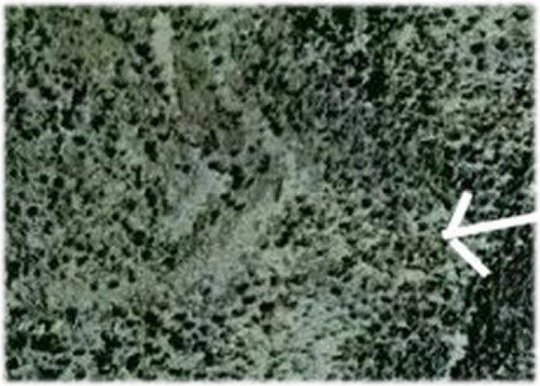
Closer view of key impact
Bad things happening to good people
Impacts and energy events stage 1
Stage 2 Along path breaks up and explodes
Impact trenches
Hot spots
Stage 2 energy events
Main pieces remaining
Interesting local geology
Aftermath investigation and cleanup
Better view of initial ground contact
Pilot applies full power – Dire emergency attempt at recovery
Meanwhile a couple of ridges away 1
Meanwhile a couple of ridges away 2
Mother nature anticipating and waiting – It only needed the human imagination to complete the picture
Skeptics probably won’t believe this is a UFO crash site. I personally don’t. and so far as I’m aware I’m the only person who’s ever suggested it might be. I’d surely like to get up there and have a look at it sometime, but for other reasons than the UFO story.
I’d like to spend about a month up there with half-dozen pack goats just nosing around the immediate area. Some places don’t need a crashed ancient UFO to have appeal.
Old Jules
Edit: You can have a look for yourself by going to flashearth dot com and entering the longitude/latitude coordinates in the lower right corner of each image.
Hydrox jumped off my lap and stalked over to the bed.
“Sometimes you human beings disgust me with your pretense.”
Him being second-in-command around here, I try to keep him up-to-date on my thinkings and directions. Seems prudent to me because he’ll have to take over if I kick. I’d just been asking him if he thought we could get along okay living in a travel trailer.
“Just what ‘we’ are we talking about here? You and me? You and all the cats?” He glared at me. “You, the cats and the chickens?”
I shrugged, wondering where he was going with this. I felt a tirade in the making. “Just you cats and me. The chickens can’t be part of it.”
“Well, that’s a relief, anyway. But I think you need to think through this second-in-command crap and all the what-if-you-ain’t-around side of it.” He gestured with his nose toward the porch. “The only ‘we’ worth talking about involves mutual resolve. Creatures willing to allow the well-being of others within the ‘we’ to influence what they do. No creature unconcerned for the well-being of the others, no creature the others don’t have a commitment to, can be part of a meaningful ‘we’.”
I thought about it a moment. “That makes sense. It’s why I was trying to keep you up-to-snuff on things.”
His frustration was obvious. “Yeah, and that’s where you’re proving how stupid you are. For me,” He tweaked a claw under his chin, “the only ‘we’ around here is you and me. And maybe Niaid, just a whisker.”
This rattled me, but he went on before I could say anything. “When that coon on the porch ran at you and I jumped in, that’s ‘we’. When you go to town and buy food for us, that’s ‘we’. But do you see Tabby or Shiva the Cow Cat lifting a paw for me if I was starving? Do you see either of them jumping in if a coon attacked me?”
He waited while I considered it. “I suppose I don’t.”
“Then they’re not a part of any ‘we’ I belong to.”
The more I pondered it the more it seemed to me he’d come upon an important thread in the fabric of reality I’d been overlooking. Not just with cats and chickens, but with every piece of human intercourse around me most of my life.
When a person goes down to City Hall, or the County Courthouse to perform some necessary business, for instance, and the clerk begins the ritual of obstruction, a ‘we’ is in the process of being defined. The clerk is the spear-point for a huge ‘we’ of contradictory demands on the ‘we’ you occupy.
“Do you have proof of residence?”
“There’s my driver’s license.”
“That’s not enough. I need a utility bill or tax return.”
“I didn’t bring that.”
“Then I can’t help you.”
The ‘we’ that clerk represents just defined a boundary excluding you from that ‘we’ and placing you inside another ‘we’ it considers an enemy. And in a real world, that definition would be mutually recognized, rather than singularly by the human spear-point drawing the boundary.
Which is probably why representative democracy was doomed to eventual failure. In a fantasy of wishful thinking a population created ‘we’ with a set of unrealistic boundaries. When new ‘we’ entities developed around government centers those included in the ‘we’ tribes were those they associated with, lived near, shared a commonality with. In Washington, D.C. In Austin, Texas.
And inevitably those outside that ‘we’ became an obstruction, a product, an enemy to their ‘we’.
“The only ‘we’ worth talking about involves mutual resolve. Creatures willing to allow the well-being of others within the ‘we’ to influence what they do. No creature unconcerned for the well-being of the others within the ‘we’, no creature the others don’t have a commitment to, can be part of a meaningful ‘we’.”
Sometimes it takes an outsider to the human ‘we’ constructions, a feline with a firm hold on reality, to recognize the obvious.
Old Jules
“Electing pet skunks to guard the henhouse might work for a while. But the skunk-instincts and chickens behind the walls they’re guarding metamorphoses the ‘we’ they live in. The skunks become a we with a priority of digging under chicken-house walls and the we of being pet skunks fades until it no longer can call itself a we.” Josephus Minimus
I must have been four, or maybe five When grandfather said, with a snicker, “Where a man wouldn’t go with a Colt .45 That boy will follow his pecker.”
Half a century now mocks: I’d surely be elated If Papa’s eye had turned to stocks Or land speculated.
I’ve frequently suspected my granddad was speaking from his own experience.
One of the rewards the Universe gave me for getting to be this old was the raging hormones fading into oblivion. There’s still plenty of passion in my life, but it’s of a different nature, and it listens to the voice of reason.
I’d never have believed back when passion was a misery to be endured that the Universe had other passions in mind if a person could just make room for them between the preoccupations.
And yet, today I listen to any one of the songs below and it brings back vivid, pleasant memories of [usually] one woman. The shadow of the past agonies is still there if I choose to examine it, but if I don’t the songs and the passage of time allows it all to be a bit nostalgic. And the songs don’t last long enough to insist on thorough remembering.
Old Jules
(Arirang) Korean Folk Song [She never had an orchestra background that I recall]
Gram Parsons and Emmylou Harris, We’ll Sweep Out the Ashes said things too well. It was one of several I put as a single song on a 90 minute tape and wore out. Live version, no embed: http://youtu.be/GQJAsEZ-S3I
Hank Snow 90 Miles an Hours Down a Deadend Street was another ‘said things too well’.
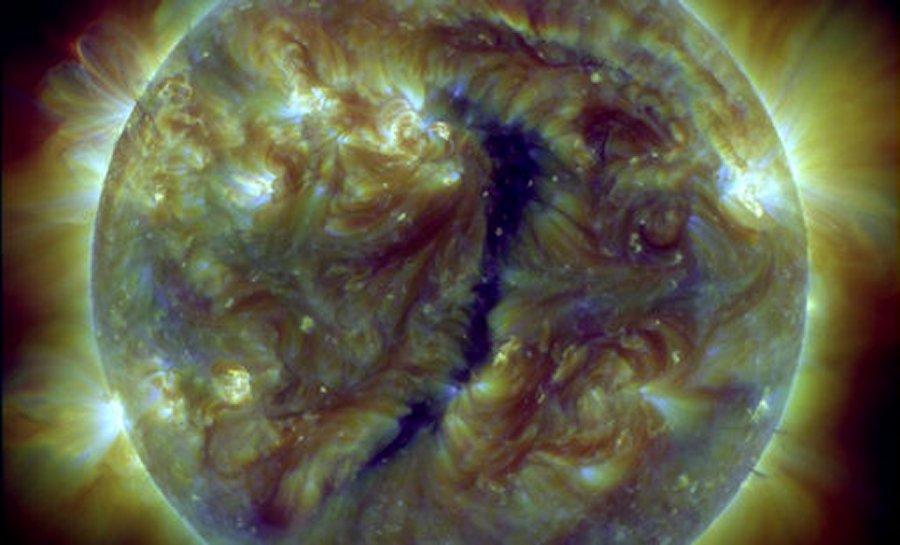
I mentioned the other day how Shiva the Cow Cat dropped the ball while we were praying up Old Sol. I’m not going to say with certainty Shiva’s responsible for this, but if she is, I’m going to give her a special scratch behind the ears as a reward.
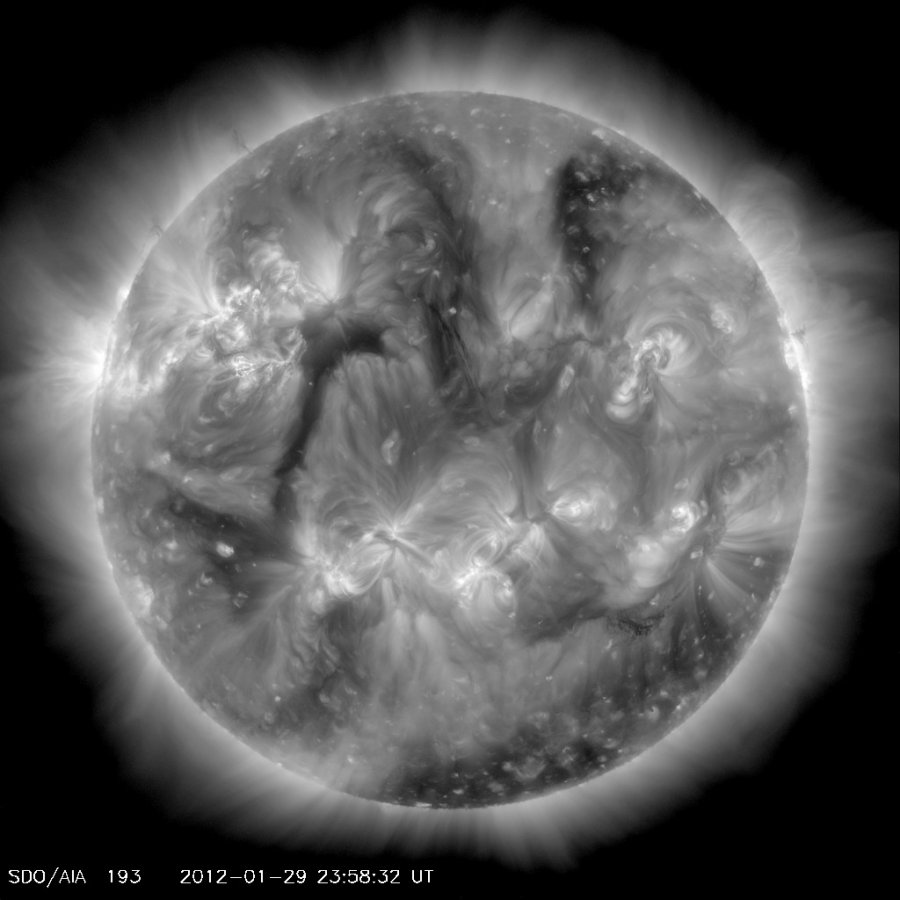
“CORONAL HOLE: NASA’s Solar Dynamics Observatory is monitoring a dark gash in the sun’s atmosphere–a coronal hole. It’s the dark vertical feature in this extreme UV image taken on Jan. 13th:
“Coronal holes are places where the sun’s magnetic field opens up and allows the solar wind to escape. This yawning hole is about 120,000 km wide and more than a million km long. Solar wind flowing from its UV-dark abyss will reach Earth on Jan. 16th or 17th, possibly sparking auroras for high-latitude sky watchers.”
Mayan calendar enthusiasts, on the other hand, choose to ignore the coincidence of Shiva’s lapse and attribute the hole to the obvious sinister consequences of the rock calendar having runned spang out of numbers.
Meanwhile, astrophysicists, unaware of Shiva’s blink, speculate it’s the work of Proxima Centauri, a hot tempered red dwarf cholla who hangs out in the same honkytonks as Old Sol, and who has a long history with a switch-blade.
I’m leaning to Shiva doing it, but what the hell do I know?
74 years old, a resident of Leavenworth, KS, in an apartment located on the VA campus. Partnered with a black shorthaired cat named Mister Midnight. (1943-2020)
Since April, 2020, this blog is maintained by Jeanne Kasten (See "About" page for further information).
https://sofarfromheaven.com/2020/04/21/au-revoir-old-jules-jack-purcell/
I’m sharing it with you because there’s almost no likelihood you’ll believe it. This lunatic asylum I call my life has so many unexpected twists and turns I won’t even try to guess where it’s going. I’d suggest you try to find some laughs here. You won’t find wisdom. Good luck.











 So Far From Heaven