Have you ever considered how much time, energy, money and lousy grades could be avoided if world history could be summarized for the kiddos into videos lasting a few minutes? For instance, consider the European conquests of Africa, the American continents, and India. The chillerns spend all kinds of time having to memorize the nigglingest details and names the teachers can’t even pronounce. Pizzzzarrro. Montezooooma. Courtessss. Geroneeemo. Krazyhorse. Not to mention the even worse ones in Africa and India.
But the hilarious fact is that all that isn’t needed. All those books didn’t need to be printed. All those names and dates didn’t need to be memorized to understand the basics of the European conquests of more-primitive geography.
Here it is. The incredible 4 minute 56 second summary of the European conquest of Africa, the Americas and India:
http://youtu.be/1csr0dxalpI
If the video doesn’t play the link below should work:
That little farm you see down there is the place where I spent a good many of my formative years after my mother remarried and we moved to Portales, New Mexico. As you can see, we’d had a pretty good year for hay, which dates the picture to 1949, or 1950, before the big drought hit.
When we sat outdoors in the evening the red neon lights blinked “Schumpert Farm Supply” across the top of the long building running diagonally to the railroad tracks until I went to bed. From my limited perspective the Schumperts were ‘rich’. In that small town that railroad running through didn’t identify who was rich but it did identify who wasn’t. That little farm I lived on and no other property that side of the tracks had any rich people.
In the rigidly established social structure in Portales business men generally came down on the side of being ‘rich’, along with professors at Eastern New Mexico University, bankers, physicians, preachers, school teachers and a few elderly ladies who lived in houses big enough to be thought of as mansions. Farmers, ranchers, Mexicans and people who worked in the businesses weren’t ‘rich’.
I doubt the adults paid a lot of attention to the social strata, but school teachers did, and the kids adopted it more firmly than a religion. Rich kids were easy to recognize because they made good grades, weren’t hassled by teachers, got elected to everything, brought cookies to school Christmas, Easter and Halloween, and had the best bicycles early, cars later. For the most part they were insufferable snobs.
But not the Schumpert boys. I was in school with Stephen and Billy, and there was a precocious younger one I don’t recall the name of. Stephen was a year older than me, Billy a year younger, and there wasn’t a breath of snobbery in the entire family. Stephen, particularly, had a knack for getting in just the right amount of just the right kinds of trouble to keep from qualifying as a goody-goody. Good solid boys from a good solid family. I had a lot of respect for all of them.
I left that town early and stayed mostly away for several decades. I lost track of almost everyone I ever knew there.
But after Y2K when I moved into town to Grants, New Mexico, I came across Billy Schumpert being president of a bank there. Naturally we got together and talked about whatever we each knew that might interest the other. Billy’s the one told me what happened to Stephen.
Stephen worked as a bank examiner several years, then became president of a bank in Colorado, maybe Denver. Had a regular family, seemed to be destined to follow a career path and eventually retire. But one morning he didn’t show for work late in the 1980s. Nobody had any idea what became of him. He wasn’t a drinker, didn’t use drugs, didn’t have a ‘secret life’. He just vanished for no apparent reason.
Over time the police and other agencies gave up, assumed he was the victim of some crime, dead. But the family put up a reward for information about Stephen, sent private investigators and others searching for him. Eventually, six, seven years later they located him living under a bridge in Seattle.
Over time everyone who loved Stephen went up there trying to talk him into returning to real life, return home.
“No! I had enough!” That’s all he’d say and he never came back.
I’ve pondered Stephen a lot during the years since I learned what he’d done with his life. In some ways I think I understand, though I’m not sure. My own life has been a long series of reversals in direction. It’s meandered, cutting as wide a swath of human experience as I was able to pack into it. So, from that perspective, I can gnaw at the edges of understanding Stephen’s behavior. But I was a wild kid and I’ve always pushed the envelope, all my life.
Stephen was ‘tame’.
I’d like to see old Stephen again if he’s alive. He’d be 70, 71 years old now and maybe wiser than he was in the 1980s when something told him he’d had enough. I’d like to sit on the porch and talk with him a long time to come to know how he came to make his choice to isolate himself, to impoverish himself.
It’s come to my attention that school is starting already. I recall being in a school auditorium as a youngster when they added the words,
‘under God’ to the Pledge of Allegiance. Mr. Doak and Mr. Burke, Civics and
History teachers, were up there trying to get it right while teaching it to a couple of hundred kids. Kids who were still on shaky ground from learning it the first time. That would have been in the mid-1950s:
Mr. Doak: “Okay. This isn’t complicated and shouldn’t take long. Just say it like you always said it, but after, ‘one nation’, pause, then say, ‘under God’, then pause again before going on.
“Try it. I pledge allegiance to the flag of the United States of America and to the Republic for which it stands, one nation,
under God,
with liberty and justice for all.”
Cacophony of 300 kids lost mid-way through. Mr. Doak pauses with a frown waiting for the noise to die down. Mr. Burke’s frowning too. He nudges Mr. Doak.
Mr. Burke: “Eh, John, hold on a minute. I think it’s supposed to be ‘one
nation under God’, not ‘one nation with a pause, under God with a pause.”
Mr.Doak: “Ralph, look at it. The comma’s in front of and after ‘under God.'”
Mr. Burke: “John, that doesn’t mean it’s supposed to sound like some run-on sentence. This is the Pledge of allegiance!”
Mr. Doak: “Ralph, I know what it is.” Doak scowls and turns back to the 300 lost faces. “Let’s try it again now.”
Burke: “No, no, no, John. Let’s try it one time my way.”
Doak grinding his teeth: “Ralph, we have to get this over with.”
Burke: “I’m not the one holding it up John. We’ve got to get this right. What you’re telling them is wrong.”
Doak: “Who’s in charge of this, Ralph? When Livingston said one of us has to do it you didn’t volunteer to get up here and explain it.”
Burke: “Neither did you.”
Doak: “No, but I eventually agreed to. You just agreed to come up and help.”
Burke: “Never mind. Tell them to do it any way you want to. The Pledge is yours! I have nothing more to say.”
Doak: “Good.” Turns back to the 300. “Okay, let’s try it again.”
The question of whether the framers of the Constitution would have thought a child having to say, ‘under God’ is a fairly weird one, by hindsight. But not because the placement of the commas is a major issue.
The reason it’s weird lies in the fact that the question of whether this nation
is indivisible was never considered by the Supreme Court, never mentioned in the US Constitution. The founders put off any debate about the indivisibility issue because every member knew that no state would agree to become a member if the decision was irreversible, whatever the circumstances. So, while it was discussed, it was also pointedly not discussed in loving detail.
Half century later it was discussed, however. The discussion began at Fort
Sumter and ended with Lee’s surrender at Appomattox Courthouse. That avoidance by the founding fathers of an inevitably crucial issue was decided by force of arms, one half, (the half possessing an army) of the nation believing it was indivisible, the other half believing it was divisible. The stronger half forced the weaker half to accept indivisibility at gunpoint after a lot of bloodshed.
Thus, the Pledge of Allegiance came into existence after Lee’s surrender at
Appomattox. The winning side forced each surrendering Confederate soldier to say a pledge accepting indivisibility as one of the precepts of citizenship, followed afterward by many generations saying the pledge from early childhood since then.
But the US Supreme Court was never asked whether that Pledge acknowledging indivisibility was Constitutional, which might have saved a hundred thousand lives, legs, arms, and a whole different approach to US governance.
Instead, they’ve been asked repeatedly to decide the easier matter of whether it’s a violation of a child’s civil liberty to utter the words, “Under God”.
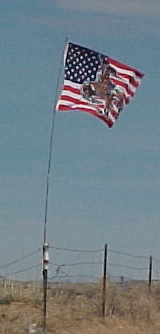
Note: The flag with a Native American waving a weapon flies summertimes near the booths along IH10 as it passes through the Laguna tribal lands. Although the Laguna universally despise the Acoma neighbors neither tribe has engaged in warfare against anyone since 1597.
I spent a while this morning visiting various blogs, groups and reading blasts. Stayed mostly away from the news feeds, however.
But I came away renewed, refreshed and relaxed from all the exercise dodging ricochets of wisdom, originality and profundity.
Found out Love’s a big deal however it happens to be packaged, especially if it’s universal and unconditional (not making any demands), and I was appropriately edified with the knowing of it.
Found out pets are cute and smart, which I hadn’t noticed before,
Found out wild animals wouldn’t hurt a flea, mostly, unless it’s the fault of some human,
Found out humans mostly wouldn’t hurt a flea if they’re properly loved,
Found out millions of chickens spending their lives in lines of 3′ wire cubes a mile long and three deep from egg to hatchet were capable of being subjected to some irony called legal cruelty if they died prematurely by some other than the normal method,
Discovered there’s an amazing breadth of conflicting, mutually exclusive truths floating around,
Discovered the wisest folk on the planet and those most prone to pass one-sentence fragments of that wisdom along to others are those who wish they’d been born with a Tribal Census Number of one sort or another, but who almost certainly weren’t (though they, followed by I, would be the last to say so). The good news is there are plenty more of the same tribe willing to shoot it back at them.
I suppose I’ve almost exhausted that source of wisdom for the moment. Thinking next I’m going to study the labels on food cans.
I probably should have mentioned something else I’m noticing and find a lot more humorous than any of the above:
The emergence of the “I fought in [name a war the US indulged in during the past half century] syndrome. Most don’t come right out and say so, but the great majority attempt to convey a distinct impression they were infantry point men, or at least out where the bullets were flying. And it was tough. The PX, pizzas and whores were all off somewhere different than where they were. Tough and scary with all those meanies trying to get through the wire every night and them laying ambushes on the jungle trails, crawling in tunnels full of snakes and little brown brothers with hand grenades. Unspoken implications they weren’t among the 150/1 REMF [rear-echelon MFs] in Vietnam, not among the 500/1 in everything since.
Naturally all this gets followed by a lot of fawning modern day patriots thanking them for protecting all this freedom we now enjoy, frowning about how little thanks and respect vets get for being vets.
If you hold your mouth right you can get a smile out of this phenomenon. Twist it around a little further and you can even squeeze out a laugh.
REMFs circa 1963
[Edit: Sheeze. Just got an email from someone thought I was saying I was a Vietnam Vet. I’m not. This pic is Korea, 1963. Nobody ever heard of Vietnam yet. That 1st Cav patch – in those days was “The horse we never rode, the line we never crossed and the yellow is the reason why”]
I took the picture but I’ve since then metamorphosed into a point-man with a nasty scowl figuring on getting a Veteran bumper sticker and some thanks for all I must have sacrificed so you modern patriots could stay free, etc etc etc etc etc.
Sometimes I think we old people really are as pathetic as young people believe we are.
10:00 AM afterthought
If lip-service croc-tears patriots actually wanted to say thanks to someone who made a sacrifice they’d pay a visit now and then to a long-term care VA hospital instead of displaying “Support Our Troops” stickers and sloganizing a lot of easy, empty rhetorical cliché. The wheel chair population wasting away forgotten in those hospitals sacrificed something they wanted to keep, even though they probably never believed they did it to protect the freedom of anyone else.
Likely it gets lonesome in there being a has-been swept off into a corner so’s they don’t distract from the enthusiasm for the ones haven’t done their unintentional sacrificing yet. Paying them an occasional visit, taking them a pecan pie, sitting around exchanging lies about wars we fought would get a lot nearer to sincerity than a thousand flags and bumper stickers.
And those guys would welcome it, though they’d have every right to be suspicious and wonder whether the world’s coming to an end.
Taking a breather here and got to thinking about something that happened a few years ago that might be worth relating.
During the post-Y2K financial challenges I substitute taught in the public schools for a while.
Those situations often leave the sub in front of a bunch of kids without any obvious means of spending the time. The regular teach, say, didn’t know he was going to get into a car wreck or have a terrible hangover, so there was sometimes no agenda.
One week I found myself in front of several days of classes of high school seniors. Rather than let them use it for a study hall, I decided to get them talking about what they believe in. Try to get them into a mode of defining it and possibly thinking in ways they hadn’t done so before.
One of the days was spent talking about civilization. What it is. What are the characteristics of a civilization, as opposed to merely a complex society or culture with traditional, defined behavioral norms?
From the beginning, every classroom full of kids believed a society couldn’t call itself a civilization if it condoned slavery within it. They continued believing that (after some discussion) even after I pointed out the fact the US allowed slavery until a century and a half ago. Almost every group of humans we dub ‘civilized’ in history had slaves.
Watching those kids absorb, then adopt the realization that by their own definitions the US couldn’t possibly have been a civilization until the end of the Civil War was fascinating. But they were universally adamant about it, even after thinking about it. When I pointed out further that slavery existed almost all over the world in one form or another until fairly recently in history….REALLY recently they gradually decided most of their recent ancestors weren’t civilized..
Once they’d decided there couldn’t be civilization without civility defined as a respect for some degree of freedom of the individual, they hung tight on it. Those kids decided human beings weren’t civilized anywhere until ‘way after a lot of civilizations (by other definitions) had risen and fallen.
Those were smarter kids than I figured on them being. And perfectly willing to stick by their guns on something they believed in.
Over the course of a few days these kids decided they absolutely believed, following a lot of debate, that due process is the foundation of civilization. They believed wars without due process were criminal, that they were the antithesis of civilization because they failed to respect human life enough to follow their own prescriptions and procedures. They believed killing, mayhem are serious matters worthy of reflection, debate, and a profound respect for doing things thoughtfully and exactly according to law. They believed failure to do so is a symptom of a society withdrawing from the condition we call ‘civilization’.
Toward the end some of them must have ratted me out to their parents. I didn’t get many sub-teaching jobs after that.
I’ve read somewhere that Chicago sold off their City Parking Meters and Towing Services to Arabs, maybe other public services, as well. Evidently some other cities are looking into similar measures, maybe already doing it. Haven’t heard of any National Parks, National Forests or other federal holdings being handed over to the Chinese to allay the servicing of our debt to them, or our trade deficit.
“We’re getting calls from investors from all across Asia who are interested in Idaho,” she said.
Idaho’s location, only another 45 minutes farther by air than Seattle from Asia, will open many opportunities, state and local officials said. The state’s low cost for doing business will help, too.Fact is, the government debt is owned by every US citizen. When the nation is mortgaged the people who hold the note loaned it with some assurance they’d either get the money back, get paid back in kind, or they’d get concessions to their advantage to make the loaning of it worth doing.
There’s no indication that industrial zone in Idaho would put any US citizens back to work, but it might do a lot to put Chinese to work on US soil, so’s they don’t have to ship their products so far to US consumers who can’t manufacture their own products such as toasters, television sets, kids toys and shoes.
I don’t know when we began giving power to strangers. I think it’s a relatively recent phenomenon. Maybe we watched too many Westerns during our formative years, learned from those steely eyed men in saloons that what strangers think about us is worth a gunfight.
Nowadays the extreme version happens in city traffic. Someone shoots someone else a bird. Next step is an exchange of gunfire.
Here’s how the scenario runs:
Some complete stranger pronounces a bias we don’t share.
Our thought response:
“This offends me.”
That thought process is driven by a deeper one:
“I want to be offended. I give this stranger the power to offend me. I assign enough value to what this stranger says, or believes, to allow it to trigger a negative emotional path within me. What this stranger says or believes matters.”
We know better.
Strangers cut too wide a swath in their traits to have any real value. They span the breadth of potential human biases. But even knowing this we give them the power to ruin a moment.
I say this is a recent phenomenon because humans of the past behaved differently. Our forefathers didn’t care what Brits thought about us because they recognized that Brits live within an entirely different set of interests.
Even today a Zuni doesn’t care what a Navajo thinks about anything because from the perspective of a Zuni, Navajos don’t have anything valid to contribute to any meaningful discussion. Navajos live in a different reality from Zunis.
Both Navajos and Zunis choose to allow themselves to be offended by the opinions of Anglos and Hispanics, but there’s a reason. They’ve found taking offense is a means of gaining power over those groups.
But neither a Zuni, nor a Navajo would bother being offended by the thoughts and words of the other because to each there’s nothing the other might think that carries the weight of validity.
Not long ago the same was true of people almost everywhere. The people in the town where I was reared cared about the opinions of people within that town, but they couldn’t have cared less what the people in Clovis, twenty miles away thought. It was generally understood that Clovis people were stupid and might think and say anything.
Today we care what everyone thinks about almost everything. We pretend to believe what they think carries value, but we know better. We just like the feel of being offended..
Make my day, Stranger! I’m handing you the power to offend me.
This leaves me cold.
Human opinion hasn’t held up well under scrutiny. It’s worth about what it costs. Mine aren’t that reliable and I haven’t found those of others to be any better.
We staff members of the New Mexico State Emergency Management Planning and Coordination Bureau [EMPAC] didn’t laugh much. We were a collection of old guys mostly retired from something else, except for a few youngsters, mostly support and training staff.
Radiation Response and Recovery [the RAD catchers] was a retiree Bird Colonel from the US Army named Sam. Hazardous Materials Response and Recovery was headed by Joe, a retired US Air Force Lt. Colonel who’d piloted B47s for the Strategic Air Command in his youth. Joe sat at the end of a runway in a B47 loaded with hydrogen bombs for two weeks during the Cuban Missile Crisis. Natural Disasters – Earthquake Preparedness was a shot-up in-Vietnam old Lt. Colonel, infantry. And so on. My program was Flood Plain Management and local coordination and training for one of the regions. Too long out of the military to remember whether I was enlisted or an officer.
Our Bureau Chief, Larry, was a retired Master Sergeant, US Army Search and Rescue, another Vietnam vet. An enlisted man coordinating the activities of field grade officers, giving instructions, approving their work and their per diem expenditures would have been a potential source of laughter if we’d all held our mouths right, but “That’s what happens when you put an enlisted man doing the job of an officer,” was a frequent grumble every time something went awry.
The staff meeting was in the bomb shelter of the old National Guard Headquarters building in Santa Fe where our offices were located.
“I had a weird call from one of the aids to the Governor this morning.”Larry’s eyes searched our dozen blank faces. “Any of you know anything about Y2K?” Calls from the Governor’s office to anyone at EMPAC was bad news. We liked to think we were invisible, nobody knew we existed. This particular governor, however, we considered a space cadet. A flake.
We all exchanged scowls while my mind toyed with the phrase. “Y2K. Y2K? Where the hell have I heard about Y2K lately?” The thing rang a bell in my head, but I couldn’t think why.
“The Gov just got back from a meeting of the Association of State Governors. They did a big program on Y2K. He’s all excited about it. Evidently there’s some damned thing going on with computers to make them all fail January first, 2000.” Sneers and a chuckle or two. We all agreed on something.
“Do any of you know what other states are doing? Any ideas what we should be doing? We have to send an answer over to the Gov’s office. We have to put together a plan of some kind.”
Background rumble around the table. “Y2K? Why the hell would all the computers crash when the 20th century turns over?” “Damned idiot governor.”
“Hmmm computers. That’s it.” Now I remembered.
“It’s all a farce, Larry.” I was remembering a conversation and exchange of emails I’d had with my ex-wife. “Carolyn heads the department in Texas that’s supposed to be preparing for it. She told me a while back they were spending a lot of money on it, hiring a lot of people. Pissed her off when I said it was just another bureaucratic scare plot to build more empires.”
Larry stared at me, mind busy with what I’d said. “Could you find out what they are doing over there?”
“Sure. Why not?”
“Also, get on the internet. Find out what people are saying is going to happen. Find out everything you can about what all the other states are doing.”
The others in the room relaxed a little. No one wanted this project and now it was clearly mine. “How much time do you want me to spend on this?”
“A week. Two maybe. We just need to put together a plan that makes sense.”
As I left the staff meeting I was feeling pleased with the diversion this offered me. Something away from flood plain management and routine emergency management coordination. I didn’t expect it to be any problem at all.
I began by sending an email to Carolyn. This was the response I got:
“The Year 2000 deal is a real threat. Lots of people have been doing lots of
work to mitigate the consequences, and we’re still ‘influencing the future’.
The real problem is that we can generally fix what we know about, but there is so much we don’t know.
For example, the power grid – there are many many power generators and power distributors in this country, and many “embedded systems” in each company. Some companies are taking the problem seriously by contacting their suppliers (of power grid equipment, as an example) to see if components will work.
Afraid of litigation, the manufacturers hem and haw around and provide no definitive data. Yes, I think there will be power outages, thus water problems, heating problems, etc, but I don’t think the whole US will go dark, and we still have some time to work on it.
One scenario I’ve heard is that elect. companies will work to distribute what power they have so that rolling black or brown outs will limit the negative affects of the power failures.
Some good news, the banking industry in the US is in very good shape. Our only fear there is fear itself. I think a lot of IT systems are being corrected at a more rapid pace than originally anticipated, and governors like yours and mine are at least anticipating problems so they can prepare for them. I think if the people anticipate the problems, and know that someone has already developed a work around, we’ll be fine.
Any disruptions will probably be short lived. I could go on, but duty calls. C.
I trusted Carolyn about as much as any man can trust an ex-wife after 25 years of marriage.
I didn’t know it yet, but for me this began the end of one lifetime and heralded the start of another.
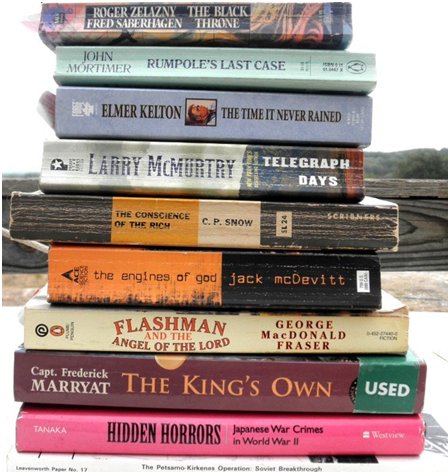
Leavenworth Papers #17 – The Petsamo-Kirkenes Operation: Soviet Breakthrough and Pursuit in the Arctic, October 1944, Major James F Gebhardt,Combat Studies Institute, US Army Command and General Staff College, 1948
Detailed examination of the Soviet success in the offensive attempting to identify what the US military should learn from it. Concluded light infantry to be the weapon of choice in arctic warfare. Examines the lessons learned by the Germans fighting under those conditions.
Good read for those interested in such matters.
Hidden Horrors – Japanese War Crimes in World War II, Yuki Tanaka, Transitions: Asians and Asian Americans Series, 1996
The Contents describes it better than I can:
1. The Sandakan POW Camp and the Geneva Convention
2. The Sandakan Death Marches and the Elimination of POWs
3. Rape and War: The Japanese Experience
4. Judge Webb and Japanese Cannibalism
5. Japanese Biological Warfare Plans and Experiments on POWs
6. Massacre of Civilians at Kavieng
Conclusion: Understanding Japanese Brutality in the Asia-Pacific War
Tanaka elaborates on the collaboration between the US and Japan to cover-up and downplay many of these events because of the post-WWII need for Japan as a strong Pacific partner against Communist aggression. Many were not investigated, prosecuted, even mentioned again in public media.
Fifty years after the Japanese surrender Tanaka writes: “Consequently, we Japanese have failed to recognize ourselves as aggressors, still less as perpetrators of war crimes. Moreover, because of the widespread perception of ourselves as victims of war, the notion of “victim” gradually expanded even to the point that the Japanese state was also seen as a victim of war.”
Reveals various deals made between the US Command under Dugout Doug and the Japanese commanders who conducted human lab experiments on POWs. Immunity from prosecution in return for everything learned in the experiments.
The King’s Own – Captain Frederick Marryat
Marryat’s a worthy read. He was a British Navy Captain when he retired in the 1820s and began publishing fiction works based on his experiences. His writings almost certainly were foundations for Horatio Hornblower and a lot of other sea yarn characters in fiction series during the 20th Century.
Marryat’s the daddy and granddaddy of them all.
Flashman and the Angel of the Lord, George MacDonald Frazer
The Flashman series is possibly the most laughing [and among the most educational] historical fiction series ever written.
I thoroughly resent Frazer dying before he wrote several more of them, though I re-read the ones he did write at least one time every decade. He’s welcome to resent me dying off without reading them again if it works out that way.
The Flashman Papers in Chronological order
Flashman [Britain, India and Afghanistan, 1839-42]
Royal Flash [England, 1842-43, Germany 1847-48]
Flashman’s Lady [England, Borneo, Madagascar 1842-45]
Flashman and the Mountain of Light [Indian Punjab 1845-46]
Flash for Freedom [England, West Africa, USA, 1848-49]
Flash and the Redskins [USA 1849-50 and 1875-76]
Flashman at the Charge [England, Crimea and Central Asia 1854-55]
Flashman in the Great Game [Scotland, England1856-58]
Flashman and the Angel of the Lord [India, South Africa, USA, 1858-59]
Flashman and the Dragon [China, 1860]
The Engines of God, Jack McDevitt
Respectable and readable sci-fi.
The Conscience of the Rich, CP Snow
Strange and unsettling book. Published during the 1950s the title’s an anachronism to such an extent the reader feels a bit lost at the beginning, figuring on some class warfare thing that would have found that name a decade later.
In fact, it’s probably the book Maugham would have written in Of Human Bondage if he’d been writing about a family of Jewish aristocrats in Britain during the 1920s and 1830s. The intractable controls imposed by the Jewish family on personal choices of family members in almost every facet of their lives.
Unsettling, but a worthy read.
Telegraph Days – Larry McMurtry
That original McMurtry book where he decided to become Louis L’Amour wasn’t bad, certainly a lot better than some that came later. I’d put Telegraph Days somewhere up near the top of his work since he became the great American novelist trying to push L’Amour out of the way.
The Time it Never Rained – Elmer Kelton
Good read about that pivotal time in the relationship between independent ranchers in the west and the US government, coincident with the drought of the 1950s.
Rumpole’s Last Case – John Mortimer
Another good Rumpole. What more needs saying?
The Black Throne – Roger Zelazny and Fred Saberhagen
Saberhagen books were always considered safe to buy at a quarter in the thrift stores until this one. I imagine it wasn’t him dropped the ball, but maybe it was just a pot-boiler for both of them. The writing craft is what’s at fault. Everything’s there, crisp dialogue, plot, characters with some depth. Good command of the language.
But something’s missing. I wouldn’t spend a quarter on it next time if I can remember when I see it again in a thrift store.
Retired university librarian. Oblique political humor of a liberal slant, frequently a smiler, sometimes a chuckler or horselaugher.
If you know more about politics than I do you might enjoy it even more. To me they’re just faces sometimes attached to names, but fun and interesting.
“Airplanes, cats, guns, war, the more than occasional rant about the party of the Confederacy, the spinelessness of the Democrats and crap about anything else that flits through the somewhat offbeat mind of an armed lesbian pinko as she slides down the Razor Blade of Life.”
I’m not crazy about a lot of the content, but the airplane pics she posts are worth the price of admission and reading the posts offers a different slant on things worth chewing on.
If you’re one of those folks who believe you ‘don’t like’ the works or Renaissance writers you might be the victim of having been forced to read the wrong ones by academians. Fact is the period includes some of the most entertaining writing mankind has ever been guilty of producing. Rabelais is one such example.
Academian praisers of Rabelais and this particular work have already expressed a lot of the truths to be found here, the exquisite style, the masterly satire. All they say is true and would be reason enough to read Gargantua and Pantagruel. I won’t repeat those laurels to affirm them. Instead, I’ll say it’s gutter crude, frequently barnyard humor with more levels than Grand Central Station.
Hilarious work.
But I’ll suggest another reason a segment of readers might find Rabelais interesting. Followers of the Thelemic ‘tradition’ created by Alister Crowley during the early 1900s might be surprised to discover Crowley’s claims to having channeled the doctrine from Horus in Cairo in 1910, were preceded by Rabelais several centuries earlier. Rabelais creates an imaginary monastery and sect of monks he names, “Thelema”, where a sign above the entry reads, “DO AS YOU WILL”. Sound familiar?
Give this book a chance. If you do you won’t regret it unless you offended by violations of polite discourse.
But if you read it as an admirer of Crowley’s channeling be prepared to have some of your balloons deflated, lean back and enjoy butchering of a sacred cow for the barbecue.
74 years old, a resident of Leavenworth, KS, in an apartment located on the VA campus. Partnered with a black shorthaired cat named Mister Midnight. (1943-2020)
Since April, 2020, this blog is maintained by Jeanne Kasten (See "About" page for further information).
https://sofarfromheaven.com/2020/04/21/au-revoir-old-jules-jack-purcell/
I’m sharing it with you because there’s almost no likelihood you’ll believe it. This lunatic asylum I call my life has so many unexpected twists and turns I won’t even try to guess where it’s going. I’d suggest you try to find some laughs here. You won’t find wisdom. Good luck.

 Have you ever considered how much time, energy, money and lousy grades could be avoided if world history could be summarized for the kiddos into videos lasting a few minutes? For instance, consider the European conquests of Africa, the American continents, and India. The chillerns spend all kinds of time having to memorize the nigglingest details and names the teachers can’t even pronounce. Pizzzzarrro. Montezooooma. Courtessss. Geroneeemo. Krazyhorse. Not to mention the even worse ones in Africa and India.






 So Far From Heaven