Tag Archives: personal

Thumbing Rides on Throwaways


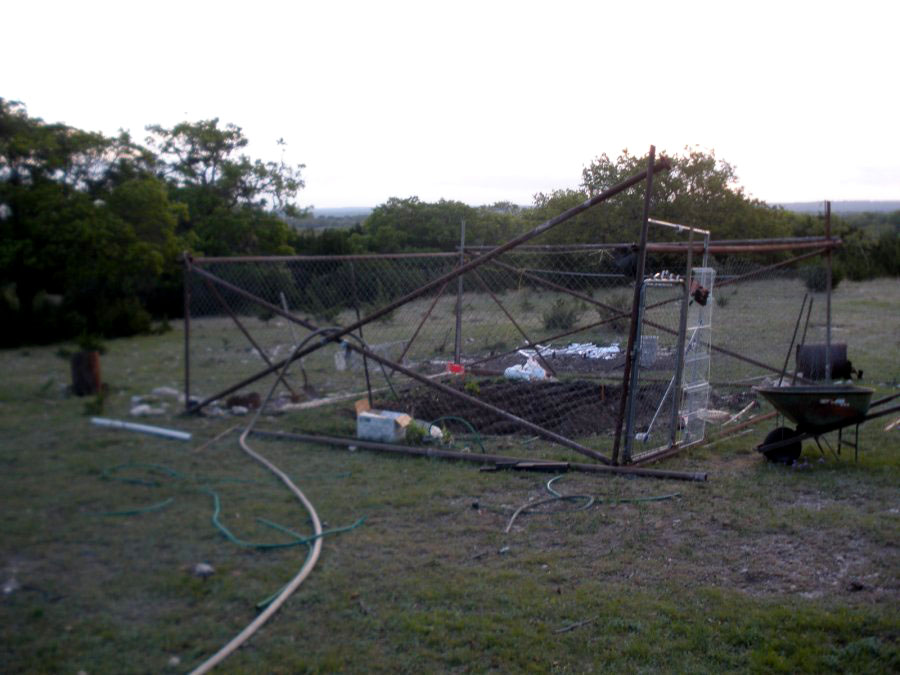
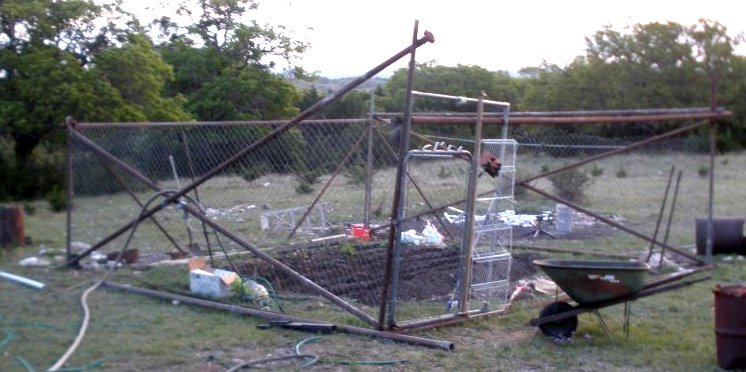
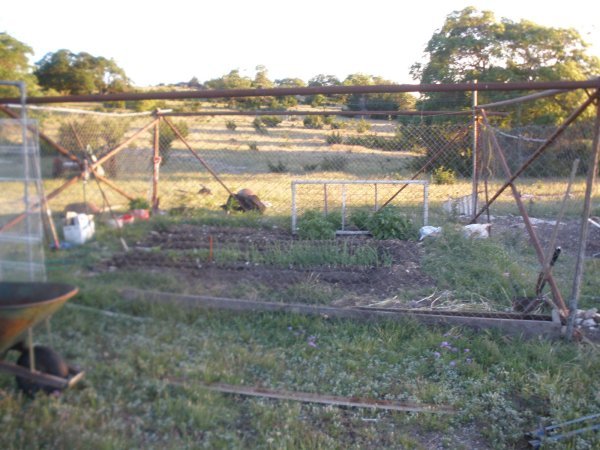
I’m a lucky man because I don’t have the money to go buy ready-rolls when it comes to getting done what needs doing. In this instance I needed a garden, but I didn’t want 86 deer, 23 wild hogs and a dozen chickens in there being Communists 24/7 messing up my diggings. But I also din’t want to have to be digging holes to support any fence I wanted to put the trouble into erecting. The layered limestone wasn’t in a mood to give up any ground in favor of having posts stuck in it.

This place has a lot of old pipe lying around wishing someone would find a use for it, so a few pieces of it became the mainstay for the structural side of the job. There were other things up behind the buildings around the owner’s workings pricking him in the conscience by not being used, as well.

A roll of 3-times used/3 times discarded chain link was also among them crying for a job after being out of work longer than a US factory worker after the guys the patriots love sent all their holdings off to be done in Mexico and China to manufacture and sell back to us.

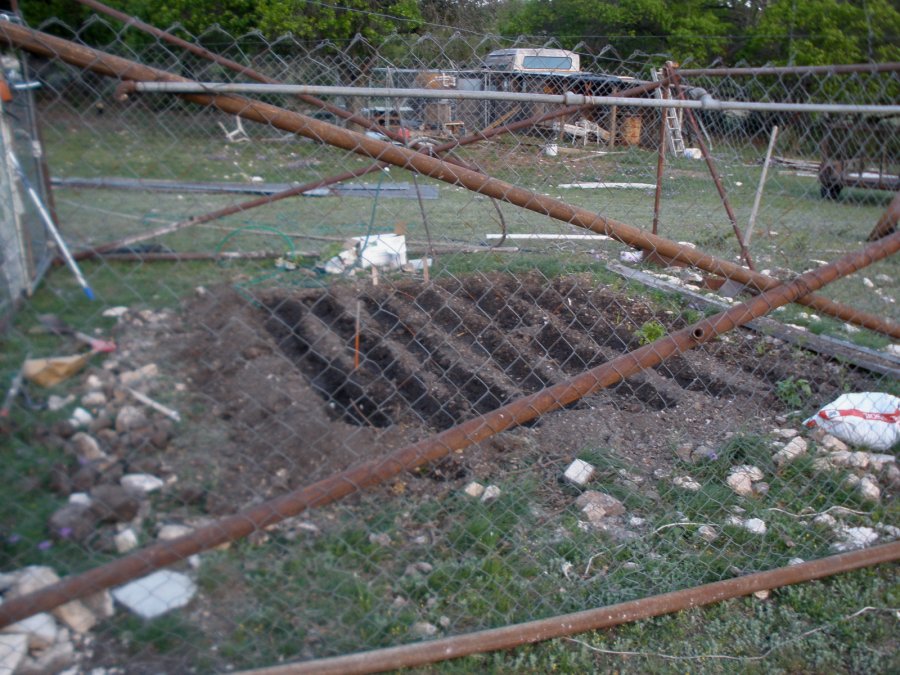
The ‘frame’ includes two welded steel triangles used to support something long forgotten, a bit of galvanized discarded water pipe, and that’s about all besides one hell of a lot of tie-wire. Ah. There’s that gate frame gives it some support on this end. But it’s strong, self-supporting and didn’t need any violations of the sanctity of the limestone substrata to allow it to become respectable.


I lacked a couple of feet having enough chain link so I made up the difference with the refrigerator shelves wired together you see beside the gate.


The whole shebang is pulled inward against itself by wires stretched across crosswise, lengthwise and diagonally from the corners, but held back from collapsing inward by the horizontal pipes. Meanwhile the chain link keeps it from falling outward.

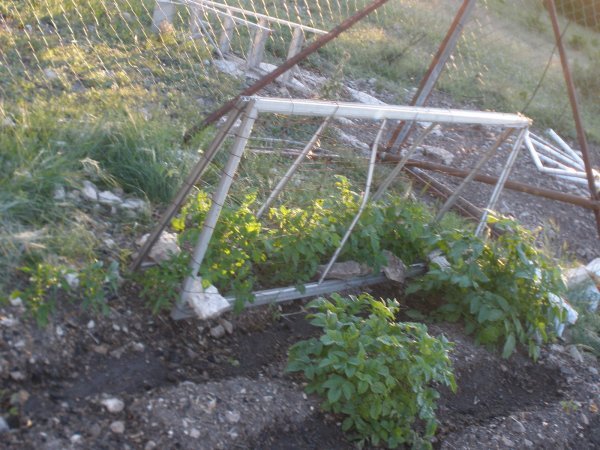
Meanwhile, I needed support for my tomato plants:


Two scrap illuminum storm doors and old goatwire served the need.

The only cost of this fence in dollars was a couple of rolls of tie wire.


One more bug scraped off the windshield of life.

White Trash Papa rides again.

HiiiiiOhhhhhhhh Silver! Awaaaaaay!

Old Jules

Marty Robbins – Little Green Valley

http://youtu.be/WT5qegD28Wo

Misplaced Worries

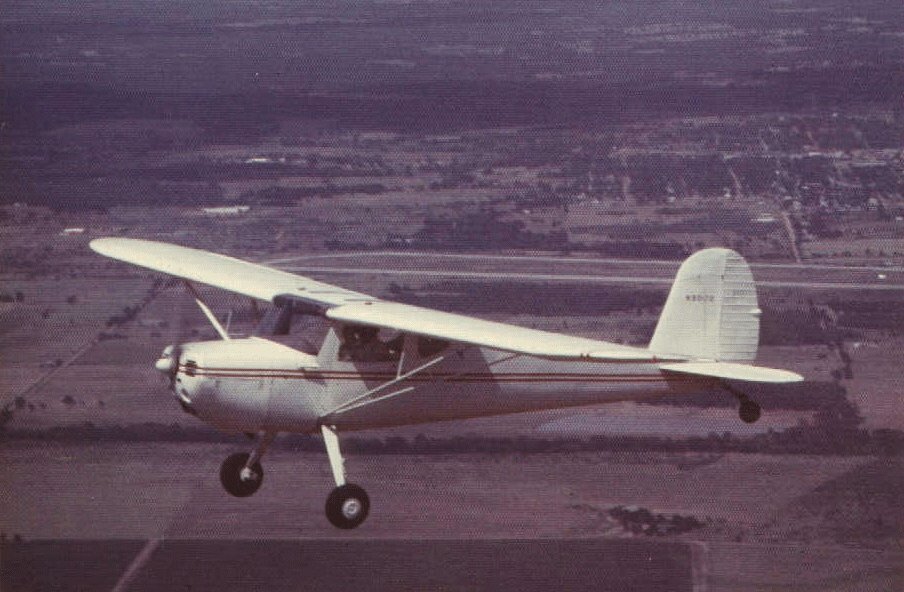
Writing an earlier y2k entry got me thinking how often we humans tend to worry about the wrong things.  Reminded me of a guy I used to fly with a bit during the late 1970s named John Rynertson.  John was a man who flew a blue Cessna 120.  It was a lot like the 140 Helldragger I flew (pictured above).  But he was also a man prone to introduce himself to people around the Killeen, Texas airport as “one of the best pilots around”.

Naturally there were those who didn’t favor his self-introductions involving pilot skills.

John wasn’t a man who could claim a lot of friends.  But he did have a wife almost as desirable as that 120 he flew.  So pretty, she was, that whenever he wasn’t flying, John was worrying about her.  He fretted over what she might be doing when he was off flying, or when he was almost anywhere he couldn’t keep an eye on her.  Which was a good bit of the time.  Old John just worried himself silly about that woman.

Then one day he was flying with some warrant officer from Fort Hood and managed to get more airspeed than that old airframe was willing to put up with.  The 120 wasn’t rated for snap rolls.  But being one of the best pilots around, John just naturally figured they weren’t referring to him when they rated the airplane.  Wings came spang off that mama at about 3,000 feet above the ground.

Turned out John didn’t need to be worrying about what his wife was doing.  If he was going to worry, he needed to be focusing on learning to stay alive and fly at the same time.

Whatever his wife might or mightn’t have been doing while he was alive, she certainly did it after he was grease scattered over an acre of ground.

Similarly, I recall all those kids who used to spend all their time worrying about getting drafted for Vietnam, then overdosed on something and ended up corpses right here in the good old US of A with never having been fired at in anger.

A person needs to use a lot of care, consult an internal map, look at the compass and GPS, picking things to be worried about.  Otherwise he’ll spend all his time worrying about things that don’t happen while the things that do sneak up behind him and tap him above the ear with a ball-peen hammer.
Old Jules

Nat Shilkret & The Victor Orchestra – Lucky Lindy
http://youtu.be/kflQSovXfw0

So. What do you think?

So.  What do you think?

I’ve never read anywhere that it happens this way, never heard anyone say they think so.  Which doesn’t mean that’s not what happens.

The EEG flattens, the body falls, spasms, something exits.

That thing that exits hangs around out in the ether trying to figure out how it got there for a while.  Then comes a voice:

“SO.  WHAT DO YOU THINK?”

Looking around isn’t an option.  It’s the first input for a while, so the hanging-around something ponders the question a while before deciding on an answer.

“I sure do like them Dodgers.”

“NO. What do you THINK?”

The hanging -around something senses some urgency in the query.  Something might be important, and the something is beginning to suspect it’s no longer alive.

“I don’t like illegal aliens, Moslems or welfare.  I love God.  I always wanted to travel and wanted my son to play football.”

Long, endless pause.

Finally the hanging-around something begins to wonder whether the voice is still present, waiting.  In life it was always best to come right out with things, so the hanging-around-something tried to turn the situation around.

“What do YOU think?”

The ether vibrates with something akin to an opening door, a shrug in the air, finality.

“I’M NOT REAL IMPRESSED WITH HUMANITY.”

The door closes.

Leonard Cohen–Everybody Knows
http://www.youtube.com/watch?v=9F8QM3tjkTE

9:30 AM:

Maybe I should have clarified the question from the beginning.

Seems to me the answers we give to life’s crucial questions are almost never truly spontaneous, but also never the product of clear, careful thinking applied inside skulls by our own brain cells.  The body of data we package and label, “What I think” is actually something we had little, or nothing to do with.  Rather than examine the source of how we came to ‘think’ it, we just pick it out of the cosmic data pool we percieve as ‘common sense’ and place it lovingly in the folder of what’s important in our lives without giving it any thought at all.

But because we’ve taken ownership of it, staked out claim to it, assigned a value to it, [all done on autopilot] it’s been elevated to the level of truth.

Now we rub our hands together in satisfaction and pronounce, “I think”

Somewhere, someone, sometime needs to actually do it occasionally.

I happen to believe I ought to be one of them, but I’m lousy at it, falling down on the job.  My gut feel is that probably everyone ought to be one of them, but it’s plain they’re lousy at it too, falling down on the job.

Old Jules

The Runaways, 1947

Causey, New Mexico, was a dot in the road.  Pavement from nowhere to nowhere running between a scattering of frame houses, a small roadside store and gas station.  A rock schoolhouse, a church, and a few rusting hulks of worn out farm machinery in the weeds. http://www.ghosttowns.com/states/nm/causey.html

Our cottage was on the same side of the road as the schoolhouse.  Most of the village was on the other side, including the windmill across the road from our house where my sister and I went for water and carrying the bucket between us to tote it home.

To my tiny, four-year-old mind, the center of town was the store, diagonally across the road, to the left of the windmill.  Everything of importance happened there.  Cars from other places stopped for gas.  The store had Milk Nickles.  Ice cream on a stick, covered with chocolate.  Pure heaven that didn’t come often.

If the store was heaven, behind our house was hell.  The toilet.  A ramshackle tower with dust flecks floating in the shafts of light that came through the cracks between the boards, light coming through underneath where the ground had caved away from the wall.  Home of black widow spiders and the occasional rattlesnake.  The place was a chamber of terrors for me.  I was always certain I’d fall through the hole to the horrors beneath when I used it.

Our little cottage had two rooms.  A sort of kitchen, living area in front also had a little counter where my mom tried to operate a little variety store.  Keychains, trinkets, a handkerchief or two.  Things that wouldn’t be found across the street at the store.

She was also a seamstress.  Most of my memories of that time include her huddled over a treadle sewing machine working on the felt curtains she was making for the stage of the school auditorium.  Mom was a woman twice divorced.  In 1947, that was no small thing.  In that time and place broken marriage was considered to be the fault of an untrained, unskilled, unwise, probably immoral woman.  Two divorces, three children, and no resources made my mother the subject of mistrust by the woman of the community, and disdain by the men.

Memories have probably faded and altered with the half century since all this happened.  The perspectives of a child plagued with fears and insecurities seem real in my recollections, but they, too, have probably been twisted with the turns and circles the planet has made around the sun; with the endless webs of human interactions, relationships formed and ended.

My sisters went to school in that village.  Frances, my sister who died a few years ago, must have been in the second grade.  Becky, maybe in the 5th.  I hung around doing whatever preschoolers do in that environment when everyone else is busy.  I have flashing memories of standing by the road throwing rocks at cars; trying to get the little girl down the road to show me her ‘wet-thing’.

I remember being lonely; of wishing aloud my mom would give me a little brother to play with.  “I wish I could,” she’d reply, “but you tore me up so much when you were born, I can’t have any more kids.”

That trauma of my birth was a favorite theme of my mom.  She was fond of telling me how the doctors were long arriving when I was ready to be born;  how a nurse and my dad held her legs down so I couldn’t emerge until the proper people were there.  How it damaged her insides and caused her to have to undergo all kinds of surgery later.

I recall I felt pretty badly about that.

During harvest season it seemed to me the entire community turned out to work in the fields.  We’d all gather in the pre-dawn at the store, then ride together to the cotton fields in the back of an open truck.  Mom and the girls were all there, along with the neighbors and some of their kids.  Two of the kids were about my age:  Wayne and Sharon Landrum.

In retrospect I doubt we preschoolers helped much.  My mom had put a strap on a pillowcase and promised a Milk-Nickle every time it was filled.  This was probably more to keep me busy and out of trouble than it was to pay for the ice cream bar.  I can’t imagine that a pillowcase would have held the ten pounds of cotton it would have taken to pay a nickle.

The lure of sweets weren’t sufficient to occupy smaller kids, I suppose.  There came a time when Wayne, Sharon, and I wandered off from the field.  At first it was just to take a walk, but the road was long and we must have made some turns.  Before too long we’d gotten so far from the farm we didn’t know the way back.  We were frightened and kept moving.

In the end we found the lights of a farmhouse sometime after dark.  The family brought us inside and fed us something.  We sat around a stove trying to keep warm until some of the searchers came and picked us up.

In the morning at the store all those field workers who’d had to lose part of a day of wages wanted vivid descriptions of the spankings we got.  They wanted to make sure.

That was my first experience with running away, at least on my own part.  My mom had done some of it, running away from my dad and her second husband.  My dad had done some of it, letting his kids go off, first to Arizona into the shelter of a brutal, drunken step-dad, then into the shack in Causey.

Old Jules

Johnny Cash– In Them Old Cotton Fields Back Home
http://www.youtube.com/watch?v=1vCK8mSyhb0

Internet Wisdom

I spent a while this morning visiting various blogs, groups and reading blasts.  Stayed mostly away from the news feeds, however.

But I came away renewed, refreshed and relaxed from all the exercise dodging ricochets of wisdom, originality and profundity.

  • Found out Love’s a big deal however it happens to be packaged, especially if it’s universal and unconditional (not making any demands), and I was appropriately edified with the knowing of it.
  • Found out pets are cute and smart, which I hadn’t noticed before,
  • Found out wild animals wouldn’t hurt a flea, mostly, unless it’s the fault of some human,
  • Found out humans mostly wouldn’t hurt a flea if they’re properly loved,
  • Found out millions of chickens spending their lives in lines of 3′ wire cubes a mile long and three deep from egg to hatchet were capable of being subjected to some irony  called legal cruelty if they died prematurely by some other than the normal method,
  • Discovered there’s an amazing breadth of conflicting, mutually exclusive truths floating around,
  • Discovered the wisest folk on the planet and those most prone to pass one-sentence fragments of that wisdom along to others are those who wish they’d been born with a Tribal Census Number of one sort or another, but who almost certainly weren’t (though they, followed by I, would be the last to say so).  The good news is there are plenty more of the same tribe willing to shoot it back at them.

I suppose I’ve almost exhausted that source of wisdom for the moment.  Thinking next I’m going to study the labels on food cans.

Old Jules

http://www.pcworld.com/article/137100/the_10_funniest_sites_on_the_internet.html

8:00 AM afterthought

I probably should have mentioned something else I’m noticing and find a lot more humorous than any of the above:

The emergence of the “I fought in [name a war the US indulged in during the past half century] syndrome.  Most don’t come right out and say so, but the great majority attempt to convey a distinct impression they were infantry point men, or at least out where the bullets were flying.  And it was tough.   The PX, pizzas and whores were all off somewhere different than where they were.  Tough and scary with all those meanies trying to get through the wire every night and them laying ambushes on the jungle trails, crawling in tunnels full of snakes and little brown brothers with hand grenades.  Unspoken implications they weren’t among the 150/1 REMF [rear-echelon MFs] in Vietnam, not among the 500/1 in everything since.

Naturally all this gets followed by a lot of fawning modern day patriots thanking them for protecting all this freedom we now enjoy, frowning about how little thanks and respect vets get for being vets.

If you hold your mouth right you can get a smile out of this phenomenon.  Twist it around a little further and you can even squeeze out a laugh.

REMFs circa 1963

[Edit:  Sheeze.  Just got an email from someone thought I was saying I was a Vietnam Vet.  I’m not.  This pic is Korea, 1963.  Nobody ever heard of Vietnam yet.  That 1st Cav patch – in those days was “The horse we never rode, the line we never crossed and the yellow is the reason why”]

I took the picture but I’ve since then metamorphosed into a point-man with a nasty scowl figuring on getting a Veteran bumper sticker and some thanks for all I must have sacrificed so you modern patriots could stay free, etc etc etc etc etc.

Sometimes I think we old people really are as pathetic as young people believe we are.

10:00 AM afterthought

If lip-service croc-tears patriots actually wanted to say thanks to someone who made a sacrifice they’d pay a visit now and then to a long-term care VA hospital instead of displaying “Support Our Troops” stickers and sloganizing a lot of easy, empty rhetorical cliché.  The wheel chair population wasting away forgotten in those hospitals sacrificed something they wanted to keep, even though they probably never believed they did it to protect the freedom of anyone else.

Likely it gets lonesome in there being a has-been swept off into a corner so’s they don’t distract from the enthusiasm for the ones haven’t done their unintentional sacrificing yet.  Paying them an occasional visit, taking them a pecan pie, sitting around exchanging lies about wars we fought would get a lot nearer to sincerity than a thousand flags and bumper stickers.

And those guys would welcome it, though they’d have every right to be suspicious and wonder whether the world’s coming to an end.

Civility and Civilization

Hi blogsters:

Taking a breather here and got to thinking about something that happened a few years ago that might be worth relating.

During the post-Y2K financial challenges I substitute taught in the public schools for a while.

Those situations often leave the sub in front of a bunch of kids without any obvious means of spending the time. The regular teach, say, didn’t know he was going to get into a car wreck or have a terrible hangover, so there was sometimes no agenda.

One week I found myself in front of several days of classes of high school seniors. Rather than let them use it for a study hall, I decided to get them talking about what they believe in. Try to get them into a mode of defining it and possibly thinking in ways they hadn’t done so before.

One of the days was spent talking about civilization. What it is. What are the characteristics of a civilization, as opposed to merely a complex society or culture with traditional, defined behavioral norms?

From the beginning, every classroom full of kids believed a society couldn’t call itself a civilization if it condoned slavery within it. They continued believing that (after some discussion) even after I pointed out the fact the US allowed slavery until a century and a half ago. Almost every group of humans we dub ‘civilized’ in history had slaves.

Watching those kids absorb, then adopt the realization that by their own definitions the US couldn’t possibly have been a civilization until the end of the Civil War was fascinating. But they were universally adamant about it, even after thinking about it. When I pointed out further that slavery existed almost all over the world in one form or another until fairly recently in history….REALLY recently they gradually decided most of their recent ancestors weren’t civilized..

Once they’d decided there couldn’t be civilization without civility defined as a respect for some degree of freedom of the individual, they hung tight on it. Those kids decided human beings weren’t civilized anywhere until ‘way after a lot of civilizations (by other definitions) had risen and fallen.

Those were smarter kids than I figured on them being. And perfectly willing to stick by their guns on something they believed in.

Over the course of a few days these kids decided they absolutely believed, following a lot of debate, that due process is the foundation of civilization. They believed wars without due process were criminal, that they were the antithesis of civilization because they failed to respect human life enough to follow their own prescriptions and procedures. They believed killing, mayhem are serious matters worthy of reflection, debate, and a profound respect for doing things thoughtfully and exactly according to law. They believed failure to do so is a symptom of a society withdrawing from the condition we call ‘civilization’.

Toward the end some of them must have ratted me out to their parents. I didn’t get many sub-teaching jobs after that.

Old Jules

White Trash Repairs: Throwing Down the Gauntlet

It’s a slow day here, is the reason I’m posting this.  It’s not because I was over reading White Trash Repairs/There, I Fixed It – Repairs blog http://thereifixedit.failblog.org/ and got riled with their uppidy attitudes.

No, I just feel a need to be forthright about the kind of person I choose to be.  Maybe that can best be expressed with a sneak preview of some projects I’ll be discussing here later.

After I haul some more rocks the above is going to be a woodshed with a watertight roof.  The hot tub was on the porch when I moved here, cracked, home to wildlife.  Now it’s metamorphosing into an eventual place to keep my firewood dry.
There’s a lot of work yet to be done raising that roof a few more feet.

Then there’s this.  A nesting box for brooding hens to keep them separate until the chicks are old enough to mix with the flock, but still protected from predators.  Refrigerator shelves cut down to fit the cable spool, mounted on a sawed-in-half lawn mower platform for mobility:

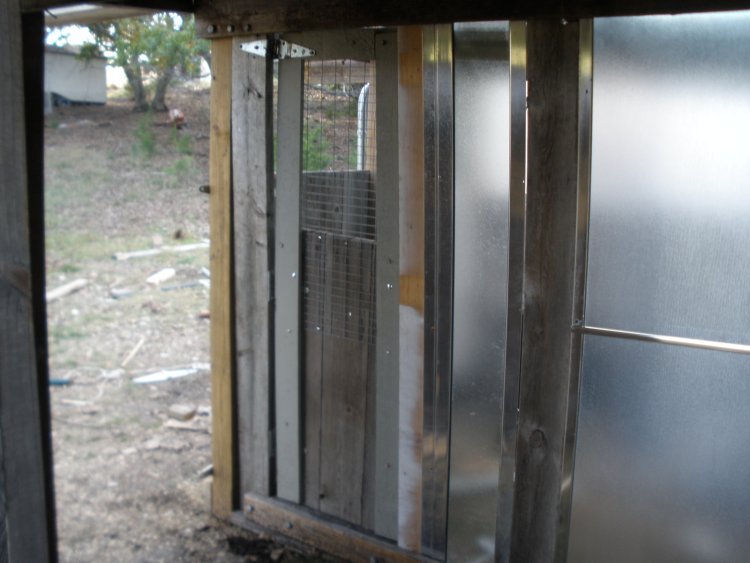
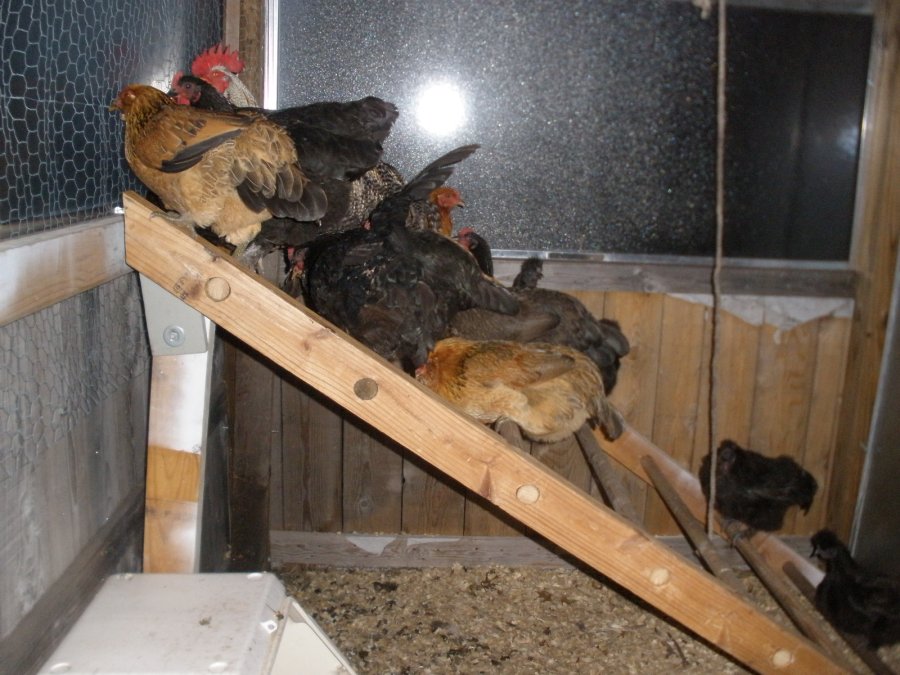
Or this:  A chicken-house fabricated entirely from salvage, discarded shower doors, camper shell roof, refrigerator shelves, whatever came to hand free:


There.  I fixed it.

Old Jules

Make my day, stranger!

I don’t know when we began giving power to strangers. I think it’s a relatively recent phenomenon. Maybe we watched too many Westerns during our formative years, learned from those steely eyed men in saloons that what strangers think about us is worth a gunfight.

Nowadays the extreme version happens in city traffic. Someone shoots someone else a bird. Next step is an exchange of gunfire.

Here’s how the scenario runs:

Some complete stranger pronounces a bias we don’t share.

Our thought response:

“This offends me.”

That thought process is driven by a deeper one:

“I want to be offended. I give this stranger the power to offend me. I assign enough value to what this stranger says, or believes, to allow it to trigger a negative emotional path within me. What this stranger says or believes matters.”

We know better.

Strangers cut too wide a swath in their traits to have any real value. They span the breadth of potential human biases. But even knowing this we give them the power to ruin a moment.

I say this is a recent phenomenon because humans of the past behaved differently. Our forefathers didn’t care what Brits thought about us because they recognized that Brits live within an entirely different set of interests.

Even today a Zuni doesn’t care what a Navajo thinks about anything because from the perspective of a Zuni, Navajos don’t have anything valid to contribute to any meaningful discussion. Navajos live in a different reality from Zunis.

Both Navajos and Zunis choose to allow themselves to be offended by the opinions of Anglos and Hispanics, but there’s a reason. They’ve found taking offense is a means of gaining power over those groups.

But neither a Zuni, nor a Navajo would bother being offended by the thoughts and words of the other because to each there’s nothing the other might think that carries the weight of validity.

Not long ago the same was true of people almost everywhere. The people in the town where I was reared cared about the opinions of people within that town, but they couldn’t have cared less what the people in Clovis, twenty miles away thought. It was generally understood that Clovis people were stupid and might think and say anything.

Today we care what everyone thinks about almost everything. We pretend to believe what they think carries value, but we know better. We just like the feel of being offended..

Make my day, Stranger! I’m handing you the power to offend me.

This leaves me cold.

Human opinion hasn’t held up well under scrutiny. It’s worth about what it costs. Mine aren’t that reliable and I haven’t found those of others to be any better.

Instrumental Theme to Dirty Harry:
http://youtu.be/ZDKRD2q3bYo

Slouching into the Millennium – August 1998

The Beginning

We staff members of the New Mexico State Emergency Management Planning and Coordination Bureau [EMPAC] didn’t laugh much.  We were a collection of old guys mostly retired from something else, except for a few youngsters, mostly support and training staff.

Radiation Response and Recovery [the RAD catchers] was a retiree Bird Colonel from the US Army named Sam.  Hazardous Materials Response and Recovery was headed by Joe, a retired US Air Force Lt. Colonel who’d piloted B47s for the Strategic Air Command in his youth.  Joe sat at the end of a runway in a B47 loaded with hydrogen bombs for two weeks during the Cuban Missile Crisis.  Natural Disasters – Earthquake Preparedness was a shot-up in-Vietnam old Lt. Colonel, infantry.  And so on.  My program was Flood Plain Management and local coordination and training for one of the regions.  Too long out of the military to remember whether I was enlisted or an officer.

Our Bureau Chief, Larry, was a retired Master Sergeant, US Army Search and Rescue, another Vietnam vet. An enlisted man coordinating the activities of field grade officers, giving instructions, approving their work and their per diem expenditures would have been a potential source of laughter if we’d all held our mouths right, but “That’s what happens when you put an enlisted man doing the job of an officer,” was a frequent grumble every time something went awry.

The staff meeting was in the bomb shelter of the old National Guard Headquarters building in Santa Fe where our offices were located.

“I had a weird call from one of the aids to the Governor this morning.”Larry’s eyes searched our dozen blank faces. “Any of you know anything about Y2K?”   Calls from the Governor’s office to anyone at EMPAC was bad news.  We liked to think we were invisible, nobody knew we existed.  This particular governor, however, we considered a space cadet.  A flake.

We all exchanged scowls while my mind toyed with the phrase. “Y2K. Y2K? Where the hell have I heard about Y2K lately?” The thing rang a bell in my head, but I couldn’t think why.

“The Gov just got back from a meeting of the Association of State Governors. They did a big program on Y2K. He’s all excited about it. Evidently there’s some damned thing going on with computers to make them all fail January first, 2000.” Sneers and a chuckle or two.  We all agreed on something.

“Do any of you know what other states are doing? Any ideas what we should be doing? We have to send an answer over to the Gov’s office. We have to put together a plan of some kind.”

Background rumble around the table.  “Y2K?  Why the hell would all the computers crash when the 20th century turns over?”  “Damned idiot governor.”

“Hmmm computers. That’s it.” Now I remembered.

“It’s all a farce, Larry.” I was remembering a conversation and exchange of emails I’d had with my ex-wife. “Carolyn heads the department in Texas that’s supposed to be preparing for it. She told me a while back they were spending a lot of money on it, hiring a lot of people. Pissed her off when I said it was just another bureaucratic scare plot to build more empires.”

Larry stared at me, mind busy with what I’d said. “Could you find out what they are doing over there?”

“Sure. Why not?”

“Also, get on the internet. Find out what people are saying is going to happen. Find out everything you can about what all the other states are doing.”

The others in the room relaxed a little. No one wanted this project and now it was clearly mine. “How much time do you want me to spend on this?”

“A week. Two maybe. We just need to put together a plan that makes sense.”

As I left the staff meeting I was feeling pleased with the diversion this offered me. Something away from flood plain management and routine emergency management coordination. I didn’t expect it to be any problem at all.

I began by sending an email to Carolyn. This was the response I got:

“The Year 2000 deal is a real threat. Lots of people have been doing lots of
work to mitigate the consequences, and we’re still ‘influencing the future’.

The real problem is that we can generally fix what we know about, but there is
so much we don’t know.

For example, the power grid – there are many many power generators and power distributors in this country, and many “embedded systems” in each company. Some companies are taking the problem seriously by contacting their suppliers (of power grid equipment, as an example) to see if components will work.

Afraid of litigation, the manufacturers hem and haw around and provide no definitive data. Yes, I think there will be power outages, thus water problems, heating problems, etc, but I don’t think the whole US will go dark, and we still have some time to work on it.

One scenario I’ve heard is that elect. companies will work to distribute what power they have so that rolling black or brown outs will limit the negative affects of the power failures.

Some good news, the banking industry in the US is in very good shape. Our only
fear there is fear itself. I think a lot of IT systems are being corrected at a
more rapid pace than originally anticipated, and governors like yours and mine
are at least anticipating problems so they can prepare for them. I think if the
people anticipate the problems, and know that someone has already developed a
work around, we’ll be fine.

Any disruptions will probably be short lived.
I could go on, but duty calls.
C.

I trusted Carolyn about as much as any man can trust an ex-wife after 25 years of marriage.

I didn’t know it yet, but for me this began the end of one lifetime and heralded the start of another.

Old Jules

Creedence Clearwater Revival– Bad Moon Rising
http://youtu.be/5BmEGm-mraE


Don’t know much about Human Beings


I don’t know much about human beings these days, though I used to think I knew everything worth knowing about them.  Putting a little distance between myself and the daily onslaught of news, spending my time in my own company instead of in the company of other people, and watch/listening instead of speaking when I’m around others has forced a realization that I don’t know spit about these creatures.

But it’s also clear to me that I didn’t know spit about them back when I knew a lot about them.  Including me.  I was in too close and personal, too much a part of the herd, to see what was happening around me.  A person inside a jetliner going several hundred miles an hour can throw a rock from the tail section all the way to the pilot and when it plunks against his scalp that rock will have traveled further than Babe Ruth ever hit a baseball.  A fly inside the cabin of a jet fighter is supersonic when it goes from the back of the cabin to the front.

In a sense, the same phenomenon is at work when humans are in the company of other humans.  Bunched up together in a stadium, concert hall, skyscraper, there’s an invisible wall around them disguising the fact the rocks they throw are going further and the flies are flying faster than anyone had any right to expect.  The person in the next seat, the stewardess serving meals and drinks, the movie playing  seems real to them, while the 20,000 feet to the ground doesn’t, while the outside rushing by doesn’t seem real at all, and all that microscopic activity on the ground below them doesn’t count for anything.

Back when I rode airliners, worked in buildings full of people, drove around inside a vehicle in heavy traffic and kept track of events I knew a lot about human beings.  Same as you do now.

But now that I’ve backed away, put some distance between myself and humanity, to me they look more like chickens than they ever looked like human beings.  I understand chickens fairly well, but I don’t know squat about human beings.

Old Jules

Simon and Garfunkel — I am a Rock
http://www.youtube.com/watch?v=My9I8q-iJCI