Tag Archives: science

Waldo – Robert A. Heinlein – Book Review

My first introduction to science fiction came in the Portales Junior High School Library around 1958.  One of the first of the hundreds of Sci-Fi books read over the course of a lifetime was Red Planet, by Robert A. Heinlein.  Probably Keith, one of the readers of this blog, stood beside me in PJHS Library and argued over who’d get to check it out first. 

The library didn’t include a lot to select from and we pored over them all.  Thunder and Roses, by Theodore Sturgeon.  City, by Clifford D. Simak.  The Martian Chronicles, by Ray Bradbury.  The Stars are Ours, and Star Born, by Andre Norton. And anything by Robert Heinlein.

Written in 1940, Waldo must have been one of Heinlein’s earliest novels.  By the late 1950s it was still too early to be profound.  Most of the setting, plot, concepts Heinlein visualized in 1940 hadn’t yet come to pass.  Hadn’t made their way into human reality in a form more concrete than a pleasurable indulgence in imagination set to words.  My memories of reading it were vague compared to hundreds of other works by Heinlein and other visionaries who hammered and blasted the new genre into mainstream readership. 

So when Waldo showed up in a box of books in the Saint Vincent de Paul Thrift Store in Kerrville for a dime each and I bought them all, noticing Waldo among them, I was only mildly interested.  Another couple of hours of something to read before dropping off to sleep, I figured.

I was wrong and discovered how wrong I was roughly 20 pages into the book.  Squinted, read and re-read it far past my normal sleep time.  Read it again the next day.  Twice.

Aside from a goodly other phenomena Heinlein described in 1940 that eventually came to pass decades later, he discusses others that haven’t yet made it into mainstream thinking.  One of which includes something I’ve been examining with insane intensity during the past several years, began experimenting with during the late 1990s.  Dropped, partly because of Y2K, partly because the Internet and home computer RAM didn’t yet allow the accumulation and examination of sufficient evidence to arrive anywhere beyond conjecture and assertion.

Thankee, Saint Vincent de Paul Thrift Store.  And thankee Robert Heinlein, particularly for this one.

I keep Waldo close at hand, thumb through it when I’m pondering where things are going as I go through my daily downloading rituals, working my way through the maze to the center. 

You mightn’t, probably won’t be as impressed with this tome as I am.  But I’m betting if you can find it you’ll be more than mildly surprised.  Find yourself asking, “How the hell did Heinlein figure all that out in 1940?

If not, you’ll at least enjoy a fun plot, good characters, a couple of hours of science fiction back when that’s what it was.

Old Jules

Earth in Upheaval – Immanuel Velikovsky – Book Review

During the last 18 months of Albert Einstein’s life, November 1953 until April, 1955. he sat around with Immanuel Velikovsky on numerous occasions mulling over the implications of the historical/geological evidence described here.  Largely ignored, met with a shrug by the scientific community because no explanation within accepted scientific theory could account for the massive physical evidence, the two men examined other possibilities, no matter how unconventional.

Mountain ranges yanked from their roots and moved laterally, sometimes as much as 100 miles during a short passage of time.  Megafauna stacked like cordwood in cracks from southern Asia to the Arctic Circle by the millions, perhaps hundreds of millions.  Countless among them quick-frozen rapidly enough to leave them relatively undecayed for examination by modern man thousands of years later. 

Entire tropical forests uprooted, moved by massive waves and left to petrify when the water receded.   When Bad Things Happen to Good Megafauna

If Einstein had lived to see the publication of Velikovsky’s book his interest, prestige and comments might have provided the momentum to carry the discussion into the overall scientific community and more widespread recognition.  Might have forced the unpalatable conclusions to which examination of the evidence leads without leaving many alternatives.

Instead, Planet in Upheaval was published quietly, largely ignored by science, Velikovsky vilified and often denounced by his peers.

But the book’s still out there, used.  Probably available from Amazon for pennies.  I bought my copy in a thrift store in Kerrville for $.25.  I couldn’t have afforded it, wouldn’t have bought it had it cost a buck.

But I bought it for quarter and have now read it enough times to make up for a lot of the people who never did.  Pick up a copy somewhere and you can make up for a few others.  I suspect you won’t be satisfied with a single reading.

If you do read it you’ll be forced to conclude, Stuff Happens.  Sometimes it happens fast and big.  And it doesn’t need man to push it along, make it happen.  Doesn’t even pause to explain itself and why it happens for the benefit of the best minds of humanity to carefully ignore.

Old Jules

Afterthought – Edited in to avoid confusion:

The book referred to here is not Chariots of the Gods.  The author is not Erich von Daniken, of whom you probably have a vague recollection as a discredited ‘scientist’, author of half-truths, incomplete truths, and fig-newtons of the imagination. 

Erich von Daniken.  Immanuel Velikovsky.  Two entirely different individuals.  They even spell their names differently.  Admittedly both foreigners by heritage, but they had little else in common.  Von Daniken actually had a following and readership.  Velikovsky, on the other hand, was a scientist.

Damned Environmentalists vs It’s All About Money

Good morning readers.  Thanks for coming by for a read this morning.

The neighbor up the hill drove down to sit awhile yesterday evening.  We discovered once again, as we have before, there are areas where we’re rigid enough in our certainties so’s there’s no room for civil discourse.  We found two of those more quickly than it takes to tell it.  One involved multi-national corporations.

Neighbor:  Sure.  They’re shipping jobs and industry overseas because labor, costs of production are cheaper.

Me:  That’s what I’m saying.  They’re indifferent to the well being of US workers, the US economy. 

Neighbor:  It’s still jobs.  Still people working, making a living.  Africa, South America.  They’re all people.

Me:  Yeah, they’re people.  But why should a guy in Minnesota trying to scratch out a living favor losing it so’s someone in Asia can have a job?

Neighbor:  He can buy products cheaper.

Me:  He can’t buy products at any price if he doesn’t have a job.  Part of the job of his government is to make sure his job stays inside the country.

Neighbor, clamping jaw:  We aren’t going to talk about this.  You and I see it differently.

Then, a few minutes later:

Neighbor:  They want to build a pipeline to bring oil from Canada to the Texas coast.  Damned environmentalists are protesting, keeping them from it.

Me:  So why don’t they refine it up there.  Canada, northern US?

Neighbor:  No shipping ports.

Me:  What they need shipping ports for?  Nobody in Canada, Minnesota needs gasoline?  Cities don’t need hydrocarbons to produce electricity?

Neighbor:  They need to sell it overseas.   It’s all about money.  They can get better prices selling it to China or somewhere.

 Me:  Who needs to sell it overseas?  The people living on the land they’d take by government mandate to  put in a pipeline?  The people in the US who’d be heating their houses and running their cars on the gasoline if it’s refined close to where it comes out of the ground?  Who?

Neighbor, getting up:  Sorry I brought it up.

Luckily, neither the neighbor, nor I, depend on any sort of agreement between ourselves.  Neither has anything invested in the opinion of the other.  And whatever we might think about it, that oil’s going to arrive where the people who burn it pay the highest price.  The Canadian sands producing oil belong to people who might be anywhere, but who own stock in a company who bought the mineral rights.  They want the most dividends so they can buy more stock and get more dividends.

Old Jules

Certainties, Self-Examination and BS

Good morning readers. Thanks for coming by for a read this morning.

If I hadn’t carefully avoided ever typing the words, “I’m dismantling Heisenberg’s Uncertainty Principle here,”  I’d find it easier to understand how a casual acquaintance could call this blog BS.  Anyone who’s certain Heisenberg’s correct usually has a conviction at a religious-level and genuflects muttering Hail Marys and Amens to the concept enough times per day to keep it fresh.  If I’d ever come right out and flatly stated it’s a fig-newton of the imagination I’d expect to be damned from hell to breakfast.

But I haven’t.

So I’m forced to conclude there must be something else I’ve posted here during the past year that a person considering himself prudent, reasonable, intelligent, could disagree with.  If I had time I’d scroll back over the entries and try to figure out what it could be.  Seems to me everything I’ve ever posted here is so patently obvious as to be absolutely outside the scope of rational argument.

For instance, I’ve frequently implied, but probably never come out and actually said I consider cops to be lowlife scum no better than the people they’re sworn to chase and catch.  Motivated by greed, lust for power, and cowardly, weak-kneed, vacuous need to find something inside themselves to rhyme with an ambiguous concept of self-worth.  Admittedly, it’s probably an over-generalization.  No doubt there are exceptions. 

Exceptions that prove the rule.

Same with politicians, rabid rabbit-frightened patriots, flag wavers, lawyers, CEOs of multi-national corporations, Texans, people with “WHOOPTEEDOO!  I’M A VETERAN” bumper stickers and mostly the rest of us.  Whomever we might be.

What’s not to like, what’s to disagree with in any of that?

But, of course, I’m a man with a weakness for brutal, honest self-examination, so I’m going to have to think more on all this.  Possibly scan over some past posts in an effort to find some slip I’ve made in my posts someone might be able to construe as BS.

Old Jules

Hurling Off Splinters and Chunks of our Lives Into the Parker Spiral

Good morning readers.  Thanks for coming by for a read this morning.  Old Sol jumped when I said “Frog!” a little while ago, so you can rest easy knowing I’ve got him headed for the horizon, rate of climb indicator showing him right on schedule.  I’m figuring his ETA’s going to be about what you’re expecting.

Back when I was a wealthy man [measured in how much time I figured was left between me and exiting the vehicle] I used to spend a lot more time and energy begging and cajoling Old Sol to behave himself.  I put up with all his yawning and complaining, because I had a lot of life I was needing to get rid of and that seemed as good a way to slough it off as anything else.

Not just that way, either.  I was fat with life, spent it like a drunken sailor hurling chunks and splinters of it off every which way, losing weight gradually until I was more comfortable carrying what was left of it around in earth gravity.  I’ve got a lot more of my life spinning around in the Parker Spiral not knowing whether it’s Abel or Mable or which way’s up than I have left around here to tip my hat to.

What’s left is comparable to trying to squeeze groceries, gasoline, cat food and necessaries into a monthly Social Security pension check, so I tend to be more conscious about what I spend it on than I used to do.  It ain’t as though there’s any of it I can afford to run off downstream without me having had a look at it.

So, once I’ve reminded Old Sol he’s got important people waiting on him, I try to get on with my other business and let him tend his own affairs.  Lately he’s been grumpy about that, running the thermometer up over a hundred degrees F, but he’s going to have to get used to it. 

I ain’t got time for Old Sol’s games, not like I thought I did back when I was fat and wealthy.

Old Jules

Magnetic Fingers et al Preliminary Hypothesis

Good morning readers.  Thanks for coming by for a read this morning.

Flux Transfer Event Topology,

Old Sol – Fondling Mother Earth With Magnetic Fingers

I doubt anyone’s going to be edified by this, understand what I’m saying, or assign anything serious to it.  But I’m going to say it anyway. 

Those flux transfer events between earth and Old Sol and their 8 minute dayside intervals are manifesting themselves in a number of indirect, measurable ways a person in his right mind wouldn’t be inclined to attribute to them.   The 8 minute gap isn’t actually an 8 minute gap, but is filled in with flux transfer events targeted somehow to other solar system bodies.  Those show up as reflected energy detectable and measurable on darkside earth, distinguishable by the magnitudes and distances of the objects doing the reflecting.

The hypothesis, weak enough to begin, weakens further relative to the ‘active’ and ‘passive’ events sunside, spinward and anti-spinword, and the ‘hidden’ events the guy at University of Iowa detected.  But there’s a body of indications the passive events are actually the boundary zone where the reflective energy merges and influences the weakening dayside events.

It’s not my intention to persuade anyone to the accuracy of what I’ve said here.  The limited testing I’ve done to form the hypothesis has been almost entirely on darkside and twilight-zone data.  However, the data I’m using is probably only one of the ways these events are manifesting themselves and being recorded as unrelated phenomena.  Anyone with an interest and a smidgen of imagination can probably find other datasets equally measurable and testable.

And anyone not interested enough to do it probably is better qualified to judge whether there’s any validity to it.

Old Jules

Flux Transfer Event Topology

http://science.nasa.gov/science-news/science-at-nasa/2008/30oct_ftes/

Good morning readers.  I’m going to have to kick this around with Old Sol while I’m coaxing him up this morning.  Meanwhile, I’ll tell you it’s nice seeing something coming out of NASA occasionally a person could consider useful and exciting.

The whole 2008 business about the 8 minute cycling had completely escaped my notice until I came across this at http://spaceweather.com/this morning.

HIDDEN PORTALS IN EARTH’S MAGNETIC FIELD: A NASA-sponsored researcher at the University of Iowa has developed a way for spacecraft to hunt down hidden magnetic portals in the vicinity of Earth. These gateways link the magnetic field of our planet to that of the sun, setting the tage for stormy space weather. [video]

Then, a bit of searching turned up this:

Magnetic Portals Connect Earth to the Sun

 http://science.nasa.gov/science-news/science-at-nasa/2008/30oct_ftes/

“We used to think the connection was permanent and that solar wind could trickle into the near-Earth environment anytime the wind was active,” says Sibeck. “We were wrong. The connections are not steady at all. They are often brief, bursty and very dynamic.”

Several speakers at the Workshop have outlined how FTEs form: On the dayside of Earth (the side closest to the sun), Earth’s magnetic field presses against the sun’s magnetic field. Approximately every eight minutes, the two fields briefly merge or “reconnect,” forming a portal through which particles can flow. The portal takes the form of a magnetic cylinder about as wide as Earth. The European Space Agency’s fleet of four Cluster spacecraft and NASA’s five THEMIS probes have flown through and surrounded these cylinders, measuring their dimensions and sensing the particles that shoot through. “They’re real,” says Sibeck.

Now that Cluster and THEMIS have directly sampled FTEs, theorists can use those measurements to simulate FTEs in their computers and predict how they might behave. Space physicist Jimmy Raeder of the University of New Hampshire presented one such simulation at the Workshop. He told his colleagues that the cylindrical portals tend to form above Earth’s equator and then roll over Earth’s winter pole. In December, FTEs roll over the north pole; in July they roll over the south pole.

Sibeck believes this is happening twice as often as previously thought. “I think there are two varieties of FTEs: active and passive.” Active FTEs are magnetic cylinders that allow particles to flow through rather easily; they are important conduits of energy for Earth’s magnetosphere. Passive FTEs are magnetic cylinders that offer more resistance; their internal structure does not admit such an easy flow of particles and fields. (For experts: Active FTEs form at equatorial latitudes when the IMF tips south; passive FTEs form at higher latitudes when the IMF tips north.) Sibeck has calculated the properties of passive FTEs and he is encouraging his colleagues to hunt for signs of them in data from THEMIS and Cluster. “Passive FTEs may not be very important, but until we know more about them we can’t be sure.”

There are many unanswered questions: Why do the portals form every 8 minutes? How do magnetic fields inside the cylinder twist and coil? “We’re doing some heavy thinking about this at the Workshop,” says Sibeck.

If NASA’s going to be throwing money around like a drunken sailor it’s good to know sometimes it hits something worth knowing.  Even a blind hog finds an acorn now and then, I reckons.

Old Jules

Giving the Devil His Due

Good morning readers.  Thanks for coming by for a read.

Before I leave Dennis Tolliver in the dust of history I’m going to share a couple of other anecdotes with you to round out your understanding of the sort of man was, might still be if he’s alive.

During the years I lived in Socorro I’d frequently stop in at Mel’s furniture store for coffee.  Often we’d stroll around the corner to Tolliver’s used car lot for the novelty.  Mel King

Mel and Dennis were close friends and both were trapped in self-images including a strong measure of outlaw-billybadass.  Nothing much was said about it, but it hovered in the background as scenery too solid not to be real.

One day we were huddled in the car lot office when a Navajo from the Alamo Rez came in with a small caliber pistol he offered as a down payment on a truck.  Dennis noted it was loaded with a round in the chamber, examined it and scowled.

Dennis:  This pissant thing?  What the hell do you think I’d want with it? 

He handed it back to the guy.

Navajo:  It’s a good pistol.

Dennis:  Good pistol my ASS.  Shoot me with this damned thing! 

He stood up and threw his arms out to make a better target.

Dennis:  Shoot me anywhere you want to with it!  If I have to go to the hospital I’ll give you the damned truck free!

The guy looked at the pistol, looked at Dennis, seemed to be considering it.  Then he just shook his head, stuffed the pistol under his belt and left.

Dennis:  Bastard was trying to set me up.  If I’d taken that pistol from him I’d have had cops all over this place.  A convicted felon in possession of a firearm!  If that bastard was real he’d have shot me and tried for the free truck.

I was more closely acquainted with a guy who’d grown up with Dennis, who enlisted in the army with him, served with him in Vietnam.  A man who had no use at all for Dennis Tolliver.  One day he explained his reason.

Several years before Dennis did his armed robbery trick in Grants the two of them found themselves in possession of some dynamite and blasting caps.  They were drunk, and went out on the Interstate blowing up traffic barrels, abandoned automobiles, whatever presented itself.

Eventually a police car came over the horizon behind them, lights and siren providing the drama.  Dennis floorboarded the truck, but the cop was on the tailgate in no time.

Dennis:  Light that stick of dynamite and throw it out on him.

The cap was taped around the dynamite stick with electrical tape.  The guy telling me the story said he lit it and tried to throw it out, but it slipped and rolled under the seat of the truck, him fumbling around under there for it.

Dennis, calmly:  You really need to get that out of here or that cop’s going to have us.

Finally the guy found it, tossed it out the window soon enough so’s it exploded outside the truck, blew out all the windows and the truck rolled into the ditch.  Dennis came out unscathed, but my bud got all his hair burned off, ended up in the hospital, then jail. 

Pissed him off royally, because he was charged and convicted for the whole mess, while Dennis walked.  Dennis even testified against him.

Worthless bastard!” was all he had to say about Dennis.

Old Jules

A Matter of Curiosity, Mostly

Good morning readers:

I doubt anyone among the current readers is going to put my speculative assertions about the abundance of platinum of a few days ago to the test.  But someone who finds the blog on a search engine someday might.  It would be a lot simpler and easier today than it was a decade-or-so ago.  Not to mention cheaper.

So, for that potential reader, here’s what I’d suggest as a minor project:

Get one of these – They’re getting cheaper every day.  $100 will probably get you one.

QX5 Microscope – Digital Blue QX5 Digital Microscope

The QX5 Microscope is the upgraded version of the award-winning Intel QX3 computer USB microscope.

Explore the microscopic world with the only USB microscope that connects to a computer. The QX5 USB Microscope includes software that allows you to view, edit, animate and even measure samples, then create slideshows and videos. The QX5 USB Microscope has the mobility to come out of its base for the viewing of larger or possibly live samples in their natural habitats.

Then build one of these:

Build a high resolution spectrograph in 15 minutes

http://sci-toys.com/scitoys/scitoys/light/spectrograph/spectrograph.html

Find a weathered Quaternary caldera and dig into the inside of the rim, near the top, saving the sample below about an inch deep to a foot deep in a five gallon bucket.  Carefully, carefully, carefully pan down the sample until whatever’s heaviest is all that’s left on the bottom of the pan. 

Then do direct microscopy on the sample, after familiarizing yourself with the appearance of micron platinum.  If you see some prime suspects work the sample down a lot further, but saving the spoils because you’re going to be interested in whatever else is left in the sample, and micron minerals are prone to float on the static surface of the water.

Once you’ve got it separated, use the spectrograph you built to determine whether what you’re seeing is actually platinum, and what else is in there with it.

If you don’t have a Quaternary caldera, but would still like to give it a try, go somewhere with a history of active vulcanism during the Quaternary, find a corrugated culvert 4-5 feet diameter going under a road  downstream, but as far upgrade as possible.  Crawl into the culvert with a whisk-broom and large spoon and take concentrate samples from the bottoms of the corrugations.

Then do your direct microscopy and spectograpy on the concentrates, same as above.

You could do something similar from streambeds in mineral bearing areas, but you’d need to learn to ‘read’ a channel so’s to know where to take your samples.

Old Jules

Old Sol: “John B Stetson’s Gone Solar”

Me:  This overcast is protecting you this morning.  I can’t tell what you’re doing up there.  You doing your stretches, getting a move on?

Old Sol:  I tell you, I welcome those mornings when I’m blessed with a little something between me and you guys.  There’s a guy named John B. Stetson been prying, taking pictures, nosing into my affairs something awful.

Me:  Yeah, I saw something about him:

http://spaceweather.com/

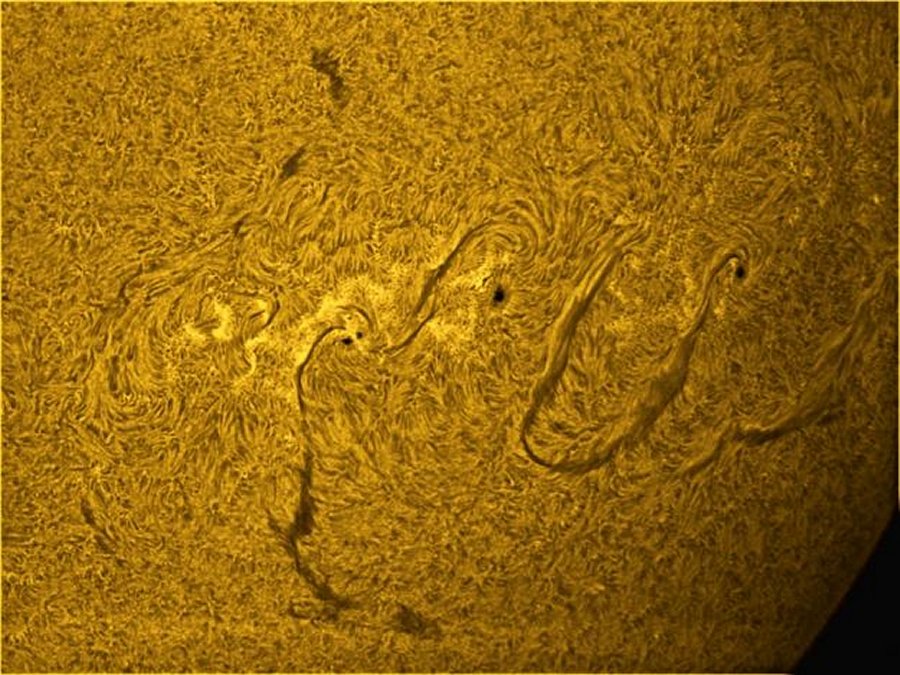
“In Falmouth, Maine, amateur astronomer John Stetson photographed the ongoing activity around sunspot AR1499.  “These solar active regions are producing M-class and C-class flares that are easy to see through my H-alpha telescope,” says Stetson.

“NOAA forecasters estimate a 25% chance of more M-class flare today, although this is probably an underestimate considering the rapid pace of development of magnetic fields near AR1499. Stay tuned.”

Old John Stetson’s probably just trying to drum up hat bidness.  Nothing directed at you, personally.  I can’t think what my nose would look like if it weren’t for John Stetson and his hats.  That horizon’s forming itself up fairly well.  I assume you’re ready to get some work done?

Old Sol:  Could you cut me some slack here?  Of course I am.  When haven’t I?  But I’ll tell you for a fact I’m getting sick of all this sophisticated surveillance equipment you’re getting down there.  It ain’t all just to sell hats, either.  Reporters forever poking around, digging up secrets.  But at least I got that chicken around behind me now.

Me:  Yeah, I’m relieved about that, too.  So are the chickens.  They saw it as a sign, began to get all worked up about it.  Nobody around here besides me has any fondness for Buff Crested Polish roosters.

Old Sol:  You guys are a caution.  Anyway, yeah, I’m right up here where I’m supposed to be.  Go do something else.

Old Jules