Tag Archives: society

News from the Middle of Nowhere

Old Sol’s going through some unusual upheavals today.  I don’t recall ever seeing such an array of sunspots reported:

“GIANT SINE WAVE: Imagine a sine wave 400,000 km long. Today, NASA’s Solar Dynamics Observatory is monitoring just such a structure. It’s an enormous filament of magnetism slithering over the sun’s northeastern limb:”

http://spaceweather.com/

Meanwhile it’s a red morning out there, so all you salesmen probably need to take warning.

Last night I was planning to haul water but I was interrupted by a wild hog meandering out from behind the truck as I came around the corner of Gale’s house.  We stood and looked at one another from about 20 feet, him undecided about whether he wanted some of me, while though I’d decided I couldn’t think of anything to do about it if he did.  When he wandered off behind a hedge I ducked inside to seal an agreement with him that we’d postpone any drama until we could each feel better about invading the personal spaces of the other.

Gale had told me he was having a lot of hogs troubling him but he didn’t mention I needed to pack a .45 walking around the place.

Maybe more later.  I’ve got to go let his chickens out.

07:45 AM – Snagged enough water to hold things together a couple of days down here without seeing any porkers.  Kay’s duck, which was missing last night when I locked down the chickens and caused me concern, flew in while I was filling the water jugs.  Eased my conscience considerable.  I hate having one of their critters come up KIA or MIA while I’m the one taking care of things.

While I was driving back down here I got to thinking about that tusker last night and the fact something’s been tearing up the pen where I keep the roosters every night.  Went out looking for hints of what might be doing it and found pig scat all around out there.  If it was there before I hadn’t noticed it and it appeared fresh.

I’m guessing whatever water source the wild hogs were using somewhere else must have dried up and motivated them with ambition to do some exploring.  It’s been a year since pigs were a problem here except for brief spatterings, a herd passing through.   I’m hoping these will follow the pattern, what’s left of them.

Tidbits you’ll be glad to know:

On this day in 1948 the Chinese formed the Peoples Republic of China, intended to create a nation of manufacturers to create all the stuff Western Europeans and US workers were having to make for themselves previously, getting their hands dirty.

On this day in 1926 Turkey began allowing civil marriage, the results of which subsequently became obvious.

On this day in 1918 the first US troops landed in Vladivostok, Russia, to help settle things down and restore the aristocrats overthrown by wossname, revolutionaries.  For those guys WWI didn’t end until 1920.

On this day in 1866, Navajo Chief Manuelito turned himself in at Fort Wingate, New Mexico, thus putting the final touches on getting all those Navajo over into the temporary [15 years] rez at Bosque Redondo, Fort Sumner bunched up with the Mescalero so’s to get the numbers down to something more tidy and manageable, which they did. [The Long Walk of the Navajo http://www.logoi.com/notes/long_walk.html ]

Old Jules

“The Java Jive” (Ink Spots, 1940)
http://www.youtube.com/watch?v=iP6IUqrFHjw&feature=related
Déjà Vu All Over Again – Ways to Be a Good American Without Waving a Chinese-made Flag

Lose the God-Damned Bigotry or Quit Calling Yourself an American -You’re Walkin’ on the Fightin’ Side of Me

on

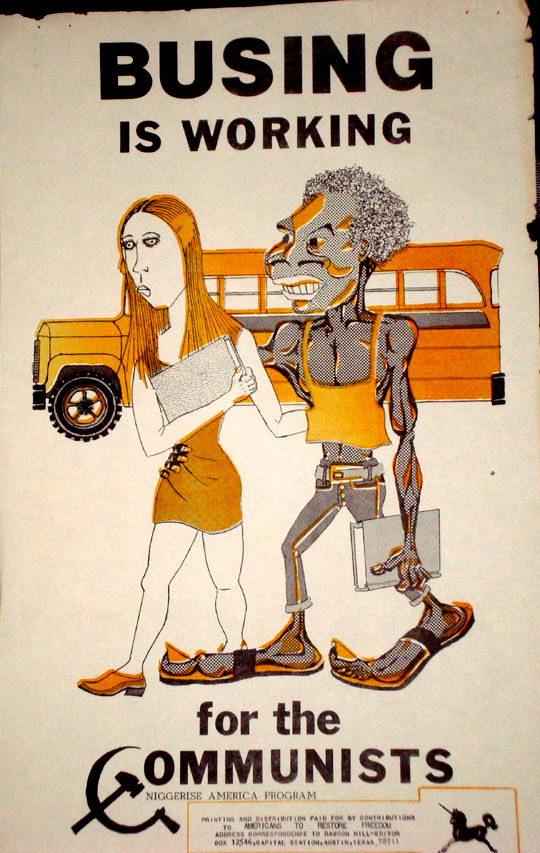
Paid for by Americans to Restore Freedom, Austin, TX 1970

A word in advance:  About the time Merle Haggard was reaching the top of the charts with “The Fighting Side of Me”, and “Okie From Muskogee” a war over forced busing was being fought in cities all across the country by good Americans.  The poster you see appeared on telephone posts, taped to the outside of doors, windows of public places, scattered on the streets. 

In 1970 a friend and I came across a guy taping one of these up near the University of Texas.  He had a ream of them beside him on the concrete.  We discussed it with him and his noggin required surprisingly little thumping to persuade him to give us all the posters and swear he would not do it anymore.   He didn’t have the strength of his convictions.

I suppose I kept a few of them  boxed up with other curiosities from  over the decades.

The administrator for this blog found a few of them among some boxes of scribblings and asked what it was all about.

Merle’s had a change of heart, repudiated a lot of what he said and did during those times, says we all make mistakes and we all eventually grow from having made them.  But interestingly, instead of vanishing from arena of public bias, the past two years has seen a re-emergence of surprisingly similar material intended to assist in denouncing the US president.

Being a good American and a good human being isn’t about waving a flag, hating Democrats or Republicans, Muslims, or people who say ugly words about political leaders.  It isn’t about fear, hysterical dialect, consumerism and waste.

Being a good American and a good human being is about personal responsibility.  About having enough confidence and courage not to feel threatened by every little thing.  About assuming the responsibility of not being part of the problem any more than is absolutely necessary.  About self-reliance.

Sometimes it’s not obvious how a person might accomplish those things.

  • On a personal level your life will find itself a lot better place if you can recognize the fact you are going to die as a means of exiting it.  Maybe disease, a car wreck, any of a thousand common ways that don’t have a damned thing to do with any foreign country, foreign leader, foreign war.  You are going to die.  No point in going into frenzies of terror and hate because the death you get stands a billion-to-one shot at being the act of a terrorist.  Trust me on that.  You are going to die, and I’ll only be the tiniest, most microscopic bit of a liar when I tell you it won’t be from anything any foreigner does  to cause it.
  • On a personal level you’ll find it’s a hell of a lot better place if you can learn what is your own business, and what isn’t.  If you can change it, it’s your business.  If you can’t, it ain’t worth concerning yourself with, getting all worked up about.
  • On a personal level you’ll find your life’s a lot better place if you spend considerable energies looking at it, instead of other places, looking at what you like about it, and what you don’t like about it, and changing what you can.  Looking in a metaphorical mirror at the sort of person you are and asking yourself if that is the sort of person you want to be.  You can’t change the kind of person the prez of bongobongoland is, but you can change the kind of person you are into someone you have more respect for.  No one respects a dishonest, hysterical coward, including you, when you see it in others.

If all of us could pull that off our own lives would be a lot better, and America would be a better place for it.  But insofar as personal responsibility and being a good American, we can expand on that a bit.  Here are a few things a good American might do without having to shout from the rooftops about what an admirable person he/she is:

Dependence on hydrocarbons is the ultimate problem of this nation you say you love.

  • Be conscious of your own energy use.
  • Every plastic grocery or garbage bag, every foam-plastic hamburger box, no matter where it was produced, drives up the price of oil.
  • Every time you fire up that hair-dryer you drive up the world-wide price of hydrocarbons.
  • Every made-in-China yellow ribbon ‘SUPPORT OUR TROOPS’ you buy to stick on your car drives up the price of hydrocarbons world-wide, increases the demand.
  • Every made-in-China flag made of nylon you wave drives up the price of oil and increases worldwide demand.
  • Every new plastic radio, CD player, computer monitor.  Every plastic wrapper from that frozen pizza pie.  Every cellophane cover and foam plastic bottom covering the piece of animal you’re having for supper and sending to the landfill afterward is driving up the world-wide competition for oil.
  • Sure, there are the other obvious things.  The things Jimmy Carter used to beg you to do when he was prez, to help you quit relying on foreign petroleum products.  Turn down the heater.  Turn up the thermostat on the AC.  Don’t drive anymore than you have to.  Which, of course, you didn’t care for then and immediately forgot when he left office (which is part of the reason you’re in the fix you are in now.)

But there’s a lot more to being a good American, as opposed to a good human being.  Here are a few more ways you could try to be part of the solution, rather than part of the problem:

Quit buying ANY foreign product if you can avoid it.  Even if it saves you a few cents.  Just say no.  Refuse and make it clear why you’re refusing.  If US workers didn’t manufacture it and you can live without it, don’t buy it.  If your old one’s broken buy a replacement used in a thrift store, garage sale or flea market.  If it can be repaired take it to a local appliance repair shop and let a US worker repair it.  Every dollar you spend on a new foreign-manufactured product reduces the value of the dollar you’ll get next paycheck because of the overwhelming trade deficit.

If this country is going to survive another century the population is going to have to begin manufacturing what it consumes, energy-wise and every other wise.  Building hamburgers to sell back and forth to one another isn’t enough to keep a country sound.

Americans are going to have to produce products, and the other Americans are going to have to buy them.  We can’t continue indefinitely sending our chunks of our trade deficit off to bongo-bongo land for petroleum, to China for plastic bags, television sets, seat covers and rubber monster toys.  We can’t starve out our farmers by buying agricultural products from Mexico and Argentina.

Being a good American involves a hell of a lot more than getting angry when some foreigner says something ugly about it.  Loyalty to America and Americans is about keeping America alive, productive, self-reliant, healthy economically.

If we can do those things we’ll find we’re spending a lot less time hurling empty rhetoric back and forth, hating the owners of bongo-bongo land oil, a lot less time bombing the hell out of foreign lands, a lot less angry and full of fear and hatred.

And we wouldn’t need to wave flags to prove we were good Americans.

Old Jules

http://www.presstv.ir/usdetail/187535.html

MERLE HAGGARD – Fightin’ Side Of Me
http://http://youtu.be/QX9X5zJ91Ac

Afterthought:  Tffnguy’s got a rant on similar but not identical subjects you might find worth a read, along with comments by a number of oldsters on my blogroll.  http://terlinguabound.blogspot.com/2011/08/divide-and-conquer.html

Who Has Been an Inspiration in Your Life, and Why?


I’m not an admirer of human beings as being particularly inspirational, on the whole.  Yeah, a lot of human sentences find themselves trapped between quotation marks in fragments people find supportive of viewpoints that won’t stand on their own hind legs.  Pithy wisdomoids giving authority to vapid premises.  Often this does happen in a synthetically inspirational context.  But the sources of those quotes usually don’t appear so wise or unblemished under careful scrutiny.

Maybe ‘inspirational’ isn’t the appropriate word to capture the concept I’m hoping to convey.

Maybe ‘has had an influence on your life you believe helped you to be a person you came nearer admiring than the one you were previously’ would more accurately describe it while filling the need for cumbersome rhetoric.  The inspiration derived from firing wisdomoids back and forth at one another isn’t made of the strong stuff I’m trying to communicate.

For instance, I used to be acquainted with a Vietnam vet, who lived in an Econoline van in Albuquerque.  He had a route of parking spots and a time schedule he’d follow to hang around each place for a while.  The street guys who were dumpster-diving knew his schedule.  They also knew  he’d pay a fair price for  anything he could get his money back on that they’d salvaged out of the trash.  After making his rounds, the Econoline would head to the flea market and he’d sell first to the crowd, then whatever was left to the flea market merchants.

By reselling it from homeless guys dumpster-diving, he provided them a means of getting some cash for a lot of things they’d have no way to sell  for themselves, or would have had a lot of difficulty getting more than a few cents for.  His route superimposed an economic network devised to offer those submerged in hardship a trickle of income, a safety net.  He provided a valuable service.

But what I particularly admired was that, when he came across someone he believed was ready to try drug or alcohol withdrawal he’d pack them up in the van and head off somewhere to the middle of nowhere, usually a small town with a restaurant or grocery store where he could pick up food and supplies. Once out of the city environment, he’d keep the addict in the van a week, two weeks, a month, drying them out, getting them clean, being there for them.

I came across him once parked at Vietnam Memorial Wall park in Truth or Consequences, New Mexico.  I didn’t realize at first what I was seeing.  I just saw his van with the white Ministry sign roughly painted on the side and recognized it and him outside it.  I stopped to chew the fat with him, then heard the moaning in the Econoline.  He caught my eye and shrugged.

“Trying to kick smack.  He’s on his second week.  It ought to start getting better in a few days.”  The odor of vomit, urine and human excretions was strong near the truck, so we drifted further afield as we talked.  Probably he was used to it, but I wasn’t.

Christian guy.  One of the Christians I’ve known that kept me believing there are honest-to-goodness bona fide Christians in the world.

I surely admired his guts, his determination and compassion.  There’s a lot about him I’d admire in myself if I looked inside me and surprised myself finding it there.

Nice to come across a Christian occasionally who isn’t all hat and no cattle.

I wonder what Jesus thought about sin.  Jesus did his talking about loving neighbors, compassion, peace-making, mercy, that sort of thing.  Hardly said anything about sin.  If he could speak his mind today I wonder if he’d forgive Saul of Tarsus the way he did Judas.”  Josephus Minimus

Here are a couple of blogs you might find of interest:

Urbandumpsterdiver’s Blog

Doing It Homeless

Old Jules

Kingston Trio-Reverend Mr. Black
http://youtu.be/sKJiDbvKbZs

John Lennon– Cold Turkey
http://youtu.be/n6wxTkkfLqM

Amazing Synopsis

Have you ever considered how much time, energy, money and lousy grades could be avoided if world history could be summarized for the kiddos into videos lasting a few minutes?  For instance, consider the European conquests of Africa, the American continents, and India.  The chillerns spend all kinds of time having to memorize the nigglingest details and names the teachers can’t even pronounce.  Pizzzzarrro.  Montezooooma.  Courtessss.   Geroneeemo.  Krazyhorse.  Not to mention the even worse ones in Africa and India.

But the hilarious fact is that all that isn’t needed.  All those books didn’t need to be printed.  All those names and dates didn’t need to be memorized to understand the basics of the European conquests of more-primitive geography.

Here it is.  The incredible 4 minute 56 second summary of the European conquest of Africa, the Americas and India:

http://youtu.be/1csr0dxalpI

If the video doesn’t play the link below should work:

http://www.youtube.com/watch?v=1csr0dxalpI

Those kids can now go back to playing on the computers with a total understanding of the history of their ancestors.

I’m going to search around to try finding some more good summaries of other hard-to-remember history.

Old Jules


Could you choose to live on the street?

That little farm you see down there is the place where I spent a good many of my formative years after my mother remarried and we moved to Portales, New Mexico. As you can see, we’d had a pretty good year for hay, which dates the picture to 1949, or 1950, before the big drought hit.

When we sat outdoors in the evening the red neon lights blinked “Schumpert Farm Supply” across the top of the long building running diagonally to the railroad tracks until I went to bed. From my limited perspective the Schumperts were ‘rich’. In that small town that railroad running through didn’t identify who was rich but it did identify who wasn’t. That little farm I lived on and no other property that side of the tracks had any rich people.

In the rigidly established social structure in Portales business men generally came down on the side of being ‘rich’, along with professors at Eastern New Mexico University, bankers, physicians, preachers, school teachers and a few elderly ladies who lived in houses big enough to be thought of as mansions. Farmers, ranchers, Mexicans and people who worked in the businesses weren’t ‘rich’.

I doubt the adults paid a lot of attention to the social strata, but school teachers did, and the kids adopted it more firmly than a religion. Rich kids were easy to recognize because they made good grades, weren’t hassled by teachers, got elected to everything, brought cookies to school Christmas, Easter and Halloween, and had the best bicycles early, cars later. For the most part they were insufferable snobs.

But not the Schumpert boys. I was in school with Stephen and Billy, and there was a precocious younger one I don’t recall the name of. Stephen was a year older than me, Billy a year younger, and there wasn’t a breath of snobbery in the entire family. Stephen, particularly, had a knack for getting in just the right amount of just the right kinds of trouble to keep from qualifying as a goody-goody. Good solid boys from a good solid family. I had a lot of respect for all of them.

I left that town early and stayed mostly away for several decades. I lost track of almost everyone I ever knew there.

But after Y2K when I moved into town to Grants, New Mexico, I came across Billy Schumpert being president of a bank there. Naturally we got together and talked about whatever we each knew that might interest the other. Billy’s the one told me what happened to Stephen.

Stephen worked as a bank examiner several years, then became president of a bank in Colorado, maybe Denver. Had a regular family, seemed to be destined to follow a career path and eventually retire. But one morning he didn’t show for work late in the 1980s. Nobody had any idea what became of him. He wasn’t a drinker, didn’t use drugs, didn’t have a ‘secret life’. He just vanished for no apparent reason.

Over time the police and other agencies gave up, assumed he was the victim of some crime, dead. But the family put up a reward for information about Stephen, sent private investigators and others searching for him. Eventually, six, seven years later they located him living under a bridge in Seattle.

Over time everyone who loved Stephen went up there trying to talk him into returning to real life, return home.

“No! I had enough!” That’s all he’d say and he never came back.

I’ve pondered Stephen a lot during the years since I learned what he’d done with his life. In some ways I think I understand, though I’m not sure. My own life has been a long series of reversals in direction. It’s meandered, cutting as wide a swath of human experience as I was able to pack into it. So, from that perspective, I can gnaw at the edges of understanding Stephen’s behavior. But I was a wild kid and I’ve always pushed the envelope, all my life.

Stephen was ‘tame’.

I’d like to see old Stephen again if he’s alive. He’d be 70, 71 years old now and maybe wiser than he was in the 1980s when something told him he’d had enough. I’d like to sit on the porch and talk with him a long time to come to know how he came to make his choice to isolate himself, to impoverish himself.

Simon & Garfunkel – Richard Cory 1966 live
http://youtu.be/euuCiSY0qYs

How Do You Say the Pledge Nowadays?

It’s come to my attention that school is starting already. I recall being in a school auditorium as a youngster when they added the words,
‘under God’ to the Pledge of Allegiance. Mr. Doak and Mr. Burke, Civics and
History teachers, were up there trying to get it right while teaching it to a couple of hundred kids.  Kids who were still on shaky ground from learning it the first time. That would have been in the mid-1950s:

Mr. Doak:  “Okay.  This isn’t complicated and shouldn’t take long.  Just say it like you always said it, but after, ‘one nation’, pause, then say, ‘under God’, then pause again before going on.

“Try it.  I pledge allegiance to the flag of the United States of America and to the Republic for which it stands, one nation,

under God,

with liberty and justice for all.”

Cacophony of 300 kids lost mid-way through.  Mr. Doak pauses with a frown waiting for the noise to die down. Mr. Burke’s frowning too.  He nudges Mr. Doak.

Mr. Burke:  “Eh, John, hold on a minute.  I think it’s supposed to be ‘one
nation under God’, not ‘one nation with a pause, under God with a pause.”

Mr.Doak:  “Ralph, look at it.  The comma’s in front of and after ‘under God.'”

Mr.  Burke: “John, that doesn’t mean it’s supposed to sound like some run-on sentence.  This is the Pledge of allegiance!”

Mr. Doak:  “Ralph, I know what it is.”  Doak scowls and turns back to the 300 lost faces.  “Let’s try it again now.”

Burke:  “No, no, no, John.  Let’s try it one time my way.”

Doak grinding his teeth:  “Ralph, we have to get this over with.”

Burke:  “I’m not the one holding it up John.  We’ve got to get this right.  What you’re telling them is wrong.”

Doak:  “Who’s in charge of this, Ralph?  When Livingston said one of us has to do it you didn’t volunteer to get up here and explain it.”

Burke:  “Neither did you.”

Doak:  “No, but I eventually agreed to.  You just agreed to come up and help.”

Burke:  “Never mind.  Tell them to do it any way you want to.  The Pledge is yours!  I have nothing more to say.”

Doak:  “Good.”  Turns back to the 300.  “Okay, let’s try it again.”

The question of whether the framers of the Constitution would have thought a child having to say, ‘under God’ is a fairly weird one, by hindsight.  But not because the placement of the commas is a major issue.

The reason it’s weird lies in the fact that the question of whether this nation
is indivisible was never considered by the Supreme Court, never mentioned in the US Constitution.  The founders put off any debate about the indivisibility issue because every member knew that no state would agree to become a member if the decision was irreversible, whatever the circumstances.  So, while it was discussed, it was also pointedly not discussed in loving detail.

Half century later it was discussed, however.  The discussion began at Fort
Sumter and ended with Lee’s surrender at Appomattox Courthouse. That avoidance by the founding fathers of an inevitably crucial issue was decided by force of arms, one half, (the half possessing an army) of the nation believing it was indivisible, the other half believing it was divisible. The stronger half forced the weaker half to accept indivisibility at gunpoint after a lot of bloodshed.

Thus, the Pledge of Allegiance came into existence after Lee’s surrender at
Appomattox. The winning side forced each surrendering Confederate soldier to say a pledge accepting indivisibility as one of the precepts of citizenship, followed afterward by many generations saying the pledge from early childhood since then.

But the US Supreme Court was never asked whether that Pledge acknowledging indivisibility was Constitutional, which might have saved a hundred thousand lives, legs, arms, and a whole different approach to US governance.

Instead, they’ve been asked repeatedly to decide the easier matter of whether it’s a violation of a child’s civil liberty to utter the words, “Under God”.

Old Jules

Civil War Songs – Oh I’m A Good Old Rebel
http://youtu.be/mO2cL64Fbaw

Battle Cry of Freedom — Civil War song on mountain dulcimer
http://youtu.be/K_jANE2QPFE

Fife and drum – Battle Cry of Freedom – 145th Gettysburg
http://youtu.be/eAsD4Bg0st0

Note:  The flag with a Native American waving a weapon flies summertimes near the booths along IH10 as it passes through the Laguna tribal lands.  Although the Laguna universally despise the Acoma neighbors neither tribe has engaged in warfare against anyone since 1597. 

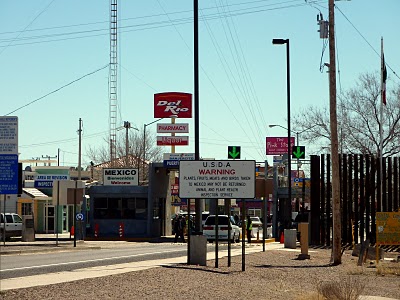
I Can’t Stop Illegal Aliens, But I Can Slow You Down, Old Timer

In 1961, I joined the US Army for three years with the intention of killing young Russian men to keep this from happening in the US:

On a regular basis,  I join the throngs of US senior citizens crossing the International Boundary to trek a couple of blocks into Mexico to buy prescription medications.  The reason we  all brave the hot, the skyrocketing gas prices, the long drive and the short walk?

A block south of the border prescription meds cost a tiny fraction of their cost a block north of the International Boundary. Plus, you don’t need a prescription.

But that’s another issue for another time.

Coming back waiting on the US side behind a line of oldsters in the US Border patrol station the fun begins.

Guy with a gun, a uniform and a Hitler mustache:  “Do you have anything to declare?”

Elderly lady pushes through the turnstile to stand in front of his table.  “I have this.”  She holds up a bulging plastic bag.

Guy with a gun, a uniform and a Hitler mustache:  “I didn’t tell you you could come through the turnstile.  Go back to the other side.”

She goes back to wherever a person is when on the other side of the turnstile.

Guy with a gun, a uniform and a Hitler mustache:  “OK.  Now you can come through.”

She goes back through the turnstile, stands in front of him.  “Do you have anything to declare?  Medications, anything?”

She holds up the bag again, but before she can speak, elderly hubby, the other side of the turnstile, holds up a bag.  “I’ve got the medications here.”  Pushes part way through the turnstile holding up the bag.

“DO NOT COME THROUGH THAT TURNSTILE UNTIL I SAY YOU CAN!”

Old man, startled, backs into never-never-land, turnstile clicking.

Hitler mustache to woman:  “Do you have anything to declare?  Medications?  Anything?”

Hubby across the turnstile to wife:  “God damn it!  I told him I have the medications over here.”

And so, ad infinitum.

Mr. Uniformed Mustache with a gun never came out and said,

“I am one stupid son of a bitch here to give elderly US citizens a hard time after they have to walk into another country to get their medications at a reasonable price.”

He didn’t need to.

Old Jules

Tom Russell– Who’s Going to Build Your Wall?
http://youtu.be/LZkAoosVLkA

Note:  I wrote this after my last trip to Mexico.  Afterward I curtailed my trips and started buying my blood pressure and other med off the Internet from Canada and India.  But I decided to post it after reading this yesterday:

Border Patrol Antics or (I got searched), Tire
http://terlinguabound.blogspot.com/2011/08/border-patrol-antics-or-i-got-searched.html

7:30 AM musings over coffee:

Maybe it’s just me, or maybe it’s a piece of a paradigm shift [whatever the hell that is] but one of the corner-of-the-eye changes I believe has happened in my lifetime within the US is a morbid fascination and indulgence in, patience with and capitulation to fears.  Maybe it’s a replacement for anger, maybe just boredom needing to speed up the heartbeat.

Back when every day was a brink-of-war crisis with the USSR the attitude was duck and cover, build a bomb shelter and bomb the bejesus out of them.  A conspicuous absence of fear.    Contrasted half-century later with a citizenry frightened so badly by a microscopic possibility a terrorist will harm them, they hire a few new layers of police, agree to be searched, and humiliated for their own protection, and indulge in a series of self-bankrupting foreign adventures with the stated intention of finding an outlaw gang hidden in fantasyville, Asia.

Hiring thugs to protect us from other thugs has probably been around for a longish while.  But never worked all that well.


So. What do you think?

So.  What do you think?

I’ve never read anywhere that it happens this way, never heard anyone say they think so.  Which doesn’t mean that’s not what happens.

The EEG flattens, the body falls, spasms, something exits.

That thing that exits hangs around out in the ether trying to figure out how it got there for a while.  Then comes a voice:

“SO.  WHAT DO YOU THINK?”

Looking around isn’t an option.  It’s the first input for a while, so the hanging-around something ponders the question a while before deciding on an answer.

“I sure do like them Dodgers.”

“NO. What do you THINK?”

The hanging -around something senses some urgency in the query.  Something might be important, and the something is beginning to suspect it’s no longer alive.

“I don’t like illegal aliens, Moslems or welfare.  I love God.  I always wanted to travel and wanted my son to play football.”

Long, endless pause.

Finally the hanging-around something begins to wonder whether the voice is still present, waiting.  In life it was always best to come right out with things, so the hanging-around-something tried to turn the situation around.

“What do YOU think?”

The ether vibrates with something akin to an opening door, a shrug in the air, finality.

“I’M NOT REAL IMPRESSED WITH HUMANITY.”

The door closes.

Leonard Cohen–Everybody Knows
http://www.youtube.com/watch?v=9F8QM3tjkTE

9:30 AM:

Maybe I should have clarified the question from the beginning.

Seems to me the answers we give to life’s crucial questions are almost never truly spontaneous, but also never the product of clear, careful thinking applied inside skulls by our own brain cells.  The body of data we package and label, “What I think” is actually something we had little, or nothing to do with.  Rather than examine the source of how we came to ‘think’ it, we just pick it out of the cosmic data pool we percieve as ‘common sense’ and place it lovingly in the folder of what’s important in our lives without giving it any thought at all.

But because we’ve taken ownership of it, staked out claim to it, assigned a value to it, [all done on autopilot] it’s been elevated to the level of truth.

Now we rub our hands together in satisfaction and pronounce, “I think”

Somewhere, someone, sometime needs to actually do it occasionally.

I happen to believe I ought to be one of them, but I’m lousy at it, falling down on the job.  My gut feel is that probably everyone ought to be one of them, but it’s plain they’re lousy at it too, falling down on the job.

Old Jules

The Runaways, 1947

Causey, New Mexico, was a dot in the road.  Pavement from nowhere to nowhere running between a scattering of frame houses, a small roadside store and gas station.  A rock schoolhouse, a church, and a few rusting hulks of worn out farm machinery in the weeds. http://www.ghosttowns.com/states/nm/causey.html

Our cottage was on the same side of the road as the schoolhouse.  Most of the village was on the other side, including the windmill across the road from our house where my sister and I went for water and carrying the bucket between us to tote it home.

To my tiny, four-year-old mind, the center of town was the store, diagonally across the road, to the left of the windmill.  Everything of importance happened there.  Cars from other places stopped for gas.  The store had Milk Nickles.  Ice cream on a stick, covered with chocolate.  Pure heaven that didn’t come often.

If the store was heaven, behind our house was hell.  The toilet.  A ramshackle tower with dust flecks floating in the shafts of light that came through the cracks between the boards, light coming through underneath where the ground had caved away from the wall.  Home of black widow spiders and the occasional rattlesnake.  The place was a chamber of terrors for me.  I was always certain I’d fall through the hole to the horrors beneath when I used it.

Our little cottage had two rooms.  A sort of kitchen, living area in front also had a little counter where my mom tried to operate a little variety store.  Keychains, trinkets, a handkerchief or two.  Things that wouldn’t be found across the street at the store.

She was also a seamstress.  Most of my memories of that time include her huddled over a treadle sewing machine working on the felt curtains she was making for the stage of the school auditorium.  Mom was a woman twice divorced.  In 1947, that was no small thing.  In that time and place broken marriage was considered to be the fault of an untrained, unskilled, unwise, probably immoral woman.  Two divorces, three children, and no resources made my mother the subject of mistrust by the woman of the community, and disdain by the men.

Memories have probably faded and altered with the half century since all this happened.  The perspectives of a child plagued with fears and insecurities seem real in my recollections, but they, too, have probably been twisted with the turns and circles the planet has made around the sun; with the endless webs of human interactions, relationships formed and ended.

My sisters went to school in that village.  Frances, my sister who died a few years ago, must have been in the second grade.  Becky, maybe in the 5th.  I hung around doing whatever preschoolers do in that environment when everyone else is busy.  I have flashing memories of standing by the road throwing rocks at cars; trying to get the little girl down the road to show me her ‘wet-thing’.

I remember being lonely; of wishing aloud my mom would give me a little brother to play with.  “I wish I could,” she’d reply, “but you tore me up so much when you were born, I can’t have any more kids.”

That trauma of my birth was a favorite theme of my mom.  She was fond of telling me how the doctors were long arriving when I was ready to be born;  how a nurse and my dad held her legs down so I couldn’t emerge until the proper people were there.  How it damaged her insides and caused her to have to undergo all kinds of surgery later.

I recall I felt pretty badly about that.

During harvest season it seemed to me the entire community turned out to work in the fields.  We’d all gather in the pre-dawn at the store, then ride together to the cotton fields in the back of an open truck.  Mom and the girls were all there, along with the neighbors and some of their kids.  Two of the kids were about my age:  Wayne and Sharon Landrum.

In retrospect I doubt we preschoolers helped much.  My mom had put a strap on a pillowcase and promised a Milk-Nickle every time it was filled.  This was probably more to keep me busy and out of trouble than it was to pay for the ice cream bar.  I can’t imagine that a pillowcase would have held the ten pounds of cotton it would have taken to pay a nickle.

The lure of sweets weren’t sufficient to occupy smaller kids, I suppose.  There came a time when Wayne, Sharon, and I wandered off from the field.  At first it was just to take a walk, but the road was long and we must have made some turns.  Before too long we’d gotten so far from the farm we didn’t know the way back.  We were frightened and kept moving.

In the end we found the lights of a farmhouse sometime after dark.  The family brought us inside and fed us something.  We sat around a stove trying to keep warm until some of the searchers came and picked us up.

In the morning at the store all those field workers who’d had to lose part of a day of wages wanted vivid descriptions of the spankings we got.  They wanted to make sure.

That was my first experience with running away, at least on my own part.  My mom had done some of it, running away from my dad and her second husband.  My dad had done some of it, letting his kids go off, first to Arizona into the shelter of a brutal, drunken step-dad, then into the shack in Causey.

Old Jules

Johnny Cash– In Them Old Cotton Fields Back Home
http://www.youtube.com/watch?v=1vCK8mSyhb0

Civility and Civilization

Hi blogsters:

Taking a breather here and got to thinking about something that happened a few years ago that might be worth relating.

During the post-Y2K financial challenges I substitute taught in the public schools for a while.

Those situations often leave the sub in front of a bunch of kids without any obvious means of spending the time. The regular teach, say, didn’t know he was going to get into a car wreck or have a terrible hangover, so there was sometimes no agenda.

One week I found myself in front of several days of classes of high school seniors. Rather than let them use it for a study hall, I decided to get them talking about what they believe in. Try to get them into a mode of defining it and possibly thinking in ways they hadn’t done so before.

One of the days was spent talking about civilization. What it is. What are the characteristics of a civilization, as opposed to merely a complex society or culture with traditional, defined behavioral norms?

From the beginning, every classroom full of kids believed a society couldn’t call itself a civilization if it condoned slavery within it. They continued believing that (after some discussion) even after I pointed out the fact the US allowed slavery until a century and a half ago. Almost every group of humans we dub ‘civilized’ in history had slaves.

Watching those kids absorb, then adopt the realization that by their own definitions the US couldn’t possibly have been a civilization until the end of the Civil War was fascinating. But they were universally adamant about it, even after thinking about it. When I pointed out further that slavery existed almost all over the world in one form or another until fairly recently in history….REALLY recently they gradually decided most of their recent ancestors weren’t civilized..

Once they’d decided there couldn’t be civilization without civility defined as a respect for some degree of freedom of the individual, they hung tight on it. Those kids decided human beings weren’t civilized anywhere until ‘way after a lot of civilizations (by other definitions) had risen and fallen.

Those were smarter kids than I figured on them being. And perfectly willing to stick by their guns on something they believed in.

Over the course of a few days these kids decided they absolutely believed, following a lot of debate, that due process is the foundation of civilization. They believed wars without due process were criminal, that they were the antithesis of civilization because they failed to respect human life enough to follow their own prescriptions and procedures. They believed killing, mayhem are serious matters worthy of reflection, debate, and a profound respect for doing things thoughtfully and exactly according to law. They believed failure to do so is a symptom of a society withdrawing from the condition we call ‘civilization’.

Toward the end some of them must have ratted me out to their parents. I didn’t get many sub-teaching jobs after that.

Old Jules