I finished off most of this bottle of Jack Daniels on December 31, 1999, while I was sitting around listening on the short wave radio to Y2K not happening, first in New Zealand, then Australia, then places further west until it got to me, where it happened well enough to make up for those other places it didn’t.
But as you can see, there was some left in the bottle when Y2K got to me. I resolved to hold it back until something else happened. I’ve had it sitting over there on the microwave collecting dust for several years, threatening to celebrate various New Year and Thanksgivings and I-don’t-know-whatalls. I’d had it in the back of my mind lately I’d do my 70th birthday with it, then slid the clock backward and thought maybe my 69th here in a few days.
But it’s colder than a bear’s butt in this cabin this morning. I’ve got water heating in the microwave half-gallon at a time to pour over my head for a warm shower before I have to walk up to Gale’s to see if Little Red’s available for a necessaries run to Kerrville. Got to thinking a hot toddie might just warm things up enough to stop some of this shivering I’m doing before I pour that water over my head.
That Y2K whiskey just mightn’t survive another hour.
On the other hand, it might be nice to have it for when I turn 75.
This is all leading up to the summation of Old Jules’ Unified Bullying Theory.
Hopefully this will be my last buildup segment before trying to summarize something I’d call a theory about bullying, supported by the interactions of animals here and childhood memories that included plenty on the subject.
My childhood friend, Keith, was reflecting on how he remembered the two of us as kids recently when we met in Fredericksburg. Fiddle-Footed Naggings and Songs of the Highway. This pretty well dated Keith’s first clear recollections of me to the sophomore year of high-school, though we’d actually been in classes together since the 4th grade. He remembered the two of us as being a couple of nerds, getting pushed around a lot.
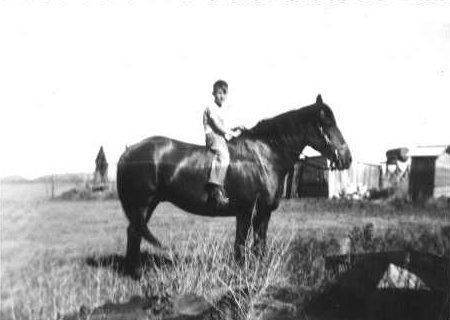
What I’m riding there just about says anything needs saying. That kid I was at that stage of my life was no bully in the making.
The picture with my two sisters might be about the time I was getting chased home by Floren and his brothers. At that point there was nobody I was likely to bully. Anyone can see the kid needs chasing home and a few beatings on the way can’t do anything but help.
But by the time this picture was taken I was hanging out at the school cafe with the Lindsey kids, smoking, and everyone knowing who was tougher than whom else. In those days any kid who could ride bareback was probably in danger of doing some bullying, too. I’m guessing all those kids from Lindsey Grade School could ride bareback.
I was bareback because the horse was stolen, though the person taking the picture almost certainly didn’t know it.
I was keeping three hogs for an FFA project in one of the buildings in the background, though the place was otherwise abandoned. I kept the horse there a couple of weeks before things got too hot, then took it out to the dirt road between this place and the neighborhood I was living in and slapped it on the rump to run it off. But the owner and authorities had already decided it hadn’t just strayed. A while later that picture glued me to the missing horse.
Sometimes I still wonder how the family adults could have been so damned stupid in those days. Where the hell did they THINK I got that horse? On the other hand, a copy of the picture became a small piece of a lot more damning evidence of how I’d been spending my adolescent years. By the time I was caught it filled up a corner of the Roosevelt County Sheriff’s Office.
Somewhere between this picture and the one above it things went south. Coincidentally, I was attending Central Grade School when the picture was taken, where I considered everyone rich kids, which they weren’t. But two years in a row I had teachers famous for their bullying.
One, the fifth grade teacher, gave me a spanking in front of the class at least once every day that year. Me, and any other kids who admitted when they were asked the first day of classes whether their parents would give them a whipping at home if they were told they got one in school. I didn’t realize until a couple of decades later it was a ruse to find out which kids wouldn’t tell their parents what was happening.
I used to want to go back to the graveyard in that town and spit and puke on his grave until a lot later in life than you might guess.
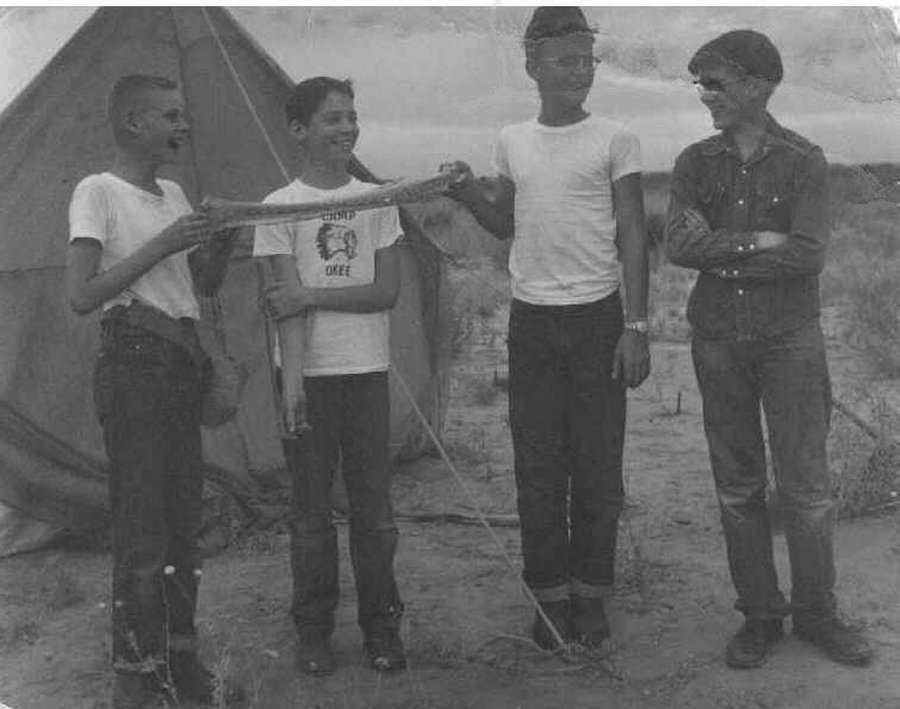
That’s me on the right at the pinnacle of my hellion/bullying times. Even that snake and the baby rattlers we found got me into a peck of trouble. Within a couple of months of the time this picture was taken I was being held in the Roosevelt County Jail for a couple of weeks waiting for them to decide whether I needed to get the rest of my education at the State Boys Reformatory at Springer, New Mexico.
They decided to keep me around on juvenile probation instead. That ended the bullying completely. If I’d looked sideways at anyone, or let myself get provoked into a fight I’d have been in Springer in a heartbeat. It was open season on me for anyone who felt the urge to kick someone around, and there was no shortage of those who did.
Here’s a year later while I was working with Kurtiss and some other youngsters for Skeeter Jenkens. A Sobering View of Y2K
That fall would be the school year Keith almost certainly remembers. Just another nerd. A peaceful, inconspicuous nerd doing his best to stay out of reform school. Midway through the Junior year it was clear I had to get out of that town, and I did. Nobody at all was sorry to see me gone.
The next bullying post is going to pull all this together with the animal bullying into Old Jules Unified Bullying Theory.
“If somebody says, I love you, to me, I feel as though I had a pistol pointed at my head. What can anybody reply under such conditions but that which the pistol-holder requires? I love you, too.”
–Kurt Vonnegut, Jr. (b. 1922), U.S. novelist. Wampeters, Foma and Granfalloons, Address at Dedication of Wheaton College Library, 1973 (1974).
She: I still have lots of trouble accepting that it’s normal and even considerate for men to NOT say I love you. I wasn’t raised that way, and I always thought if the man wouldn’t say it, it simply meant he wasn’t thinking it either. The first guy I ever fell in love with wouldn’t say it, and it was years before I realized he had good reasons not to. Saying he loved me would have made me draw all kinds of inappropriate conclusions.
He: I think there are lots of reasons for not saying I love you besides not loving you. The trouble is, the word’s got hooks in it. You can lie, and say “I love you,” when you don’t. But when you do, and go around admitting it a lot, that’s really screwed up. I kind of put that in this category of you and me. I try my best not to say that. I feel like it puts a burden on you to try and read into that what the hell I’m meaning, and it puts an equal burden on me to somehow assume you’re understanding, “Okay, this means this, this, this, and this, but it doesn’t mean this, this, this, and this.” (Laughter) So I generally work at not saying it.
She: From my end, I work at not saying it because I know it bugs you to hear me say it. If you’re not going to say it, I don’t want to say it. It makes me feel silly, even if I really think it and feel like saying it, when you don’t need to hear it.
He: If we had a strictly platonic relationship, we could say that, and no danger. If we were just friends, no problem, say it all you want to. Until that’s the case, you got to be damn careful with it.
On the other hand, see, the moral equivalent of your ex-husband not saying it in so many ways has brought you to where you are right now. It didn’t have to happen. I may be wrong, but I think I know women. I think I know you pretty well. If your ex-husband had done anything right, you wouldn’t be where you are right now. The guy blew it. He either didn’t know anything about women, or just didn’t give a shit.
If you have something like what you and he had, and you wanted to save it, you’d have to at least do this, to keep it going. For you and most women, “this” doesn’t happen to be much. It just takes a little bit of tenderness, a lot of respect, and the pretense, if not the reality, of a willingness to listen to what you’re saying, what you’re feeling, and what you’re needing and wanting.
I’m talking about married women who have a couple of kids and are domestic. It really doesn’t take very much to keep them happy. All you have to do is be attentive, and respectful and loving, and they’ll roll over and shake your hand, or play dead, or do any damn thing you want them to. (Laughter)
She: I feel very frustrated by what you are saying, because I feel like I’m being described as a less complex person than I am, but I can’t find anything untrue about it. I guess it works pretty well with me. When I met you I was impressed by your doing those exact things. But maybe all you’re describing is a normal healthy relationship where two people care enough to be considerate and attentive, where they don’t automatically assume they know what’s happening in the other person’s life.
I’m going to get away from the brave new world of the 21st Century and the animal kingdom for this segment and go back a few million years to my childhood. I explained a little about that farm on the other side of the railroad tracks here: Could you choose to live on the street?, but to pursue the bullying issue I’ll elaborate a bit.
The kids who lived on the other side of those tracks were overwhelmingly tough, poor, and ‘bad’. The families were farm laborers or otherwise unskilled, lots of kids, and Hispanic or considered ‘white trash’. The kids living there went to Lindsey Grammar School, and the RR tracks defined the boundary between Lindsey and the other two grammar schools.
In 1949, when I was starting school my mother went to war with the superintendent of schools and the school board to make certain I went to East Ward, not Lindsey. She succeeded.
Meanwhile, on this side of the tracks and the highway there were a few neighborhoods of kids who belonged in Lindsey, but were doomed by geography to go to school with the regular population at East Ward. One of those was a boy named Floren Villianueva and his siblings. A tough, bad, mean as hell youngster with older brothers meaner than him. He and I entered the first grade in the same class.
Floren and I somehow got crosswise with one another almost the first day of classes during recess. He gave me a blow to the stomach that knocked the wind out of me, doubled me over and might well have been responsible for the hernia of the goozle that’s caused me trouble to this day.
After school each afternoon Floren and his brothers walked home the same route I did, and for a few days they went the extra distance to chase me home, throwing rocks at me when they couldn’t catch me, beating hell out of me when they could. Me finding safety only when I went through the door to the house.
That naturally came to the attention of my mom after a few days. One afternoon she was standing on the porch shaking a rug and saw me running across the tracks chased by Floren and his brothers. They came right into the yard, and she grabbed a broom and chased them off, yelling insults.
When they were gone she turned on me in a fit of rage, grabbed me by the ear and dragged me into the house where she kept her switch. While she was beating hell out of me she was yelling, “If I ever see or hear of you running from a fight again this is nothing compared to what you’ll get.”
When my step-dad got home she told him about it and he just shook his head. “Running from a bunch of God-damned Mexicans!”
I went about in disgrace a few days, the story circulating among the adults with me in hearing distance, all of them dumbfounded by my cowardice.
But I never ran from a fight again. I started carrying a heavy stick with me walking home and only had to whack one of those other kids upside the head with it one time. Afterward Floren and I fought a lot of times during recess and I never whipped him, but I took the beatings rather than the alternatives.
This is too lengthy for me to continue where I’m going with it, but it’s necessary background to get in place before going forward in this segment.
Bullying’s getting all out of hand here since the weather’s cooled. I’ve written about this hen before, probably under the heading, News From the Middle of Nowhere. She’s always been a Communist from earliest chickhood. But most recently she’s begun spending her nights locked up with the two younger roosters, one a Black Silky, the other a Silky/Australorp cross. Then, after everyone’s out ranging, I let her out of the young rooster pen to range with the rest of the flock and do her laying in the same nests as the other hens.
The chickens are allowed to bully the cats here because it’s the lesser of two evils – the cats all know and respect the fact chickens aren’t to be bullied, whatever their feline instincts argue otherwise. So naturally, the chickens are well aware of this and bully the hell out of every cat that gets in the way of whatever catches their eye.
Sooooo. I re-established the cat houses for the cold weather and the felines explored and tested each for personal priorities and preferences, not taking into account the Commie hen. The cats know those are THEIR shelters. The one this Communist is sitting in is the preferred sleeping place of Shiva the Cow Cat. Not a nesting box for Communist Party meetings between chicken and egg.
Unfortunately, Shiva also knows she’s not allowed to swat the bejesus out of the hen when it becomes a contest over who gets to take over the Shiva-house. So Shiva snoozes until the Commie arrives, then the chicken comes in and gives her a couple of pecks, Shiva exits out the other side, and Ms. Commie settles down to drop a bluegreen egg.
But that’s only a piece of the bullying going on here. I was going to tell a bit about an 8-9 year old kittenish cat named Tabby who’s begun testing my patience by bullying the hell out of the older felines.
But I’ll save that so’s I won’t be tempted to use language strong enough to cause the lady-readers to blush.
This place is looking every day more like a bunch of human beings trying to get along.
He called it honesty;
Was sincerely fond
In spite of all she wasn’t
And so many things she was
He found repelling.
She called it cruelty;
He wasn’t fond enough
To call it love
The following is a transcript of a recorded conversation I had with a woman several years ago. I don’t know whether I still agree with myself about what I said here, but I suppose I must have at the time.
She: You were talking about these dependency relationships, where the man, if he wants certain things from a woman, is willing to put up with a certain amount of bullshit to get it, and the woman usually ends up with more bullshit to tolerate. And you made a point of saying that, whether or not he says “I love you,” makes a big difference in how she’s handling it. What does that mean, does he feel like he has to say it, even if he doesn’t really love her? Why is it so important for women to hear that, but it doesn’t seem to be important for men to say it? Or is that just some circumstances, and some relationships?
He: It’s just some circumstances and some relationships, but it’s pretty pervasive. Fact is, it doesn’t matter what the guy feels. He can truly love her. He can sort of love her. He can not know whether he loves her. Or he can not love her. But he knows the rules say that he’s got to say that he loves her.
From the perspective of the woman, she can’t know which one of those situations he’s in. She doesn’t acknowledge that such things exist. But the female sex has forced the issue. Thanks to 10,000 years of females demanding that men say they love them whether they do or not, you have all the men saying I love you, easily.
Now some don’t, I don’t, some other old guy friends of mine don’t, but it’s a subject of some discussion between us, it pisses us off. Fact is, that’s what women try hard to make a guy do, they are willing to go through all kinds of games and machinations to try to force a man to say it, no matter what the man feels.
My friends encounter it all the time with women. I’ve encountered it with most of the women I’ve ever gotten involved with. It’s pretty much a hundred percent. It’s as though they don’t give a rat what you’re really feeling.
What women are saying is, “Okay, what I want you to do is say I love you, whether you feel it or not, and I’m gonna behave as though I believe it’s true, for whatever reasons. Then I can use it as a bludgeon against you.”
(“Ooh, you said you loved me, and now you’ve done this or that, or haven’t done this or that, to prove you were lying. What you’ve done or haven’t done is prima facie evidence of your liarhood! And down underneath that is proof that you are lowlife scum because you said it to get something out of me. And besides that, the fact you actually don’t love me is proof you are cold and unfeeling, because I love you sooooo much.”).
“So,” the female sex is saying, “First and foremost I want to hear you say it. I want you to hear yourself say it. And I’m going to take all kinds of coercive and manipulative steps to make you do that.”
Well, the fact is, most of the male population out there says, (“Screw it.” *sigh* ) “Okay, I love you.”
She: You don’t think most women really want to know?
He: Well, they want to know if the answer is Yes. None of them want to know if the answer is No. “I want you to tell me you love me, and I want it to be true.” But if it isn’t true, say it anyway. The object isn’t getting a better hold on reality, or a better understanding about how he actually feels. The object is to hear him say those words, and to make him hear himself saying them.
She: So it doesn’t really matter whether he loves her or not, if he’s going to play that game and say it?
He: Well, he’s going to play it. But fact is, men know this about women. And for the most part, men have a really cynical view of it. It’s something that gets talked about. She’s on the warpath? “ Oh, send her some roses. Tell her you love her, man. Snuggle up a little bit. She’ll get over it.”
Guys will, for the most part, go ahead and do it. They’ll do whatever they have to do to make their lives easier. And so the upshot is that women have created a situation where a guy out there who won’t lie is all of a sudden called cold and unfeeling, when in fact all he is, might be just honest.
One of the problems is in the difference in the way men and women view sex. Men, as a rule, have no problem with the concept of uncomplicated sex. Even if they don’t happen to indulge in it. Women, on the other hand, have 10,000 generations of training to use it as a weapon or an instrument of coercion and extortion. The monopoly women have is one they’ve guarded so consistently, so long that for most women the concepts of sex and power are inseparable.
Selling sex for any commodity is prostitution. Trading sex for power instead of money isn’t exempt. But those who do it are ‘unadmitted whores’, as opposed to straight, upfront whores.
Many years ago a whore named Frenchie in a bar on the waterfront in Texas was bantering with me. I was trying to seduce her in the non-commercial sense. “Sex is no fun if there’s no money involved!” was her final answer.
Frenchie just about said it all, one way or another, and if you think of money as a synonym for power.
One of the reasons women who don’t admit they are whores dislike women who do admit it so much involves the concept of inflation. From the perspective of a non-admitted whore, the whore is selling a commodity for mere money that’s worth so much more than money. In doing so, she (the admitted whore) is making that commodity available for a price that’s easily met, thereby robbing all non-admitted whores of some measure of power. Several generations of Texas men had their first encounters with uncomplicated sex at a cathouse in LaGrange called the Chicken Ranch (now famous). For most of those men visits to the Chicken Ranch ended up as the ONLY encounters with uncomplicated sex in their entire lives.
The only commodity rarer and more precious than uncomplicated sex is honesty.
Probably 1978-’79 I was going north on the Interstate somewhere between Waco and Waxahachie preparing to exit when I saw a woman past the ramp trying to thumb a ride. Henry Lee Lucas and Otis Toole had been at work leaving a string of female corpses up and down the Interstate at the time. When I saw her I split-second decided to take a route further north so’s to give her a ride and get her off the Interstate.
“I saw you swerve back onto the highway to pick me up.” She settled the bag with her belongings onto the floorboard. Attractive, dark skinned lady in her mid-20s with a coy smirk. “You must like my looks.”
“Hi. Where you headed? I just decided to pick you up to tell you about something you might not know. I’ll get off further north than I was going to.” I was wearing a pair of cutoff jeans and she was making herself obvious staring at my lower legs.
“I’ve been on the road for a month. I usually don’t take rides from four-wheelers, but I like your looks.”
I wasn’t in the market for having my looks liked by some female who’d been on the road a month hitching rides with truckers. The whole concept gave me a shrinking sensation in my groin. I explained to her about why I’d picked her up, about how someone was killing women on the Interstate and leaving their bodies cluttering up the landscape from hell to breakfast.
“Where are you from before you started hitching? Can you go back there?”
She settled back and gave my legs a rest, frowning. “I’m from the Kickapoo Reservation.” She named a mid-western state. “My husband was drunk and mowing the grass. Slipped and cut the front half of his foot off.”
That last sentence had a lot of visual impact for me. It drew a cringe and a moment of silent recovery. But after I’d digested it the next question was obvious. “So what are you doing here, thumbing rides?”
“I left before he got out of the hospital.” Her face twisted into a mask of indignation. “I wasn’t going to hang around there carrying that SOB like a turd between two sticks for the rest of his life! I’ve been on the road ever since.”
My exit wasn’t far up the road so I just left it at that. Made a mental note to turn loose of the handle if I ever slipped and fell backward mowing the grass.
There’s a temptation to believe we moderns living within the boundaries of the US have a lot in common with one another, and in many ways we do. But what we have in common with one another isn’t necessarily what we believe we do. One of those areas of commonality probably has to do with the perception of Native Americans as a somewhat generic group of people with a lot in common with one-another and far less in common with whites and Hispanics.
This leads to a lot of packages of thinking among people not living on the Rez, whether they’re whites, second or third generation off-Rez Native Americans, Hispanics, or folks who carry a bit of tribal blood in their veins a few generations old, but never lived on the Rez.
One of the packages contains a romanticized view that the cultural heritages on the Rez still exist, still carry some similarity to those before the coming of Europeans, and are similar to one-another. The phrase, ‘the old ways’ has found its way into the language of those seduced into buying the package. The “I-know-the-old-ways-too-because-my-granddad-was-a-Cherokee [or Apache, etc]” syndrome frequently found among artists, blue-eyed-blond-haired ladies in Atlanta, and in cities across the nation among those who see something wrong with modern life and hunger for a deeper spiritual life.
The fact is, those tribes don’t have much at all in common with one another, aside from being packaged and treated as though they were similar for at least a century-and-a-half by the US Government, far longer for some in the eastern US. Bits and pieces of the original cultures have survived on some reservations, less on some, almost none on some. And those cultures remaining are as unlike one another as they are different from European.
But I’ve digressed. I began this blog entry with the intention of talking about a particular cultural phenomenon re-emerging on Navajo tribal lands, strange and not easily understood by anyone including the Din’e living there. The Skin Walker. A person who voluntarily adopts witch-like and other behaviors that violate the most fundamental religious/spiritual forbiddings of the tribe. The subject, even the name is such that even most Din’e have only a general understanding of what those practices are. But there’s no lack of agreement that Skin Walkers are a threat to everyone, a cause for revulsion, anger, fear, hatred.
On the Pine Hill Navajo (self-determination) Rez south of Ramah Chapter there’s a place that’s come to be called, “Skin-Walker Valley” by everyone who’s willing to use the word. Interestingly, the valley extends into an area checkerboarded with white-owned lands called Candy Kitchen.
What’s surprising is that, while the Skin-Walker phenomenon clearly began on Din’e land, the weirdness and negativity spills over and permeates into the white community. Although some good folks, both white and Din’e, live and make out as best they can in this remote area, it’s shockingly pervaded by all manner of crime. Speed freaks and laboratories are drawn there as by a magnet.
Violence is pandemic. As an example, a few years ago three Navajo youths tortured and killed an octogenerian white woman in her home, puncturing her skull with a screwdriver eighteen times until she died. She had nothing much worth stealing. They did it for ‘fun’. When the lads were identified they were arrested on the Rez, where tribal authorities resisted giving them up for white justice for several days.
Meanwhile, deep in the Rez to the north, near Pueblo Pintada, another valley is rapidly coming to be known as ‘Skin-Walker Valley’, and another at Alamo, far to the southeast.
This phenomenon, were it discussed openly and recognized as in need of investigation, would be far easier for tribal officials to develop strategies to deal with. Open discussion would also help nearby residents and authorities off the Rez toward a clearer perspective concerning an energy and a belief system that is oozing up through the cracks of their lives, slouching across from tribal lands.
But this is getting too long and it’s time to turn out the chickens. Maybe more later.
Edit: 7:50am
This poem was written a few years ago about an event on the minds of northwest New Mexico at the time. The fact it happened near ‘Skin-Walker Valley’ was a cause for a lot of concern and confusion.
Last Friday Night
“It’s just too deep in the Rez
For a white-man style killing,” he says:
“A bullet each to the back of the head,
At Pueblo Pentada two brothers are dead;
Two Navajo brothers are dead.
“It isn’t a skin-walker killing;
No feud, not a woman too willing.
A knife, a club, a thirty-ought-six
Is common enough and at least doesn’t mix
White man logic with Navajo tricks:
No bullet each to the back of the head!
But at Pueblo Pentada two brothers are dead!
Two Navajo brothers are dead.”
From Bread Springs to Shiprock you’ll hear people say
“No place is safe now! You can’t get away!”
Nageezi to Yah Ta Hay
You’ll hear the Din’e people say
“The killer’s from Pie Town or Santa Fe.
Some white, somehow, somewhere must pay
For a bullet each to the back of the head!
At Pueblo Pentada two brothers are dead!
Two Navajo brothers are dead.”
There’s no danger of our remembering the past in the ways required to keep us from repeating it. However, if we could, we might be well advised to look at areas:
1. Spanish Inquisition – to keep religious zealots in their proper place,
2, The French Revolution – to remind us about the down-side of revolutionary fervor,
3. The Soviet Union – to further remind us,
4. Santa Fe Trail – The eroded, abraded gorges and arroyos along the length of it to remind us it’s worth looking at the ground we’re standing on occasionally, rather than devoting all our attention to the horizon and a future we influence, but don’t comprehend.
5. The Chacoan/Mogollon, the Inca, the Aztec, the Mayan, to get our feet back on the ground when we indulge our fantasies that someone, once, ‘had it right’.
6. Japan in the 1930s, to remind ourselves the most rabidly cruel torturers can be forgiven, rebuilt, and sell us television sets and automobiles with impunity.
7. Hiroshima, to remind us surprises can happen to the most devoted, arrogant and unwary.
8. The ruins of castles, fortifications, National Cemetaries to remind us these crises we’re submerged in this moment will pass, as well, and be forgotten.
9. The DDT consequences of the 1960s to remind us science doesn’t have all the answers, that sometimes it’s better to put up with an insect than using the most expedient means of exterminating it.
10. Any man-made catastrophe, debacle in human history to remind us of the law of unforseen consequences.
To remind us we aren’t as smart as we tend to see ourselves.
To remind us, no country ever attacked another thinking it would lose.
No religious zealot ever killed or tortured anyone of another belief system believing his behavior would eventually be pointed to as proof of the falsehood of his beliefs.
No scientist ever released an invention or development believing it might one day destroy his kids, or their kids.
74 years old, a resident of Leavenworth, KS, in an apartment located on the VA campus. Partnered with a black shorthaired cat named Mister Midnight. (1943-2020)
Since April, 2020, this blog is maintained by Jeanne Kasten (See "About" page for further information).
https://sofarfromheaven.com/2020/04/21/au-revoir-old-jules-jack-purcell/
I’m sharing it with you because there’s almost no likelihood you’ll believe it. This lunatic asylum I call my life has so many unexpected twists and turns I won’t even try to guess where it’s going. I’d suggest you try to find some laughs here. You won’t find wisdom. Good luck.








 So Far From Heaven