Tag Archives: thoughts

Make my day, stranger!

I don’t know when we began giving power to strangers. I think it’s a relatively recent phenomenon. Maybe we watched too many Westerns during our formative years, learned from those steely eyed men in saloons that what strangers think about us is worth a gunfight.

Nowadays the extreme version happens in city traffic. Someone shoots someone else a bird. Next step is an exchange of gunfire.

Here’s how the scenario runs:

Some complete stranger pronounces a bias we don’t share.

Our thought response:

“This offends me.”

That thought process is driven by a deeper one:

“I want to be offended. I give this stranger the power to offend me. I assign enough value to what this stranger says, or believes, to allow it to trigger a negative emotional path within me. What this stranger says or believes matters.”

We know better.

Strangers cut too wide a swath in their traits to have any real value. They span the breadth of potential human biases. But even knowing this we give them the power to ruin a moment.

I say this is a recent phenomenon because humans of the past behaved differently. Our forefathers didn’t care what Brits thought about us because they recognized that Brits live within an entirely different set of interests.

Even today a Zuni doesn’t care what a Navajo thinks about anything because from the perspective of a Zuni, Navajos don’t have anything valid to contribute to any meaningful discussion. Navajos live in a different reality from Zunis.

Both Navajos and Zunis choose to allow themselves to be offended by the opinions of Anglos and Hispanics, but there’s a reason. They’ve found taking offense is a means of gaining power over those groups.

But neither a Zuni, nor a Navajo would bother being offended by the thoughts and words of the other because to each there’s nothing the other might think that carries the weight of validity.

Not long ago the same was true of people almost everywhere. The people in the town where I was reared cared about the opinions of people within that town, but they couldn’t have cared less what the people in Clovis, twenty miles away thought. It was generally understood that Clovis people were stupid and might think and say anything.

Today we care what everyone thinks about almost everything. We pretend to believe what they think carries value, but we know better. We just like the feel of being offended..

Make my day, Stranger! I’m handing you the power to offend me.

This leaves me cold.

Human opinion hasn’t held up well under scrutiny. It’s worth about what it costs. Mine aren’t that reliable and I haven’t found those of others to be any better.

Instrumental Theme to Dirty Harry:
http://youtu.be/ZDKRD2q3bYo

Slouching into the Millennium – August 1998

The Beginning

We staff members of the New Mexico State Emergency Management Planning and Coordination Bureau [EMPAC] didn’t laugh much.  We were a collection of old guys mostly retired from something else, except for a few youngsters, mostly support and training staff.

Radiation Response and Recovery [the RAD catchers] was a retiree Bird Colonel from the US Army named Sam.  Hazardous Materials Response and Recovery was headed by Joe, a retired US Air Force Lt. Colonel who’d piloted B47s for the Strategic Air Command in his youth.  Joe sat at the end of a runway in a B47 loaded with hydrogen bombs for two weeks during the Cuban Missile Crisis.  Natural Disasters – Earthquake Preparedness was a shot-up in-Vietnam old Lt. Colonel, infantry.  And so on.  My program was Flood Plain Management and local coordination and training for one of the regions.  Too long out of the military to remember whether I was enlisted or an officer.

Our Bureau Chief, Larry, was a retired Master Sergeant, US Army Search and Rescue, another Vietnam vet. An enlisted man coordinating the activities of field grade officers, giving instructions, approving their work and their per diem expenditures would have been a potential source of laughter if we’d all held our mouths right, but “That’s what happens when you put an enlisted man doing the job of an officer,” was a frequent grumble every time something went awry.

The staff meeting was in the bomb shelter of the old National Guard Headquarters building in Santa Fe where our offices were located.

“I had a weird call from one of the aids to the Governor this morning.”Larry’s eyes searched our dozen blank faces. “Any of you know anything about Y2K?”   Calls from the Governor’s office to anyone at EMPAC was bad news.  We liked to think we were invisible, nobody knew we existed.  This particular governor, however, we considered a space cadet.  A flake.

We all exchanged scowls while my mind toyed with the phrase. “Y2K. Y2K? Where the hell have I heard about Y2K lately?” The thing rang a bell in my head, but I couldn’t think why.

“The Gov just got back from a meeting of the Association of State Governors. They did a big program on Y2K. He’s all excited about it. Evidently there’s some damned thing going on with computers to make them all fail January first, 2000.” Sneers and a chuckle or two.  We all agreed on something.

“Do any of you know what other states are doing? Any ideas what we should be doing? We have to send an answer over to the Gov’s office. We have to put together a plan of some kind.”

Background rumble around the table.  “Y2K?  Why the hell would all the computers crash when the 20th century turns over?”  “Damned idiot governor.”

“Hmmm computers. That’s it.” Now I remembered.

“It’s all a farce, Larry.” I was remembering a conversation and exchange of emails I’d had with my ex-wife. “Carolyn heads the department in Texas that’s supposed to be preparing for it. She told me a while back they were spending a lot of money on it, hiring a lot of people. Pissed her off when I said it was just another bureaucratic scare plot to build more empires.”

Larry stared at me, mind busy with what I’d said. “Could you find out what they are doing over there?”

“Sure. Why not?”

“Also, get on the internet. Find out what people are saying is going to happen. Find out everything you can about what all the other states are doing.”

The others in the room relaxed a little. No one wanted this project and now it was clearly mine. “How much time do you want me to spend on this?”

“A week. Two maybe. We just need to put together a plan that makes sense.”

As I left the staff meeting I was feeling pleased with the diversion this offered me. Something away from flood plain management and routine emergency management coordination. I didn’t expect it to be any problem at all.

I began by sending an email to Carolyn. This was the response I got:

“The Year 2000 deal is a real threat. Lots of people have been doing lots of
work to mitigate the consequences, and we’re still ‘influencing the future’.

The real problem is that we can generally fix what we know about, but there is
so much we don’t know.

For example, the power grid – there are many many power generators and power distributors in this country, and many “embedded systems” in each company. Some companies are taking the problem seriously by contacting their suppliers (of power grid equipment, as an example) to see if components will work.

Afraid of litigation, the manufacturers hem and haw around and provide no definitive data. Yes, I think there will be power outages, thus water problems, heating problems, etc, but I don’t think the whole US will go dark, and we still have some time to work on it.

One scenario I’ve heard is that elect. companies will work to distribute what power they have so that rolling black or brown outs will limit the negative affects of the power failures.

Some good news, the banking industry in the US is in very good shape. Our only
fear there is fear itself. I think a lot of IT systems are being corrected at a
more rapid pace than originally anticipated, and governors like yours and mine
are at least anticipating problems so they can prepare for them. I think if the
people anticipate the problems, and know that someone has already developed a
work around, we’ll be fine.

Any disruptions will probably be short lived.
I could go on, but duty calls.
C.

I trusted Carolyn about as much as any man can trust an ex-wife after 25 years of marriage.

I didn’t know it yet, but for me this began the end of one lifetime and heralded the start of another.

Old Jules

Creedence Clearwater Revival– Bad Moon Rising
http://youtu.be/5BmEGm-mraE


Don’t know much about Human Beings


I don’t know much about human beings these days, though I used to think I knew everything worth knowing about them.  Putting a little distance between myself and the daily onslaught of news, spending my time in my own company instead of in the company of other people, and watch/listening instead of speaking when I’m around others has forced a realization that I don’t know spit about these creatures.

But it’s also clear to me that I didn’t know spit about them back when I knew a lot about them.  Including me.  I was in too close and personal, too much a part of the herd, to see what was happening around me.  A person inside a jetliner going several hundred miles an hour can throw a rock from the tail section all the way to the pilot and when it plunks against his scalp that rock will have traveled further than Babe Ruth ever hit a baseball.  A fly inside the cabin of a jet fighter is supersonic when it goes from the back of the cabin to the front.

In a sense, the same phenomenon is at work when humans are in the company of other humans.  Bunched up together in a stadium, concert hall, skyscraper, there’s an invisible wall around them disguising the fact the rocks they throw are going further and the flies are flying faster than anyone had any right to expect.  The person in the next seat, the stewardess serving meals and drinks, the movie playing  seems real to them, while the 20,000 feet to the ground doesn’t, while the outside rushing by doesn’t seem real at all, and all that microscopic activity on the ground below them doesn’t count for anything.

Back when I rode airliners, worked in buildings full of people, drove around inside a vehicle in heavy traffic and kept track of events I knew a lot about human beings.  Same as you do now.

But now that I’ve backed away, put some distance between myself and humanity, to me they look more like chickens than they ever looked like human beings.  I understand chickens fairly well, but I don’t know squat about human beings.

Old Jules

Simon and Garfunkel — I am a Rock
http://www.youtube.com/watch?v=My9I8q-iJCI

Too Much Blame or Praise

Visiting blogs since starting this one has been an unexpected learning experience. The general impression that almost everyone is concerned about the state of the world and the nation wasn’t a surprise.

But the fortified positions, the polarization, the nagging thought that a lot of people would gladly enforce their viewpoints on others at gunpoint if they had the option, is troubling if accurate. The middle ground, the concept of a loyal opposition, even the concept of people still potentially being okay if they have different political, religious, differing gender viewpoints just isn’t out there anymore. No live-and-let-live in the mix.

The level of rancor between opposing opinions approaches a level where it wouldn’t be too shocking if, say, a 9/11 happened in an environment limiting US victims to a particular political or religious bias, and sets of blog dialogues appearing to express:

“What the hell! They were all Tea-Baggers!”

Or,

“What the hell! They were all pinko liberals!”

Or Democrats, Republicans, Muslims, Catholics, Baptists.

There are already posts on blogs I visit saying, “Let God sort them out.”

I can’t help wondering whether I’m the only one troubled by this.

I used to know a guy, a good man, who was also an alcoholic of the sort you’d rather not be too close to. Jay was his name, an ex-Lieutenant Colonel in the US Army Air Corps, B24 pilot of um-de-umph hundred bombing missions over Germany during WWII. War hero.

By the mid-1960s Jay had a drinking problem bad enough to be placed repeatedly into the hands of the Texas Alcoholic Rehabilitation Commission to dry out. Finally, in those days a bright new shining light among the mental health medicos was the pre-frontal lobotomy, was chosen as the tool of choice for curing what ailed old Jay….. But the unfortunate side effects were that a lot of him ceased to be Jay.

But those wise medicos knew what was best for him, they’d read all the recent advances and articles, so they strapped him down to a gurney and inserted electrodes on his temples and shot the juice to him. Several times.

I’d heard about all this, thought it was fairly awful, but what the hell. A few months later I was among a group of young folks friends of his who got invited to spend a day on Galveston Bay cruising around in Jay’s cabin cruiser down there.

Jay was wearing a tee-shirt that proclaimed, “I’d rather have a bottle in front of me than a prefrontal lobotomy”. And he did.

It finally killed him, alcohol, the lobotomy didn’t change that…. but he always believed, afterward, that it was a fairly shabby thing for society to have done to him, that lobotomy. Deprived him of his right to make his own mistakes. At least, it attempted to.

If you boil all that down and scrape the leavings off the bottom of the pot, that’s about the way I feel about the likely outcome of the undercurrents at work in this country.

Someone’s going to get the upper hand, one side or the other.

The ones left holding smaller bag might need a bottle to soften up the resulting enforced prefrontal lobotomies and attitude adjustments.

A Great Cultural Revolution

If old Jay were alive he’d probably buy a tee-shirt.

Old Jules

Give a Person a Fish

Hi blogsters:

I never see that phrase about fish without a flash of memory.

During the 1950s drought stock ponds were drying up all over the southwest.  There came a day a lot like this one, though it was probably warmer, when a kid named David Cagle and I were wandering around the ruins of cow country and came across a pond that was maybe five acres of surface and about three inches deep in water.  Every square foot of water had a fish flopping in it.  I’ve never seen anything like it.

A few hundred yards from the pond was an abandoned barn where we’d noticed an old galvanized washtub someone had probably used to water calves when there was still water, or feed them when there was still food.  We hoofed over to that barn and snagged the tub, waded into that fish and cow-mud calf deep throwing fish into the tub.

We glowed over that tub full of fish all the way home, him on one handle, me on the other, thinking how deeeeeelighted our folks would be with the treasure we were bringing them.

Both of us smelled a joyous combination of cow-mud and fish when we got to David’s house, went in through the kitchen door and watched his mama shriek even before she turned around and saw the fish.

“Get those fish out of this house!”

We got them out and she followed us into the yard to hose him down before she’d allow him inside.  Me, she ordered to take those fish with me and head down the road.

My own mom took a more circumspect view of things, mainly because she wasn’t home when I got there.  I cleaned myself up and filled the kitchen sink with all the fish it would hold and started killing and gutting them.  The job was far enough along to make quitting a moot point when she got home.

I gutted a lot of fish over the next couple of days, though I did move the operation out into the back yard.

My mom’s one of those kind of people who remember such things after she can’t remember her own name.  I’m not sure I’ve ever returned to her company during the past 50 years without being reminded of it.

Give a person a fish and he might not appreciate it, but he won’t starve until the fish is digested.

But give a person a fishing pole and he’ll almost surely hook an ear or nostril before it’s over.

Old Jules

Sons of the Pioneers–  Cool Clear Water

Woody Guthrie–Dust Bowl Blues
http://www.youtube.com/watch?v=jQYKJaWuj0Y

Clean Underwear and Hard Times

I think my mom would have made a deal with the devil for one of these in 1947.  She didn’t get one, nor anything else of the sort until around 1957, but I don’t recall her washing clothes in a washtub after the early 1950s.  From around 1954 until she got a home washing machine she went to the Laundromats with most of the other ladies.  I’m guessing this one was probably manufactured in the late 1940s.

I’d watched in one of the thrift stores in town for some while, them asking $55, then marking it down to $35, nobody interested enough to plug it in and find out if it worked.  But after it had been there long enough to cause me to figure they were getting tired of seeing it I plugged it in.

“HUMMMMMM!”

No vibration, nothing moving, just a clicking of the spring loaded timer and the sound of an electric motor trying to push the immoveable object.  I unplugged it more quickly than I plugged it in, carried it up to the cashier and told him it didn’t work, told him what it was doing and what was going to happen if someone plugged it in and left it trying to run.

“We can’t fix it.  We don’t have a repair department.”

“Yeah, maybe nobody can.  They haven’t manufactured parts for it in 50 years.  But maybe someone can.”

“Do you want to try?”

“Maybe.  How much do I have to risk betting I can?”

He made me an offer I couldn’t refuse.

The only tool required to get it running was my foldup Leatherman, oil, and a rag. It’s out there washing seven pairs of my jockey shorts at the moment.  I don’t envy it.

Been a long while since I’ve been so blessed.

Reflections of a Y2K Survivor

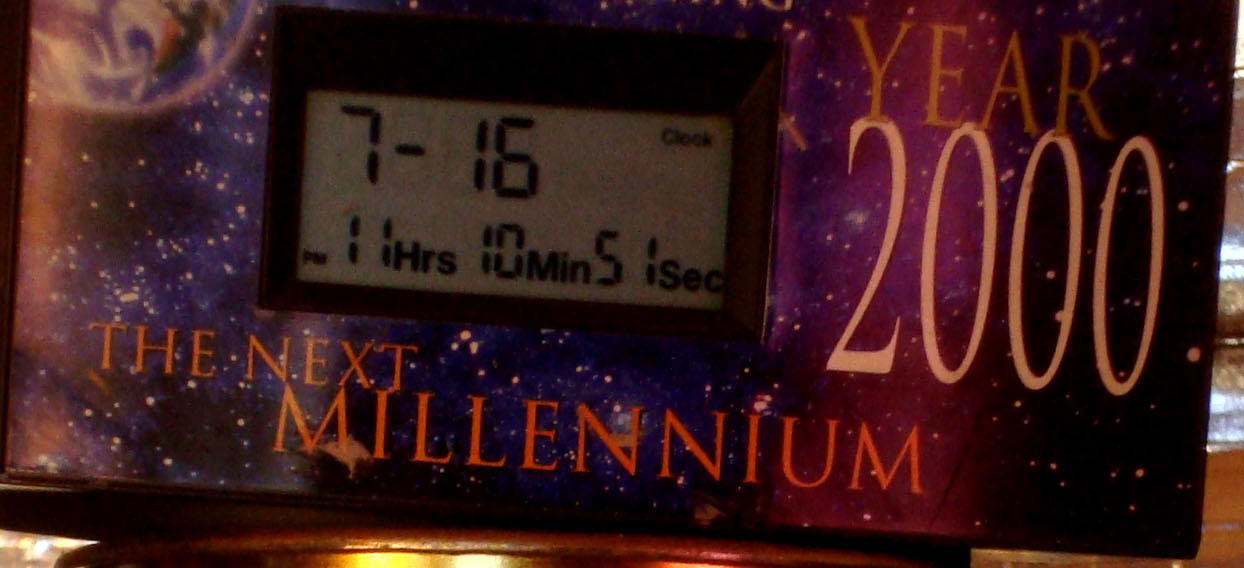
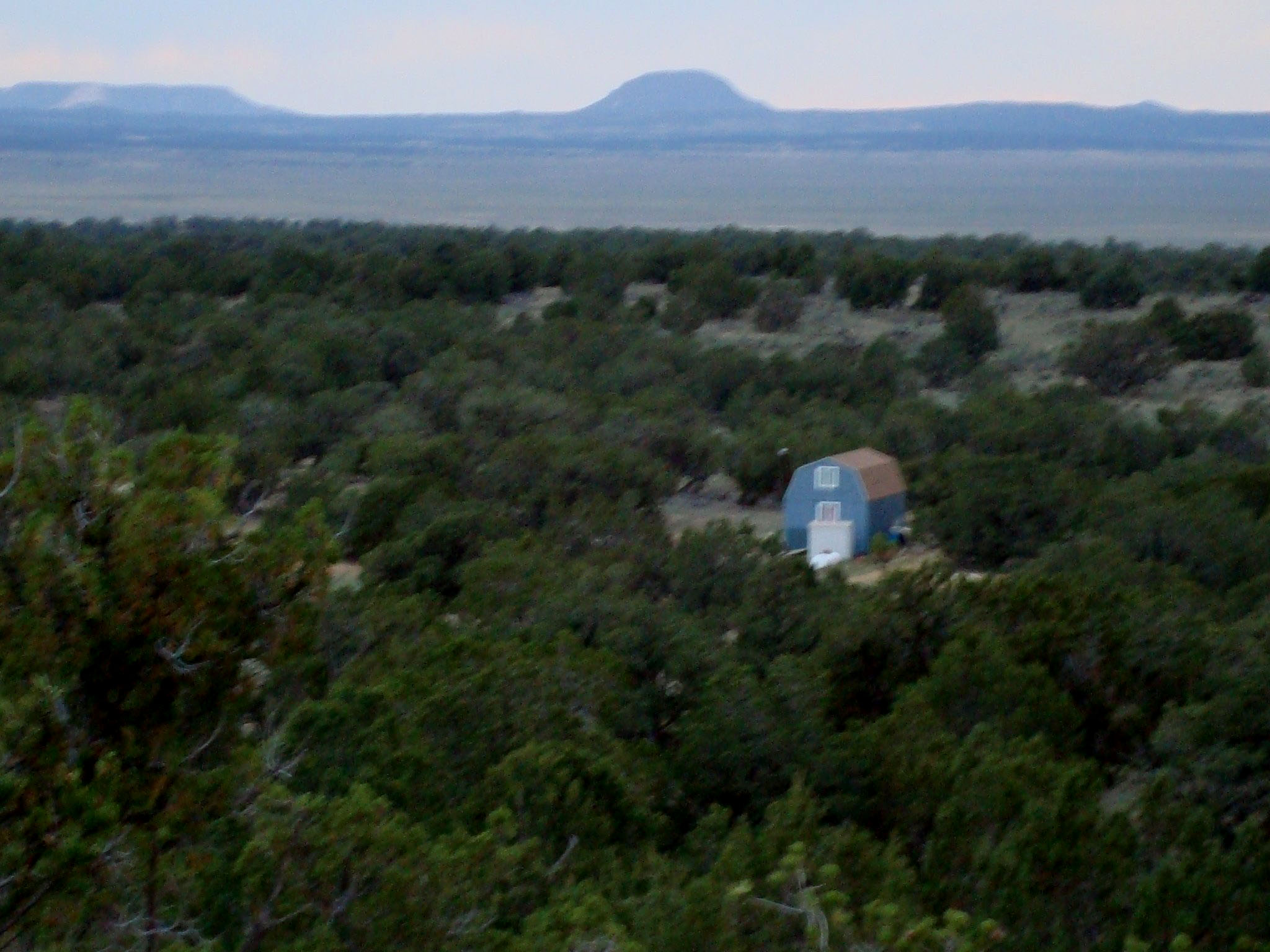
I was one of those weirdos who believed so thoroughly in Y2K that I quit the last years of a career, cashed in my retirement, walked away from the IRS, all the bills, a house mortgage,  totally believing it was all moot because in just a few months it would all collapse.  I figured there was  a chance high enough to bet on that everyone left after the chaos would be wandering around hungry, diseased, and dying, if the computer gurus were telling the truth.  January 1, 1999, I performed the irreversible deed.  The retirement money made a down payment on 140 acres of land in remote high desert, I drilled a well, built a cabin, stocked up on countless items the throngs of hopeless survivors would need to survive a bit longer.

I knew there was a medium possibility the IRS, the land payments, all the rest would eventually come due if Y2K didn’t happen, but I thought the consequences of it happening and me not doing it were worse than the alternative of taking the plunge and it not happening. Once a person considers seriously  the possibility that society might collapse, it’s surprising how reasonable it seems to think so.

Did my best to be a refugee camp waiting to happen. I bought a lot of chicks to be eggs and food for the future hungry.  I knew I couldn’t survive long because of the shelf-life of a medication I require to stay alive, but I had hopes a few folks could survive thanks to a lot of training and experience I’d had in woods lore, emergency management, and survival. I moved in to a tent on the 140 acres in mid-1999, until the cabin was built and the well drilled.

I spent the next 16-18 months pretty much alone, sometimes going weeks without seeing another person. It was the best time of my entire life. I loved it.  I wouldn’t change a minute of 1999 until now, but they were the hardest years I’ve ever lived.  I’m a risk taker, more than most, but I’m also a damned fool.  Fool enough to believe Y2K not happening January 1, 2000, doesn’t mean Y2K won’t ever happen.  But also fool enough to know I’m not wise enough to know when it will, nor whether it will.

This blog will include some of the material written during that time. The rest is a compilation of reflections, before and since, of my varied runs at the brick wall of something rhyming with wisdom.

Old Jules
Steve Goodman–The 20th Century is Almost Over

http://tiny.cc/trxiy

Learning to Live with Being Stupid

The discovery, beginning about 15 years ago, that I’m not anywhere near as smart as I think I am, and that I’m a world away from knowing as much as I think I know, has been unsettling and somewhat disruptive.  That realization, along with the concurrent observation that an overwhelming piece of what I do know is wrong, hasn’t been as easy to incorporate into something useful in my life as you might think.

Before my smarts and knowings all started to unravel I was a fairly impressive person.  I could explain, without you even asking me to do it, just about anything you might be wondering about.  I knew what you ought to do with your life, how your life became the lousy, empty mess it appears to me to be, and what the government ought to do about anything it had the power to do.  I knew what men ought to do about women and other men, and I knew what women ought to do about men and other women.

I began to get screwed out of that when  out of the corner of my eye I noticed some aspects of my own life that I wouldn’t recommend to anyone.  It crept into my consciousness that I’d made a lot of choices and given a plethora of advice to others that simply didn’t have a lot of merit.

This didn’t come all at once.  It started as a trickle with a lot of seemingly small matters I couldn’t help noticing, which I tried to compartmentalize and ignore, same as everyone else does.  But eventually I couldn’t keep them inside the fences I’d built for them.  They were forever sneaking over mingling with others I’d locked up in file drawers I’d clearly marked, “TOP SECRET – DO NOT OPEN”.

This forced me to try to herd them back where they belonged, but in doing so the others tagged along, dancing and clowning and shamelessly demanding I recognize they existed, wanting me to scratch them behind the ears and pay some attention to them.

I figured the easiest approach would be to have a look at their blood lines and shoot the mongrels and mutts, but keep the purebreds.  This required an examination of how I came by all that knowing of every description.

It rocked me to my boot heels to find almost every one of those certainties  came from something someone else said, and I believed it, hugged it tight, and called it my own.  That wouldn’t have been so bad if I hadn’t then asked myself where the people I’d heard it from came to own it.   Imagine my surprise when it dawned on me they’d also heard it from someone else, who heard it from someone else.

Gradually, I realized I hadn’t done much thinking for myself.  In fact, I hadn’t based much of anything on the evidence of my own eyes and observations.  Strangers with the voice of authority told me many things other strangers had told them and I frequently accepted it as gospel.  I often abdicated my intelligence in favor of those strangers many times removed.   Without consciously deciding to do so, I treated truth as though it relied on a vote-count of humans to decide its own nature.

I hate it, discovering something like that.  The last 15 years of dismantling a system of giving strangers default authority to control my mind and my life hasn’t even been entirely successful.  I still constantly find the opinions of strangers creeping in, waving their arms around, trying to grab control so I won’t be stupid anymore.

But I’m determined to keep at it.  All those strangers saying things back and forth to one another and believing it over time hasn’t done much good for the people who believe it now.

And it never did me a damned bit of good, even though I was smarter when I believed it, too.
Old Jules

Glen Campbell – Gentle on My Mind
http://www.youtube.com/watch?v=cFIRTtn_ZSE

Off the Shelf: What I’ve Been Reading


The nearest town, 15 miles away, has started a library, so I paused in my various re-readings off my own bookshelves to check out library books.   I was familiar with some of the authors I began with, but it had been a long time since reading them.

Elmore Leonard–  I ran through a plethora of his books in a short time.. everything the library had.  I’ve never read a book by the man I didn’t like, whether it’s the westerns he began with, or the detective stories that later became his tour de force.  I recommend him to anyone in danger of doing some light reading.  However, I came across one that’s unlike any Elmore Leonard I’ve ever read.  The Touch.  Those of you into metaphysics and healing would probably find it of interest.  It’s the best handling of the stigmata phenomenon, guru-ism, and commercial evangelism that I’ve ever read.

Rudolpho Anaya– This guy came highly recommended by the librarian.  Sorry, folks.  I came away thinking some editor somewhere dropped the ball on the three books I checked out.  Loose sloppy writing, wordy, rambling.  I suspect editors are a lot more forgiving of ethnic writers  and mooshy metaphysical gawdawful rambling flashbacks these days than when I dealt with them as a writer.  150 pages of Rudolpho Anaya would have benefited by a lot of cutting and brutal rewriting, and still ended up with maybe 75 pages worth the time.  Maybe.

Nevada Barr– Never heard of her, but I thought I’d give it a try.  Checked out three books, made it twenty-five pages into one and declared, “No more!”

Elizabeth M. Cosin– I check a couple of these out because the first one was named Zen and the City of Angels.  I’m willing to try what I don’t know, and the name of the yarn brought back pleasant memories of Zen and the Art of Motorcycle Maintenance.  Checked out two.  Score, zero-two.  They’ll go back in hopes someone else can struggle through them.

Poul Anderson– checked out The Stars are Also Fire because I recall liking Anderson’s work several decades ago.  The Boat of a Million Years comes to mind.  It was a fine work.  However, this Stars are Fire piece seems to me to be the work of a person who needed to smoke some weed to get his mind back, or a manuscript written early in his career, a dead turkey no publisher would touch by an unknown writer, dragged up out of the files and published as a pot-boiler hack to raise grocery and whiskey money, riding the name of the later, more competent Poul Anderson.  I’m 67 pages into it, debating with myself whether to drop the effort and read some William Soroyan off my own shelf until I get back to the library tomorrow.

I’d like to point out to you that the sentence-before-the-last in the previous paragraph is five lines long.  Count’em.  Five.

No good writer would put a sentence that long on a page where some poor human might read it.

Old Jules
Reading Increases the Imagination:
http://www.youtube.com/watch?v=NeUid2rv848

Riding the Rap

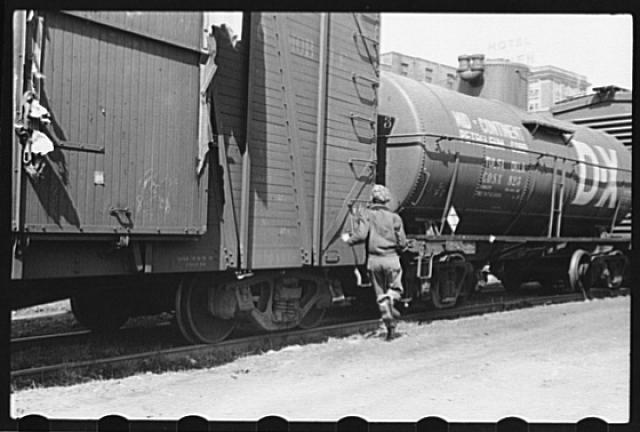
One of the the ways youngsters in Portales, New Mexico, used to entertain themselves summer days was hopping a freight train for a ride to Clovis, twenty miles away.  We’d hang around a while doing nothing, then hop another back to Portales.

Bums hanging around the Clovis yard would tell us which trains not to catch.  A kid wouldn’t want to be on a mile-a-minute diesel locomotive as it went through Portales and end up in Roswell, 90 miles west, wondering how to get home without the war department discovering what he’d been doing.

It wasn’t quite a decade later, summer, 1964, I was in NYC hanging around Greenwich Village thinking I was a beatnik.  I decided to head back to the desert Southwest.  The easiest way of getting out of the city appeared to be to hop a freight.  Seemed logical that any train I caught ought to be going South, or West, or Southwest.

Sometime after dark the train stopped at Rochester and and two cops had their pistols pointed at me.  Handcuffs, fingerprints, paperwork, and off to the slammer.  Rochester, New York, awaiting an arraignment so’s they could decide whether to charge me with the NY felony of riding freight trains and send me off to the pen two-to-five years.

That Rochester jail was the first place I ever heard the phrase, ‘riding the rap’.  Prisoners used it to describe what happens when you’re caught (the rap) and sentenced (serving your time – riding it).

Considering how frequently we humans are wrong about almost everything, and how seldom we’re right, it’s a mystery.  We go to sooo much trouble convincing ourselves we’re right.  Once we adopt an opinion about how things are, we hang onto it with hair,  teeth, and toenails and ride it.

At the beginning of the 20th Century a consortium of top-scientists announced to that all the major discoveries science would ever make had already been made.  Human beings all over the world believed them.  They’ve continued patting themselves on the back from then until now.  The airplane, the atomic bombs, moon landings, plastic, computers, tubeless tires, television,  and quantum physics were just tying up loose ends.

In our personal lives this brave new century is a time to pick something safe, something that will stay on the rails.  Something that won’t provide us with any growth experiences.  Safety nets.  Insurance policies.  Spectator sports.  World news.

We might be bored to tears, but by damn we know who the Bulgarians ought to elect for their president, and by damn, we know who killed John Kennedy and what’s the best ball team.

The only rap we have to ride is knowing our lives are slipping away without our having done anything but a little flag-waving.  Whoopteedoo, watched the Super Bowl.  Whoopteedoo, went to a concert.  Whoopteedoo, got a car.  Whoopteedoo, died of cancer.

But by God, I was right.  Knew, by damn, who the Bulgarians should have elected for their prez.  Knew which ball club was best, win or lose.

Life flashing before the eyes during the last minute of life, I wonder if a person gets to thrill again to the 1999 Super Bowl.

Or whether he might wish he’d chosen some other rap to ride.  Chosen a life with more risk, more flair, so they wouldn’t write his epitaph, “He knew everything already and played it safe.  Sixty times around the sun and he never fixed a flat tire.”

Old Jules

Creedence Clearwater Revival- Midnight Special
http://www.youtube.com/watch?v=DksGi7B5BdM&feature=related