Greg Bear gave himself a hefty job of work for this 473 page tome. The subject is the arrival of aliens on the surface of the earth, the gradual discovery of their motive to ‘eat’ the planet, and the reactions of science and politicos as the realization becomes certainty.
In some ways the internal plotting resembles Heinlein’s, The Puppet Masters, in others, Larry Niven’s, Lucifer’s Hammer. However, if you’re a reader who finds himself studying the characterization as the author develops it, the tool used in furthering the plot, you might find this one a bit annoying.
Although Greg Bear’s handling of the plot requires the introduction of a lot of characters for the reader to attempt to keep track of, he does a fairly craftsman-like job. He’s obviously aware of the problem and uses a lot of internal plotting to provide the reader with anchors of segment for each of them to assist. If he hadn’t been a workmanlike writer he’d never have succeeded as well as he did, which isn’t to say he succeeded completely. Greg Bear’s skill at characterization kept the work from becoming a complete disaster.
The plot develops rather slowly, and to keep the interest of the reader the author introduces a number of not-often-used event features as crucial pieces of his plot. This served in my instance to keep me determined to finish the book.
The concepts Greg Bear introduces are compelling enough to cause me to pause in the reading about 2/3 of the way through to allow some digestion of it all before continuing. There was no temptation to leave it alone after a day, but I found when I returned I found I already had to reorient myself, reacquaint myself with the individuals connected to names among his multitude of characters, briefly re-study which sub-plot I’d absented myself from when I stopped to contemplate what he was doing.
I believe authors could gain a lot of benefit by carefully studying Bear’s handling of a complex plot broken constantly by updating internal, brief sub-plots, and constant shuffling a population of characters within. Before reading the book I might have thought it was an impossible task. After reading it I’d conclude it was merely improbable in a Tolstoyesque sort of way.
I’ve pondered how he might have done it better, considering the task he set for himself, and haven’t thought of any way it could have been done without removing some of the sub-plots, which he’d made essential to the overall plot development. A trap he’s too competent an author to have caught himself in unaware.
Too busy might be how I’d describe the book, but still compelling enough to cause the reader to work hard to struggle through. At least some patient readers.
She loved bridge
He loved mostly poker;
Never understood
How his sevens-high full house
Betted to the limit
Looking at her pair
Of Aces
Turned out to be
Disaster
Crushed beneath
An Ace high full
Every time he let her
Cut the deck
So you hate him.
Wish him ill.
You have a problem.
If he could only feel
The fear, the doubt, the horror;
If he could only satisfy your
Yearning
For him to feel those things
He might do it.
He might.
If he could only understand
How much it means to you
To cause him pain;
With what a flood of anguish
And venom you despise
Hunger his agony
And want to be responsible;
Want him to know,
He certainly might try.
But, he can’t.
Despair’s no longer sexy
To those who’ve seen it naked.
Fear cowers under a straight,
Steady gaze.
You’ll have to offer something
More frightful
Than your silly rage;
Your idealized terror;
Something more dismal
Than your impotent concept of
Emptiness;
Something with more substance
Than your scorn;
Something more somber than you
Think death is
To make him care.
Life will hand him defeats
His days will serve up
A ration of pain
He’ll deal with them as he must
And always know those blows
Aren’t yours.
They’re just life.
Being on top was such fun!
The products were cheap, and the gun
Assured they’d keep coming
Velocities numbing
Til ammo we’d spang out of run.
Those multi-national boys
Didn’t make you buy all of those toys.
You bought them not thinking
From China, though shrinking
Your dollars without so much noise.
It’s jobs that you want, and you’re right
But you’ve got to be part of the fight.
Throw out all your plastic
incumbents and spastic
Buying and crying and spite.
The CEOs bankers and pols
Helped you do it but aren’t Commie moles
It’s true they’re just like you
Their coppers will strike you
While your coppers strike at the doles.
Stopping a train just ain’t easy
The methods are bloody and sleazy
But changing direction
Requires a correction
More solid than whiney and breezy.
3 am I wake
Find you atop me
Kneading
I savor
The soft purr
Of you
The gentle scratch
Of nail on flesh
Tiny pleasure pain
I hold
I hold
I hold
Until I can wait
No more
Lift you
Lovingly aside
And rise
You follow watching
My grimaced
Downward
Push
Muscle pressure
Pain
Release
Your tail
Lashes S and Z
In empty air
Green eyes fixed
I search absently
For a synonym
For piss hard
And ponder how
Like the useless
Appendix
This serves no function.
No. No.
It reminds
Remembers
Other uses
Other times.
There’s something mildly annoying and intrusive about having ourselves tagged and numbered by some damned academian somewhere as a particular personality type. But when my good friend, Rich, sent me this link along with the question, “Does this remind you of anyone you know?” I clicked it.
“INTJs are strong individualists who seek new angles or novel ways of looking at things. They enjoy coming to new understandings. They tend to be insightful and mentally quick; however, this mental quickness may not always be outwardly apparent to others since they keep a great deal to themselves. They are very determined people who trust their vision of the possibilities, regardless of what others think. They may even be considered the most independent of all of the sixteen personality types. INTJs are at their best in quietly and firmly developing their ideas, theories, and principles.” —Sandra Krebs Hirsch[15]
If I were the kind of person who allowed himself to get pissed off about things other people do and say this would really piss me off. In the first place, I don’t even believe in psychologists and psychology. What the hell do they know about anything?
Secondly, wrapping people up into a nice little package and putting a colorful bow on it, sending it out as though it were a gift for anyone who wants to claim he knows something about people and the way they think is an invitation for more of that sort of insufferable thinking-behavior disguised as learning.
Thirdly, the way institutional science is forever confusing itself with engineering without ever pondering the consequences, next thing you know there’ll be all manner of psychologists getting themselves government grants to devise ways to profile their homespun stereotypes so’s some branch of government with an opinion about a particular type can identify them for their own purposes.
For instance, every day you can read about physicists at CERN and other labs patting themselves on the back and saying, “Oh yeah, we’re creating baby black holes. They just vanish. No danger of one of them getting away and gulping up the planet earth.” As though they know what the hell a microscopic black hole is doing, or likely to do in orbit. Heck, maybe it was just in a slower orbit and got left behind until the next time earth comes around Old Sol to pass through and grow a little every pass.
Think about it. Those Manhattan Project guys developing the atomic bomb consisted of a significant portion of whom thought testing that device might set fire to the atmosphere. They got out-voted, not because anyone knew it wouldn’t, but because most believed it was a low probability.
How’s that for some exercise in risk-taking judgement? “Hey, let’s put it to a vote. How many think there’s a big chance if we detonate this thing it will destroy all life on the planet by setting fire to the atmosphere?”
40 PhD physicists raise their hands.
“Okay, how many don’t think there’s a very big chance it will?
60 PhD physicists raise their hands.
“Cool! Let’s run with it!”
And the majority turned out to be right. Whoopee! Now, generations of scientists later all over the world consortium of pointee-heads in laboratories and behind desks at universities can hold that up as an example of how to measure risks they’re taking without ever getting outside their closed circles of wisdom and knowledge.
But I’ve digressed. Back to these grant-prostitutes calling themselves psychologists.
You and everyone else can be assured there are graduate students somewhere creating a box to hold all your personality traits, figuring out the buttons to push to produce a particular behavior from you. What words, images, sounds will inspire you to buy a particular type of product, vote a particular way, choose a direction for your life. The grad students just do the work, but some hotshot pointee-headed prof will give a paper about it when the National Association of Prostitute Psychologists meets next spring and position himself for more grant money.
But you can be equally assured that cop shops and the ilk have hired them out to help them see what else is in the box they have you in. Yeah, you’re all these things, so you’re also probably a serial killer, terrorist, baby-raper, or someone who just doesn’t have any damned use for authority figures.
You’ll be damned lucky if they don’t outlaw you sometime because some hired-hand grad student working for a grant-hack prof put the wrong thing in your box.
Here’s an example. A gentle, harmless personality box. But just listen to what else is in there to light up the eyes of the cop shops. But I suppose old John Denver’s probably not concerned about it.
Old Jules
The John Denver Show (BBC), 1973 – Poems, Prayers and Promises
If you’re in the Northern hemisphere and you look to the south to the constellation Centaurus tonight you might view Alpha Centauri. 4.5 light years away. The nearest star to this one claiming ownership of us and our planet.
That’s right. About the time the light from Alpha Centauri was leaving home on the journey to your eye, all that clothing you see in the photo was sparkling new sitting on shelves in stores, racking up cash register numbers and causing people to have to frown at the bills at the end of the month. Now every item hanging there is worth less than a US dollar. Nobody likes products produced when the light from Alpha Centauri was just cranking up the engine, gunning the motor and heading here.
Weirdly, the value of everything around you reflects what I’m describing. Doesn’t matter whether it’s a toaster, a washing machine, an automobile, frequently even a marriage.
Face it. That stuff you’re buying won’t be worth squat when the light starting from Alpha Centauri today reaches here.
Maybe you’re humanocentric and think that’s lousy behavior on the part of a star, or maybe you’re one of those apologists who blame it on humanity, or Old Sol. But either way, you’re not looking at the worst case.
Consider Vega.
Northwest sky, bright, 25 light years. “Nothing wrong with Vega,” a person might think. But you’d be wrong. Almost everything people yearned and bankrupted themselves buying in 1986, when Vega was sending out the light you’ll see tonight, is in landfills and junkyards. Owning something manufactured when that light was leaving Vega’s worse than owning something manufactured in the USSR on Monday or Friday.
But there’s a lot more. When Vega was shooting that dot of light at your rods and cones writers were pounding away on typewriters and computers months at a time cranking out manuscripts, publishers running them up to the tops of the lists, creating tomes of gigantic lasting importance. But Vega took care of that, too:
New York Times Best Seller Number Ones Listing
Not one stayed around until that light from Vega reached here.
You can buy any one of them for a quarter, sometimes a dime at the Salvation Army Thrift Store.
————————————
Computers? When Vega was spitting out that dot of light you see here’s what was happening:
Microsoft releases MS-DOS3.2. It adds support for 3.5-inch 720 kB floppy disk drives. [130] (December 1995 [146]) (March [346.254])
Apple Computer introduces the Macintosh Plus. It features a 8 MHz 68000 processor, 1 MB RAM, SCSI connector for hard drive support, a new keyboard with cursor keys and numeric keypad, and an 800 kB 3.5-inch floppy drive. Price is US$2600. It is the first personal computer to provide embedded SCSI support. [46] [75] [120] [140] [180.222] [203.68] [346.167] [346.268] [593.350] [597.94] [611.41] [750.49]
Lotus Development announces it would support Microsoft Windowswith future product releases. [1133.22]
Microsoft releases MS-DOS3.25. [346.268]
Two months after releasing Microsoft Windows, Microsoft has shipped 35,000 copies. [1133.22]
The first virus program for the IBM PC appears, called the Brain. It infects the boot sector of 360 kB floppy disks. [1230.56] [1805.23] (1987 [1260.193])
IBM announces the IBM RT Personal Computer, using RISC-based technology from IBM’s “801” project of the mid-70s. It is one of the first commercially-available 32-bit RISC-based computers. The base configuration has 1 MB RAM, a 1.2 MB floppy, and 40 MB hard drive, for US$11,700. (With performance of only 2 MIPS, it is doomed from the beginning.) [31] [116] [205.114] [329.129] [1311] [1391.D1]
Compaq Computer introduces the Compaq Portable II. [108]
Tandy debuts the Tandy Color Computer, with 64 kB RAM. It is the successor to the Color Computer 2. [1133.21]
AT&T creates the first silicon fabrication of its CRISP architecture CPU, incorporating 172,163 transistors, and operating at 16 MHz. [660.6]
Apple Computer introduces the Macintosh 512K Enhanced, for US$2000. It features an 8 MHz 68000 processor, 512 kB RAM, and 800 kB 3.5-inch floppy drive. [46] [75] [597.94]
Seen any of that stuff lately? No. It’s all deep in attics, closets, garages, or in the city dumps.
But when you look up there at Vega, that’s what you’re seeing. All that stuff shiny and new gleaming in the eyes of you back then, packaged up for birthdays, anniversaries, Christmas. Happy faces.
The erosion of human values following a straight line between Vega and your optic nerve. All that stuff listed above, the cars, the computers, the books, people worked their asses off to manufacture it and others worked their asses off to buy it all.
But that time lag between Vega and here screwed it all. Rendered it worthless.
I’m not partisan on this, not pointing fingers of blame at Vega. I don’t know whether it’s the fault of Vega, or whether it’s a conspiracy concocted by the same people who assassinated President Kennedy back when the light you see when you look at 19 Draconis or Alpha Cephei was leaving home.
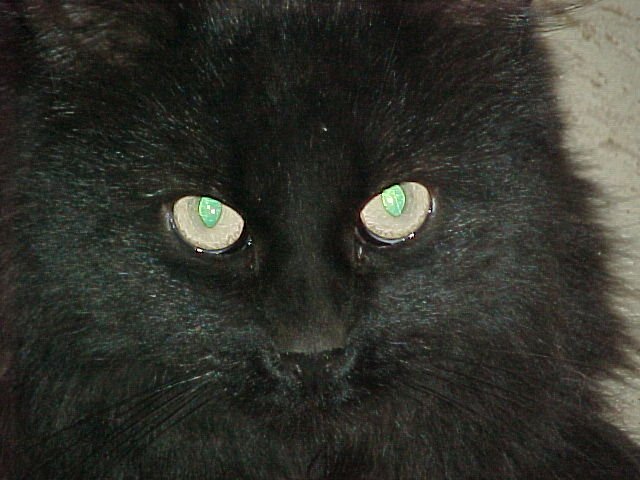
Niaid was curled up on the bed, [I double-checked] so whatever else that critter was, it was an outsider. The chickens were ranging free and I couldn’t hear any alarm from them, but this guy just looked too big to have roaming around without interruption.
As I came around the cabin where I could see him better:
It was obvious the feline was operating out of a different reality. Which didn’t necessarily mean he didn’t need to be the focus of protective measures. But how does a person protect his chickens from a shadow-cat? I’ve done some websearching on the various news sites and checked out the methods incorporated by the US Government into programs to avoid having shadow-cats disrupting citizen-like critters such as these:
The consensus seems to be you have to get one of these:
No matter what the cost.
I’m not certain I want to have one of those running around here loose, even when I have dangerous shadowcats skulking around peeking at my holdings.
Once something of that sort gets a foothold there’s no predicting where it will end:
Sugar pills in toy jars
Candy counter cures
For the sensory deprived
For the spirit that yearns hardship
Facade struggle for the
Stagely frightened
Sedentary soul
Living a reality
Where gangster boss of fantasy
Celluloid deeds and words
Are worth repeating;
Gladiator wars in plastic armor
Oaken clubs and pigskin missiles
Pudding danger jello struggles
Hard and real inside the mind
Inside the molded plastic
Toy of the mind
Man who cleans the windshield
At the signal is an actor
In the show last night
On MTV or HBO
Sexy girls dancing
In the background
As he postures
Rag and bucket
On the glass
Toy hero pushes button
In the Kevlar coated dragon
Of the field
Sees the enemy extinguished
In a prophylactic
Box of evening news
Before and after
Old war movies
All the same
Any loss is accidental
Cost of war’s
In higher taxes
Salaries for heroes
Fuel bullets
Not in blood
Not in blood
Sterile sealed
In plastic baggies
Plastic baggies
Hold the artificial
Flavor
Of the life
When life was real
Yet the sickness
Needs a remedy and cure
Sugar pills in toy bottles;
New candy counter pudding
For the soul.
A man I went to grammar school, junior high and some high school with, then several decades later became reacquainted and huff-puffed a lot of up and down mountain canyons recently began visiting this blog. If no other reader enjoys the tale, at least he will, because he was there:
The following is copyrighted material from a book I wrote once. I give myself permission to use it here. [ Crazy Lost Gold Mine-ism]
I’ve never concerned myself much with the dangers of wild animals during my extensive time in the woods. Mostly they’ll mind their own business if a person takes reasonable precautions and doesn’t go out of his way to provoke them. In New Mexico backlands of the late 20th century the real threats usually come in the form of humans. When those happen they usually come as suddenly and unexpectedly as finding one’s self in the middle of a herd of elk.
Grasshopper Canyon and Stinking Springs are on the northern end of the Zunis below Oso Ridge on the west face of the mesa. Two canyons run north and south, parallel to the face, half a mile apart, separated from one another by steep, narrow walls several hundred feet high. These two walls consist of coral reef from some ancient time when Oso Ridge was an island. The canyons aren’t easily accessible, so I prospected there a while.
The land below Oso Ridge around Grasshopper Canyon is checker-boarded in ownership. Grasshopper is all National Forest, but immediately south is a section of Navajo tribal land. Adjacent to the Navajo section is a section belonging to the Zuni tribe. Fences between these sections allow a person to always know whether he’s on public land or tribal land.
I was working Grasshopper Canyon with my friend Keith, a stockbroker from Santa Fe. We separated and worked the arroyos southward parallel to one another, gradually moving toward the fence delineating the Navajo section. Occasionally we’d call out through the woods to make certain we weren’t out-distancing one another. The last thing either of us expected was an encounter with another human in those woods.
I was bent over taking samples from the bed of a shallow arroyo, just deep enough so when I straightened I could view the small meadow around me. I stood getting my breath and stretching the kinks out of my back when I saw a man dressed in cammies backing out of the woods at the edge of the meadow. He was being stealthy, carrying a .22 rifle in a ready position. He had twenty to thirty colorful birds hanging on a string around his neck the way a fisherman carries a stringer of fish. As I watched, almost invisible to him with only the top of my head showing above the arroyo, his eyes searched the woods to his right where Keith was working. Keith had called out from there a few moments previously.
Still watching Keith’s direction the man backed toward me until he was only a few feet away from me. “Nice string of birds.” I scrambled up the bank while he spun and pointed the .22 in my general direction.
“My partner’s in the woods back behind you. You don’t want to be firing in that direction.” We studied one another. He eyed the shoulder rig I was wearing and the butt of the 9 mm automatic showing from the bottom. “’You out here killing songbirds?”
Mister Songbird was a young man and from appearances, a Zuni. He stared a moment longer before answering. My impression was that he was considering whether I was a game warden or other law enforcement official. “I’m getting them for Zuni New Year. They let us do that.”
We talked for a few minutes, me accepting what he said at face value, and the tension gradually dissolved. He agreed to get the hell out of the canyon because we were working there and wouldn’t want any shooting. Besides, we’d probably messed up his hunt with our yelling and bustling around the woods. I watched him back into the meadow to the south and allowed myself to sigh with relief.
Back in Santa Fe I called the US Fish and Game Department. I thought there was a remote chance the feds were really allowing Zunis to kill protected species birds on National Forest land. If so, I was prepared to be indignant.
When I told my story the fed was silent a moment. “You are a lucky man,” he observed. “You confronted an armed man committing multiple Federal felonies and he didn’t shoot you.”
* The following didn’t make it into the final draft of the manuscript: The fed also observed the Zuni lad would have spent a lot more years in prison for killing those songbirds than he would have for killing me. I drew a good bit of comfort from knowing that.
Eventually logic won out over the other appeals of the Zuni Mountains as a location for the lost gold mine I was searching for. Although the Zunis were handy for me, being only a few hours drive from Santa Fe, they were too far from Tucson.
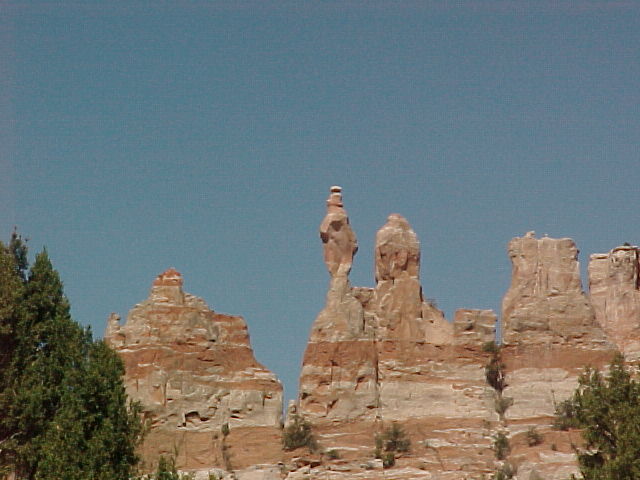
Also, too many prominent landmarks in the area would have immediately brought the original survivors back. The route I imagined them following would have taken them within sight of Los Gigantes and enough other one-of-a-kind eccentricities to make the location unmistakable.
Even the Big Notch and Little Notch in the Continental Divide can be seen from miles to the west. There’s nothing else similar to it in North America.
74 years old, a resident of Leavenworth, KS, in an apartment located on the VA campus. Partnered with a black shorthaired cat named Mister Midnight. (1943-2020)
Since April, 2020, this blog is maintained by Jeanne Kasten (See "About" page for further information).
https://sofarfromheaven.com/2020/04/21/au-revoir-old-jules-jack-purcell/
I’m sharing it with you because there’s almost no likelihood you’ll believe it. This lunatic asylum I call my life has so many unexpected twists and turns I won’t even try to guess where it’s going. I’d suggest you try to find some laughs here. You won’t find wisdom. Good luck.









 So Far From Heaven
