I’ve never read anywhere that it happens this way, never heard anyone say they think so. Which doesn’t mean that’s not what happens.
The EEG flattens, the body falls, spasms, something exits.
That thing that exits hangs around out in the ether trying to figure out how it got there for a while. Then comes a voice:
“SO. WHAT DO YOU THINK?”
Looking around isn’t an option. It’s the first input for a while, so the hanging-around something ponders the question a while before deciding on an answer.
“I sure do like them Dodgers.”
“NO. What do you THINK?”
The hanging -around something senses some urgency in the query. Something might be important, and the something is beginning to suspect it’s no longer alive.
“I don’t like illegal aliens, Moslems or welfare. I love God. I always wanted to travel and wanted my son to play football.”
Long, endless pause.
Finally the hanging-around something begins to wonder whether the voice is still present, waiting. In life it was always best to come right out with things, so the hanging-around-something tried to turn the situation around.
“What do YOU think?”
The ether vibrates with something akin to an opening door, a shrug in the air, finality.
Maybe I should have clarified the question from the beginning.
Seems to me the answers we give to life’s crucial questions are almost never truly spontaneous, but also never the product of clear, careful thinking applied inside skulls by our own brain cells. The body of data we package and label, “What I think” is actually something we had little, or nothing to do with. Rather than examine the source of how we came to ‘think’ it, we just pick it out of the cosmic data pool we percieve as ‘common sense’ and place it lovingly in the folder of what’s important in our lives without giving it any thought at all.
But because we’ve taken ownership of it, staked out claim to it, assigned a value to it, [all done on autopilot] it’s been elevated to the level of truth.
Now we rub our hands together in satisfaction and pronounce, “I think”
Somewhere, someone, sometime needs to actually do it occasionally.
I happen to believe I ought to be one of them, but I’m lousy at it, falling down on the job. My gut feel is that probably everyone ought to be one of them, but it’s plain they’re lousy at it too, falling down on the job.
We staff members of the New Mexico State Emergency Management Planning and Coordination Bureau [EMPAC] didn’t laugh much. We were a collection of old guys mostly retired from something else, except for a few youngsters, mostly support and training staff.
Radiation Response and Recovery [the RAD catchers] was a retiree Bird Colonel from the US Army named Sam. Hazardous Materials Response and Recovery was headed by Joe, a retired US Air Force Lt. Colonel who’d piloted B47s for the Strategic Air Command in his youth. Joe sat at the end of a runway in a B47 loaded with hydrogen bombs for two weeks during the Cuban Missile Crisis. Natural Disasters – Earthquake Preparedness was a shot-up in-Vietnam old Lt. Colonel, infantry. And so on. My program was Flood Plain Management and local coordination and training for one of the regions. Too long out of the military to remember whether I was enlisted or an officer.
Our Bureau Chief, Larry, was a retired Master Sergeant, US Army Search and Rescue, another Vietnam vet. An enlisted man coordinating the activities of field grade officers, giving instructions, approving their work and their per diem expenditures would have been a potential source of laughter if we’d all held our mouths right, but “That’s what happens when you put an enlisted man doing the job of an officer,” was a frequent grumble every time something went awry.
The staff meeting was in the bomb shelter of the old National Guard Headquarters building in Santa Fe where our offices were located.
“I had a weird call from one of the aids to the Governor this morning.”Larry’s eyes searched our dozen blank faces. “Any of you know anything about Y2K?” Calls from the Governor’s office to anyone at EMPAC was bad news. We liked to think we were invisible, nobody knew we existed. This particular governor, however, we considered a space cadet. A flake.
We all exchanged scowls while my mind toyed with the phrase. “Y2K. Y2K? Where the hell have I heard about Y2K lately?” The thing rang a bell in my head, but I couldn’t think why.
“The Gov just got back from a meeting of the Association of State Governors. They did a big program on Y2K. He’s all excited about it. Evidently there’s some damned thing going on with computers to make them all fail January first, 2000.” Sneers and a chuckle or two. We all agreed on something.
“Do any of you know what other states are doing? Any ideas what we should be doing? We have to send an answer over to the Gov’s office. We have to put together a plan of some kind.”
Background rumble around the table. “Y2K? Why the hell would all the computers crash when the 20th century turns over?” “Damned idiot governor.”
“Hmmm computers. That’s it.” Now I remembered.
“It’s all a farce, Larry.” I was remembering a conversation and exchange of emails I’d had with my ex-wife. “Carolyn heads the department in Texas that’s supposed to be preparing for it. She told me a while back they were spending a lot of money on it, hiring a lot of people. Pissed her off when I said it was just another bureaucratic scare plot to build more empires.”
Larry stared at me, mind busy with what I’d said. “Could you find out what they are doing over there?”
“Sure. Why not?”
“Also, get on the internet. Find out what people are saying is going to happen. Find out everything you can about what all the other states are doing.”
The others in the room relaxed a little. No one wanted this project and now it was clearly mine. “How much time do you want me to spend on this?”
“A week. Two maybe. We just need to put together a plan that makes sense.”
As I left the staff meeting I was feeling pleased with the diversion this offered me. Something away from flood plain management and routine emergency management coordination. I didn’t expect it to be any problem at all.
I began by sending an email to Carolyn. This was the response I got:
“The Year 2000 deal is a real threat. Lots of people have been doing lots of
work to mitigate the consequences, and we’re still ‘influencing the future’.
The real problem is that we can generally fix what we know about, but there is so much we don’t know.
For example, the power grid – there are many many power generators and power distributors in this country, and many “embedded systems” in each company. Some companies are taking the problem seriously by contacting their suppliers (of power grid equipment, as an example) to see if components will work.
Afraid of litigation, the manufacturers hem and haw around and provide no definitive data. Yes, I think there will be power outages, thus water problems, heating problems, etc, but I don’t think the whole US will go dark, and we still have some time to work on it.
One scenario I’ve heard is that elect. companies will work to distribute what power they have so that rolling black or brown outs will limit the negative affects of the power failures.
Some good news, the banking industry in the US is in very good shape. Our only fear there is fear itself. I think a lot of IT systems are being corrected at a more rapid pace than originally anticipated, and governors like yours and mine are at least anticipating problems so they can prepare for them. I think if the people anticipate the problems, and know that someone has already developed a work around, we’ll be fine.
Any disruptions will probably be short lived. I could go on, but duty calls. C.
I trusted Carolyn about as much as any man can trust an ex-wife after 25 years of marriage.
I didn’t know it yet, but for me this began the end of one lifetime and heralded the start of another.
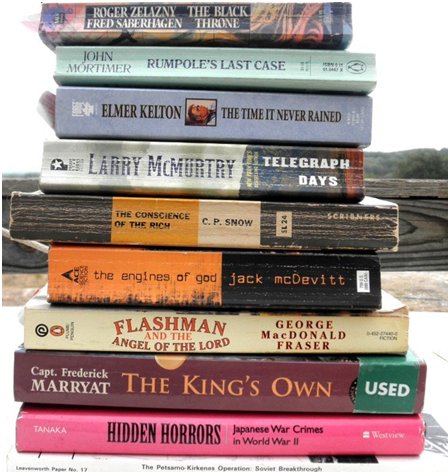
Leavenworth Papers #17 – The Petsamo-Kirkenes Operation: Soviet Breakthrough and Pursuit in the Arctic, October 1944, Major James F Gebhardt,Combat Studies Institute, US Army Command and General Staff College, 1948
Detailed examination of the Soviet success in the offensive attempting to identify what the US military should learn from it. Concluded light infantry to be the weapon of choice in arctic warfare. Examines the lessons learned by the Germans fighting under those conditions.
Good read for those interested in such matters.
Hidden Horrors – Japanese War Crimes in World War II, Yuki Tanaka, Transitions: Asians and Asian Americans Series, 1996
The Contents describes it better than I can:
1. The Sandakan POW Camp and the Geneva Convention
2. The Sandakan Death Marches and the Elimination of POWs
3. Rape and War: The Japanese Experience
4. Judge Webb and Japanese Cannibalism
5. Japanese Biological Warfare Plans and Experiments on POWs
6. Massacre of Civilians at Kavieng
Conclusion: Understanding Japanese Brutality in the Asia-Pacific War
Tanaka elaborates on the collaboration between the US and Japan to cover-up and downplay many of these events because of the post-WWII need for Japan as a strong Pacific partner against Communist aggression. Many were not investigated, prosecuted, even mentioned again in public media.
Fifty years after the Japanese surrender Tanaka writes: “Consequently, we Japanese have failed to recognize ourselves as aggressors, still less as perpetrators of war crimes. Moreover, because of the widespread perception of ourselves as victims of war, the notion of “victim” gradually expanded even to the point that the Japanese state was also seen as a victim of war.”
Reveals various deals made between the US Command under Dugout Doug and the Japanese commanders who conducted human lab experiments on POWs. Immunity from prosecution in return for everything learned in the experiments.
The King’s Own – Captain Frederick Marryat
Marryat’s a worthy read. He was a British Navy Captain when he retired in the 1820s and began publishing fiction works based on his experiences. His writings almost certainly were foundations for Horatio Hornblower and a lot of other sea yarn characters in fiction series during the 20th Century.
Marryat’s the daddy and granddaddy of them all.
Flashman and the Angel of the Lord, George MacDonald Frazer
The Flashman series is possibly the most laughing [and among the most educational] historical fiction series ever written.
I thoroughly resent Frazer dying before he wrote several more of them, though I re-read the ones he did write at least one time every decade. He’s welcome to resent me dying off without reading them again if it works out that way.
The Flashman Papers in Chronological order
Flashman [Britain, India and Afghanistan, 1839-42]
Royal Flash [England, 1842-43, Germany 1847-48]
Flashman’s Lady [England, Borneo, Madagascar 1842-45]
Flashman and the Mountain of Light [Indian Punjab 1845-46]
Flash for Freedom [England, West Africa, USA, 1848-49]
Flash and the Redskins [USA 1849-50 and 1875-76]
Flashman at the Charge [England, Crimea and Central Asia 1854-55]
Flashman in the Great Game [Scotland, England1856-58]
Flashman and the Angel of the Lord [India, South Africa, USA, 1858-59]
Flashman and the Dragon [China, 1860]
The Engines of God, Jack McDevitt
Respectable and readable sci-fi.
The Conscience of the Rich, CP Snow
Strange and unsettling book. Published during the 1950s the title’s an anachronism to such an extent the reader feels a bit lost at the beginning, figuring on some class warfare thing that would have found that name a decade later.
In fact, it’s probably the book Maugham would have written in Of Human Bondage if he’d been writing about a family of Jewish aristocrats in Britain during the 1920s and 1830s. The intractable controls imposed by the Jewish family on personal choices of family members in almost every facet of their lives.
Unsettling, but a worthy read.
Telegraph Days – Larry McMurtry
That original McMurtry book where he decided to become Louis L’Amour wasn’t bad, certainly a lot better than some that came later. I’d put Telegraph Days somewhere up near the top of his work since he became the great American novelist trying to push L’Amour out of the way.
The Time it Never Rained – Elmer Kelton
Good read about that pivotal time in the relationship between independent ranchers in the west and the US government, coincident with the drought of the 1950s.
Rumpole’s Last Case – John Mortimer
Another good Rumpole. What more needs saying?
The Black Throne – Roger Zelazny and Fred Saberhagen
Saberhagen books were always considered safe to buy at a quarter in the thrift stores until this one. I imagine it wasn’t him dropped the ball, but maybe it was just a pot-boiler for both of them. The writing craft is what’s at fault. Everything’s there, crisp dialogue, plot, characters with some depth. Good command of the language.
But something’s missing. I wouldn’t spend a quarter on it next time if I can remember when I see it again in a thrift store.
Retired university librarian. Oblique political humor of a liberal slant, frequently a smiler, sometimes a chuckler or horselaugher.
If you know more about politics than I do you might enjoy it even more. To me they’re just faces sometimes attached to names, but fun and interesting.
“Airplanes, cats, guns, war, the more than occasional rant about the party of the Confederacy, the spinelessness of the Democrats and crap about anything else that flits through the somewhat offbeat mind of an armed lesbian pinko as she slides down the Razor Blade of Life.”
I’m not crazy about a lot of the content, but the airplane pics she posts are worth the price of admission and reading the posts offers a different slant on things worth chewing on.
If you’re one of those folks who believe you ‘don’t like’ the works or Renaissance writers you might be the victim of having been forced to read the wrong ones by academians. Fact is the period includes some of the most entertaining writing mankind has ever been guilty of producing. Rabelais is one such example.
Academian praisers of Rabelais and this particular work have already expressed a lot of the truths to be found here, the exquisite style, the masterly satire. All they say is true and would be reason enough to read Gargantua and Pantagruel. I won’t repeat those laurels to affirm them. Instead, I’ll say it’s gutter crude, frequently barnyard humor with more levels than Grand Central Station.
Hilarious work.
But I’ll suggest another reason a segment of readers might find Rabelais interesting. Followers of the Thelemic ‘tradition’ created by Alister Crowley during the early 1900s might be surprised to discover Crowley’s claims to having channeled the doctrine from Horus in Cairo in 1910, were preceded by Rabelais several centuries earlier. Rabelais creates an imaginary monastery and sect of monks he names, “Thelema”, where a sign above the entry reads, “DO AS YOU WILL”. Sound familiar?
Give this book a chance. If you do you won’t regret it unless you offended by violations of polite discourse.
But if you read it as an admirer of Crowley’s channeling be prepared to have some of your balloons deflated, lean back and enjoy butchering of a sacred cow for the barbecue.
Hi blogsters:
Sometimes trying to piece together our lives can be quite a chore. Peaceful Warrior posted something on one of the groups about the way his name has been a problem to him, and it got me thinking about it.
I was given a name at birth that nobody since has been able to pronounce. They followed that with another one nobody’d ever heard of. So when I exited that burg at the age of 15 or so, I left those two names behind and became Jack for most purposes.
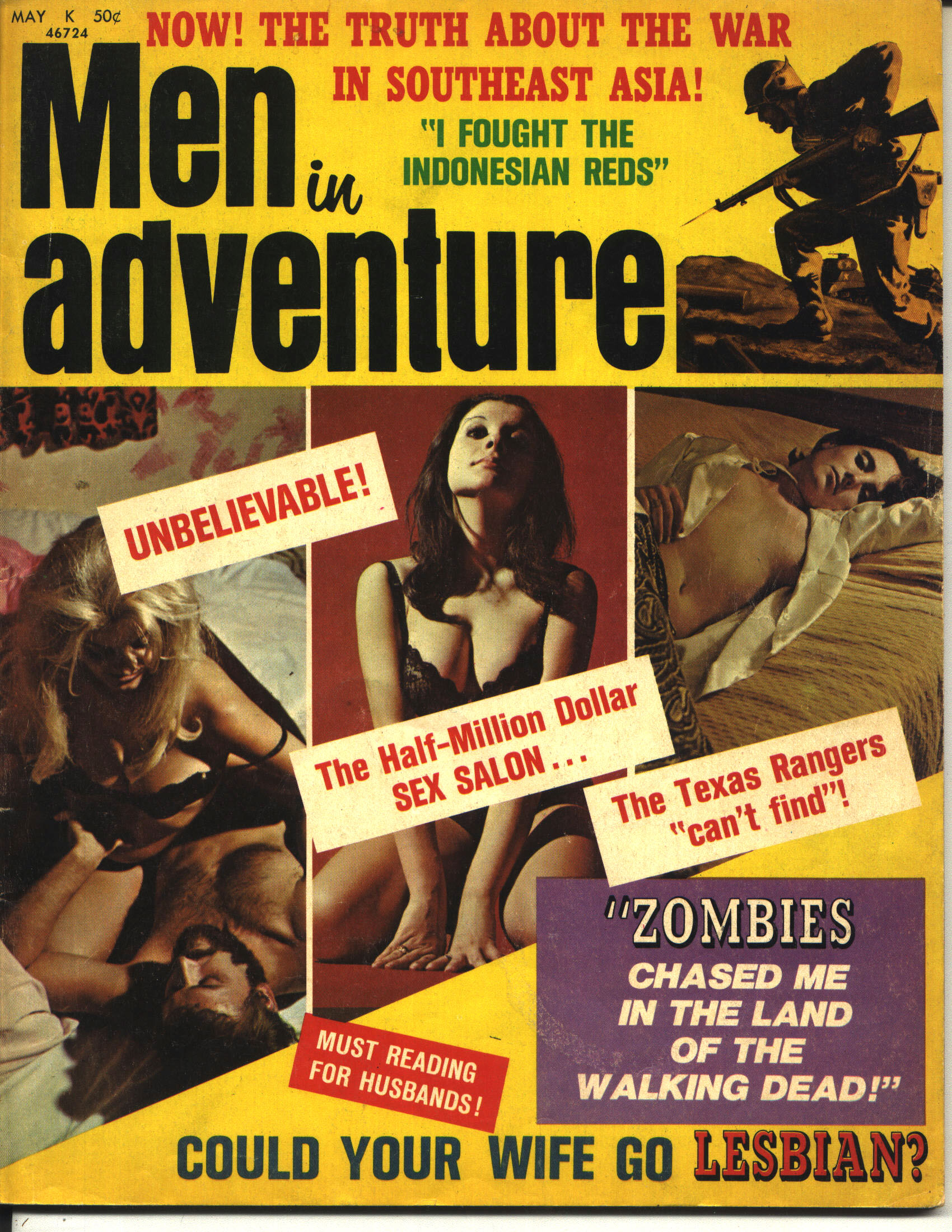
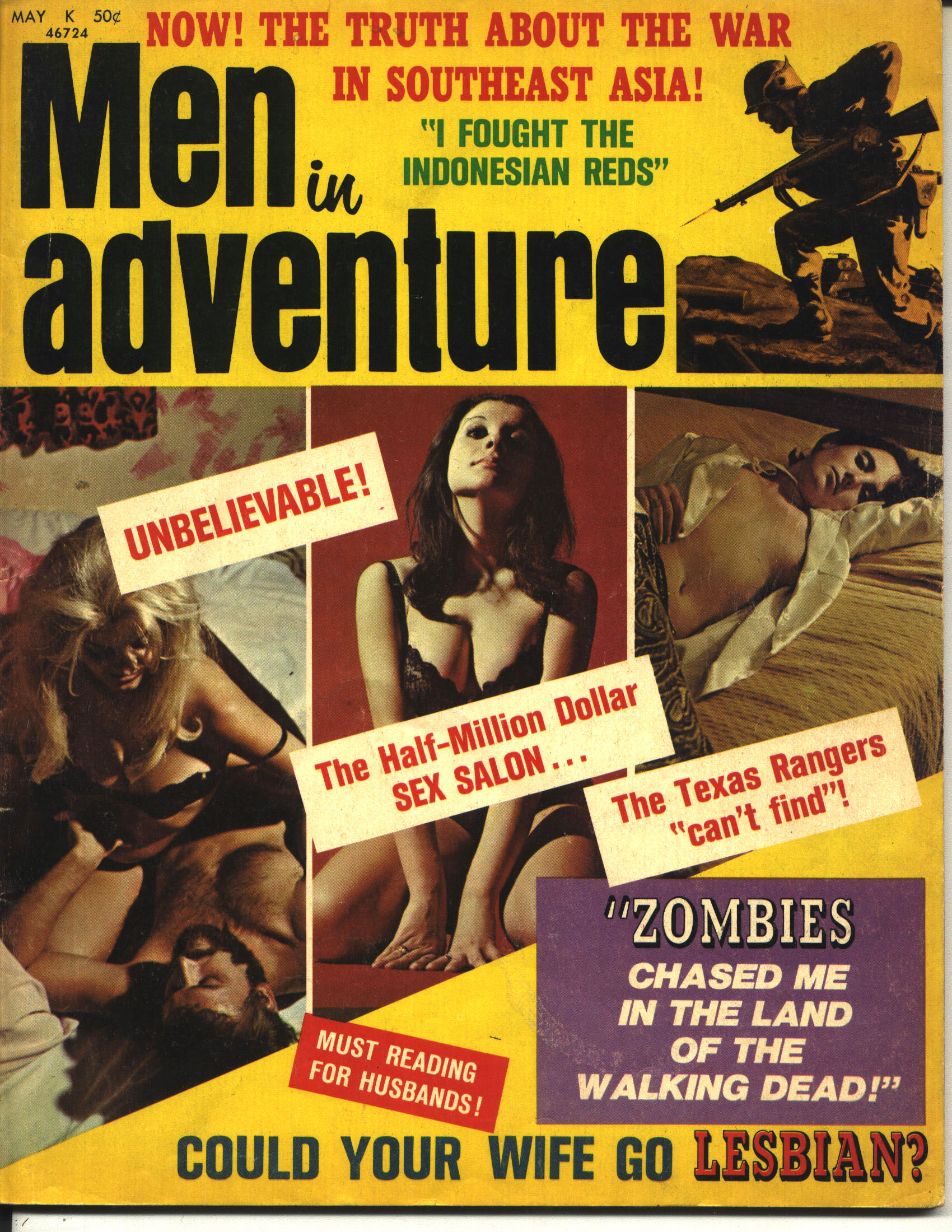
But as a struggling young writer in the late ’60s I found myself needing yet another handle…. I was writing for the hairy-chested men magazines… Men, For Men Only, a genre of magazines that vanished by the mid-1970s.
They usually had a picture on the cover of a Marine with a machete struggling with python wrapped around a half-naked woman in some jungle. That sort of thing.
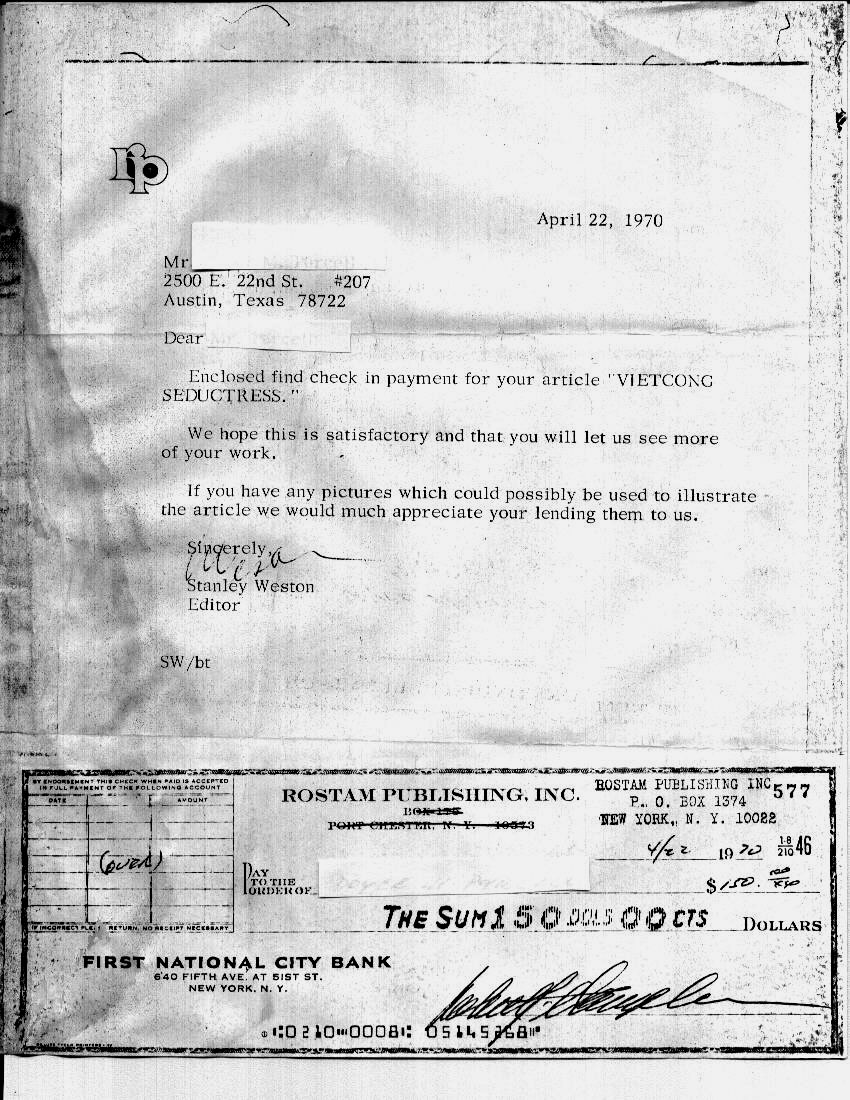
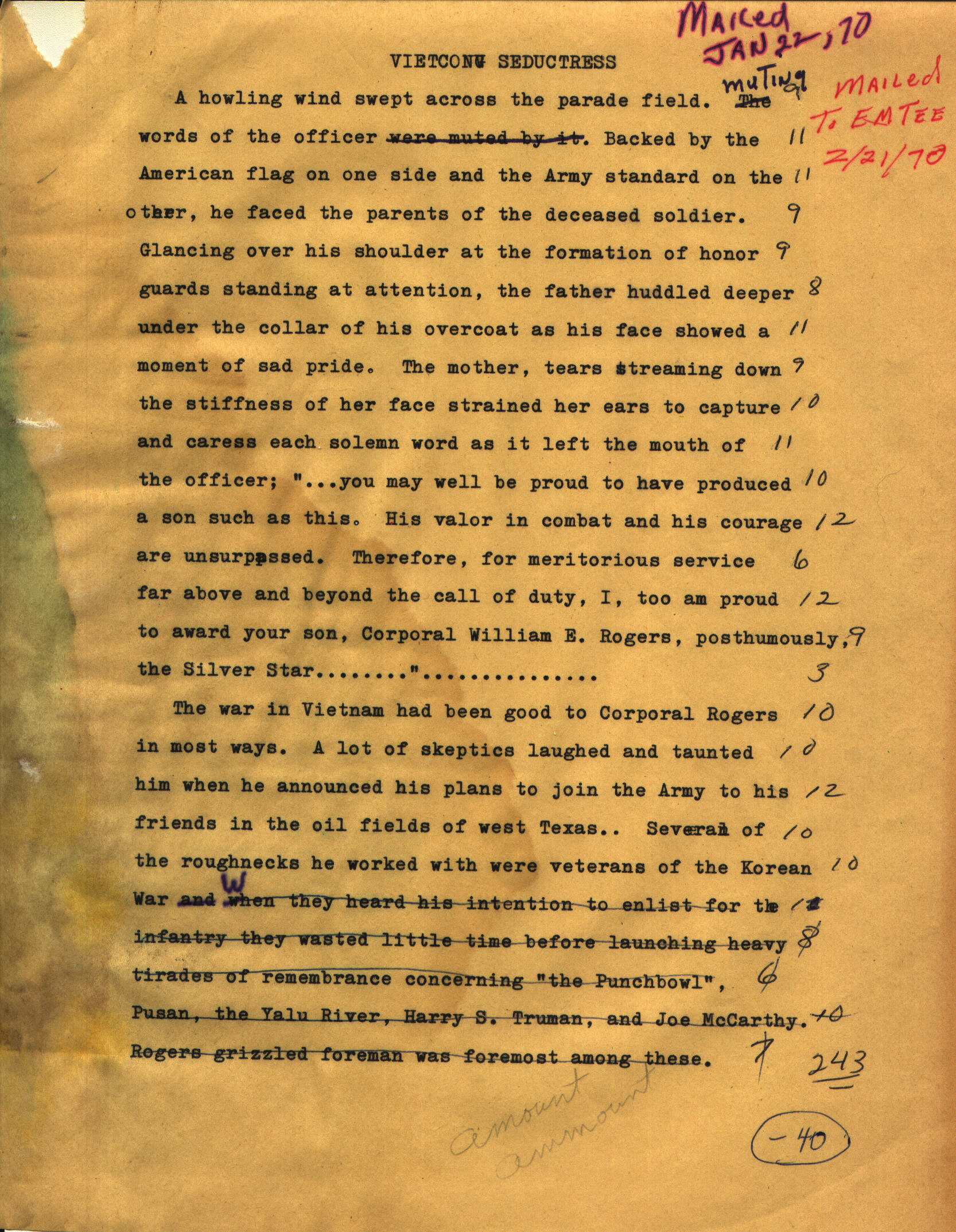
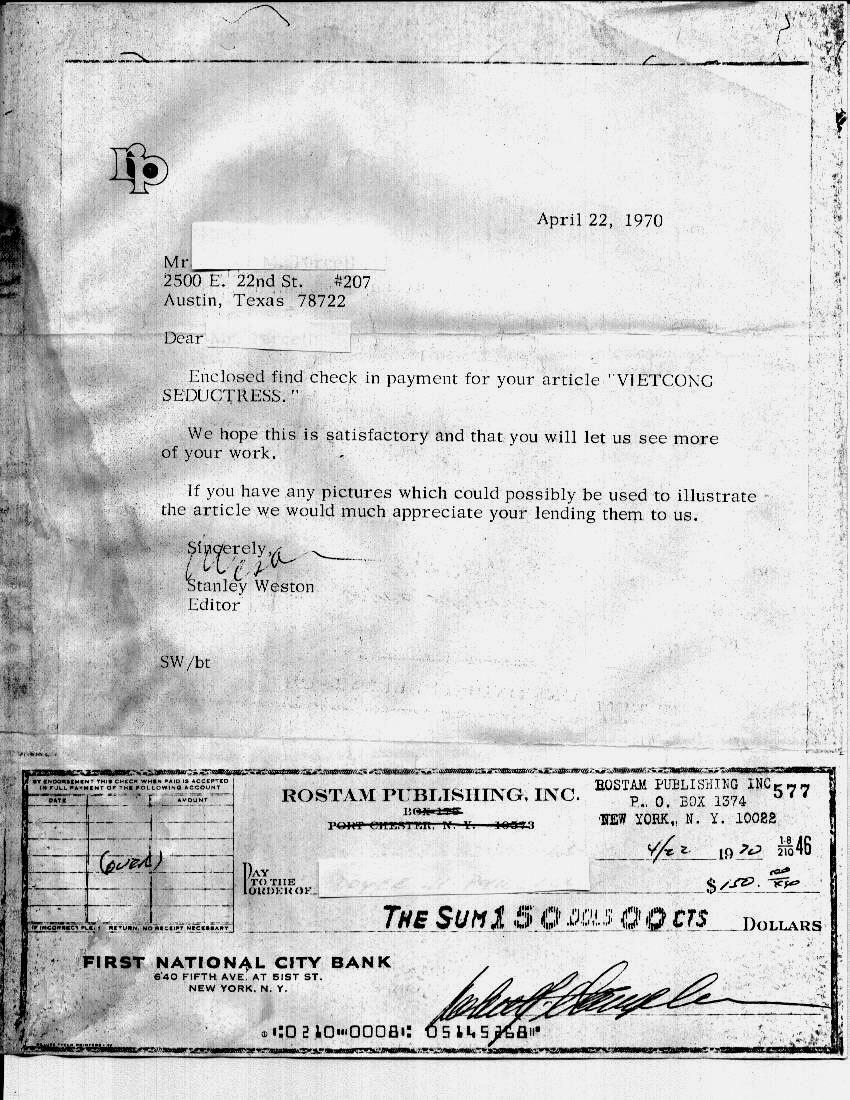
Well, fact was, in those days I thought there was half-a-chance I’d want to be president, or try to get a decent job sometime. Didn’t want stories like, Viet-Cong Seductress, or The Half-Million Dollar Sex Salon The Texas Rangers Can’t Find following old Jack around the remainder of his life. Adopted the pseudonym, Frank C. Riley, which worked well enough.
Then the market collapsed for hairy-chested men stories. Best paying hack-writer market left was something called ‘Confession‘ mags, which must have been read by the mothers of Romance Novel readers of today. I figured, what the hell.
Popped out I Was An Outlaw Motorcycle Mama, sent it off, got a nice letter back telling me there was a middling amount of what they read they liked, but that I needed to work on my female perspective a bit. Eventually they published it, but they never bought another, though I tried. But unless I’m mistaken, Motorcycle Mama was the only time I ever succeeded in passing myself off as a woman. Only time I really ever tried, during that confessions market thing.
Amazing the things a man will do for money.
Old Jules
Hack Writing
Editor:
“Give me a 750 word
Masterpiece
Describing
How crushed ice
Machines
Can be used
On construction sites
To slow the cooling
And surface cracking
Of freshly poured
Cement.
Make it lively
Make it dance
I want it yesterday
We’ll argue
Prices
Three months from now
When you see the check.”
“Give me 2000 words
To titillate
Give me that whorehouse
That famous Chicken Ranch
In La Grange, Texas.
I want pockets picked
I want gonorrhea
I want luscious hookers
And hints of corruption
Deep in Texas
Law enforcement
I want it yesterday
We’ll argue
Prices
Three months from now
When you see the check.”
“I want 2000 words
Fiction
Something about
Beautiful Vietcong seductresses
Luring innocent GIs
To bed and death
In some stinking thatched hut
With pigs squealing outside
I want to see her despair
Her soul searching
As she discovers she loves him
I want a hint of non-fiction.
We’ll argue
Prices
Three months from now
When you see the check.”
Workshop:
“I want a poem
About how you feel
When your lover
Jilts you
In favor of someone
Of his own sex
And begins
Taking hormones.
I want the word
Encyclopedia
Used in every
Third line.
No pay
You just have
The pleasure
And satisfaction
Of doing what I
Told you to.
To help you
Get used to the feel
Of being a writer”
From “Poems of the New Old West”, NineLives Press, Copyright 2003
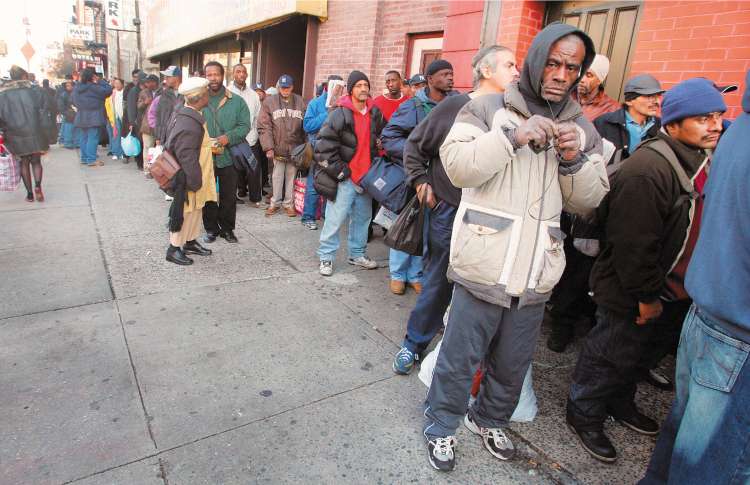
Someone sent me an email forward the other day explaining to me how illegal aliens, welfare recipients, other low-lifes and me, retired and living off Social Security, is what’s causing this great country to go down the tube. I swan.
I don’t have a TV, don’t listen to radio, don’t read newspapers or magazines, but I do get email forwards and see sidebar news flashes at Internet sites. So knowing the country is down the tube didn’t come as a complete shock to me. Every couple of weeks I go to town for groceries, chicken feed and other necessaries, and the fact gasoline prices are a mite high, bread, milk and produce are worth more than they used to be, and people are older, all had me wondering if things hadn’t slipped downhill.
But knowing all those old people in the grocery lines and I are causing it surely gave me pause.
Made me realize life is harder for people with ball-caps turned sideways, studs in their nostrils, belly buttons and lips, tattoo-tears running down off their faces, and attitude have it tougher than I did all those years I was younger than I am now, because I wasn’t up here then.
I mostly try to mind my own business and tend my own affairs. I don’t want to be a part of a problem someone else has. If people living down in the trailer parks sitting in the backs of their pickups drinking beer Saturday afternoons are suffering harder than they would if I was out living under a bridge somewhere dumpster-diving for a living I wouldn’t be half the man I think I am if I didn’t consider it a viable alternative.
I paid money every paycheck for about 50 years into Social Security, but I never figured I’d come to depend on it for a living. When it happened I never stopped to consider that expecting some of it back was different from people living off their military retirement, Federal Employment Retirement, or Congressional Retirement systems.
If I need to go dumpster-diving and live under a bridge to clear my conscience I figure I can do it. Lots of people are already doing it. Just looking at them I hadn’t thought about the moral high ground they’re holding.
I’ve encountered this other places, but the first time was several years ago from the man in the picture.
Dean Kindsvater. Deano. A man who never saw $50,000 free and clear in his sixty-four years of life. He played the lottery, but he’d scoff when the prizes weren’t in the high millions. He’d buy tickets for the big jackpots and wouldn’t even check them if nobody won. “Hell,” he’d say, “those small prizes aren’t even worth the trouble!”
Here’s a guy, never finished high school, left home in his low-teen years, bounced around as a dish washer and short-order cook for years. Finally got into the HeeChee jewelry manufacturing business in the early `70s. Bought an old railroad hotel in Belen, NM, ran a team of illegal aliens out of the top floor until someone discovered Heechee could be made cheaper in Southeast Asia.
Deano rode through, living in one room of the bottom floor of that hotel the remainder of his life. Windows all boarded up, top floor a vacant ruin of pigeon droppings and the debris of the life of the man. He opened a junk shop and sold odds and ends and made up the difference moving a little jade on the side. Lived downstairs with a propane bottle for heat, extension cords running all over the place from the one outlet, keeping the TV going, the microwave oven for coffee, refrigerator for TV dinners. Cold water sink to wash his utensils.
Three mongrel dogs living there with him.
The only book Dean ever read in his entire life convinced him he could make a living playing Blackjack, which he couldn’t. Visiting him in that hotel the first time, knocking on that door, hearing him coming from the interior coughing, reminded me of a Frankenstein movie, him as Igor.
I was with him once when someone asked him what religion he was. “Christian.”…. “No… I mean what denomination? Catholic? Baptist?”
Deano thought about it before he answered. “Catholic.” But the conversation afterward suggested Deano didn’t know the difference between a Catholic and a Baptist. He’d never stopped to think about it. To him those churches he never went into were all alike, all the same bunch of folks. Never entered his mind that it might be something worth thinking about. Never been in a church in 64 years of life, never paused to wonder anything at all about anything at all, so far as I could tell. A unique man.
But Deano thought the prizes too small to bother with if the jackpot was just $10 million. Never even bothered to check if he’d won the $100K someone had a ticket for in NM, but had never claimed. He had, in common with a lot of other people, that scorn for the smaller prizes that could have changed his life. He’d probably be shyly flattered, knowing his picture was up here for strangers to see. Flattered and a little suspicious. “How’s this going to make anyone any money?” he’d ask the universe.
RIP Deano.
Hope the prizes are bigger wherever the heck you are these days.
74 years old, a resident of Leavenworth, KS, in an apartment located on the VA campus. Partnered with a black shorthaired cat named Mister Midnight. (1943-2020)
Since April, 2020, this blog is maintained by Jeanne Kasten (See "About" page for further information).
https://sofarfromheaven.com/2020/04/21/au-revoir-old-jules-jack-purcell/
I’m sharing it with you because there’s almost no likelihood you’ll believe it. This lunatic asylum I call my life has so many unexpected twists and turns I won’t even try to guess where it’s going. I’d suggest you try to find some laughs here. You won’t find wisdom. Good luck.

 So. What do you think?






 So Far From Heaven