Category Archives: 1990’s

A Few Things Zuni – Part 1

During the early 1990s the Coincidence Coordinators conspired to make Zuni Pueblo and the geography surrounding it a major focus in my life.  I mentioned a bit about Zuni here:  This is Zuni Salt Lake, but over the next couple of whiles I’d like to tell you a bit more about them. 
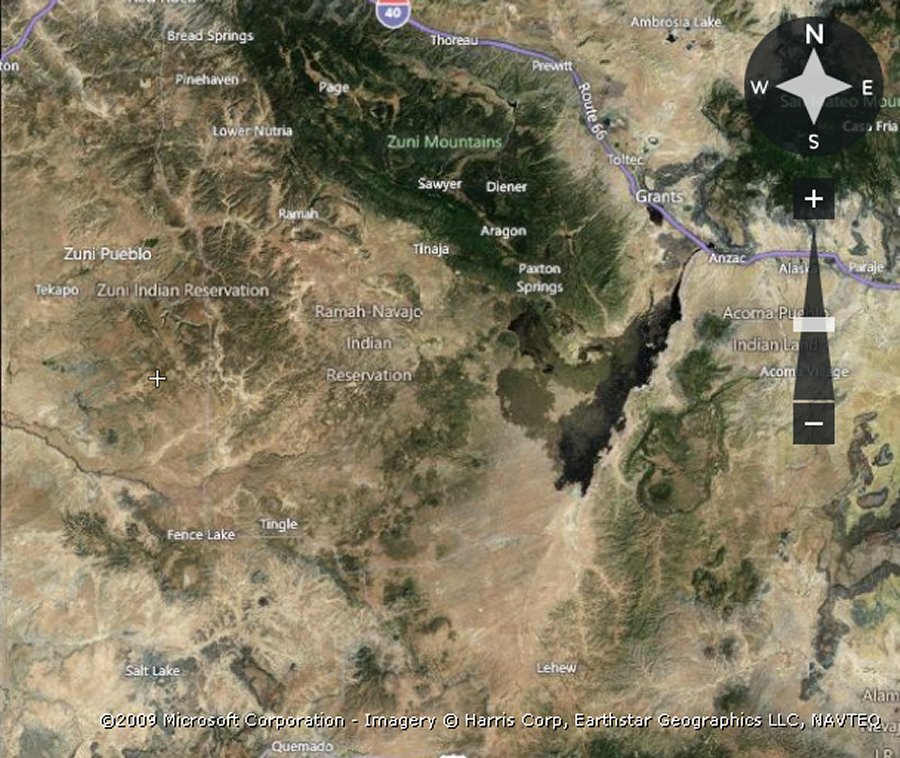
At the time the overwhelming part of my salary was paid by FEMA and a part of my job involved mitigation of recurring natural disaster damage behind federal disaster expenditures.  In New Mexico a huge percentage of the recurring expense was located on Navajo lands, but flooding on the Zuni River reared its head as a concern during the same time period.

Meanwhile, the Coincidence Coordinators got into the act.  The search for the lost gold mine was being driven by documents from the US Archives, New Mexico State Archives, fragments of mention from 19th Century newspapers, later-in-life memories of men connected to the events and documented in books, topo maps and other researched sources.

Keith and I, examining and submerging ourselves together during that phase of my search, concluded the areas to the east of Zuni, and to the south were prime candidates for the location.  Candidates based on what we knew at the time.  Wilderness Threats.

By my own recollection that phase of the search lasted only three, maybe four years, maybe less.  But it led by numerous routes, into more than a decade of closer association with Zuni, both as a tribe, and as a geography.  I’ll be posting more about that, about Keith’s and my explorations, about the Zuni pueblo and the people living there, and about some aspects of the history and culture.

But I’ll begin by posting this piece of doggerel I wrote a long time ago about my first visit to the Zuni Rez and my first encounter with the Zuni and Ramah Navajo.  That meeting with the Zuni Tribal Council burned itself into my memory as few things I’ve experienced this lifetime have.

Flooding on the Zuni land
Tribal chairman calls
Upstream Ramah Din’e band
Over grazing galls.

Ancient ruins I travel past
Forgotten tribes of old
And finally arrive at last
On Zuni land as told:
Tribal council meets, he chants
A time warp history.

I Listen long the raves and rants
And river mystery:
Navajo must have his sheep
To have his wealth, it’s plain.
Too many kids, too many sheep
Too little grass and rain.
Forgotten white man wrongs and deeds
The raids of Navajo
Corn that didn’t sprout the seeds
And stumbled Shalako
More sheep grazed than in the past
Arroyos grew wide and deep
Siltation settled hard and fast
In riverbed to sleep.

Navajo siltation choked
An ancient channel bed
Water rose above the banks
200 cattle dead
Houses flooded, ruined cars
Fields of grain were lost
A playground field a channel mars
And who should bear the cost?

The tribal chairman Ramah band
Listened to my tale
Stony silence, steady hand
Informed me I would fail.

“If those Zunis don’t like floods
Tell them to reduce the chances;
We’ll hold back our streams of muds
If they’ll call off their damned rain
dances.”

(Doggerel to smile by)

Old Jules
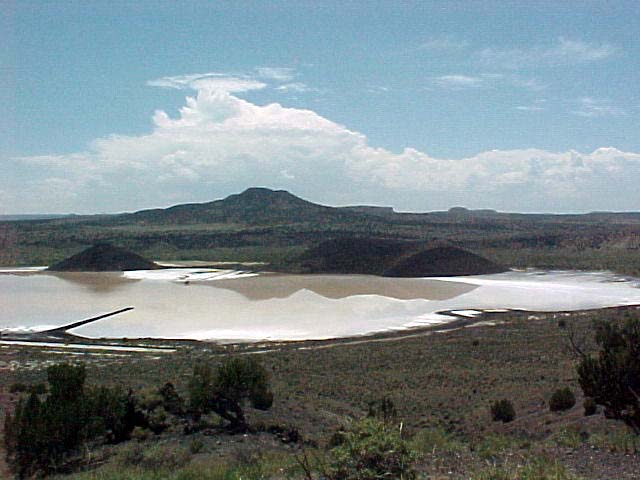
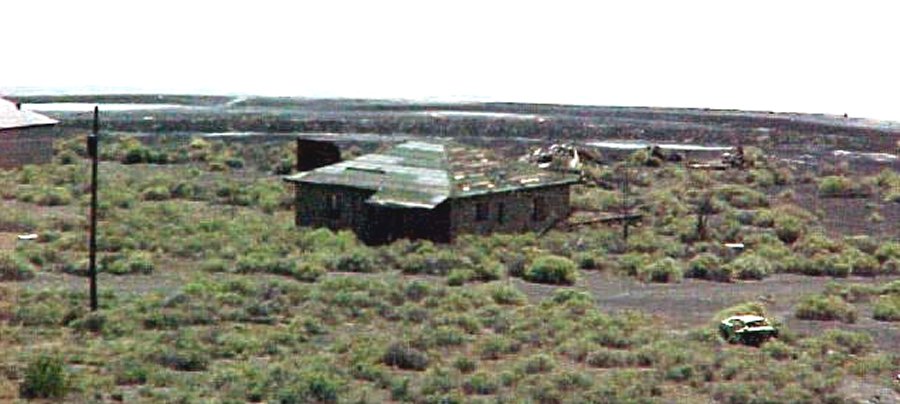
This is Zuni Salt Lake


It’s about forty miles south of the Zuni Rez, almost in AZ.

There’s a ghost town you can barely see in the pic…. used to be a considerable community down in there when it was private land, from the mid-1800s until the 1950s, evaporating salt from the huge concrete beds.  Most of the buildings are still intact, though they’re going away rapidly.

Today it belongs to the Zuni tribe, one section of land, but it’s not in the national trust as part of the Rez.  Tribes have been acquiring a lot of land from casino monies and other ways during the past decades, making the lands acquired ‘tribal’, but not Rez, which puts them into an interestingly ambiguous position insofar as road maintenance and county taxes.

Salt Lake was acquired as a piece of a lawsuit against the US government involving an airplane with a hydrogen bomb aboard that crashed on the Rez, with first responders being Zunis, but which the feds didn’t bother telling them about the bomb, leaving emergency workers exposed to hazardous materials without knowing it.  The tribe got a few million out of that, which they used to purchase 60k acres of land to the south of the Rez, but Salt Lake was thrown in as a bonus.

Salt Lake’s a sacred place for the Zunis, home of Salt Mother.  If you are willing to risk hopping the fence and wandering around down there ….. it’s a volcano crater with a hollow secondary plug you can climb, then a spiral trail leading back down inside … that’s where most of the rituals for Salt Mother are held… but all over that section you’ll pass over various religious items from recent times you’d be well advised to leave untouched.

Salt Lake used to be the place all the warring tribes got their salt throughout history.  A place where a constant truce between enemy tribes existed.

It’s also part of what the power companies would love to strip mine.   The great percentage of the desert surrounding it, from north of Springerville, and Saint Johns, Arizona is government land with shallow coal deposits comparatively inexpensive to ‘recover’.  They’ve already converted the desert on the Arizona side to a wasteland.  Still desert, but more in the moonscape vein than the usual, regular arid country mode.

The people in El Paso and Phoenix need electricity so they can fire up their hair dryers every morning, and keep their homes refrigerated.   Those places have climates uncomfortable to the human skin most of the time and they’d rather savage a few million acres of country they’ve never visited and never will than suffer a few degrees of discomfort and use a towel to dry their hair.

Which the Zuni believe would thoroughly piss off Salt Mother, with considerable resulting pain for the Zunis, and all the rest of us.

They might be right.

The Zuni and a few commie-pinko-obstructionist greenie environmentalists are the only people who give a damn, and the other desert-dwellers in the area would welcome the jobs helping ravage the country around them would bring to the area.  The last time I looked the Zuni tribe was burning up a lot of tribal money trying to stop the mine expansion into New Mexico.  The prospects didn’t appear promising because the New Mexico government, the feds, and the mining interests were stacked up singing songs of human progress and greater good.

Heck, it’s been a few years now.  Maybe they’re already mining it.  Probably easier to ask someone in Phoenix or El Paso whether the hair dryer worked this morning and if it did, assume that desert has gone to the moon.

Old Jules


Old Sol’s Moodiness and Being a Character In a Book

In case you’re one of those people who hasn’t been staring at the sun, here’s a brief update before I tell you about an interesting tidbit in my life:  Finding myself a character in a ‘memoir’ [actually a novel] written by my step-brother published as non-fiction.  But important things first:

From http://spaceweather.com/

Here he is November 28:

As you can see, the south pole stuff’s maintaining itself, still doing what it was doing when I last mentioned it.

Here’s today.

Still something going on down there, but the grandstanding is still north of the equator.

Strangeness

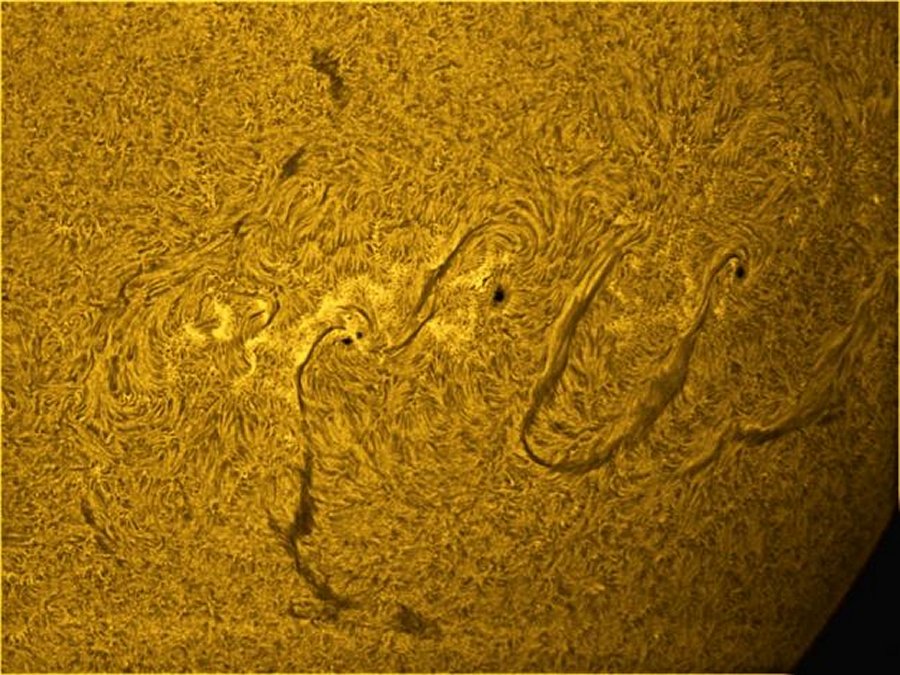
SINUOUS SUNSPOTS: A line of sunspots stretching across the sun’s northern hemisphere appears to be an independent sequence of dark cores. A telescope tuned to the red glow of solar hydrogen, however, reveals something different. The sunspots are connected by sinuous filaments of magnetism:

“These sunspots writhe and squirm energetically as they rotate away from us!” says John Nassr, who took the picture on Nov. 28th from his backyard observatory in Baguio, the Philippines.

The connections suggest an interesting possibility. While each sunspot individually poses little threat for strong solar flares, an instability in one could start a chain reaction involving all, leading to a widespread eruption. Readers with solar telescopes are encouraged to monitor developments.

I could write a lot about this but none of it would necessarily be true, so I’m doing my best not to have an opinion while keeping my foot in the door for afterward saying “I told you so,” if I can get by with it.

Okay.  Now for the main thrust of this post.  Before beginning the post I visited the Bobby Jack Nelson Forum on Amazon to see what was being said about him: http://tinyurl.com/7zj2la3

A while back I got an email on an old email address I rarely check anymore from a lady who wanted to discuss my step-brother, Bobby Jack Nelson.  She explained he’d offed himself in a nursing home in San Saba, Texas, and that she’d had a long-term relationship with him. 

But Bob had told her a lot of things she’d begun to think were lies.  She just wanted to bounce some of them off me because she knew he and I had associated considerably during the 1980s and early 1990s when he was writing Keepers – A Memoir. http://tinyurl.com/d82tcsk.

 To be honest the whole thing qualified as strange enough to keep life worth living.  Bob and I saw quite a bit of one another during those years, and I knew he was writing a novel about, among other things, his childhood in Portales, New Mexico.  I considered him a friend.

 But one day in the late-1990s [as soon as the novel had been accepted by a publishing house, I later discovered] while I was living in Socorro, New Mexico, I got a call from Bob.  He didn’t mention the novel, but he said he was going off to South America and wouldn’t be returning to the US, so I wouldn’t be hearing any more from him.

I got reports from various mutual acquaintances they’d seen him in Texas here and there, so I figured he just wanted to break off our association, which was puzzling, but okay by me.  Then I got a call from a Dallas reporter asking what I thought of the book, which I hadn’t been aware was published.

 Naturally, I bought and read a copy.  Suddenly it was clear to me why the reporter had called me, but also why Bob had suddenly taken a powder.  My first reaction to reading it would have been to trip up to that mountain town he was staying in while writing it and beat hell out of him.

I was honestly dumbfounded the man could bring himself to publish such a pack of lies as non-fiction.  But a person would have had to have been there, or remembered what he’d said back earlier had happened, to recognize there was barely a grain of truth in any of it.

Gradually I cooled down and just forgot about Bob until the lady contacted me to tell me he was dead, and how he’d died.

We exchanged a lot of emails over several months, and it was a journey of mutual discovery.  But the discoveries came in the form of Bob being an even worse liar than I’d have thought possible knowing already he was an accomplished liar.  And for her, not knowing he was a liar at all, I suppose it provided her some closure to find the man she loved, somewhat idolized, was in awe of, was not the person she’d believed him to be.

 Oddly enough, I think Bob tried to warn me a number of times about himself.  Several times he told me over the years that he was a liar, but I didn’t grasp the extent of what he was saying.  Other times he told me he wasn’t what I thought he was, and I shrugged that off, too.

But what came as a shock to me, first with the book, and later with what the lady told me, was that Bob absolutely despised me.  That, I’d have never guessed during the years I wasted pieces of my life associating with him in what seemed a mutually warm, friendly relationship.

Live and learn.

Old Jules


A Sobering View of Y2K

That tribal talk a week or so ago got me thinking about an old Mescalero bud I’ve known on and off through the parts of this lifetime that matter. We go long times without seeing one another, but we top off the long spells by bumping into one another in unlikely places.

Kurtiss and I first met working on Skeeter Jenkins’ ranch near Kenna, New Mexico. Must have been 1958, ’59. Skeeter wasn’t a joyful man on his ranch-hands. He’d berate Kurtiss by comparing him to us white lads, then he’d turn around five minutes later and tell us we weren’t half as good cowboying as that damned Apache over there.

I guess the only good that came out of that job was the bond that formed between Kurtiss and me, and the lifelong lesson I learned about not trusting ranchers. Old Skeeter cheated all of us spang out of a hard week pay and spread around the word none of us were worth the board he’d furnished working for him.  Fortunately, he’d done that sort of thing before, so nobody paid him any mind when it came to hiring us for other jobs, which we frequently got screwed out of our pay on, same as with Skeeter.

The last time I ran into Kurtiss must have been 1998, ’99. He and a couple of Arizona broncos were sitting on the tailgate of a truck parked for a powwow in Albuquerque when I came across them and a case of beer that was too close to gone to be any good.  When we’d killed what was left of that case we kicked out of there and spent the night singing ’50s rock and roll songs, getting roaring drunk and filling in on the minutia of our lives since we’d last met.

Spent a good bit of time talking about Y2K also, which was much on my mind at the time, and they’d never heard of it.   I expected that and explained to them. Those Apaches thought that just might be something really fine.

Kurtiss immediately thought of a state cop over toward Ruidoso who’s bad about kicking around folks who’ve had a bit much to drink, “I hope nobody gets to that prick before I do.”

Those Apaches demonstrated some rich imagination concerning the nuances of Y2K aftermath.  “We’ll be able to run raids on the Rio Grande tribes like the old days!”   This didn’t interest the Arizonians.  They were fairly sure Mexico would be open for a bit of raiding, though, and better pickings.

Then Kurtiss went thoughtful.  “I’d sure as hell like to kill me some Navajo.”  He told the old story of Bosque Redondo and all the slaughter the Din’e did to the less numerous Mescalero during the decade years they shared the reservation.   Apache numbers there were decimated until only 1800 were left alive when they escaped the rez and went back to Mescalero.

Bosque Redondo was fresh on his mind because of Navajo whines he heard at the Gathering of the Tribes Powwow. “Mescalero’s too large for such few people.” (The enormous Din’e Rez is getting jam-packed these days, by comparison.) “They ought to take some of that land away and give it to us,” was the general theme.

We fought our way down,” Kurtiss quoted himself. “And you guys multiply like rabbits.”

This led to some laughs and sneers about the theme of the Gathering of Nations Powwow, “Celebrating 400 years of unity (among the tribes)“.

I wonder where that was,” one of the Coyoteros grunted. “The Apache never saw it and neither did our enemies. Those Mexicans and Pima and all those town Indians were lucky the whites came along to save them.”

Mostly those guys were in agreement in their scorn for other southwestern tribes. “They don’t know how to use the land,” gesturing with a nod and a slight pucker of the lips.

A whole different view of the end of life as we know it.

Old Jules


This Anonymous Manifesto

I’d wondered when something of this sort would happen without actually believing it ever would.

Someone keeping better track of current events than I do will probably see this as a yawn. . old news.  But when someone sent me an email after talking to me on the phone about it yesterday you could have knocked me over with a feather.  After pondering it a while this entire grassroots Occupy [fill in the blank] thing strikes me as rhyming a lot with what happened during the early 1990s when the Eastern Block, the USSR, and Iran all fell to pieces in less time than it takes to tell it.

Rich, a close friend, sent me a link to a site, We Are the 99 Percent, which if there’s any substance to it, might be the beginnings of something unpredictable enough to keep it interesting for a while.  I suppose I didn’t think there was enough of that left in the world to even consider.  My initial reaction was a bit of a ho-hum.  These seem to be peaceful folk demonstrating peacefully, which, while gratifying to see going on isn’t likely to undo anything. 

But then, in walks someone, or some group called ‘Anonymous’ and joins hands with the Occupy folk. 

PC Magazine Article

Here’s the transcript of the latest Occupy Wall Street video from Anonymous:

Greetings, institutions of the media.

We are Anonymous.

The events transpiring within Wall Street have caught our eye.

It seems that the government and federal agencies enjoy enforcing the law a little bit too much. They instate unjust laws as mindless automatons, blindly following orders with soulless precision.

We witness the government enforcing the laws that punish the 99 percent while allowing the 1 percent to escape justice, unharmed, for their crimes against the people.

We have observed this same government failing to enforce even the minimal legal restraints of Wall Street’s abuses. This government who has willingly ignored the greed at Wall Street has even bailed out the perpetrators that have caused our crisis.

We will not stand by and watch the system take over our way of life.

We the people shall stand against the government’s inaction.

We the people will not be witnesses to your corruption and ill-gotten profits.

We will not labor for your leisure.

We will not assist you in any way.

This is why we choose to declare our war against the New York Stock Exchange. We can no longer stay silent as the population is being exploited and forced to make sacrifices in the name of profit.

We will show the world that we are true to our word. On Oct. 10, NYSE shall be erased from the Internet. On Oct. 10, expect a day that will never, ever be forgotten.

Vox Populi, Vox Anon.

The Voice of The People is The Voice of Anonymous.

We are Legion. We are the 99 percent.

We do not forgive. We do not forget.

Wall Street: Expect us.

http://www.pcmag.com/article2/0,2817,2394071,00.asp#fbid=_qbOvyUs5hm

That seems to shine an entirely different light on things.  I don’t know whether anyone’s actually able to jiggle remote computers in a way that allows them to shut down something like Wall Street Stock Exchange, especially after giving warning ahead of time they plan to do it.  But I think making the threat is bound to have every capability in the kingdom concentrated on keeping them from doing it, first, and hauling their butts off to the slammer as soon as they can slap a pair of handcuffs on them.

Gutsy stuff, or a level of confidence surprising from the perspective of a person who figures the powers-that-be can do anything they want to do with impunity.  If they manage to do it the resulting power-shift leverage would inevitably seem to make a sharp turn in favor of the people calling themselves the 99 percent.  But do or don’t, it pulls things out of the realm of peaceful demonstration and gives the powers the excuse they might have been wishing for to drag out the machine guns against the 99 percenters.

The people posting on the 99 percent site appear to be just regular people with a lot of justified bitterness about how things are going and a determination for legitimate change.  But thinking back on the history of revolutions, the signs and banners walking out in front of the parade have always been followed back in the baggage train with enough guillotines to separate a lot of fact from fiction after the dark underbelly of human nature is exposed.

What comes out the other end tends to look a lot different than anyone thought it would going in.  If this isn’t just a flash in the pan it sounds as though the people in the collateral damages zones might be in for some interesting times.  But, hell.  I guess we’re all in the collateral damages zones.

Revolution – The Beatles

 http://youtu.be/KrkwgTBrW78

Wilderness Threats


A man I went to grammar school, junior high and some high school with, then several decades later became reacquainted and huff-puffed a lot of up and down mountain canyons recently began visiting this blog.  If no other reader enjoys the tale, at least he will, because he was there:

The following is copyrighted material from a book I wrote once.  I give myself permission to use it here. [ Crazy Lost Gold Mine-ism]

I’ve never concerned myself much with the dangers of wild animals during my extensive time in the woods.  Mostly they’ll mind their own business if a person takes reasonable precautions and doesn’t go out of his way to provoke them.  In New Mexico backlands of the late 20th century the real threats usually come in the form of humans.  When those happen they usually come as suddenly and unexpectedly as finding one’s self in the middle of a herd of elk.

Grasshopper Canyon and Stinking Springs are on the northern end of the Zunis below Oso Ridge on the west face of the mesa.  Two canyons run north and south, parallel to the face, half a mile apart, separated from one another by steep, narrow walls several hundred feet high.  These two walls consist of coral reef from some ancient time when Oso Ridge was an island.  The canyons aren’t easily accessible, so I prospected there a while.

The land below Oso Ridge around Grasshopper Canyon is checker-boarded in ownership.  Grasshopper is all National Forest, but immediately south is a section of Navajo tribal land.  Adjacent to the Navajo section is a section belonging to the Zuni tribe.  Fences between these sections allow a person to always know whether he’s on public land or tribal land.

I was working Grasshopper Canyon with my friend Keith, a stockbroker from Santa Fe. We separated and worked the arroyos southward parallel to one another, gradually moving toward the fence delineating the Navajo section.  Occasionally we’d call out through the woods to make certain we weren’t out-distancing one another.  The last thing either of us expected was an encounter with another human in those woods.

I was bent over taking samples from the bed of a shallow arroyo, just deep enough so when I straightened I could view the small meadow around me.  I stood getting my breath and stretching the kinks out of my back when I saw a man dressed in cammies backing out of the woods at the edge of the meadow.  He was being stealthy, carrying a .22 rifle in a ready position.  He had twenty to thirty colorful birds hanging on a string around his neck the way a fisherman carries a stringer of fish.  As I watched, almost invisible to him with only the top of my head showing above the arroyo, his eyes searched the woods to his right where Keith was working.  Keith had called out from there a few moments previously.

Still watching Keith’s direction the man backed toward me until he was only a few feet away from me.  “Nice string of birds.”  I scrambled up the bank while he spun and pointed the .22 in my general direction.

My partner’s in the woods back behind you.  You don’t want to be firing in that direction.”  We studied one another.  He eyed the shoulder rig I was wearing and the butt of the 9 mm automatic showing from the bottom.  “’You out here killing songbirds?”

Mister Songbird was a young man and from appearances, a Zuni.  He stared a moment longer before answering.  My impression was that he was considering whether I was a game warden or other law enforcement official.  “I’m getting them for Zuni New Year.  They let us do that.”

We talked for a few minutes, me accepting what he said at face value, and the tension gradually dissolved.  He agreed to get the hell out of the canyon because we were working there and wouldn’t want any shooting.  Besides, we’d probably messed up his hunt with our yelling and bustling around the woods.  I watched him back into the meadow to the south and allowed myself to sigh with relief.

Back in Santa Fe I called the US Fish and Game Department.  I thought there was a remote chance the feds were really allowing Zunis to kill protected species birds on National Forest land.  If so, I was prepared to be indignant.

When I told my story the fed was silent a moment.  “You are a lucky man,” he observed.  “You confronted an armed man committing multiple Federal felonies and he didn’t shoot you.”

*     The following didn’t make it into the final draft of the manuscript: The fed also observed the Zuni lad would have spent a lot more years in prison for killing those songbirds than he would have for killing me.  I drew a good bit of comfort from knowing that.

Eventually logic won out over the other appeals of the Zuni Mountains as a location for the lost gold mine I was searching for.  Although the Zunis were handy for me, being only a few hours drive from Santa Fe, they were too far from Tucson.

Also, too many prominent landmarks in the area would have immediately brought the original survivors back.  The route I imagined them following would have taken them within sight of Los Gigantes and enough other one-of-a-kind eccentricities to make the location unmistakable.

Even the Big Notch and Little Notch in the Continental Divide can be seen from miles to the west.  There’s nothing else similar to it in North America.

Marty Robbins – Little Green Valley

http://youtu.be/WT5qegD28Wo

Crazy Lost Gold Mine-ism

This post requires some background to get to what it’s about.  The first part is background.  The actual subject of the post doesn’t start until ‘way on down toward the bottom.

Back before Y2K happened I spent a lot of years and energy researching and searching the mountains of SW New Mexico for a particular lost gold mine.

Doing a thing of that sort, the smart individual would keep his mouth shut about it.  But I don’t qualify in that regard.  I spent several years poring over records and winter nights poring over maps with a magnifying glass, almost always certain of knowing where it was, chawing at the bit to get out into the barrancas to file a claim on it.  But also putting my research into a form others searching for it might find helpful.  Insane.

Eventually I found a location where evidence on the ground fit the legend locations well enough to keep me working the west face of that mountain, climbing and unclimbing it with friends and associates, building up a lot of muscle, finding a lot of interesting rocks, and getting surprising assays, but no joy to speak of on gold.

“A burned out cabin ruin with an aspen tree growing out of the inside, bear claw marks 12 feet up, 3 hand forged nails, a longtom sluicebox axed out of a 3 foot diameter log, a spring 75 feet above the sluice, an arrastra below.  A mysterious map chiseled on the face of a 300 pound rock surface depicting the exact layout of the canyon, the cabin, the waterfall, all so accurately depicted the person had to have scrutinized the layout from the mountaintop, then scratched it on this stone 600 vertical feet below and half a mile away.  The rock was carefully placed on the canyon wall above eye-level so it was easily seen, but only by someone looking up.”

By 1998 I’d spent a lot more treasure, worn out vehicles, worn out relationships with lady friends and put a lot of friends to sleep going on about it and spending all my waking hours thinking, searching, or talking about it.  I decided it had taken up enough of my life and it was time to move on to other things after one final effort.

I took several weeks of vacation from work and spent it determined to get that gold mine out of my life, or into it in a way that didn’t include continued searching for it.  During part of it Gale and Dana, another old friend, joined me up there.

But that’s all another story.

During the 1990s I used to get several letters and phone calls a week from other people who were searching for the mine, asking questions about specifics of my research findings, asking questions about various terrain features, or just wanting me to go climb a mountain where they knew it was but didn’t feel like climbing themselves, willing to give me 10% of it if they were correct.  Of course they always knew they were correct.

But gradually that all tapered off.  In 2003, in the desperate throes of surviving the desperate financial aftermath of Y2K I published a book about my research, and the calls, emails and letters started coming in again for a while, but again gradually receded after a few years.  Those guys all got old and everything quieted down.

That lost gold mine slid spang out of my life.

But finally, here’s what this post is about.

Suddenly, beginning a couple of months ago, my old email address box began a new trickle, becoming a stream, of questions about all manner of details about those canyons and researches I elaborated on in the book.  Old guys, some older than I, were suddenly making noises about ideas, searches, evidently studying the book and maps, wanting refinements on what I’d described.

2011, every old worn-out has-been treasure hunter in Christendom  is suddenly wanting me to search my memory-banks about canyons I once stomped around in.  I’ve mostly answered the emails, tried to remember and flesh out what most of them were asking about, but a lot of it’s just too mixed in with too many other canyons, rocks and trails to recover with clarity.

But some of them are actually being subtle but provacative, wanting to argue with me about research findings, value judgements I made regarding 160 year old documents I dug up in the US Archives, military records, and a particular Apache I consider a key in the affair.

Heck, it ain’t as though I found the damned mine.  I don’t know where it is, though I spent a lot of years, treasure, sweat, and women thinking I did.  Now, suddenly I have people coming out of the woodwork wanting me to change my mind about where I thought it was because my reasons for thinking it weren’t the same as their reasons for thinking it’s somewhere I didn’t think it was.

Absolooooodle, incomprehensibly, insane.

Yeah.  It’s real important where I think it is.  If I don’t think it’s where it is, that old gold mine’s likely to switch places with where it thought it was.  Next thing you know it will be where I thought it was.  And that ain’t where these other guys now think it is, so I need to change my mind and think it’s where they think it is.  Otherwise it won’t be there.

I have no idea what the hell this is all about.  Maybe the price of gold combined with worrying about Social Security has the geezers going crazy thinking they’re 50 years old again.

Old Jules

Billy Vaughn And His Orchestra – The Shifting Whispering Sands ( 1956 )

The Horror of Discovering You Love Opera

A performance of Don Giovanni with the great Italian baritone Antonio Scotti (as Don Giovanni). Scotti sang the role of Don Giovanni at Covent Garden, London, in 1899 and again at the Metropolitan Opera, New York in December of the same year.

It never dawned on me I was proud I didn’t like opera.  I’d never heard any opera except brief snatches or in spoofs.  I’d never given any conscious thought at all to the fact I thought people who went to operas did it to show off to other people who went to operas, or were snooty and just wanted to impress someone, or were sissies.  Never gave it a single thought.

To my mind a person who went to operas was just naturally, naturally, naturally someone I had no respect for, had no time for, would never take seriously.  I didn’t need to think about it.  I knew.  I don’t recall anyone ever trying to change my thinking about it, either.  I imagine they all knew same as I did those opera goers were phonies and sissies.

So, sometime in the late-1980s when my ex-wife got a couple of opera tickets for a performance on the University of Texas campus I wasn’t overjoyed.  I suited up and traveled down there under duress, grumbled behind her to our seats, scowled when the lights went down and battened down the hatches for hard weather.

Over the next couple of hours a pair of blinders was removed from my eyes, plugs removed from my ears.  A war went on inside me as the realization dawned that I loved this stuff.  The next time an opera came to Austin it was me insisting we get tickets.

That would be bad enough if it had stopped there.  But when my marriage broke up in 1992, and I relocated to Santa Fe, mildly affluent, I discovered a Santa Fe Opera exists.  I attended a performance, and thereafter every year bought season tickets and used them as long as I could afford them.

I’ve attended a lot of concerts and live performances in my life and enjoyed many with Townes Van Zandt, Guy Clark, Kinky Friedman, Leonard Cohen, Loudon Wainwright and others, including a few Broadway performances.  But I’d be lying if I claimed every opera I ever attended wasn’t as thrilling and uplifting as I walked out as any of those.

And naturally, I hate myself for it and hang my head in shame admitting it.

Florida Grand Opera-DON GIOVANNI, The Don’s final scene

Desert Emergency Survival Basics

You survival and preparedness-oriented readers might find something you didn’t already know in here to be useful.  The Introduction section to the book Desert Emergency Survival Basics explains my purposes for writing it better than I can today:

The potential range of human experience includes finding ourselves in unanticipated dangerous situations. Most of those situations have been examined minutely and described in print in the form of survival manuals. Desert survival is not an exception. Excellent books are available to explain primitive survival in the desert southwest duplicating lifestyles of Native Americans a thousand years ago. That is not the intent of this book.

A few decades ago I had an acquaintance with a man named Walter Yates. Walter had the distinction of surviving a helicopter crash in the far north woods by jumping into a snowdrift before the impact. He managed to survive winter months with almost nothing except the clothes on his back when he jumped.

Walter’s experience was a worthy test of human potential for emergency survival in extreme conditions. The margin for error was microscopic. The reason he survived rested on his ability to quickly detach his mind from how things had been in the past, how he wished they were, and accept completely the situation he was in. He wouldn’t have made it out of those woods if he couldn’t rapidly assess his new needs and examine every possibility of fulfilling them. “It’s all in the mind,” he once told me.

The margin for error in the desert is also narrow. That margin is dehydration. Extremes of temperature are also a factor, but they are more easily managed than the needs of the human body for water. Anyone who survives an unanticipated week in desert country did so by either having water, by carrying it in, or finding it.

Over the years I’ve followed a number of search and rescue accounts and discussed the issue with searchers. The general thinking among those workers is that a person missing in the desert southwest should be found or walk out within three to five days. After three days the chances for live return spiral downward. Returns after five days are lottery winners. When a missing person isn’t found within a week, it’s usually because he’s been dead for five days.

This book is to assist in avoiding situations that lead to the need to survive those crucial three days, and to provide the basics of how to walk out and how to find water in the desert southwest. If you need the emergency information here it will be because you became lost, stranded by mechanical failure, or physically incapacitated. I won’t address the bugs and plants you might find to eat. If you have water you’ll survive without eating until rescue.

When this book was written I had a close association with New Mexico State Search and Rescue (SAR). I was also writing a book about a lost gold mine at the time. The State Search and Rescue Coordinator (SARC) knew about the book. I had a special arrangement with him because I was spending a lot of time in remote canyons searching. If something delayed me there I didn’t want them to send out the SAR guys to look for me.

One day in the coffee-room SARC asked me about my progress in the search and the gold mine book. I explained the lost gold mine search to him and how the information available in the past was sketchy.

“So you’re writing a book that’s likely to cause flatlanders to go out into the desert searching for this thing?”

I thought about it a moment before I answered. “It might. A lot of people would have tried anyway, but this book might bring in some who wouldn’t have come otherwise.”

SARC glared at me. His whole world revolved around  flat-landers getting lost in the mountains or desert. Several times every month they’d scramble the forces to try to locate someone misplaced. Sometimes it’s a brain surgeon from Houston who got himself mis-located mountain climbing on the east face of Sandia Mountain within sight of Albuquerque . Other times a physicist from California gets off the pavement in the desert and loses his bearings. Sometimes SAR arrived in time to save their lives. New Mexico back country can be unforgiving.

“If you’re going to publish a book that will take a lot of idiots out where they can get into trouble you’d damned well better include some warnings on desert survival and how they can stay out of trouble! I don’t want to spend the next five years dragging the bodies of your readers out of the arroyos in body bags.”

That conversation ultimately resulted in this tome.

Over time it’s been expanded and rewritten numerous times to eventually become what’s posted here. Here’s the link, but there’s a new page for it on the navigation bar at the top of the page.
Desert Emergency Survival Basics

Old Jules


Sons Of The Pioneers – Cool Water

To Live is to Fly


Good morning everyone, Admin. (Jeanne) here.

Old Jules told me that some folks have been asking about who I am and wonder how I came to be “behind the scenes” on this blog. He asked  me  to explain a bit about how we met and got to this point.

We actually met in a y2k chat room. When my ex and  I were researching y2k in ’98, I  was new to the internet and immediately became addicted to chat, where this guy who could really turn a phrase caught my attention with his sharp, although often warped, sense of humor. He obviously was an expert about  emergency preparedness and soon he and his y2k website became my number one resource.

When he got his property at a land auction in the summer of ’99, we also bought a piece of land and I went from Kansas to  New Mexico for the first time to sign the closing papers. My family put up our own getaway cabin about a mile and a half down the road from his place.  After three more trips to put supplies in place, I had a suspicion that y2k was going to be less of an event than had been predicted. I  decided to take advantage of the chance to give my kids a taste of a life not only in a different culture, but without telephone, electricity, or indoor plumbing. By New Year’s I was there with all five of my kids, and I  lived there for 4 more months with the three of them that were homeschooling.  Jules and my family became good neighbors. He again became a valuable resource for us when we were studying New Mexico culture, history, and geography.

After my family reunited back in Kansas, we stayed in close contact. When I quit homeschooling and began working outside the home, he again became a mentor for me, since his career  in management positions gave him perspectives that would have taken me years to learn.  After my divorce a few years later we shared a house in Placitas, N.M. for a couple of years before I again moved back to Kansas. I’ve visited Old Jules in New Mexico many times, and in Texas a few times.  We’ve taken a lot of day trips, hit the thrift stores, and shared our cats, music, and books.  We’ve also collaborated on various  projects.  He’s been great about encouraging me in my art work, too.

I work two library jobs, and I’ve always had a passion for reading and writing.  I’ve had blogs myself, but I decided a while ago that my own expression should focus more on my art  than writing. I have other friends who are writers and I enjoy following their progress. Living on the edge as Old Jules does, with a slow dial-up connection on a phone line that I happen to know has a tree branch lying across it right now, makes it difficult for him to maintain a blog site. Since I’ve always enjoyed reading what Old Jules writes, I’m happy to help by using my fast internet connection to set up and maintain the blog.  So this blog is truly a joint project.  When we can, we use photos that we’ve taken ourselves, and discussing which music  fits each post is one of the parts about it that I enjoy most.

Because we live 800 miles apart, we don’t actually see each other very often,  so we’re grateful to live in a time when y2k didn’t bring down the grid,  destroying communications and becoming the end of the world as we know it.
We hope you’re grateful, too.

Mandala 56
Addendum: Here’s a link to my Deviant Art page for those who’d like to see more of my drawings. I don’t update the page very often, but it’s a handy place to have a gallery!
http://mandalagal.deviantart.com/gallery/

Townes Van Zandt– To Live is to Fly