Tag Archives: History

My Genes Apologize to Your Genes

It’s become popular during the past few decades for individuals believing they have come connection to a group of dead men judged by hindsight to have harmed other groups of dead men, to apologize for the offending activities of the deceased they believe they’re responsible for to living people it didn’t happen to.

My granddad had a cap and ball pistol he inherited from his granddad.  The butt had a lot of notches carved into it, which probably meant the weapon had been the instrument of the untimely deaths of a good many people who might otherwise have lived longer.

Genetic karma?

The man pictured above owned slaves in his lifetime, fought in wars and feuds.  He was the great-grandfather of the man below, my biological father.

But his daughter was the mother of this man:  Cole Younger.  Killer, bank and train robber, rider with Quantrill during the Civil War.

Meanwhile the same genetic pool was spreading itself across the continent like some sexually transmitted disease.   Cherokee, Choctaw and other tribes sneaked into the mix.

So here’s the problem: 

I want to make all this right with all the people in the gene pool derived from the dead people who were wronged by the dead people within my own gene pool.  I’d like to offer them an apology for the ugly stuff those who share my gene pool did to them.

For instance, the guy with all the hair on his face was part of the ugliness perpetrated against the Cherokee and Choctaw and the Trail of Tears.  Naturally, if I’m to rid myself of the overwhelming guilt I need to apologize to some group of living people those painful things did not happen to.  Cherokee and Choctaw, preferably.

But, whoooowah!  The people on the Cherokee and Choctaw side of my gene pool are me.  How can I convey my regrets to the Cherokee and Choctaw in me from the guilt-laden Anglo side?  And can I assume without fear of error that my Cherokee and Choctaw genes don’t include someone who did something to some other group I need to absolve?

Is there some living group of people out there seething over something that didn’t happen to them, but happened to their ancestors as a result of some offense committed by holders of the Cherokee Choctaw genes?

And what’s all that turmoil and guilt churning around in my gene pool doing to my cells and whatnot?

Just to be on the safe side and try to set things right I think I’d best give myself a present as a gesture to calm things down.  Yeah, I think I’ll eat an orange or banana.

Old Jules


The Leaves That Were Green

Coming back from Fredericksburg yesterday I spotted this sitting in a field 100 yards off the pavement.  I felt an immediate kinship, made a U-turn to go back for a closer look.

The first new vehicle I ever owned was a 1970 F150.  Standing here looking at this one too-long left in a pasture, flat tires, dents and proud sign I flashed a brief, joyful memory of driving mine back to Austin from the dealership in Luling. 

Someone did the same with this one from some other dealership.  I wonder if he remembers the day, wonder if he’s even alive to remember some piece of geography he shared with this heap of steel, glass and rubber before me.

The young don’t know enough
About being young
They squander youth
And never know ’til later.
Any lad of twelve will testify
An eight-year-old can’t even qualify
To be a child
At eighteen our own ignorance
At fifteen is finally written
In language we comprehend:
We know the score
Reality’s the icing on the cake
Of youthful fantasies;
When the young grow old
They know a lot
About being young
But almost nothing
About being old.

But trucks know
Trucks have the dents
Worn bearings
Frayed seat-covers
Holding a thousand
Passed-gas kisses
Spilled drinks
Forgotten miles
Of those who forgot.

Old Jules

The Forbidden Door of the Occupy Protests

The politico dependent portion of the US population has gone to enormous effort to keep the boundaries of dialogue within a poured concrete septic tank for an awfully long time.  Those boundaries have confined what can be expressed by the totally disfranchised, the largely disfranchised, the mildly disfranchised and the slightly disfranchised safely outside platforms for discussion.

Two dominant political parties, lobbyists, government contractors, financial institutions, pharmaceutical companies and the health industry, multi-national corporations and defense industry entitlement organizations have all found comfortable niches to work within that structure and prosper.  The symbiosis benefits the yin of government officials, both elected and hired-hands, and furthers the interests of the yang of anyone with the financial backing to feed the gargantuan resulting from it all.

Technology and communications at a grassroots level have conspired to abruptly allow voices outside that structure to be heard in the context of peaceful assembly by citizens with little in common besides their frustration with being locked outside the box.  Evidently enough of that dissatisfaction exists to spread their numbers over a surprisingly wide area.

Enough to set off the burglar alarms across the spectrum of the comfort zones of those accustomed to doing precisely as they wish quietly in warm and friendly waters.  Probably their best strategy would have been to ignore it all and almost certainly it would have gone away.  It would have faded without the tsunami of indignation the bought and paid for elements of mass communication rattling denouncement through every channel, calling out the cavalry, piling insult and venom on those peacefully expressing themselves in harmless ways.

This ‘movement’ wasn’t created by the seedlings who began it.  The Occupy Wall Street movement would have died on the vine if it hadn’t been nurtured and fertilized by the shrill cries of the safe and comfortable denouncing it.  And by continuing to do so they provide the life blood for future expansion.

The protests on wall street are those coming from inside the buildings.  Someone’s opening a door they believed they had locked.

Me thinks the lady [inside the buildings] protests too much.

Old Jules

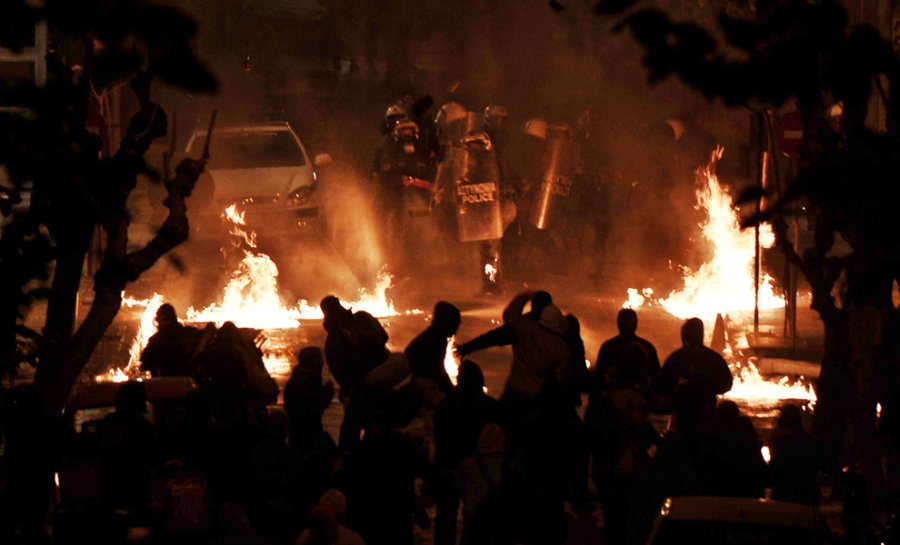
Mobs, Violent Protests, and Riots

I find my views about rioting to be possibly artificially drawn away from magnetic north by several personal experiences with them, as well as having been an adult during the giant city burning episodes around the time of the MLK killing. 

From personal observation and experience I feel a high level of certainty that every riot since the 1960s was and is heavily infiltrated by police or other government provocateurs, pushing, inflaming and instigating to direct events toward violence.  I’m not suggesting the riots wouldn’t have happened without them.  The riots would almost certainly have happened anyway.   I honestly don’t have a clue why they’re doing it.

But my first experience with it was Halloween, 1960, in Borger, Texas. During the days before Halloween the kids in high school were all gearing up for it, but I was a newbie in town, had no reason to anticipate what they saw as the normal way to celebrate Halloween. Wild and wooly oil-field worker traditions combined with a boys-will-be-boys tolerance on the part of adults left the options wide open.

The newspaper the next day described it as a quieter than usual Halloween with the main damage being someone starting a bulldozer at a construction site and driving it through a house, nobody hurt.

A few hundred teenagers drunk on main street armed with eggs, veggies, rocks, jars of gasoline, cornering police paddy wagon with barrage after barrage, following them back to the station house and setting fire to the lawn was just a beginning.  I never saw anything like it, even during the riots at the University of Texas I was a part of a decade later.

My point is, rioting is fun, it’s joyful, it’s seductive if the anonymity of a mob can be maintained and when there are no consequences. It doesn’t take much to get people rioting under those circumstances.

On the other hand, the day after Kent State and afterward throughout the remainder of the Vietnam War the temptation to riot was always there so long as it was someone else stepping off the curb into the street. The police and a lot of the rest of the country made it plain by word and attitude they felt tolerance for what happened at Kent State and wouldn’t mind seeing it again.

I recall what a letdown it was when I realized I wasn’t the gutsy hotshot I had people thinking I was, that I was just a loudmouth coward when it came to offering myself up for what I claimed I believed in by making myself a target for all those cops to practice on.

I don’t think things are much different now. My near-certainty about riots in the US is that the government response will determine whether there are riots, or won’t be.  I don’t give advice, but if I did I’d suggest anyone involved in a peaceful demonstration immediately remove himself/herself from the area as rapidly as possible at the first sign of violence.

I’d suggest carefully exploring the route and area of the demonstration on maps and on the ground beforehand.  Pre-arranged escape routes memorized to allow getting the hell out of dodge.  Cell phones set with standby text messages to friends and cohorts to get the message out immediately that things are going sour.  But I won’t suggest it.

But I don’t have a lot of reason to think having a riot going on and being in the center of it is a place I’d want to spend a lot of time.

Old Jules


The Joys of Already Knowing

Morning Blogsters:

Around 1969, I was in a freshman Geology course at the University of Texas, first week of classes. The instructor was a grad student teaching assistant who began the course with an overlay of how geologists determine the age of a particular layer of deposition.

Along about the third day a kid who’d been sitting next to me raised his hand. I’d noticed him squirming from the first day, and now he just had to get whatever was bothering him off his chest.

“I’ve been trying to understand what you’re saying, but it’s confusing. How can all this be true, all those depositions being so old when the world’s only (some specified low-range number of thousands) years old. It’s all been calculated when God created the earth.”

After the chaotic eruption of laughter from forty sophisticated freshmen who knew better subsided the instructor directed his response to the now-cringing questioner.

“You can’t have it both ways. This is a Geology course. Everything you hear in this room is based on the premise that the earth is ancient beyond imagination. That the world we see around us is the product of eons of tectonic activity. Of faulting, lifting, erosion, weathering followed by more of the same.

“I’m not going to try to convince you that what you’ve said is wrong. But I’ll tell you that if you can’t accept, for the sake of discussion, the possibility that the book in front of you describes reality, you’ll never get through this course.”

The kid joined me at a table in the Union coffee shop later. He was still upset and confused by the incident, the laughter. Turned out the kid truly couldn’t wrap his mind around the concepts being discussed. He KNEW it to be otherwise at such a fundamental level that he’d have had to relax all manner of other things he KNEW and held sacred to even consider it.

So he dropped the course and never let his mind out of the cage he’d built around it.

The experience that kid had in a geology classroom isn’t too different from what all of us encounter in life. It’s all a matter of where we place the boundaries of the cage.

Within a decade of the incident the geology world was turned upside down with emergence of tectonic plate theory, and much of what he’d have learned if he’d finished the course would have been out of date.

But Tectonic Plate Theory found similar boundaries among geologists’ minds during the difficult battle for acceptance. Old department heads wrestled against it in a war as bloody as a fundamentalist preacher would have fought against the concept of an earth more than a couple of thousand years old. They’d just placed the boundaries a bit further out than the kid and whatever school teacher told him the world was young. Those old geology profs KNEW there was no such animal as continental drift. No point in discussing evidence supporting it.

It’s a juggling act. In some pursuits the only doorway involves a body
of data we like to call ‘facts’. But frequently the doorway isn’t big
enough to allow a person through with his suitcase full of all his
life-accumulated facts he treasures. He has to pare them down to fit
into a briefcase, or a fanny-pack and leave the rest behind so’s to get
through the door and understand what he sees in the room he’s trying to
get into. If he tries tricking the system and dragging all the rest of
his facts through in a cotton-sack or some such thing he’ll be forever
tripping on them and stumbling.

A man’s got to be careful what he knows in this lifetime [maybe others,
also]. Traveling light can save a lot of trouble.

Old Jules

3.5* ’til Infinity   * = Billion years ago.

Best Quick and Dirty Movie Scenes Ever – Baggage Check

There’s a strange logic here:

Life’s full of choices of this sort but we rarely recognize them.


There are several of these, difficult to pick one over another:

We’ve probably all experienced this thing with a pesky fly.


This one’s in a class all its own


I still have a vivid recollection of seeing this for the first time 60 years ago and wanting to get under my seat at the theater.


These two scenes almost belong in the same movie.  Chilling.

 Cabaret – Tomorrow Belongs to Me – “Do you think you can control them?”

http://youtu.be/3EE_BoCw9zk

 Panzerlied (Battle of the Bulge with english intro)  “Too young!  They’re too young!”

http://youtu.be/8JDkdc246QQ

Zulu – The final attack – A brief history of the European conquest of everywhere else.  “They don’t have any tenors among them.  That’s for sure.”

It all sort of runs together:  “Tell your sweetheart not to pine, to be glad her boy’s in line.”

Yankee Doodle Dandy http://youtu.be/2R1jiVcIGcg

Patton – “At least you’ll be able to tell them you didn’t spend it shovelling shit in Louisiana.”


Followed by this:

Network – Mad as Hell Scene  – “I’m mad as hell and I’m not going to take it anymore!”


Cool Hand Luke – “I don’t care if it rains or freezes.”


Treasure of Sierra Madre – “Badges?  We don’t nee no stinkin badges

http://wwyoutubehttp://www.youtube.com/watch?v=CGcVhoHdRFow.youtube.com/embed/MsVi2RqE7ek

North by Northwest – Climbing the American ladder of success


The Alamo – “When I was a boy any girl would turn up a bunch of trees like that, cut a bunch down and one for a ridge pole and build herself a cabin alongside the other.  Seems like all anyone would ever need.”


The Outlaw Josie Wales parleys with 10 Bears – “Dying ain’t so hard for people like you and me.  It’s living that’s hard.  Governments don’t live here.  It’s people who live here.  I’m saying people can live here together without butchering one another.”


WWII Time Warp Encounter

The father of a man I used to know had been a Hungarian tank commander on the Eastern front during WWII.  (He bore a striking resemblance to an aging  Robert Shaw in his role as a German tank commander in Battle of the Bulge).  He was there for the Axis invasion of the USSR, all the way to the suburbs of Moscow.

He was captured by the Soviets early in the war before they began shooting their officer prisoners, then exchanged and sent back to Hungary to recuperate.  But later as the casualties mounted and the Eastern Front meat grinder demanded more meat, he was sent back.

One of the battles late in the war provided him a ticket to a German Hospital facility and an injury sufficient to keep him there until the surrender.  Surrender, by incredible luck, he vowed, to US forces.   He was held in a camp while prisoners from USSR-held  countries were sent back for mass executions.   His membership in the NAZI party in Hungary would have made his demise a certainty.

Disguised as a woman, this man escaped the camp and journeyed to South America.  That’s where my amigo was born.  Afterward the family moved to Canada.  I became friends with his son during the ’70s at the University of Texas where he was several years ‘all-but-dissertation’ for his PHD in Linguistics.  His father’s status as a ‘wanted’ war criminal in Hungary remained in force throughout the old man’s entire life.

I asked him once about the Eastern Front experience, knowing he was unrepentant.  I’d been carrying a nagging curiosity about it for years.

Those were heady times,” he smiled, Kind of fun, actually.  Going up against infantry and squadrons of Soviet cavalry in an armored vehicle.  Sometimes you might kill a hundred men before breakfast.

He stopped and pondered a moment.

Then they got the T-34.  That took a lot of the fun out of it.”

I guess it did.  The other side never really appreciated how much fun it was, though.

Old Jules

 Panzerlied (Battle of the Bulge with english intro)

http://youtu.be/8JDkdc246QQ

Food, Books and Other town stuff

FOOD:  There’s an all-you-can-eat pizza joint where you get all the salad you want, a drink and a selection of all kinds of pizza slices as many times as you go back for them and as many kinds as you want for $5.00.  You wouldn’t believe how much salad and pizza a person can eat in an hour-or-so.

Only trouble is I always feel sort of bloated and sometimes have stomach cramps after I eat there.  Maybe it’s something in the food.

Thrift Store 25 cent books acquired:

A Canticle for Leibowitz – Walter M. Miller:  Good SF I read every 10 years or so.

Rebel – Bernard Cornwell – I like Cornwell fairly well but I haven’t read this one.  Civil War historical fiction

Quick Silver – Clark Howard – Never heard of the author.  Taking potluck on this one.

Double Jeopardy – Colin Forbes –  Another potluck.  Never heard of the author.

The Heart of the Matter – Graham Greene – I might have read this one sometime.  But the only Graham Greene I’ve ever not liked was Brighton Rock, required reading in some English course.

The Name of the Rose – Umberto Eco –  Time I read this one again. 

High Sorcery – Andre Norton – I might have read it 40 years ago.  Usually liked Andre Norton.

Fuzz – Ed McBain – Potluck.  Never heard of him.  Looks like an extortion, cops and robbers yarn.

The Third Man – Graham Greene – Once more before I die.

Hobbit and others – JRR Tolkien – Hell, for .25 why not one more time?

Foucault’s Pendulum – Umberto Eco – I dunno if I can do this one again.  I ain’t as young as I used to be.

The Blue Hammer – Ross Macdonald – I read all these 30 years ago, loved them but ran spang out.  Nice finding this one.

The Forge of God – Greg Bear – Never heard of him.  Appears to be SF.

Flashman at the Charge – George Mcdonald Frazer – Sheeze.  I love finding these.  I must have read the entire Flashman series a dozen times over the decades.  They never grow old.

Old Jules

—————————

Occupy 40 MPH – a successful protest

Protesting people being uncivil to senior citizens

I’m back from town and today I began my Occupy 40 Miles per Hours Protest of people saying and doing ugly things to senior citizens.  A long line of sympathetic protestors formed behind me, sometimes dozens joined me in the protest.  Many even honked their horns and flashed their lights on and off.

I doubt most of them knew what we were protesting, but they joined me anyway, slowing down and enjoying themselves on those hilly, curving roads.

I could tell which ones I was justified in my protesting of them because they yelled at me and shot me the bird as they finally went around me.

An uplifting, community-like experience all in all.

Old Jules

Occupy Utopia

Chaos just isn't all that rare

I’ve been reading a lot of blogs about the ‘Occupy [fill in blank] phenomenon.  The hints of panic from the powerful, the ambiguous hopes of the demonstrators, the near-certainty what’s happening is both the beginnings of a time of public expression about dissatisfaction, and a manifestion of unsatisfied expectations.

Seeing all that brings insistently to mind how intrusive the illusions of a utopian ideal penetrate and embed themselves in the tiny fragment of humanity where chaos took a break long enough for non-chaos to become the expectation.  Mainly in Europe, Japan, the US, Australia and Canada post-WWII.

For the remainder of the world chaos never went to sleep and never expected it to slumber.  Africa, the Middle East, much of South America, Cambodia, Vietnam, the former USSR and other Eastern Block countries, Pakistan and Afghanistan have all experienced so much chaos within living memory there’s probably no danger of them occupying Wall Street.

It might be worth noting it’s an illusion being protested.  Copshops and politicians have never ceased being corrupt in the US, Europe, Japan, anywhere.  The super-wealthy were never not-greedy, never unwilling to sell their countries and their souls to become wealthier.  Religious zealots have never ceased being willing to slaughter disbelievers, rob them, enslave them, though they’ve briefly been restrained somewhat inside defined boundaries since WWII. 

The protests are against the entire history of human behavior.

It might also be worth shaking the head in horror and awe that this comes as a surprise to anyone.  Where have these people been for the past half-century while populations were slaughtering themselves and one another all over the planet except where  they lived?  How could they have come to live inside some bubble of belief that the venal aren’t venal, the greedy aren’t greedy and the corrupt aren’t corrupt?

The bubble is probably an artifact of improved communications, television, public education turning a blind eye to anything outside the sphere being brainwashed into the malleable brain tissue of those vulnerable to it.

Suddenly the bubble bursts.  Chaos yawns, stretches and begins to reawaken.

Old Jules