Tag Archives: Nature

Fire Ants, Dishwashing and Drought

Having to haul water offers up a rare challenge insofar as cooking and cleaning up afterward.   Before the drought became so severe I’d mitigated the problem by putting my dirty dishes into potato or grapefruit bags and placing them on imported fireant beds.  A day later, voila!  Clean clean clean!

All I had to do is pull them out of the bags and wipe them down with a moist towel or cloth and they were ready to use.

But as the summer progressed and the soil dried the fire ant beds became more difficult to locate.  Without moisture in it the soil here has no structure.  The beds became invisible, and concurrently the ants seemed just to go underground.   Imported fire ants,  common name: red imported fire ant
scientific name: Solenopsis invicta Buren (Insecta: Hymenoptera: Formicidae: Myrmicinae) are eating machines.  They’ll eat anything.

http://entomology.ifas.ufl.edu/creatures/urban/ants/fire_ant16.htm

“Mounds are built of soil and are seldom larger than 46 cm (18 in) in diameter. When a mound is disturbed, ants emerge aggressively to bite and sting the intruder. A white pustule usually appears the next day at the site of the sting (Cohen 1992).

I looked for other alternatives with other ant species, no joy.  What I discovered is that good American fire ants just don’t want to do that kind of work.  I tried it with every kind of ant bed I could find, dishes stacking up in the sink, me gradually being forced to use hauled water and scouring pads to clean up dishes and utensils.

If I couldn’t find some good American fireants willing to work or some way to locate illegal imported fireants for the job I was going to be reduced to hauling water a lot more, or get a dog to lick that stuff off the eatingware.

Luckily that 24/7 September 13, moonbows and canned thunder outdoor canned thunder brought in the first measurable rainfall in 100+ days here, just as you thought it would.  There’s enough moisture in the soil now to let the fire ant mounds get some altitude so’s I’ll be able to locate them for my dishwashing.

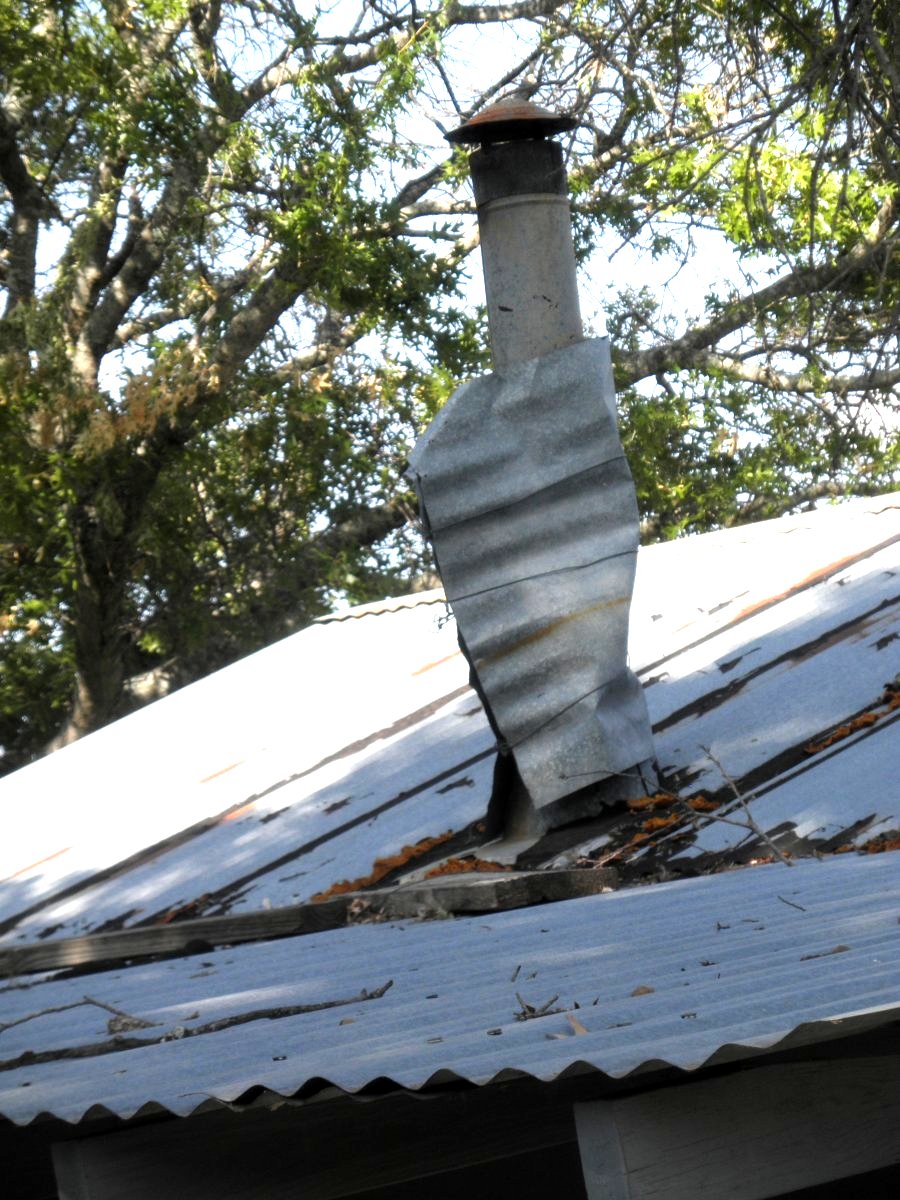
On the other hand, the rain proved my chimney-fix didn’t entirely accomplish what was intended.

Water was hitting the chimney outside, intruding and running down the stovepipe as far as the elbow, then dripping in.

Hard to think of a good quote to sum up all this.  “It’s an ill wind that blows no good?”

But it’s all good.  I just have to cut that oversized chimney-pipe and put it on there as a sleeve over the old chimney soon.  Better knowing it now than discovering it when Mr. Bullgoose Daddy-Longlegs storm comes in.

Old Jules

Roof and Chimney Leaks — White Trash Repairs

Edited in Preface:  Someone’s told me this post is a bit grim, which floored me.  That is NOT what this is all about.  I might well be the happiest man on the planet, the most joyful and grateful for the roof over his head, for the animalcules, for every moment of this life I’m blessed with.  I am sure as hell not complaining about the way I live in this post, not poking around looking for sympathy from anyone.  There’s not one of you I’d trade lives with.

Please allow your mind to read what follows with a smile.  I love this crap.  This post is me laughing at myself, laughing at whatever life might throw at me, telling life, “Do your damnedest!  I’ll keep coming.”

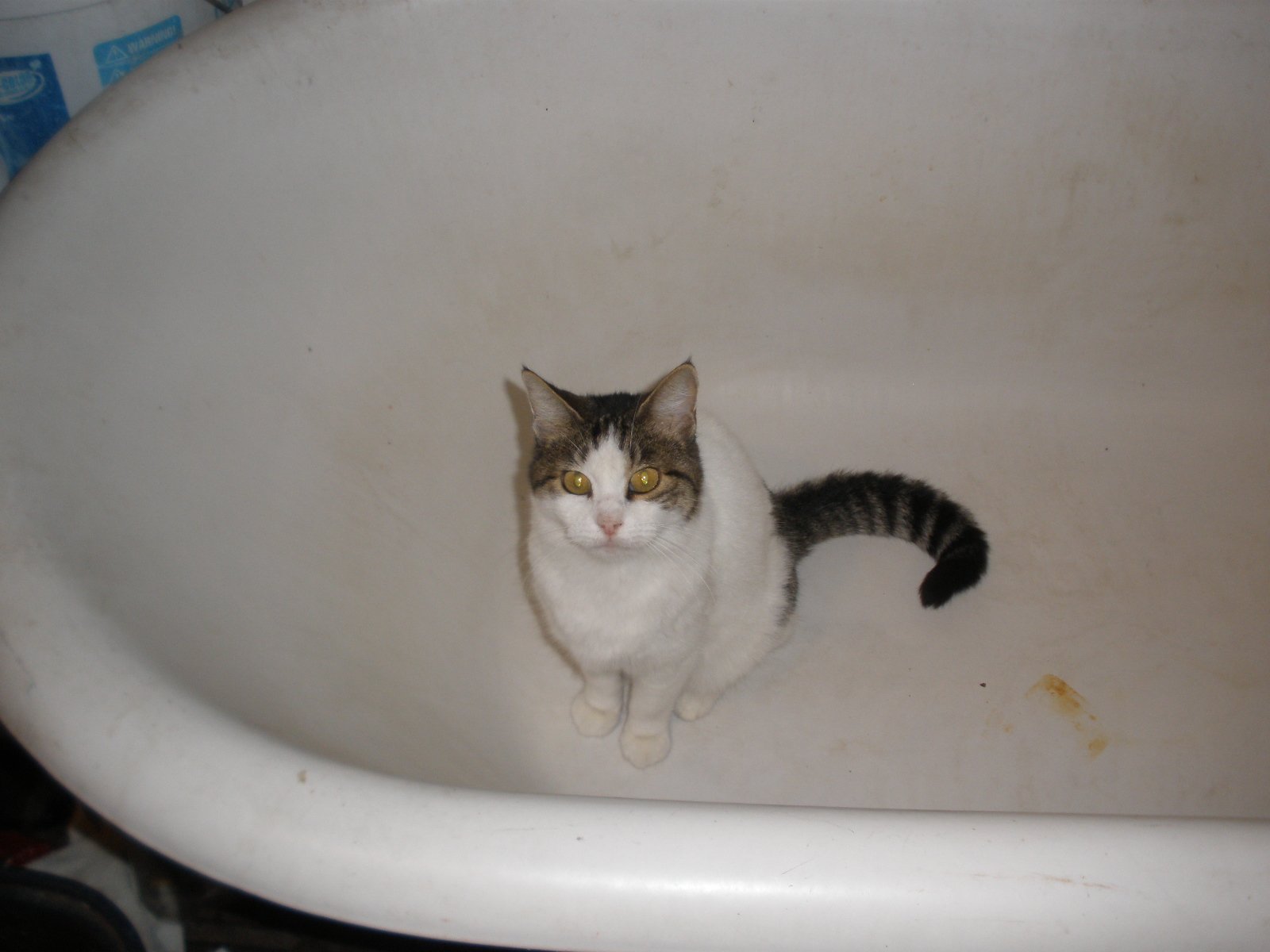
“Science,”  Hydrox the jellicle cat insists, “You observe, you formulate a premise, you test the premise and revise it, then you test again.  Just make damned certain it’s right this time.”  Hydrox is one of the two felines indoors during cool, and especially during inclement weather.   “If science isn’t cutting it try some engineering.”

He takes a jaundiced view of hiding under something to get away from thunder only to get drenched by a lousy roof repair experiment.   Hydrox is attuned Level 3 Reiki.

Reiki Masters,” he assures me, ” At least cat Reiki Masters, don’t appreciate being interrupted from doing high-minded things by getting sloshed because of criminal negligence on the part of a human being.”

Back when I was attuning him several people thought this mightn’t be a good thing.  It’s been a mixed blessing.

That chimney pipe was leaking badly back when it still rained.  But this repair job hasn’t had the test of a good rainfall yet.

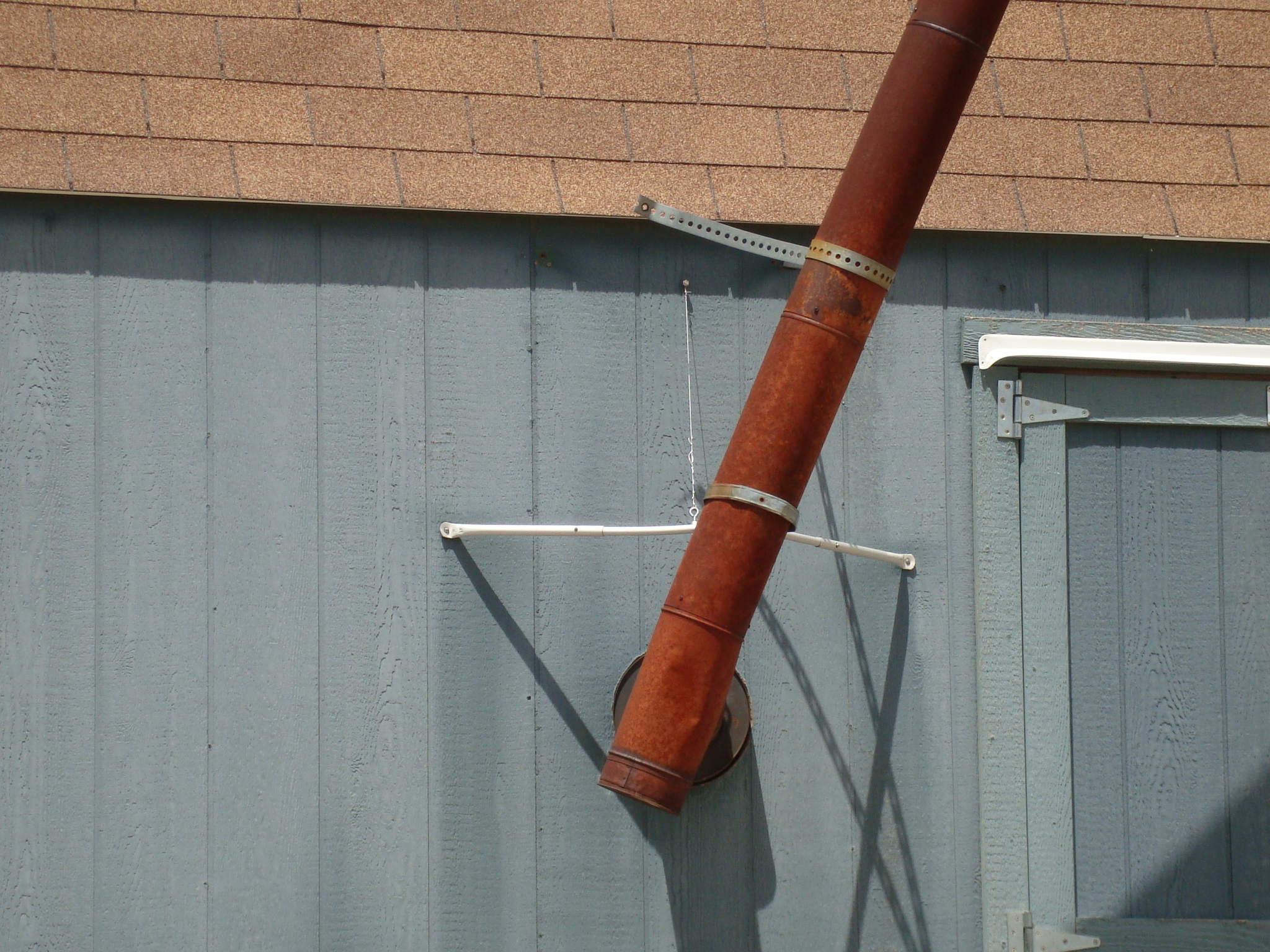
Edit:  This larger diameter stovepipe came from Habitat for Humanity Thrift Store [toward the bottom here:   Curiouser and curiouser ] for a couple of bucks.  If the current fix doesn’t work I’ll cut the down-end with the angle cutter to match the slope of the roof, cut the top shorter than the chimney vent and sleeve the chimney with it.  I thinks it will block of a lot, if not all the pesky intrusion of rain into the chimney pipe.

As you can see, I’ve smeared tar all over the the joints in the sheet metal roof, in addition to the customized chimney.  That didn’t work too well, I’ll confess.  Got some other things to try though.  The light brown or tan you see is the foam you get at the hardware store that is touted as being able to plug large leaks by expanding into them to fill in the space.  No joy on that.

The chimney problem’s crucial.  Water hitting the side of it goes inside, runs down to the elbow in the bedroom but doesn’t slow down much:

[The gray hat’s a XXXXXX John B Stetson I picked up at a silent auction a few years ago for $10.  Man who owned but never wore it died and left it to me, though we never met.]

Naturally there’s a backup plan to keep water from coming down on the bed in the unlikely event it rains:

This has worked pretty well in the light rain arena.  Hasn’t been tested in a bull goose honest-to-goodness wind blowing rain sideways daddy-long-legs storm.

But we didn’t reach a consensus, the felines etc. on the matter of roof repairs and leaks.  Shiva the cow-cat argues, “What the hell!  Here’s a perfect spot for both those indoor cats in a thunderstorm.  What’s the big deal?  If they don’t like it throw them outdoors with Tabby and me.

I’m sick and tired of all the age discrimination around here in favor of geriatric cats.”

Meanwhile:

Old Jules

Bob Dylan– Hard Rain’s Gonna Fall

September 13, moonbows and canned thunder

Expect an uneventful day, blogsters.  Nothing has happened in the world on September 13, since 1922:

Turkey
1922 Turkey Constantinople

13th Sept. 1922 : Following the Turkish Victory in Constantinople, crowds have taken to the streets and are attacking Greek churches and homes and destroying them . The Turkish troops have been dispatched to keep order. The spread of Typhus and the Plague are now reaching epidemic proportions but authorities are insisting they do no not wish aid in the form of medical assistance from neighboring countries.

Siege of Constantinople Public Domain Photo

Full Size Original Here:
http://en.wikipedia.org/wiki/Image:Siege_of_Constantinople.jpg    Well.

Actually there was this: U.S.
1926 U.S.A. Bandits Robbing Mail Trains

13th September 1926 : The Post Office Department sent a memo to it’s army of 25,000 railway mail clerks an order to shoot to kill any bandits attempting to rob the mail, this follows an ever increasing number of robberies by bandits on the mail service which carries millions of dollars worth of mail every day. They also issued a statement saying that if the robberies continue the marines will be bought in again to protect the mail. http://www.thepeoplehistory.com/september13th.html

But otherwise nothing’s ever happened on September 13, since 1922, so relax.

On the other hand, this from Spaceweather.com

HARVEST MOONBOW: Last night’s Harvest Moon was so bright, it did something normally reserved for the sun. It made a rainbow:

“I was surprised to see a rainbow at night,” says Marsha Adams of Sedona, Arizona, who took the picture nearly 2 hours before sunrise. “The rainbow was apparently caused by the Harvest Moon beaming through the rain clouds.”

Indeed, moonlight reflected by raindrops breaks into the colors of a rainbow just like sunlight does. It takes an especially bright Moon, however, to make the phenomenon visible to the human eye. Did anyone else spot a Harvest Moonbow? Submit your images here.

http://spaceweather.com/

Yeah, Old Sol’s still got a case of measles or chicken pox.  Astrophysicists are attempting to arrive at a consensus about which, without success:

http://spaceweather.com/

I’ve been talking this over with the cats and chickens this morning, the September 13 ennui, and the possible implications and ramifications as they apply to the human psyche and potential injecting something to mitigate it all.  Eventually we agreed on a course of action.

Today I’m going to be playing a constantly repeating CD of a violent thunderstorm outdoors with as much volume as I can coax out of the receiver and speakers.  We here in the middle of nowhere want to do our small part for humanity while maybe giving a whispering hint to Mama Nature without being pushy.

It’s a true fact I’ve observed whenever I’ve been around watching people watch television:  When the box shoots out canned laughter it triggers laughter on the people watching it.  It’s time, the cats, the chickens and I have decided, to give Mama Nature a healthy dose of canned thunder and the sound of rain falling.

Old Jules

9:30 AM – Raising the ante:

On the off-chance I’m being too subtle in my communications with Mama Nature, I’ve got a load of socks and underwear in my handy-dandy 1947 Kenmore washing machine [ Clean Underwear and Hard Times ] running the gauntlet.  After the rinse I’m not going to wring them out, but instead will hang them from the line to provide the nearest thing I’m able to rainfall hitting the dirt underneath the line.

I’m betting between the canned thunder, the sound of rainfall, and all that dripping underneath, Mama Nature’s plenty smart enough to put it all together.

I just hope I got all the soap out of my socks and drawers.  I don’t need Mama Nature soaping down the countryside and trying to wash all the stuff out of the holes in the roof I’ve been plugging to stop the leaks if it ever rains.

Desert Emergency Survival Basics

You survival and preparedness-oriented readers might find something you didn’t already know in here to be useful.  The Introduction section to the book Desert Emergency Survival Basics explains my purposes for writing it better than I can today:

The potential range of human experience includes finding ourselves in unanticipated dangerous situations. Most of those situations have been examined minutely and described in print in the form of survival manuals. Desert survival is not an exception. Excellent books are available to explain primitive survival in the desert southwest duplicating lifestyles of Native Americans a thousand years ago. That is not the intent of this book.

A few decades ago I had an acquaintance with a man named Walter Yates. Walter had the distinction of surviving a helicopter crash in the far north woods by jumping into a snowdrift before the impact. He managed to survive winter months with almost nothing except the clothes on his back when he jumped.

Walter’s experience was a worthy test of human potential for emergency survival in extreme conditions. The margin for error was microscopic. The reason he survived rested on his ability to quickly detach his mind from how things had been in the past, how he wished they were, and accept completely the situation he was in. He wouldn’t have made it out of those woods if he couldn’t rapidly assess his new needs and examine every possibility of fulfilling them. “It’s all in the mind,” he once told me.

The margin for error in the desert is also narrow. That margin is dehydration. Extremes of temperature are also a factor, but they are more easily managed than the needs of the human body for water. Anyone who survives an unanticipated week in desert country did so by either having water, by carrying it in, or finding it.

Over the years I’ve followed a number of search and rescue accounts and discussed the issue with searchers. The general thinking among those workers is that a person missing in the desert southwest should be found or walk out within three to five days. After three days the chances for live return spiral downward. Returns after five days are lottery winners. When a missing person isn’t found within a week, it’s usually because he’s been dead for five days.

This book is to assist in avoiding situations that lead to the need to survive those crucial three days, and to provide the basics of how to walk out and how to find water in the desert southwest. If you need the emergency information here it will be because you became lost, stranded by mechanical failure, or physically incapacitated. I won’t address the bugs and plants you might find to eat. If you have water you’ll survive without eating until rescue.

When this book was written I had a close association with New Mexico State Search and Rescue (SAR). I was also writing a book about a lost gold mine at the time. The State Search and Rescue Coordinator (SARC) knew about the book. I had a special arrangement with him because I was spending a lot of time in remote canyons searching. If something delayed me there I didn’t want them to send out the SAR guys to look for me.

One day in the coffee-room SARC asked me about my progress in the search and the gold mine book. I explained the lost gold mine search to him and how the information available in the past was sketchy.

“So you’re writing a book that’s likely to cause flatlanders to go out into the desert searching for this thing?”

I thought about it a moment before I answered. “It might. A lot of people would have tried anyway, but this book might bring in some who wouldn’t have come otherwise.”

SARC glared at me. His whole world revolved around  flat-landers getting lost in the mountains or desert. Several times every month they’d scramble the forces to try to locate someone misplaced. Sometimes it’s a brain surgeon from Houston who got himself mis-located mountain climbing on the east face of Sandia Mountain within sight of Albuquerque . Other times a physicist from California gets off the pavement in the desert and loses his bearings. Sometimes SAR arrived in time to save their lives. New Mexico back country can be unforgiving.

“If you’re going to publish a book that will take a lot of idiots out where they can get into trouble you’d damned well better include some warnings on desert survival and how they can stay out of trouble! I don’t want to spend the next five years dragging the bodies of your readers out of the arroyos in body bags.”

That conversation ultimately resulted in this tome.

Over time it’s been expanded and rewritten numerous times to eventually become what’s posted here. Here’s the link, but there’s a new page for it on the navigation bar at the top of the page.
Desert Emergency Survival Basics

Old Jules


Sons Of The Pioneers – Cool Water

Choose Something Like a Star

Choose Something Like a Star

by Robert Frost – 1947

O Star (the fairest one in sight),
We grant your loftiness the right
To some obscurity of cloud —
It will not do to say of night,
Since dark is what brings out your light.
Some mystery becomes the proud.
But to be wholly taciturn
In your reserve is not allowed.

Say something to us we can learn
By heart and when alone repeat.
Say something! And it says “I burn.”
But say with what degree of heat.
Talk Fahrenheit, talk Centigrade.
Use language we can comprehend.
Tell us what elements you blend.

It gives us strangely little aid,
But does tell something in the end.
And steadfast as Keats’ Eremite,
Not even stooping from its sphere,
It asks a little of us here.
It asks of us a certain height,
So when at times the mob is swayed
To carry praise or blame too far,
We may choose something like a star
To stay our minds on and be staid.

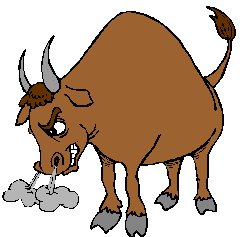
Don’t Call an Angry Jersey Bull a Sick Cow

He won’t like it.


  Every spring and fall the lady friend I mentioned in So Long, and Thanks for all The Valentines entry and I used to go adventuring down the Rio Grande to the wildlife refuges.  We’d watch the antics of the full quota of migrating birds at Bosque del Apache  Wildlife Refuge near San Antonio, NM  [ http://friendsofthebosque.org/aboutrefuge.html ] and other sites near the river.  We carried our cameras and binoculars along, same as everyone else, and let where the birds were tell us where it was okay to go.

One year we were scouting the roads and farms on the east side of the river when we spotted a huge flock of cranes grazing among a dairy herd.  No signs forbidding trespassing, so I followed the irrigation ditch bank to get us as near them as possible.  Then we got out of the truck and began threading our way through the cows as we tried to get close enough for good pictures while the birds tried to foil the effort by moving further away.

The cattle were contained by an electric fence positioned about 18 inches off the ground.  The lady and I got separate by about 40 yards, me trying to be sneaky and circle around the cranes, her a few feet away from the cattle but on the side of the fence opposite them.

Jules! There’s something wrong with that cow.”  I was focused on the cranes and didn’t pay her any mind.  I didn’t care if there was something wrong with one of the cows.  “Jules! That cow is SICK.”

This happened several times, me still ignoring it, her becoming increasingly shrill.  Finally, frustrated, I glanced toward her.  SHEEZE!

A huge Jersey bull was snorting and pawing up a dust cloud fifteen feet across that single strand of electric wire from her, telling her to “QUIT CALLING ME A COW!”

I yanked off my mackinaw.  “THAT IS NOT A COW.  STAND STILL!  DON’T SAY ANYTHING ELSE!  DON’T MOVE!”  I waved the mackinaw in the air.  “HYAAAAH!  HAYAAAH LOOKEE HERE YOU BASTARD!”

Snort.  Stomp.  Paw.  Dust.  Now he’s turning my way and I ain’t even across the fence from him.  “Hyahhhh!”  Less enthusiasm.

To her:  “Back away slowly.  REALLY slow.  Hyahhhh!”  Me backing away too, still waving the mackinaw, stepping across the fence, him taking a few paces toward me.  “HEAD TO THE TRUCK!  Slowwwww and easy.  Don’t attract his attention again.”  SOB’s thinking he’ll charge me, moving my way stomping and snorting, pawing up dirt.

I got up on the ditch road thinking how I can jump into seven, eight feet of water if I need to without ruining the camera and binocs.  He’s maybe 40 feet away, still coming.  She’s beside the truck.  “OKAY!  START YELLING AND WAVING YOUR ARMS AROUND, THEN IF HE TURNS GET IN THE TRUCK!”

She did, he did, and I did.  He never came past the fence.

When I was a kid a Jersey bull was universally known to be a dangerous beastie.  We had to sit through films at school telling us to watch out for them.  I read somewhere once that more kids on farms were killed by Jersey bulls than died any other way.  She sat through the same films.

I suppose she forgot.

Or maybe I was just more tuned in because of a Jersey milk cow who used to chase me all over the barnyard, me trying to get her into the stall for milking.  My step-dad always sneered at me about that, “All you have to do is grab that ring in her nose!  She won’t do anything after that.”

I don’t recall I ever got close enough to grab that ring and test it out.  I preferred batting her across the nose with a broken hoe handle.

When It’s Mushroom Picking Time in Minnesota http://teresaevangeline.blogspot.com/2011/09/when-its-mushroom-picking-time-in.html reminded me of this.  Rather than bog down her comments with my yarns I figured I’d best post it here if I wanted to tell it.

Old Jules

Johnny Cash -the Bull Rider
http://youtu.be/TViGS1ePGp8

6:15 AM Newsflash:

Last night I heard a ruckus outside the back window along with the sound of destruction.  I shined a flashlight through the screen and found a feral sow and 5-6 piglets about the size of Cocker Spaniels had broken into the rooster pen and were tearing everything up, one trying to get up the chute to the night rooster fortress.

I got the .22 and picked a target, the one tearing up my chute, fired through the screen, resulting in more destruction of the pen, a squealing, flopping-all-over-the-place pig, herd stampede by the others, and one ANGRY feral sow.

She’s been out there all night snorting and grunting.  My guess is that piglet’s still alive out there, injured, and she’s waiting until I come out to express her displeasure.

I’m not going outdoors until it’s light enough to see what I’m doing and she’s doing so’s we can come to some sort of permanent understanding about the issues involved.

Old Jules

7:30 AM aftermath

Judging from appearances she and the pigs ate the one I shot during the night.  Stinks something awful all over back there.  They did a lot of damage to the rooster pen, which I’ll have to shore up today while the two roosters run loose and hopefully leave The Great Speckled Bird: Respecting our Betters alone.

The Liar: The Great Speckled Bird, Part 2 might have to hang off in the background today, leaving the hens alone.

Damage from the hogs wasn’t restricted to the chicken pen.  They tore off some of the siding to the storage building trying to get to the chicken feed, also, broke pieces off.  More repairing and shoring up necessary there.

When I went out the sow was in a cedar thicket near the main henhouse where I could hear, but couldn’t see her.  Couldn’t tell whether the pigs were in there, too, or not.  I agreed not to go in after and she agreed to not come out after me.

Old Jules

News from the Middle of Nowhere

Old Sol’s going through some unusual upheavals today.  I don’t recall ever seeing such an array of sunspots reported:

“GIANT SINE WAVE: Imagine a sine wave 400,000 km long. Today, NASA’s Solar Dynamics Observatory is monitoring just such a structure. It’s an enormous filament of magnetism slithering over the sun’s northeastern limb:”

http://spaceweather.com/

Meanwhile it’s a red morning out there, so all you salesmen probably need to take warning.

Last night I was planning to haul water but I was interrupted by a wild hog meandering out from behind the truck as I came around the corner of Gale’s house.  We stood and looked at one another from about 20 feet, him undecided about whether he wanted some of me, while though I’d decided I couldn’t think of anything to do about it if he did.  When he wandered off behind a hedge I ducked inside to seal an agreement with him that we’d postpone any drama until we could each feel better about invading the personal spaces of the other.

Gale had told me he was having a lot of hogs troubling him but he didn’t mention I needed to pack a .45 walking around the place.

Maybe more later.  I’ve got to go let his chickens out.

07:45 AM – Snagged enough water to hold things together a couple of days down here without seeing any porkers.  Kay’s duck, which was missing last night when I locked down the chickens and caused me concern, flew in while I was filling the water jugs.  Eased my conscience considerable.  I hate having one of their critters come up KIA or MIA while I’m the one taking care of things.

While I was driving back down here I got to thinking about that tusker last night and the fact something’s been tearing up the pen where I keep the roosters every night.  Went out looking for hints of what might be doing it and found pig scat all around out there.  If it was there before I hadn’t noticed it and it appeared fresh.

I’m guessing whatever water source the wild hogs were using somewhere else must have dried up and motivated them with ambition to do some exploring.  It’s been a year since pigs were a problem here except for brief spatterings, a herd passing through.   I’m hoping these will follow the pattern, what’s left of them.

Tidbits you’ll be glad to know:

On this day in 1948 the Chinese formed the Peoples Republic of China, intended to create a nation of manufacturers to create all the stuff Western Europeans and US workers were having to make for themselves previously, getting their hands dirty.

On this day in 1926 Turkey began allowing civil marriage, the results of which subsequently became obvious.

On this day in 1918 the first US troops landed in Vladivostok, Russia, to help settle things down and restore the aristocrats overthrown by wossname, revolutionaries.  For those guys WWI didn’t end until 1920.

On this day in 1866, Navajo Chief Manuelito turned himself in at Fort Wingate, New Mexico, thus putting the final touches on getting all those Navajo over into the temporary [15 years] rez at Bosque Redondo, Fort Sumner bunched up with the Mescalero so’s to get the numbers down to something more tidy and manageable, which they did. [The Long Walk of the Navajo http://www.logoi.com/notes/long_walk.html ]

Old Jules

“The Java Jive” (Ink Spots, 1940)
http://www.youtube.com/watch?v=iP6IUqrFHjw&feature=related

Drought, Starving Wildlife Stewardship and Paradox

Looking for solutions

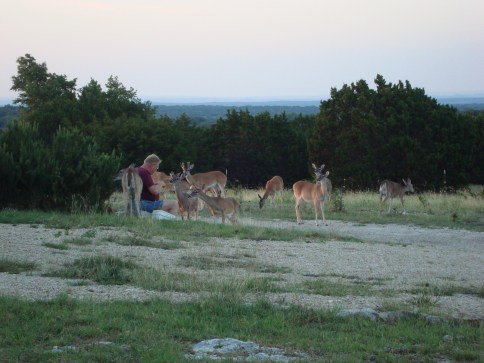
There’s an irony in this picture.  Gale, the man feeding the deer, owns this 300 acres I live on.  One of the reasons he originally bought it had to do with the passion for hunting he spent most of his life following, which, 40 years ago was a passion we shared and was one of the ties leading to our becoming friends.  Between us we’ve killed more large mammals than either of us can remember, though I don’t recall we ever hunted together.

Each of us following the routes our lives took us gradually and independently lost any interest in killing any more if it could be avoided.

Which is still a long way from sitting on a rock feeding tame deer every evening.  I’ve never arrived there.  I’d far prefer the deer staying out in the woods tending their own affairs and leaving me to tend mine, which they refuse to do.

Now, along comes the extended drought.  Today he’s feeding a herd of 30-40 starving deer up there, spending $100 + per month on corn, range cubes and hay.  If he tried to feed them enough to get them beyond near-starvation he’d bankrupt himself doing it.  He’s picking cactus tines out of the lips and noses of his tame deer because they’re so hungry they’re trying to eat prickly pear cactus.

I’ve got another 20-30 down here I’m not feeding intentionally.  ‘Mine’ are so desperate for food they constantly hang around waiting for me to feed the chickens, refuse to be run away further than I can throw a rock, and even come onto the porch for the cat food when any is left outdoors.

But watching a herd of deer starve to death, whether you’re feeding them and given them names, or are just some guy trying to mind his own affairs and have them forced on him as unwelcome guests, is a troubling position to be in.  A few days ago he and I were discussing it trying to come up with some means of providing them more to eat without him having to spend a lot more money doing it.

Eventually it came to me people in Kerrville are probably still mowing their lawns, bagging the grass clippings and putting them out on the curbs to be picked up by the city.  We talked about this a while and considered the fact the bags of grass ferment when sealed, creating a feed we’ve both been around called silage, which livestock love.

Next time either of us goes to town we’ll be looking at lawns to see if we’re right in believing they’re still watering grass and mowing it.  If they are, I’ll soon be putting up a post on Kerrville FreeCycle Yahoo Group asking if any of them would,

  1.  be willing to allow a trailer to be positioned on their lots where others could bring bagged grass clippings so we could haul them off weekly or a couple of times per month to feed the deer, and
  2. if such a lot and such a trailer were in place in Kerrville, would they be willing to carry their clippings there instead of just to the curb in front of their homes.

But this mightn’t work, and even if it works it’s only a partial solution to the problem.

I’m looking for ideas and information.  You others living in drought-stricken areas, do you have any idea what, if anything, locals with starving deer populations are doing to supplement their feeding?

Any ideas or experiences that might lead to even interim or partial solutions will be appreciated.

Thanks,  Old Jules

Money isn’t the solution to this problem, but the performance in Cabaret does seem apropos somehow:

Cabaret- Money

http://youtu.be/I8P80A8vy9I

News from the Middle of Nowhere

El Palenque

El Palenque doesn’t think;
Knows his only job
And does it;

Perfection without
Compromise.

Old Jules copyright 2003 NineLives Press

Escape artist

Unless the Great Speckled Bird is closed up in the other pen so the younger roosters can’t open a can of whoopass on him I keep them separated here:

”]and every night deer, coons and other critters break into the cage for leftover feed or as a possible access to the fortress.  Before I let the two roos into the pen at daybreak each day I go around the base and make repairs with wire pinchers and tie wire.

And every few days this guy finds a way out.  So I herd the Great Speckled Bird off to the other pen for his own protection.

Mr. Leon Trotsky, I swear to you, is pushing his luck.

———————————————

Meanwhile:  My personal

PATRIOTIC TRADE DEFICIT AWARD

for the most ironic news item:

Quick News: American flags made in China

http://www.presstv.ir/usdetail/187535.html

————————————————————

A couple of other blogs I especially enjoyed today:

Old Fools Journal: Toast or How I sometimes make briquets using the “Lot of Smoke” method.

http://www.oldfool.org/

Cardboard Reality Interventions #237 – The Outaspaceman

http://outaspaceman.blogspot.com/

—————————————

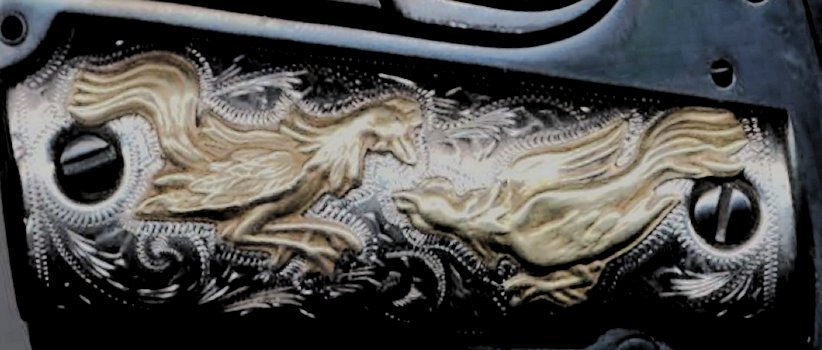
TOM RUSSELL LIVE GALLO DEL CIELO

http://www.youtube.com/watch?v=Wgom-IWpKdM

http://youtu.be/Wgom-IWpKdM

Swatting Flies in the Last Century


A letter to 6 year old Julia in Kansas before Y2K:

Sunday, Nov. 7, 1999
The Great Divide

Good morning, Julia.

I’m sitting here in the cool dawn, sipping a cup of coffee, listening to the chickens crow and being heckled unmercifully by the blacks for favors. The two polish roosters, Rosencrantz and Guildenstern, are beginning to try their hands at crowing without notable success. They tend to be off on their time and they cut the crowing short of the ur-ur-urrrrr of the more mature birds.

But enough of this chicken news.  I began writing this to discuss the subject of fly swatting with you, certainly a more worthy focus of discourse when watching the birds in their activities, which reminded me how gratified I was by your interest in the various flock members during your visit. So I’ll finish the chicken component of this letter by saying you are right to be interested in them.

The importance of chickens in human life, now and in the past, cannot be over-stated. Even the great human philosopher, Plato, in the Socrates dialogues, put mention of a chicken in the final words of Socrates, prior to his death. Socrates, pacing, reflecting, and finally on the verge of succumbing to the hemlock he’d taken, spoke abruptly; almost as an afterthought, to Crito, (one of his yes-men): “Crito, we owe a cock to Asclepius. Please pay without fail.”

So there you are. In fact, one of the deeper philosophical questions of this and earlier times contemplated by wise men everywhere is, “Why did the chicken cross the road?”

Why, indeed. However, as I’ve said, the subject of this letter was intended to be fly swatting, not chickens, and I’ll not have it compromised by endless meanderings on lesser matters. The prowess with the flyswatter you demonstrated during your visit demands nothing less.

I’ll begin by saying that when I was a youngster (back when the 20th century had only begun its interminable mid-life crisis), it was widely, almost universally,  recognized that children are far more adept at killing flies than are adults. Probably because of their lightning reflexes and sharper eye. This wisdom has suffered neglect partly because of screen doors, refrigeration, air conditioning, indoor plumbing, and other curses of modern life.

In my day, anytime there was a gathering of adults for dominoes or canasta, picnics or outdoor parties, even if there was only one child present, he would quickly be given a fly swatter and put to the task. When more than one child was present, usually it was thought that the rowdiest, most rambunctious child, the one most likely to lead the others to acts of courage, bravado, or cunning, would be the best suited to ridding the affair of the fly nuisance.

I can promise you that in those days my fly swatting skills were second to none. However, over the years I’ve lost my razor edge. My reflexes are no longer as sharp, and the keenness of eye is largely gone, as the case with most adults.

Of course, the proper tools are also the victims of disuse. There were giants in the earth for fly swatting tools back then. For a dime you could purchase a fly swatter with a limber wooden handle and a flap of heavy rubber or leather that was equal to the most severe fly nuisance. My granddad had one he’d made himself of tooled leather that could sometimes send three or four flies at once off to the hereafter.

In those times the fly problem was probably worse than it is today. I’ve never seen it happen, but I was told many times by adults who had themselves seen it, of incidents where a child lapsed in the task he’d been assigned, fell behind, and was actually carried away by swarms of the angry insects.

Anyway, I’m sitting here, a burned-out has-been in the fly swatting arena, hoping to give you a few tips – the old worn out champ passing on a few tricks to a future talent who is yet a novice. Even with the fly swatting tools available in stores today, I firmly believe you can hone the skills with diligence and patience to become, as Marlon Brando coined the phrase in, “On the Waterfront”, a contender.

First off, it’s important to recognize that flies frequently jump backward or drop downward in their efforts to elude the slap. If you anticipate this and lead them a little, you’ll find what would otherwise have been a useless swing that did little more than knock over a lamp or a porcelain knick-knack, will result in the satisfying trophy of a fly in the dishwater or in a large bowl of coleslaw underneath the target area.

Secondly, you need to always keep in mind that while fly killing is a high priority to adults when they put you to the task, the priority invariably changes when they see a dead fly dropping into their drink. So, unless you do it unobserved, I’d suggest you’ll be more widely acclaimed for your skills if you steer well clear of anything but the most subtle or inadvertent trajectory of a defunct fly into any food or drink which is in view of an adult or older child who can’t be trusted to remain silent in the shared joy of secret knowledge. Most can’t, I myself learned in the hard school of experience.

Thirdly, the swing, or swings. Usually the fly swatter, (the tool, not the child wielding it) works best with short abrupt flicks of the wrist from an area only a foot or so above the insect. With the lighter tools of today’s world, the swing probably needs to be handled with vigor and with a little attention to the follow-through. On a window or other surface where the flies are thickly gathered, sometimes a series of rat-tat-tat slaps can net a goodly pile of carcasses and numbers for your growing record book.

Keep in mind that even on days when you are approaching previous records, adults are unlikely to be impressed when a previous record broken is accompanied by fly remains smeared across the front of the refrigerator or permanently embedded in a window screen. Fly killing is a matter involving politics, philosophy, and judgment, as well as the keenness of eye and lightening reflexes mentioned earlier.

I suppose the thing that got me started thinking of writing you about flies is the abundance of them in this house the last couple of days. I don’t know why. Usually they are attracted to areas where there’s livestock. But here there is no livestock. Just the three cats, the chickens, and myself.

You might tell your mom and dad I’ve been using my wood stove the last couple of days. It’s enough to roast a human out of the house with a single large log burning on a cold night. But getting it hot enough to cook food requires a lot of smaller wood. With large logs inside it won’t boil water between now and the day you, Julia, become the bride of some fortunate suitor.

Your dad will want to know the thing I went through the wall with did fine with normal fires, but when I determined to stoke it full of small wood for a breakfast fire and coffee this morning it charred the paper front on the insulation around the outer pipe. Of course, the stovepipe was glowing red through that episode, which is to be avoided.

You might also mention that trying to erect a stovepipe along a wall by one’s self is a thing you haven’t really lived until you’ve done. Cartoons used to show shanty houses with zigzagging stovepipe. I never knew why until now.

Hanging the kitchen cabinets alone was also one of those experiences which, like the man who decided to carry a cat home by the tail, will most likely remain burned in memory for a while.

I’m not inclined to regret anything in my recent past and hope I never will. The person I now am differs from the person I was at your age as a result of cumulative lessons I’ve learned from choices I’ve made between that time and this. However, there’s nevertheless a temptation to gnash my teeth a little for not having taken advantage of your dad’s kind offer to help with the electrical wiring from the windmill, solar panels, inverter, and batteries, into the house. I’m reminded of that offer each time I fiddle with the connections and the hidden short somewhere shuts down the inverter.

Hmmm… this letter has gone on and on. There’s nothing particularly personal or confidential about it, except the tips on fly killing, so feel free to share it with your family. Or keep it until you are able to read better and read it yourself.

Best wishes to your brothers and your mom and dad.

Affectionately,
Old Jules

Note from Julia in 2008:
I honestly don’t remember this at all. This is by far the best letter ever written to me, I’m just glad I can read it and appreciate it now!
~ Julia

Burl Ives– Blue Tail Fly
http://youtu.be/1ardNXjE-_I