
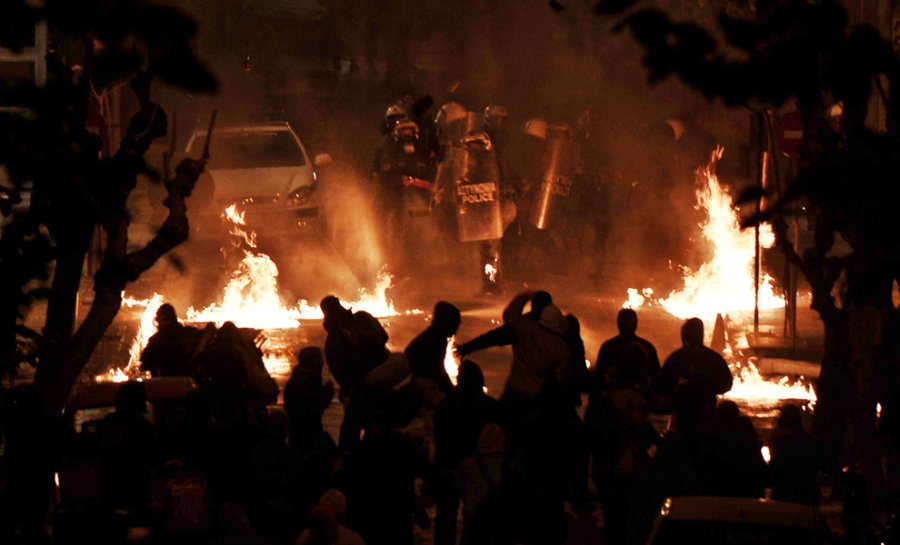
I find my views about rioting to be possibly artificially drawn away from magnetic north by several personal experiences with them, as well as having been an adult during the giant city burning episodes around the time of the MLK killing.
From personal observation and experience I feel a high level of certainty that every riot since the 1960s was and is heavily infiltrated by police or other government provocateurs, pushing, inflaming and instigating to direct events toward violence. I’m not suggesting the riots wouldn’t have happened without them. The riots would almost certainly have happened anyway. I honestly don’t have a clue why they’re doing it.
But my first experience with it was Halloween, 1960, in Borger, Texas. During the days before Halloween the kids in high school were all gearing up for it, but I was a newbie in town, had no reason to anticipate what they saw as the normal way to celebrate Halloween. Wild and wooly oil-field worker traditions combined with a boys-will-be-boys tolerance on the part of adults left the options wide open.
The newspaper the next day described it as a quieter than usual Halloween with the main damage being someone starting a bulldozer at a construction site and driving it through a house, nobody hurt.
A few hundred teenagers drunk on main street armed with eggs, veggies, rocks, jars of gasoline, cornering police paddy wagon with barrage after barrage, following them back to the station house and setting fire to the lawn was just a beginning. I never saw anything like it, even during the riots at the University of Texas I was a part of a decade later.
My point is, rioting is fun, it’s joyful, it’s seductive if the anonymity of a mob can be maintained and when there are no consequences. It doesn’t take much to get people rioting under those circumstances.
On the other hand, the day after Kent State and afterward throughout the remainder of the Vietnam War the temptation to riot was always there so long as it was someone else stepping off the curb into the street. The police and a lot of the rest of the country made it plain by word and attitude they felt tolerance for what happened at Kent State and wouldn’t mind seeing it again.
I recall what a letdown it was when I realized I wasn’t the gutsy hotshot I had people thinking I was, that I was just a loudmouth coward when it came to offering myself up for what I claimed I believed in by making myself a target for all those cops to practice on.
I don’t think things are much different now. My near-certainty about riots in the US is that the government response will determine whether there are riots, or won’t be. I don’t give advice, but if I did I’d suggest anyone involved in a peaceful demonstration immediately remove himself/herself from the area as rapidly as possible at the first sign of violence.
I’d suggest carefully exploring the route and area of the demonstration on maps and on the ground beforehand. Pre-arranged escape routes memorized to allow getting the hell out of dodge. Cell phones set with standby text messages to friends and cohorts to get the message out immediately that things are going sour. But I won’t suggest it.
But I don’t have a lot of reason to think having a riot going on and being in the center of it is a place I’d want to spend a lot of time.
Old Jules

 So Far From Heaven
Nice Post. I as a young radical in a later era came through a similar evolution. I thought radical confrontation was a great way to win gains and radicalize folks and wrote two papers on rioting in grad school. I got out and went from part time radical to full time radical activist for a couple of years and did lots of different types of actions but helped organize a lot of in your face protests at the local nuclear power plant that was having some problems. Kick em when they’re down you know. It was all good until the first police riot and i was sitting in jail seeing my friends drug in beaten and maced and charged with felony assault. After the police beat the crap out of you they like to charge you with assault to justify your injuries. That was enough for me to re-think that style of activism and lose some disdain for the ballot box (although after being involved with one serious campaign it was enough to bring it back). When I was going to more protests and my Dad was still alive he would always hammer home that know your escape route if shit hit the fan. Good advice for interesting times.
Morning multiconstruct. Thanks for coming by to read and visit. Your dad was a wise man. Gracias, Jules
On one of my three visits to Occupy Wall Street recently, I was on a sidewalk and was briefly separated from my husband. I stepped back to a less crowded area to look for him. During that time a police officer bumped me not once, but twice — when there was enough room for that not to happen. I believe he was attempting to provoke me, a petite 52-year-old woman. I did not acknowledge him and moved away. It was a frightening moment, and your advice makes a lot of sense. I enjoyed talking with the protesters, but the police were scary.
Morning Nadine: Thanks for the anecdote and the visit. Sometimes we’re tempted to forget those cops are carrying around all their personal biases and attitudes when they’re on the job pretending to be just trying to protect and defend, I reckons. Gracias, Jules
thanks for your point of view!
+
frizztext: And thanks for yours. Jules
Indeed, we seldom see any kind of protest without infiltration and provocateurs. Lately they’ve been getting caught and video-taped, but that really doesn’t seem to have changed anything.
Good seeing you Ed. No, I gather they don’t care if they’re captured on camera. Gracias, Jules