Category Archives: Books

The Boy Captives – J. Marvin Hunter – Book Review

Hi readers.  Thanks for coming for a read.  I bought this tome in a thrift store in Kerrville before I knew it’s the hottest piece of literature to be had in TimeWarpVille [Junction], Texas. 

I suppose that qualifies me to brag I have a nose for cool, an instinct for hot, to boast that I was also country when country wasn’t cool, same as the song said. 

Over in TimeWarpVille every business in town has a stack of these with a $10+ pricetag.  And customers standing in line to buy soft drinks, potato chips, deer corn, and steel fenceposts will each answer verbal quiz questions about it, when asked. 

They likes it.  They likes it real good.  They know the family heirs to the publishing history.  This I know to be true because I asked and was answered.

I’m reasonably comfortable some of the other parts of this non-fiction book are also true.  There’s a fair amount of documentation and affidavits from people alive at the time of the incidents certifying various parts of the story they had personal knowledge about.

I’d guess the older brother, Clinton’s part of the tale he’d possibly be able to pass a polygraph on 75-80%.  Maybe higher.  Most of the details he gives don’t conflict with anything clearly different and known under more verifiable circumstances elsewhere.

Brother Jeff’s part of the tale, however, has a somewhat different air about it, to my suspicious mind.  I ain’t going to say he wasn’t traded to the Apache, not going to say he wasn’t adopted by Geronimo.  But if I had to stake any money on the truth or fiction of it I’d put my large bills on most of his story being lost in the dust of history because it ain’t on these pages.

Not that it matters.  Fact is, the book is a hoot, an interesting read, a flashback to a time when Brother Comanche still rode southeast under a Comanche moon, killing, taking captives, stealing horses.   Good descriptions from a couple of kids of settlers before their capture about their lives, the family.

And both brothers succeed in spinning yarns Marvin Hunter could put on a printed page well enough to keep the reader turning them, not putting the book aside for something with more potential for holding the mind in place.

You Texas readers would almost certainly enjoy this tome, thinks I.

Old Jules

From The Mixed-Up Files of Mrs Basil E Frankweiler – Book Review

Hi readers.  I don’t know whether I’ve ever mentioned on this blog that I’m a big admirer of a lot of young adult fiction writers.  Mainly Newbery Award folk because I wouldn’t take a chance on anything else that didn’t come highly recommended.  So, when I found From The Mixed-Up Files of Mrs Basil E Frankweiler, by EL Konigsberg in a 10 cent basket at the dogpound thrift store in Kerrville, I snagged it.  Same as I’d have done with any Newbery.

I’m glad I did.  Fact is, while I haven’t encountered many books with that award I considered unworthy of the time spent reading them, occasionally I have.  But this one’s from back when writers were writers and readers were glad they were.

The basic plot’s just a brother and sister who decide to run away from home.  But beyond that summary it becomes a reading experience, as opposed to the alternatives too frequently provided in best selling books.

The kids each have talents, each balancing the weaknesses of the other, each recognizing that fact, and the entire plot and characterization orbits it, relies on it.  The brother’s the financial side of things.  The sister’s a planner.

So she plans where two youngers could probably really have gotten by with hiding in 1967 for a couple of weeks without being discovered, without getting bored.  And the brother provides the funds needed to get there with his winnings from cheating at cards on the school bus.

What’s not to like?  Hell, nothing’s not to like.  It’s a fast read, so it leaves the reader with plenty of time to read it twice, which he’ll want to do if he’s an admirer of good, serious wordsmithing manifested in plots, characters and fast moving events.

They hide in the Metropolitan Museum, evade guards, study a sculpting by a master, discovering secrets about it,  and bathe in the fountain at night fishing for coins.

Great read if you aren’t a snob who only reads really good Stevie Ray King, Norbert Robbers and Louis L’Amour.

Old Jules

Waldo – Robert A. Heinlein – Book Review

My first introduction to science fiction came in the Portales Junior High School Library around 1958.  One of the first of the hundreds of Sci-Fi books read over the course of a lifetime was Red Planet, by Robert A. Heinlein.  Probably Keith, one of the readers of this blog, stood beside me in PJHS Library and argued over who’d get to check it out first. 

The library didn’t include a lot to select from and we pored over them all.  Thunder and Roses, by Theodore Sturgeon.  City, by Clifford D. Simak.  The Martian Chronicles, by Ray Bradbury.  The Stars are Ours, and Star Born, by Andre Norton. And anything by Robert Heinlein.

Written in 1940, Waldo must have been one of Heinlein’s earliest novels.  By the late 1950s it was still too early to be profound.  Most of the setting, plot, concepts Heinlein visualized in 1940 hadn’t yet come to pass.  Hadn’t made their way into human reality in a form more concrete than a pleasurable indulgence in imagination set to words.  My memories of reading it were vague compared to hundreds of other works by Heinlein and other visionaries who hammered and blasted the new genre into mainstream readership. 

So when Waldo showed up in a box of books in the Saint Vincent de Paul Thrift Store in Kerrville for a dime each and I bought them all, noticing Waldo among them, I was only mildly interested.  Another couple of hours of something to read before dropping off to sleep, I figured.

I was wrong and discovered how wrong I was roughly 20 pages into the book.  Squinted, read and re-read it far past my normal sleep time.  Read it again the next day.  Twice.

Aside from a goodly other phenomena Heinlein described in 1940 that eventually came to pass decades later, he discusses others that haven’t yet made it into mainstream thinking.  One of which includes something I’ve been examining with insane intensity during the past several years, began experimenting with during the late 1990s.  Dropped, partly because of Y2K, partly because the Internet and home computer RAM didn’t yet allow the accumulation and examination of sufficient evidence to arrive anywhere beyond conjecture and assertion.

Thankee, Saint Vincent de Paul Thrift Store.  And thankee Robert Heinlein, particularly for this one.

I keep Waldo close at hand, thumb through it when I’m pondering where things are going as I go through my daily downloading rituals, working my way through the maze to the center. 

You mightn’t, probably won’t be as impressed with this tome as I am.  But I’m betting if you can find it you’ll be more than mildly surprised.  Find yourself asking, “How the hell did Heinlein figure all that out in 1940?

If not, you’ll at least enjoy a fun plot, good characters, a couple of hours of science fiction back when that’s what it was.

Old Jules

Advice and Consent

Good morning readers. Thanks for coming by for a read this morning.

Ring

Me:  Wassat?  The damned telephone?  Where the hell is it?  Ahh!  Under that.  Get off there, cat!

Ring. 

Me:  [scowling.  Into the phone.] This better be good.

Telephone:  Old Jules?

Me:  Who’s asking?

Telephone:  This is George Armstrong Custer MacGruder.  I’m calling for the president.

Me:  President of what?

Telephone:  President of the United States.

Me:  What?  The black guy?  Tell him I don’t vote.

Telephone:  He knows you don’t vote.

Me:  Then why the hell are you calling?

Telephone:  He reads your blog.  Hopes you’ll answer some questions.

Me:  I don’t want some president nosing around in my affairs.  I don’t stick my nose into his business.  He needs take care of whatever it is he does up there.

Telephone:  Nothing he’s tried so far is working.  He’s casting around for ideas.  desperate.

Me:  That’s laudable, anyway.  You’ve got the wrong number.  I don’t have any ideas.  Tell him to take up Zen.  Learn to use the I Ching.

Telephone:  I Ching?

Me:  Yeah.  The Book of Changes.  Chinese.  Divination.  Confucius.  All that.  The John Richard Lynn translation of Wang Bi’s the best one I’ve found.  Yarrow stick method.  Damned coins will throw you off.    Tell him to pay close attention to the changing lines.  You still there?

Telephone:  I’m taking notes.  Sorry.

Me:  Anything else you need?  I’ve got things to do here.

Telephone:  So you’re saying the President needs to consult an oracle?

Me:  You said nothing else is working didn’t you?

Telephone:  Can you think of any other advice you’d like to give the President?

Me:  I don’t give advice.  Except I advise you not to call me again.  I get pissed off sometimes when people bother me.

Telephone:  Could he send you an email?

Me:  As long as he’s not trying to sell anything, persuade me to vote, or ask my advice.

Telephone:  Thanks.

Me:  Sure.  Anytime.

Old Jules

The Illusion of Survival

Several years ago during that pesky time when the publishing house had accepted Desert Emergency Survival Basics for publication, but I hadn’t yet seen the contract they were proposing, the editor was asking for re-writes and a number of changes in the final draft. We discussed it on the phone a number of times and I was pecking away at it, but holding back until I’d seen what they were bringing to the table. 

But before I got too far along I got a call from him because of a news event.  A family in Oregon, or Washington had taken a back road in the National Forest, gotten snowed in, and died because they didn’t apply some of the basics suggested in the Survival Book.

Him:  The scope of the book is broader than the name suggests.  It shouldn’t require a lot of work to make it a general survival manual.

Me: A lot of work’s already gone into it.  And I’ve already re-written it the way you suggest earlier.  You’ve got it in front of you.  Before I do any more work on it you and I need to talk about money.  Every time I’ve asked about what you’re offering as an advance you’ve hedged.  Said you needed to discuss it with the boss.

Him:  We don’t usually offer much in the way of advances.  We’re not that big, even though we offer a lot of titles.

Me:  Then you and I probably don’t have much to talk about.  You know and I know I’m never going to see a penny beyond the advance.  I have a fair idea what’s contained in your standard contract.  I’m not going to lift another finger on this book until I see an advance, and if it’s not enough to pay for my time already, hearing you’re going to be flexible about changing the contract details.

Him:  I’ll talk to the boss.  But that book needs to be published.  That family might have survived if they’d read it.

Me:  I’ve got some survival issues of my own here.  Hypothetical people who might die won’t pay my rent.  I’ve already done the work.  But if you’re proposing to print that book and give it away so neither of us makes anything on it what you’re saying might make sense.  Appeal to my better nature.

Him:  I can’t do that.  We’re in business.

Ultimately they sent me the standard contract and offered a token advance.  The willingness to alter the details of the contract didn’t include changes that would have allowed me to eventually get paid for my labor by eliminating provisions for them to squirm out of paying.

I’ve thought about that a lot over the years and eventually concluded the entire concept of survival and survival books qualifies as a cruel hoax.  An ironic illusion.  Because human beings are going to experience death inevitably as a means of exiting the vehicle.  Some are going to die getting lost in the woods.  If they survive getting lost it’s almost certainly going to be luck, instinct, or common sense.

As an example, somewhere earlier on this blog I described a snowstorm Keith and I got caught in on Santa Rita mesa, and how the GPS seemed to be lying about where the truck was.  How we believed the GPS instead of what we knew to be true, and more-or-less quickly found the truck.

That same snowstorm, not too far away, a kid was lost.  The news was full of it, Search and Rescue eventually was ready to give him up for dead.  But the kid, clothed in a light jacket, used his brain, sheltered under a rock ledge, and made it out after five unlikely days.

Which isn’t at all the same as saying the kid survived.  He won’t.  Neither will anyone else.

Old Jules

Art Work Update from Jeanne

Last week when I finally cleared the decks and got out all the pens again, I realized how critical it seemed for me to start drawing every day. In the meantime I came across this little book while I was shelving at the library:

It describes Resistance and how to combat it. Those of you who are doing creative work already know what I’m talking about. But knowing the characteristics of Resistance and having a plan to fight it helps. I’m going to have to own this book just in case I ever see myself getting away from drawing again.

So here are a few photos for you showing what I’ve been working on.These aren’t scans, so the photo angles will be a bit off.

Although I find the asymmetrical ones very fun to work on, I also demand that I retain my ability to do the symmetrical ones free-hand. All those curlicues in the middle area compensate somewhat for where it got off track. I hope.

I rarely get out a ruler, but on this one I did for the next stage. I just used it to mark dots where I wanted to start those outside edge designs. Once I had one that I thought was round, and when I got a circular mat cut for it, it turned out it wasn’t round at all. So now I’m more careful about that, either making sure it’s round or not getting round mats!

Here’s one more from the end of last night:
I don’t think it’s finished, but at this point it’s definitely time to walk away and not look at it for a few days.

However, I couldn’t help bringing it over to Paint Shop Pro to see what I could come up with:
Love it!

Here’s a close-up of an old one that I had already matted about 6 years ago. I had pens that weren’t as good as the ones I use now, so I’m brightening it up with better colors:
I guess that center motif has always been a favorite of mine. I need to break away from that.

Just for fun, here’s a photo of the above taken under a black light:

A photo of the work table. My son took a card table and cut off the legs so it’s only about a foot high.  I sit on a cushion on the floor. I have a clamp-on light and a clamp-on magnifier. It works great since I can move it around easily and can use it for anything up to a couple of feet square.
Oh, I also worked on that long strip one lying across the pens. But I’ll show you that one again when it’s finished.
I hope everyone has a good creative day!
Jeanne


The Implosion Conspiracy – Louis Nizer – How the USSR got the Atomic Bomb

When Louis Nizer penned The Implosion Conspiracy it might be said enough time had passed to provide perspective.  Two decades had passed since the trial and execution of the Rosenbergs rocked the nation.  Nizer disliked Communists, asserted he’d refuse to defend one in his profession as a defense attorney.  However, he wrote a lengthy analysis of the trial, the transcripts, testimonies, the individuals involved in an even-handed manner that wouldn’t have been possible during the Commie craze days of the events.

Basic events leading to the trial:  The US was developing the atomic bomb at Los Alamos, New Mexico during the late stages of WWII.  The information was being shared with the US Ally, Britain, but kept secret from the US Ally, the USSR.  Elaborate security measures were in place to assure the developments remained the exclusive property of the US and British governments.  Elaborate almost beyond description, devised by the US military and the FBI.
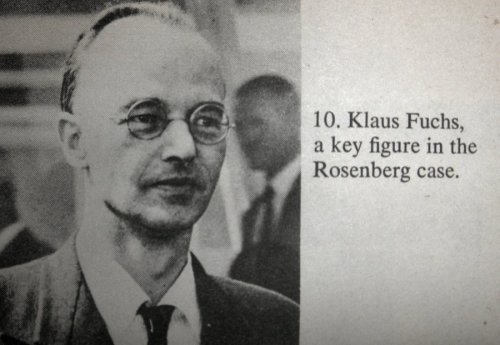
But the British liaison to the project was physicist Klaus Fuchs, a spy for the Soviet Union.  The Germans knew Fuchs to be a Soviet spy, but the British and Americans didn’t, until they gained access to records captured as they advanced into Germany.

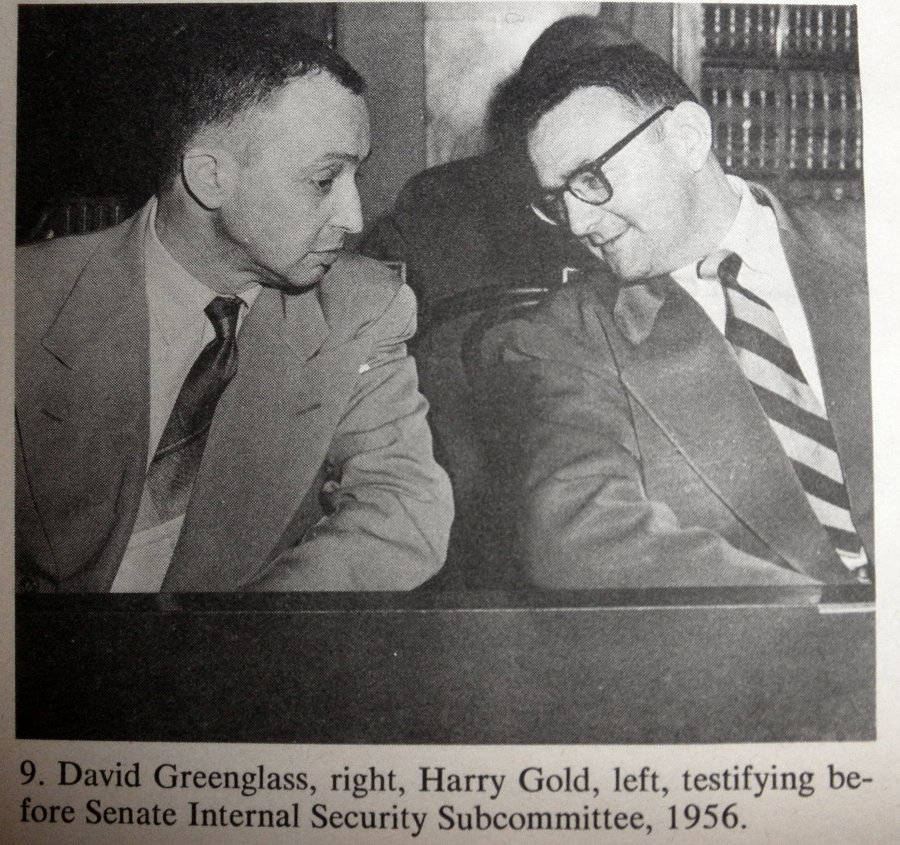
Aside from Fuchs, the other USSR source for information about developments at Los Alamos was David Greenglass, a US Army machinist and brother to Ethyl Rosenberg.  Greenglass had been a Communist his entire adult life and had been separated from an earlier military job because of questions about his loyalty and honesty.

David Greenglass stole the crucial secrets of the lens molds used to detonate the bomb, the implosion device.  By hindsight, it’s clear he did it for money, for the same reasons he stole automobile parts, uranium, anything he could lay hands on to sell on the black market.

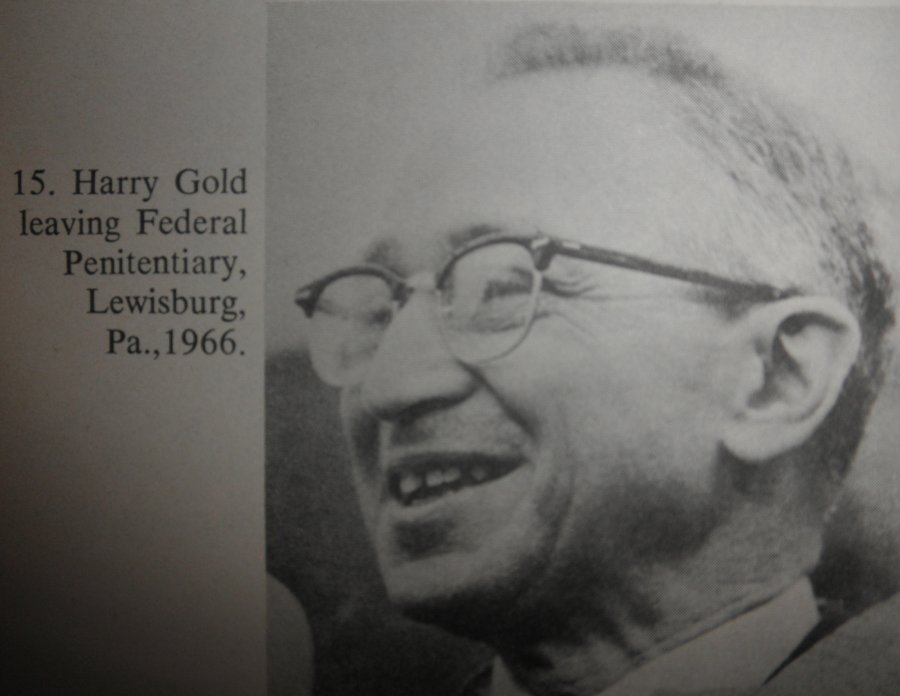
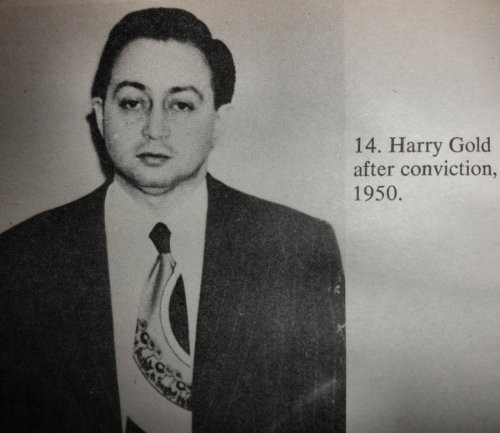
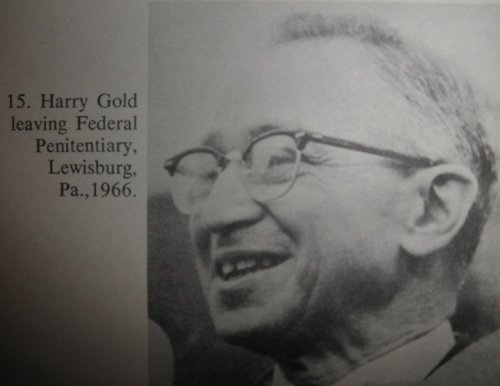
Greenglass passed the secrets to his wife, Ruth, who passed them to Harry Gold.  Gold was the direct connection to the Soviet spymaster, Yakovlev, in the Soviet Embassy.  It’s clear enough from everything provided in evidence and testimony that Gold was a man without loyalty to any nation, ideal, idea, or human being other than himself.  He did it for the money and for no other reason. 
The testimony of Greenglass, awaiting trial for treason, and his wife, Ruth, who  was never charged, provided the testimony connecting Julius and Ethyl Rosenberg to the plot.  The witness stand accusations by Greenglass against his sister and brother-in-law, and the corroborating testimony from his wife, who didn’t yet know whether she’d be charged, constituted almost the only evidence of the prosecution.  The other witnesses directly involved in the plot mostly did not know the Rosenbergs, or barely knew them and knew little of their activities.

Because of the weakness of the government case insofar as testimony and physical evidence of the Rosenberg involvement in actual spy activities, the focus of the prosecution became a trial of Communist ideology.  Witnesses who knew nothing about the plot, the bomb secrets, the Rosenbergs  were called to testify about how they’d switched their own loyalties from Fascism to Communism, then become loyal US citizen-experts making a living selling books and giving lectures on the insidiousness of Communism.
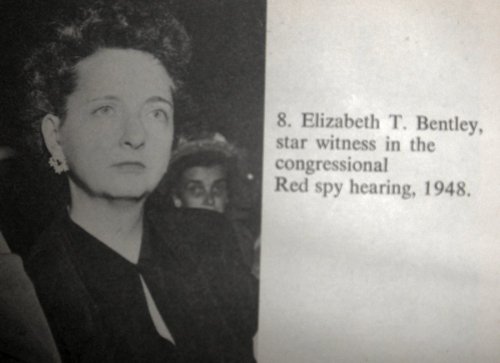
The trial transcripts excerpts Nizer provides make it clear the Defense had two opponents:  the US Attorney prosecutor, and the judge, who constantly intervened, interrupted, interjected in ways clearly intended to prejudice the jury against the defendants.

The key players who gave, or sold the atomic bomb to the USSR in 1945 went free, or were given relatively light sentences.
The Rosenbergs, clearly Communist idealists, possibly part of the plot, died in the electric chair.

When Allied forces found documents in Germany revealing Fuchs as a Soviet spy the chain of resulting indictments followed a path to almost all the conspirators except the Rosenbergs.  Before spymaster Yakovlev fled the US, during his last meeting with Gold, he made the following observations:

Yakovlev:  Don’t you remember anything I tell you?  You’ve been a sitting duck all this time.  We probably are being watched right now.  How we pick such morons I’ll never understand!  We’ve been living in a goldfish bowl because of you.  Idiot!  Idiot! 

I am leaving the country immediately.  I’ll never see you again.  Just go away.  Don’t follow me.

He went.

But the answer to Yakoviev’s question is worth an answer.  They recruited from the US Government, the US military, from US universities, from US businessmen.

From the same pool of applicants who later sold their industries, their industrial tools, secrets, capabilities, economies, and debts to the Peoples Republic of China and other foreign nations.

They weren’t Communists, like the Rosenbergs.  They were opportunists, entrepreneurs, devil-take-the-hindmost politicians, like their descendants a few generations later.

Old Jules

Today on Ask Old Jules:  Value of Animal vs. Human Lives?

Old Jules, does an animal’s life mean as much or nearly as much to you as a human’s, or do you feel animals are insignificant/worthless in comparison? Also, do you believe it is ever morally right to harm/kill animals? What about humans?

Redcoat, by Richard Holmes – Book Review

When an author succeeds in creating a page turner from a segment of history beaten thoroughly to death by a thousand other historians and writers of historical fiction there should be some background music and applause.


Richard Holmes has succeeded. 

Redcoat follows the British soldier through the Seven Year War, the Peninsula War, the wars in the Americas, the wars in India through the Sepoy Mutiny and Afghanistan to the Crimea.    And every page contains some new surprise, some fragment of detail the reader won’t have encountered previously. 

Ever wondered where the idea for Hornblower’s fascination with the Lady Barbara Wellesley most likely originated?  Illustrations:  “Below:  The Marquess of Anglesey was a talented cavalry commander who, when Lord Paget, beat the French at Benavente and Sahagun.  Unfortunately he ran off with Wellington’s sister-in-law and could not be re-employed in the Peninsula.  As Lord Uxbridge he lost a leg at Waterloo.”

Or, page 154, Lt. Arthur Moffat Lang, “Many are given to drink and drunkenness like the Germans.  Foreign wines on account of their being accustomed to beer, does not agree with them, and in hot countries over-seas brings on burning fevers . . .”

Holmes has sifted through the chaff of history to cover the subject thoroughly on the outside in a 427 page epidermis, along with constant peeks at the liver, the bladder, the spleen and the dirt under the fingernails of the British soldier:  A man as limited and flawed as the Brown Bess musket he carried into battle, but one who experienced a surprisingly long series of successes where failure would have been far more appropriate.

‘Christopher Duffy suggests of the eighteenth century that:  “The most pronounced moral traits of the English were violence and patriotism.”‘

If that sounds familiar today it might be worth pondering whether it’s part of the package the 20th Century delivered to your own doorstep. 

Excellent work and a worthy read, Redcoat.

Old Jules

A Side to ‘Freedom’ Worth Considering

Those of us spoiled to a particular concept of freedom and the fear it’s coming unravelled might be well served to read Papillon once in a while.  I didn’t mention it in my review of it here, but I should have:  Papillon.

From one perspective the entire book is about freedom of a sort we, confined to our mental boxes containing what freedom is, refuse to acknowledge exists, can exist, for ourselves and those around us.  It’s the story by Henri Charriere of his own life, searching and occasionally finding that kind of freedom while trapped in an environment few slaves in history could match for savagery endured.  A deliberate, carefully devised savagery imposed by a modern, civilized nation.

A nation, I’ll add, not too unlike our own.

But what I intended to say about Papillon this post is one of the corner-of-the-eye aspects of freedom and Charriere’s finding of it during the most trying of times.  Once when he was in solitary confinement so severe as to be intended to drive him insane, to break him, destroy him.  Another when he was confined to a boat with other escapees mid-ocean.

These shreds of rhetorical freedom we savor can be unravelled like a wool sweater with a touch of pen to paper.  The freedom Charriere describes are immune to confiscation.   But they’re the responsibility of each of us to find within ourselves.  Nobody’s capable of giving them to us by signing a paper.  We can’t win them by force of arms by storming a Bastille, or Winter Palace.

The winds of history are eroding away those easy freedoms written on parchment and signed into some illusion of reality for most of the citizenry.  That’s happening and there aren’t any heroes likely to ride in on white horses, nor White Houses to save them. 

But we don’t have to allow ourselves the anguish of loss.  A piece of each of us lives outside the rules and the rule-makers, the savages, the rapacious Viking kings of government and finance.

Maybe the starting place for finding real freedom requires losing the illusion that Viking kings can give it to us and take it away.

Choose Something Like a Star


 Choose Something Like a Star

by Robert Frost – 1947

O Star (the fairest one in sight),
We grant your loftiness the right
To some obscurity of cloud –
It will not do to say of night,
Since dark is what brings out your light.
Some mystery becomes the proud.
But to be wholly taciturn
In your reserve is not allowed.

Say something to us we can learn
By heart and when alone repeat.
Say something! And it says “I burn.”
But say with what degree of heat.
Talk Fahrenheit, talk Centigrade.
Use language we can comprehend.
Tell us what elements you blend.

It gives us strangely little aid,
But does tell something in the end.
And steadfast as Keats’ Eremite,
Not even stooping from its sphere,
It asks a little of us here.
It asks of us a certain height,
So when at times the mob is swayed
To carry praise or blame too far,
We may choose something like a star
To stay our minds on and be staid.

It isn’t as though you have a more favorable alternative.

Old Jules

Jeanne’s Christmas Gift to Visitors and a Few Non-Gifted Words


Jeanne does Christmas but she has a gift worth giving.  I mostly don’t do Christmas so I tips my hat in gratitude she’s here to give it.

Note from Jeanne: This is one of the largest gel pen drawings I’ve ever made. It’s 24 x 24 inches square. I did that size as an experiment for a contest entry for a casino, but when I didn’t win, I re-worked it quite a lot and decided to show it in other exhibits.  I hope you enjoy looking at it!

Morning Readers,

Hope all of you are getting the cobwebs out of your punkin heads sufficiently to maximize whatever joy a person gets out of sitting around a Christmas tree unwrapping packages.

I overslept here, didn’t wake until dawn.  Maybe some of this Christmas spirit thing rubbed off on me and disrupted my routines.  Nice morning.  Quiet outside, cool, but not a shock to hit you when you climb out from under the covers or hit you in the face when you venture outside.

A red dawn.  Sailorman would be concerned about that, I expect.

Last night the cats refused to keep me entertained, so I began reading H. D. F. Kitto’s, The Greeks.  It’s a book I’ve read before, but I occasionally read it again as a refresher course.  Kitto’s work is a fairly expansive treatise on life in Greece during the Classical Period, but he constantly jumps backward so’s to demonstrate how they got where they were and why.

Those Classical Greeks are worth the effort of remembering about.  They’re as much how we got where we are as Homer, the Dorians, the Minoans are how they came to be what they were.  We owe our ability to think in particularly organized ways to them, mathmatics, philosophy, their practical use of democracy, even our concept of drama to some extent.

But we in the West also owe the curse of the Utopian Ideal to their pointy little heads.

That Utopian Ideal has haunted us every since, even though the Greeks, themselves never actually believed in it.  They knew perfectly well that human beings are fundamentally flawed in ways that assure they’ll poison their own watering holes, then run them dry.  They knew that wherever human weakness fails to do the trick, fate, or the gods will step in to lend a hand.

Those Greeks studied Homer much the way really devout Christians study the Old Testament.  And Homer, whatever else it might be, is a refined catalog of human strengths and weaknesses.  Of the drumbeat repetition of human experience.

In their own way, the Greeks were experts on a few thousand years of history in ways we aren’t.  They learned from it, not as we believe we’ve learned from it, but haven’t, but rather as an assurance that human beings make the same mistakes over and over.  That they’ll go on making them as long as there’s a human being left to do the job.

The Greeks derived a wisdom from their knowledge of history, but the wisdom was an oblique one that provided a separate wisdom….. one that included the certainty there’ll never be any Utopia.  Never be any meek inheriting much of anything and holding onto it.

But that’s my premise, not Kitto’s.

I hope you’ll spend a bit of time remembering what Christmas was supposed to be the anniversary of the beginning of.  Not baby-Jesuses or Santa Clauses, readers, but a beginning of a spiritual commitment to peace, love, understanding.

An ideal for breaking the endless cycle of power struggles, killing, worship of gluttony and greed.  A beginning for human beings to take responsibility for their own behavior, attitudes and lives.

Christmas.  Jesus.  A beginning of not being so frightened of everything.  So angry.  So aggressive and downright rattlesnake ugly mean you want to kill strangers a long way from here who are no threat to you if you’ll leave them alone, and take joy from doing it.

A beginning of having the faith that death is part of human experience, and that isn’t something you have to be so damned cowardly scared of it keeps you furious and wanting to look away at anything at all to take your thoughts away from having to do it.

I hope you’ll remember that for a few moments, readers, but I know you won’t.

I ain’t a Utopian.

Old Jules