Category Archives: Reading

Greg Bear – The Forge of God – Book Review

Greg Bear gave himself a hefty job of work for this 473 page tome.  The subject is the arrival of aliens on the surface of the earth, the gradual discovery of their motive to ‘eat’ the planet, and the reactions of science and politicos as the realization becomes certainty.

In some ways the internal plotting resembles Heinlein’s, The Puppet Masters, in others, Larry Niven’s, Lucifer’s Hammer.  However, if you’re a reader who finds himself studying the characterization as the author develops it, the tool used in furthering the plot, you might find this one a bit annoying.

Although Greg Bear’s handling of the plot requires the introduction of a lot of characters for the reader to attempt to keep track of, he does a fairly craftsman-like job.  He’s obviously aware of the problem and uses a lot of internal plotting to provide the reader with anchors of segment  for each of them to assist.  If he hadn’t been a workmanlike writer he’d never have succeeded as well as he did, which isn’t to say he succeeded completely.  Greg Bear’s skill at characterization kept the work from becoming a complete disaster.

The plot develops rather slowly, and to keep the interest of the reader the author introduces a number of not-often-used event features as crucial pieces of his plot.  This served in my instance to keep me determined to finish the book. 

The concepts Greg Bear introduces are compelling enough to cause me to pause in the reading about 2/3 of the way through to allow some digestion of it all before continuing.  There was no temptation to leave it alone after a day, but I found when I returned I found I already had to reorient myself, reacquaint myself with the individuals connected to names among his multitude of characters, briefly re-study which sub-plot I’d absented myself from when I stopped to contemplate what he was doing.

I believe authors could gain a lot of benefit by carefully studying Bear’s handling of a complex plot broken constantly by updating internal, brief sub-plots, and constant shuffling a population of characters within.  Before reading the book I might have thought it was an impossible task.  After reading it I’d conclude it was merely improbable in a Tolstoyesque sort of way.

I’ve pondered how he might have done it better, considering the task he set for himself, and haven’t thought of any way it could have been done without removing some of the sub-plots, which he’d made essential to the overall plot development.  A trap he’s too competent an author to have caught himself in unaware.

Too busy might be how I’d describe the book, but still compelling enough to cause the reader to work hard to struggle through.  At least some patient readers.

Old Jules

The Joys of Already Knowing

Morning Blogsters:

Around 1969, I was in a freshman Geology course at the University of Texas, first week of classes. The instructor was a grad student teaching assistant who began the course with an overlay of how geologists determine the age of a particular layer of deposition.

Along about the third day a kid who’d been sitting next to me raised his hand. I’d noticed him squirming from the first day, and now he just had to get whatever was bothering him off his chest.

“I’ve been trying to understand what you’re saying, but it’s confusing. How can all this be true, all those depositions being so old when the world’s only (some specified low-range number of thousands) years old. It’s all been calculated when God created the earth.”

After the chaotic eruption of laughter from forty sophisticated freshmen who knew better subsided the instructor directed his response to the now-cringing questioner.

“You can’t have it both ways. This is a Geology course. Everything you hear in this room is based on the premise that the earth is ancient beyond imagination. That the world we see around us is the product of eons of tectonic activity. Of faulting, lifting, erosion, weathering followed by more of the same.

“I’m not going to try to convince you that what you’ve said is wrong. But I’ll tell you that if you can’t accept, for the sake of discussion, the possibility that the book in front of you describes reality, you’ll never get through this course.”

The kid joined me at a table in the Union coffee shop later. He was still upset and confused by the incident, the laughter. Turned out the kid truly couldn’t wrap his mind around the concepts being discussed. He KNEW it to be otherwise at such a fundamental level that he’d have had to relax all manner of other things he KNEW and held sacred to even consider it.

So he dropped the course and never let his mind out of the cage he’d built around it.

The experience that kid had in a geology classroom isn’t too different from what all of us encounter in life. It’s all a matter of where we place the boundaries of the cage.

Within a decade of the incident the geology world was turned upside down with emergence of tectonic plate theory, and much of what he’d have learned if he’d finished the course would have been out of date.

But Tectonic Plate Theory found similar boundaries among geologists’ minds during the difficult battle for acceptance. Old department heads wrestled against it in a war as bloody as a fundamentalist preacher would have fought against the concept of an earth more than a couple of thousand years old. They’d just placed the boundaries a bit further out than the kid and whatever school teacher told him the world was young. Those old geology profs KNEW there was no such animal as continental drift. No point in discussing evidence supporting it.

It’s a juggling act. In some pursuits the only doorway involves a body
of data we like to call ‘facts’. But frequently the doorway isn’t big
enough to allow a person through with his suitcase full of all his
life-accumulated facts he treasures. He has to pare them down to fit
into a briefcase, or a fanny-pack and leave the rest behind so’s to get
through the door and understand what he sees in the room he’s trying to
get into. If he tries tricking the system and dragging all the rest of
his facts through in a cotton-sack or some such thing he’ll be forever
tripping on them and stumbling.

A man’s got to be careful what he knows in this lifetime [maybe others,
also]. Traveling light can save a lot of trouble.

Old Jules

3.5* ’til Infinity   * = Billion years ago.

Food, Books and Other town stuff

FOOD:  There’s an all-you-can-eat pizza joint where you get all the salad you want, a drink and a selection of all kinds of pizza slices as many times as you go back for them and as many kinds as you want for $5.00.  You wouldn’t believe how much salad and pizza a person can eat in an hour-or-so.

Only trouble is I always feel sort of bloated and sometimes have stomach cramps after I eat there.  Maybe it’s something in the food.

Thrift Store 25 cent books acquired:

A Canticle for Leibowitz – Walter M. Miller:  Good SF I read every 10 years or so.

Rebel – Bernard Cornwell – I like Cornwell fairly well but I haven’t read this one.  Civil War historical fiction

Quick Silver – Clark Howard – Never heard of the author.  Taking potluck on this one.

Double Jeopardy – Colin Forbes –  Another potluck.  Never heard of the author.

The Heart of the Matter – Graham Greene – I might have read this one sometime.  But the only Graham Greene I’ve ever not liked was Brighton Rock, required reading in some English course.

The Name of the Rose – Umberto Eco –  Time I read this one again. 

High Sorcery – Andre Norton – I might have read it 40 years ago.  Usually liked Andre Norton.

Fuzz – Ed McBain – Potluck.  Never heard of him.  Looks like an extortion, cops and robbers yarn.

The Third Man – Graham Greene – Once more before I die.

Hobbit and others – JRR Tolkien – Hell, for .25 why not one more time?

Foucault’s Pendulum – Umberto Eco – I dunno if I can do this one again.  I ain’t as young as I used to be.

The Blue Hammer – Ross Macdonald – I read all these 30 years ago, loved them but ran spang out.  Nice finding this one.

The Forge of God – Greg Bear – Never heard of him.  Appears to be SF.

Flashman at the Charge – George Mcdonald Frazer – Sheeze.  I love finding these.  I must have read the entire Flashman series a dozen times over the decades.  They never grow old.

Old Jules

—————————

Long Day Journey Into an Ant Bed

I should have known this was coming yesterday when I took a nap and kept noticing a few things crawling on me occasionally.  But I was preoccupied with musing about other goings on. 

Then last night I went in there to rest a few minutes and conked out, only to be awakened around midnight-thirty with a lot of things crawling on me.  Pretty much all at once, doing a little stinging here and there.

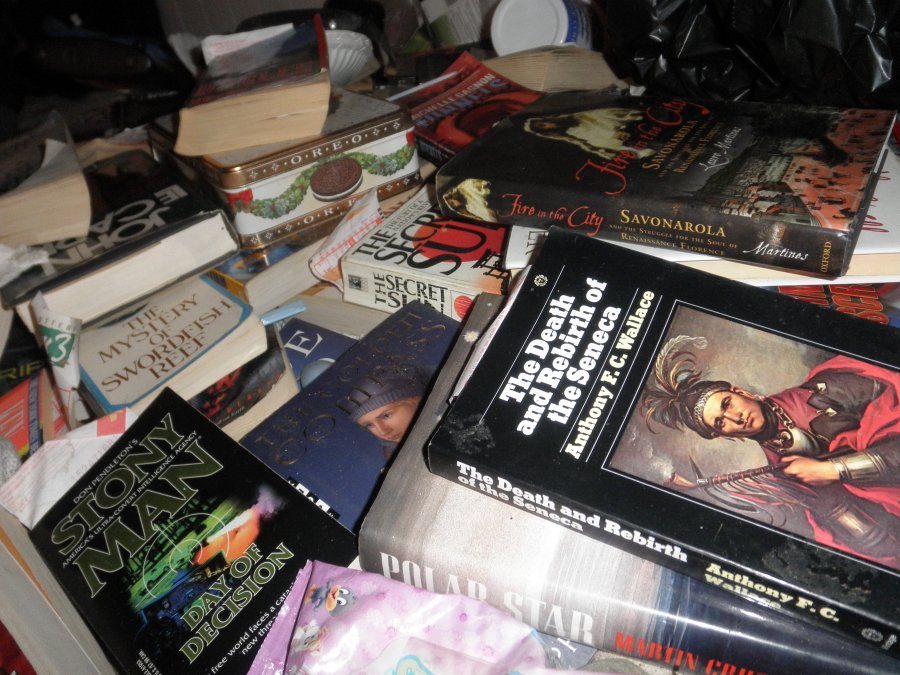
That half of the bed is taken up by upwards of a hundred books, some read already, some partway through the experience of being read, some waiting to be read, some held for re-reading.    They’re usually not enough of a problem to outweigh the advantage of having a book near at hand when I need something to read.  But when I turned the light on, here’s what I saw last night:

It’s not the first time that’s happened and I could have prevented further invasion if I’d been paying closer attention.  I keep a container of boric acid powder nearby and usually try to do a pre-emptive strike on them on a fairly regular basis.  But it requires taking the layers upon layers of books off and squirting the boric acid powder all over the underlying bed surface.

This, I’m reluctant to do, because everything gets disorganized and I lose track of which things have already been read, which are waiting to be read, which are occupied holding something else up, and generally where things are.

So they sneaked up on me.  I had to do it in the middle of the night with no pre-planning, no organization at all.

Sheeze.  Now it’s chaos in there.

————————————–

9:30 AM edit:

Heck, I might as well add this since I’ve got them there together now.  Here are a couple of authors I’ve come across lately I’ve enjoyed a lot.

They’re thrift store books, so I’m not certain you could find them easily, but both authors have an interesting approach, plotting is tight, characterization’s good, and they hold the attention well. 

Upfield writes about an aboriginal who’s an Australian police homicide detective and his mystery solvings, along with his ethnic difficulties trying to do his job in that setting, along with his internal struggles demanding he go back to being a bushman.  Good reads.

Alexander’s a completely different bag of tricks.  He’s created a blind brother to Henry Fielding, author of Tom Jones, who’s a magistrate-cum-detective in London.  His characters include Dr. Johnson, whores, a pirate, poets, actors, and all manner of peasantry.  The narrator is actually a ‘Boswell’ sort relating the activities and events, a young teenager taken off the streets.

I don’t have enough distance from the Alexander books yet to decide whether it’s his unique and innovative setting, plotting and characterization intrigues me so much about him, or whether he’s also a damned good author.

Old Jules

11:20 AM edit:

Heck, I might as well add these since everything’s screwed up in there anyway:

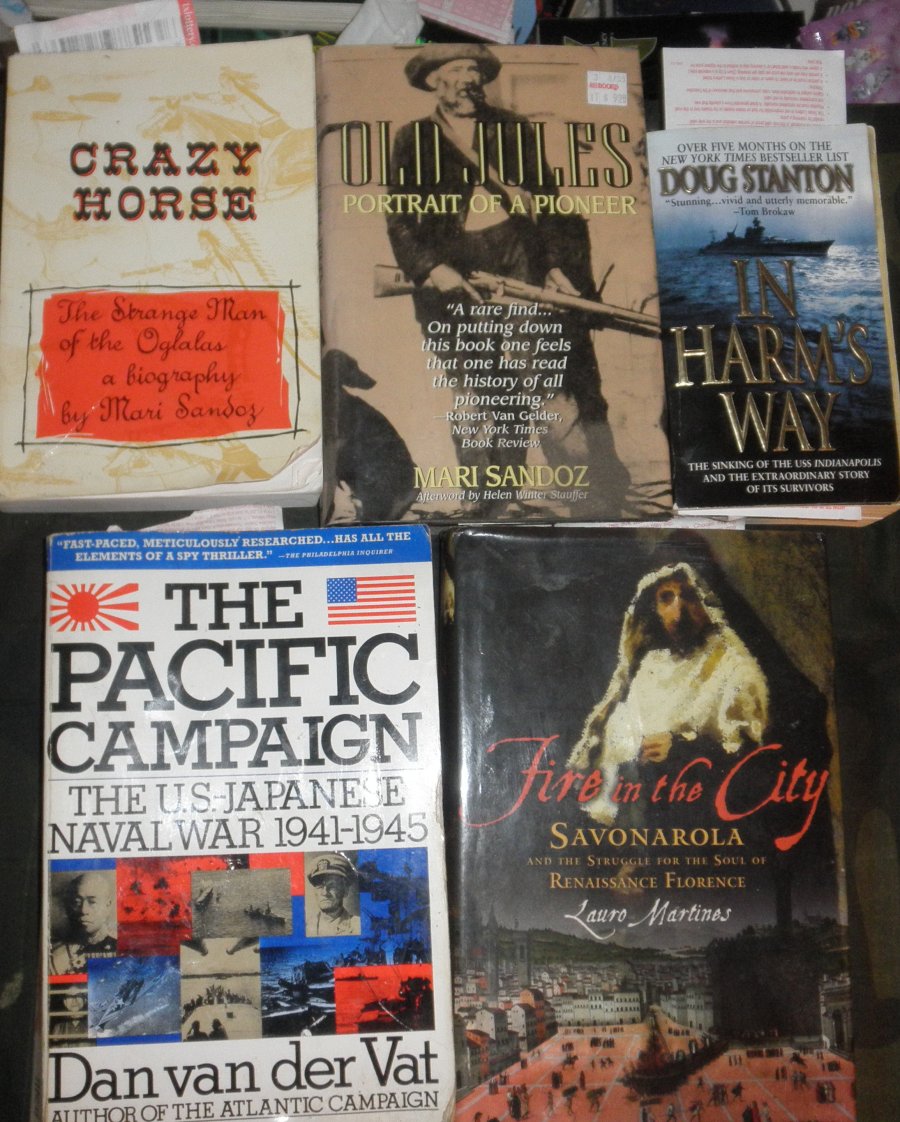
Mari Sandoz – Crazy Horse, and Old Jules.  Mari’s my daughter in a previous lifetime.  Her biography of Crazy Horse is better than a lot of others about him.  Her biography of me during that lifetime is as good as you’d expect from a daughter.

Doug Stanton, In Harm’s Way is the hair-raising account of the sinking of the USS Indianapolis during the last days of WWII, and the ordeals of the survivors in shark infested waters off the coast of Japan.

Dan van der Vat, The Pacific Campaign is nothing to write home about. Of the thousand-or-so books following the steps, events, tactics and strategies of the Pacific War this one ranks in the bottom third,in my estimation.

Lauro Martines, Fire in the City, is a narrative of the strange and
surprising emergence of Friar Girolamo Savonarola in Rennaisance Florence.  So little attention has been paid this fascinating man and time it’s worth the read even if you aren’t crazy about Martines’s particular style of writing and his method of organizing his material.

Fifteen Flags – Ric Hardman

A Chief-Executive War Half-Century Before Vietnam

[They didn’t come back even when it was over, over there]

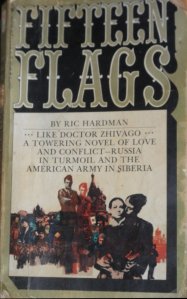
Sometimes we get lucky and a fiction work sets us off on a journey of discovery.  For me, this was such a work.  Fifteen Flags was a launchpad.

One of the defining events of the 20th Century was the Russian Revolution.  The International response, both in diplomacy and military intervention set the tone for the next seven decades of Soviet interactions with Europe and the US, and to a lesser degree, Japan.

I’d done a lot of reading years ago about the US troop involvement at the time of the Russo-Japanese War and  had a vague background of reading about the International forces guarding the railroads while the White Russians fought the Trotsky forces.  I even knew US forces were involved.

But what Ric Hardman managed to do with this tome was to broaden the scope of what happened there in my own perception enough to cause me to want to know more.  Hardman’s characters, whether they’re US troops, Japanese cooperating in the International venture to guard the railways, Chinese, Czech, or German POWs trying to survive being prisoners awaiting release in a time of military chaos and famine:  “Life is cheap.”

If I had to make a one sentence summary of this book, this set of events, this episode in world history I suppose no better words exist.

WWI — Russia

http://www.marxists.org/glossary/events/w/ww1/russia.htm

Allied intervention in the Russian Civil War

http://en.wikipedia.org/wiki/Allied_intervention_in_the_Russian_Civil_War

Polar Bear Expedition

http://en.wikipedia.org/wiki/Polar_Bear_Expedition

American Expeditionary Force Siberia

http://en.wikipedia.org/wiki/American_Expeditionary_Force_Siberia

——————————————–

Book Reviews:
Do you enjoy reading reviews of books as a part of planning what you’d like to read?  Jeanne, the lady who administers this blog, is a library employee  in KS, and tells me about books, sometimes calls me when she’s picking through boxes of books in an auction parking lot waiting to be hauled to the dump after an auction, to find out if I’d like to own them.

But Jeanne also put me on to this newsletter library people evidently read:

Shelf Awareness
http://www.shelf-awareness.com/readers-issue.html

Full of reviews of books soon to be published.

———————————————-

How to sell your war to the cannon fodder:

Cagney/Cohan, “Over There”, from Yankee Doodle Dandy [WWI] (1942)
http://youtu.be/d-z98aBCe8E

Did You Ever Fake Reading a Book?

The e-newsletter  Shelf Awareness  occasionally includes author interviews where a standard question is “What book have you faked reading?”   This brought to mind something I can tell  now because I don’t think they can take my high school diploma back from me.

When we students who began school in the first half of the 20th Century in Portales, New Mexico entered Junior High in 1957, they explained a lot of what we had to get done during the next few years if we wanted to graduate from high school. If those years passed and we hadn’t done each thing on the list we’d be pumping gas the remainder of our lives.

Among the various academic requirements was Major Book Report every year. I didn’t see this as a problem up front. I was a heavy reader and couldn’t imagine a deadline arriving on that one without me nailing it in plenty of time.

But somehow the 8th or 9th grade came along and spang, there I was, with Mrs. Wilbanks standing before the class announcing day-after-tomorrow our big book reports were due. Suddenly I was in a panic. I’d read plenty of books, but none that came to mind as qualifying for a big book report. Those normally had to be cleared with the teacher ahead of time, which somehow slipped by me for one reason or another.

I don’t know what made me decide to invent a book that didn’t exist.  It seems insane all these decades later.  But I suppose  I concluded I just hadn’t read any Big Books after I went to the library and saw the lists of the ones other kids had been thumbing through and dogearing.

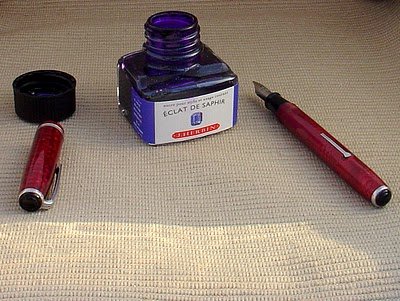
But I got out my Esterbrook fountain pen with the turquoise ink and set to work inventing a Big Book I’d read.  “Chessman”, by Borden Deal .  It was a good book and I regret Borden Deal never wrote it.  I turned in the book report on time and sighed thinking I’d cheated death one more time.

A few days later Mrs. Wilbanks brought the graded book reports in and prepared to pass them back, but she cautioned us to just look at the grades and corrections, then hand them back in.  They’d go into our permanent files with our other Big Book Reports until we graduated High School.

Then she pulled out a book report from the stack I could recognize from my desk near the back of the room.  Sloppy, turquoise handwriting on yellow paper.

I don’t give A+ on Big Book Rep0rts, but I’ve made an exception this time.”  She lighted up the room with her smile and gestured toward me with it while I sank into my seat.  “I believe this might be the best Big Book Report ever written by one of my students.”

Knowing that book report was up there hanging over my head as evidence bothered me a lot.  When I left Portales and headed for another school my 11th year, I hoped they’d let me carry my records so I could snag it, but it wasn’t to be.  Next year I changed schools again and again didn’t get an opportunity to steal it back.

Not until I graduated in 1961 did I again get my hands on my Big Book Report on “Chessman”, by Borden Deal.  I packed it away with all my other important papers and kept it until Y2K, when it went into the fire after one last read.

If you haven’t read the book I recommend you write it.  It’s a winner.

Old Jules


The Coasters – Charlie Brown
http://youtu.be/dS9sOCRH3MU

Papillon


Hi blogsters:

A couple of days ago I came across a tattered copy of Henri Charrierè’s, Papillon on the bookshelf.   I’d read it many times over the decades, but there’s always one more read left in it, it seems.  This might be the last.

Charrierè’s autobiography always has something new to tell me, depending on where my life is when I re-read it.

Papillon (Charrierè) was transported to the French prison islands of Guinea in the Caribbean in 1931, where thousands of prisoners were kept out of sight and mind of the French citizenry.  Devil’s Island was the most well known, but it was only one of the camps where 80 percent of the prisoners died before serving out their sentences.

The book is a story of courage, determination, brutality, as Papillon goes through a series of escape attempts, dungeons, unthinkable tortures, solitary confinements at a time in history when the ‘civilized world’ was no more civilized than it was before, or since.  Eventually, he escaped and became a worthy citizen of Venezuela from 1945 until he wrote the book in 1967.

In some ways the writing and the stories both remind me of the fiction works of Gabriel Garcia Marquez.

Strange how some nationalities get all the credit, while others manage to escape notice.  The Spaniards and Portuguese take their battering from the waning memories of the Inquisition.  The Russians from the Gulag camps.  The Chinese from the Great Cultural Revolution.  The Belgians from the terrors they poured onto the Congo.  The Cambodians, the Ethiopians and the Germans have all been held up to the light and examined with appropriate repudiation.

Somehow the Brits and the French just managed to escape notice when the recognition for some of the vilest institutionally sanctioned acts of human brutality in modern human history.

Papillon.  A book worth reading and thinking about by all you ‘jail’em-til-they-rot’ enthusiasts.

We haven’t caught up to the French, Brits, Spaniards, Cambodians, Chinese, Russians, Belgians, Germans, and other civilized nations yet.  But we have the ingredients.

Plenty of prisoners and prisons.  A freedom-loving population of the same kind of jurors, courts, prosecutors who sent Papillon and thousands of others off to a life and deaths they’d never tolerate for any cute animal that appeared in a Walt Disney film named Bambi.

Old Jules

Papillon Trailer
http://www.youtube.com/watch?v=DARD1l-tr6g

Papillon(1973) – Theme from Papillon
http://www.youtube.com/watch?v=gNp_3dpiTno&feature=related


Internet Wisdom

I spent a while this morning visiting various blogs, groups and reading blasts.  Stayed mostly away from the news feeds, however.

But I came away renewed, refreshed and relaxed from all the exercise dodging ricochets of wisdom, originality and profundity.

  • Found out Love’s a big deal however it happens to be packaged, especially if it’s universal and unconditional (not making any demands), and I was appropriately edified with the knowing of it.
  • Found out pets are cute and smart, which I hadn’t noticed before,
  • Found out wild animals wouldn’t hurt a flea, mostly, unless it’s the fault of some human,
  • Found out humans mostly wouldn’t hurt a flea if they’re properly loved,
  • Found out millions of chickens spending their lives in lines of 3′ wire cubes a mile long and three deep from egg to hatchet were capable of being subjected to some irony  called legal cruelty if they died prematurely by some other than the normal method,
  • Discovered there’s an amazing breadth of conflicting, mutually exclusive truths floating around,
  • Discovered the wisest folk on the planet and those most prone to pass one-sentence fragments of that wisdom along to others are those who wish they’d been born with a Tribal Census Number of one sort or another, but who almost certainly weren’t (though they, followed by I, would be the last to say so).  The good news is there are plenty more of the same tribe willing to shoot it back at them.

I suppose I’ve almost exhausted that source of wisdom for the moment.  Thinking next I’m going to study the labels on food cans.

Old Jules

http://www.pcworld.com/article/137100/the_10_funniest_sites_on_the_internet.html

8:00 AM afterthought

I probably should have mentioned something else I’m noticing and find a lot more humorous than any of the above:

The emergence of the “I fought in [name a war the US indulged in during the past half century] syndrome.  Most don’t come right out and say so, but the great majority attempt to convey a distinct impression they were infantry point men, or at least out where the bullets were flying.  And it was tough.   The PX, pizzas and whores were all off somewhere different than where they were.  Tough and scary with all those meanies trying to get through the wire every night and them laying ambushes on the jungle trails, crawling in tunnels full of snakes and little brown brothers with hand grenades.  Unspoken implications they weren’t among the 150/1 REMF [rear-echelon MFs] in Vietnam, not among the 500/1 in everything since.

Naturally all this gets followed by a lot of fawning modern day patriots thanking them for protecting all this freedom we now enjoy, frowning about how little thanks and respect vets get for being vets.

If you hold your mouth right you can get a smile out of this phenomenon.  Twist it around a little further and you can even squeeze out a laugh.

REMFs circa 1963

[Edit:  Sheeze.  Just got an email from someone thought I was saying I was a Vietnam Vet.  I’m not.  This pic is Korea, 1963.  Nobody ever heard of Vietnam yet.  That 1st Cav patch – in those days was “The horse we never rode, the line we never crossed and the yellow is the reason why”]

I took the picture but I’ve since then metamorphosed into a point-man with a nasty scowl figuring on getting a Veteran bumper sticker and some thanks for all I must have sacrificed so you modern patriots could stay free, etc etc etc etc etc.

Sometimes I think we old people really are as pathetic as young people believe we are.

10:00 AM afterthought

If lip-service croc-tears patriots actually wanted to say thanks to someone who made a sacrifice they’d pay a visit now and then to a long-term care VA hospital instead of displaying “Support Our Troops” stickers and sloganizing a lot of easy, empty rhetorical cliché.  The wheel chair population wasting away forgotten in those hospitals sacrificed something they wanted to keep, even though they probably never believed they did it to protect the freedom of anyone else.

Likely it gets lonesome in there being a has-been swept off into a corner so’s they don’t distract from the enthusiasm for the ones haven’t done their unintentional sacrificing yet.  Paying them an occasional visit, taking them a pecan pie, sitting around exchanging lies about wars we fought would get a lot nearer to sincerity than a thousand flags and bumper stickers.

And those guys would welcome it, though they’d have every right to be suspicious and wonder whether the world’s coming to an end.

A Question for the Brave New World


When I went back to my hometown as a young soldier on leave, Christmas, 1961, it was enough of an event to bring my granddad in from his hardscrabble farm.

We sat around the living room, my mom and step-dad, sisters, and granddad, mulling over the war we were certain to have with the Soviet Union soon.

At that point I was as well-educated (by usual standards) as any of the people in the room and all our ancestors by virtue of having completed high school prior to entering the Army.

In talking about the (then current) brink-of-war crisis my granddad muttered something in Latin.  My mother and step-dad cocked an ear.

“Cicero’s probably not the best place to gain any wisdom about America today,”  My step-dad frowned and adjusted his dentures, followed by another Latin quote.

“Neither is Pliny.”  My mom shook her head at both of them.

Young man who knew everything worth knowing, I was.

I didn’t know any Latin, didn’t know who Pliny was, nor Cicero.  I was as ‘well educated’ as anyone in the room and considered my knowledge sufficient to have a wealth of valuable opinion on the issues of the day.  I felt a vague discomfort with them spouting Latin back and forth at one another and naming people I knew nothing about.

I had reason to recall that conversation in 1976, the US Bicentennial year, when the state of America and the state of education was being examined and bandied about.  Thoughtful minds were concerning themselves that Americans were becoming illiterate and ill-educated.

The thinkers of 1976, asked Americans to ask themselves whether they were better educated than their parents and grandparents, despite many more years spent in formal educational institutions.

The general answer in polls was that Americans considered themselves more canny, better informed than their parents, though weaker in most areas of knowledge once considered essential for a person to be ‘educated’.

The moving finger writes and then moves on.

Are you better educated than your parents and grandparents?

Better educated?
Less well-educated?
Know more about everything but less well-educated?
Less well-educated, less well-informed than parents?
Smarter and with more common-sense without Latin, history, philosophy, and other useless studies?

Sam Cooke- Wonderful World