Category Archives: 1960’s

21st Century King-Election Weenies Got Nothing on 1968

No way you could manage it.

The Vietnam War raging in a daily bodycount to see if we were winning right now; half- the cities in the US on fire with race riots.  Decision time for America:

So the Democrats ran Humphrey Dumprey, pledged to keep the War going, continue with LBJ strategy counting bodies.

The Republicans ran Tricky Dicky Nixon, pledged to get us out of Vietnam, but only with ‘honor‘.  [Same as he ran on four years later.]

And on a third party campaign, pro-segregation, former Alabama Governor George Wallace ran to ‘Take Back America’.  And get out of Vietnam in 90 days if it couldn’t be won.  And he carried five Southern states.  I’ll leave it to your imagination identifying ‘take it back from whom’.

Hell, Humphrey Dumprey only carried eight states that election.

So the outcome was we got peace with honor for four years with Tricky Dixon and the war killing them off like flies, counting bodies.  Dixon elected again, four years later and everyone in sight fleeing Vietnam hanging from helicopters off the top of the US embassy in Saigon. 

But honorably.

I think I voted in the 1968 King Election, but my mind won’t allow me to examine the memory in enough detail to recall whom I voted for.  Seems clear to me today I should have just given it a miss.  I think I’d remember that.

One of my favorite Playboy limericks of the time:

There was a young man named Hollis
Used snakes and snails for his solace
The offspring had scales
And prehensile tails
And voted for Governor Wallace.

Wish I’d written that.

Yeah, we were weenies in those days, but REAL MEN weenies.  We knew how to do it up right.

Old Jules

Beating Dead Horses – Lynching Poor Old Ayn Rand Again

Good morning readers.  Thanks for coming by for a read this morning.

I gather from the email forwards that someone’s not satisfied Ayn Rand has been accepted as pathetic enough, wrong enough, dead enough to be left alone.  Subject lines by non-psychiatrists, non-psychologists are taking the trouble to declare her a lunatic.

Poor, sad, bitter woman trapped inside a self yearning for men to be hairier chested, more muscled-up, more knock-em-around, slap-em-down and screw ’em.  More like the good old days, taking what they want from anyone too weak to keep them from it.

I wonder why they don’t just leave her the hell alone.  The 20th Century had no shortage of miserable, confused people, plenty of them writers, submerged in bitterness and misplaced notions of how it could be better.

In some ways every time Ayn Rand and her wishes come up I find myself thinking of Sylvia Plath, similar in so many ways, but with a different slant on the sort of man Rand longed for:

Daddy   
by Sylvia Plath 

 
You do not do, you do not do
Any more, black shoe
In which I have lived like a foot
For thirty years, poor and white,
Barely daring to breathe or Achoo.

Daddy, I have had to kill you.
You died before I had time–
Marble-heavy, a bag full of God,
Ghastly statue with one gray toe
Big as a Frisco seal

And a head in the freakish Atlantic
Where it pours bean green over blue
In the waters off beautiful Nauset.
I used to pray to recover you.
Ach, du.

In the German tongue, in the Polish town
Scraped flat by the roller
Of wars, wars, wars.
But the name of the town is common.
My Polack friend

Says there are a dozen or two.
So I never could tell where you
Put your foot, your root,
I never could talk to you.
The tongue stuck in my jaw.

It stuck in a barb wire snare.
Ich, ich, ich, ich,
I could hardly speak.
I thought every German was you.
And the language obscene

An engine, an engine
Chuffing me off like a Jew.
A Jew to Dachau, Auschwitz, Belsen.
I began to talk like a Jew.
I think I may well be a Jew.

The snows of the Tyrol, the clear beer of Vienna
Are not very pure or true.
With my gipsy ancestress and my weird luck
And my Taroc pack and my Taroc pack
I may be a bit of a Jew.

I have always been scared of you,
With your Luftwaffe, your gobbledygoo.
And your neat mustache
And your Aryan eye, bright blue.
Panzer-man, panzer-man, O You–

Not God but a swastika
So black no sky could squeak through.
Every woman adores a Fascist,
The boot in the face, the brute
Brute heart of a brute like you.

You stand at the blackboard, daddy,
In the picture I have of you,
A cleft in your chin instead of your foot
But no less a devil for that, no not
Any less the black man who

Bit my pretty red heart in two.
I was ten when they buried you.
At twenty I tried to die
And get back, back, back to you.
I thought even the bones would do.

But they pulled me out of the sack,
And they stuck me together with glue.
And then I knew what to do.
I made a model of you,
A man in black with a Meinkampf look

And a love of the rack and the screw.
And I said I do, I do.
So daddy, I’m finally through.
The black telephone’s off at the root,
The voices just can’t worm through.

If I’ve killed one man, I’ve killed two–
The vampire who said he was you
And drank my blood for a year,
Seven years, if you want to know.
Daddy, you can lie back now.

There’s a stake in your fat black heart
And the villagers never liked you.
They are dancing and stamping on you.
They always knew it was you.
Daddy, daddy, you bastard, I’m through.
12 October 1962
 

But nobody ever bothers dragging Plath up out of the grave and horsewhipping her.  What the hell.

Old Jules

Portales, New Mexico’s Multi-Phased Personality Test

I found out the other day there’s another occasional reader here shared classrooms and the seven-year drought with me in the 1950s.  Surprising, the people of that town and that vintage clicking to remember.

Every kid in Portales, New Mexico, believed Gene Brown and Bobby Thomas were lower trash than they, themselves were.  Including me.  I can’t recall now why they believed it, though both started smoking before they learned to masturbate, most likely.

But maybe the fact both kids were considered such lowlifes explained the reason I ran around with them a while, caught those freight trains to Clovis with them.  [Riding the Rap]. 

Bobby Thomas quit school, lied about his age and joined the army when we were 9th graders.  The next time I saw him he was a different person from the buzzard-necked, shunned youngster he’d been.  I’ve often thought quitting school, for him, must have been a cheap price to pay for an opportunity to be out from under the pall of scorn the town piled on him for being whatever they thought he was.

Gene Brown, on the other hand, was still vilified as one of the historical lowlifes 30 years later when I went back for a visit.  Never saw him, but I was surely impressed with how the sign the town stamped on his back stayed through the decades.  Likely he came by it honestly.  Certainly early.

On the other hand, a lot of the higher society folk who shunned those two managed to make lousy enough choices in life to earn their later reputations as lowlifes.   And some of the kicked around, not-quite lowlifes did impressive, though maybe meaningless things with their lives.

My old friend, Fred Stevens, who spent early years as a hotshot savings and loan president, went down with the ship in the mid-80s crash, was as solid a citizen as I’ve ever known.  But he assured me I’d have thought differently if I’d known him as an S&L president.

I’m sorry I didn’t get up to Seattle for a chance to reacquaint myself with the other banker from our kidship, but after he’d chosen to live under a bridge instead of running a financial institution.  [Could you choose to live on the street?]

But I think the one I’d like most to know before I die is the one walked around the corner from a class reunion at the Cal Boykin Hotel in the early 1990s.  Reunion for the grad classes 1960-1970.  Fred Stevens told me about it.  One of the attendees walked into a bank branch a block from the Cal Boykin Hotel and stuck it up.  Walked clean away with $1500 and a well-deserved place in local legend.

I hope he’s remembered.  Wish I’d thought of it and had the brass to do it.

Old Jules

The Limerick Masters of Yesteryear – The Lost Artform

By the time I arrived at adulthood the state of the limerick as a masterpiece of the literary foil was in alarming decline.  Playboy Magazine attempted to inject new life into the medium during the 1960s and 1970s by paying $500 for limerick submissions accepted for publication.  The selection process was tough and they accepted only true masterpieces.

During those years I submitted no fewer than ten [10] limericks per month and never had one accepted.  Hundreds of limericks.  There was no place in Playboy for second-rate hacks.

While the artform requires a particular meter, the truly well-constructed one needs more.  Internal rhyming.  Puns.  Lilting beat to simulate waves on a beach.  A joy to the tongue and ear. 

To illustrate my point, here is perhaps the best limerick ever written, once published in Playboy:

The new cineramic emporium
Is not just a super-sensorium
But a highly effectual
Heterosexual
Mutual masterbatorium.

Every time I run those timeless words through my mind, I’m humbled.

I don’t know whether the image at the top of the page depicts a man who once wrote limericks and submitted them to Playboy.  He almost certainly could have.  Possibly should have.

He might have been a contender.

Old Jules

From The Mixed-Up Files of Mrs Basil E Frankweiler – Book Review

Hi readers.  I don’t know whether I’ve ever mentioned on this blog that I’m a big admirer of a lot of young adult fiction writers.  Mainly Newbery Award folk because I wouldn’t take a chance on anything else that didn’t come highly recommended.  So, when I found From The Mixed-Up Files of Mrs Basil E Frankweiler, by EL Konigsberg in a 10 cent basket at the dogpound thrift store in Kerrville, I snagged it.  Same as I’d have done with any Newbery.

I’m glad I did.  Fact is, while I haven’t encountered many books with that award I considered unworthy of the time spent reading them, occasionally I have.  But this one’s from back when writers were writers and readers were glad they were.

The basic plot’s just a brother and sister who decide to run away from home.  But beyond that summary it becomes a reading experience, as opposed to the alternatives too frequently provided in best selling books.

The kids each have talents, each balancing the weaknesses of the other, each recognizing that fact, and the entire plot and characterization orbits it, relies on it.  The brother’s the financial side of things.  The sister’s a planner.

So she plans where two youngers could probably really have gotten by with hiding in 1967 for a couple of weeks without being discovered, without getting bored.  And the brother provides the funds needed to get there with his winnings from cheating at cards on the school bus.

What’s not to like?  Hell, nothing’s not to like.  It’s a fast read, so it leaves the reader with plenty of time to read it twice, which he’ll want to do if he’s an admirer of good, serious wordsmithing manifested in plots, characters and fast moving events.

They hide in the Metropolitan Museum, evade guards, study a sculpting by a master, discovering secrets about it,  and bathe in the fountain at night fishing for coins.

Great read if you aren’t a snob who only reads really good Stevie Ray King, Norbert Robbers and Louis L’Amour.

Old Jules

Keeping Out the Riff-Raff

Good morning readers.  Thanks for coming by for a read this morning.

It’s been a longish while since I was in jail.  If memory serves me right it would have been late 1965, early 1966.  I was working for Southern Pacific Railroad in Port Lavaca, Texas.   It was payday night and I had $400 smackers cash in my pocket.

Another SP employ, Leonard, and I were out at the better of the drinking establishments in town, scoping out the ladies and being cool in our sports jackets, ties and dance-me-to-the-moon shoes.  We were the only customers dressed so spiffy, but we didn’t care.

The time was close on midnight and the bartender lady called last call.  Leonard and I were leaning on the bar, talking to a couple of late-night ladies and he signaled the bartender.  “What’s in that weird bottle bottle there?”  Pointed to one in a row of bottles behind the bar.

What are you?  LCB? [Texas Liquer Control Board]” 

I thought she was joking and I’d had just enough to drink to think I was funny.  “I’m not, but HE is,” pointing to Leonard.  “Better look out.  He just shut down the Beachcomber, across the street.”

Red Sails in the Sunset was playing on the jukebox and I led the lady beside me to the dance floor.  But it was close to closing and midway through the dance she said she wanted to go to the ladies room.  I walked her down stairs and visited the Men facility. 

As I came back out, Leonard was on the stairs, grabbed my arm.  “They think we’re LCB!  They called the cops.  We need to get out of here!”

I’ve still got half a drink up there and we need to settle our tabs.”  So we headed back up, opened the door to a place full of Port Lavaca’s finest.  “That’s him!”  Bartender lady points at me.  “He said they were LCB!”

I just calmly smiled at the Chief of Police, explained what had happened.  He wasn’t amused.  Had Leonard and me empty our pockets, counted our cash, looked at our Southern Pacific IDs.  Turned to another cop, “I want to know who these guys are, where they come from, why they’re here!”

Turned back to us.  “Pay what you owe here.  We’re taking you in.  We get all kinds of riff-raff coming into town making trouble.  We don’t put up with it.  You got me out of bed.”

So, we suddenly owed $50 each on our bar tabs, because the bartender knew a good thing when she saw it.  And the cops hauled us off to the copshop, two different cars, three cops per car.  Before they locked us up for the night the Chief explained we’d be charged with impersonating police officers.  Said we’d be spending six months in prison.

But next morning he was benevolent.  Said if we’d plead guilty to Drunk and Disorderly and pay the fines, he’d turn us loose.

Which we both finally decided was the least of the potentially bad things to grow out of all this.  My guess is that if we hadn’t one of us might have been the male lead in Cool Hand Luke instead of Steve McQueen. 

I don’t care if it rains or freezes.

Old Jules


Khe Sanh – Two Worthy Reads – Book Reviews

The Hill Fights – The First Battle of Khe Sanh, Edward F. Murphy

Considering he also authored Semper Fi, – Vietnam, and is/was probably a fairly gung-ho man, Murphy does a surprisingly workmanlike job depicting what actually led up to the Khe Sanh bloodbath, why became a bloodbath, and where the responsibility for it having become a bloodbath clearly rested.  All without pointing fingers of blame.  He just describes events as reported by the people involved in them.  For instance:

“Fourteen of the eighteen patrols Wilder sent out early in July found NVA, several within mere minutes of being inserted into their patrol areas.  He learned from other intelligence sources that the North Vietnamese 324B Division had moved south of the Ben Hai River with the mission of conquering Qang Tri Province.  When Wilder dutifully reported this to higher headquarters, he unwittingly stepped into the fray raging between General Westmoreland and General Walt.

“Within days General Walt, General Kyle, and Major General Louis B. Robertshaw, commander of the 1st Marine Air Wing, arrived at Wilder’s headquarters at dong Ha for a personal briefing from Wilder.  As soon as Wilder mentioned the presence of the NVA 324B Divbision, Robertshaw rudely interrupted him.  “You’re a liar,” Robertshaw accused Wilder.

If any single incident could sum up what happened to the unfortunate grunts getting themselves blown apart at Khe Sanh over the next couple of years, that probably does it.  What happened to the US lower-grade officers and enlisted men throughout the Vietnam experience, for that matter.

It echoes and it rhymes.  The M16, newly issued and fired for familiarization before being taken into combat.  Jams.  Jams.  Jams.  So the cover story becomes, “You’ve got to keep it CLEAN!  If you don’t keep it clean, it jams.  Your own fault, marine!”

A few weeks later squads, platoons were being slaughtered by the NVA at Khe Sanh.  Found afterward with jammed M16s, unable to return fire against the enemy.  Marines complained, the high command accused them of lying.  Of not cleaning their weapons.  The slaughter continued until a letter home from a dead marine ended up being read on the floor of the US Congress and an investigation began.

The M16 was designed around a cartridge containing a particular propellent.  But a major military contractor with the right connections offered a cheaper cartridge because it contained a different, more inexpensive powder.  Millions of rounds purchased, all defective.  Probably hundreds, maybe thousands of US servicemen lost their lives because they were provided weapons incapable of returning fire without jamming.

Friendly fire?  Khe Sanh began with a US air strike dropping napalm several miles off target on the friendly village of Khe Sanh, killing 250 villagers and injuring hundreds more.  Following that it was helicopter gunships, fighter aircraft and artillery strikes opening up on ground troops by mistake. 

Air forces all over the world from early during WWII provided their planes with IFF [Identify Friend/Foe] radio transponders.  Somehow the concept never seeped down to include ground troops being protected from friendly fire.  As late as Gulf War 1 it continued to happen.  And at Khe Sanh it happened a lot.

Then there were the commanders who just made lousy choices for whatever reasons other than the well-being of the troops they commanded.  “You guys aren’t likely to find anything up there.  Take off your flak jackets and leave them down here.”  Twice.  Two separate occasions.  Two bloodbaths.

There was no overall strategy for US troop involvement in Vietnam.  The curse of the undeclared, presidential wars from WWII onward.  The US high command couldn’t agree among themselves what the roles of the troops under their commands should be and how they should perform those roles.

Despite all this, The Hill Fights – The First Battle of Khe Sanh, Edward F. Murphy doesn’t dwell on this side of things.  He simply provides a detailed history, day-to-day of one of the countless debacles of the 20th Century quickly forgotten when another president needed some other injection of excitement to keep the voters going to the poles, the flags waving, and the patriots pounding their fists on their chests.

[Incidently, there’s a good photo section in the book.  I was surprised to see my old friend,  Mel King as a young marine standing unidentified next to a Company Commander who’d just gotten a few of his men out alive and unhurt.  Mel must have gotten his injuries later.]

—————————————————

A Marine at Khe Sanh, by John Corbett.  A young marine just out of basic training arrives in country at Khe Sanh and spends the next 77 days living in a foxhole, almost constantly under mortar, artillery and rocket attack.  This is his diary. 

Kennedy, Johnson, and Nixon never got around to hanging their heads in shame for the young men the dead and crippled as by-products their Vietnam presidential military adventures.  But then, I don’t suppose any of the other, later ones have, either, for theirs.

After all, a lot of the right people made one hell of a lot of money from those wars.  You can’t make an omlette without breaking some eggs.

Old Jules

The Electric Kool Aid Acid Test

Hi readers.  Thanks for coming by.

Maybe the reason I lured myself into allowing my hopes to include that 1977 C60 school bus was just a time warp slipped in briefly.  Fond memories have a way of coming back to haunt folks as they approach the jumping off place, I reckons.

A million years ago, Back Just Before Hippies Were Invented, summer, 1964, when KoolAid was just KoolAid and acid was still just something to excite a strip of litmus paper, I had my first experience driving a school bus.

As described in the post linked above, I’d gotten out of jail in Rochester, NY, walked halfway down Ohio, been picked up by a taxicab going deadhead back to Terre Haute, Indiana, after taking a drunken businessman to Columbus, OH, to see his estranged wife and kids.  He left me on a street corner in Terre Haute, where I dodged beer bottles thrown by kids the rest of the night.

Mid-morning a yellow school bus pulled across the intersection where I was standing, a car pulling a trailer pulling in behind it.  Loma Linda Academy painted on the side.  The door popped open and the driver yelled, “Do you know how to drive this thing?”

I had a middling amount of experience driving dump trucks and such when I was younger, and I was hungry enough for a ride to lie through my teeth.  “Sure thing.  Nothing to it!”  He vacated the driver seat, I took it, and we said goodbye to Terre Haute.

Turned out he was a Baptist minister moving his family to Las Vegas, New Mexico.  He’d contracted with the manufacturer to take the bus to Loma Linda, California, figuring he’d stack the seats in back, load up his belongings in the empty space, and get the hauling expenses paid for by delivering the bus.

Rick Riehardt was his name.  Young, 30ish man with a nice family.  One of several Baptist ministers I’ve met in my life I came to respect and was able to enjoy their company.  But a menace behind the steering wheel of a school bus.

The rear of the bus was loaded with his belongings, forward of that, loose seats stacked, with about half the seats still bolted to the floor, up front.  Rick had a five-gallon jug of KoolAid and a cooler loaded with Bologna sandwiches behind the driver seat.  He was “a loaf of bread and a pound of red” sort of man when it came to eating on the road.

We struck up a salubrious acquaintance as we motored along in that bus, picking up other hitch-hikers as we came to them.  Enough, at times, to fill the intact seats in the bus.  College kids, soldiers on leave or in transit, bums, beatniks, people who didn’t care to admit where they’d been, where they were going. 

One kid who’d just been down south working with SNCC and marching with emerging civil rights movement, marching, getting beat-hell-out-of by redneck sheriffs, getting treated like a stinking step-child by a lot of the blacks he was supporting.

The hitchers rotated on and off the bus as we drove southwest, Rick and my ownself being the only constants, me being the only driver.  We hadn’t gone far before Rick began cajoling me to drive the bus on to California after he’d unloaded it in Las Vegas, re-installed the seats, and he’d leave the family behind.  But I was headed for Portales, New Mexico.  Figured on getting off and heading south at Santa Rosa, well east of Las Vegas.

Eventually I agreed to it because I didn’t think there was a chance in hell he’d get the bus to California in one piece driving it himself.  That, and I was probably hallucinating on KoolAid and bologna sandwiches by that time.

We parted as friends, him offering to buy me a bus ticket back to Portales, me insisting I’d ride my thumb.  Caught a ride in Needles, CA, with four drunken US Marines in a new Mercury Station Wagon on 72 hour pass.  Headed for Colorado Springs.  All they wanted from me was for me to stay sober and awake watching for Arizona Highway Patrol airplanes.  Every time I dozed they’d catch me at it and threaten to put me back afoot.

We made it from Needles, CA, to Albuquerque alive, about 1100 miles in 12 hours.  I was ready for a rest.  Crawled into a culvert and slept until I had my head back on straight enough to stick out my thumb again.

Rick and I used to exchange post cards for a decade or so, but I lost track of him somewhere back there.  Never lost track of the KoolAid and bologna, though.  I still keep it around in my head in case I ever need it.

Old Jules

A Military Man

Previously posted August 21, 2005:
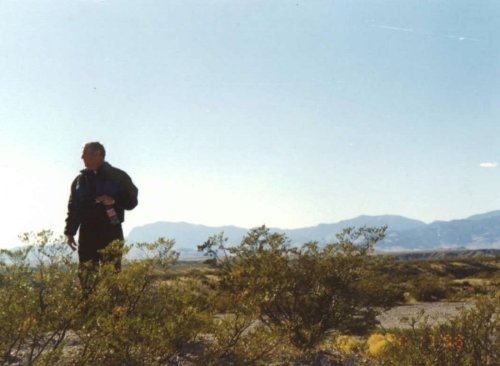
The man in this picture is my old friend Richard Sturm.

[Note:  I’m going to edit this a bit before I post it to the So Far From Heaven blog, add and subtract a few hindsights and afterthoughts.  Jules]

Richard died in December, 2004, in Port Lavaca, Texas.

Richard was a 100% disabled veteran of the United States Army. From 1964, until his death he spent his entire adult life in and out of Veterans hospitals. When he wasn’t in a hospital he was usually in a café somewhere drinking coffee and being friendly with anyone who’d give him the time of day.

Or he was with me, camping, fishing, seeing the sights, singing, passing the time. That happened less than he’d have liked, probably more than I’d have preferred in a lot of instances. Richard wasn’t an easy man to be around.   

A while back [2011] his brother and I were discussing Richard, and Vic remarked, “You never really saw Richard when he was at his worst.”  I didn’t say so at the time, but I think I spent a lot more time with Richard over the years than Vic did, or than Vic was ever aware I did. 

Aside from Richard, all those Sturms were super-achievers, and although I spent a lot of years from 1965 onward considering Vic among my best friends, he was a busy man.  People sought him out.  If I wanted to talk to him, I called him.  Over all those decades I could count on one hand the times he initiated a contact between the two of us.  “People call me.  I don’t call them,” he explained to me once when I mentioned it to him.   I’d guess that applied to Richard, same as it did to me.

But that’s digression, edited in this May, 2012, with a lot of hindsight.

Before Richard volunteered for the Army he was a patriotic youth, intelligent, dynamic, from a family of super-achievers. He graduated from high school with honors, well liked and respected by his teachers and classmates. A young man with a future. Then he joined the US Army.

In 1964, he was stationed in Massachusetts with the Army Security Agency. Without his knowledge or consent, he was selected for an experiment by the career military men who were his superiors. He was given a massive dose of LSD. He sustained permanent brain damage as a result.

Richard spent several months in a mental ward of an Army hospital, presumably under observation by the powers-that-be, to see what they’d wrought. Then they gave him is medical discharge, released him from service and from the hospital, and sent him home without confiding to anyone what the problem was and why it happened.

Several years later after he’d been examined, had his thyroid removed, given electric shock treatments, everything the puzzled medicos could think of to try and improve this mysterious condition, his brother, an attorney, came to suspect something of what had happened. The stories of events of this sort had begun to creep out of hiding and into the press.

A formal demand was made for release of his records, and finally the story came out.

Richard wasn’t injured defending his country. He didn’t get his skull fractured on some battlefield by enemies. He was betrayed by the career military men of his own country, officers and enlisted men, whom he’d given an oath to obey and defend. He served in good faith, and he was betrayed by his country.

Some have noted on the threads that I don’t have an automatic high regard for career military men. They’re correct. Richard’s just an extreme example of thousands of men who’ve been killed, injured, disabled by irresponsible, insane, and idiotic decisions by men who make a career of blindly following orders without thinking, weighing consequences, not feeling any remorse so long as they were ordered to do it.

Like good little NAZIs, Japanese, Soviets, Israelies, Americans, Cambodians, British, Africans, Chinese, Cubans, Argentinans and military men everywhere.  Just following orders. 

Support our troops.

Old Jules

2012 note:  During a conversation with Vic in 2011, I mentioned the LSD experiment and Vic replied, “It’s a shame I could never prove it.  Richards records were all destroyed in a fire at the Army Records Holding Center in the late 1960s.”  Live and learn.  Somewhere back there, I must have heard it from Richard, I came to think the records had been uncovered and it was established, official fact.

Introduction to Being a Hermit

The following is an email that Old Jules wrote several years ago and subsequently posted on a previous blog. I’m posting it after his description of the Peace Corps experience to give continuity to that time period.  ~Jeanne

Old Jules:
This was the most recent of a long line of exchanges with an online friend, a man  who mostly he believes his life is a living hell out of habit, except when he reminds himself he’s blessed, which is only when I remind him to remind himself, thinks I.

Thought I’d share it with you blog readers.  I don’t believe I’ve ever mentioned my brief life as a hermit.

Morning Pal:

I suppose you’re right.  You live a complicated life.  It would be complicated, just with your interpersonal relationships, even if you didn’t have a job that would be enough to satisfy most needs for complication.  Even if you didn’t have a piece of real estate that’s located in and part of a subtle war zone.  It’s relatively easy to imagine how you’d have some difficulties focusing, relaxing, or anything else.

A long time ago, when I had a complicated life, I used to wonder whether a stay in the sort of place where you work, an asylum, would do the trick as a means of getting me removed from the system of complications I’d built around myself to help make myself unhappy.  I concluded that it wouldn’t.

 I also gave some thought to whether prison life would do it, but unless it was one of those kinds of Federal prisons all the Watergate folks went to, I don’t think it could.

Thought about a Trappist monastery a bit, even.  That might do it.  I don’t know, but it seemed so otherwise out of sync with my nature that I never tried it.

But I had the advantage over most people, because I knew what I was missing.  When I got booted out of the Peace Corps in 1964, after a bit of time trying to complicate my life in Honolulu the way a person will, I was contacted by the US Army Reserve telling me they wanted to know where I was in case they wanted to reactivate me for Vietnam if they needed people with my particular MOS.  In those early days of 1965 nobody knew where all that was going and reactivating the reserves was considered a real possibility.

My support for US military adventures overseas went away entirely during my tour in the Far East.  I was gonna have nothing to do with Vietnam.  I decided I was going to spend the remainder of my life as a hermit living in the jungle on the big island….. a place called Wiamono Valley on the drainage of the Kohala range…. used to be a village in there but it was wiped out by the tidal wave in 1947 and nobody laid claim on it since.  Nobody in there but a blind mule and me…. for six weeks that mule had company.

That six weeks with nobody to talk to but a blind mule changed my whole life.  It was a pivotal moment for me, one of the greatest blessings of my stay in this reality this time around.  In addition to a book-full of other benefits, it gave me a realization of what’s possible for a human being, mind-wise, if he can succeed in either simplifying his life, or in (I didn’t know then) distancing himself from the web of values, properties, interpersonal relationships and other tangle we do our best to mire ourselves in so we can’t see or hear what we’re trying to keep from seeing and hearing…… the voice of what’s beneath.

I definitely understand what you’re saying, my friend.  Hang in there.

(Old Jules)