3 am I wake
Find you atop me
Kneading
I savor
The soft purr
Of you
The gentle scratch
Of nail on flesh
Tiny pleasure pain
I hold
I hold
I hold
Until I can wait
No more
Lift you
Lovingly aside
And rise
You follow watching
My grimaced
Downward
Push
Muscle pressure
Pain
Release
Your tail
Lashes S and Z
In empty air
Green eyes fixed
I search absently
For a synonym
For piss hard
And ponder how
Like the useless
Appendix
This serves no function.
No. No.
It reminds
Remembers
Other uses
Other times.
After the literary Mehitabel, the first namesake to enter my life was in 1967. She was a stray, moved in ahead of a hurricane reputed to be headed for Houston. My new wife and I took her in because she was hungry, pregnant, and a violent storm might be coming.
She was near to giving birth and decided my sock drawer was the best option, refused to be dissuaded. So I built her a cat house behind the apartment. She didn’t stay around long after the kittens died, evidently because of drinking her milk.
Mehitabel #2 was a bob-tailed calico. Amazing cat, a loyal companion for 17 years. I once watched her in horror and awe as she mauled a full grown German Shepherd and similarly sized mutt, though they intended it to be the other way around, then found themselves surrounded, blocked repeatedly in their attempts to escape by a feline seemed to prefer two at a time.
I could spend pages telling Mehitabel #2 stories, but I won’t, except to say she was the mother of Hydrox #1, Hydrox #2, Xerox #s 1 and 2, and The Great Rumpus Cat #1. I always figured she was reincarnated from Mehitabel #1.
Over the years I always kept the cat population contained in a set of names lying in wait for a cat to fit in them, Mehitabel, Hydrox, Xerox and The Great Rumpus Cat being the primary ones. The method always worked well for me, but cats needed to fit particular qualifications to seize a particular name. Hydrox and Xerox were always jellicle cats. Mehitabel had to qualify by meeting other standards, generally following the Don Marquis model.
Mehitabel #3 came in around 1996, me fresh out of cats, her being a pregnant bookstore cat in Socorro, New Mexico. When Mehitabel #3 emerged from sleep and demanded I pick her up I asked the lady-owner, “She’s close. When these kittens are weaned could I have one?”
“You can have HER.”
“I don’t want half-a-dozen cats.”
“I know. As soon as the kittens are weaned you can have her.”
The enthusiasm and insistence of the lady told me I had the right cat. Mehitabel and I hit it off beautifully. But I was on the road a lot, and despite the cat door she was able to use to go in and out, I sensed Mehitabel was lonely.
Mel, a good friend, had a pregnant jellical female, Electra, living in his garage, and when the kittens were born I picked out Hydrox #4, or maybe 5. Freshly weaned, I carried him home to introduce him to Mehitabel #3. She hated him.
Mehitabel showed no signs of accepting him, so I went back to Mel and borrowed the second-best of the litter, Niaid, on an indefinite loan to keep him company. I didn’t try to fit her into the name thing because she was just a loaner.
As the pair matured I’d frequently ask Mel, “You needing this cat back?”
“No,” he’d assure me, “I’m fine.” Then Mel partnered with me on the Y2K land, though he stayed in town except for a week leading up to January 1, 2000, so the Niaid issue wasn’t a concern.
But in the background, throughout her life, Mehitabel bullied both of them unmercifully. When we went to live in a single-room apartment in Grants, New Mexico, toward the end of 2000, she could lay down the law and they couldn’t get away from her. But eventually Mehitabel #3 went on permanent mouse patrol, relieving the household of a lot of tension.
That’s where the screw-up happened in the life-long cat naming procedures. A stray pregnant cat emerged from catdom at a motel Jeanne was staying in while visiting me in Grants, which she took back to Kansas with her. Named her Shiva, largely because of my lousy abilities at prognostication.
I had no idea the was going to eventually fill the Mehitabel #4 slot.
But she did and it’s screwed everything up from a cat naming perspective. I doubt I’ll live long enough to get it back on track. One of Shiva’s litter’s living with me, as well. Sheeze! Her name????
Salvaged wheelbarrow, salvaged nightstand and salvaged material stapled over door opening
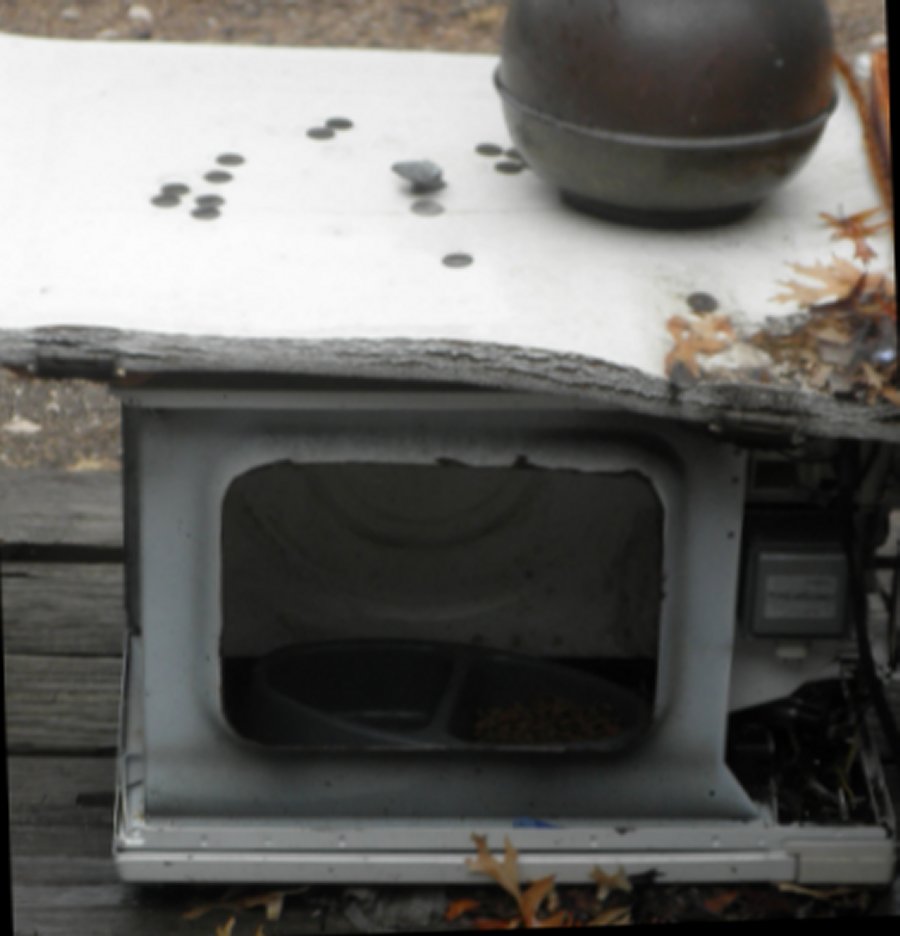
Salvaged microwave stripped of components with the back cut off makes a great means of keeping the cat food dry
Heavy rain and the cool snap last got me scrambling to give the cats a way to get out of the weather and keep the food dry. Looks as though it will serve, but I’ve got to work on several more shelters. They’re there, but need upgrading a bit.
I’ll confess I’m behind the curve on a lot of things. I should have re-wrapped that electrical tape around the busted phone line before the rain hit. Internet’s back in tin-can telephone speeds this morning.
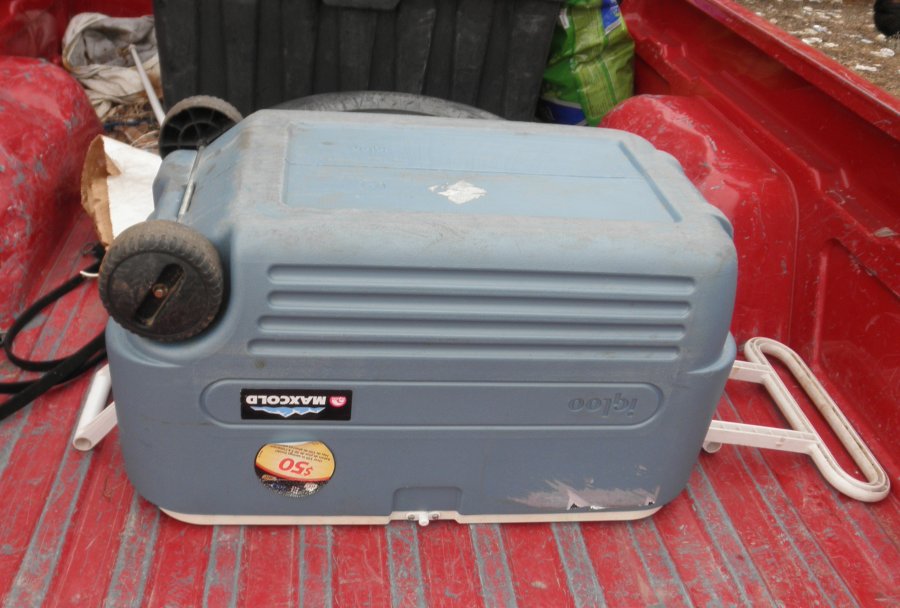
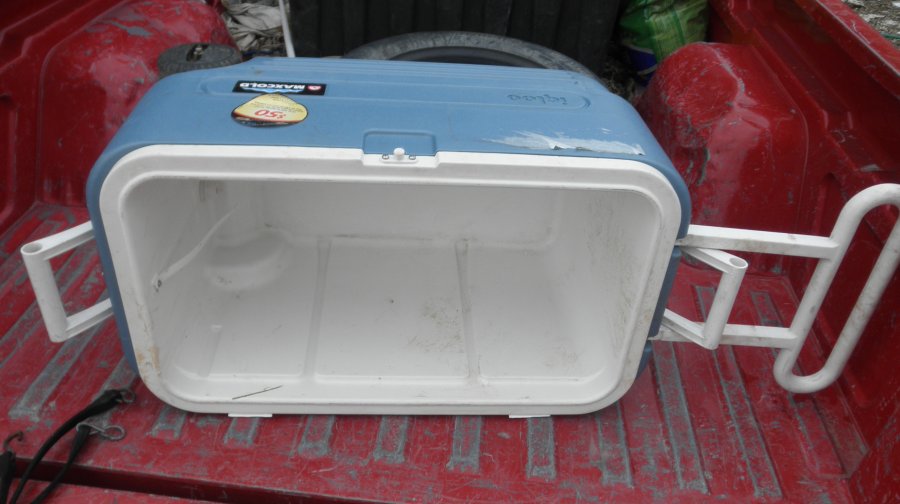
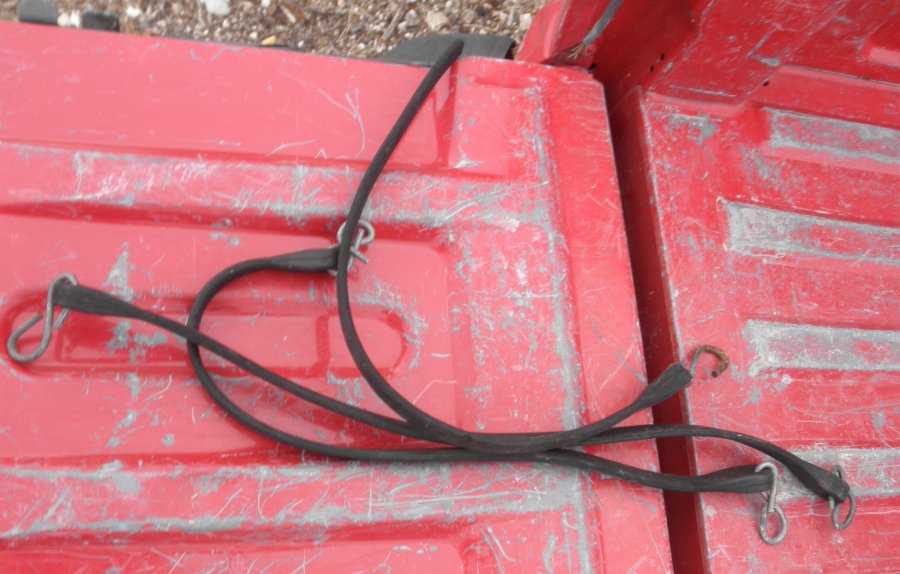
Gale and Kay were working the Mesquite Show in Fredericksburg this weekend, so I borrowed Little Red today and went into town for necessaries. But when I’m on the road I always shop the grader ditches and investigate any potentially useful items thrown or blown out of vehicles. Today was great insofar as upgrading cathouses:
The top was missing on this, but otherwise it's in good shape
The cats will be fighting over which gets to sleep inside this
I find a lot of these lids in the ditches and this one almost fits.
Also found these rubber bungie cords near another bunch of trash in the ditch
This is a confusing situation. First I consulted my feline advisers about it, which didn’t help much.
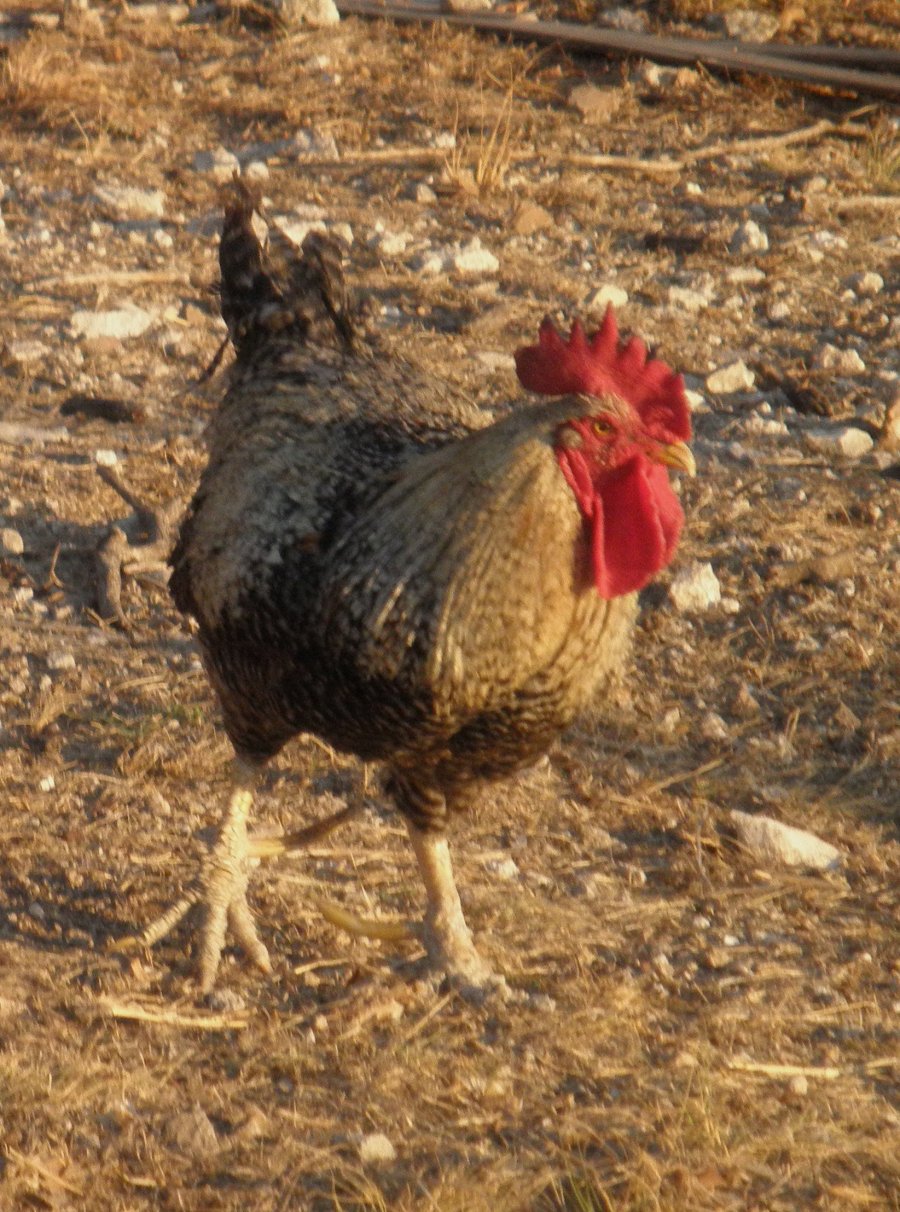
Mr. Hydrox did, however, point out that the chickens, coons, possums and deer want to be like cats, coming onto the porch eating cat food, which gave me pause. But then I discussed it with the Great Speckled Bird, who pointed his spurs of blame in the direction of the deer and the coons, mainly.
“You’re constantly having to run them out of the chicken feed you put out for us. Those deer aren’t even scared of you, but it’s fun watching you trying to chase them off throwing rocks, cussing and waving your arms around. Damned deer want to be like us chickens.”
The deer were next in line for consultation. That’s more difficult because they don’t speak proper English. But a young buck assured me it was the feral swine causing the problem. “Squeeee deer are just hungry. Squeee don’t meannnnn no harm ner try busting things up. Most of ussss. It’s them damned wild hawggggs doing that. They want to beeeeee like us deer. Copycat bastards.”
What I was trying to figure out was why ‘we’ US citizens want the rest of the world to be like us.
At least, we want them to want to be like us
Time was not so long ago when the US cared so little about whether the rest of the world wanted to be like us, or not, the thought would have never entered their heads yea or nay. Prior to WWII most US citizens wanted nothing more than to go about their own affairs and be left strictly out of the troubles spilling blood all over the planet. What the rest of the world did was the business of the rest of the world.
Earlier, during the Civil War, when the UK was trying to decide whether to join the French in the invasion of Mexico, the Prime Minister was saying a lot of things to Queen Victoria about the leadership of the country (Abraham Lincoln), the reasons for the war, the conduct of the war, that Americans would have found painful to hear if they hadn’t been too busy killing one another to pay attention.
But they’d have found those remarks between the PM and the Queen painful because they contained so much truth. Not because they cared a damn what the leaders of the UK thought about the US.
We’ve spent the last half-century trying to make the rest of the world want to emulate us, politically. Most of the world wasn’t interested. But we did succeed in a lot of ways nobody anticipated. We shipped all our industry off to the countries we’d spent a lot of lives and treasure whupping the socks off of, trying to help them be like us just a few years earlier.
By ‘we’, I’m not talking about ‘me’, nor am I talking about ‘you’ if you happen to just be a regular person who wasn’t involved in making decisions to ship all our production, manufacturing and skilled labor jobs off to third world countries because of the cheap labor and ostensibly trying to help them to be like us.
The ‘we’ I’m talking about is some nebulous consortium of folks who had enough money to own companies, factories, mines, lumber mills, steel mills and all the other components involved in a healthy economy with a population of employed citizens.
And by ‘we’ I’m also talking about several generations of bought and paid for politicians of both parties who found themselves more attracted to serving the interests of those described immediately above than protecting the interests of the citizens who elected them to public office.
When the parts of ‘we’ described above were minding ‘our’ own business the part of ‘we’ not included had thriving industry, plenty of jobs, affluence. Anyone who wanted a job could find one.
But gradually, as ‘we #1’ and ‘we #2’ succeeded in making the rest of the world in our own image in some unanticipated ways, all three of ‘our’ industry and production infrastructures became a dead shell. All ‘our #3’ jobs became government related, or pure government, or ‘service’, such as selling insurance, flipping hamburgers, running the sewer plant, advertising, cashiers, sales, lawyering, medical, and cops. The kinds of jobs producing nothing of lasting value, nothing for export.
And in the process, the world we made in our own image wanted to be like us. They wanted cars, television sets, air conditioners, microwave ovens. They became super-consumers. They began needing petroleum products for energy, for plastic rubber monster toys for the kids. Petroleum to run their power plants to refrigerate. Petroleum to run their hair dryers. Petroleum to run their industries.
They became like us.
Meanwhile, the dead hull of US industry didn’t demand so much energy, but our automobiles, air conditioners and plastics requirements continued to do so.
But the rest of the world wanted it, too. They became like us. Prices skyrocketed.
So, now we don’t have any industry, don’t produce anything, but still need the energy to run. And so, also, does the rest of the world because they’ve done as we hoped. They became like us. Now maybe we need to find some other ways to make them want to be like us, before they decide to be like us in some other unanticipated ways we’ll like a lot less.
But a couple of decades ago the entire Eastern Block of Nations, along with Iran, did something we might be well served to emulate. They kicked out all the politico factions who’d been selling out the interests of the citizenries, tried a lot of them for treason and other serious crimes, and tried to start anew.
Now that they’ve managed to become like us it’s time we tried to be like them.
Finally, Tabby pointed out what’s probably both true and obvious.
“You run those chickens off the porch when they try to steal our food. You do whatever you have to do to keep the coons and possums from killing the chickens. You drive the deer away from the chicken feed. And you kill the swine because they’re dangerous to all of us and destroy everything that stands in their way of taking everything from all of us.
I should have known this was coming yesterday when I took a nap and kept noticing a few things crawling on me occasionally. But I was preoccupied with musing about other goings on.
Then last night I went in there to rest a few minutes and conked out, only to be awakened around midnight-thirty with a lot of things crawling on me. Pretty much all at once, doing a little stinging here and there.
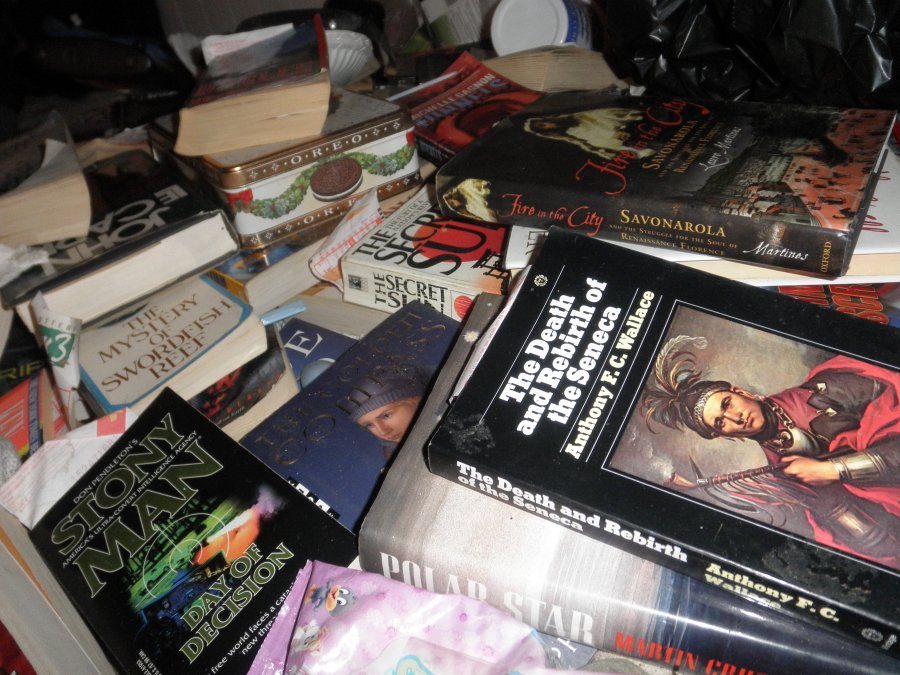
That half of the bed is taken up by upwards of a hundred books, some read already, some partway through the experience of being read, some waiting to be read, some held for re-reading. They’re usually not enough of a problem to outweigh the advantage of having a book near at hand when I need something to read. But when I turned the light on, here’s what I saw last night:
It’s not the first time that’s happened and I could have prevented further invasion if I’d been paying closer attention. I keep a container of boric acid powder nearby and usually try to do a pre-emptive strike on them on a fairly regular basis. But it requires taking the layers upon layers of books off and squirting the boric acid powder all over the underlying bed surface.
This, I’m reluctant to do, because everything gets disorganized and I lose track of which things have already been read, which are waiting to be read, which are occupied holding something else up, and generally where things are.
So they sneaked up on me. I had to do it in the middle of the night with no pre-planning, no organization at all.
Sheeze. Now it’s chaos in there.
————————————–
9:30 AM edit:
Heck, I might as well add this since I’ve got them there together now. Here are a couple of authors I’ve come across lately I’ve enjoyed a lot.
They’re thrift store books, so I’m not certain you could find them easily, but both authors have an interesting approach, plotting is tight, characterization’s good, and they hold the attention well.
Upfield writes about an aboriginal who’s an Australian police homicide detective and his mystery solvings, along with his ethnic difficulties trying to do his job in that setting, along with his internal struggles demanding he go back to being a bushman. Good reads.
Alexander’s a completely different bag of tricks. He’s created a blind brother to Henry Fielding, author of Tom Jones, who’s a magistrate-cum-detective in London. His characters include Dr. Johnson, whores, a pirate, poets, actors, and all manner of peasantry. The narrator is actually a ‘Boswell’ sort relating the activities and events, a young teenager taken off the streets.
I don’t have enough distance from the Alexander books yet to decide whether it’s his unique and innovative setting, plotting and characterization intrigues me so much about him, or whether he’s also a damned good author.
Old Jules
11:20 AM edit:
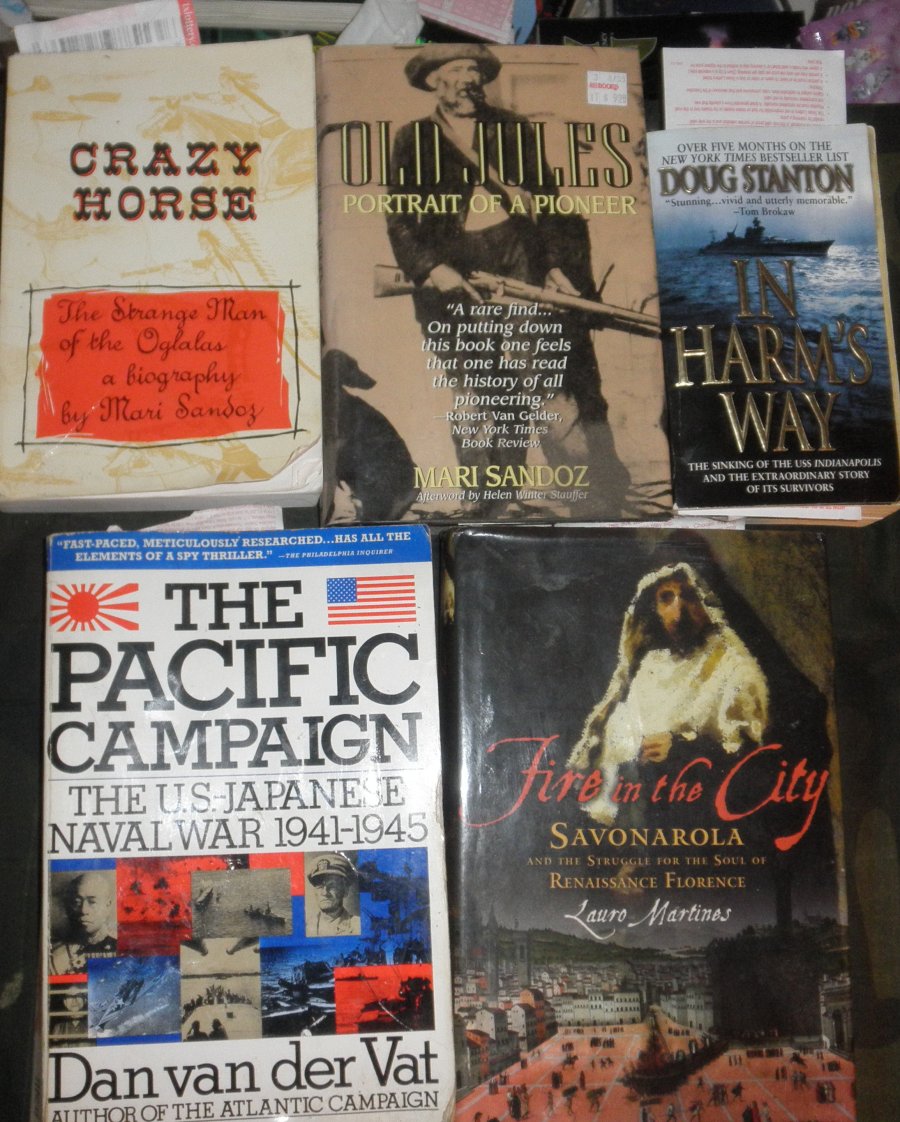
Heck, I might as well add these since everything’s screwed up in there anyway:
Mari Sandoz – Crazy Horse, and Old Jules. Mari’s my daughter in a previous lifetime. Her biography of Crazy Horse is better than a lot of others about him. Her biography of me during that lifetime is as good as you’d expect from a daughter.
Doug Stanton, In Harm’s Way is the hair-raising account of the sinking of the USS Indianapolis during the last days of WWII, and the ordeals of the survivors in shark infested waters off the coast of Japan.
Dan van der Vat, The Pacific Campaign is nothing to write home about. Of the thousand-or-so books following the steps, events, tactics and strategies of the Pacific War this one ranks in the bottom third,in my estimation.
Lauro Martines, Fire in the City, is a narrative of the strange and
surprising emergence of Friar Girolamo Savonarola in Rennaisance Florence. So little attention has been paid this fascinating man and time it’s worth the read even if you aren’t crazy about Martines’s particular style of writing and his method of organizing his material.
Niaid was curled up on the bed, [I double-checked] so whatever else that critter was, it was an outsider. The chickens were ranging free and I couldn’t hear any alarm from them, but this guy just looked too big to have roaming around without interruption.
As I came around the cabin where I could see him better:
It was obvious the feline was operating out of a different reality. Which didn’t necessarily mean he didn’t need to be the focus of protective measures. But how does a person protect his chickens from a shadow-cat? I’ve done some websearching on the various news sites and checked out the methods incorporated by the US Government into programs to avoid having shadow-cats disrupting citizen-like critters such as these:
The consensus seems to be you have to get one of these:
No matter what the cost.
I’m not certain I want to have one of those running around here loose, even when I have dangerous shadowcats skulking around peeking at my holdings.
Once something of that sort gets a foothold there’s no predicting where it will end:
Sugar pills in toy jars
Candy counter cures
For the sensory deprived
For the spirit that yearns hardship
Facade struggle for the
Stagely frightened
Sedentary soul
Living a reality
Where gangster boss of fantasy
Celluloid deeds and words
Are worth repeating;
Gladiator wars in plastic armor
Oaken clubs and pigskin missiles
Pudding danger jello struggles
Hard and real inside the mind
Inside the molded plastic
Toy of the mind
Man who cleans the windshield
At the signal is an actor
In the show last night
On MTV or HBO
Sexy girls dancing
In the background
As he postures
Rag and bucket
On the glass
Toy hero pushes button
In the Kevlar coated dragon
Of the field
Sees the enemy extinguished
In a prophylactic
Box of evening news
Before and after
Old war movies
All the same
Any loss is accidental
Cost of war’s
In higher taxes
Salaries for heroes
Fuel bullets
Not in blood
Not in blood
Sterile sealed
In plastic baggies
Plastic baggies
Hold the artificial
Flavor
Of the life
When life was real
Yet the sickness
Needs a remedy and cure
Sugar pills in toy bottles;
New candy counter pudding
For the soul.
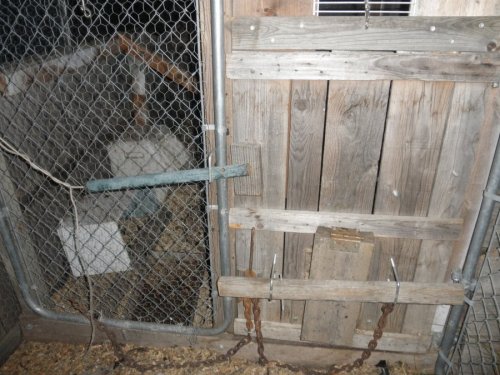
From the inside of Night Fortress 2 there’s a step up through the exit hole and he’s having a lot of difficulty with it because of his crippled leg and wing.
Those chains, incidently, are part of an ongoing war with generations of Brother Coon trying to dig into the fortress at night. The links where they meet the ground have treble-hooks wired to them to discourage digging there, but it’s a labor intensive game. They’re the first line of defense. Under the wood chips they’re on the holes are stuffed with prickly pear cactus, then covered with wood chips. Brother Coon eventually gets past them all and insists on my going to the next level of debate: The Lost Coon Diggings
Even the largest hen doesn’t have a problem with it. But after the hens are all out harvesting the night carcasses under the bug-light he’ll still be in there crowing, evidently dreading the prospect of fighting his way through that opening.
I load the chicken drinking water up with home-made colloidal silver, catch him and soak his legs in orange-peel tincture, and it all seems to help, but gradually GSB’s hard living before I got him’s coming home to roost.
Usually GSB doesn’t indulge in cliche, but maybe his mind’s going, too. Lately I’ve heard him say more than once, “If I’d known I was going to live this long I’d have taken better care of myself.”
If he keeps doing that I might be tempted to chop off his head.
A man I went to grammar school, junior high and some high school with, then several decades later became reacquainted and huff-puffed a lot of up and down mountain canyons recently began visiting this blog. If no other reader enjoys the tale, at least he will, because he was there:
The following is copyrighted material from a book I wrote once. I give myself permission to use it here. [ Crazy Lost Gold Mine-ism]
I’ve never concerned myself much with the dangers of wild animals during my extensive time in the woods. Mostly they’ll mind their own business if a person takes reasonable precautions and doesn’t go out of his way to provoke them. In New Mexico backlands of the late 20th century the real threats usually come in the form of humans. When those happen they usually come as suddenly and unexpectedly as finding one’s self in the middle of a herd of elk.
Grasshopper Canyon and Stinking Springs are on the northern end of the Zunis below Oso Ridge on the west face of the mesa. Two canyons run north and south, parallel to the face, half a mile apart, separated from one another by steep, narrow walls several hundred feet high. These two walls consist of coral reef from some ancient time when Oso Ridge was an island. The canyons aren’t easily accessible, so I prospected there a while.
The land below Oso Ridge around Grasshopper Canyon is checker-boarded in ownership. Grasshopper is all National Forest, but immediately south is a section of Navajo tribal land. Adjacent to the Navajo section is a section belonging to the Zuni tribe. Fences between these sections allow a person to always know whether he’s on public land or tribal land.
I was working Grasshopper Canyon with my friend Keith, a stockbroker from Santa Fe. We separated and worked the arroyos southward parallel to one another, gradually moving toward the fence delineating the Navajo section. Occasionally we’d call out through the woods to make certain we weren’t out-distancing one another. The last thing either of us expected was an encounter with another human in those woods.
I was bent over taking samples from the bed of a shallow arroyo, just deep enough so when I straightened I could view the small meadow around me. I stood getting my breath and stretching the kinks out of my back when I saw a man dressed in cammies backing out of the woods at the edge of the meadow. He was being stealthy, carrying a .22 rifle in a ready position. He had twenty to thirty colorful birds hanging on a string around his neck the way a fisherman carries a stringer of fish. As I watched, almost invisible to him with only the top of my head showing above the arroyo, his eyes searched the woods to his right where Keith was working. Keith had called out from there a few moments previously.
Still watching Keith’s direction the man backed toward me until he was only a few feet away from me. “Nice string of birds.” I scrambled up the bank while he spun and pointed the .22 in my general direction.
“My partner’s in the woods back behind you. You don’t want to be firing in that direction.” We studied one another. He eyed the shoulder rig I was wearing and the butt of the 9 mm automatic showing from the bottom. “’You out here killing songbirds?”
Mister Songbird was a young man and from appearances, a Zuni. He stared a moment longer before answering. My impression was that he was considering whether I was a game warden or other law enforcement official. “I’m getting them for Zuni New Year. They let us do that.”
We talked for a few minutes, me accepting what he said at face value, and the tension gradually dissolved. He agreed to get the hell out of the canyon because we were working there and wouldn’t want any shooting. Besides, we’d probably messed up his hunt with our yelling and bustling around the woods. I watched him back into the meadow to the south and allowed myself to sigh with relief.
Back in Santa Fe I called the US Fish and Game Department. I thought there was a remote chance the feds were really allowing Zunis to kill protected species birds on National Forest land. If so, I was prepared to be indignant.
When I told my story the fed was silent a moment. “You are a lucky man,” he observed. “You confronted an armed man committing multiple Federal felonies and he didn’t shoot you.”
* The following didn’t make it into the final draft of the manuscript: The fed also observed the Zuni lad would have spent a lot more years in prison for killing those songbirds than he would have for killing me. I drew a good bit of comfort from knowing that.
Eventually logic won out over the other appeals of the Zuni Mountains as a location for the lost gold mine I was searching for. Although the Zunis were handy for me, being only a few hours drive from Santa Fe, they were too far from Tucson.
Also, too many prominent landmarks in the area would have immediately brought the original survivors back. The route I imagined them following would have taken them within sight of Los Gigantes and enough other one-of-a-kind eccentricities to make the location unmistakable.
Even the Big Notch and Little Notch in the Continental Divide can be seen from miles to the west. There’s nothing else similar to it in North America.
Three of these four worthless felines are getting a bit long in the tooth, two longer than the next in line. It’s been a tough summer with the drought and heat wave, so I’ve had to take some measures to give them some relief I couldn’t provide for myself.
Shiva’s not one of the two oldest, but she had a health event a couple of winters ago that’s taken a long time to recover from, and she has a special job here if the cows ever come back. She’s Shiva the Cow Cat. Loved chasing cows back when they were bothersome. [ Artful Communications – White Trash Repairs 3 ]
I might add some other meanderings here today as other things come to mind, but what’s on my mind this morning is I need to start working on the front porch cat houses I put together last fall to give them all places to get out of the elements. Now that the heat’s bending in the other direction I wouldn’t be shocked to see a winter rearing it’s head before I’m ready for it.
Old Jules
————————————-
7:45 AM – Escape Route Possibilities – Fridge and trailer
Another issue that’s been on my mind a lot lately is creating myself a place to live if anything intervenes to insist I get the hell out of Dodge. The whole thing’s complicated by the contract I have with these cats, all but one of them, to take care of them until they die off, or I die off. I’ve talked with them about it, and they have some strong views about minimum living conditions, etc, which I’m obliged to consider. A tent or under a bridge doesn’t meet their minimum criteria.
I mentioned in an earlier post that I’m looking around for an old travel trailer I can get for a price I can afford, and the new truck up there Gale’s going to help me pull to town to let an honest-to-goodness mechanic fix the wiring mess, inspect it to get it legal, and eventually pull whatever I come up with for it to pull.
While I’m scouting around looking for an old travel trailer I’ve also been looking at this, considering whether it mightn’t offer an alternative:
Of course, if I select this option I’ll be building it from salvaged recycled materials.
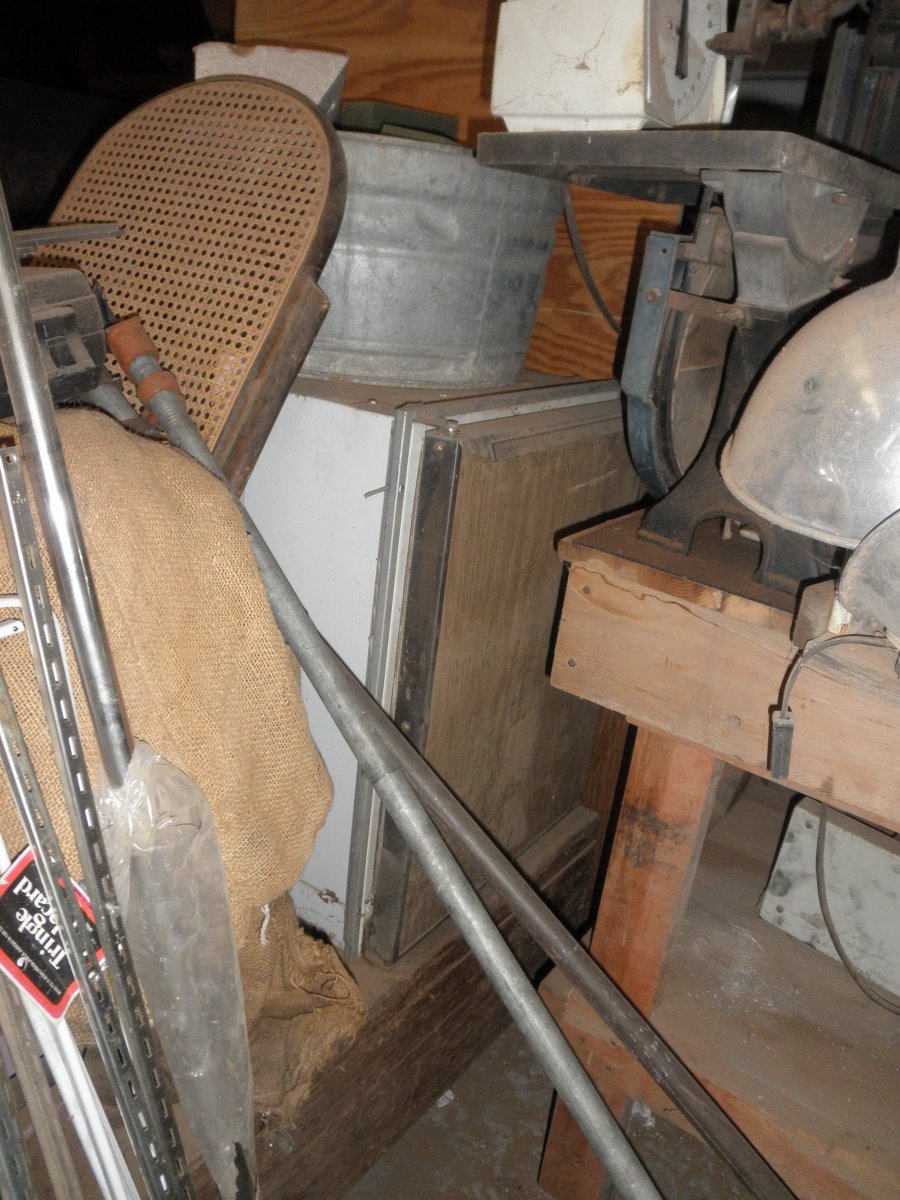
This trailer below has been sitting there with that load on it from the time Gale and Kay moved here from Pflugerville. His shop building was full and he didn’t have anywhere to put all that stuff, so it’s stayed there, everything on it getting ruined by the weather and the tires going flat.
another view:
That lathe, left rear, is troubling to see. But so’s a lot of the other once-useful items on there.
another view:
another view:
If I can think of somewhere to put that junk, protecting whatever’s left worth protecting, I just might be able to talk him out of the trailer if I decide the building a house on a trailer option seems the best after everything’s considered.
On the other hand, the fridge is now a sure thing. I was talking with Gale while he was doing some jewelry work the other day and noticed this, down there bottom center:
Turns out it’s the gas/electric fridge out of an old travel trailer I gave him about 30 years ago. He says it’s mine if I want it.
Having to haul water offers up a rare challenge insofar as cooking and cleaning up afterward. Before the drought became so severe I’d mitigated the problem by putting my dirty dishes into potato or grapefruit bags and placing them on imported fireant beds. A day later, voila! Clean clean clean!
All I had to do is pull them out of the bags and wipe them down with a moist towel or cloth and they were ready to use.
But as the summer progressed and the soil dried the fire ant beds became more difficult to locate. Without moisture in it the soil here has no structure. The beds became invisible, and concurrently the ants seemed just to go underground. Imported fire ants, common name: red imported fire ant scientific name: Solenopsis invicta Buren (Insecta: Hymenoptera: Formicidae: Myrmicinae) are eating machines. They’ll eat anything.
“Mounds are built of soil and are seldom larger than 46 cm (18 in) in diameter. When a mound is disturbed, ants emerge aggressively to bite and sting the intruder. A white pustule usually appears the next day at the site of the sting (Cohen 1992). ”
I looked for other alternatives with other ant species, no joy. What I discovered is that good American fire ants just don’t want to do that kind of work. I tried it with every kind of ant bed I could find, dishes stacking up in the sink, me gradually being forced to use hauled water and scouring pads to clean up dishes and utensils.
If I couldn’t find some good American fireants willing to work or some way to locate illegal imported fireants for the job I was going to be reduced to hauling water a lot more, or get a dog to lick that stuff off the eatingware.
Luckily that 24/7 September 13, moonbows and canned thunder outdoor canned thunder brought in the first measurable rainfall in 100+ days here, just as you thought it would. There’s enough moisture in the soil now to let the fire ant mounds get some altitude so’s I’ll be able to locate them for my dishwashing.
On the other hand, the rain proved my chimney-fix didn’t entirely accomplish what was intended.
Water was hitting the chimney outside, intruding and running down the stovepipe as far as the elbow, then dripping in.
Hard to think of a good quote to sum up all this. “It’s an ill wind that blows no good?”
But it’s all good. I just have to cut that oversized chimney-pipe and put it on there as a sleeve over the old chimney soon. Better knowing it now than discovering it when Mr. Bullgoose Daddy-Longlegs storm comes in.
74 years old, a resident of Leavenworth, KS, in an apartment located on the VA campus. Partnered with a black shorthaired cat named Mister Midnight. (1943-2020)
Since April, 2020, this blog is maintained by Jeanne Kasten (See "About" page for further information).
https://sofarfromheaven.com/2020/04/21/au-revoir-old-jules-jack-purcell/
I’m sharing it with you because there’s almost no likelihood you’ll believe it. This lunatic asylum I call my life has so many unexpected twists and turns I won’t even try to guess where it’s going. I’d suggest you try to find some laughs here. You won’t find wisdom. Good luck.


















 So Far From Heaven


