Evidently a bat got confused and got snagged in the buglight instead of coming into the cabin to fly around as they usually do.
Every m0rning the chickens feast under that light as soon as I turn them loose. But I think I’d best unplug it before I poke around with a stick trying to get that bat out of there.
Ah well. Maybe the chickens will eat it.
This cool morning had me putting on clothing instead of running around with nothing but shoes on to turn out the chickens and feed the cats. But it reminded me I’ve been almost a year without any gas for the cookstove and no way except the woodstove to knock the morning chill out of the cabin. I’m going to have to do something about that.
Then there’s this:
It’s coming nigh onto time to haul water again. Probably also ought to try to figure out what’s wrong with that well pump. It’s been since last December it quit, but I didn’t want to rush anything. If I need to pull that pump I didn’t want to do it in cold weather when it happened, but didn’t want to do it in hot weather the rest of the time.
Saw this in the parking lot of the Humane Society Thrift Store the other dayInside the guy was easy to identify, looked about like you'd figure
He was poking around in a box of old LP records. I tried to start a conversation with him about old music but he wasn’t having any of it.
This old XP’s going kerplunk. I picked up a replacement at the Thrift Store and if I can figure out where all these wires go I’ll have it in here in a jiffy as soon as I get around to it.
North by Northwest – Climbing the American ladder of success
The Alamo – “When I was a boy any girl would turn up a bunch of trees like that, cut a bunch down and one for a ridge pole and build herself a cabin alongside the other. Seems like all anyone would ever need.”
The Outlaw Josie Wales parleys with 10 Bears – “Dying ain’t so hard for people like you and me. It’s living that’s hard. Governments don’t live here. It’s people who live here. I’m saying people can live here together without butchering one another.”
The father of a man I used to know had been a Hungarian tank commander on the Eastern front during WWII. (He bore a striking resemblance to an aging Robert Shaw in his role as a German tank commander in Battle of the Bulge). He was there for the Axis invasion of the USSR, all the way to the suburbs of Moscow.
He was captured by the Soviets early in the war before they began shooting their officer prisoners, then exchanged and sent back to Hungary to recuperate. But later as the casualties mounted and the Eastern Front meat grinder demanded more meat, he was sent back.
One of the battles late in the war provided him a ticket to a German Hospital facility and an injury sufficient to keep him there until the surrender. Surrender, by incredible luck, he vowed, to US forces. He was held in a camp while prisoners from USSR-held countries were sent back for mass executions. His membership in the NAZI party in Hungary would have made his demise a certainty.
Disguised as a woman, this man escaped the camp and journeyed to South America. That’s where my amigo was born. Afterward the family moved to Canada. I became friends with his son during the ’70s at the University of Texas where he was several years ‘all-but-dissertation’ for his PHD in Linguistics. His father’s status as a ‘wanted’ war criminal in Hungary remained in force throughout the old man’s entire life.
I asked him once about the Eastern Front experience, knowing he was unrepentant. I’d been carrying a nagging curiosity about it for years.
“Those were heady times,” he smiled, “Kind of fun, actually. Going up against infantry and squadrons of Soviet cavalry in an armored vehicle. Sometimes you might kill a hundred men before breakfast.“
FOOD: There’s an all-you-can-eat pizza joint where you get all the salad you want, a drink and a selection of all kinds of pizza slices as many times as you go back for them and as many kinds as you want for $5.00. You wouldn’t believe how much salad and pizza a person can eat in an hour-or-so.
Only trouble is I always feel sort of bloated and sometimes have stomach cramps after I eat there. Maybe it’s something in the food.
Thrift Store 25 cent books acquired:
A Canticle for Leibowitz – Walter M. Miller: Good SF I read every 10 years or so.
Rebel – Bernard Cornwell – I like Cornwell fairly well but I haven’t read this one. Civil War historical fiction
Quick Silver – Clark Howard – Never heard of the author. Taking potluck on this one.
Double Jeopardy – Colin Forbes – Another potluck. Never heard of the author.
The Heart of the Matter – Graham Greene – I might have read this one sometime. But the only Graham Greene I’ve ever not liked was Brighton Rock, required reading in some English course.
The Name of the Rose – Umberto Eco – Time I read this one again.
High Sorcery – Andre Norton – I might have read it 40 years ago. Usually liked Andre Norton.
Fuzz – Ed McBain – Potluck. Never heard of him. Looks like an extortion, cops and robbers yarn.
The Third Man – Graham Greene – Once more before I die.
Hobbit and others – JRR Tolkien – Hell, for .25 why not one more time?
Foucault’s Pendulum – Umberto Eco – I dunno if I can do this one again. I ain’t as young as I used to be.
The Blue Hammer – Ross Macdonald – I read all these 30 years ago, loved them but ran spang out. Nice finding this one.
The Forge of God – Greg Bear – Never heard of him. Appears to be SF.
Flashman at the Charge – George Mcdonald Frazer – Sheeze. I love finding these. I must have read the entire Flashman series a dozen times over the decades. They never grow old.
I’ve been reading a lot of blogs about the ‘Occupy [fill in blank] phenomenon. The hints of panic from the powerful, the ambiguous hopes of the demonstrators, the near-certainty what’s happening is both the beginnings of a time of public expression about dissatisfaction, and a manifestion of unsatisfied expectations.
Seeing all that brings insistently to mind how intrusive the illusions of a utopian ideal penetrate and embed themselves in the tiny fragment of humanity where chaos took a break long enough for non-chaos to become the expectation. Mainly in Europe, Japan, the US, Australia and Canada post-WWII.
For the remainder of the world chaos never went to sleep and never expected it to slumber. Africa, the Middle East, much of South America, Cambodia, Vietnam, the former USSR and other Eastern Block countries, Pakistan and Afghanistan have all experienced so much chaos within living memory there’s probably no danger of them occupying Wall Street.
It might be worth noting it’s an illusion being protested. Copshops and politicians have never ceased being corrupt in the US, Europe, Japan, anywhere. The super-wealthy were never not-greedy, never unwilling to sell their countries and their souls to become wealthier. Religious zealots have never ceased being willing to slaughter disbelievers, rob them, enslave them, though they’ve briefly been restrained somewhat inside defined boundaries since WWII.
The protests are against the entire history of human behavior.
It might also be worth shaking the head in horror and awe that this comes as a surprise to anyone. Where have these people been for the past half-century while populations were slaughtering themselves and one another all over the planet except where they lived? How could they have come to live inside some bubble of belief that the venal aren’t venal, the greedy aren’t greedy and the corrupt aren’t corrupt?
The bubble is probably an artifact of improved communications, television, public education turning a blind eye to anything outside the sphere being brainwashed into the malleable brain tissue of those vulnerable to it.
Suddenly the bubble bursts. Chaos yawns, stretches and begins to reawaken.
There’s something mildly annoying and intrusive about having ourselves tagged and numbered by some damned academian somewhere as a particular personality type. But when my good friend, Rich, sent me this link along with the question, “Does this remind you of anyone you know?” I clicked it.
“INTJs are strong individualists who seek new angles or novel ways of looking at things. They enjoy coming to new understandings. They tend to be insightful and mentally quick; however, this mental quickness may not always be outwardly apparent to others since they keep a great deal to themselves. They are very determined people who trust their vision of the possibilities, regardless of what others think. They may even be considered the most independent of all of the sixteen personality types. INTJs are at their best in quietly and firmly developing their ideas, theories, and principles.” —Sandra Krebs Hirsch[15]
If I were the kind of person who allowed himself to get pissed off about things other people do and say this would really piss me off. In the first place, I don’t even believe in psychologists and psychology. What the hell do they know about anything?
Secondly, wrapping people up into a nice little package and putting a colorful bow on it, sending it out as though it were a gift for anyone who wants to claim he knows something about people and the way they think is an invitation for more of that sort of insufferable thinking-behavior disguised as learning.
Thirdly, the way institutional science is forever confusing itself with engineering without ever pondering the consequences, next thing you know there’ll be all manner of psychologists getting themselves government grants to devise ways to profile their homespun stereotypes so’s some branch of government with an opinion about a particular type can identify them for their own purposes.
For instance, every day you can read about physicists at CERN and other labs patting themselves on the back and saying, “Oh yeah, we’re creating baby black holes. They just vanish. No danger of one of them getting away and gulping up the planet earth.” As though they know what the hell a microscopic black hole is doing, or likely to do in orbit. Heck, maybe it was just in a slower orbit and got left behind until the next time earth comes around Old Sol to pass through and grow a little every pass.
Think about it. Those Manhattan Project guys developing the atomic bomb consisted of a significant portion of whom thought testing that device might set fire to the atmosphere. They got out-voted, not because anyone knew it wouldn’t, but because most believed it was a low probability.
How’s that for some exercise in risk-taking judgement? “Hey, let’s put it to a vote. How many think there’s a big chance if we detonate this thing it will destroy all life on the planet by setting fire to the atmosphere?”
40 PhD physicists raise their hands.
“Okay, how many don’t think there’s a very big chance it will?
60 PhD physicists raise their hands.
“Cool! Let’s run with it!”
And the majority turned out to be right. Whoopee! Now, generations of scientists later all over the world consortium of pointee-heads in laboratories and behind desks at universities can hold that up as an example of how to measure risks they’re taking without ever getting outside their closed circles of wisdom and knowledge.
But I’ve digressed. Back to these grant-prostitutes calling themselves psychologists.
You and everyone else can be assured there are graduate students somewhere creating a box to hold all your personality traits, figuring out the buttons to push to produce a particular behavior from you. What words, images, sounds will inspire you to buy a particular type of product, vote a particular way, choose a direction for your life. The grad students just do the work, but some hotshot pointee-headed prof will give a paper about it when the National Association of Prostitute Psychologists meets next spring and position himself for more grant money.
But you can be equally assured that cop shops and the ilk have hired them out to help them see what else is in the box they have you in. Yeah, you’re all these things, so you’re also probably a serial killer, terrorist, baby-raper, or someone who just doesn’t have any damned use for authority figures.
You’ll be damned lucky if they don’t outlaw you sometime because some hired-hand grad student working for a grant-hack prof put the wrong thing in your box.
Here’s an example. A gentle, harmless personality box. But just listen to what else is in there to light up the eyes of the cop shops. But I suppose old John Denver’s probably not concerned about it.
Old Jules
The John Denver Show (BBC), 1973 – Poems, Prayers and Promises
I should have known this was coming yesterday when I took a nap and kept noticing a few things crawling on me occasionally. But I was preoccupied with musing about other goings on.
Then last night I went in there to rest a few minutes and conked out, only to be awakened around midnight-thirty with a lot of things crawling on me. Pretty much all at once, doing a little stinging here and there.
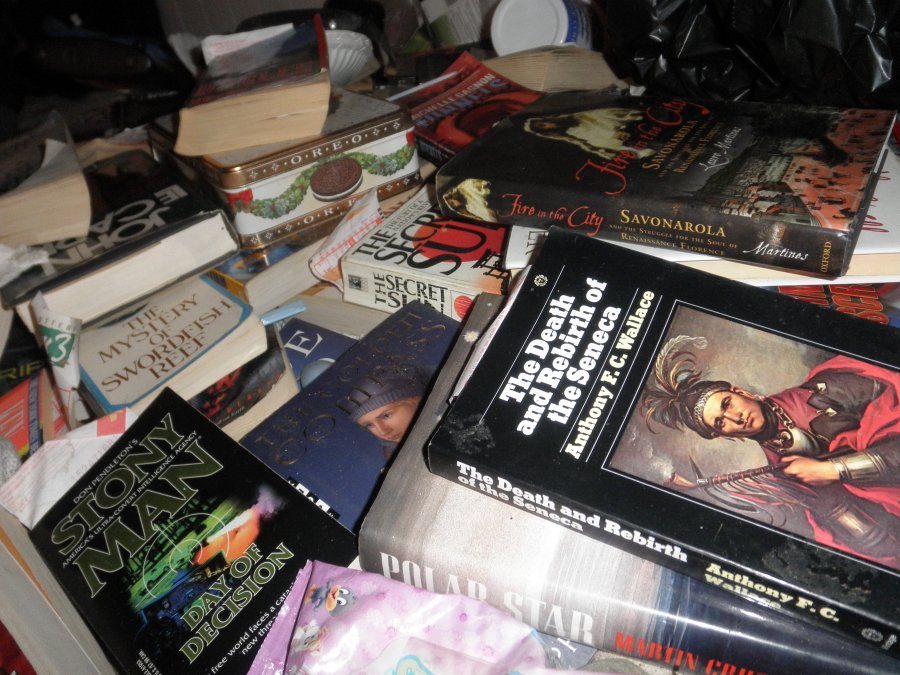
That half of the bed is taken up by upwards of a hundred books, some read already, some partway through the experience of being read, some waiting to be read, some held for re-reading. They’re usually not enough of a problem to outweigh the advantage of having a book near at hand when I need something to read. But when I turned the light on, here’s what I saw last night:
It’s not the first time that’s happened and I could have prevented further invasion if I’d been paying closer attention. I keep a container of boric acid powder nearby and usually try to do a pre-emptive strike on them on a fairly regular basis. But it requires taking the layers upon layers of books off and squirting the boric acid powder all over the underlying bed surface.
This, I’m reluctant to do, because everything gets disorganized and I lose track of which things have already been read, which are waiting to be read, which are occupied holding something else up, and generally where things are.
So they sneaked up on me. I had to do it in the middle of the night with no pre-planning, no organization at all.
Sheeze. Now it’s chaos in there.
————————————–
9:30 AM edit:
Heck, I might as well add this since I’ve got them there together now. Here are a couple of authors I’ve come across lately I’ve enjoyed a lot.
They’re thrift store books, so I’m not certain you could find them easily, but both authors have an interesting approach, plotting is tight, characterization’s good, and they hold the attention well.
Upfield writes about an aboriginal who’s an Australian police homicide detective and his mystery solvings, along with his ethnic difficulties trying to do his job in that setting, along with his internal struggles demanding he go back to being a bushman. Good reads.
Alexander’s a completely different bag of tricks. He’s created a blind brother to Henry Fielding, author of Tom Jones, who’s a magistrate-cum-detective in London. His characters include Dr. Johnson, whores, a pirate, poets, actors, and all manner of peasantry. The narrator is actually a ‘Boswell’ sort relating the activities and events, a young teenager taken off the streets.
I don’t have enough distance from the Alexander books yet to decide whether it’s his unique and innovative setting, plotting and characterization intrigues me so much about him, or whether he’s also a damned good author.
Old Jules
11:20 AM edit:
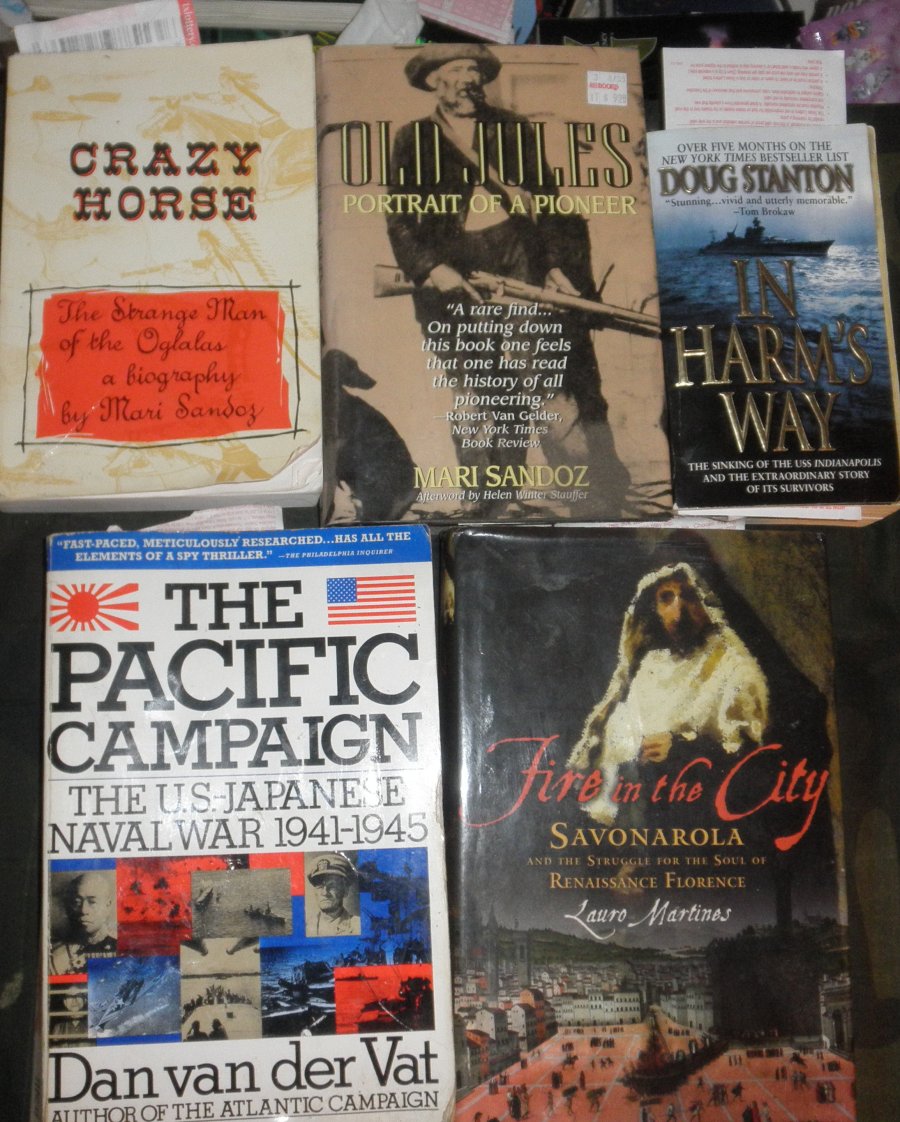
Heck, I might as well add these since everything’s screwed up in there anyway:
Mari Sandoz – Crazy Horse, and Old Jules. Mari’s my daughter in a previous lifetime. Her biography of Crazy Horse is better than a lot of others about him. Her biography of me during that lifetime is as good as you’d expect from a daughter.
Doug Stanton, In Harm’s Way is the hair-raising account of the sinking of the USS Indianapolis during the last days of WWII, and the ordeals of the survivors in shark infested waters off the coast of Japan.
Dan van der Vat, The Pacific Campaign is nothing to write home about. Of the thousand-or-so books following the steps, events, tactics and strategies of the Pacific War this one ranks in the bottom third,in my estimation.
Lauro Martines, Fire in the City, is a narrative of the strange and
surprising emergence of Friar Girolamo Savonarola in Rennaisance Florence. So little attention has been paid this fascinating man and time it’s worth the read even if you aren’t crazy about Martines’s particular style of writing and his method of organizing his material.
If you’re in the Northern hemisphere and you look to the south to the constellation Centaurus tonight you might view Alpha Centauri. 4.5 light years away. The nearest star to this one claiming ownership of us and our planet.
That’s right. About the time the light from Alpha Centauri was leaving home on the journey to your eye, all that clothing you see in the photo was sparkling new sitting on shelves in stores, racking up cash register numbers and causing people to have to frown at the bills at the end of the month. Now every item hanging there is worth less than a US dollar. Nobody likes products produced when the light from Alpha Centauri was just cranking up the engine, gunning the motor and heading here.
Weirdly, the value of everything around you reflects what I’m describing. Doesn’t matter whether it’s a toaster, a washing machine, an automobile, frequently even a marriage.
Face it. That stuff you’re buying won’t be worth squat when the light starting from Alpha Centauri today reaches here.
Maybe you’re humanocentric and think that’s lousy behavior on the part of a star, or maybe you’re one of those apologists who blame it on humanity, or Old Sol. But either way, you’re not looking at the worst case.
Consider Vega.
Northwest sky, bright, 25 light years. “Nothing wrong with Vega,” a person might think. But you’d be wrong. Almost everything people yearned and bankrupted themselves buying in 1986, when Vega was sending out the light you’ll see tonight, is in landfills and junkyards. Owning something manufactured when that light was leaving Vega’s worse than owning something manufactured in the USSR on Monday or Friday.
But there’s a lot more. When Vega was shooting that dot of light at your rods and cones writers were pounding away on typewriters and computers months at a time cranking out manuscripts, publishers running them up to the tops of the lists, creating tomes of gigantic lasting importance. But Vega took care of that, too:
New York Times Best Seller Number Ones Listing
Not one stayed around until that light from Vega reached here.
You can buy any one of them for a quarter, sometimes a dime at the Salvation Army Thrift Store.
————————————
Computers? When Vega was spitting out that dot of light you see here’s what was happening:
Microsoft releases MS-DOS3.2. It adds support for 3.5-inch 720 kB floppy disk drives. [130] (December 1995 [146]) (March [346.254])
Apple Computer introduces the Macintosh Plus. It features a 8 MHz 68000 processor, 1 MB RAM, SCSI connector for hard drive support, a new keyboard with cursor keys and numeric keypad, and an 800 kB 3.5-inch floppy drive. Price is US$2600. It is the first personal computer to provide embedded SCSI support. [46] [75] [120] [140] [180.222] [203.68] [346.167] [346.268] [593.350] [597.94] [611.41] [750.49]
Lotus Development announces it would support Microsoft Windowswith future product releases. [1133.22]
Microsoft releases MS-DOS3.25. [346.268]
Two months after releasing Microsoft Windows, Microsoft has shipped 35,000 copies. [1133.22]
The first virus program for the IBM PC appears, called the Brain. It infects the boot sector of 360 kB floppy disks. [1230.56] [1805.23] (1987 [1260.193])
IBM announces the IBM RT Personal Computer, using RISC-based technology from IBM’s “801” project of the mid-70s. It is one of the first commercially-available 32-bit RISC-based computers. The base configuration has 1 MB RAM, a 1.2 MB floppy, and 40 MB hard drive, for US$11,700. (With performance of only 2 MIPS, it is doomed from the beginning.) [31] [116] [205.114] [329.129] [1311] [1391.D1]
Compaq Computer introduces the Compaq Portable II. [108]
Tandy debuts the Tandy Color Computer, with 64 kB RAM. It is the successor to the Color Computer 2. [1133.21]
AT&T creates the first silicon fabrication of its CRISP architecture CPU, incorporating 172,163 transistors, and operating at 16 MHz. [660.6]
Apple Computer introduces the Macintosh 512K Enhanced, for US$2000. It features an 8 MHz 68000 processor, 512 kB RAM, and 800 kB 3.5-inch floppy drive. [46] [75] [597.94]
Seen any of that stuff lately? No. It’s all deep in attics, closets, garages, or in the city dumps.
But when you look up there at Vega, that’s what you’re seeing. All that stuff shiny and new gleaming in the eyes of you back then, packaged up for birthdays, anniversaries, Christmas. Happy faces.
The erosion of human values following a straight line between Vega and your optic nerve. All that stuff listed above, the cars, the computers, the books, people worked their asses off to manufacture it and others worked their asses off to buy it all.
But that time lag between Vega and here screwed it all. Rendered it worthless.
I’m not partisan on this, not pointing fingers of blame at Vega. I don’t know whether it’s the fault of Vega, or whether it’s a conspiracy concocted by the same people who assassinated President Kennedy back when the light you see when you look at 19 Draconis or Alpha Cephei was leaving home.
He thinks he’s big, but he’s got no substance. Old Sol’s nothing but a lot of helium and hydrogen. Sure, okay. A couple of percentage points of other elements thrown in to give the illusion of diversity. Big freaking deal.
Sheeze, look at him all held together by belts of interlocking magnetic fields without even suspenders to hold them up. Can’t even maintain magnetic polarity more than ten years or so. Long-term goals? Forget it.
Old Sol’s all bluster and hot air. Got everyone convinced he’s a big deal, but he ain’t, as such things go. Almost any self-respecting planet has more substance in its little finger than Old Sol has on his best day, which only happens when something big hits him.
Oh yeah. He talks the talk all right. But can he walk the walk on average, day-to-day stuff like maintaining his magnetic polarity? Sure, he’s got plenty of education but does he have any common sense?
A performance of Don Giovanni with the great Italian baritone Antonio Scotti (as Don Giovanni). Scotti sang the role of Don Giovanni at Covent Garden, London, in 1899 and again at the Metropolitan Opera, New York in December of the same year.
It never dawned on me I was proud I didn’t like opera. I’d never heard any opera except brief snatches or in spoofs. I’d never given any conscious thought at all to the fact I thought people who went to operas did it to show off to other people who went to operas, or were snooty and just wanted to impress someone, or were sissies. Never gave it a single thought.
To my mind a person who went to operas was just naturally, naturally, naturally someone I had no respect for, had no time for, would never take seriously. I didn’t need to think about it. I knew. I don’t recall anyone ever trying to change my thinking about it, either. I imagine they all knew same as I did those opera goers were phonies and sissies.
So, sometime in the late-1980s when my ex-wife got a couple of opera tickets for a performance on the University of Texas campus I wasn’t overjoyed. I suited up and traveled down there under duress, grumbled behind her to our seats, scowled when the lights went down and battened down the hatches for hard weather.
Over the next couple of hours a pair of blinders was removed from my eyes, plugs removed from my ears. A war went on inside me as the realization dawned that I loved this stuff. The next time an opera came to Austin it was me insisting we get tickets.
That would be bad enough if it had stopped there. But when my marriage broke up in 1992, and I relocated to Santa Fe, mildly affluent, I discovered a Santa Fe Opera exists. I attended a performance, and thereafter every year bought season tickets and used them as long as I could afford them.
I’ve attended a lot of concerts and live performances in my life and enjoyed many with Townes Van Zandt, Guy Clark, Kinky Friedman, Leonard Cohen, Loudon Wainwright and others, including a few Broadway performances. But I’d be lying if I claimed every opera I ever attended wasn’t as thrilling and uplifting as I walked out as any of those.
And naturally, I hate myself for it and hang my head in shame admitting it.
Florida Grand Opera-DON GIOVANNI, The Don’s final scene
74 years old, a resident of Leavenworth, KS, in an apartment located on the VA campus. Partnered with a black shorthaired cat named Mister Midnight. (1943-2020)
Since April, 2020, this blog is maintained by Jeanne Kasten (See "About" page for further information).
https://sofarfromheaven.com/2020/04/21/au-revoir-old-jules-jack-purcell/
I’m sharing it with you because there’s almost no likelihood you’ll believe it. This lunatic asylum I call my life has so many unexpected twists and turns I won’t even try to guess where it’s going. I’d suggest you try to find some laughs here. You won’t find wisdom. Good luck.













 So Far From Heaven


